
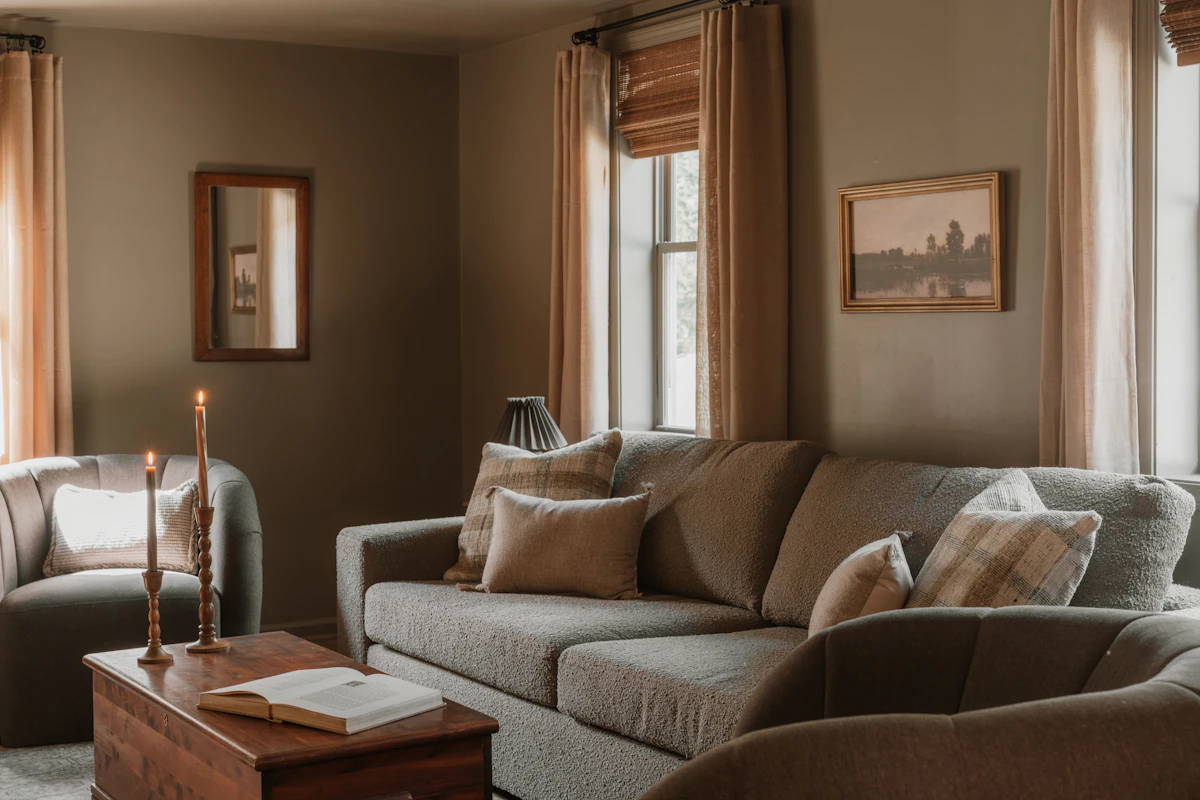
THE ART OF FEELING AT HOME / DESIGN FIELD GUIDE
You walk into a friend’s living room and, before you have noticed the sofa or the artwork, you have already decided you would like to stay. Later, you return to your own perfectly tidy home and wonder why it feels strangely unfinished.
The difference is not necessarily money, square footage or decorating talent. It is often the small decisions that make a room easy to enter, comfortable to occupy and pleasant to share. Here is how to make a room feel inviting without turning your home into a showroom.
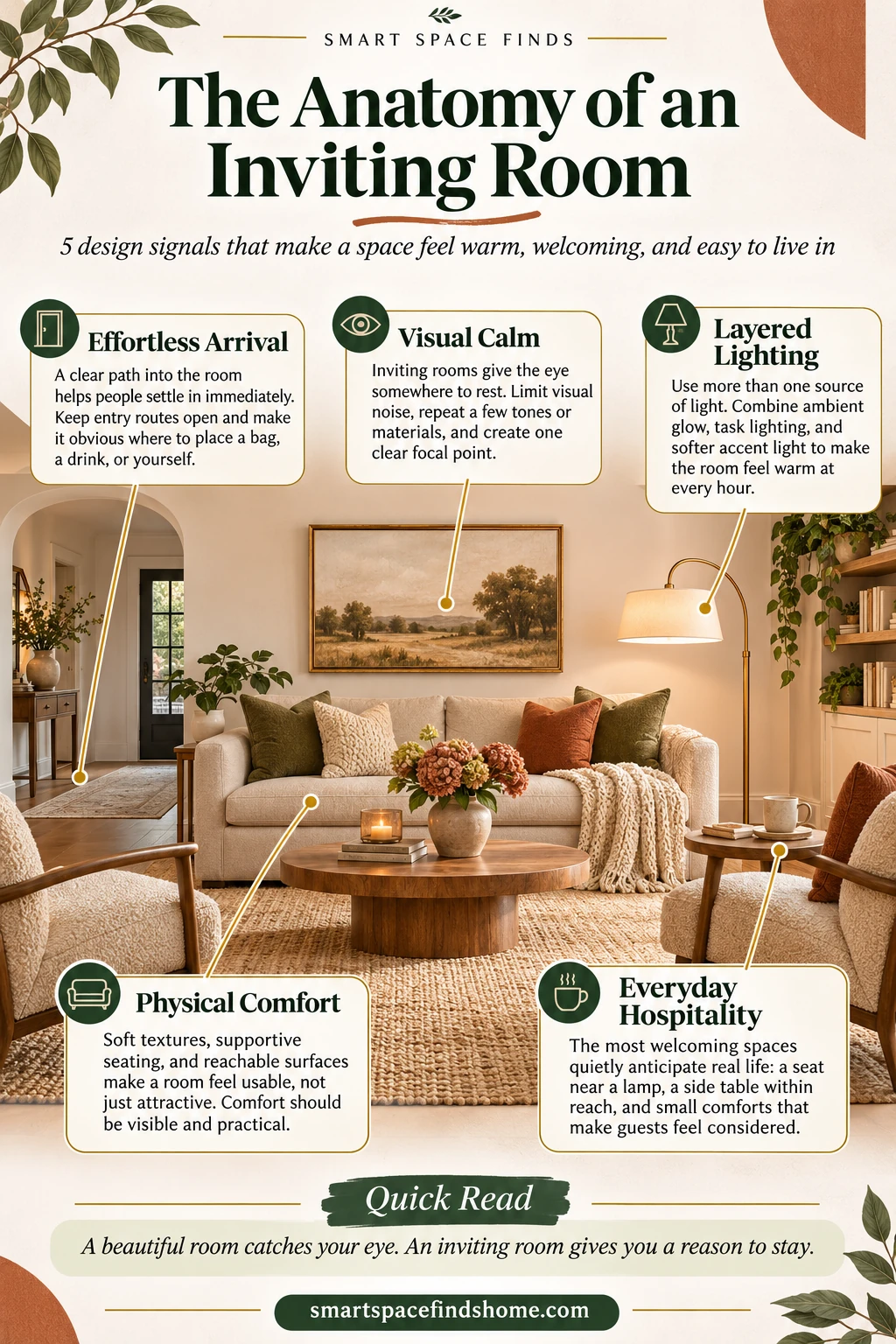
A beautiful room catches your eye. An inviting room gives you a reason to stay.
The five signals of an inviting room
Use our Room Invitation Framework as a practical observation tool, not a scientific personality test. Each signal asks a question about the experience of using your home.
Can I enter without hesitation?
Can my eyes settle?
Can I see comfortably?
Can my body relax?
Can I use what I need?
DESIGN PRINCIPLE 01
Make the entrance effortless
Stand at the doorway with a bag in one hand. Can you see where to walk, where to put the bag and where to sit? If not, the room is asking visitors to solve three small problems before they can relax. Move the basket out of the walking route, rotate a chair away from the doorway and clear a landing spot. In a narrow apartment, a wall hook can do the work of a console without taking floor space.
DESIGN PRINCIPLE 02
Give the eye a resting place
Choose the view you want to notice first: a window, an artwork, a bookshelf or a beautiful chair. Let nearby objects support it rather than compete with it. A dark frame repeated in a table base can connect separate pieces; an empty patch of wall can make a favorite painting more noticeable. You do not need symmetry or a neutral palette.
DESIGN PRINCIPLE 03
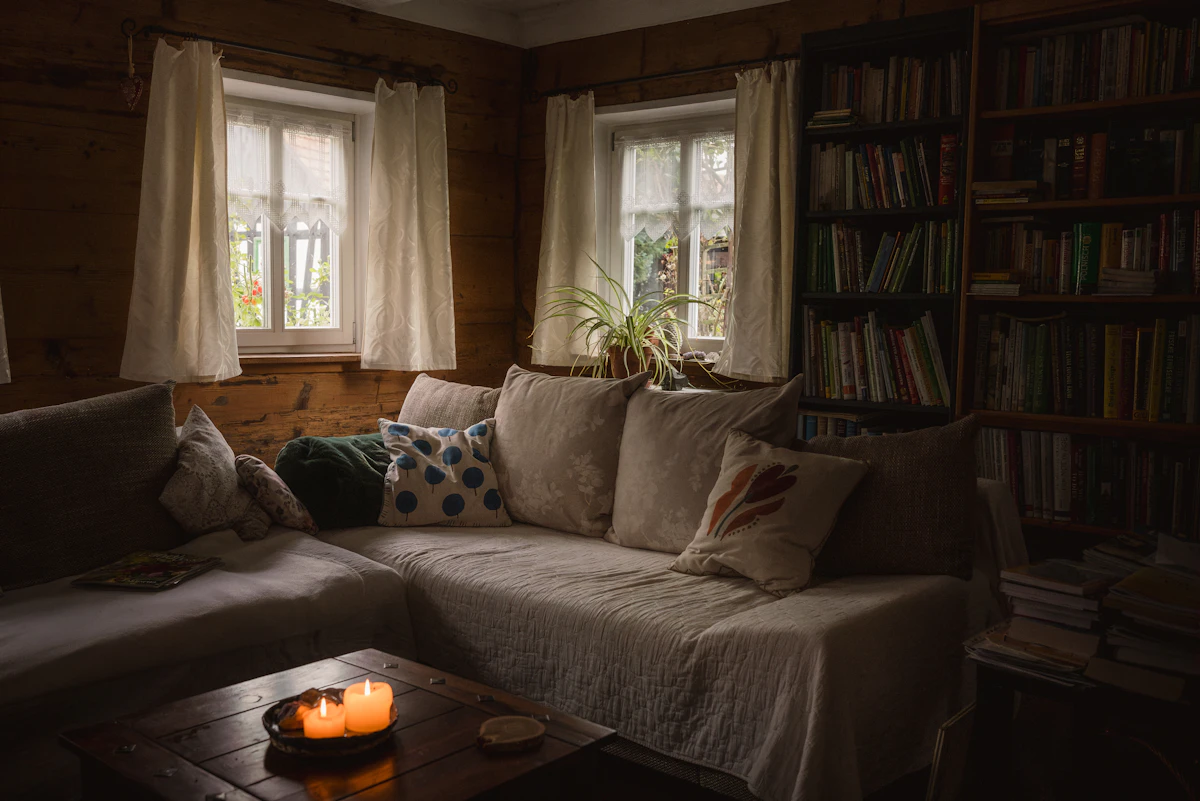
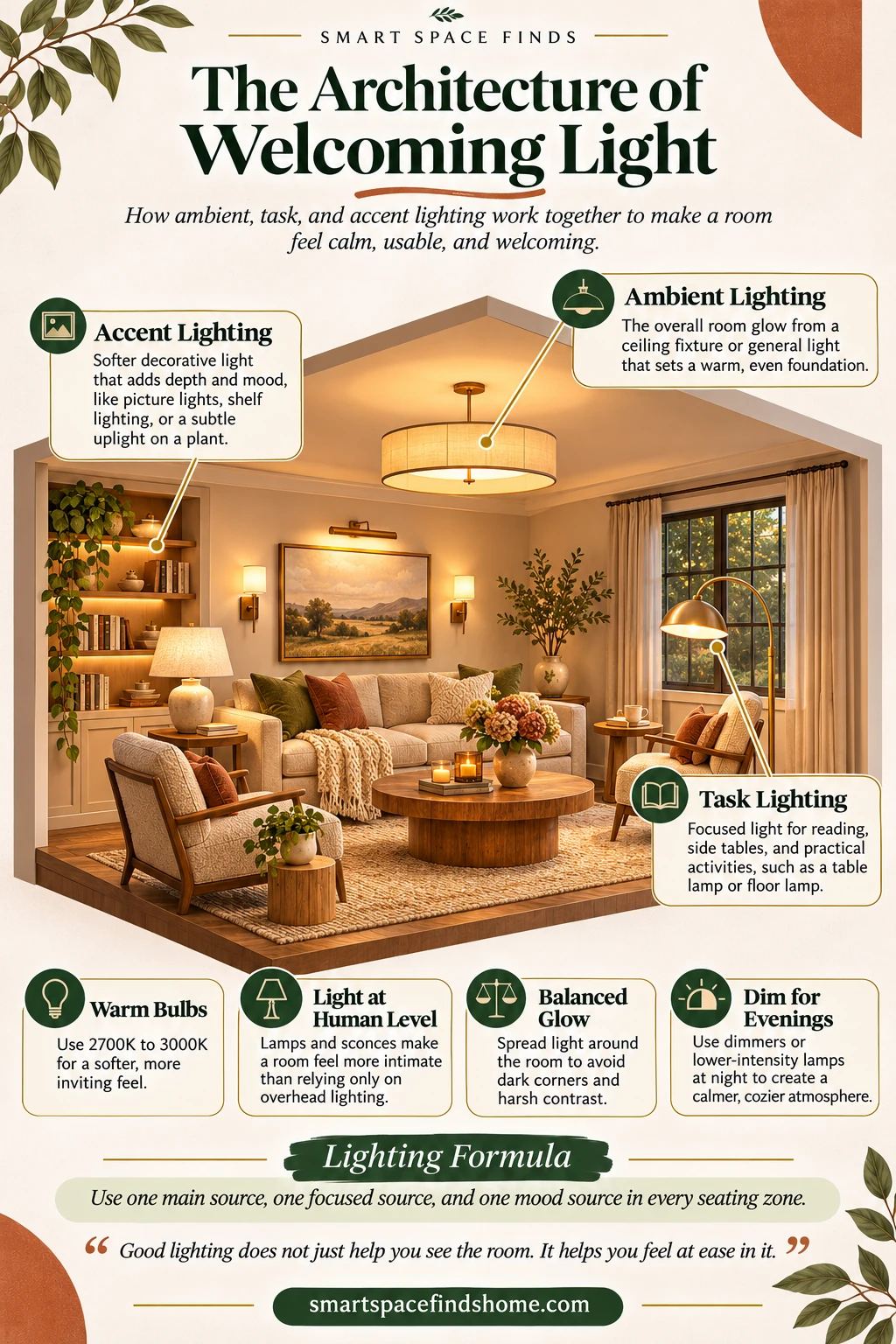
Bring light down to human level
At dusk, a bright ceiling fixture may illuminate the floor yet leave faces in shadow. Place a shaded lamp beside the sofa and direct a reading light toward the page, not the person opposite. Keep enough general light for safe movement. Warm-white bulbs around 2700–3000 K are a useful starting point for evening living areas; choose brightness separately from color temperature. Check fixture ratings and dimmer compatibility.
DESIGN PRINCIPLE 04
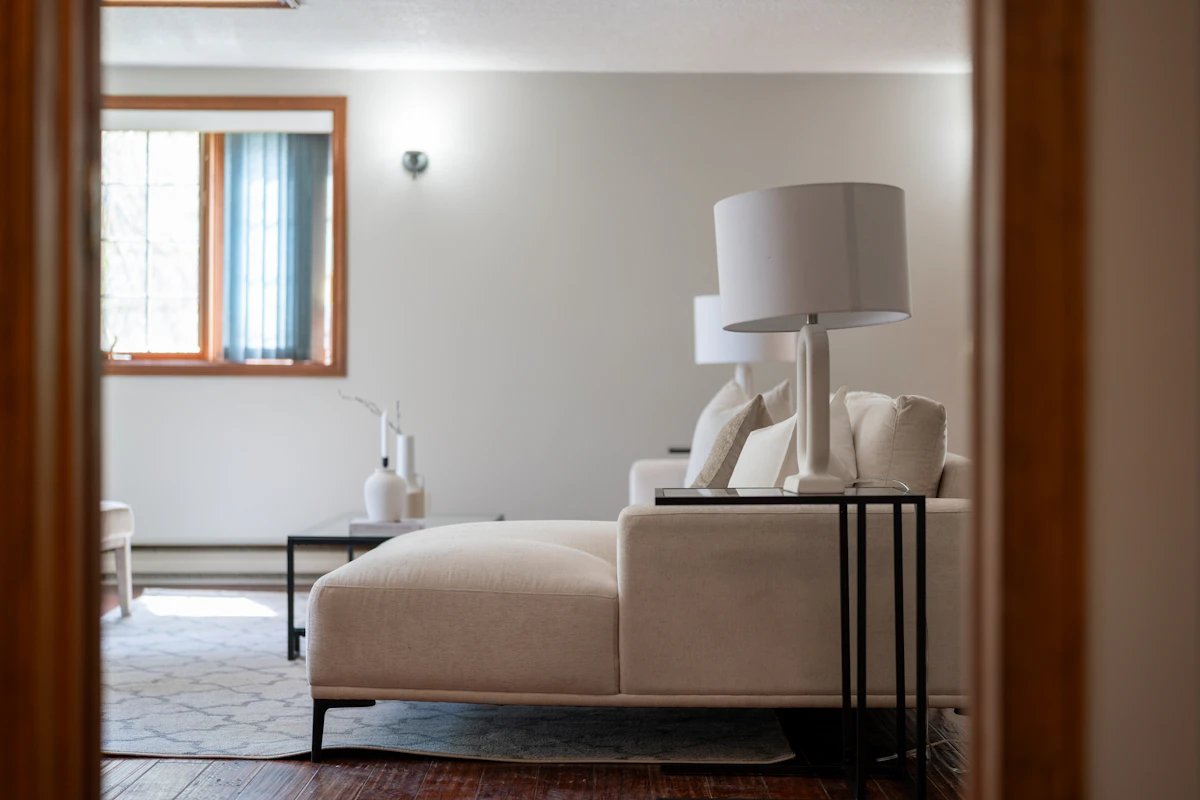
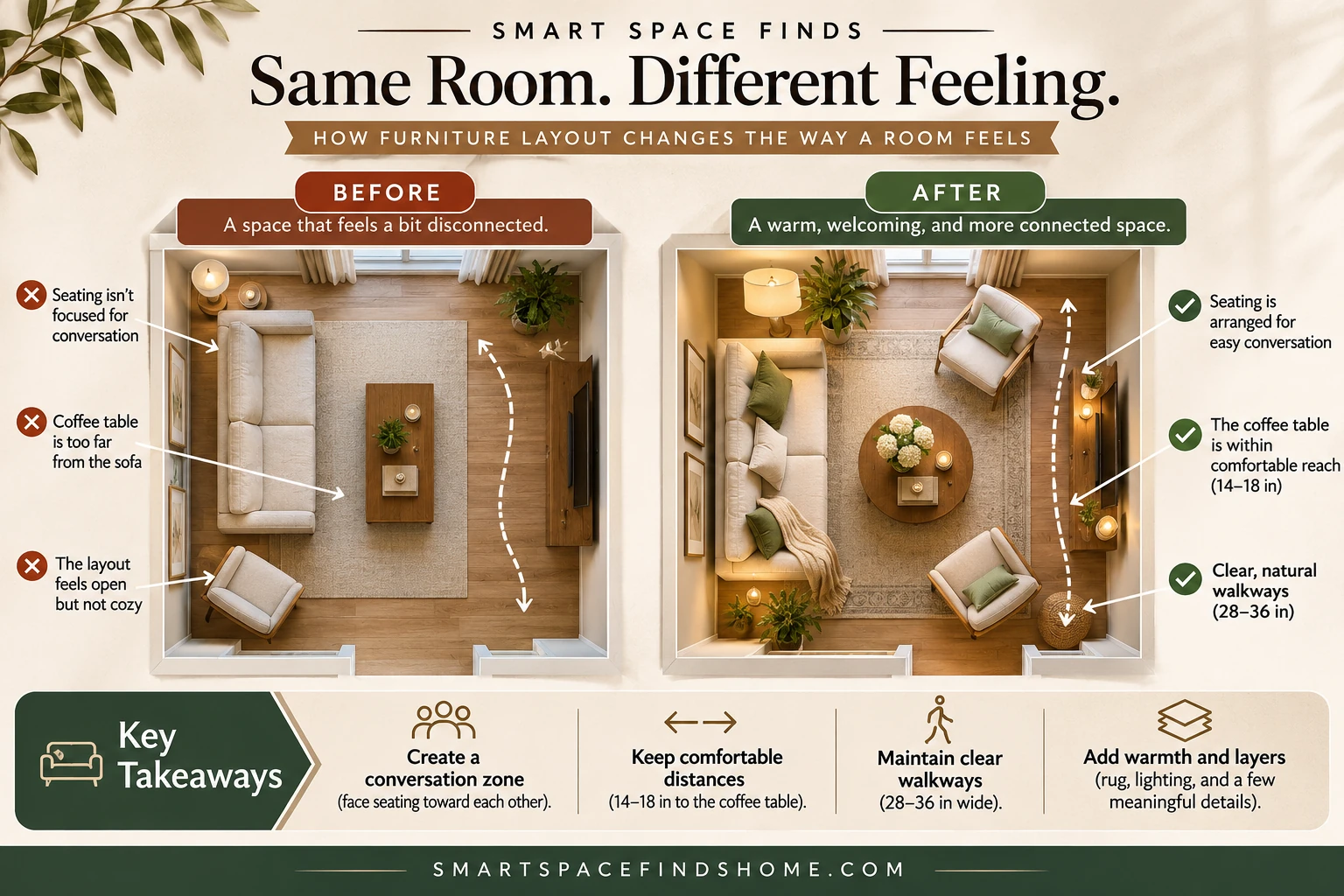
Arrange furniture for conversation
A sofa and chair that face only a television make watching easy but chatting awkward. Angle one chair toward the sofa, then sit in both positions and test the conversation. Keep the main route outside the seating group where possible. A gap of roughly 14–20 inches between a sofa and coffee table is a useful starting experiment, depending on reach and furniture size. This is not an accessibility standard; keep primary circulation separate and allow enough clearance for the people using the room. A large room may work better with two smaller seating groups.
DESIGN PRINCIPLE 05
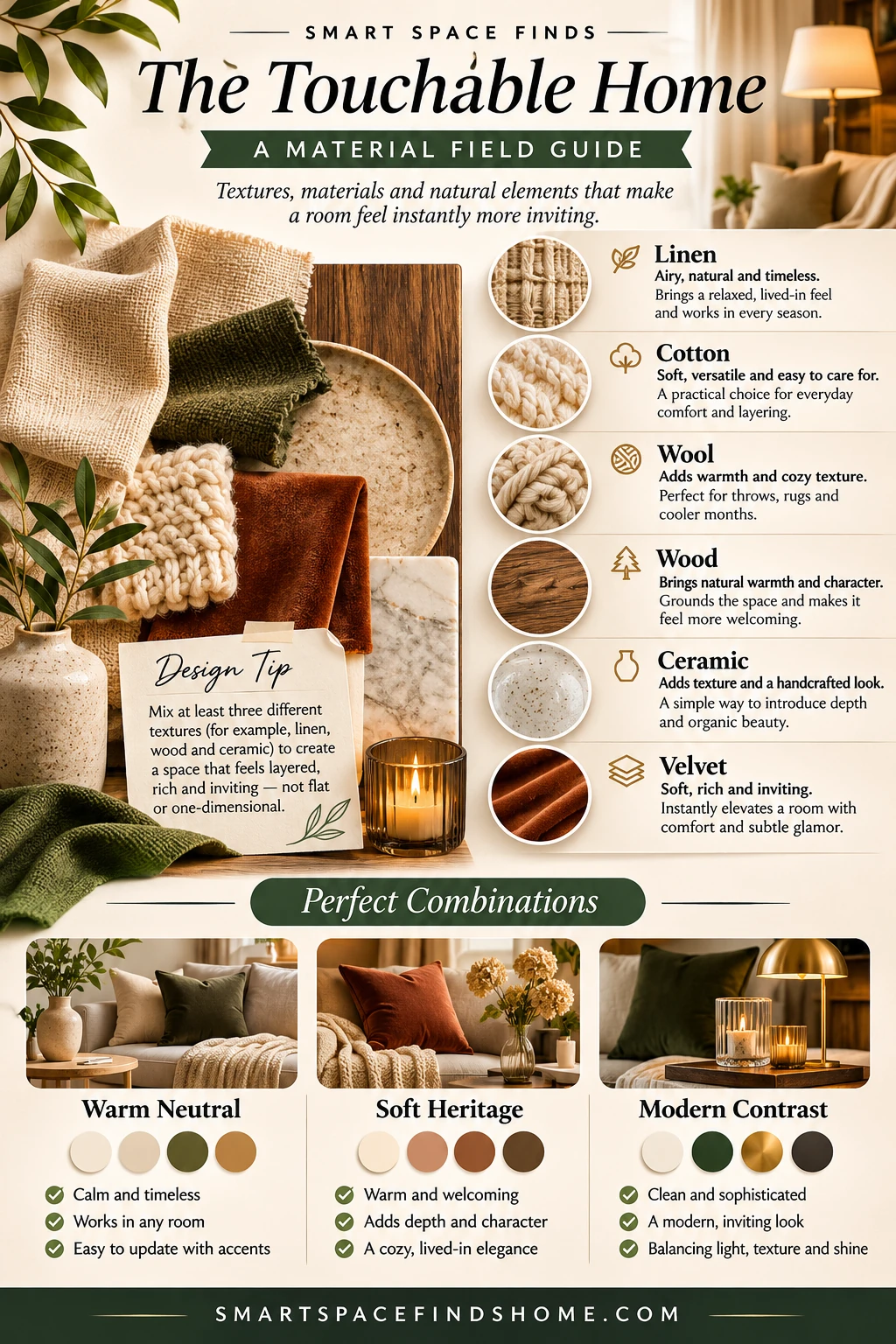
Choose textures that welcome everyday use
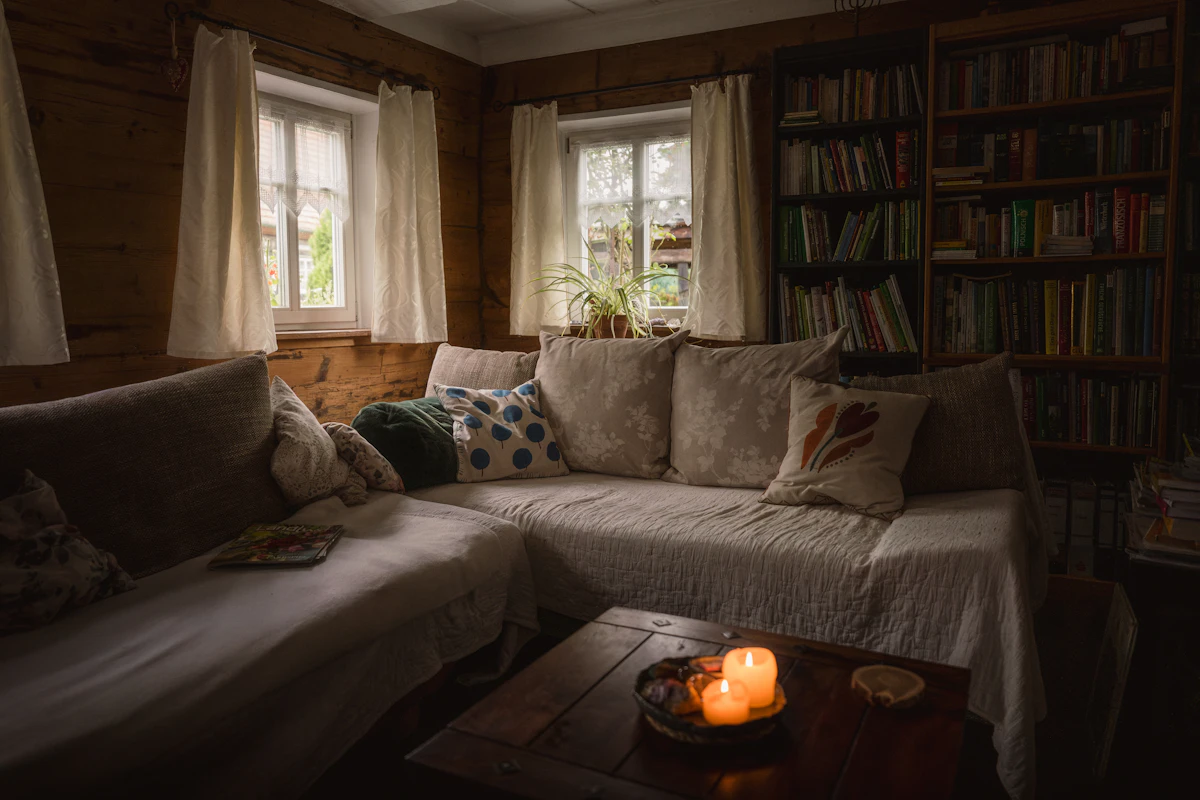
A room can look soft and still be uncomfortable. Start with contact points: the seat, the floor under bare feet and the fabric against your arm. Combine a washable throw, a rug with a suitable nonslip pad and a cushion that supports rather than crowds the seat. For pets or young children, prioritize cleanability and secure rug edges. For texture-sensitive households, smooth cotton may be preferable to wool or bouclé.
DESIGN PRINCIPLE 06
Make every seat feel considered
Sit in the least desirable chair. Is there a place for a glass, enough light to read and a comfortable way to stand up? A little drink table or a firm supportive cushion can transform an overlooked spot. People with limited mobility may prefer a higher, firmer seat with arms to a deep low sofa. Leave room to approach the seat without stepping around furniture.
DESIGN PRINCIPLE 07
Soften the sound, not just the look
Clap once in an empty-feeling room and listen for a lingering ring. Hard floors, glass and bare walls can make conversation feel sharper. Curtains, upholstered furniture and rugs may reduce reflections, though they do not soundproof a room. Start with the largest exposed surface. Keep curtains away from heat sources and avoid obstructing vents.
DESIGN PRINCIPLE 08
Add character without adding clutter
The most memorable rooms often contain a few things that tell a story: a family photograph, a repaired ceramic bowl or a book that someone actually reads. Choose objects that matter to you, not just objects that match. Repeat one material or color to bring cohesion while allowing contrast. Keep surfaces usable rather than filling every gap.
DESIGN PRINCIPLE 09
Create a small ritual of hospitality
Imagine a friend arriving on an ordinary Tuesday. A place to set their keys, a glass of water and somewhere comfortable to sit are more useful than a perfectly styled coffee table. Keep a small tray available, a spare coaster near the seat and a throw within reach if needed. Avoid strongly scented products when guests have sensitivities.
THE DESIGN LAB
How to make your particular living room feel welcoming
There is no single recipe for warmth. A room with limited daylight needs a different intervention from a large open-plan space. Start with the condition you actually live with.
A small apartment
Trade an obstructive coffee table for a compact side table if the walkway is tight. Use one well-scaled rug rather than several loose mats. Keep the window accessible and leave one surface free.
A dark or north-facing room
Open window coverings when privacy permits. Use a shaded lamp near a seat and an indirect light on a wall. Compare fabric and paint samples at the time you normally use the room.
A large, echoing room
Bring seating into a smaller group instead of spreading it around the perimeter. Define a gathering zone with a rug and a second zone for reading. Add soft furnishings where sound reflects.
A rental with gray finishes
Keep the permanent surfaces. Introduce warmer undertones through a throw, artwork or wood-toned accessory. Choose freestanding lighting instead of changing electrical fittings.
A busy family room
Reserve a reachable spot for toys, remote controls and blankets. Choose washable fabrics and stable furniture. Keep the main walking route free even when the room is in use.
A minimalist home
Replace visual clutter with material contrast: smooth wood, soft fabric and a matte ceramic object. Preserve the quiet appearance while making seating and lighting genuinely useful.
THE MATERIAL EDIT
Build warmth without repainting
Choose a base you already own, a supporting material and one small accent. These combinations are illustrative rather than mandatory decorating rules.
Warm neutral
Oatmeal linen, walnut and muted olive
Soft heritage
Cream cotton, terracotta and aged wood
Modern contrast
Soft white, forest green and warm brass
Before buying anything, place your existing textiles next to the furniture in daylight and again at night. If a combination looks pleasing only under store lighting, it may not work in your home.
Why does my living room still feel cold?
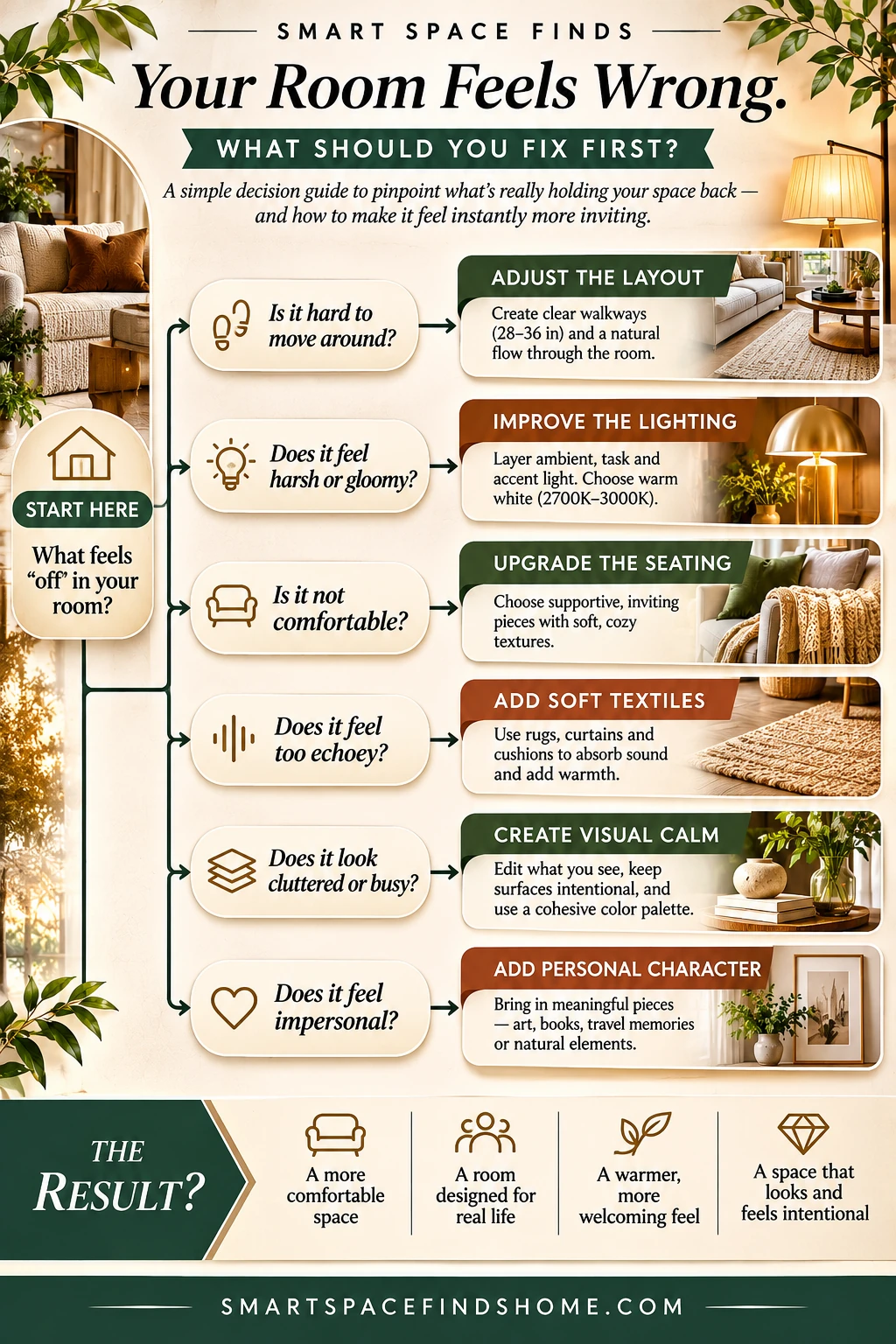
Diagnose the friction before changing the decor. These are starting points, not rules that every household must follow.
Try a shaded lamp and reduce glare.
Turn a chair inward and free the walking route.
Remove objects from seats and useful surfaces.
Display one meaningful object where you see it daily.
Test curtains or a secured rug before buying more decor.
THE PRACTICAL EDIT
The room invitation test: what to fix first
Stand at your entrance, then sit in the seat you use most. Answer these five questions. This is an informal planning exercise, not a validated psychological scale.
Choose your next step: Fix any unchecked item affecting safe access first. Then address lighting and seating before decorative details. If all five are checked, enjoy the room for a week before making another purchase.
THE THREE-MOMENT METHOD
Design for the moments that actually happen
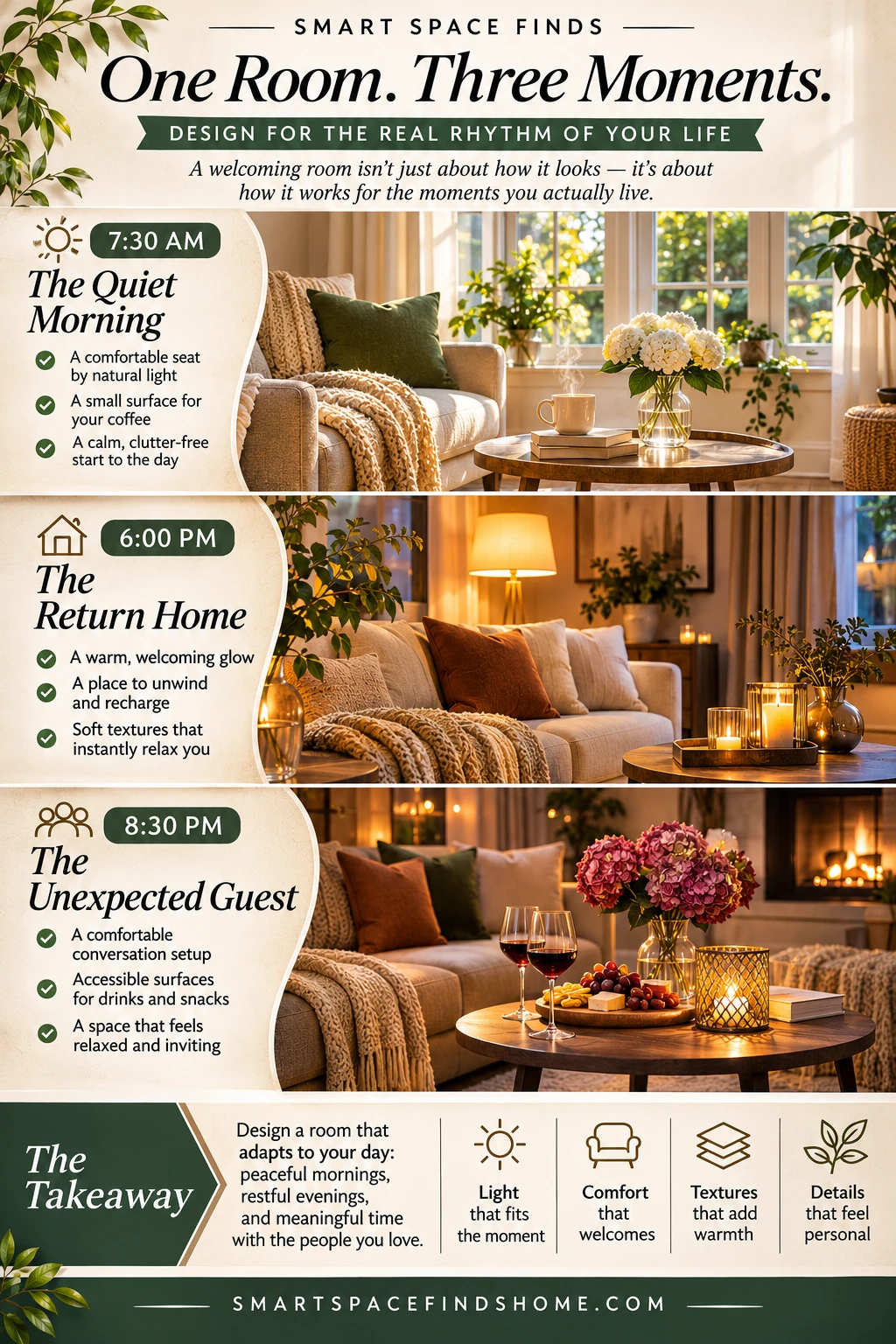
Instead of planning a room around a photograph, design around three ordinary moments. Walk through each one before buying anything.
7:30 AM
The quiet morning
Can you open the curtains, sit with a coffee and find a place for the cup without rearranging the room?
6:00 PM
The return home
Can you switch on a useful lamp, put down your belongings and sit without moving a pile of cushions?
8:30 PM
The unexpected guest
Can two people sit facing each other, hear each other and reach a drink without shifting furniture?
Your next move: fix the moment that is hardest to complete. A room that supports your actual routine is more useful than a perfectly coordinated one.
The one-week experiment: change less, learn more
Take a photo before moving anything. On day one, clear your route. On day two, reposition a lamp. On day three, adjust the seating. Keep the arrangement for the remaining four days. Note whether you use the room more often, reach for things more easily or find conversations more comfortable. If a change does not help, reverse it. This is a personal observation exercise, not a scientific test.
If you still want to shop, write down the exact problem, the available dimensions and your budget. Buy for that need rather than for a finished-room photograph.
The 15-minute room reset
Try this no-buy sequence after sunset. Tick each step as you go; your selections are not stored.
Choose your first upgrade by budget
$0: rearrange existing furniture, relocate lamps, remove excess cushions and borrow a tray from the kitchen.
Under $50: consider compatible bulbs, a washable cushion cover or a simple coaster set only if they address a problem.
$50–$150: consider a stable floor lamp, a compact side table or curtains suited to your window. These are planning budgets, not live retail prices.
For larger purchases, measure the room and test the layout first. See our budget home makeover guide and small-home comfort ideas.
REAL LIFE, NOT A SHOWROOM
Three common decorating mistakes worth avoiding
Buying a matching set before testing the layout
A coordinated collection can still make movement difficult. Map your seating and door swings before ordering.
Confusing dimness with warmth
A dark room is not automatically relaxing. Keep useful light for reading, steps and conversation; use lamps to control glare.
Styling away everyday life
A table covered in objects cannot hold a cup. Keep the favorite pieces and deliberately reserve practical space.
For a more personal approach, explore our guide to finding your interior design style or our home color palette guide.
Frequently asked questions
How can I make my living room feel welcoming without buying anything?
Clear the entry, reposition a lamp, angle seating toward conversation and make one surface available for a drink. Use an existing blanket or meaningful object to add character.
What colors make a room feel inviting?
Warm whites, muted greens, clay tones and soft browns can work well, but the light in your room and your preferences matter more than any single palette. Test samples in daylight and evening light.
How do I make a small living room cozy without clutter?
Keep the walking route open, use fewer but more useful accessories and choose lighting that does not take up valuable floor space.
Can a minimalist room feel welcoming?
Yes. Comfortable seating, pleasant light and a few useful or meaningful objects can create warmth without visual density.
How do I make a room inviting for guests with different needs?
Offer a clear approach, stable seating at different heights when possible, good lighting and a reachable surface. Ask guests about specific accessibility or sensory needs rather than assuming.
How can I make a room feel warmer when the furniture is gray?
Keep the gray furniture and test warm wood, cream textiles or muted rust accents beside it. Use a shaded lamp with a warm-white bulb in the evening, while preserving adequate task lighting. Avoid replacing a comfortable sofa simply because its color feels cool.
Should I use candles or fragrance?
Neither is necessary. Unscented spaces can be more comfortable for sensitive guests. Flameless lighting can provide a similar visual effect without an open flame.