
The design of everyday life / Five objects, five better routines
It is a familiar little sequence: your phone charger slips behind the nightstand, the teaspoon disappears into a crowded drawer, and the sweater you washed yesterday is still draped over a chair. None of these problems is dramatic. Together, they make a home feel harder to live in than it needs to be.
The most useful small inventions that solve everyday problems do not require a smart home, a renovation, or a new routine. They change one awkward detail in the routine you already have. Here are five clever household inventions that deserve attention for their function rather than their novelty.
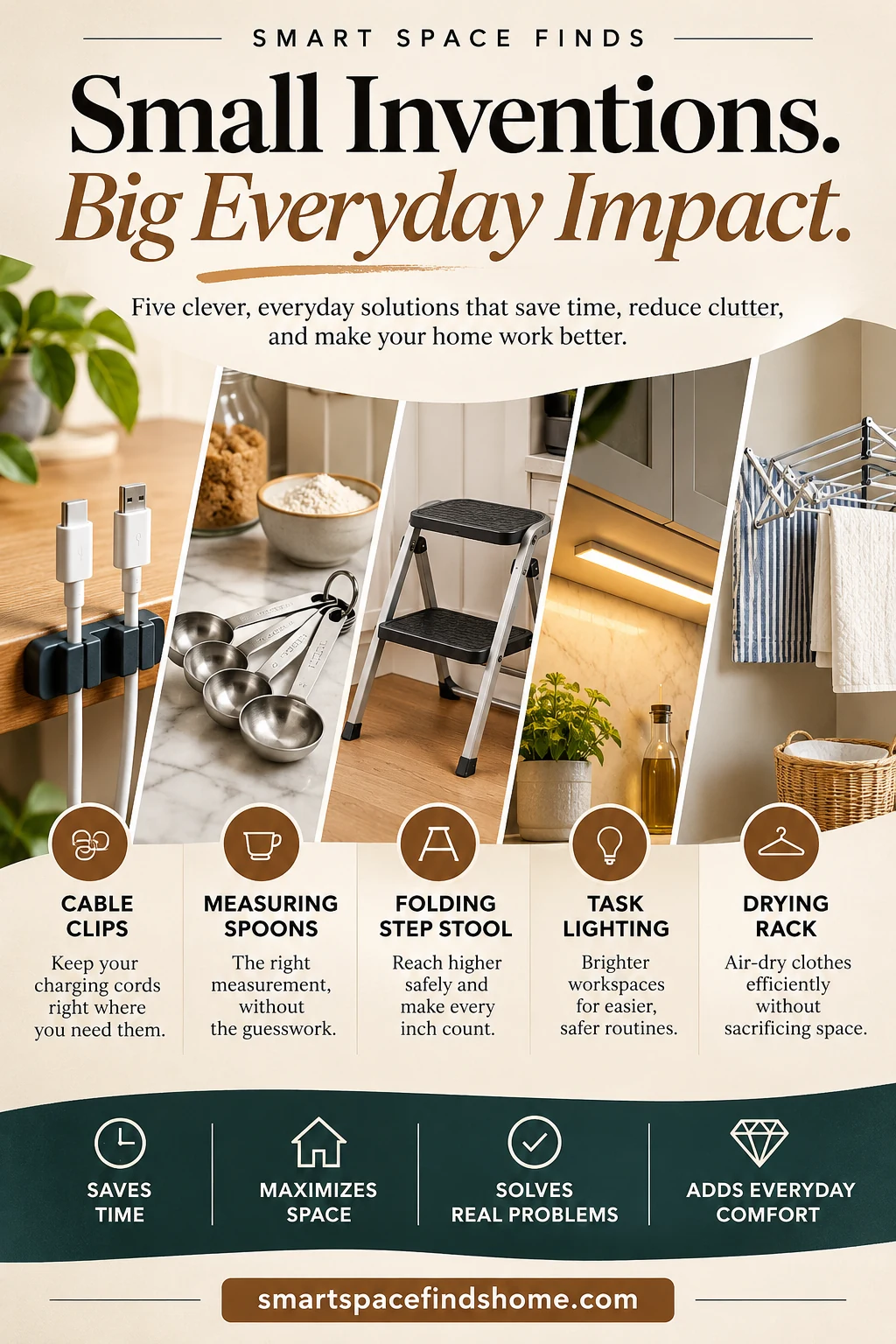
Five small inventions at a glance
On a small screen, swipe the comparison table sideways to see every column.
| Everyday problem | Small invention | Check first |
|---|---|---|
| Charging cord falls out of reach | Cable clip | Cable diameter and finish |
| Measuring spoons get separated | Magnetic measuring spoons | Markings and cleaning instructions |
| Upper shelves are difficult to reach | Folding step stool | Load rating and stability |
| Your body casts a shadow on the counter | Under-cabinet task light | Placement and electrical suitability |
| Wet laundry takes over the room | Wall-mounted drying rack | Wall support and airflow |
01 / The art of retention
1. Cable clips: give every charging cord a home
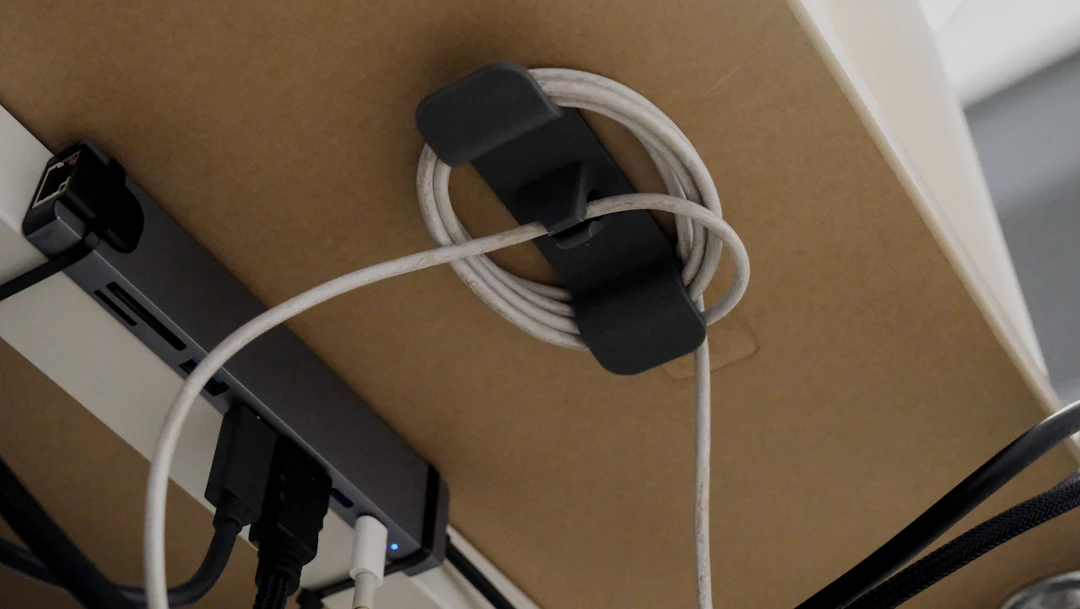
A beautifully styled nightstand can still be frustrating if you have to reach behind it every evening to retrieve a charging cable. The issue is not necessarily the amount of cable you own. It is that the loose end has nowhere to return after you unplug your phone.
A small cable holder creates a consistent parking point. Open silicone clips work well for cords that stay in position, while closing or magnetic holders can be useful when you frequently remove a cable. A weighted holder is worth considering if you do not want adhesive on furniture.
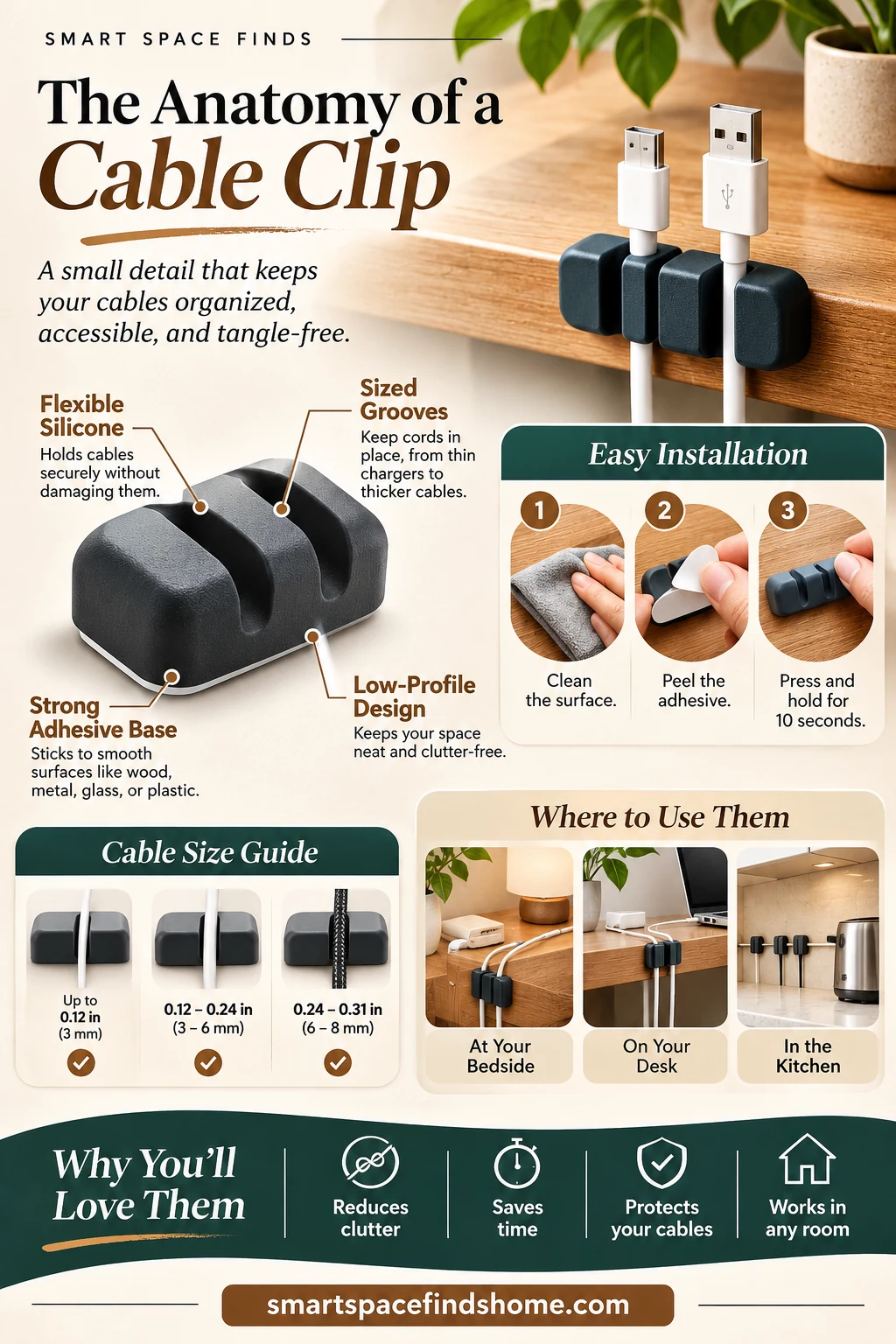
How to choose a cable organizer
- Measure the cable diameter rather than assuming every clip fits every cord.
- Choose a position within easy reach without stretching the cable or bending it sharply at the connector.
- Check the manufacturer’s adhesive and removal instructions against your furniture finish.
- Keep ventilation openings on chargers clear and replace damaged cords.
Design detail: Place the clip near the rear side of the nightstand, not across the middle of its surface. The cord remains accessible without becoming the focal point.
Try before buying: Move the charging point to a location where the cord naturally rests. If that solves the problem, skip the clip.
SMART SPACE FINDS / THE EDIT
Cable Management Essentials
As an Amazon Associate, we earn from qualifying purchases. Product details and availability may change; verify the listing before ordering.
JOYROOM Magnetic Cable Clips — 9 Pack
Keep charging cords accessible at frequently used stations.
Lamicall Spring Cable Holder Clips — 6 Pack
Closing clips for cords that need to stay in place.
OHill Self-Adhesive Cable Clips — 16 Pack
Multiple mounting points for organizing lightweight cables.
Cable Matters Silicone Magnetic Cable Organizer
A flexible cable management option for desks.
02 / The art of grouping
2. Magnetic measuring spoons: make the whole set behave like one tool
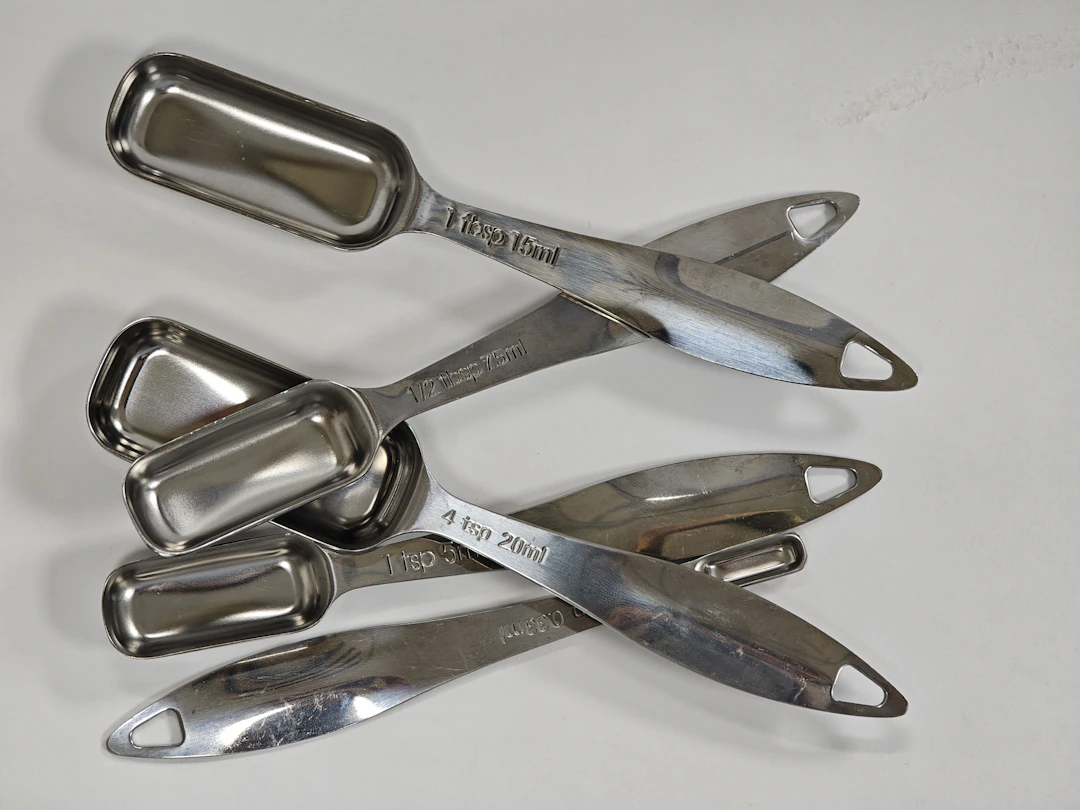
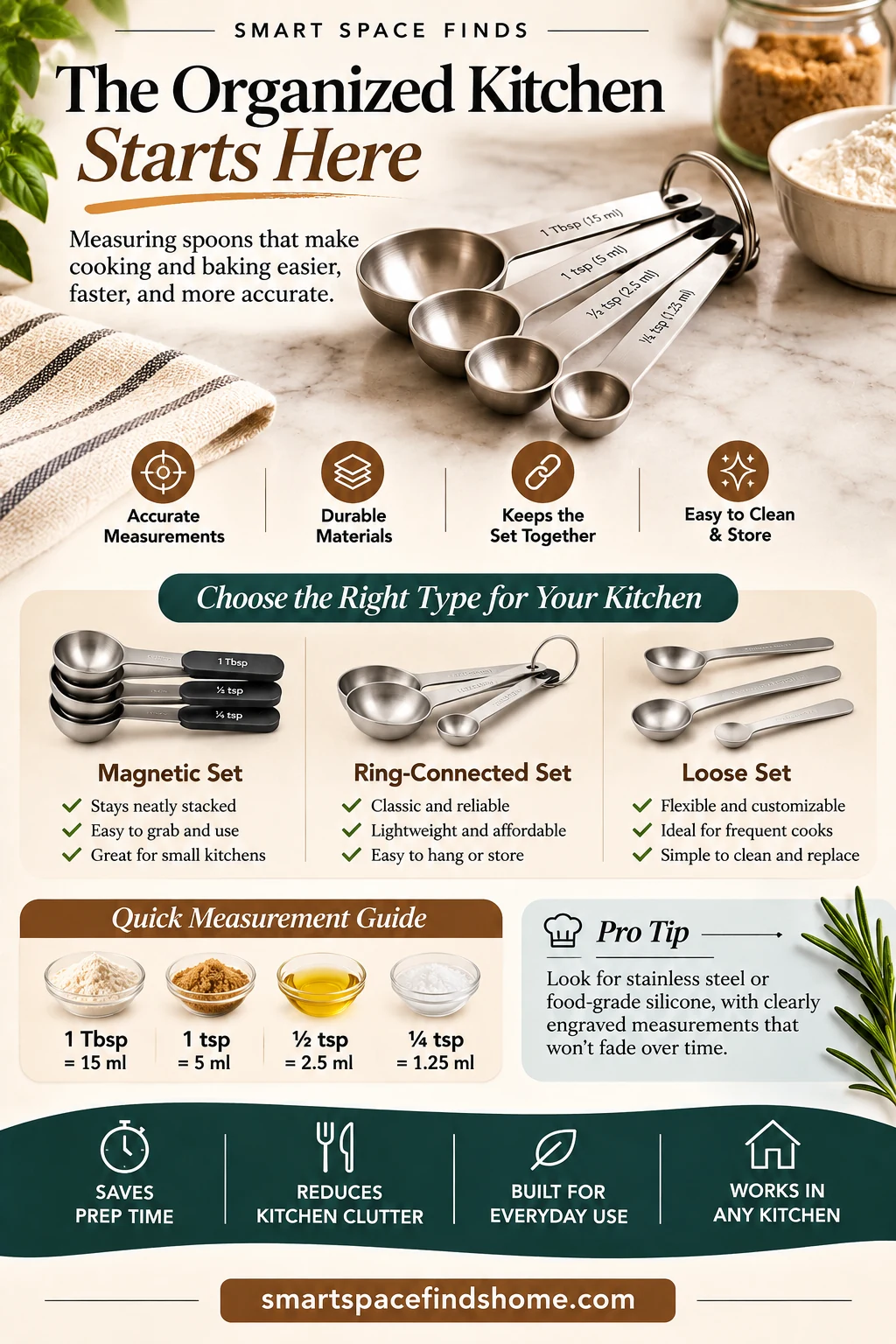
When a recipe calls for half a teaspoon, finding the right measure should not be a separate task. Loose spoons migrate under utensils; ring-connected sets can be awkward to separate when one spoon needs washing. Magnetic nesting sets address the storage problem while allowing individual pieces to be removed.
What makes a useful measuring spoon set?
Look for durable, legible US customary measurements, a comfortable handle, and a shape that fits the containers you actually use. Narrow spoon bowls can help with spice jars; rounded bowls may be easier to fill with some ingredients. A leveler is useful for dry ingredients, but magnetic storage alone does not guarantee accurate capacity.
For everyday cooking, a compact set covering your usual recipe measurements may be enough. For baking, prioritize clearly marked sizes and reliable measuring technique over decorative finishes. Confirm dishwasher compatibility and inspect the set for loose or damaged magnets.

Skip this upgrade if: Your existing set is complete, accessible, and easy to clean. A small drawer divider may be all you need.
SMART SPACE FINDS / THE EDIT
Precision Kitchen Essentials
As an Amazon Associate, we earn from qualifying purchases. Product details and availability may change; verify the listing before ordering.
Spring Chef Magnetic Measuring Spoons — Black
Nesting spoons for compact storage.
OXO Good Grips Magnetic Stainless Steel Measuring Spoons
Magnetic storage keeps the set together.
ChefAide Dual-Sided Magnetic Measuring Spoons — 8 Piece
Dual-ended design for different ingredient containers.
Spring Chef Rectangular Nesting Measuring Spoons
Narrow bowls for accessing spice jars.
Premium Stainless Steel Measuring Spoons — 6 Piece
A compact set for everyday recipe measurements.
Simply Gourmet Measuring Cups & Spoons — 12 Piece
Combined measuring tools for cooking and baking.
TILUCK Stainless Steel Measuring Cups & Spoons — 10 Piece
A coordinated set for kitchen measuring tasks.
03 / The art of access
3. A folding step stool: turn unreachable storage into usable storage
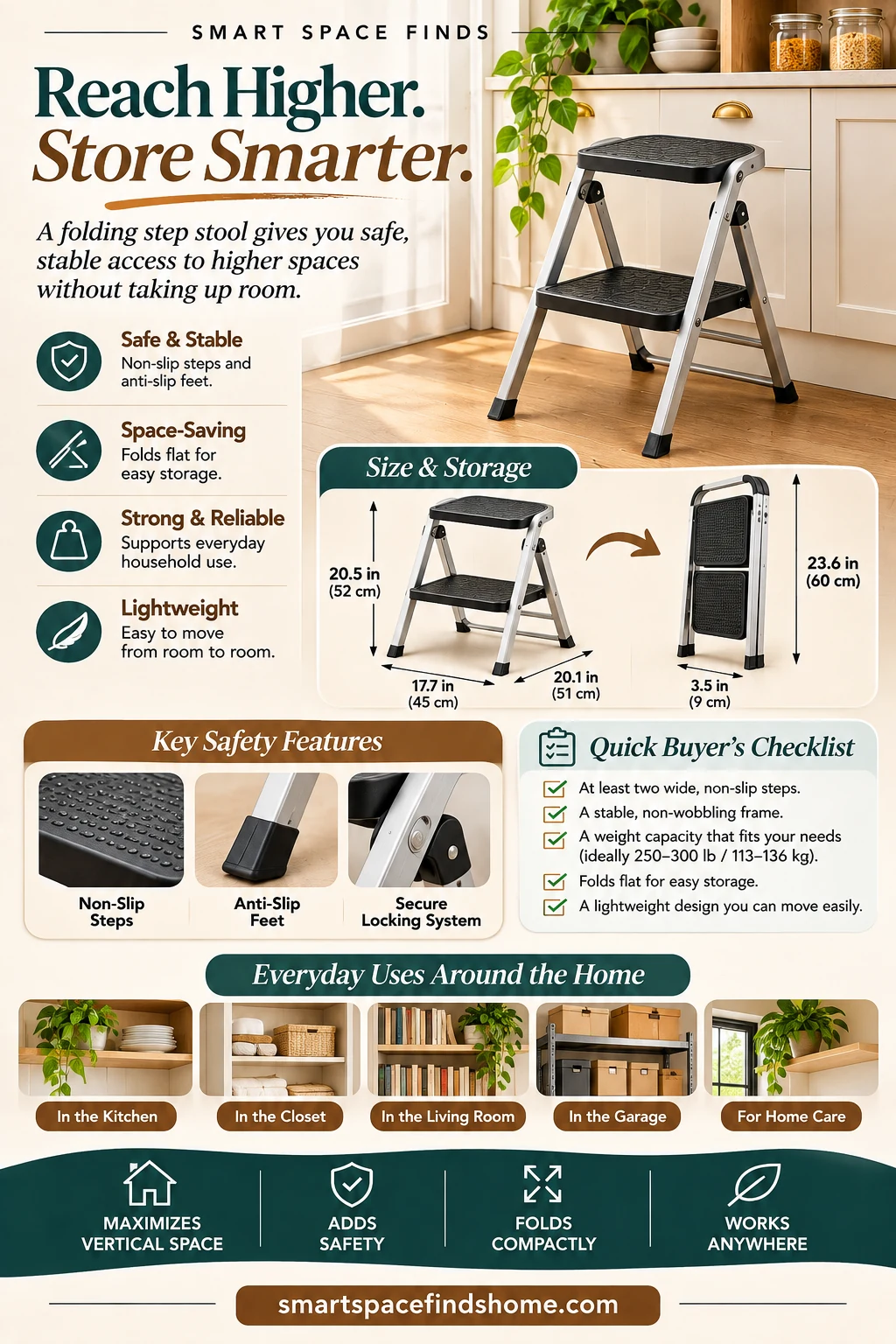
Upper cabinets often become a holding area for things we forget we own. A suitable step stool can make some of that space useful again, especially for occasional access in a compact kitchen or utility closet. Its real advantage is not just height: it is the ability to fold away when the task is finished.
Choose for the person and the task, not the folded size alone
- Check the stated load rating, including anything you will carry.
- Look for a stable footprint, slip-resistant standing surface, and a secure opening mechanism.
- Make sure you can fully open the stool on a level floor with adequate room around it.
- Select an appropriate step height so you do not need to stretch or lean sideways.
Follow all manufacturer instructions, keep hands clear of folding hinges, and never substitute a chair, countertop or unstable object. If you need greater height, more support or cannot use the stool safely, choose an appropriate alternative or ask for assistance.
Adult step stool or children’s learning tower? These are different products with different intended users and hazards. Do not assume a child’s tower is an appropriate adult access aid, or that an adult stool is safe for unsupervised children.
Storage rethink: Move heavy and frequently used objects to comfortable reachable shelves first. Reserve upper cabinets for lighter, less frequently needed items. A stool should support a better storage layout, not compensate for a poor one.
SMART SPACE FINDS / THE EDIT
Smart Vertical Access
As an Amazon Associate, we earn from qualifying purchases. Product details and availability may change; verify the listing before ordering.
Check the exact model for CPSC recalls and verify intended use, load rating and instructions before purchase.
HBTower Folding Steel Step Ladder with Handrail
Consider for occasional access; verify height and load rating.
HBTower 2-Step Folding Ladder
Compare open footprint and folded storage dimensions.
Utopia Home 9-Inch Folding Step Stool
Compact option; check intended user and load rating.
Handy Laundry 9-Inch Folding Step Stool
Check stability, locking mechanism and intended use.
Delxo 13-Inch Folding Step Stool
Compare step height with the task and available space.
HBTower 9-Inch Folding Step Stool with Safety Lock
Check the exact locking mechanism and model instructions.
04 / The art of visibility
4. Under-cabinet lighting: fix the shadow, not just the room
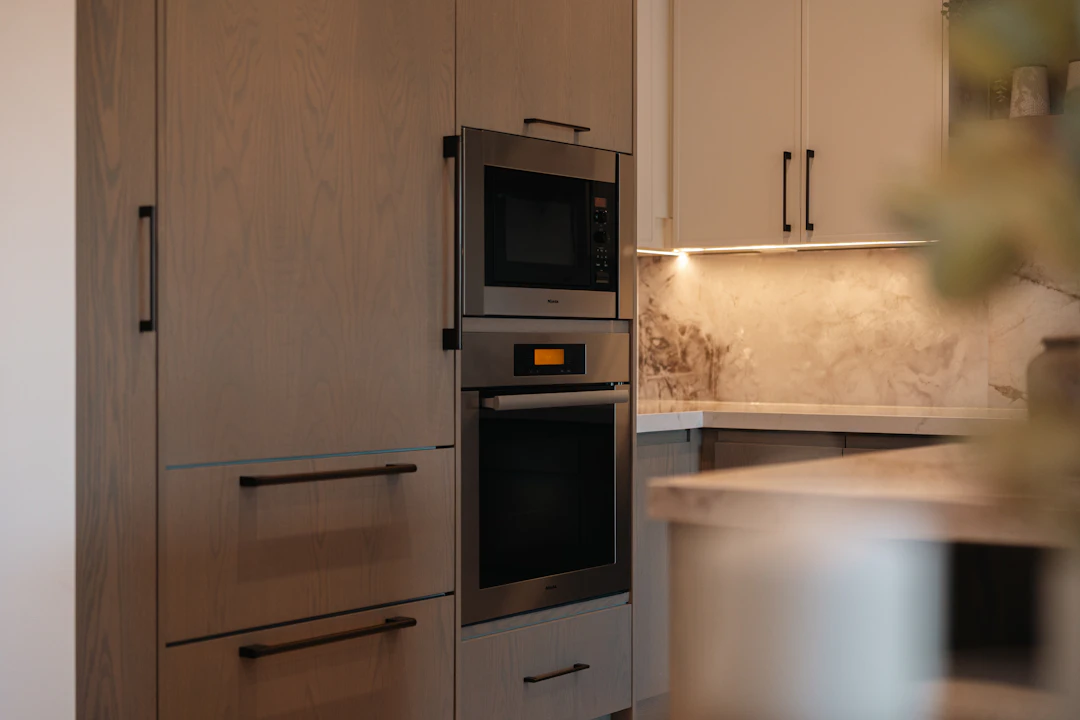
A kitchen can look bright from the doorway while the chopping board remains surprisingly dark. Overhead light often sits behind the person preparing food, and upper cabinets block some of the light reaching the countertop. Task lighting addresses this by bringing illumination closer to the work itself.
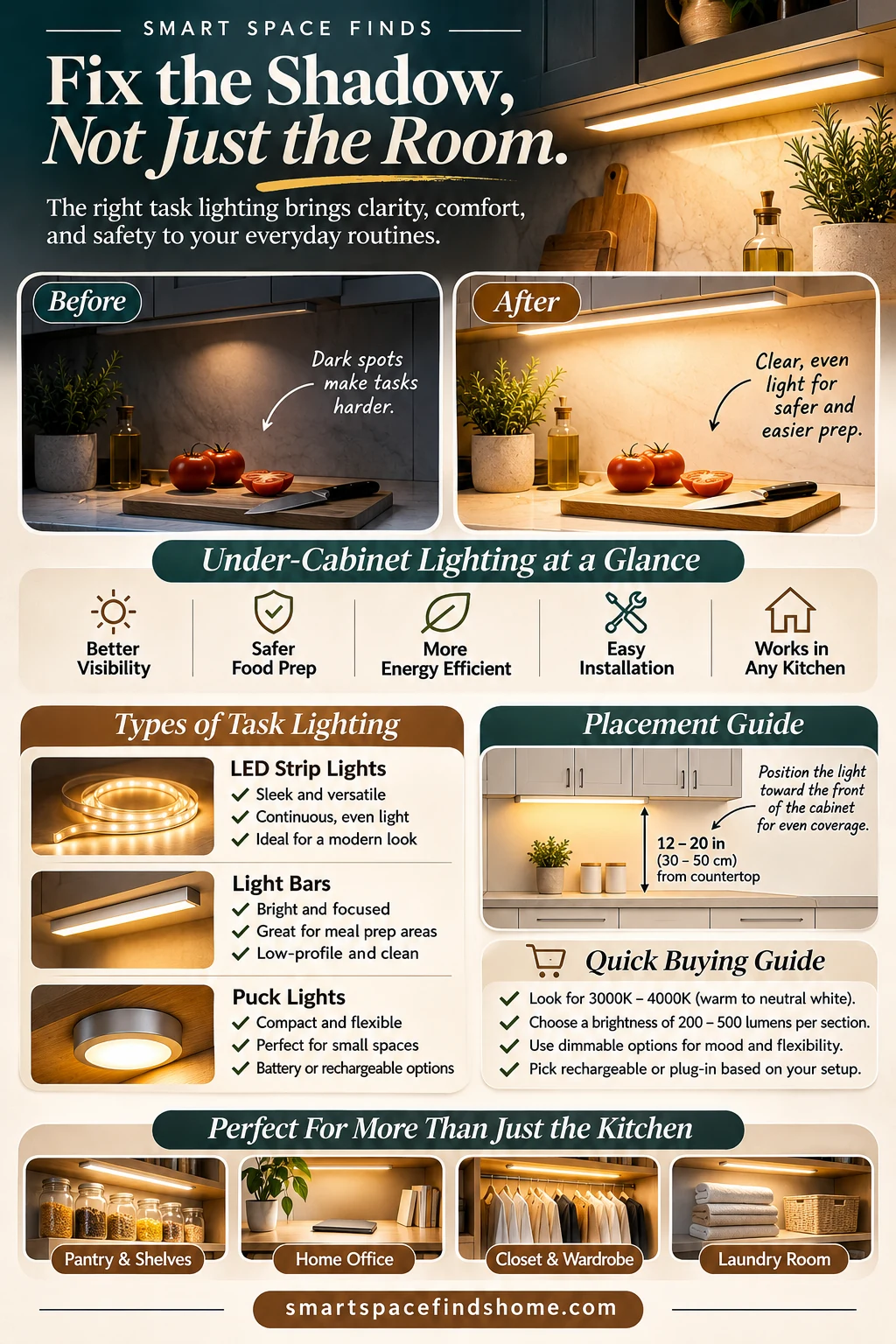
Rechargeable, plug-in or hardwired?
- Rechargeable lights
- Useful for occasional tasks and locations without an accessible outlet. Check runtime at the brightness you intend to use.
- Plug-in fixtures
- A practical option for frequent use where an appropriate outlet and safe cord route are available.
- Hardwired fixtures
- Worth considering for a permanent kitchen lighting plan; installation should follow local electrical requirements and be handled by a qualified professional where required.
For a comfortable visual result, consider a diffused light source that illuminates the actual preparation area without exposing bright LEDs at eye level. A warm-to-neutral white can blend with existing kitchen lighting, but choose brightness and color quality for the work you do. Sensor lights can work in cupboards; a reliable continuous-on mode is often preferable for longer preparation tasks.
Check before installation: Follow the fixture’s location, heat, moisture, mounting and electrical ratings. Do not position an unsuitable light directly above a heat source or where it may be splashed.
SMART SPACE FINDS / THE EDIT
Better Task Lighting
As an Amazon Associate, we earn from qualifying purchases. Product details and availability may change; verify the listing before ordering.
MCGOR 10-Inch Rechargeable Under-Cabinet Lights — 2 Pack
Rechargeable option for locations without convenient outlets.
14.7-Inch Rechargeable Magnetic Under-Cabinet Lights — 2 Pack
Longer light bars for wider work areas.
Gritin 10.2-Inch Three-Color Under-Cabinet Lights
Compare color settings and runtime for your tasks.
EZVALO Motion Sensor LED Puck Lights
Consider for occasional illumination inside cabinets.
Ansen 24-Inch Hardwired Under-Cabinet Light
Permanent lighting option; follow electrical installation requirements.
JUSJUBR 12-Inch Plug-In LED Light
Plug-in option where a suitable outlet is available.
WOBANE Dimmable LED Strip Lighting Kit
Flexible lighting layout with adjustable brightness.
Goodea Under-Cabinet Lights with Charging Station
Compare charging convenience and operating time.
05 / The art of adaptability
5. A wall-mounted drying rack: borrow space only when you need it
Wet laundry has a way of taking over the furniture. A chair becomes a clothes rack, a door becomes a towel rail, and a narrow hallway becomes an obstacle course. A fold-away drying rack offers a different approach: give laundry a dedicated place that occupies less room when empty.

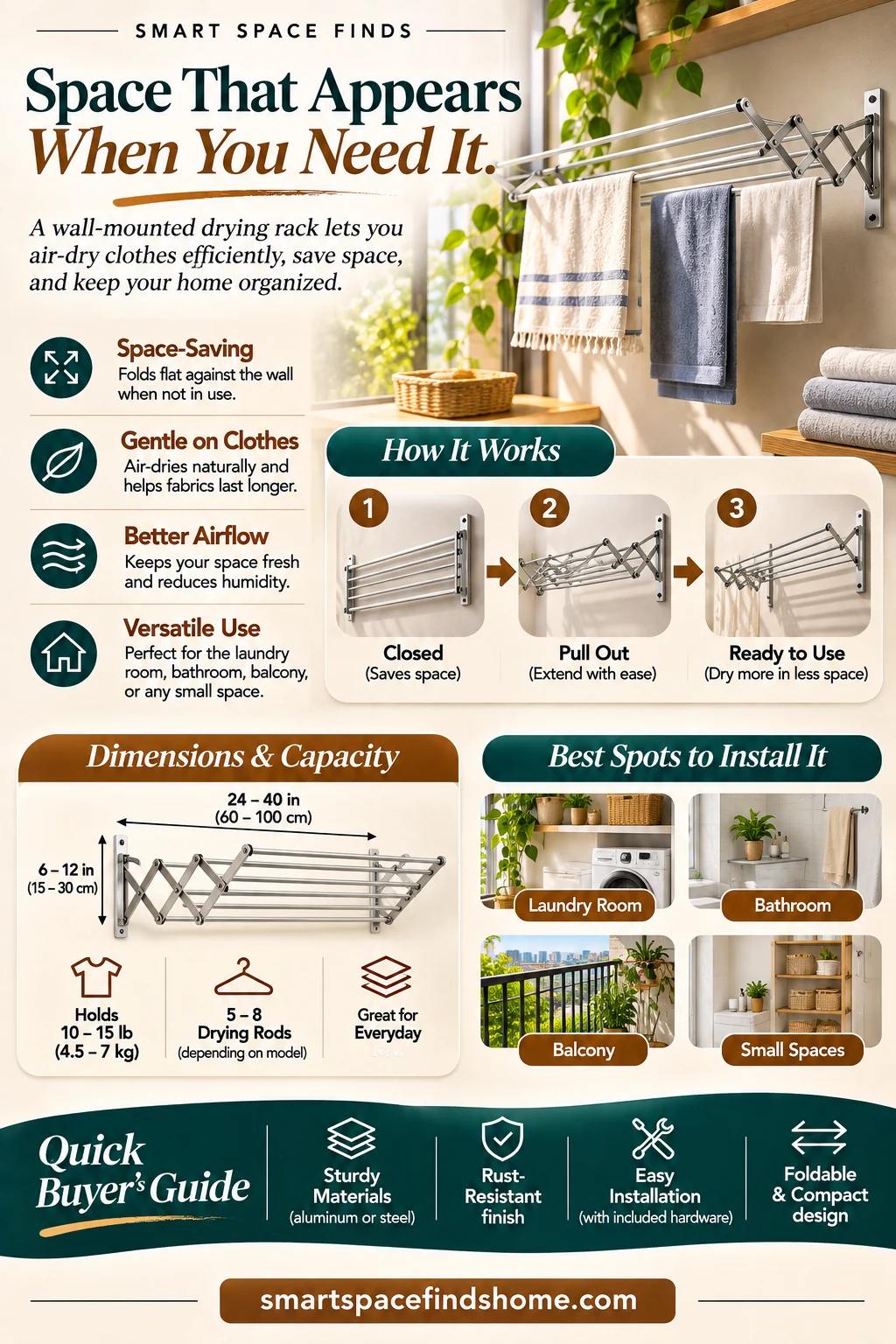
Measure the rack in both positions
Check the closed depth, open projection, drying rail spacing, and clearance from doors, walkways and appliances. Think about the garments you dry most often: a compact rack may suit hand-washed shirts and towels, while larger loads may need a different solution. Some delicate knits require flat drying according to their care labels.
Check the manufacturer’s wet-load capacity and installation requirements. Wall materials and fixings must be appropriate for the load; seek qualified help when uncertain and get permission where your lease requires it. Keep damp clothing spaced apart and provide ventilation to manage indoor humidity.
Renter-friendly alternative: A suitable over-door or freestanding folding rack can be a better choice when drilling is not permitted. Check door clearance and stability before using it.
SMART SPACE FINDS / THE EDIT
Space-Saving Laundry Solutions
As an Amazon Associate, we earn from qualifying purchases. Product details and availability may change; verify the listing before ordering.
Vikaqi 32-Inch Wall-Mounted Drying Rack — 5 Rods
Compact wall-mounted option for smaller laundry loads.
Vikaqi 40-Inch Wall-Mounted Drying Rack — 6 Rods
Wider drying area; measure wall clearance first.
ZdwCyl Tri-Fold Wall-Mounted Drying Rack
Folding design for adaptable laundry zones.
HEILAIYI Retractable Wall-Mounted Clothes Rack
Retractable option for occasional garment drying.
JAUREE Foldable Wall-Mounted Laundry Rack — 18 Hooks
Hook-based arrangement for hanging garments.
Joseph Joseph Wall-Mounted Foldaway Drying Rack
Foldaway format for limited floor space.
GorillaLine Retractable Clothesline
Retractable line; verify mounting and tension requirements.
BAKON Over-the-Door Folding Clothes Rack — 2 Pack
Consider where drilling is restricted; check door fit.
Amazon Basics Foldable Portable Clothes Drying Rack
Freestanding alternative for flexible drying locations.
Find the fix that fits your day
Start with the moment that feels familiar. Each link takes you directly to the relevant solution.
- At bedtime: I keep losing the end of my charging cord.
- While cooking: I spend too long finding the right measuring tool.
- While organizing: I cannot comfortably reach occasional-use items.
- At dinner time: My counter is dark even when the kitchen lights are on.
- On laundry day: Damp clothes occupy furniture and walking space.
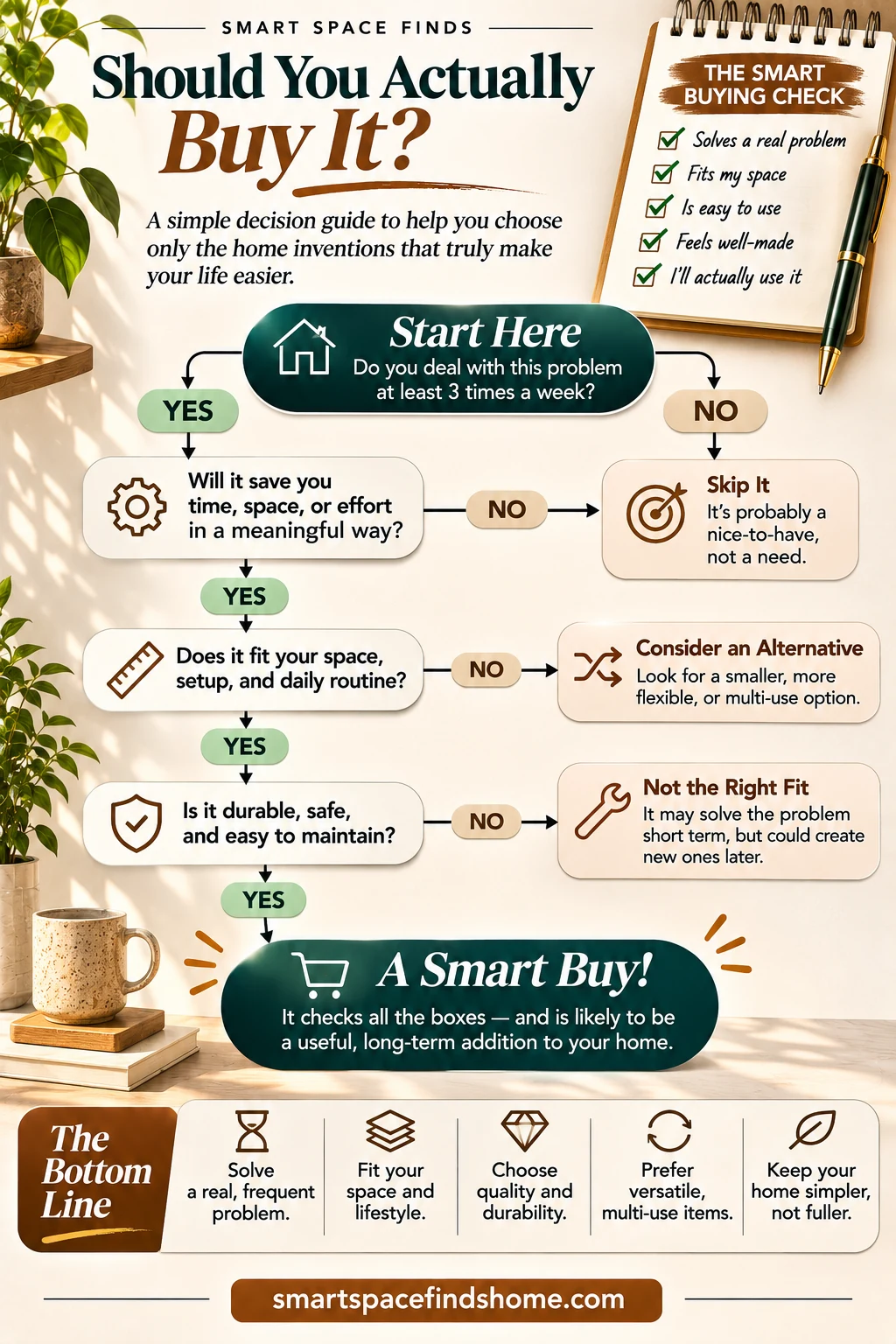
The Everyday Friction Audit: which invention should you buy first?
Before shopping, observe one ordinary day at home. Notice the moments when you search, reach, untangle, reposition or move something just to complete another task. Write down the recurring inconvenience and score each proposed solution using the four questions below.
The 8-point usefulness test
Give each answer 0 points for no, 1 for partly, and 2 for yes.
- Does the problem happen at least weekly?
- Would this solution remove a repeated step?
- Does it fit the available space without creating clutter?
- Can I install, use and maintain it safely?
6–8: Worth investigating. 4–5: Compare a simpler alternative. 0–3: Probably skip it. Safety and compatibility are mandatory regardless of score.
This is an editorial decision aid, not a tested scientific scale. Use it to compare priorities rather than to predict savings or performance.
A seven-day experiment in a more functional home
Day one: notice the five recurring problems. Day two: change the placement of charging cords. Day three: reorganize measuring tools. Day four: move frequently used items into comfortable reach. Day five: observe shadows at your work counter. Day six: measure a possible laundry drying zone. Day seven: choose only the upgrade that still makes sense after the free adjustments.
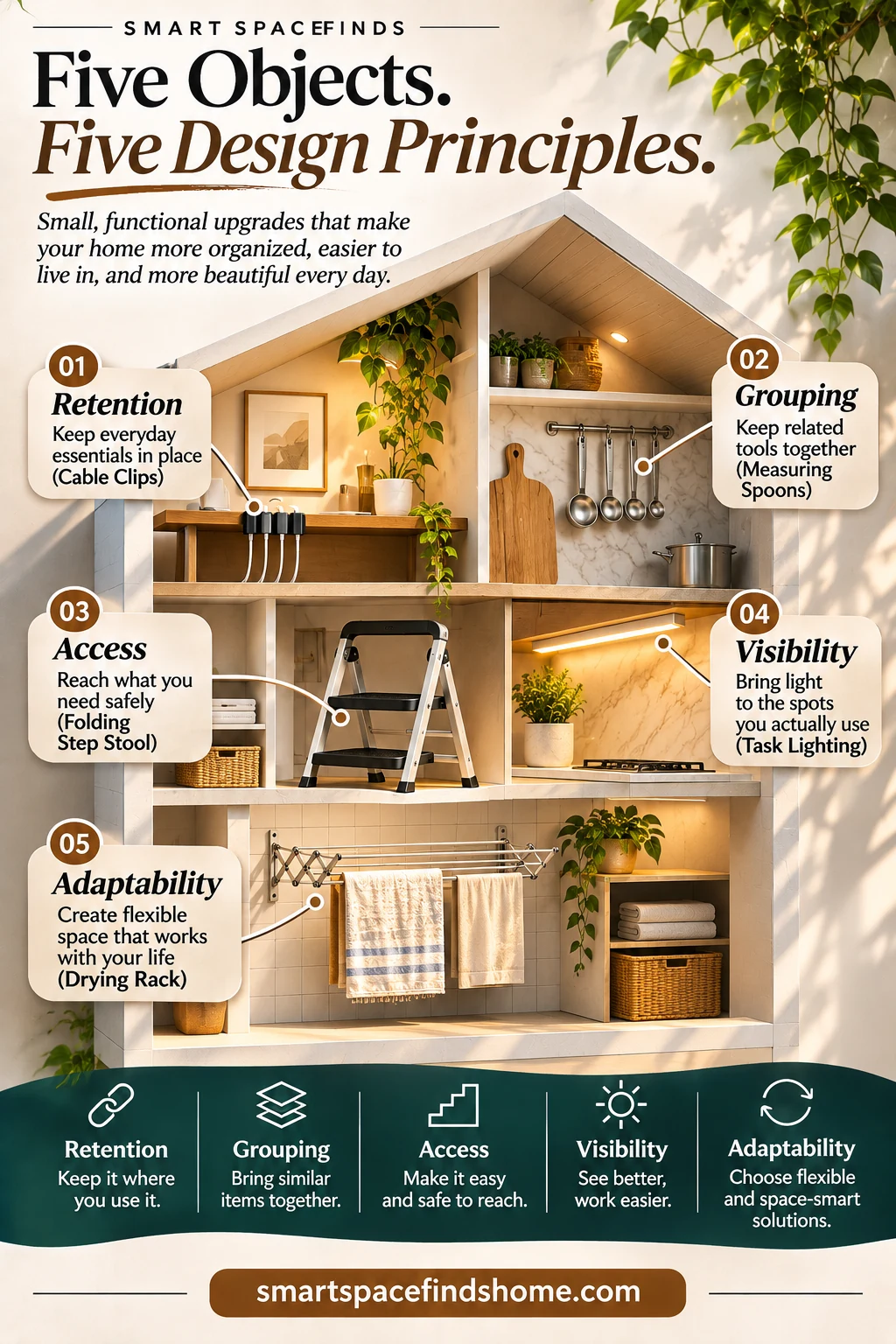
Why these five inventions work: the design hiding in plain sight
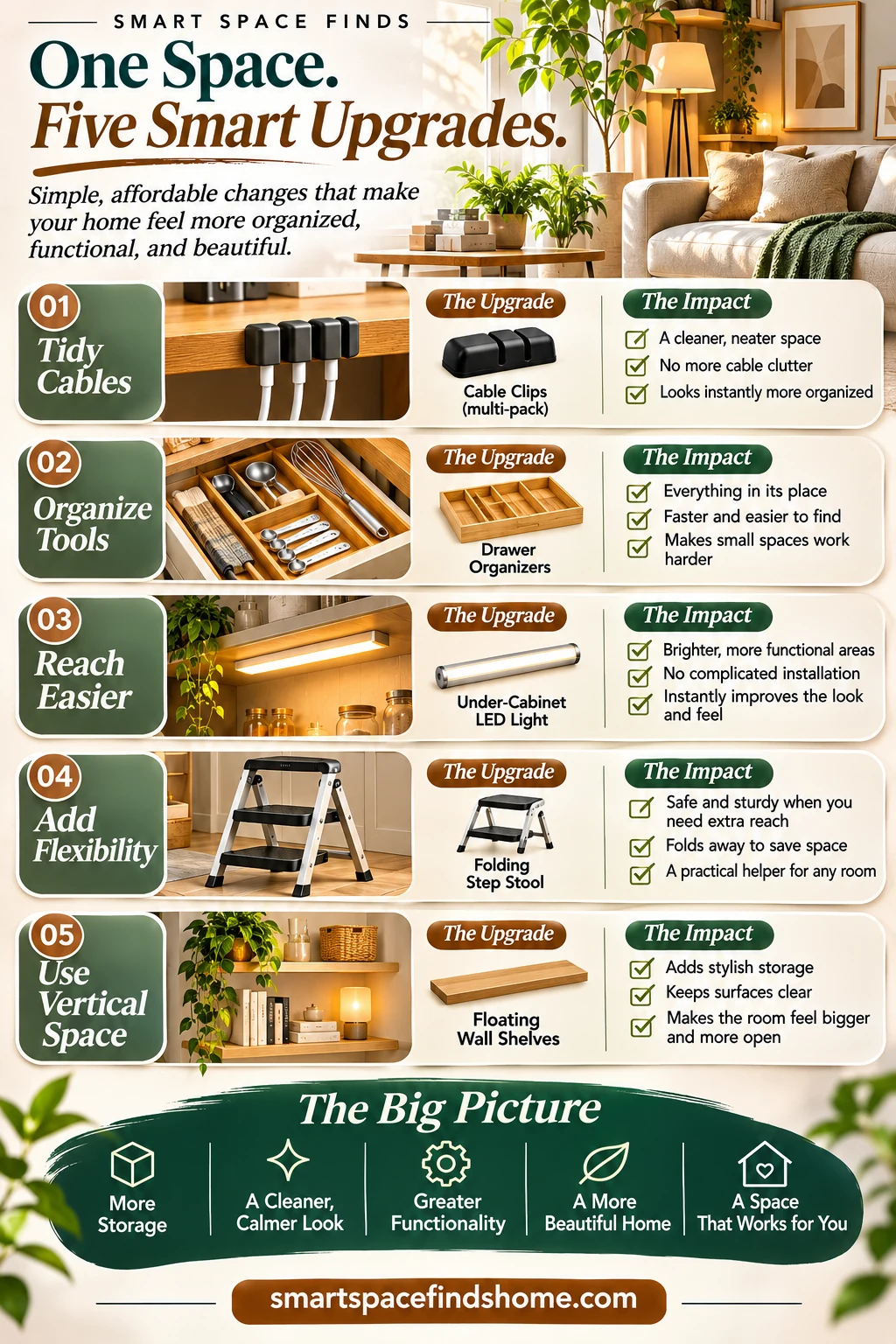
Each object changes a different relationship between you and your home. A cable clip creates a predictable resting place; magnetic spoons group related tools; a folding stool improves access; task lighting moves illumination to the point of use; and a folding drying rack makes a surface available only when needed. These are five distinct design principles, not five reasons to shop.
- Retention: Give frequently misplaced objects a consistent home.
- Grouping: Keep tools for the same task together.
- Access: Put the things you need within a comfortable reach.
- Visibility: Illuminate the work rather than merely the room.
- Adaptability: Prefer furniture and storage that can change with the task.
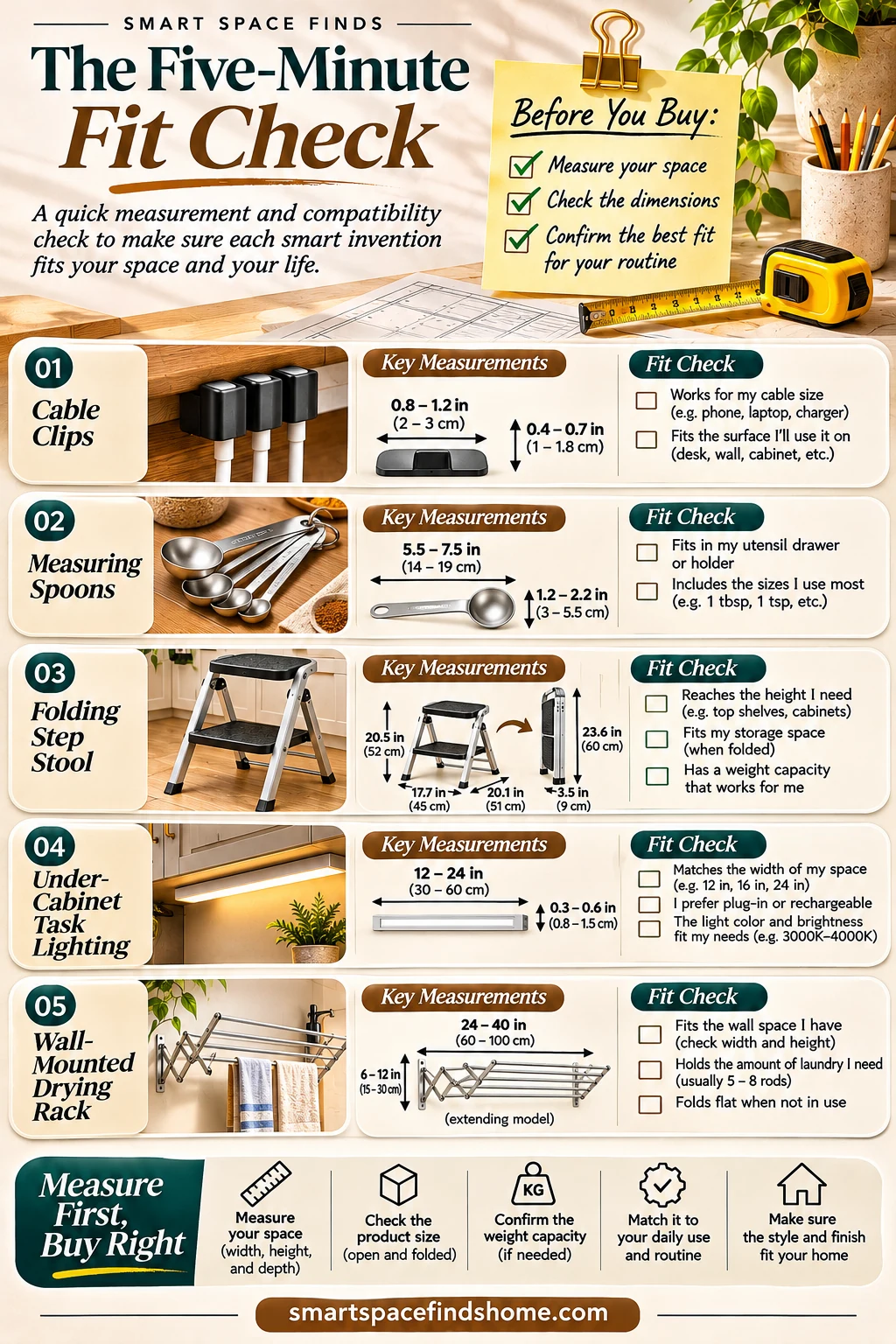
Before you shop: the five-minute fit check
Use a ruler, a piece of paper and the space you already have. Record the dimensions in inches and compare them with the actual product specification rather than the listing photograph.
| Solution | Measure or observe | Common mismatch |
|---|---|---|
| Cable holder | Cord diameter and reach | Clip grips too tightly or cord cannot reach device |
| Measuring spoons | Spice jar opening and drawer clearance | Wide bowl will not enter narrow jars |
| Step stool | Open footprint and folded storage | Stool obstructs cabinet doors or walking route |
| Task light | Cabinet underside and outlet position | Visible glare or unsafe cable route |
| Drying rack | Open depth and mounting surface | Wet garments obstruct a doorway |
After the purchase: the one-week reality check
Give the improvement seven ordinary days. Is the charger still easy to reach? Are all the measuring spoons returning to the same place? Is the stool easy to open and store? Does the light stay useful for a full preparation session? Can clothes dry without blocking a route? If a solution fails, check placement and compatibility before buying a second accessory. Follow the seller’s return policy rather than keeping a gadget that does not fit your routine.
Make the improvement look intentional
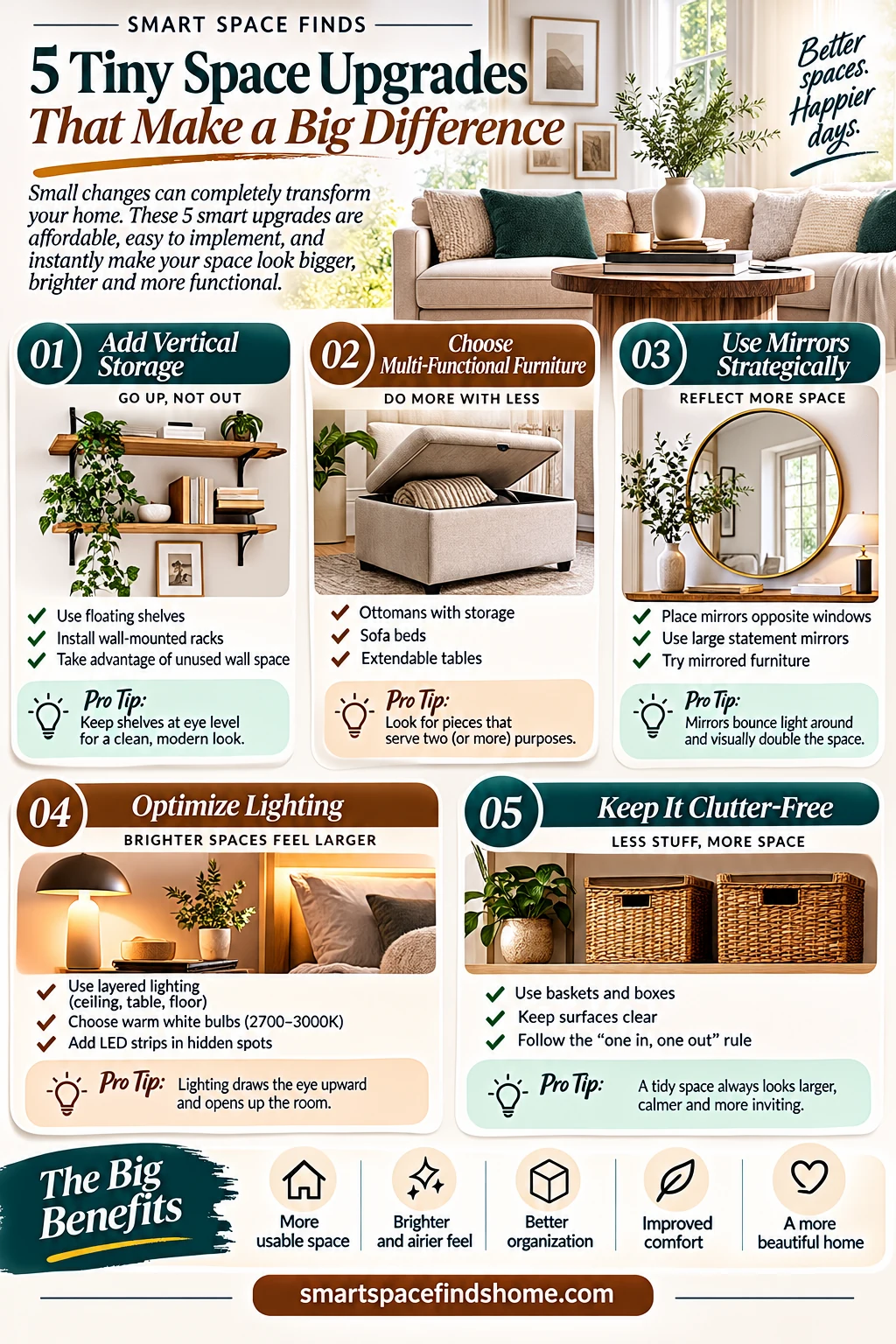
Choose finishes that quietly belong to the room: a discreet cable holder that blends with the furniture, brushed steel tools in a kitchen drawer, a stool that stores out of sight, a concealed light source and a drying rack that visually recedes when folded. Function comes first; color and finish help the solution feel like part of the home rather than an afterthought.
Continue designing a home that works better
- Create a more functional desk setup
- Choose multipurpose kitchen tools for small kitchens
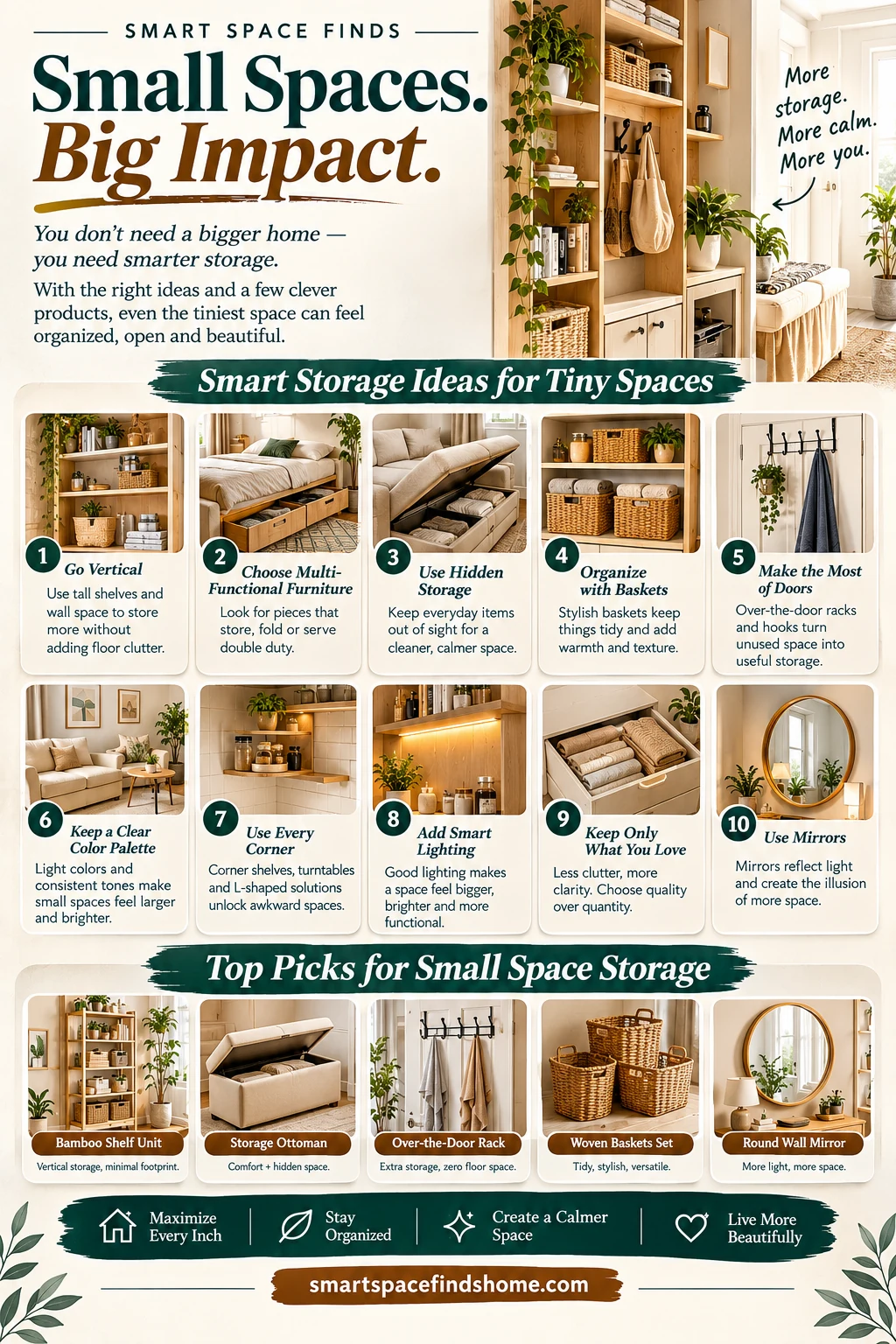
- Explore clever small-space solutions
- Find space-saving laundry room storage ideas
Editorial approach: These recommendations are based on design reasoning and published product-selection guidance, not hands-on testing of individual products by Smart Space Finds. Always verify the specifications and instructions for your chosen model.
Frequently asked questions
What are some small inventions that solve everyday household problems?
Cable clips, magnetic measuring spoons, folding step stools, under-cabinet task lights and wall-mounted drying racks address common problems involving misplaced items, access, visibility and limited space.
Which useful household gadgets are best for renters?
Weighted cable holders, removable storage accessories, suitable freestanding folding stools, rechargeable task lights and freestanding drying racks can be useful when permanent installation is restricted. Verify surface compatibility and lease requirements.
Are magnetic measuring spoons more accurate?
Not necessarily. Magnets help keep the set together. Accuracy depends on the dimensions of the measuring tool and how ingredients are measured.
Can I install a wall-mounted drying rack on drywall?
Only if the rack’s installation instructions allow that wall construction and the mounting system can safely support the intended load. Consult a qualified installer if the wall structure is unclear.
How do I avoid buying gadgets that become clutter?
Choose a recurring problem, try a free rearrangement first, and measure the available space. Avoid products that solve an inconvenience you rarely experience or require more upkeep than the original task.
What if you have only enough room or budget for one improvement?
Start with the task that interrupts your day most often. For someone working from home, that might mean a better charging point. For a frequent cook, it could be a well-lit preparation surface. For someone living without a dryer, a dedicated drying area may make the biggest difference. Do not prioritize a product simply because it is inexpensive: consider the space it occupies, the installation it requires, and the effort of maintaining it.
If several people share the home, agree on the placement before making a permanent change. A solution that is intuitive for everyone is more useful than one that only works for the person who installed it.
Small changes, quieter routines
A well-designed home is not measured by the number of clever objects inside it. It is measured by how easily you can do the things you already do. Choose one detail that repeatedly interrupts your day and make it easier. That is where the most useful upgrade begins.