
The kitchen drawer is rarely cluttered all at once. One specialty slicer, one mini chopper, one clever-looking gadget at a time—and suddenly there is nowhere to put the tools you actually use.
A well-edited kitchen works differently. Rather than chasing a tool for every ingredient, it relies on a few reliable essentials that perform several jobs comfortably. This guide focuses on multi-purpose kitchen tools for small kitchens: what they can realistically replace, what they cannot, and how to decide whether each one deserves the storage space.
The Smartest Kitchen Has Fewer Single-Purpose Tools
These are not five miracle gadgets. They are five practical categories that cover the repetitive work of home cooking, without insisting you abandon a specialty tool you love.
Think about a normal Tuesday dinner: slice a few vegetables, grate Parmesan, roast everything on a pan and whisk together a quick dressing. That meal needs several tasks, not necessarily several gadgets. This distinction matters in a small apartment, where every inch of countertop and drawer capacity has another potential use.
Our selection criteria are straightforward: versatility, ease of cleaning, safe handling, durability, and space efficiency. We prioritize the tool you will reach for weekly, not the one with the longest list of attachments. We also point out where the specialist still wins: sometimes a single-use item earns its place because you use it frequently.
A SMALL-KITCHEN PRINCIPLE
Buy for the meals you make.
Store for the space you have.
5 Multi-Purpose Kitchen Tools Worth Considering
01 / A Comfortable Chef’s Knife
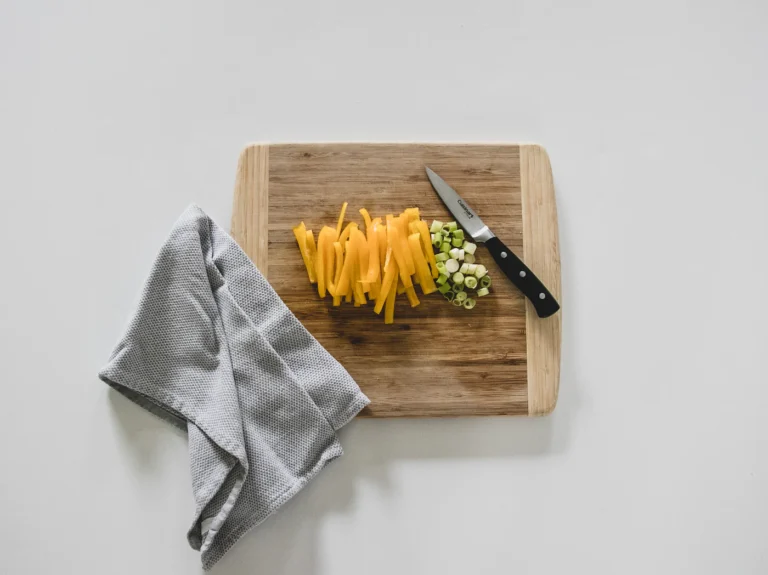
A good chef’s knife is the foundation of everyday prep. It handles onions, herbs, carrots, potatoes and a surprising number of ingredients that inspire their own countertop gadgets. An approximately 8-inch blade is a common all-round option, but fit matters more than any standard size. If a shorter knife offers better control in your hands and on your board, that is the smarter choice.
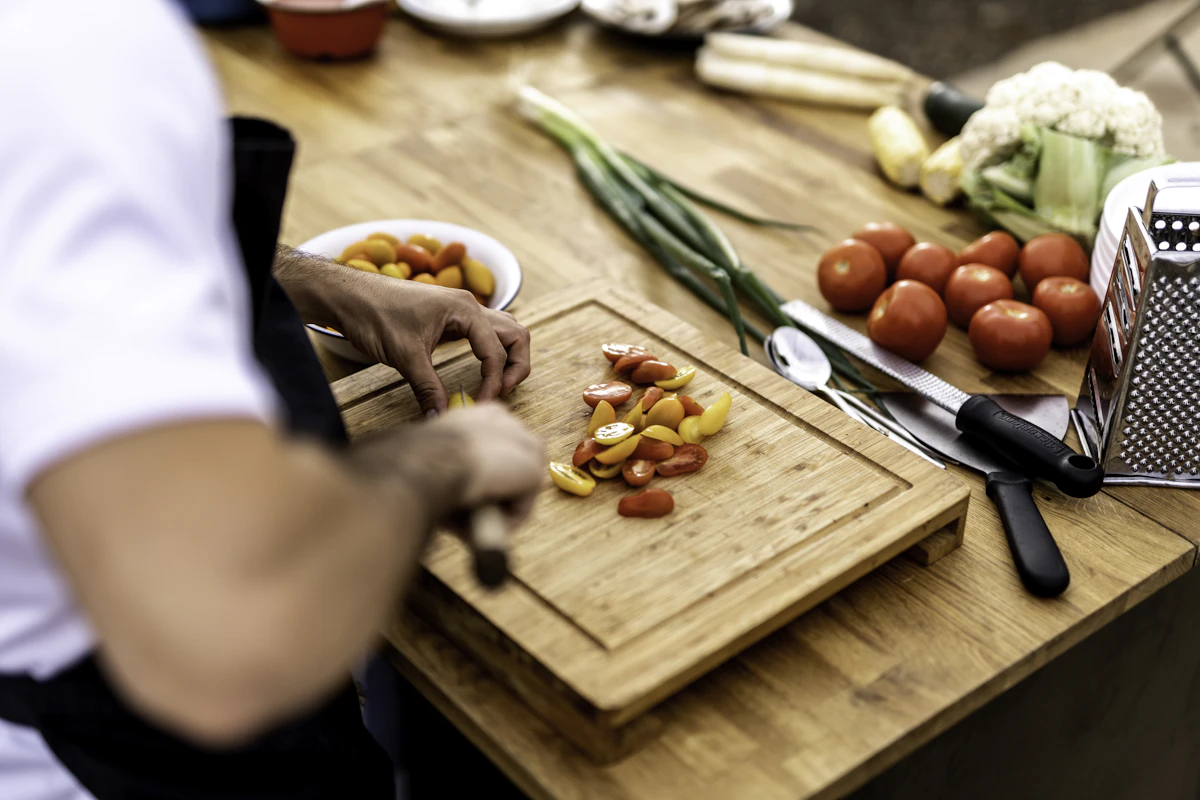
Potentially replaces: dedicated herb cutters, avocado slicers and some manual vegetable choppers. Does not replace: a serrated bread knife, a peeler for every cook, or a mandoline when uniform paper-thin slices matter. Avoid pretending one blade is perfect for every job.
- Look for: comfortable grip, predictable balance, easy sharpening and a safe storage solution.
- Before buying: measure your preferred cutting-board space and consider whether the handle becomes slippery when wet.
- Safety: use a stable board, keep fingertips clear, and never leave an unprotected blade loose in a drawer.
THE ESSENTIAL FIVE · PREP
The Everyday Prep Edit
Compare handle comfort, blade length and investment level before choosing your everyday knife.
Mercer Culinary Millennia 8-Inch Chef’s Knife
Everyday value · M22608
Victorinox Fibrox Pro 8-Inch Chef’s Knife
Lightweight prep · Black Fibrox
HENCKELS Classic 8-Inch Chef’s Knife
Classic forged option · 31161-201
WÜSTHOF Classic 8-Inch Chef’s Knife
Premium alternative · 8 in
02 / A Four-Sided Box Grater
A reliable box grater is a modest investment in flexibility. One side may shred cheese coarsely, another finely, while other surfaces handle certain vegetables or slicing tasks depending on the specific design. It is especially useful for quick weeknight portions when setting up and washing a food processor would take longer than the grating itself.
Potentially replaces: several separate handheld shredders. Does not replace: a large-capacity processor when you prepare big batches or a purpose-built fine zester when extremely fine citrus zest is essential. Do not assume every surface works equally well.
- Look for: wide stable base, solid handle, well-finished cutting surfaces and manageable cleaning.
- Best for: cheese, carrots, zucchini and other suitable ingredients in moderate quantities.
- Safety: slow down as ingredients become small; a cut-resistant glove can reduce risk.
THE ESSENTIAL FIVE · GRATE
One Tool, Multiple Textures
Choose by grating surfaces, removable container and how easily the tool stores and cleans.
OXO Good Grips 4-Sided Box Grater
Container included
KitchenAid Gourmet Box Grater
Detachable measuring container
OXO Good Grips Etched Box Grater
Removable zester
Cuisipro 4-Sided Box Grater
Stainless steel · 746850
03 / An Immersion Blender for Soups and Sauces
If your regular meals include creamy soups, bean purées, simple sauces or homemade dressings, a compact immersion blender can be a practical alternative to storing a second large blending appliance. Blending in a suitable pot or tall container also means fewer transfers and, often, less washing.
It is not a universal replacement for a countertop blender. Many immersion models are poorly suited to crushing ice, extremely thick mixtures or high-volume batches. Whisk and mini-chopper attachments may extend their uses, but only if you have room to store them and a reason to use them.
- Look for: comfortable grip, appropriate power, detachable shaft if desired, and manufacturer-approved use with hot ingredients.
- Best for: cooks who make soups, sauces or dressings at least a few times a month.
- Safety: keep blades submerged as instructed to avoid splashing, follow hot-liquid guidance and unplug before cleaning.
THE ESSENTIAL FIVE · BLEND
Blend Without the Bulk
Compare basic corded blending and accessory options; always review model-specific hot-liquid guidance.
KitchenAid Variable Speed Corded Hand Blender
KHBV53CU · Contour Silver
Braun MultiQuick 5 Vario Hand Blender
MQ5025BK · Black
Cuisinart Smart Stick Variable Speed
CSB-179 · Stainless steel
04 / A Rimmed Sheet Pan That Works Beyond Baking
A sturdy rimmed sheet pan moves effortlessly between roasted vegetables, one-pan dinners, cookies and simple ingredient organization. It delivers flexibility without motors, cords or attachments, and most shapes stack efficiently when you own more than one.
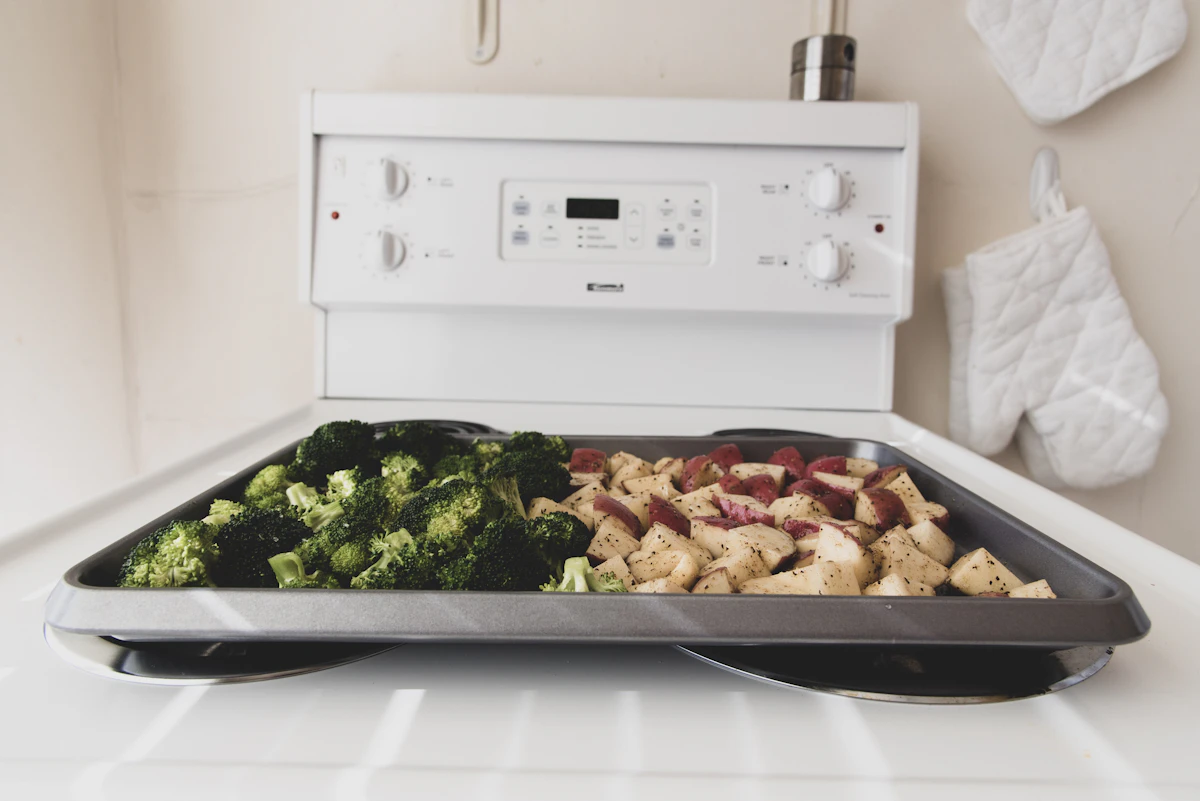
A typical US half-sheet pan measures roughly 18 × 13 inches, but that does not mean it fits every apartment oven. Check rack clearance and oven interior dimensions before purchasing. A quarter-sheet may be a more useful size in compact spaces.
Potentially replaces: some purpose-built shallow baking trays and separate ingredient trays. Does not replace: a deep roasting dish, a skillet or a vessel for liquid-heavy recipes.
- Look for: rimmed design, sturdy construction, appropriate oven-temperature rating and dimensions that fit your oven.
- Storage idea: store vertically in a narrow cabinet divider if horizontal stacking is awkward.
- Care: follow the manufacturer’s guidance on high heat, utensils and thermal shock.
THE ESSENTIAL FIVE · BAKE
The Workhorse Bakeware Edit
Measure oven clearance first, then pick the number and dimensions of pans you will actually use.
Nordic Ware Naturals Half Sheet 2-Pack
Two natural-aluminum half sheets
USA Pan Half Sheet Pan Set of 2
Aluminized steel · Two pans
Nordic Ware Naturals Quarter Sheet with Grid
Compact quarter sheet and grid
Nordic Ware Naturals 3-Piece Sheet Pan Set
Three practical pan sizes
05 / A Small Set of Nesting Mixing Bowls
Bowls are useful long before a recipe reaches the oven. One can hold measured ingredients, another can whisk dressing and a larger one can toss vegetables or salad. When they nest, three bowls can require little more shelf space than the largest bowl alone.
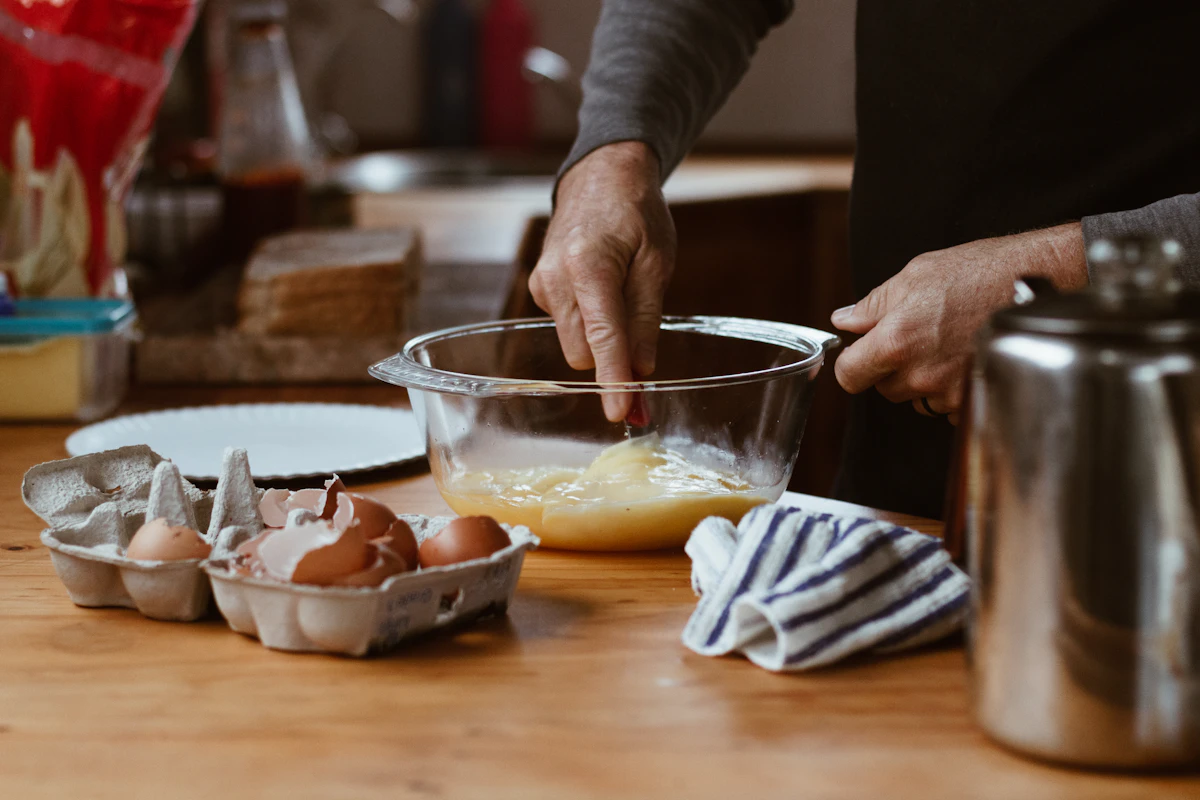
Potentially replaces: some separate prep, mixing and serving bowls. Does not replace: oven-safe cookware or food-storage containers unless the bowls are specifically approved for those uses. Stainless steel cannot go in a microwave; glass and plastic requirements vary by product.
- Look for: nesting profile, two or three genuinely useful sizes and a material that matches your cooking habits.
- Choose stainless steel if: low weight and resistance to everyday knocks matter most.
- Choose appropriate glass if: seeing the contents and certain reheating uses matter, after checking the manufacturer’s instructions.
THE ESSENTIAL FIVE · MIX
Mix, Serve & Store
Look for genuinely nesting sizes and manufacturer-approved lids, materials and reheating uses.
Cuisinart 3-Piece Stainless Mixing Bowls with Lids
CTG-00-SMB · 1.5, 3, 5 qt
Pyrex Essentials 3-Piece Glass Mixing Bowls
Clear glass · Three sizes
OXO Good Grips Stainless Steel Mixing Bowl Set
Three-piece steel set
Umite Chef 8-Piece Mixing Bowls with Lids
Steel · Lids and accessories
OXO Good Grips 3-Piece Steel Mixing Bowls
Blue and Gray · Three-piece
THE EDITOR’S SHORTLIST
Choose by how you really cook
A knife, sturdy board, mixing bowls and a sheet pan have the broadest everyday uses.
Prioritize knife control, a stable grater and an oven-safe sheet pan.
Consider the immersion blender before another bulky countertop appliance.
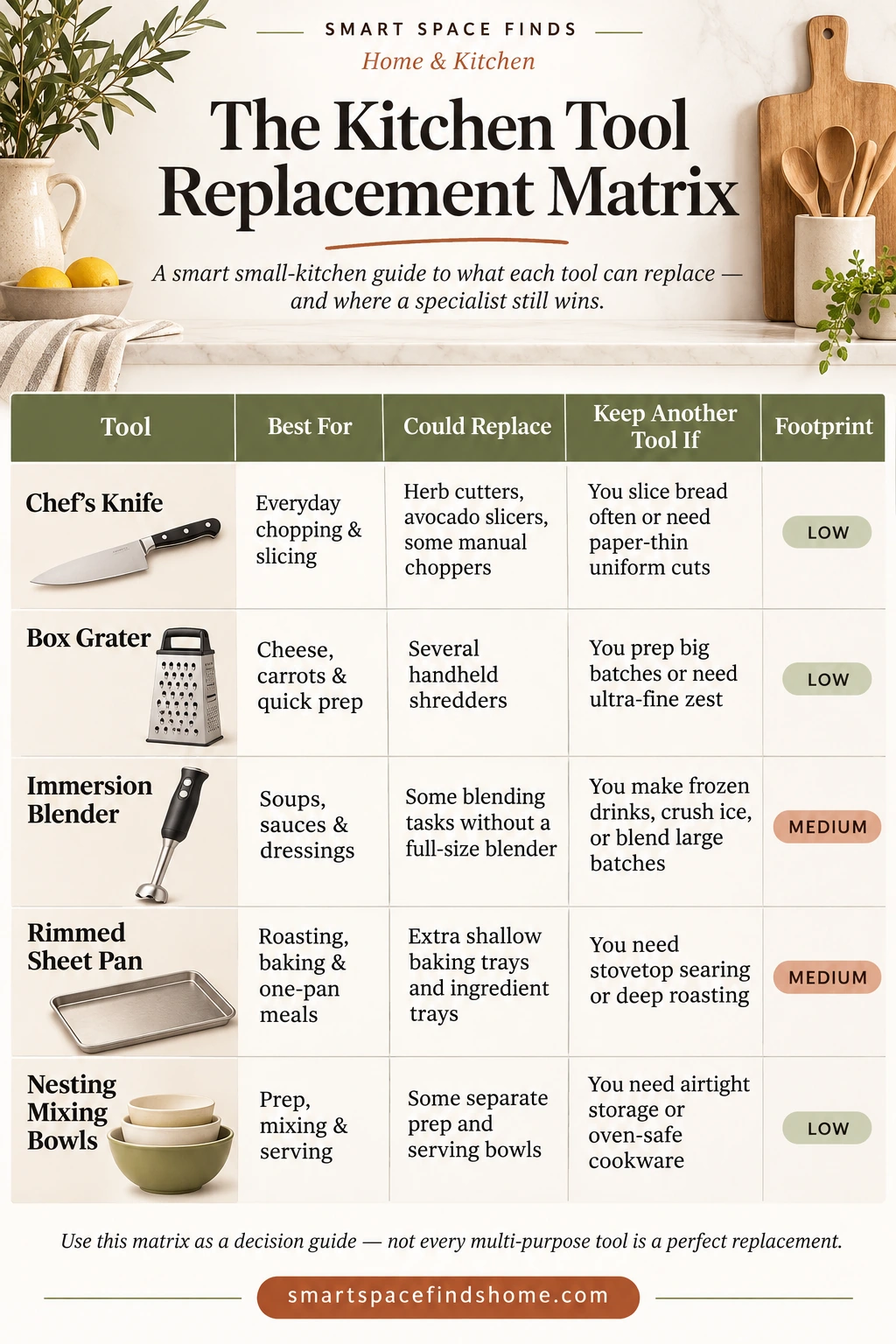
The Tool Replacement Matrix: What You Gain—and What You Give Up
A product that can do several jobs is only a good purchase if it performs your frequent tasks comfortably. Use this comparison as a decision guide rather than a promise that different appliances work identically.
| Essential | Tasks consolidated | When to keep a specialist |
|---|---|---|
| Chef’s knife | Chopping herbs and slicing many everyday ingredients | Crusty bread or extremely fine, uniform slicing |
| Box grater | Fine/coarse grating of cheese and some vegetables | Large-volume shredding or ultra-fine zest |
| Immersion blender | Some soups, sauces and dressings | Ice, thick frozen blends or large volumes |
| Rimmed sheet pan | Roasting, baking and staging ingredients | Stovetop searing or liquid-heavy roasting |
| Nesting bowls | Mixing, tossing, serving and mise en place | Specialist heated or airtight storage tasks |
A Mini Kitchen Workflow That Makes These Tools More Useful
Buying fewer gadgets is only half the equation. Their storage positions determine how efficient your space feels. Try a simple three-zone setup that reflects the order in which you cook:
Cutting board, knife and grater close to your main clear work surface.
Nesting bowls together; immersion blender stored safely nearby if used often.
Sheet pans near the oven, stored vertically if the cabinet allows.
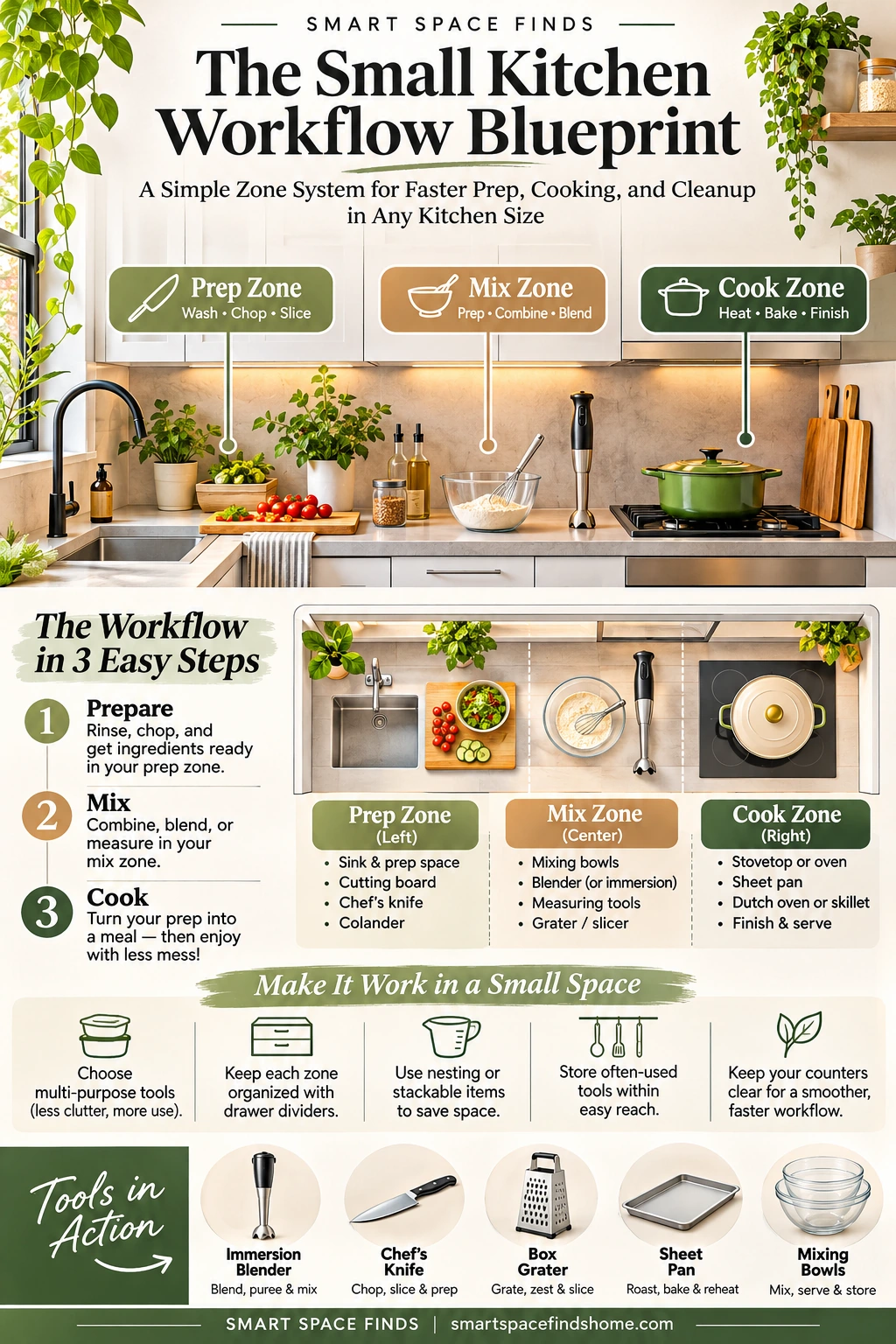
A real-world example: For a roasted-vegetable bowl, prepare produce beside the sink, toss with oil in the medium mixing bowl, spread on a sheet pan and whisk a quick dressing in the smallest bowl. The same core tools serve different stages without adding extra gadgets to your counter.
For related space-saving strategies, read our kitchen drawer organization guide, one-wall kitchen storage ideas and compact countertop organization ideas.
How We Chose These Five Essentials
Our criteria are rooted in everyday small-kitchen workflows: how many recurring tasks a tool performs, whether it stores without dominating a drawer, the effort needed to clean it, and whether a safer or more convenient specialist remains necessary. This is an editorial evaluation of tool categories, not independent laboratory testing of individual models. We have not assigned performance scores or invented hands-on product experience.
A useful rule for a typical US apartment kitchen is to measure your actual constraints—not just the product: drawer depth for knife protection, the clear width of the prep surface, cabinet height for bowls, and interior oven clearance for baking sheets.
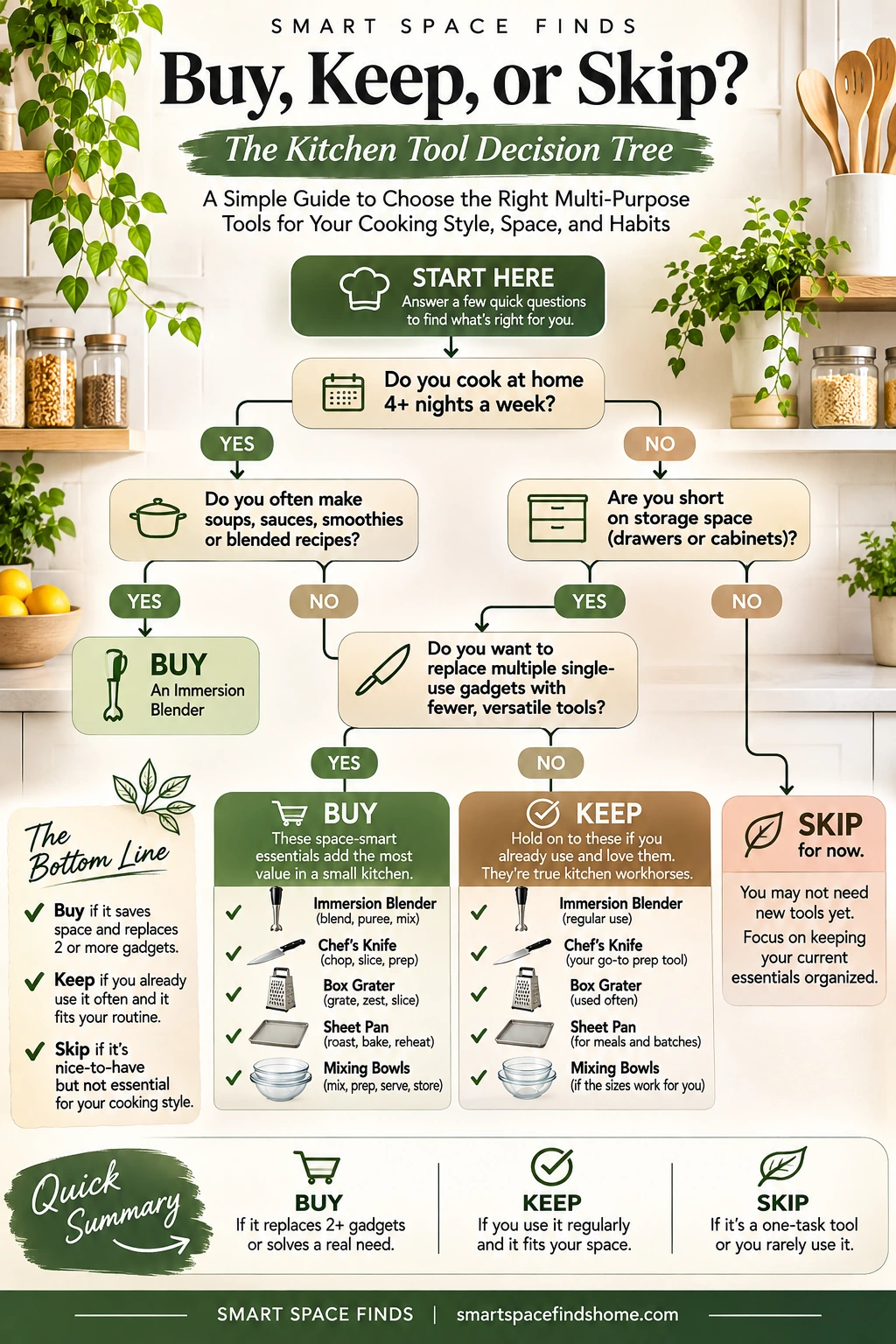
The Buy-or-Keep Checklist
Before ordering any kitchen tool, answer the questions below with a particular meal in mind. It is a small habit that can save more space than another storage organizer.
- Will I use it weekly? A monthly specialist may belong in a less accessible cabinet, not your best drawer.
- Which exact tasks does it replace? Name at least two, then confirm the replacement works safely for both.
- Can I clean it quickly? Awkward attachments can erase the time savings promised by the product.
- Does it fit? Measure the blade-safe storage, oven opening, cabinet depth or shelf height before you buy.
- Does it complement what I own? Start by testing existing tools; avoid buying duplicates simply because they are marketed as multifunctional.
A 10-Minute Gadget Drawer Reset
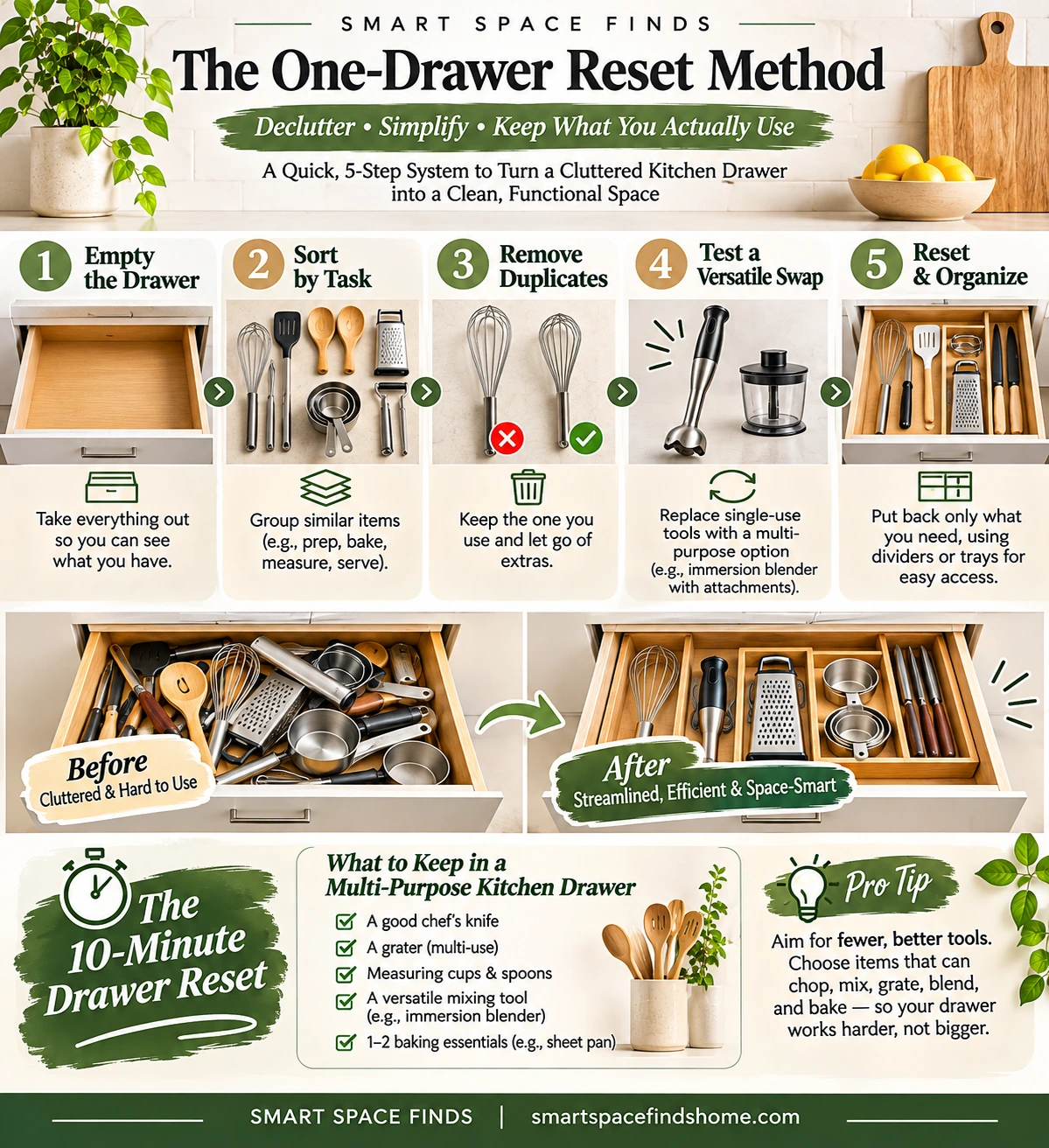
Take every single-purpose gadget out of one drawer. Group by the job it performs: cutting, shredding, blending, baking or mixing. Choose one duplicate category and try your next normal recipe with the most versatile tool you already own. If it works comfortably, move the redundant item into a temporary review box; do not donate or discard anything until you have tested the new setup.
Clean and return only what you use. Give daily essentials easy access and store the rest out of the prime preparation zone. This single-drawer experiment is more useful than declaring you need to own exactly five tools.
TRY IT BEFORE YOU BUY
The One-Week Kitchen Test
Choose one gadget you rarely use. Put it aside for seven days, then cook your usual meals with the essentials you already own. If you miss it repeatedly, keep it. If another tool works just as well, consider donating the duplicate.
No shopping required. No forced minimalism. Just a practical test of what earns space.
Frequently Asked Questions
What are the most versatile kitchen tools for a small apartment?
A well-fitting chef’s knife, a box grater, a rimmed sheet pan and a few nesting mixing bowls cover many common preparation tasks. An immersion blender can be worthwhile if soups and sauces appear regularly in your cooking.
Can an immersion blender replace a regular blender?
For certain soups, sauces and dressings, yes. It may not perform as well with ice, thick frozen drinks or large batches. Follow the model’s instructions and match it to your typical recipes.
Are multi-purpose kitchen gadgets always better?
No. A device with many attachments can occupy more space and take longer to clean. A dedicated tool is worth keeping when you use it often and it works noticeably better.
What size sheet pan works in a small oven?
Measure the oven cavity and rack clearance first. A half-sheet pan is commonly about 18 × 13 inches, while smaller quarter-sheet styles can suit compact ovens.
How many mixing bowls does a beginner need?
Two or three nesting bowls in distinct useful sizes can be enough for many everyday meals. Buy based on your usual portion sizes and available shelf space.
How do I organize cooking tools without buying new organizers?
Group items by use, remove duplicates only after testing alternatives, keep frequent-use tools near the relevant work zone and store occasional equipment farther away.
The Bottom Line: Let Every Tool Earn Its Place
A well-designed small kitchen is not about living with less for the sake of minimalism. It is about making room for the cooking you actually enjoy. Choose tools by the meals you make, the jobs they solve and the space they occupy. Then let the unnecessary gadgets go—one thoughtful decision at a time.