
The practical small-space edit / 5 solutions, 1 smarter home
A small home rarely needs more stuff. It needs a better relationship between the things you own and the space they occupy. These five clever small-space solutions make ordinary routines easier—without making your rooms feel like a storage showroom.
Start with the friction you experience every day: reaching behind a sink, finding room to work, locating shoes, identifying cords, or drying laundry. Choose the solution that removes that friction while preserving clearances, safe installation, and the look of your home. You can test most of these ideas before buying anything.
First, identify the space problem—not the product
In compact homes, a beautiful organizer can become another obstacle. Before shopping, name the single routine you want to improve and observe it for three days. What do you reach for? What do you move out of the way? What never returns to its place?
Hard to reach?Choose pull-out access, not deeper shelves.
No room for a desk?Choose a temporary work surface with a closing routine.
Entryway always messy?Give shoes and bags a designated landing zone.
Little annoyances repeat?Labels and fold-away hardware may outperform large furniture.
Our editorial decision rule is simple: frequency × frustration × fit. Prioritize changes that address a daily irritation, make a noticeable difference, and physically fit your space. A gorgeous storage piece that blocks a door is a bad solution.
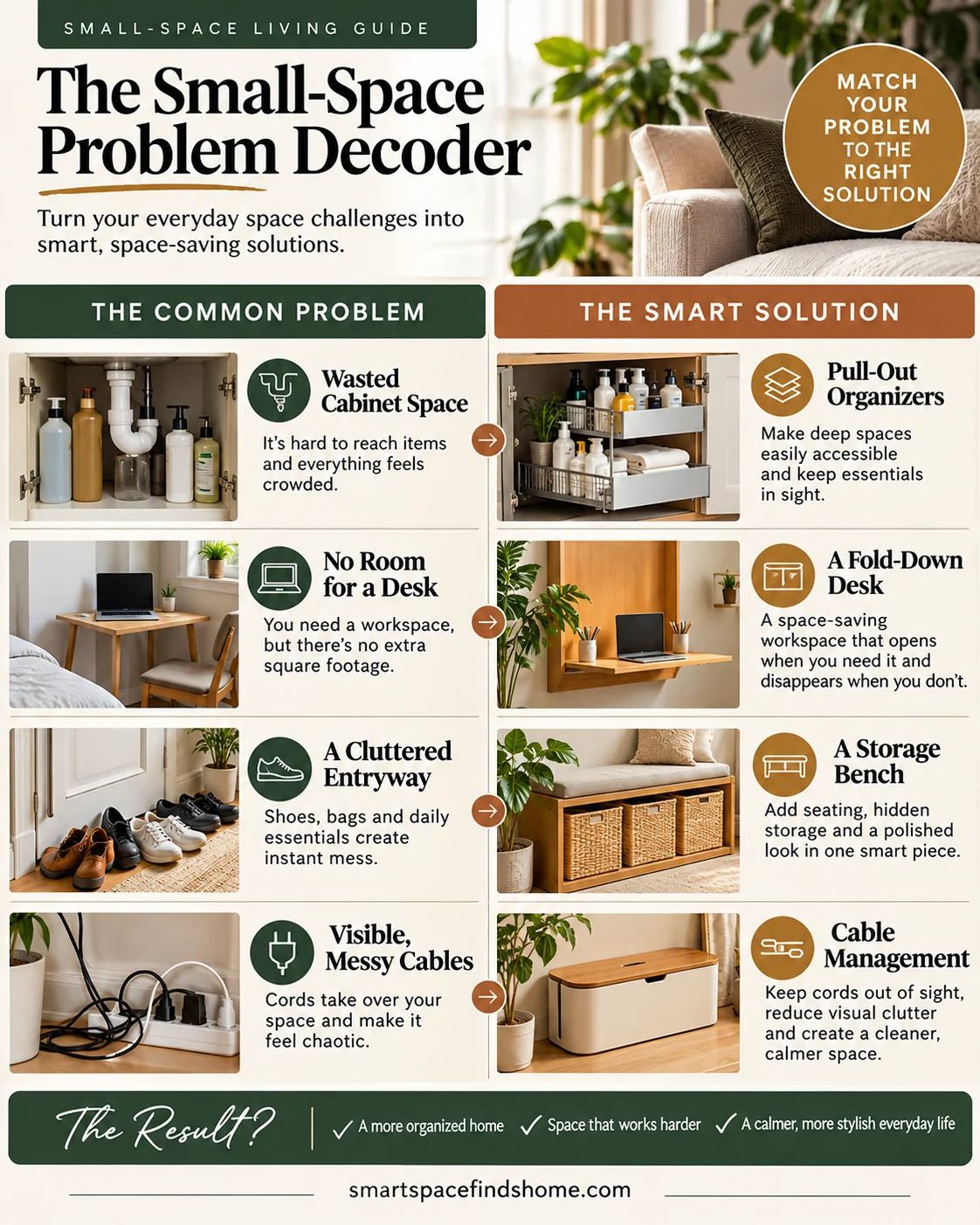
Five clever small-space solutions, thoughtfully chosen
01 / Kitchen & bathroom
Use a pull-out tray to make the back of a sink cabinet useful
Under-sink cabinets are deceptively awkward: pipes interrupt the middle, cleaning bottles disappear into the back, and the hinge side may reduce the usable opening. A low pull-out tray can turn that deep, frustrating reach into a simple slide.
Best for: deep cabinets with accessible plumbing and frequently used cleaning supplies. Not ideal for: cabinets with active leaks, tight pipe clearance, or doors that prevent the tray from extending.
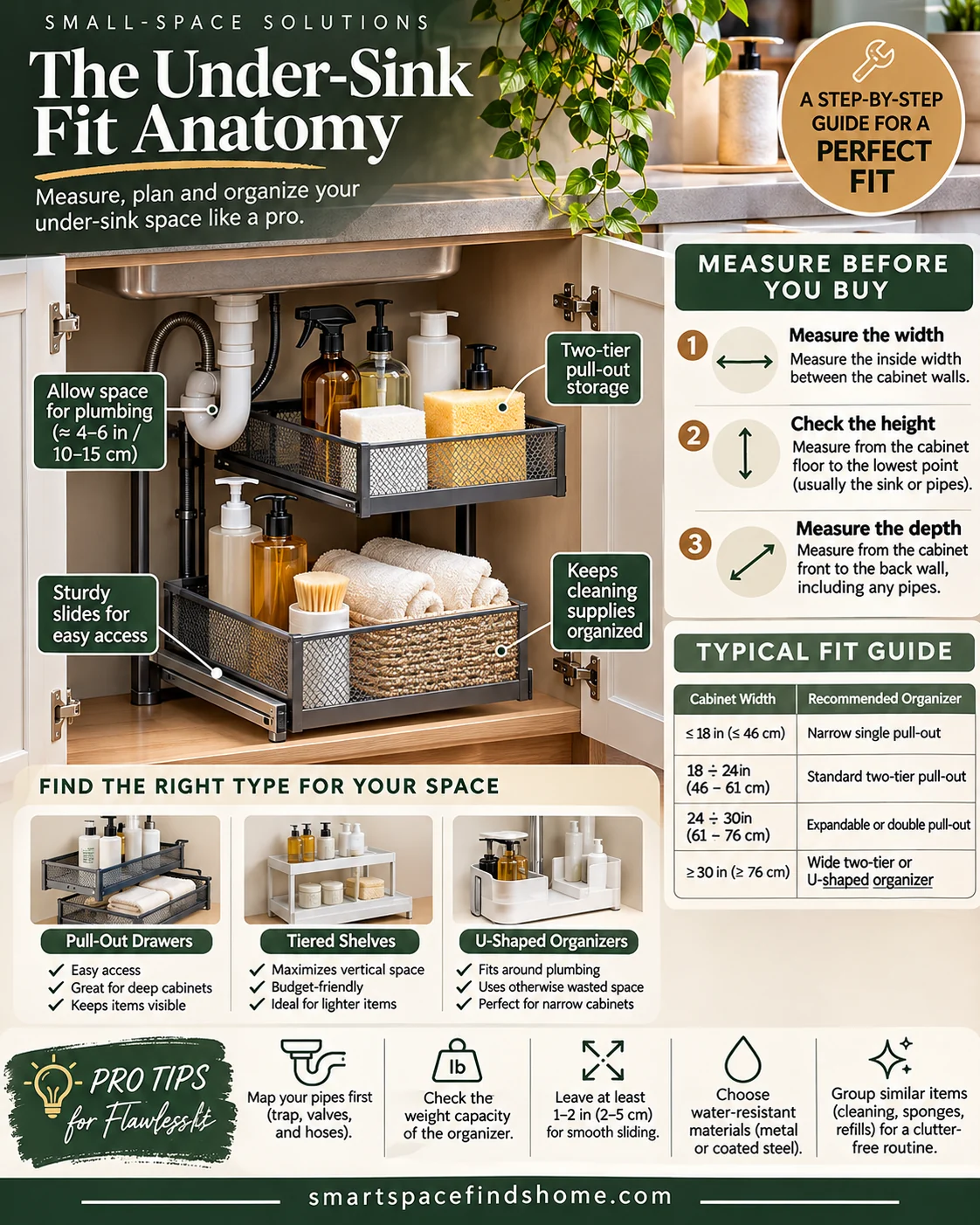
For a lower-cost test, place your everyday items on a removable shallow bin and pull the whole bin forward. If the routine improves, a properly fitted slide-out organizer might be worth the investment. Keep cleaners in their original labeled containers, follow product storage instructions, and store hazardous supplies securely.
02 / Work-from-home nook
Try a fold-down desk that disappears after work
A folding wall desk creates a work surface where a full desk would dominate the room. The real advantage is not only its slim closed profile: it lets a studio apartment change function between morning work and evening living.
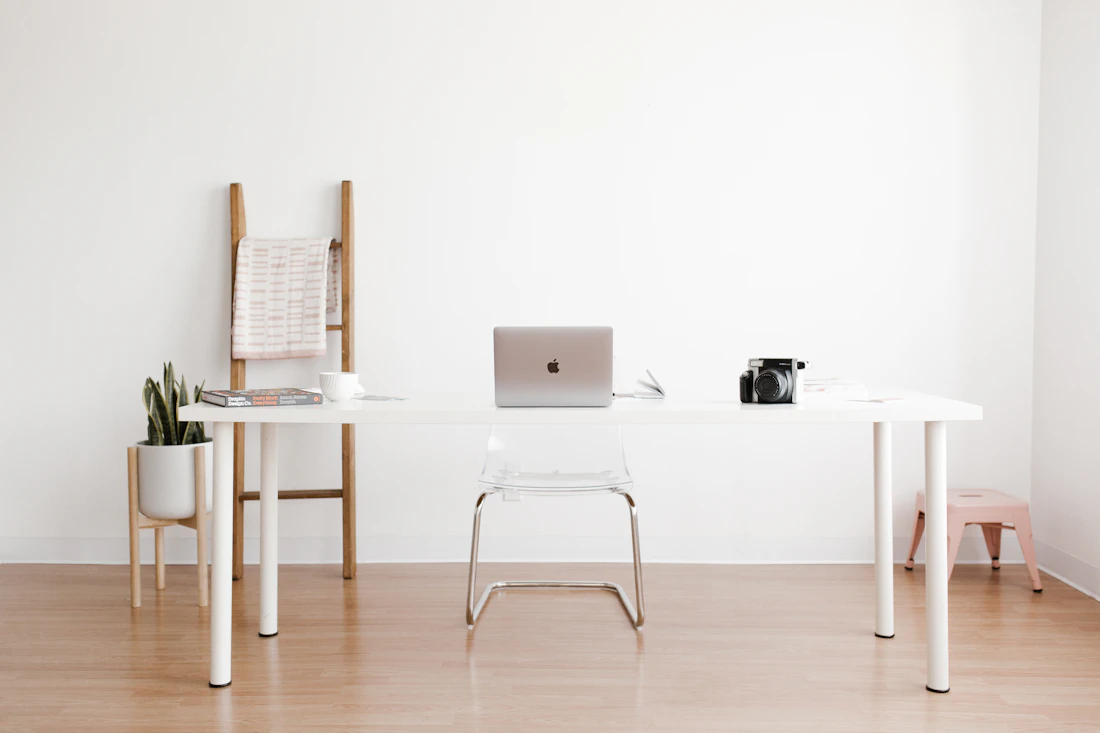
Best for: occasional laptop work, study sessions, or a compact writing station. Not ideal for: heavy monitors, frequent paper projects, unstable walls, or rentals that prohibit suitable mounting.
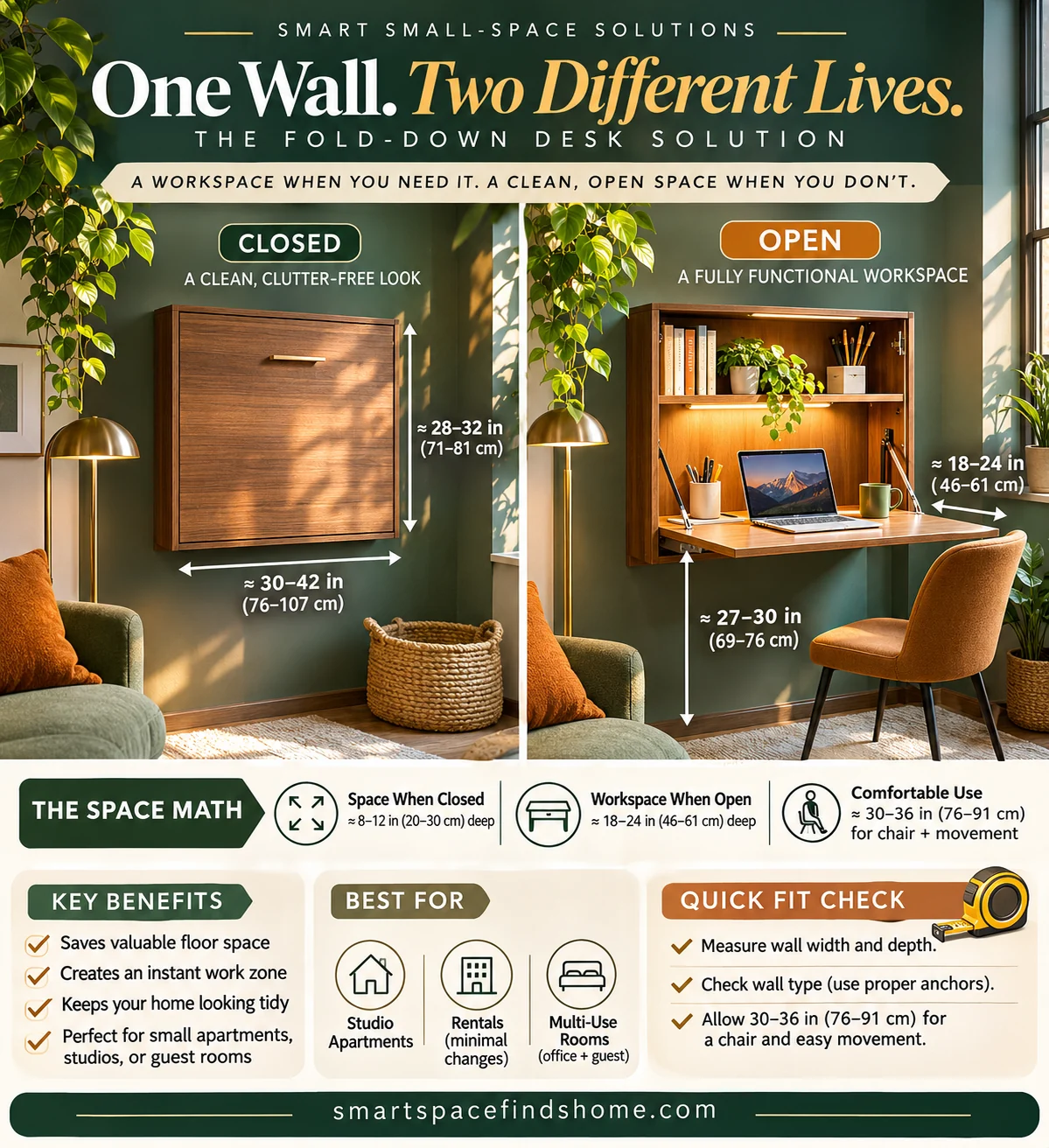
Try the layout with a cardboard tabletop mockup. Sit at the intended height, open the nearest door, and check whether people can still move through the room. If mounting isn’t feasible, a small freestanding secretary desk or folding table is often a better renter-friendly choice.
03 / The entrance edit
Make an entry bench earn its footprint with hidden shoe storage
An entry bench offers a place to put on shoes and somewhere for the pairs that otherwise cluster by the doorway. The strongest version also creates a designated home for a bag, key tray, or seasonal accessories—without crowding the path.
Best for: entries where sitting down is useful and shoe clutter reappears daily. Not ideal for: extremely narrow walkways where even a slim bench interferes with movement or door access.
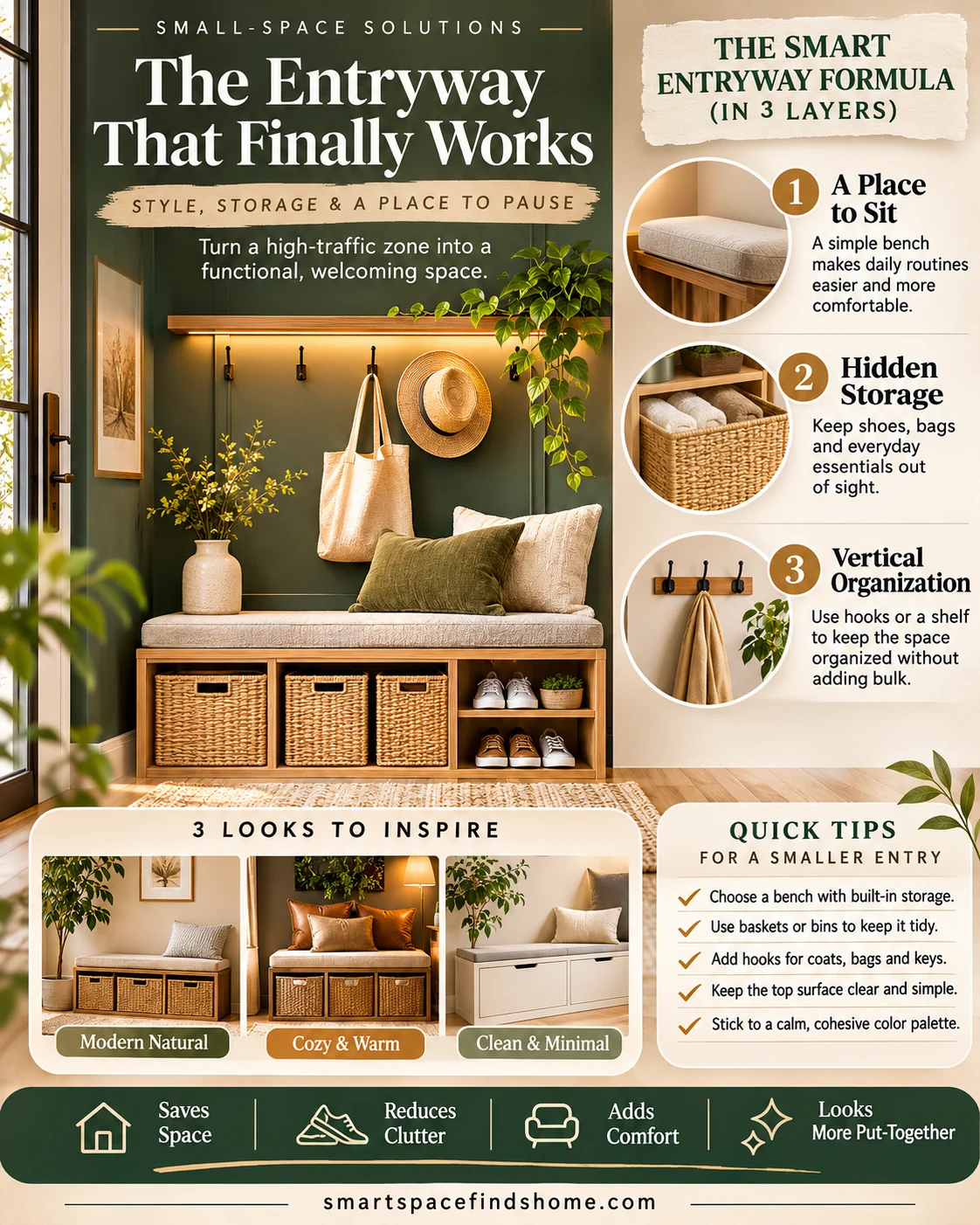
Wet shoes need somewhere to dry before going into concealed storage. A slatted lower shelf may be more practical than a sealed box if damp footwear is part of your daily routine. For a cleaner visual composition, repeat one finish—natural oak, warm white, or soft charcoal—and keep hooks aligned above the bench.
04 / Invisible organization
Label cables so you stop unplugging the wrong thing
Not every clever home improvement needs furniture. Reusable cable labels are inexpensive, nearly invisible in a room, and surprisingly useful behind a desk or media console. Identifying the modem, monitor, speaker, and chargers prevents needless unplugging and makes cleaning simpler.
Best for: multiple similar cords, shared chargers, and hard-to-reach power strips. Not ideal for: using labels to hide worn cables or as a reason to overload outlets.
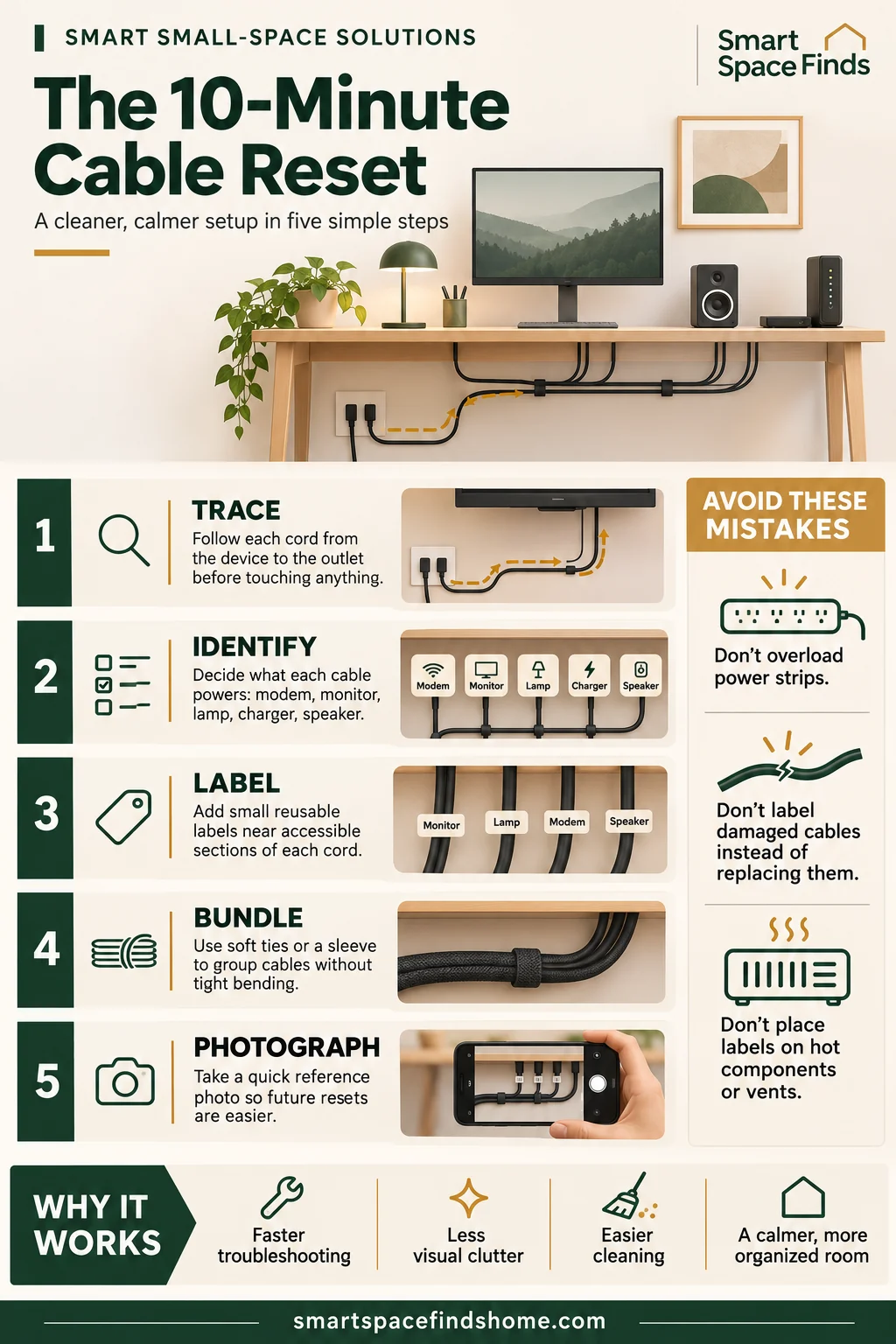
For a neater overall system, use a cable sleeve or a few reusable ties with slack at each end. Avoid tight bends, pinched insulation, or enclosed configurations that conflict with device instructions.
05 / Laundry & utility
Fold your drying rack away when the laundry is done
A folding wall-mounted drying rack solves an awkward spatial conflict: laundry needs temporary hanging space, but a permanent floor rack can dominate a hallway or bathroom. A well-positioned fold-away design creates drying capacity only when you need it.
Best for: compact laundry zones with appropriate wall support and ventilation. Not ideal for: high-traffic passages, poorly ventilated rooms, weak mounting surfaces, or places where damp laundry can touch electrical fixtures.
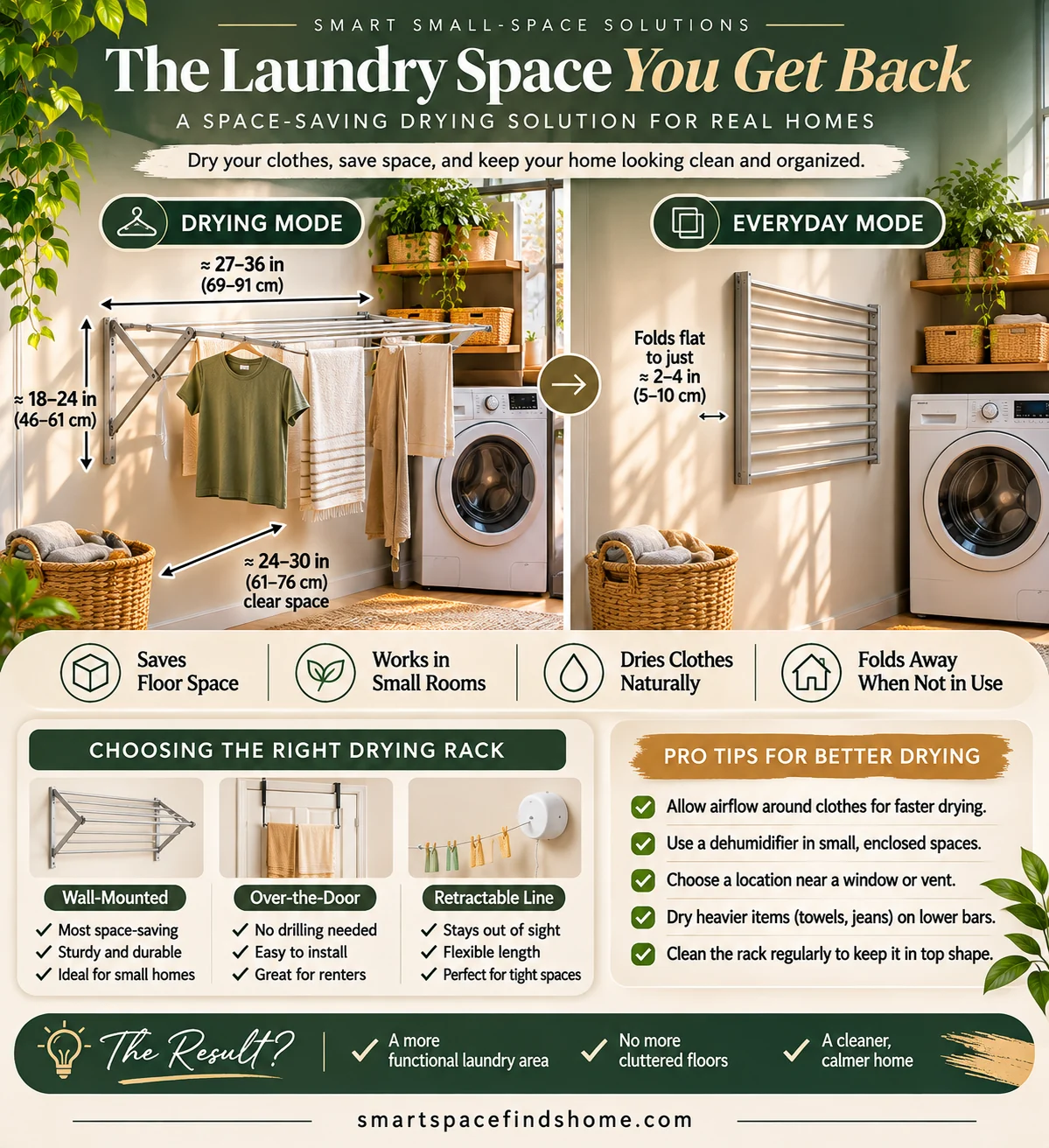
If you rent, consider a quality over-door or freestanding rack rated for its intended use. Proper airflow matters: overcrowding a small rack can slow drying and increase indoor moisture.
The design principle / Open only when needed
Think in two footprints: stored and in use
That fold-down desk might be only a few inches deep while closed—but the working footprint includes the tabletop, chair, your knees, and the path behind you. A drying rack needs similar breathing room while extended. Even a pull-out sink tray needs enough space outside the cabinet to slide and reach what is inside.
The hidden question isn’t “Will it fit?” It’s “Will the room still work while I’m using it?”
Which solution fits your actual home?
Start with reversible upgrades
Test removable bins, freestanding shoe storage, reusable labels, and portable drying racks. Choose mounted furniture only when your lease, wall type, and professional or manufacturer guidance allow it.
Make one area serve two routines
A surface that disappears is helpful only if it’s easy to clear. Give each work item a nearby home so transitioning from office to living space takes minutes, not a complete reset.
Protect the walking route first
If a bench would pinch the route, don’t force it. Try a low-profile shoe tray inside a closet or a properly secured slim cabinet. Leave door swings, stairways and exit paths unobstructed.
The small-space solution comparison
| Solution | Main benefit | Installation | First thing to check |
|---|---|---|---|
| Pull-out sink tray | Reach everyday supplies | Removable or mounted | Pipes and hinges |
| Fold-down desk | Temporary work surface | Usually structural mounting | Wall and open-depth clearance |
| Storage entry bench | Seating and shoe control | Usually freestanding | Door swing and walkway |
| Reusable cable labels | Faster identification | No tools | Heat and cable condition |
| Folding drying rack | Temporary drying space | Wall-mounted or portable | Wet load and airflow |
The tiny measurements that save a big return
Take a photo of the space with a tape measure visible, then record five things: the inside width, the usable height, the unobstructed depth, the door opening, and how far the solution extends during use. Photograph hinges, pipes, outlets, and baseboards too. That small reference album is often more useful than a shopping screenshot.
Make it tangible: outline the fully opened furniture with painter’s tape, then walk through the space carrying a laundry basket or grocery bag. If it feels awkward in a ten-minute test, it probably will not improve your routine.
Fit check: will the idea actually work?
Measure the free space you have and the amount the product occupies when fully open. Use the examples below to calculate remaining clearance manually. This worksheet does not certify building-code compliance, structural load capacity, or accessibility.
Calculate it yourself in 30 seconds
Available width − fully opened projection = remaining clearance.
Measure at the tightest point, and check doors, walkways, accessibility and manufacturer’s mounting instructions separately. These are illustrative calculations—not universal clearance standards.
How to make practical organizers look considered—not cluttered
Use quiet repetition. A consistent wood tone or metal finish makes several functional pieces feel like a design decision. Warm oak with muted olive, cream with brushed nickel, or walnut with deep green each offers a coherent direction.
Leave visual breathing room. Conceal what you do not need every day, keep commonly used items accessible, and avoid filling every inch of a shelf simply because space exists.
Keep mechanisms simple. A rack that is awkward to open or a drawer that catches on a hinge will not be used consistently. Test the complete movement before committing.
The visual edit / A home, not a hardware catalog
Three quietly expressive design directions
Choose one material to repeat across your organizers, then add one restrained accent. Under-sink fittings can be utilitarian; visible furniture deserves the same design thought as the rest of the room.
Five mistakes that turn clever storage into extra clutter
- Buying by product dimensions only. Open clearance matters as much as closed width.
- Ignoring rental restrictions. Check lease terms and mounting requirements before drilling.
- Choosing closed storage for damp items. Build drying time and ventilation into the routine.
- Organizing before decluttering. Remove expired, redundant, or unused items before adding containers.
- Confusing a viral trick with a safe feature. Follow manufacturer instructions and never improvise load-bearing hardware.
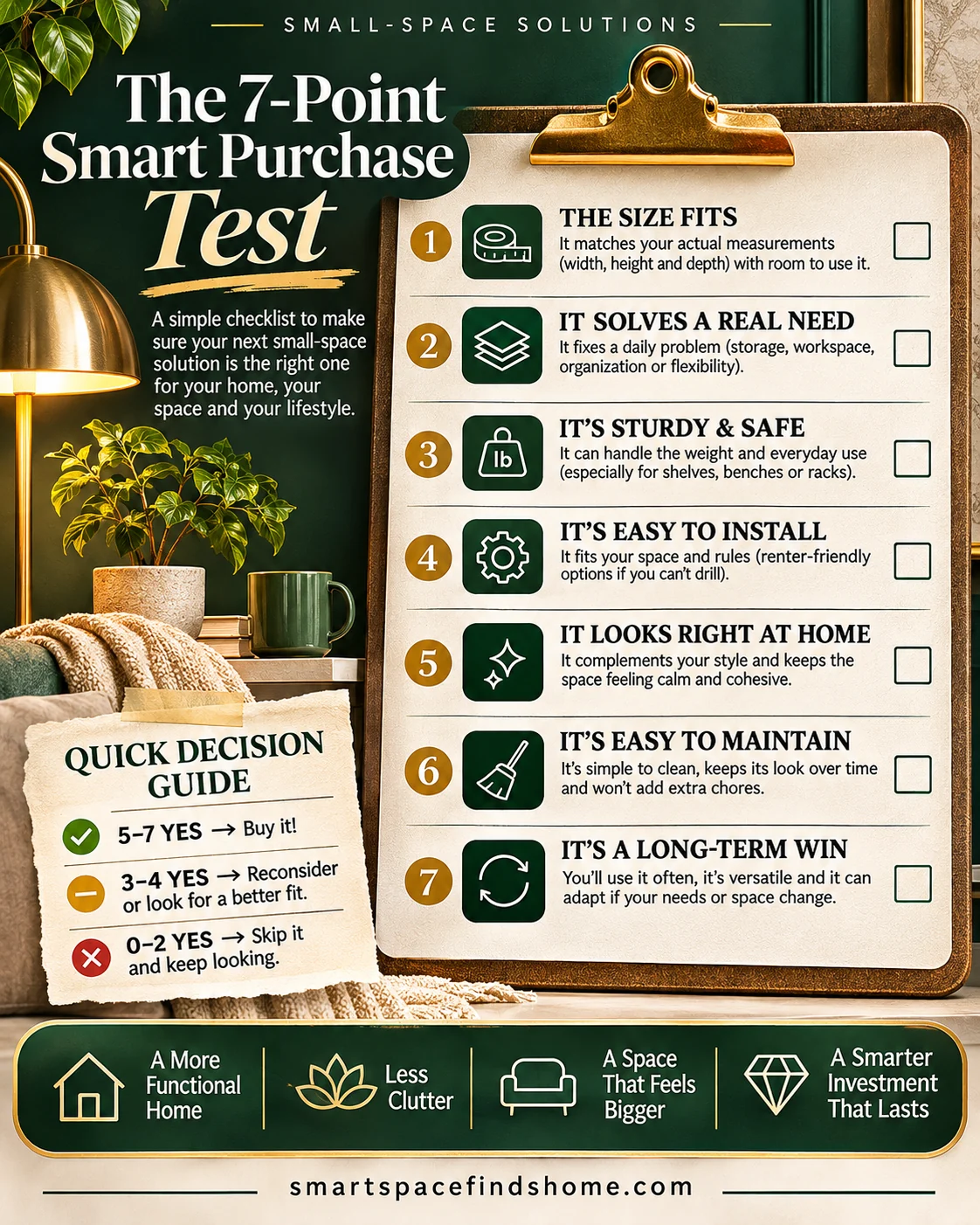
Before you buy: a seven-point checklist
- Name the repeated problem the item will solve.
- Check whether an existing tray, hook, or container can solve it.
- Measure the entire installed and fully opened footprint.
- Check wall, hinge, moisture, and power constraints.
- Verify manufacturer instructions and relevant ratings.
- Plan how it will be cleaned and maintained.
- Choose one coherent finish that fits the room.
The purchase filter
When is a clever gadget actually worth the money?
Run a simple value test before you buy. Ask: How often will I use it? What exact annoyance will disappear? What new maintenance will it introduce? If the answers are unclear, keep testing instead of purchasing.
Budget check: compare the total cost of the solution—including hardware, installation and any lost access—against the no-buy alternative. A $15 bin used every day may deliver more value than an elaborate pull-out mechanism that catches on plumbing.
Design for day 30, not just day one
That beautifully organized cabinet will only stay beautiful if everything has a return route. Keep everyday items at hand height; store backstock separately; label categories rather than individual products when contents change; and give damp shoes and laundry time to dry. A quick weekly reset matters more than a complicated storage system.
“Easy to put away” is a better standard than “beautiful in a photograph.”
For households sharing a small space, make the system intuitive to everyone. If only one person remembers which basket holds the refills, the organizer hasn’t quite finished its job.
A 20-minute no-buy test
Spend five minutes identifying the single most frustrating corner, five removing what does not belong, five mapping the area with tape or cardboard, and five testing a simpler routine. If the problem remains after three days, the right purchase becomes much clearer.
Frequently asked questions
What are the most useful small-space solutions for apartments?
Start with items that improve everyday access without consuming much floor space: removable cabinet trays, entryway shoe storage, cable labels, foldable work surfaces, and compact drying systems. Choose according to the room’s actual constraints.
How can I add storage without drilling?
Try freestanding slim carts, removable bins, benches, and suitable over-door accessories. Check that each item is stable, does not block exits, and is compatible with the door or surface.
Are fold-down desks good for renters?
They can be practical, but many require structural wall mounting. Check your lease and the manufacturer’s installation requirements. Where drilling is not permitted, choose a freestanding folding desk or secretary-style cabinet instead.
How do I choose an under-sink pull-out organizer?
Measure the narrowest usable width, plumbing clearance, cabinet depth, hinge interference, and opening size. A two-tier organizer may not fit around an existing sink trap; a low single tray is often more flexible.
Can I use a wall drying rack in a bathroom?
Only where the wall, fixing system, load rating, clearance, and ventilation make it suitable. Keep wet items away from electrical fittings, avoid overloading it, and follow installation instructions.
How do I make a small home feel less cluttered without buying more organizers?
Edit duplicates, give high-frequency items a designated home, remove unused decor, simplify cable routes, and preserve open surfaces. Organization works best when it reduces the number of decisions in each routine.
Make the right choice in under a minute
Start with a caddy, cable labels, or freestanding storage.
Test a removable tray before a fixed pull-out system.
Measure the unfolded footprint and plan a fast reset.
Protect circulation before adding a bench.
Keep exploring small-home design
Looking for more ideas? Explore how to use an overlooked corner, small products that solve everyday problems, and renter-friendly bathroom upgrades.
The final edit
A genuinely clever home solution isn’t the one with the most moving parts. It’s the one you hardly notice because your day works better. Measure carefully, buy selectively, and let each improvement earn its place.