
SMARTER EVERYDAY LIVING · THE FIVE-MINUTE EDIT
A lived-in home doesn’t need to look perfect. These five-minute home resets help you reclaim a useful counter, a clear doorway, and a little breathing room—without spending your evening cleaning.
Start here: Pick one area, set a five-minute timer, and stop when it ends. Each reset below is a separate option, not another five-part daily checklist.
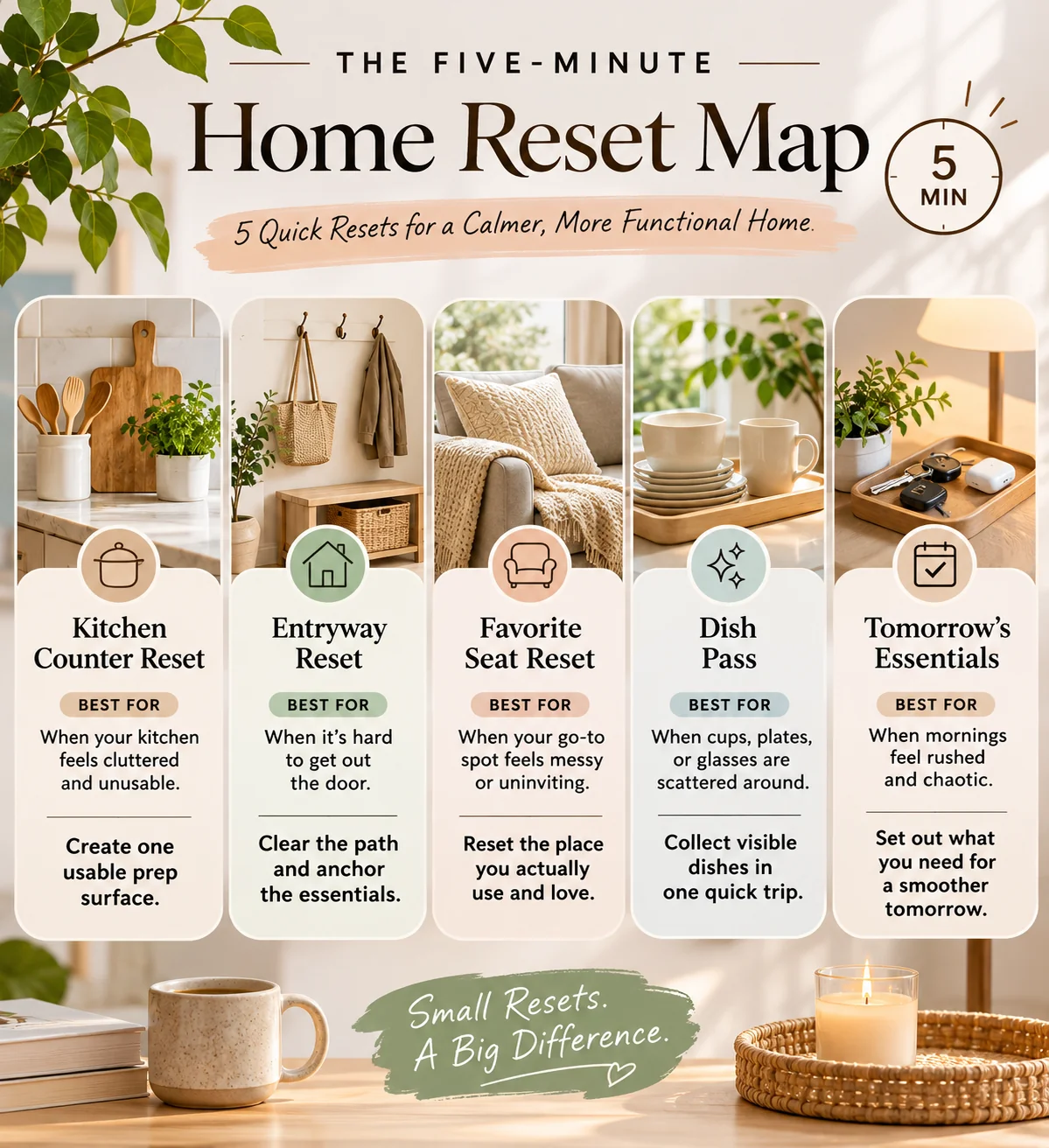
How do five-minute home resets work?
Prepare
Arrive
Unwind
Collect
Begin
A home reset should give you time back—not become another thing to keep up with.
A five-minute home reset is a short, focused tidy that makes one frequently used space work better. It is not deep cleaning, a full-room declutter, or a challenge to race through tasks that need care.
The simplest formula is choose one zone → remove the obvious friction → make it usable → stop. Maybe that means clearing enough counter space to make breakfast or returning the shoes that block your apartment door. A better-functioning space is the finish line.
Quick reality check: Some days you will finish early. Other days, five minutes will only make a dent. Both are fine. Clean spills safely, handle perishable food promptly, and never let the timer override hygiene or accessibility needs.
1. Give your kitchen counter its working space back
Best for: Busy mornings, compact kitchens, and evenings when cooking feels like too much.
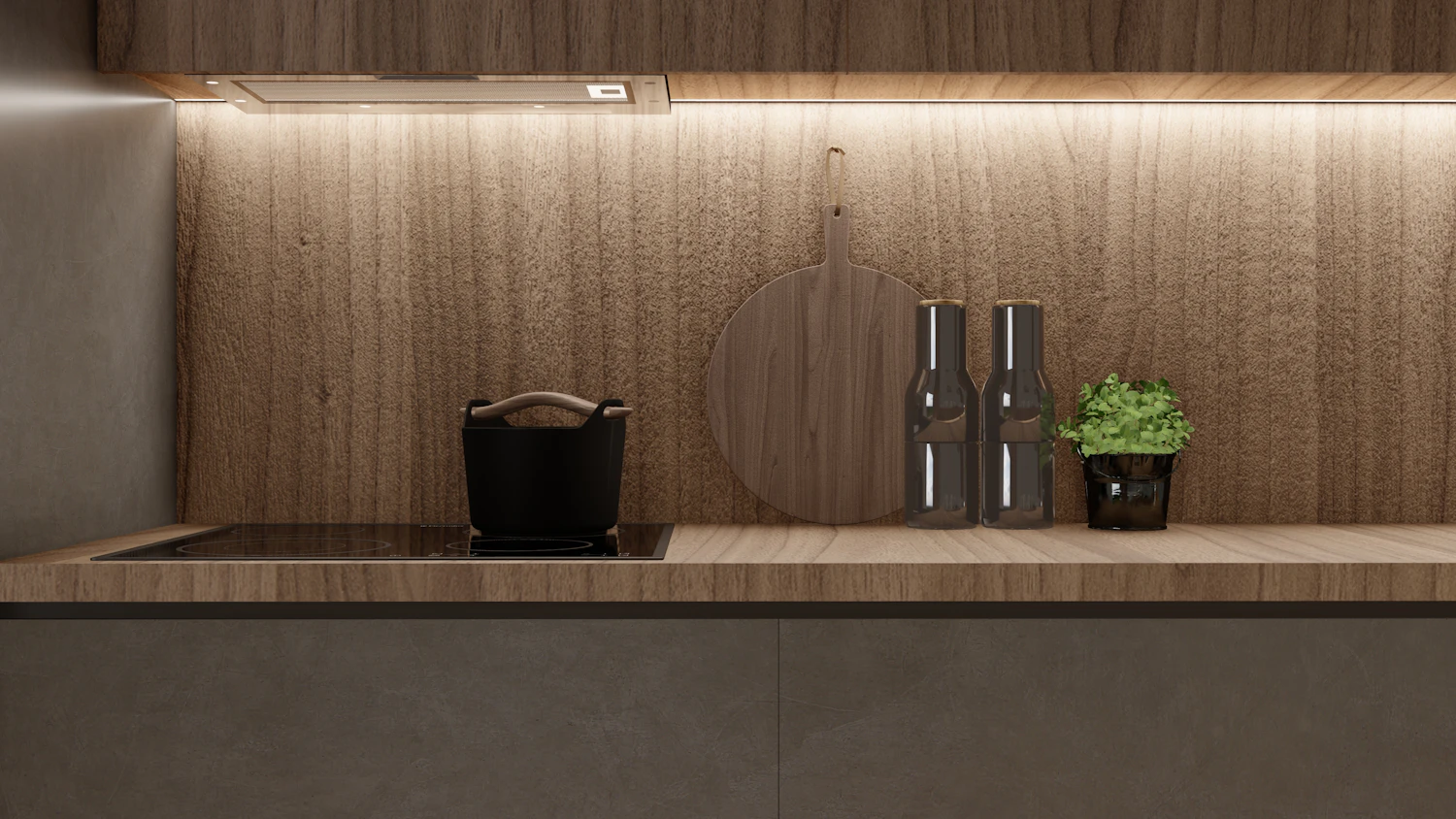
A countertop can collect mail, grocery bags, mugs, and appliances so gradually that there is nowhere left to chop an onion. Instead of reorganizing the entire kitchen, restore just the area you use most.
- Minute 1: Put refrigerated or perishable food away promptly; do not delay food-safe storage to follow the timer.
- Minutes 2–3: Move dishes to the sink or dishwasher, then return stray objects to their existing homes.
- Minutes 4–5: Wipe the cleared section with a cleaner suitable for the surface, following its label and any required contact time.
In a tiny kitchen: Aim for one clear cutting-board-sized patch—not an empty countertop. If you use the same three things every day, keeping them accessible may be more practical than hiding them.
For a more permanent improvement, explore our one-wall kitchen storage ideas.
2. Make the entryway easier to walk through
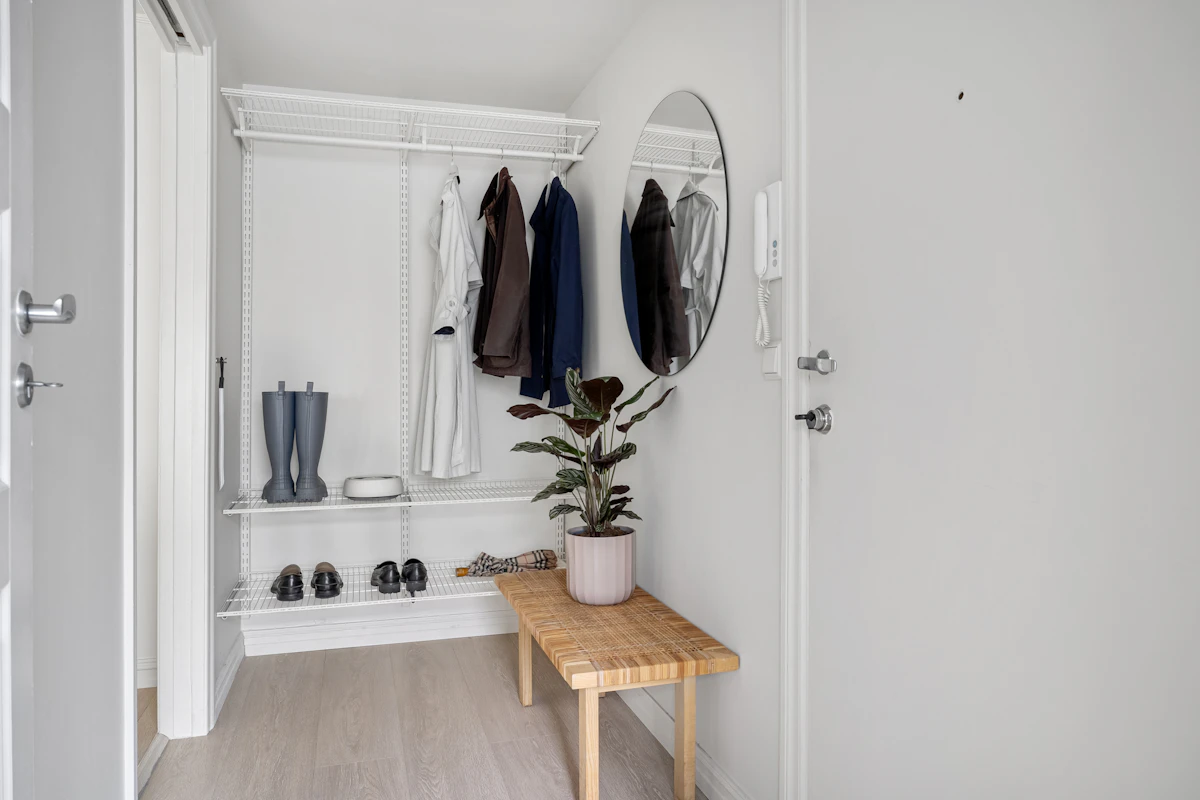
Best for: Small apartments, shared households, and mornings when everyone is leaving at once.
The entrance often carries the evidence of an entire day: shoes, packages, jackets, tote bags, and keys. Your goal is simple: an easy-to-use doorway and one reliable landing spot.
- Minute 1: Move shoes and bags away from the walking path.
- Minutes 2–3: Hang the coats you use; return extras to their usual storage.
- Minutes 4–5: Place keys and daily essentials in a visible, reachable location.
Renter-friendly variation: Try a small tray on an existing shelf or a freestanding basket before buying or mounting anything. Keep exits and accessible routes unobstructed.
More inspiration: five ways to make your home feel less cluttered.
3. Reset the seat you actually want to sit in
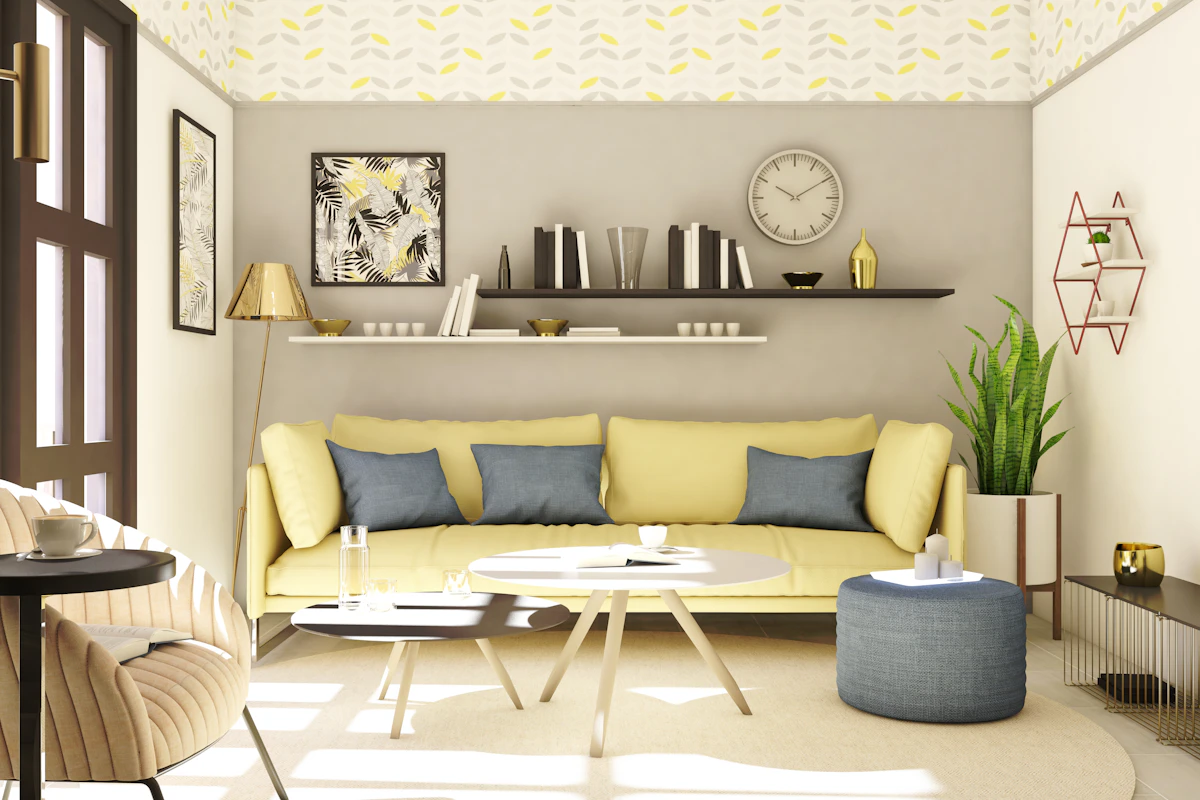
Best for: After-work downtime, shared living rooms, or a studio apartment where one surface does several jobs.
Instead of straightening every decorative object, reclaim your favorite place to relax. Gather loose items that belong elsewhere, return the remote to a predictable spot, and clear the coffee table enough for a cup of tea or a book.
- Minutes 1–2: Collect wrappers, used cups, and items that have obvious homes.
- Minutes 3–4: Clear the seat and a useful portion of the nearby surface.
- Minute 5: Fold one throw or position a cushion if it makes the space more comfortable.
Keep it realistic: You do not need a styled, photo-ready living room. You need one comfortable place to sit. For the atmosphere afterward, see our cozy evening ideas.
4. Make one dish-collection pass
Best for: Work-from-home desks, bedrooms, and family spaces where mugs quietly multiply.
Instead of making several trips, gather the dishes from one room and carry them back together. Put them in the sink or dishwasher, handle leftover food appropriately, and leave the room free of used plates and cups.
Try this: Keep your hands free for a safe, manageable load. If an item is heavy or breakable, make another trip rather than stacking it precariously. The aim is fewer distractions, not speed at any cost.
If dishes accumulate because the kitchen feels crowded, consider adjusting where your everyday dishware lives rather than adding another storage product.
5. Set up tomorrow’s easiest first step

Best for: Early starts, school mornings, commutes, and days packed with appointments.
Before you unwind, choose a single place for tomorrow’s keys, bag, transit pass, or paperwork. Put only what you actually need there, and take a quick look at your schedule.
- Minutes 1–2: Gather the essentials for the next outing.
- Minutes 3–4: Check whether anything must be charged, signed, or taken out of the fridge tomorrow.
- Minute 5: Place the essentials at a safe, practical pickup point.
For shared homes: Use separate labeled spots only when the household would benefit; one uncluttered shelf can work just as well. Read our guide to making your morning routine easier.
Which reset should you choose today?
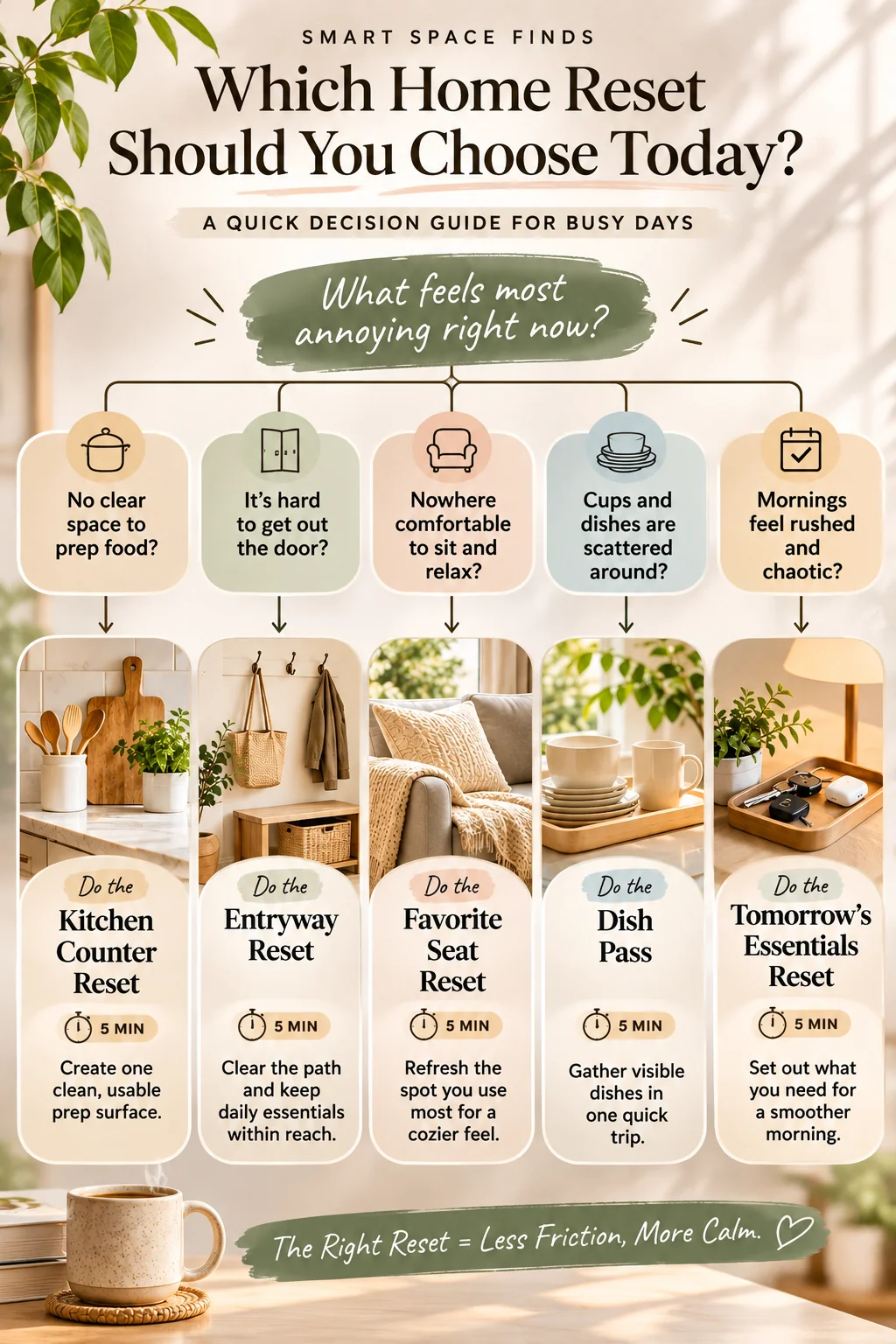
| If you notice… | Start with… | The useful result |
|---|---|---|
| No place to prep food | Kitchen counter | One usable work area |
| Shoes by the door | Entryway | A clearer path |
| Nowhere comfortable to sit | Sofa area | A usable seat |
| Cups in every room | Dish collection | One room free of used dishes |
| Morning scrambling | Tomorrow’s essentials | Less searching at the door |
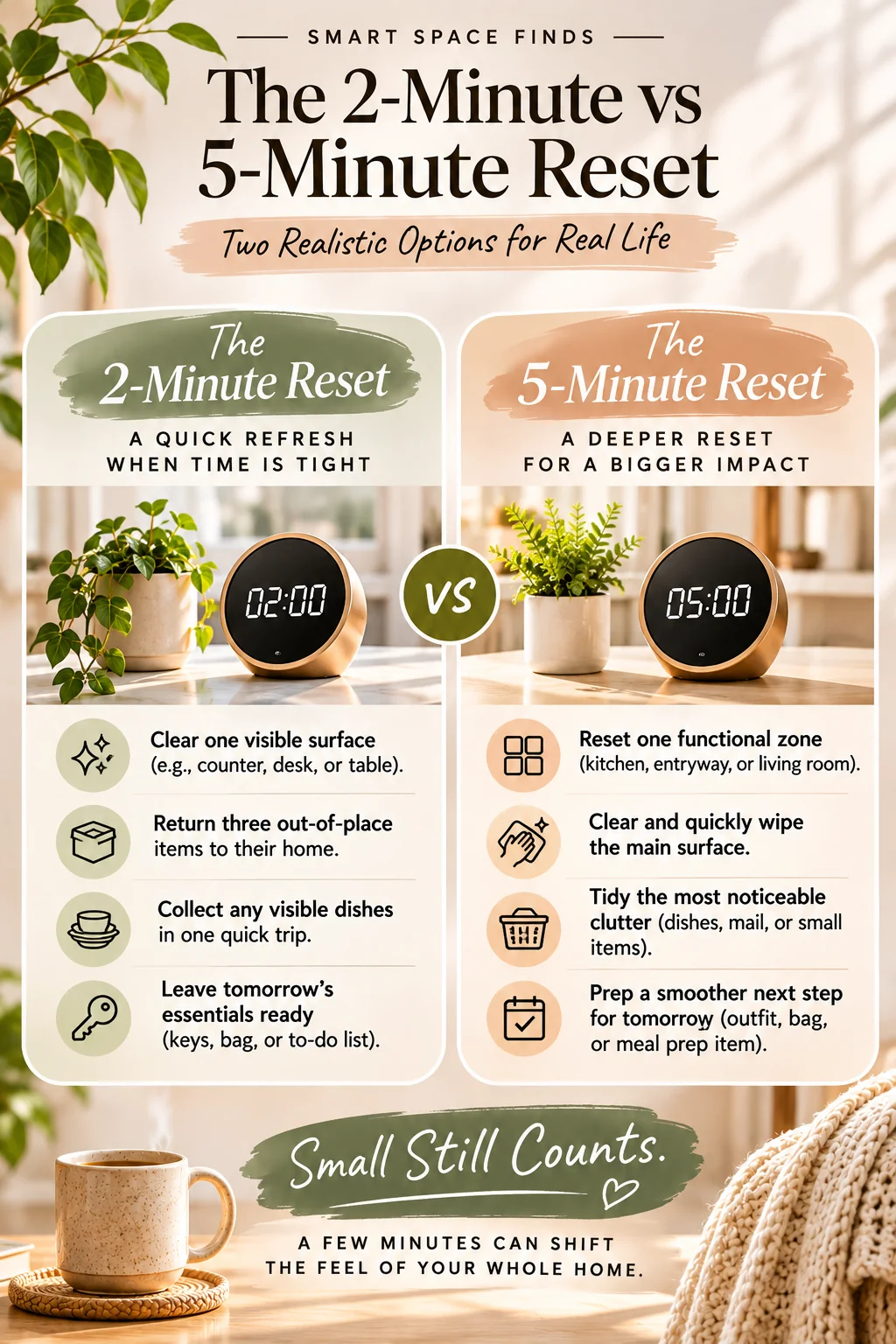
The two-minute version for especially busy days
Your home, your pace.
Five minutes is an option, not a minimum. On a demanding day, choose one small action: put away three shoes, collect the cups on your desk, or leave your keys in their usual spot. If you need to rest instead, the routine can wait.
What to leave for another day
A five-minute reset works better when it has boundaries. Resist opening a drawer to sort its contents, starting a closet overhaul, or moving furniture just to achieve a better-looking photo. Those jobs deserve their own time and attention.
Keep proper cleaning separate: disinfecting where appropriate, addressing mold, tackling hazardous messes, and safely cleaning food-contact surfaces may require specific instructions and more time. A quick tidy does not substitute for them.
A gentle seven-day test: keep what helps
If you want to see whether these routines suit your life, pick one reset and try it on a few ordinary days this week. Notice whether it makes the next activity easier: Can you start cooking faster? Find your keys? Sit down without moving a pile?
There is no streak to protect and no need to buy new bins. If the reset adds work without removing friction, change it or let it go. For more simple, repeatable habits, see everyday home maintenance habits.
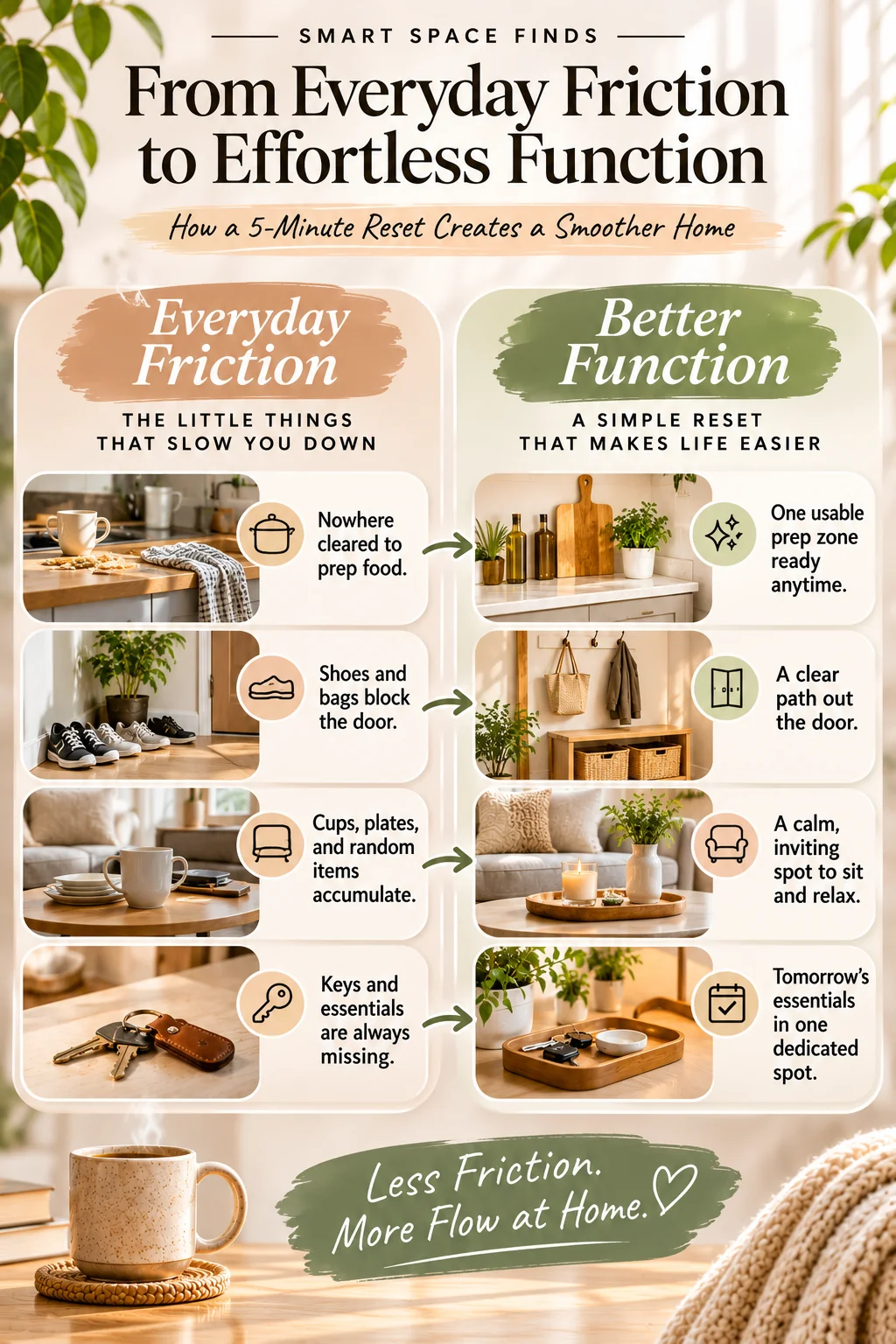
THE SMALL-SPACE PLAYBOOK
Make the five-minute reset easier next time
When the same clutter returns every day, the problem may be the setup—not your effort. Choose one tiny adjustment that removes a step from the routine.
- Give everyday objects a landing spot. Keep keys, chargers, and frequently worn shoes near where you actually use them, without blocking walkways.
- Make putting things away easier than leaving them out. Use an existing open shelf or reachable hook before adding new storage.
- Keep one small surface available. A usable kitchen prep zone or desk corner often matters more than a perfectly styled room.
- Share the system, not a standard of perfection. In a shared home, agree on where essentials belong and keep that location accessible to everyone.
Before you shop: Observe the problem for a few days. If you already own a tray, basket, or hook that works, you don’t need a new one. A purchase makes sense only when it reduces repeat searching, improves access, or frees up useful space.
How to adapt a five-minute reset to your household
For renters: Favor freestanding trays, baskets, and removable solutions that are compatible with your surfaces and lease. Avoid drilling or adhesive installations without checking the rules.
For families: Give children age-appropriate choices, such as returning their own shoes or books. Store sharp tools, chemicals, and medicines safely rather than leaving them within easy reach for convenience.
For limited mobility or low-energy days: Reduce bending and carrying. Reset a seated-height surface, use only steps you can perform comfortably, or ask for assistance with heavier items. A two-minute variation is still useful.
For shared apartments: Focus on one common friction point instead of trying to change every roommate’s habits. A consistent key tray or clearly designated dish area is easier to maintain than an elaborate system.
Editorial note: Tidying restores function; cleaning removes dirt; disinfecting is a separate process when needed. Follow product labels and required contact times, and never mix household cleaners. A countdown timer should never replace safe food handling or proper cleaning instructions.
Frequently asked questions
Can you really tidy a home in five minutes?
You can make a meaningful improvement to one area in five minutes. A whole-home clean generally takes longer; the purpose here is a usable zone, not a spotless home.
Should I do all five resets every day?
No. Choose the one that would make the biggest difference today. Doing every reset would turn a five-minute idea into a much longer routine.
What if I live in a studio or a very small apartment?
Choose by activity instead of room: one food-prep surface, one clear path, or one comfortable chair. Flexible spaces benefit from small, practical zones.
Do I need baskets, labels, or cleaning gadgets?
Not to start. Existing shelves, hooks, and a familiar place for daily essentials may be enough. Consider a product only after you know which repeated problem it would solve.
What if someone else in my household creates the clutter?
Use the reset to improve shared systems, not to assign blame. A reachable spot for shoes, keys, or dishes can help everyone return things more easily.
THE TAKEAWAY
Make one part of home easier to use. Then get back to living in it.