
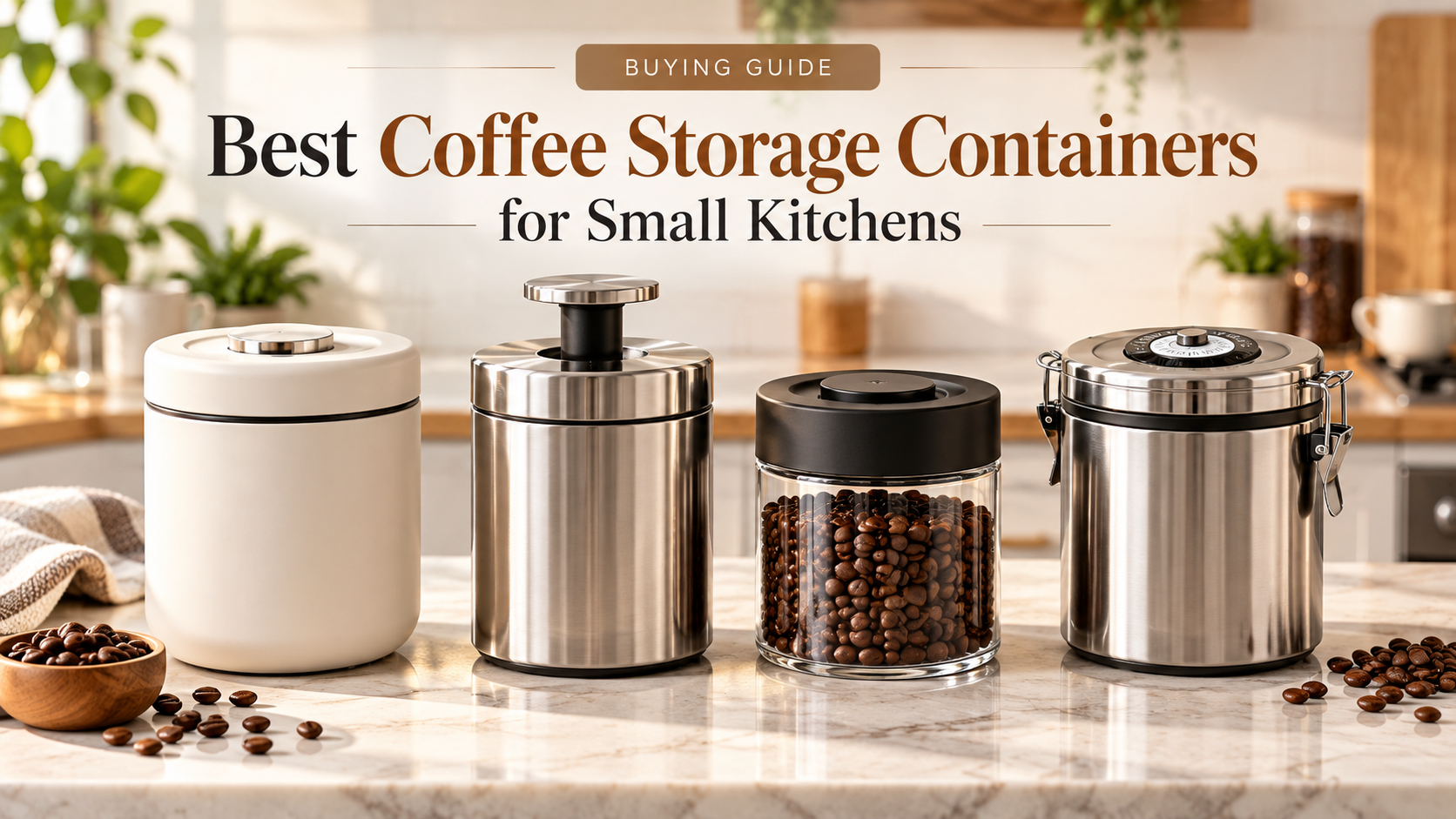
Good coffee storage is about protecting flavor without sacrificing valuable kitchen space. Whether your morning routine revolves around a compact capsule machine, a portafilter espresso maker or a small grinder, a container should be easy to open, easy to clean and genuinely suitable for what you store. This buying guide compares four recognizable approaches—vacuum sealing, air displacement, push-button airtight storage and one-way-valve steel storage—so you can choose with confidence.
Updated October 2026 · Independent editorial comparison based on published specifications, not hands-on testing.
Quick verdict
Editorial note: Product photos, canister finishes and comparison illustrations may depict different variants from the linked Amazon listing. Always check the chosen color and capacity at checkout.
The best coffee storage container for a small kitchen depends on your brewing routine rather than one universal winner. Choose Fellow Atmos if you buy whole beans and want a vacuum-sealing ritual; Airscape Classic if you prefer a reusable inner plunger that reduces the air space above your beans; Prepara EVAK Fresh Saver if you want a simple push-down lid and short, transparent container; or Coffee Gator if you like a conventional steel canister with a date tracker and one-way valve. None of these turns stale coffee fresh again. A well-sealed opaque original coffee bag in a cool cupboard may already be entirely adequate.
Before You Buy: 5-Minute Coffee Storage Checklist
- Check the exact Amazon color, size and capacity against the listing.
- Decide whether you store whole beans, grounds or both.
- Measure counter depth, height and lid-opening clearance.
- Prefer opaque storage if the container will sit in bright light.
- Choose a seal you can operate and clean every morning.
What matters most in coffee storage?
Coffee is sensitive to oxygen, heat, light and moisture. Oxygen exposure drives changes in aroma, while heat and direct sunlight speed deterioration. Humidity and repeated temperature swings are poor storage conditions. The most useful solution is therefore a container that closes reliably, protects its contents from light, fits your typical purchase size and is convenient enough that you will actually use it correctly every morning. Storage technology is not a substitute for buying freshly roasted beans in quantities you can finish while they taste good.
The four containers at a glance
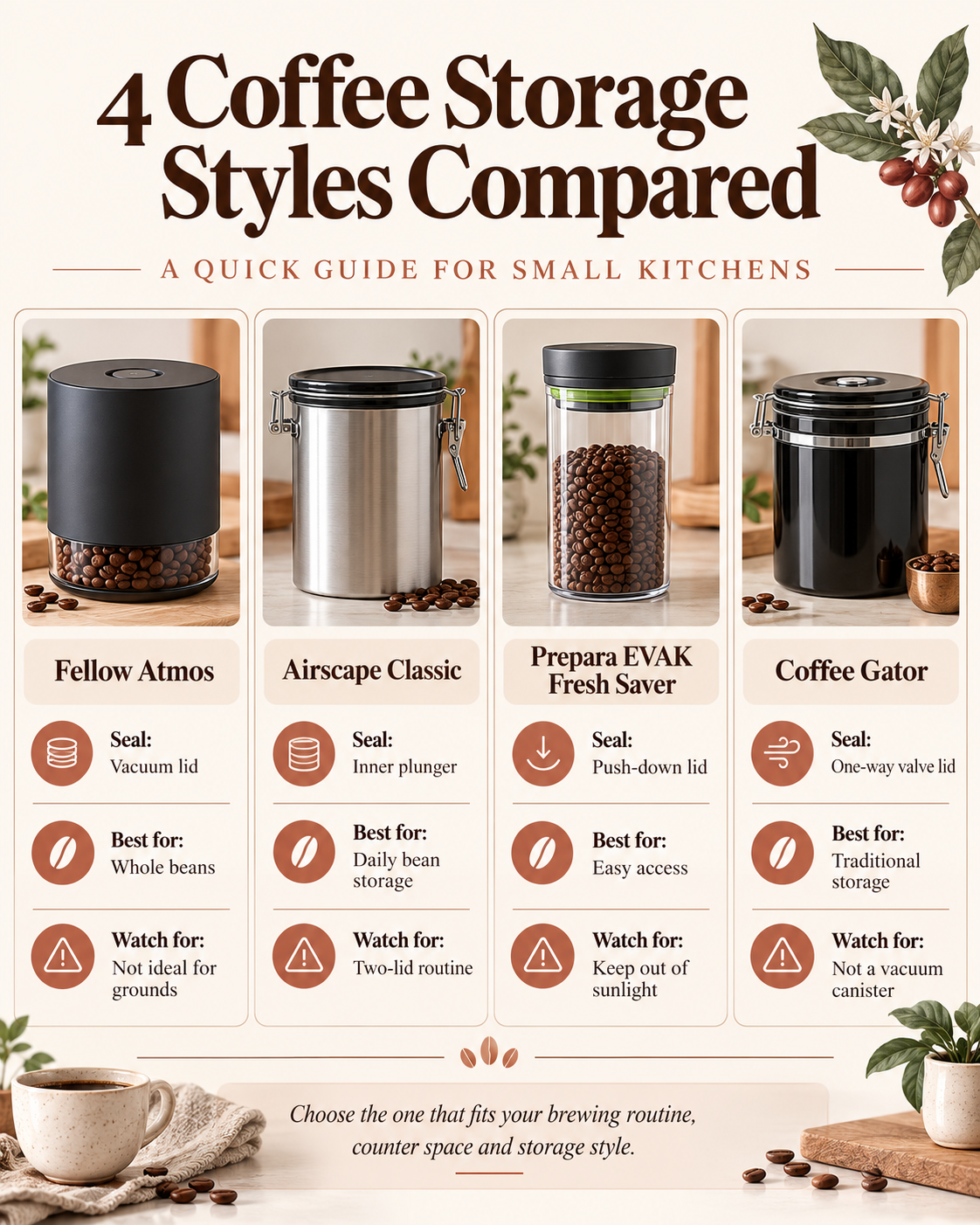
| Container | How it seals | Best for | Important caveat |
|---|---|---|---|
| Fellow Atmos | Manual vacuum pump in lid | Whole-bean drinkers seeking less air exposure | Manufacturer advises against ground coffee |
| Airscape Classic | Inner plunger lid pushes excess air out | Everyday bean storage without vacuum pumping | Two-lid routine takes a little practice |
| Prepara EVAK Fresh Saver | Push-down lid displaces air | Simple access and short storage footprint | Clear body needs protection from sunlight |
| Coffee Gator | Gasketed seal and one-way valve | Traditional steel canister and date tracking | Valve does not remove all air already inside |
1. Fellow Atmos — a premium whole-bean vacuum canister
Best for: people buying fresh whole beans who are happy to spend a few seconds sealing the lid after every use.
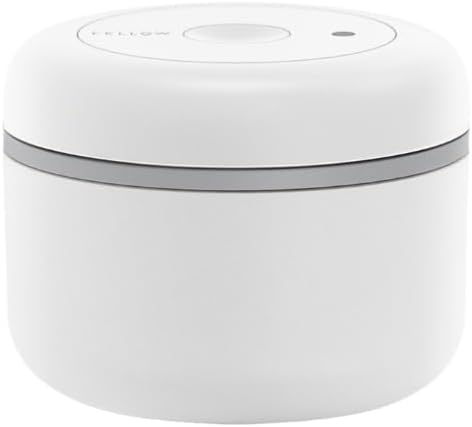
The Fellow Atmos uses a pump built into the lid to remove air from the container and create a vacuum. Unlike an ordinary gasketed tin, it does more than simply stop new outside air entering. Manual versions use a twisting action; different sizes and finishes exist, so compare the exact variant before ordering. Fellow’s listed bean capacities include approximately 6 oz for 0.4 L, 11 oz for 0.7 L, and up to 16 oz of some lighter or medium roasts for 1.2 L. Bean volume varies by roast and density, so do not assume a one-pound bag always fits a nominal 1.2 L canister.
Trade-offs: the vacuum mechanism adds complexity, and the manufacturer advises twisting periodically to maintain the seal. The lid is not dishwasher safe. Most importantly, Fellow recommends whole beans only: coffee grounds can clog the intake valve. If you regularly buy pre-ground coffee, this should not be your default pick.
Small-kitchen tip: the linked white 0.4 L model is intended for a modest whole-bean supply. Choose capacity for the beans you actually use, not the largest size that looks attractive on a product page.
2. Airscape Classic — a practical air-displacement option
Best for: coffee drinkers who want a straightforward, durable storage method without electronics or a vacuum pump.
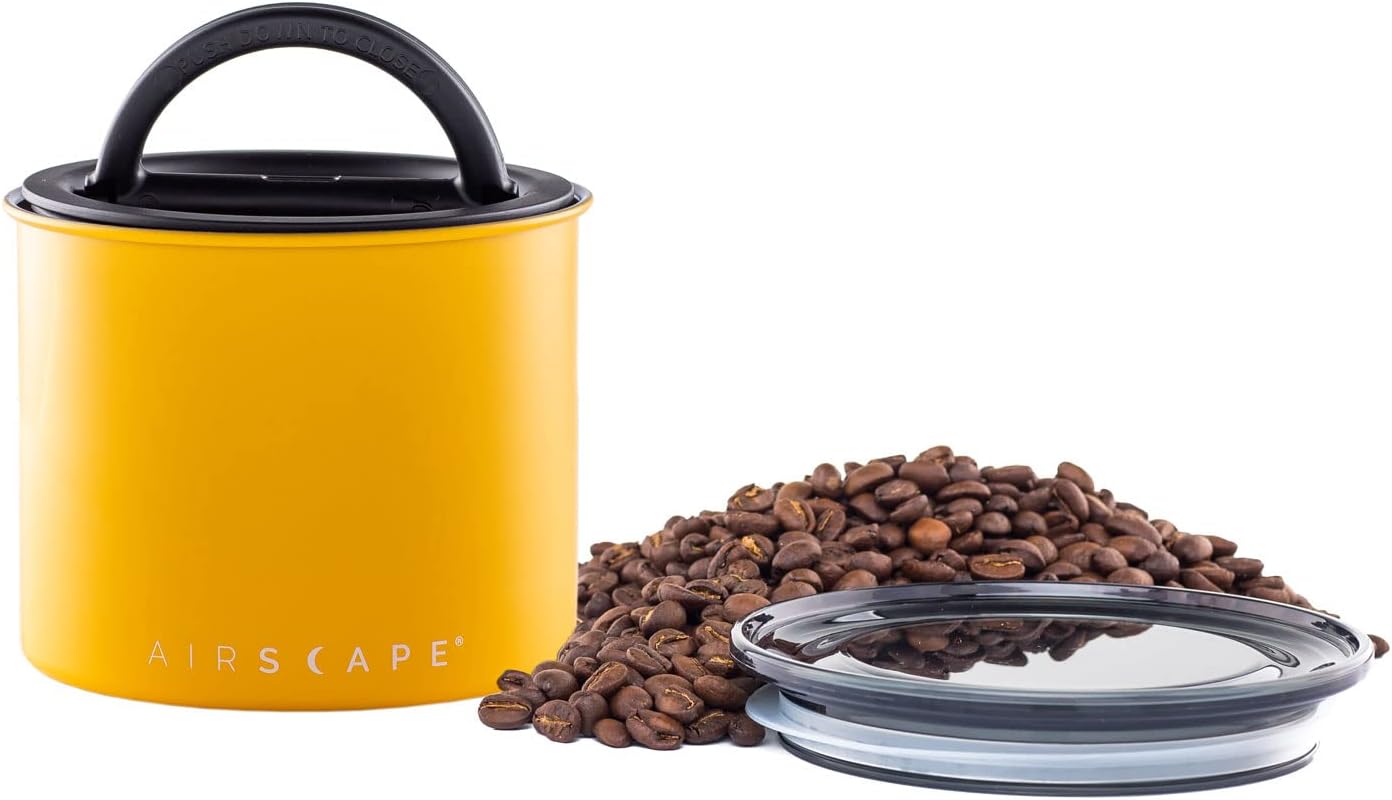
Airscape takes a different approach: an inner plunger lid moves down toward the coffee and pushes out the air trapped above it. This is useful because the amount of empty headspace grows as you use your beans. The system is not identical to pulling a vacuum; it physically displaces air rather than creating the same pressure difference as Atmos. Stainless-steel versions provide a light-blocking body and a clean, café-inspired appearance.
Trade-offs: opening involves removing an outer lid and lifting the inner lid, then pushing it down again when closing. Some buyers will enjoy the ritual; others will prefer a single-button container. Confirm the actual capacity and finish of the specific Airscape SKU, because the brand sells several sizes including unusually large versions for bulk buyers.
Small-kitchen tip: a smaller Airscape on a dedicated tray can organize a grinder, scoop and bean storage without creating a crowded visual line across your countertop.
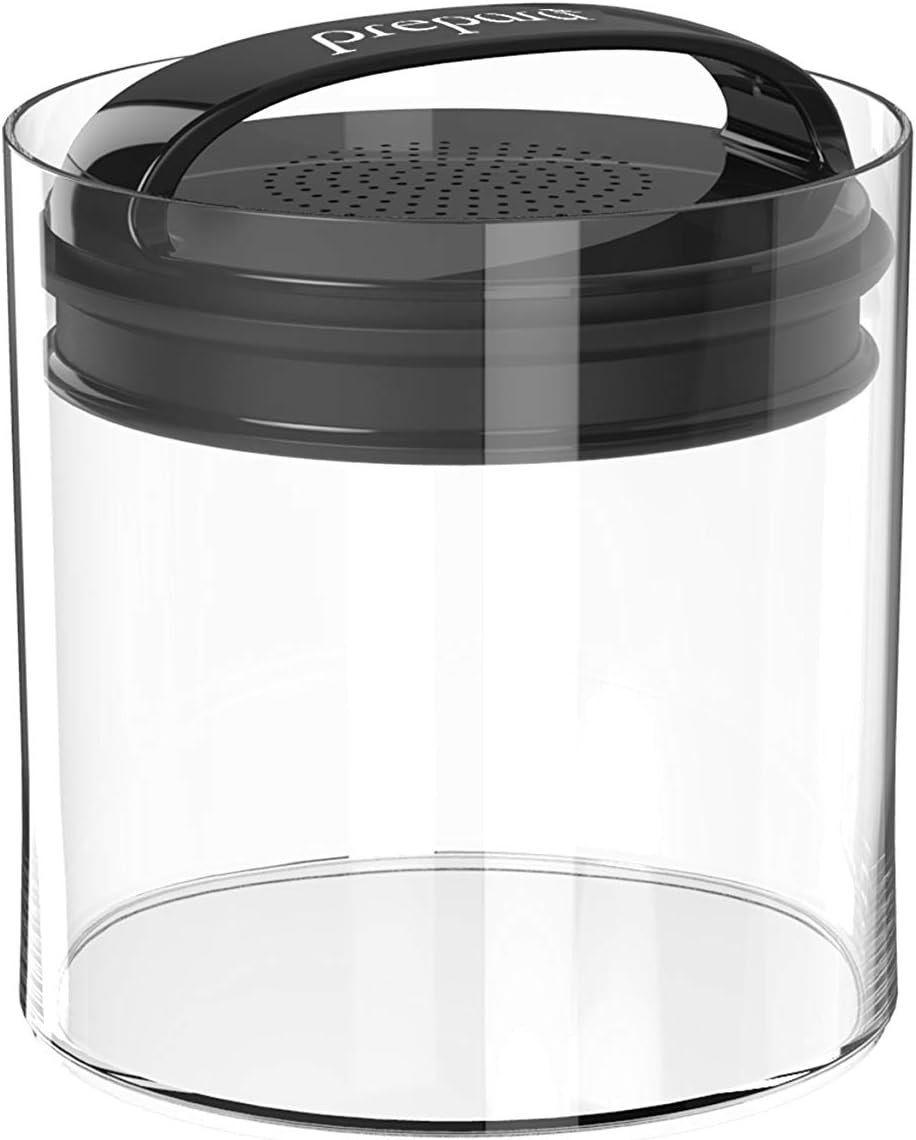
3. Prepara EVAK Fresh Saver — push-down air displacement
Best for: households looking for a practical air-displacement container with straightforward lid operation and visibility of remaining coffee.
The Prepara EVAK Fresh Saver uses a sliding, push-down lid to displace air from the space above coffee beans or other dry food. Unlike an electric vacuum pump, this design requires no charging or batteries. The linked Large/Short variant is a clear plastic canister with a dark handle and has a published footprint of approximately 14.4 × 14.4 cm and height of 14.6 cm. Confirm the precise stated capacity with the current Amazon listing, since third-party product specifications sometimes mix units.
Trade-offs: the transparent body is visually useful but provides less light protection than opaque steel. Keep it away from direct sunlight, preferably in a cupboard. Like Airscape, it displaces air rather than necessarily creating the vacuum pressure of Fellow Atmos.
Small-kitchen tip: its relatively short height works best where overhead cupboard clearance matters more than a narrow footprint. If your counter is very shallow, compare its width and depth before buying.
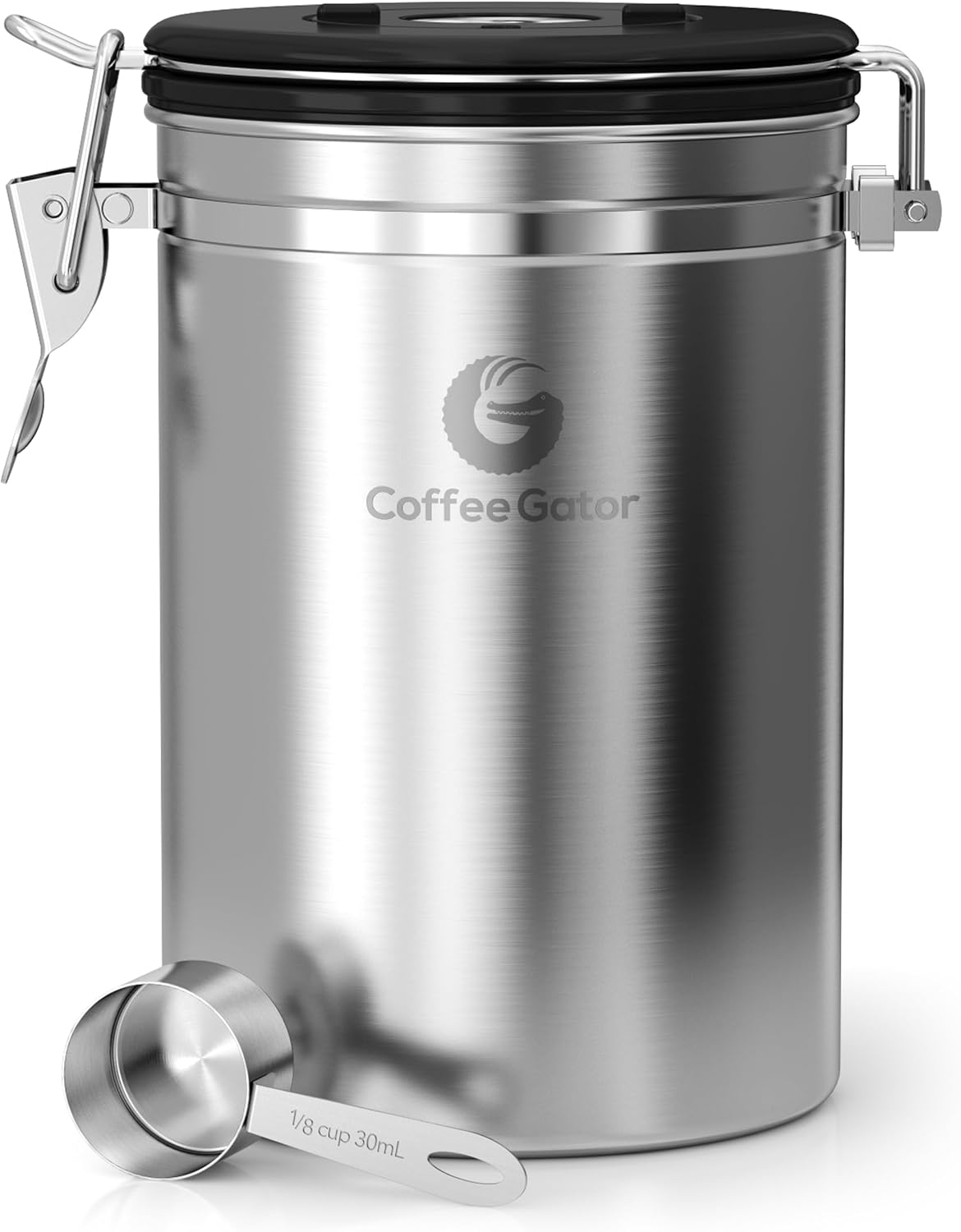
4. Coffee Gator — a traditional steel canister with date tracking
Best for: coffee drinkers who want a familiar canister shape, opaque construction and a visible reminder of when coffee was opened or roasted.
Popular Coffee Gator stainless-steel coffee canisters use a sealing lid, a one-way CO₂ valve and a date-tracking wheel. A one-way valve is intended to let escaping gas out while limiting air entering from outside. It is not a vacuum pump and should not be marketed as one. The external date wheel is helpful if you rotate bags or switch beans often, but it does not measure freshness; you still need sensible buying and storage habits.
Trade-offs: replacement-valve requirements and dimensions vary by model. Carefully check whether an individual listing includes spare valves or a scoop instead of assuming all bundles are the same. For limited countertops, the canister may be visually bulkier than an equally capable low-profile bag stored in a cupboard.
How much capacity do you really need?
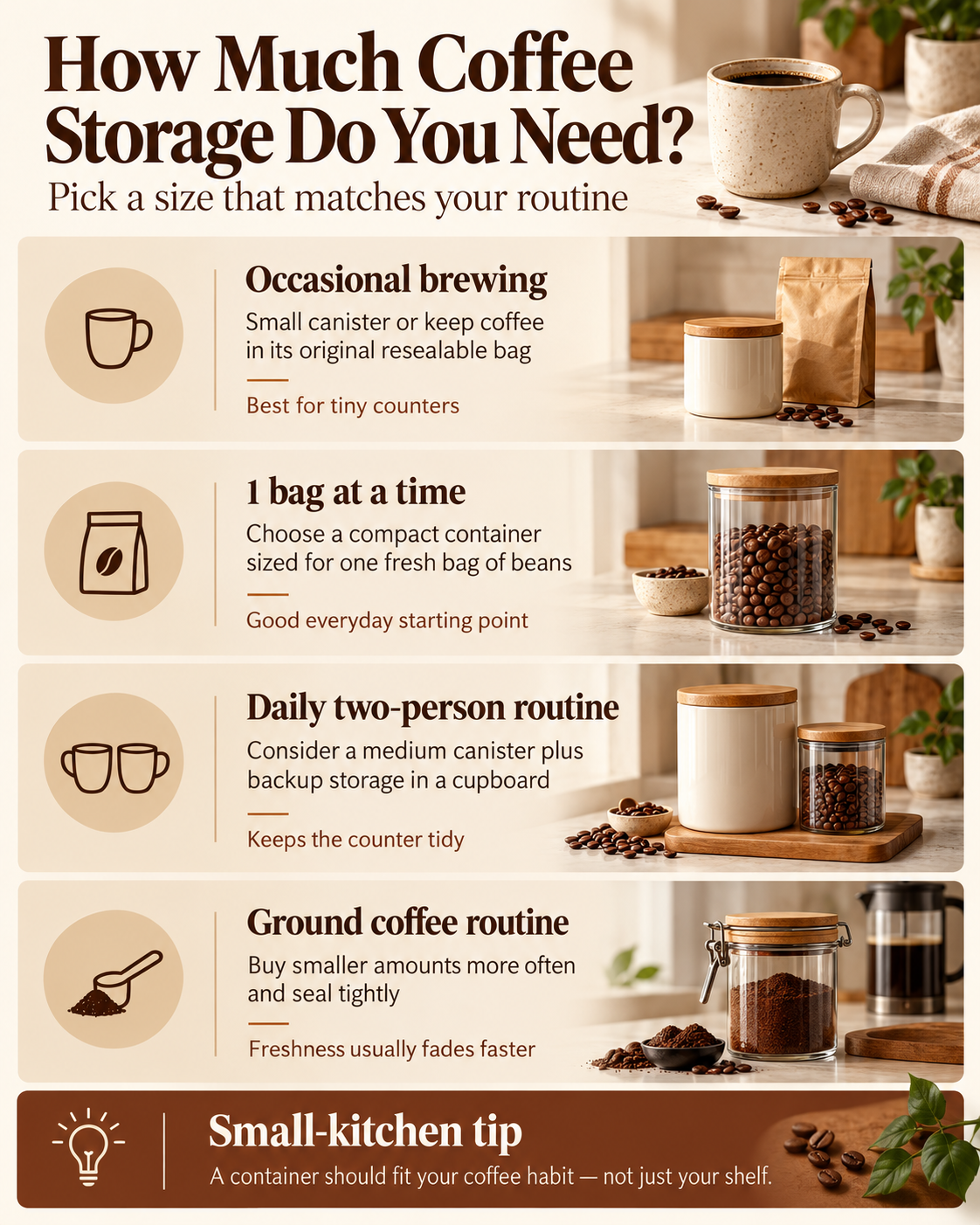
The right capacity is more useful than the largest advertised capacity. Think about the amount of coffee consumed before your next grocery or roaster order. A two-person household brewing daily may need considerably more storage than someone who drinks two espresso shots only on weekends.
| Your coffee habit | Practical starting point | Space strategy |
|---|---|---|
| Occasional brewing | Small canister or original resealable bag | Store inside a cool cupboard |
| Regular 250 g purchases | Compact whole-bean canister | Keep only daily equipment visible |
| Regular 450 g purchases | Size explicitly rated for the bag weight | Check lid and scoop clearance |
| Bulk purchases | Separate daily supply from reserve storage | Avoid a large half-empty countertop bin |
These are planning examples, not laboratory shelf-life guarantees. Coffee density and roast level affect how much fits in any container.
Countertop planning: make a coffee station look intentional
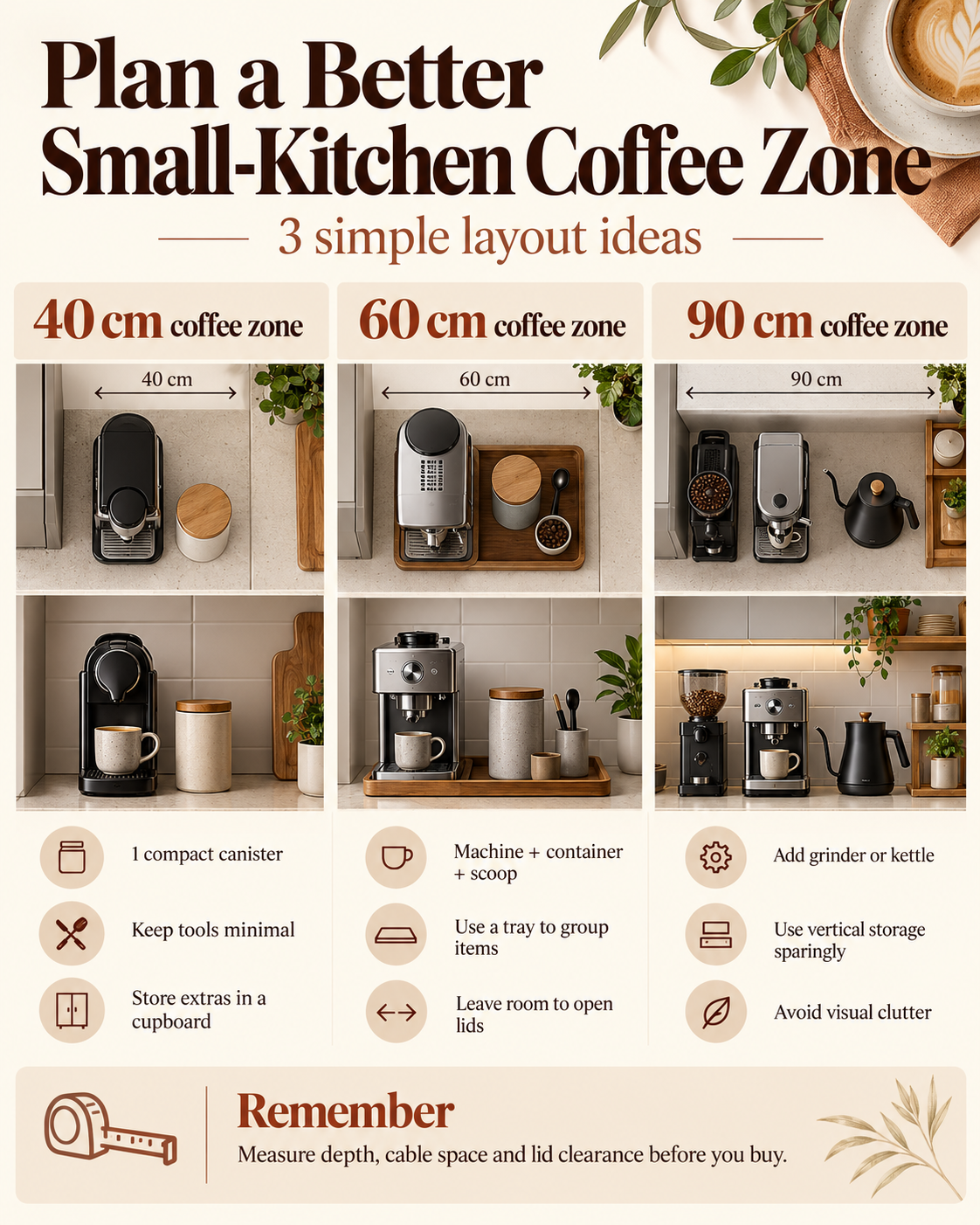
Before shopping, measure the width and depth available after accounting for your coffee maker, kettle, grinder and power cables. The canister should not obstruct access to a water tank or the opening of a cupboard door. A compact tray can visually unite a canister, small scoop and mug without allowing accessories to creep across the entire counter.
40 cm coffee zone: prioritize the machine and one small container, or store coffee inside a cupboard. 60 cm zone: consider a narrow canister beside the machine and leave room to make drinks. 90 cm zone: a grinder, airtight container and preparation area may all fit, depending on actual product dimensions. These widths refer to available usable countertop space; they are not promises that a particular branded machine-and-canister combination will fit.
Whole beans versus ground coffee: an important distinction
Ground coffee presents more surface area to the surrounding air than whole beans and generally loses desirable aromatics faster. If your routine allows it, buy beans and grind shortly before brewing. If convenience requires pre-ground coffee, choose a product specifically approved for grounds, keep it tightly sealed, and buy smaller amounts more often. This is especially relevant when comparing the whole-bean-focused Fellow Atmos with containers that are also suitable for dry foods: check each product’s intended contents.
Never place damp scoops inside the container. Let washed components dry fully before refilling. Avoid transferring warm freshly ground coffee into a canister merely to store it for days; grinding closer to brewing is a simpler quality improvement.
Storage mistakes that undermine even a premium canister
- Keeping coffee in direct sunlight: a decorative glass jar looks lovely but exposes beans to light unless it stays in a closed cupboard.
- Buying an oversized container: a large half-empty vessel still holds a lot of air around a small quantity of beans.
- Using a vacuum lid for grounds against instructions: fine particles can interfere with a mechanism designed for whole beans.
- Forgetting a seal or gasket: wipe away stray grounds and confirm the lid closes correctly after each use.
- Storing next to the hob: heat and temperature swings are not ideal for flavor preservation.
- Confusing date wheels with freshness tests: dates help you manage stock, but aroma and taste still evolve.
Do you need a vacuum canister at all?
Not necessarily. If your coffee arrives in an opaque, reliably resealable bag with a functioning closure and you finish it quickly, that bag may be the most sensible low-cost solution. An upgraded canister earns its place when the original packaging leaks, you decant coffee frequently, you need tidier daily access or you want to reduce air exposure after opening. Choose storage to solve a problem you actually have, not because a gadget looks impressive in a social-media coffee corner.
Frequently asked questions
What is the best coffee container for a small kitchen?
For a dedicated whole-bean routine, a compact Fellow Atmos or Airscape can work well. For a push-down air-displacement option, Prepara EVAK is a practical alternative. Your exact counter measurements and buying habits matter more than a blanket ranking.
Is a vacuum coffee canister better than an airtight jar?
A vacuum design removes some air rather than merely sealing the air already inside. The benefit depends on correct operation, your beans and how frequently the lid opens. A good opaque airtight container or well-sealed original bag is still useful.
Can I put ground coffee in Fellow Atmos?
The manufacturer advises against using Atmos for ground coffee because particles can clog its intake valve. Consider a container intended for grounds instead.
Should coffee beans go in the refrigerator?
For ordinary daily use, cool, dry, room-temperature cupboard storage is usually simpler than refrigerator storage, which can introduce moisture, odors and repeated temperature changes.
Should I use a clear container?
Clear containers can be convenient if they are kept out of sunlight, but an opaque body offers more reliable light protection for visible countertop storage.
What if my bag does not fit the advertised liter capacity?
Volumetric capacity is not the same as bean mass: roast level and bean density vary. Follow the manufacturer’s bean-weight guidance for the exact size and do not overfill the closing mechanism.
Final recommendation
Choose for your workflow: Fellow Atmos for a premium whole-bean vacuum setup, Airscape for a mechanical air-displacement approach, Prepara EVAK for simple push-down air displacement and a short storage profile, or Coffee Gator for traditional steel storage with date tracking. If you have almost no spare counter space, your existing resealable opaque coffee bag in a cool cupboard may still win.
For a complete setup, read our Best Compact Coffee Machines for Small Kitchens comparison and our Coffee Station Ideas for Small Kitchen Counters guide.
Editorial transparency and product availability
This guide compares published product specifications and practical storage considerations; it does not claim hands-on laboratory freshness testing or personal product testing. Product versions, capacities, accessories and availability can change. Amazon product preview cards link to specific Amazon listings. Before buying, verify the color, size and accessories in each listing; the editorial photographs and illustrations may show different variants.
Affiliate disclosure: As an Amazon Associate, Smart Space Finds earns from qualifying purchases. This guide contains four Amazon affiliate product links, and we may receive a commission at no additional cost to you.