
Small-Space Design Journal / The Shelf Edit
Beautiful shelves should make a small apartment feel calmer—not force you to drill into a wall, buy a dozen accessories, or compromise safety. This guide walks you through shelf types, easy styling formulas, storage decisions, and renter-specific precautions, from a single bookcase to an entire studio apartment.
Quick answer: Start with the shelves you already own. Keep heavy essentials low, group small items inside a basket or box, repeat two complementary materials, and reserve some open space. If you need additional display room, compare low freestanding units, furniture with built-in shelves, and approved wall-mounted options before buying.
Disclosure: Smart Space Finds may earn a commission from qualifying purchases through links in our articles, at no additional cost to you. As an Amazon Associate, we earn from qualifying purchases. Product recommendations are selected for relevance and practicality.
1. Choose the Right Type of Shelf for Your Rental
“Renter-friendly” describes a process—not a guarantee of zero marks or zero holes. Review your lease and building rules, then choose a solution appropriate to the wall, floor, intended load, and household. A low, stable storage piece may be easier to accommodate than a tall shelf, but tall shelving still requires the manufacturer’s specified tip-over protection.
| Option | Best use | Trade-off / safety check |
|---|---|---|
| Low freestanding bookcase | Books, baskets and a display surface | Check stability and load limits; secure when required |
| Compact cube organizer | Mix of closed bins and open display | Check dimensions, floor level and anti-tip instructions |
| Shelf integrated into a desk or console | Studio apartment or home-office corner | Confirm clearance and furniture stability |
| Tall ladder or leaning shelf | Narrow vertical footprint | Often requires secure wall attachment; not automatically drill-free |
| Wall-mounted floating shelf | Light visual profile above furniture | Usually needs correctly specified mounting hardware and permission |
| Small decorative ledge or tray on existing furniture | Mini display for a few light objects | Never overload an unsupported or unstable surface |
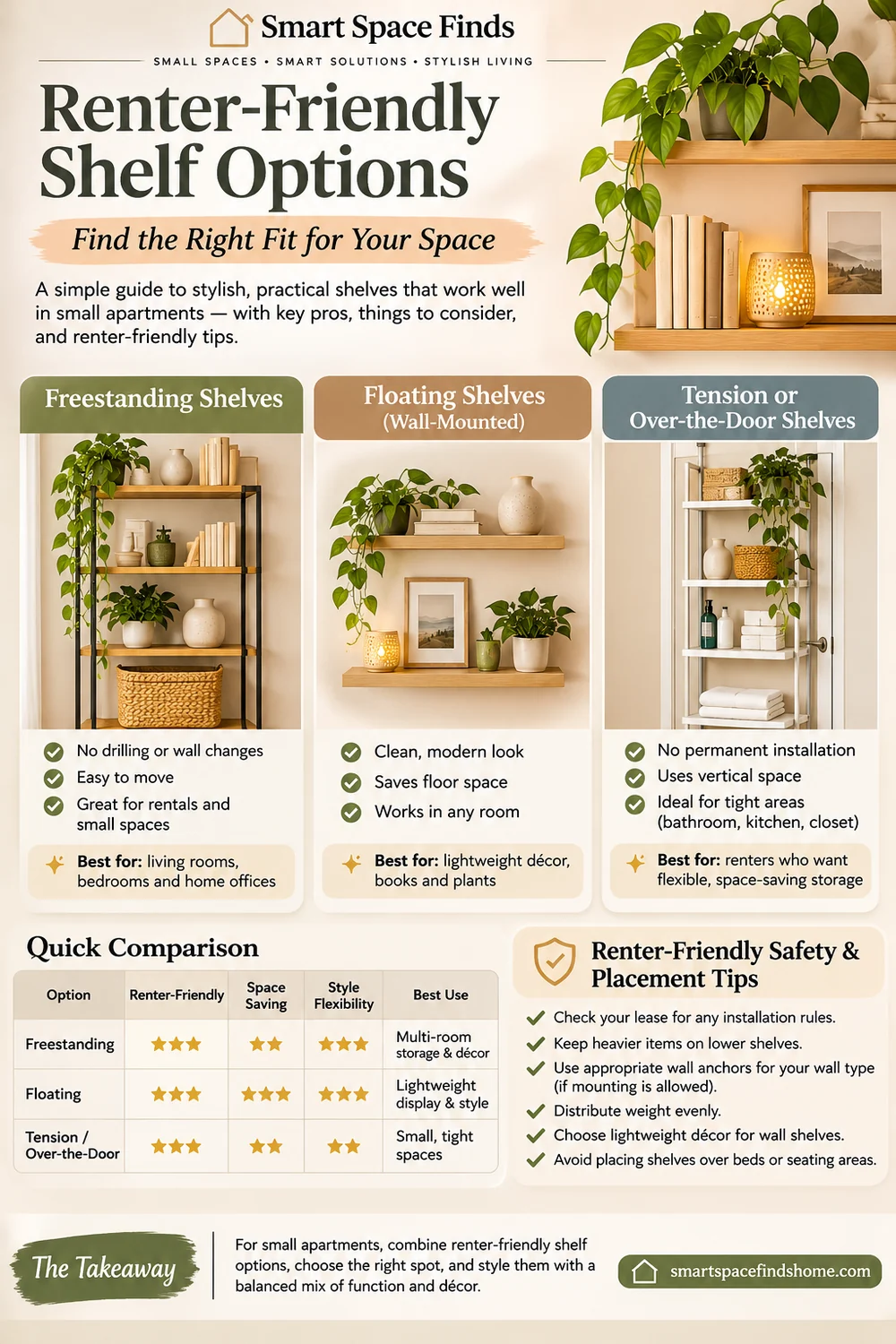
Floating shelf alternatives that still look intentional
Use the top of a low cabinet as a display ledge; choose a narrow freestanding bookcase beside a sofa; or style one shelf in an existing storage unit. A slim console behind a sofa can also create a layered display without installing a floating shelf. These options help avoid new wall holes, but they do not remove the need to follow furniture anchoring guidance.
Before buying, measure these five things
- Available width and depth, including the skirting/baseboard.
- Door swing, circulation space and access to outlets.
- Largest book, storage bin or object you need to fit.
- Floor level and whether the shelf can be secured as directed.
- Distance from heat, moisture and direct sunlight for books and plants.
2. Three Shelf Styling Formulas That Actually Work
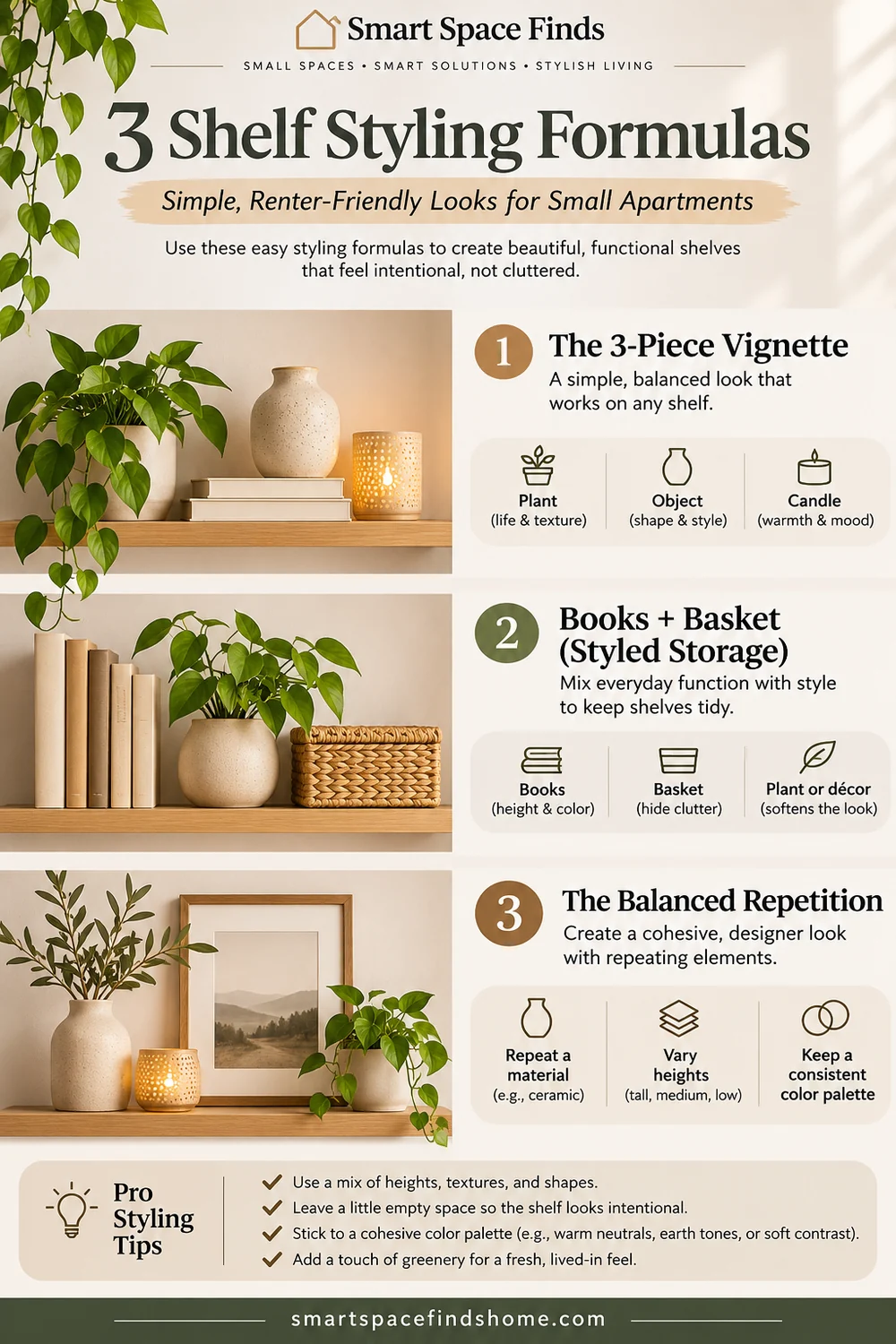
Formula A: The 3-piece vignette
Start with one tall item (a vase or framed print), one lower item (a short stack of books), and one personal accent (a small bowl or keepsake). Vary heights and depth. A three-piece vignette is a visual starting point, not a rule that every shelf needs exactly three objects.
Formula B: Books + basket + breathing room
Make books the functional anchor, corral charging cables or stationery in one opaque basket, and leave a visible gap. This is particularly useful when the shelf needs to hold everyday belongings as well as decor. Avoid storing a heavy basket above easy reach.
Formula C: Repetition with a small twist
Repeat two colors or finishes—for example, pale oak and matte cream—across adjacent shelves, then introduce a single contrasting element such as charcoal ceramics or a muted olive-green plant. The display looks collected without requiring matching sets.
How much empty space should you leave?
There is no universal percentage. Step back and check whether you can distinguish each group from across the room. If not, remove one item or combine several small pieces on a tray. The aim is an easy-to-maintain display, not an artificially empty shelf.
3. Style Books, Plants, Art and Decorative Objects
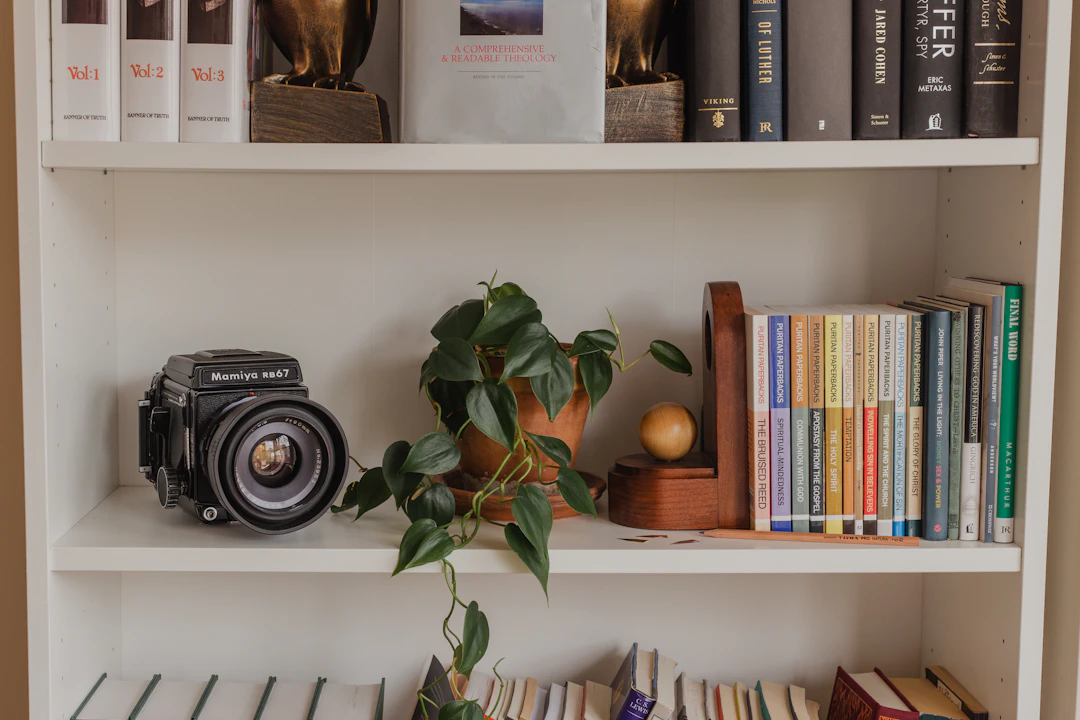
Books: mix vertical and horizontal arrangements
Stand frequently used books upright with a proper bookend. Lay a small group horizontally to vary the outline, but keep stacks low enough to reach. Check shelf capacity before loading a full row of hardcovers: books are heavier than their visual footprint suggests.
Plants: choose the right light, not just the right pot
Use small plants that suit the room’s natural light. Put every pot on a waterproof saucer or tray, and keep wet containers away from paper and untreated wood. For an especially tight or dark shelf, a realistic faux stem can provide softness without water damage risk.
Art, pottery and sentimental objects
Lean a modest framed print only where it can rest securely without slipping. Avoid positioning breakable ceramics or glass high above seating or walkways. Select one meaningful object rather than filling every gap with inexpensive filler decor.
4. Real-World Styling Ideas by Room
Living room: a low bookcase beside the sofa
Try this: Display favorite books on one side, a small pottery piece on the other, and keep a shallow box for remote controls at the easiest-to-reach level. Add lighting nearby rather than overcrowding a shelf with fragile lamps and cords. For more ideas, see our small living room storage guide.
Studio apartment: one shelf, two jobs
Let the bottom section store daily essentials in matching bins while upper, easily accessible shelves display books and a few decorative accents. A bookcase can visually define zones, but do not use it as a free-standing room divider unless its manufacturer permits that configuration and you can meet stabilization requirements. Compare our studio room-divider ideas.
Bedroom: restful instead of crowded
Use a single small framed print, a closed box for accessories, and a few books. Keep heavy objects away from the edge of shelves close to the bed and avoid precariously mounted shelves above your head. Explore cozy bedroom lighting ideas for a softer overall atmosphere.
Kitchen: accessible and easy to clean
Keep daily items together, leave room for cleaning, and avoid putting books or delicate art in steam-prone zones. A stable counter-height shelf may work for lightweight mugs or accessories only if it is specifically rated for the load and conditions. Our small kitchen countertop styling guide offers additional layout ideas.
Home office: make useful items part of the design
Group notebooks vertically, store loose stationery in one container, and choose one desk-friendly plant or sculpture. Do not run charging cables where they can be pulled off a shelf. See small home-office comfort upgrades.
5. Warm Scandinavian and Japandi Color Palettes
| Look | Palette | Materials | Styling cue |
|---|---|---|---|
| Warm Scandinavian | Oat, ivory, light oak | Wood, linen, matte ceramic | Soft textures and restrained contrast |
| Contemporary Japandi | Stone, sand, warm charcoal | Oak, handmade-style pottery, paper | Simple silhouettes and empty space |
| Earthy modern | Terracotta, cream, muted olive | Wood, stoneware, woven fiber | One warm accent in each vignette |
| Soft contrast | Chalk white, walnut, black | Dark wood, metal, clear glass | Dark accents used sparingly |
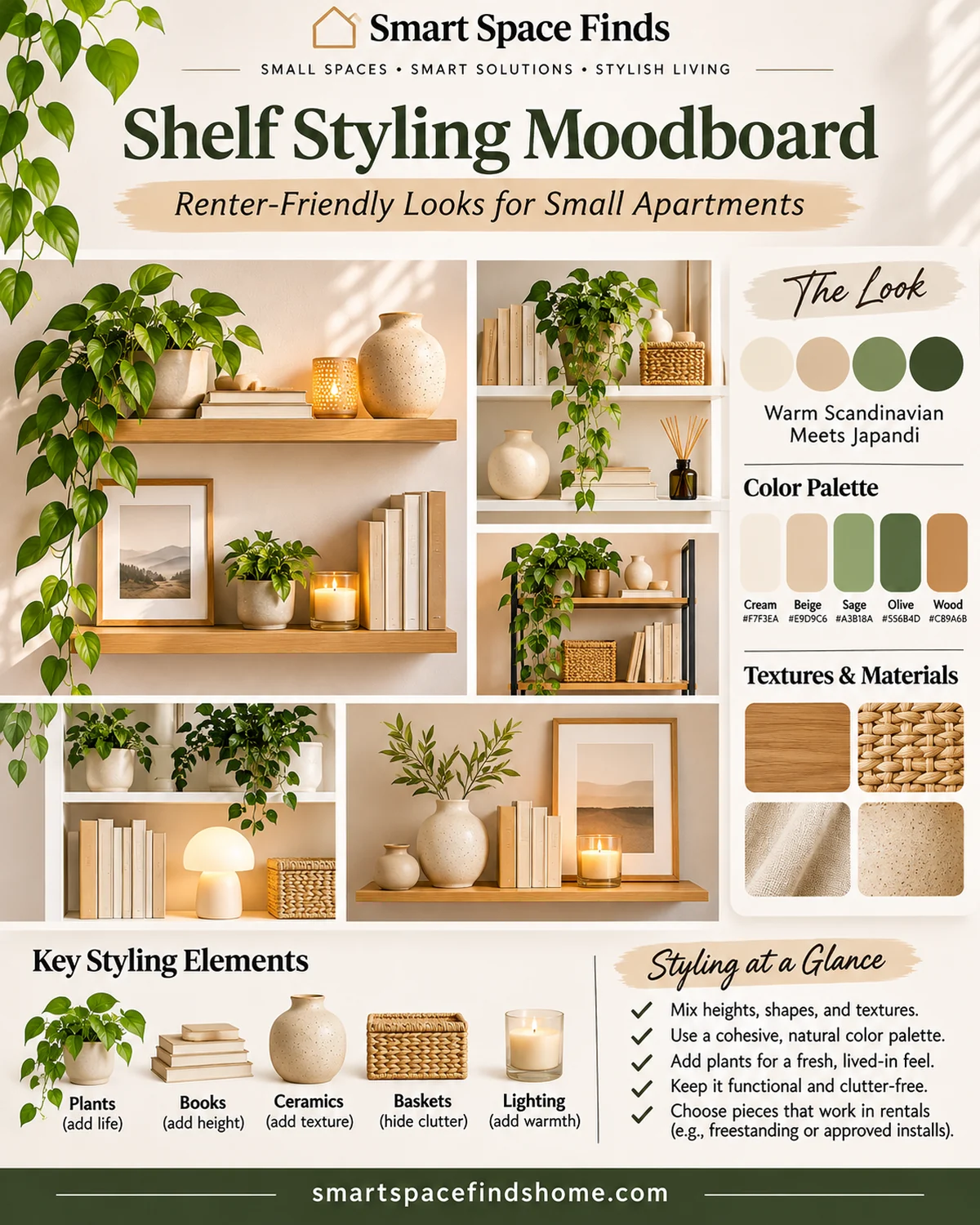
Use the existing room finishes as your starting point. Repeating a rug, cabinet or sofa color is usually more cohesive than introducing an unrelated “Pinterest palette.” Natural textures can coexist with modern metal pieces; you do not need to replace furniture to achieve the look.
6. Make Shelves Look Collected, Not Cluttered
- Edit first: Remove everything and sort into display, everyday-use and elsewhere.
- Put function back: Return books, storage and essentials before decorative objects.
- Create anchor groups: Build one or two focal points, depending on shelf length.
- Repeat a finish: Echo the same material at different heights.
- Use concealed storage: Choose bins for unappealing small necessities.
- Check from the doorway: Remove anything that makes the scene feel restless.
- Revisit in a week: If reaching an item is annoying, change the arrangement.
7. Renter Safety: Weight, Anchoring and Wall Damage
Important: No-drill is not a synonym for safe. Do not treat adhesive picture strips, removable hooks or unspecified tension hardware as load-bearing support for floating shelves or heavy decor. Follow the product’s exact surface, weight and installation instructions. Wall mounting may require studs or appropriately specified anchors; lease permission does not replace correct installation.
For tall furniture, bookcases and other pieces with tip-over risk, follow the manufacturer’s anti-tip instructions. The U.S. Consumer Product Safety Commission advises securing bookcases and other furniture to help prevent injuries, keeping heavier items lower, and keeping climb-attracting objects away from higher levels. If your rental rules do not allow the needed attachment, choose a different storage solution rather than leaving a potentially unstable unit unsecured. Read the CPSC Anchor It! guidance.
Use felt pads under suitable decor where appropriate, test materials on inconspicuous surfaces, and protect wood from wet planters. Remember that removable adhesives can still damage paint, especially on weak, recently painted or textured surfaces.
8. Budget-Friendly Shelf Styling Shopping Plan
Shop the gap, not the photograph. Most small apartments need fewer accessories than styled inspiration pictures suggest. First reorganize what you own; buy only the storage or finishing piece that solves a genuine problem.
| Priority | Consider | Why it earns its space |
|---|---|---|
| 1 — Function | Bookends or sturdy storage baskets | Keep useful items contained |
| 2 — Capacity | Appropriately rated low bookcase or cube unit | Provides real storage, subject to safety requirements |
| 3 — Texture | Small ceramic vase or tray | Adds contrast without many extra pieces |
| 4 — Personality | Personal photograph or art | Makes a basic arrangement distinctive |
| 5 — Greenery | Small plant and protective saucer | Introduces a natural accent where suitable |
Our shopping philosophy: Buy the missing function, not a picture-perfect arrangement. Featured Amazon finds are optional inspiration, not essentials. Confirm the exact model, current availability and installation requirements before buying; never treat adhesive strips as structural shelf supports.
9. A 30-Minute Shelf Reset Checklist
- ☐ Measure usable width, height and depth.
- ☐ Confirm the unit’s weight rating and required anchoring.
- ☐ Move heavy books and objects to lower levels.
- ☐ Choose two finishes and one optional accent color.
- ☐ Group functional small items in one closed container.
- ☐ Build one three-piece focal vignette.
- ☐ Protect surfaces from water and scratches.
- ☐ Step back and remove one unnecessary item.
- ☐ Confirm clear walkways and safe access.
- ☐ Take a photo and adjust after one week of actual use.
10. Common Shelf Styling Mistakes
Buying decor before measuring: creates visual clutter and unusable storage. Making everything symmetrical: can feel rigid; vary scale while balancing visual weight. Ignoring shelf depth: leaves objects overhanging. Overloading the top: increases instability and makes daily access awkward. Assuming all “removable” products are damage-free: overlooks paint and surface compatibility.
Frequently Asked Questions
Can renters install floating shelves?
Sometimes. Check lease terms and obtain the necessary permission before drilling. Correct mounting hardware, wall construction and rated load remain essential.
Are adhesive floating shelves safe for books?
Do not assume so. Adhesive hooks and picture-hanging strips are generally not substitutes for engineered structural shelf mounting. Only use a product for a load and surface explicitly approved by its manufacturer.
How do I style an inexpensive bookcase so it looks intentional?
Reduce the number of visible objects, place books in deliberate groups, conceal miscellaneous items in a consistent basket, and repeat one material or color across levels.
What can I put on shelves in a very small bedroom?
Prioritize a few books, a lightweight framed piece and closed storage for everyday necessities. Avoid heavy or breakable displays above beds or seating.
Should I anchor a freestanding bookcase?
Follow the manufacturer’s instructions and current safety guidance. Many bookcases require anti-tip anchoring, especially in homes with children. A rental restriction is not a reason to skip required stabilization.
How do I decorate without spending much?
Restyle your own books, framed photos and containers before shopping. One coordinated basket or thrifted vase can be more useful than several inexpensive novelty accents.
How do I keep plants from damaging shelves?
Choose suitable plants, use waterproof saucers, check for overflow, and keep moisture away from books and unsealed materials.
What is the best color palette for small-apartment shelves?
Choose colors that already exist in the room, then repeat two main finishes and use one restrained accent. Warm Scandinavian and contemporary Japandi palettes work well when you prefer an uncluttered look.
Final Thoughts: Style for Real Life
The most convincing shelves are not the fullest ones. Choose a stable, appropriate unit; make useful belongings easy to reach; repeat a few considered textures; and leave enough room for everyday life. A good renter-friendly update looks attractive today and is still practical when you move.
Continue with our renter-friendly storage hacks, apartment makeover ideas, and closet organization guide.