
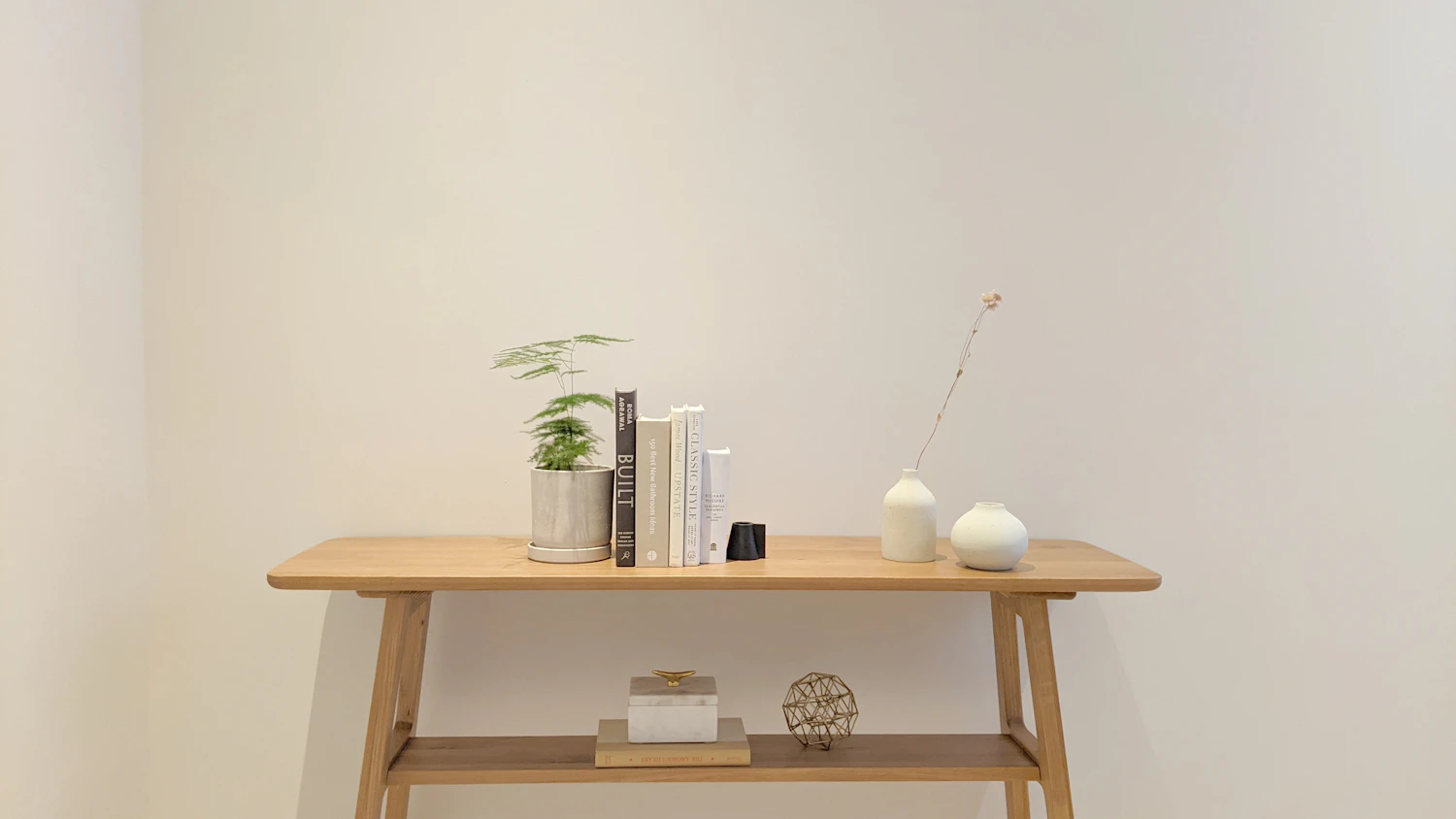
THE EFFORTLESS EVERYDAY · SMARTER LIVING
A calmer home doesn’t require a total reset. Start with five small changes that make the things you already do feel noticeably simpler.
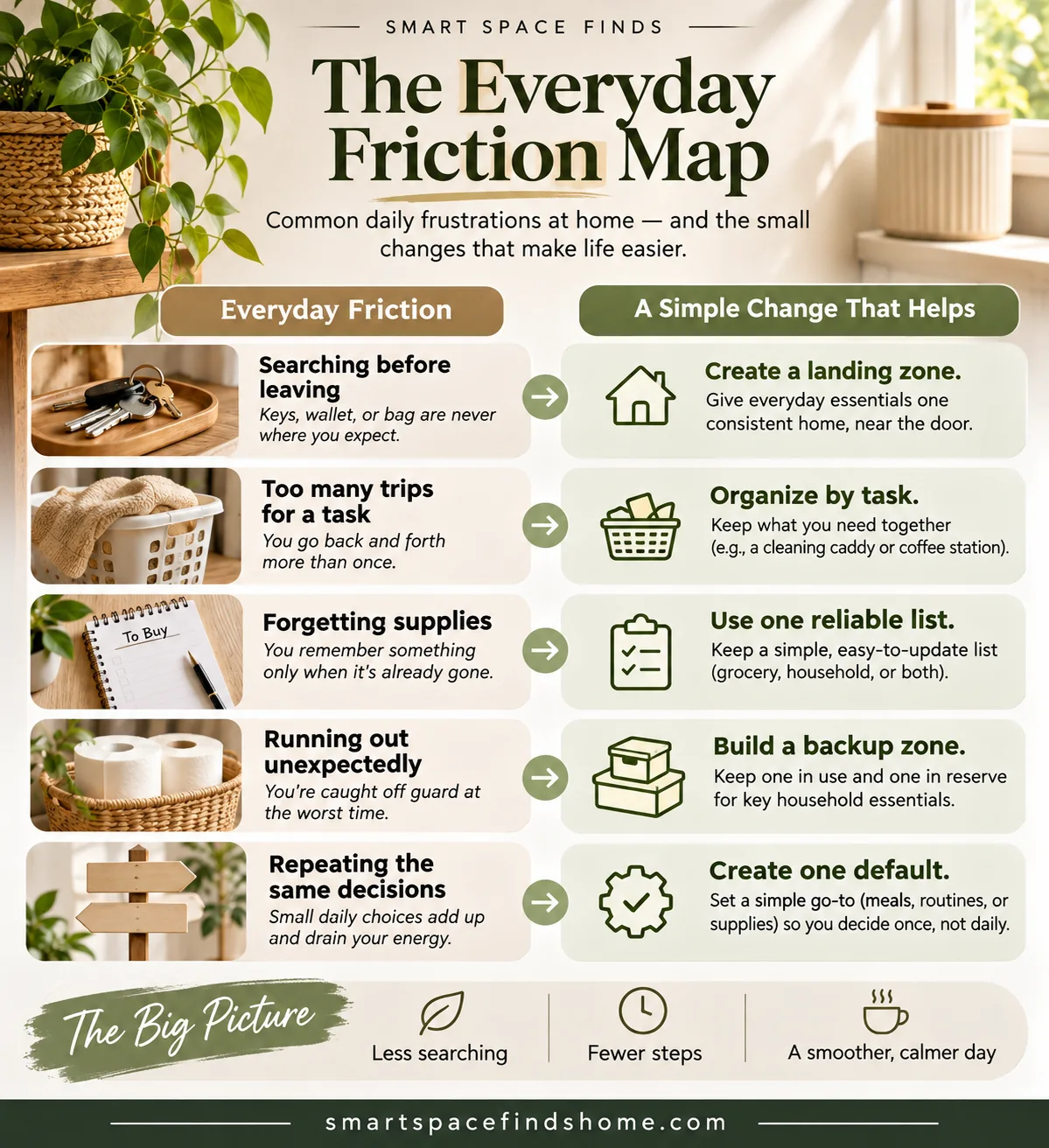
Think about the last time you searched for your keys, walked across the house for a cleaning supply, or realized you were out of something in the middle of a busy morning. None of those moments is a major problem on its own. Together, they add unnecessary steps to an ordinary day.
The most useful way to make everyday life easier at home isn’t to build a perfect routine. It’s to notice where your home creates repeated work, then change one small detail so the next day runs more smoothly. This guide covers five practical ideas for entryways, household supplies, grocery lists, backup essentials, and everyday decisions. Most can be tested with things you already own.
THE EDITOR’S FIELD NOTES / THREE PRINCIPLES
Start with the moment that repeatedly slows you down.
Move, group, or simplify something you already use.
Test it during normal life, not a perfect week.
Why small home systems can work better than big organizing projects
Large organizing projects can be satisfying, but they’re not always easy to maintain. A system that depends on remembering several new rules may become one more job. A small home system works when it fits a behavior that’s already happening: putting down your keys, making breakfast, gathering laundry, or noting that you’re running low on soap.
Instead of asking, “How can I organize everything?” ask three narrower questions: What do I look for repeatedly? What task requires too many trips? What decision do I make almost every day? Your answers point to the places where a modest change may be most helpful.
01 / EVERYDAY ESSENTIALS
Create a home for the things you reach for every day
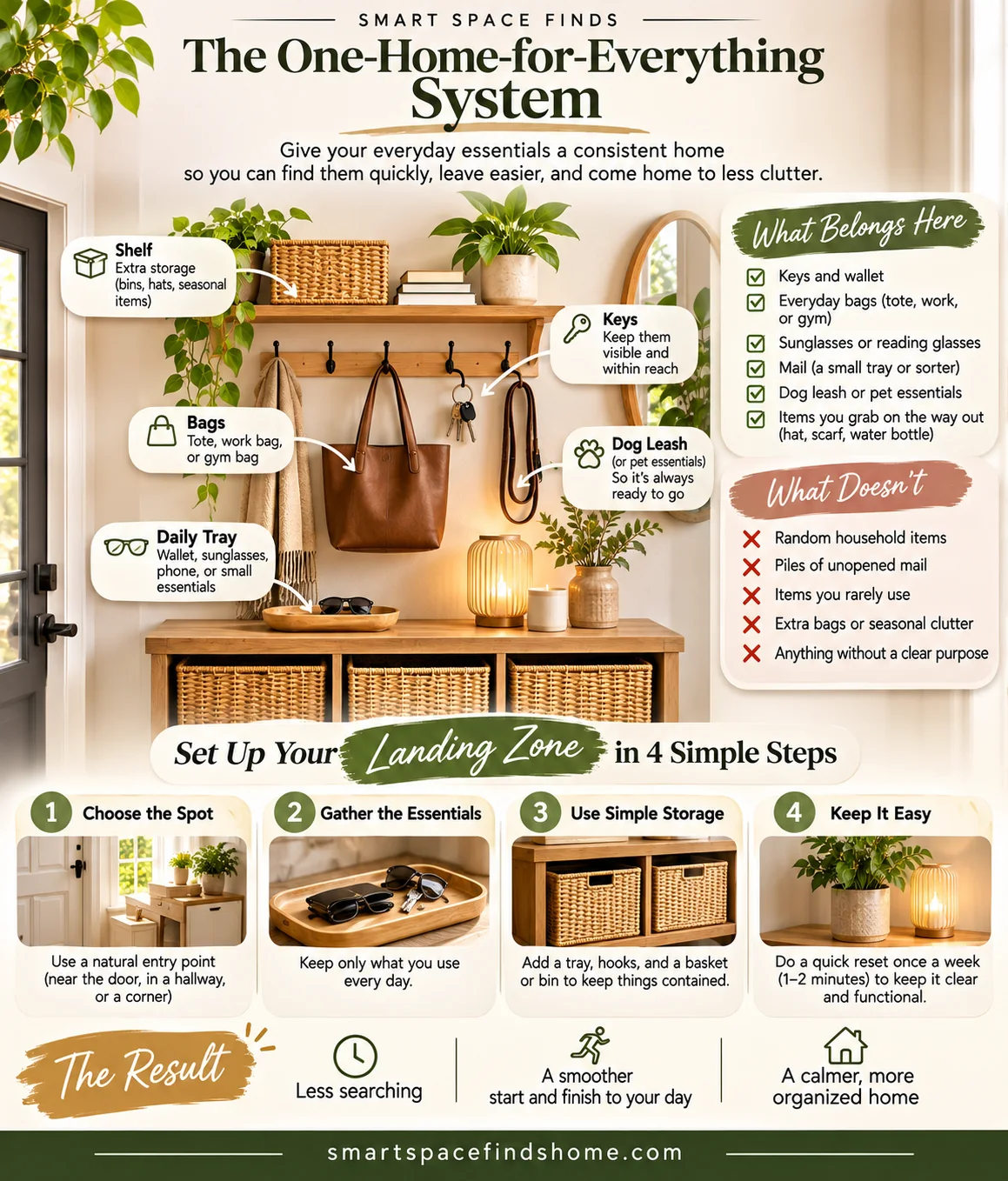
An entryway doesn’t need a built-in bench or custom cabinetry to work well. It needs an obvious landing place for the items that come and go with you: keys, wallet, sunglasses, transit card, bag, or dog leash. The right location is usually where you naturally stop—not necessarily the most photogenic corner of the room.
Start by noticing where essentials end up during a typical week. If your keys already land on a kitchen counter, a small tray at that spot may work better than an elaborate organizer across the room. If coats collect on a chair, a reachable wall hook or freestanding rack may be more realistic than a closet several steps away.
A setup that works in a small apartment
Choose one compact surface or vertical area. Keep a shallow dish for pocket-size essentials, a hook for the bag you use most, and a clear place for incoming mail. Leave space to set something down without moving other objects. In a shared household, assign each person a distinct hook or section only if there is enough room.
What to avoid
Don’t turn the landing zone into a catchall for deliveries, unopened mail, and miscellaneous objects. Remove anything that doesn’t help you leave or enter the home. For renters, check the weight limits and removal instructions of any adhesive hooks, and avoid hanging heavy objects on untested surfaces.
For more layouts for homes without a dedicated hallway, explore our small-apartment entryway drop-zone ideas.
The Everyday Landing Zone Edit
Start with what you already own. If keys, bags, or incoming mail still lack a convenient spot, these compact organizers offer a few practical ways to create one.
Umbra Estique Entryway Organizer
Mail and key storage in one wall-mounted station.
Yamazaki Home Magnetic Key Rack — White
A small magnetic tray and hooks for everyday essentials.
Yamazaki Home Magnetic Key Rack — Alternative Finish
A finish alternative for the same compact entryway idea.
Umbra Estique Over-the-Door Hook Organizer
Extra hanging space when a fixed wall organizer is impractical.
As an Amazon Associate, we earn from qualifying purchases. Product availability, versions, and prices may change.
02 / LESS BACKTRACKING
Organize supplies around the task, not just the item
Traditional organization often groups like with like: all paper in one place, all cleaning cloths in another, and every spare container together. That can look tidy, but it doesn’t always match how you use things. Task-based organization means keeping safe-to-store items together when you routinely use them at the same time.
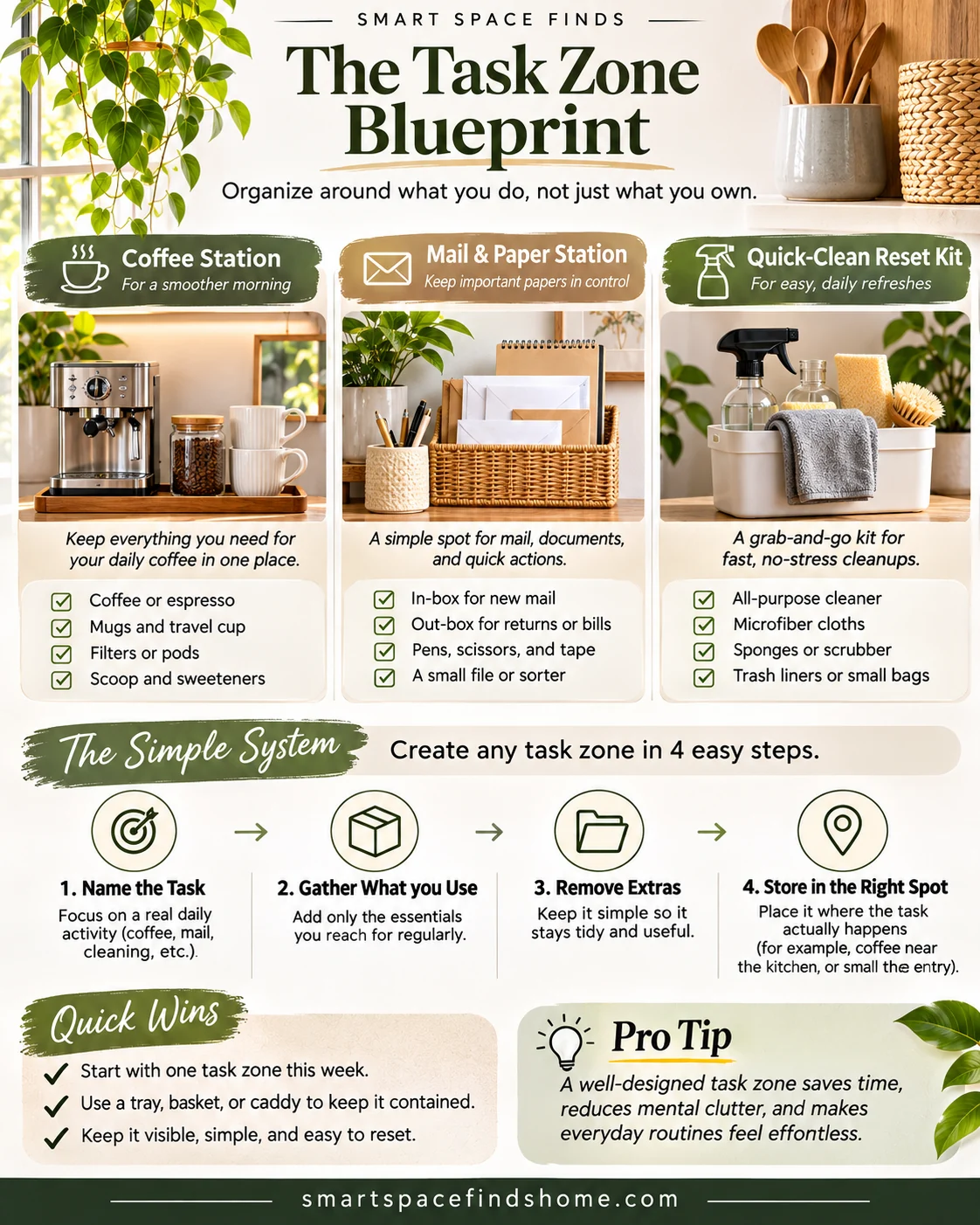
For example, if you often wrap gifts or mail packages, keep tape, scissors, labels, and blank cards together in a portable container. If your morning routine includes coffee, put filters, scoops, and mugs within easy reach of the coffee maker. You spend less time gathering and returning the same supplies.
Build a task zone in four steps
First, name one repetitive task. Second, list what you actually reach for when doing it. Third, remove duplicates or items that belong elsewhere. Finally, store the remaining supplies in a location that makes the task convenient. A drawer, small bin, or existing shelf may be enough.
Safety comes before convenience
Do not group household chemicals with food, medications, cosmetics, or children’s supplies simply because they are used in the same room. Keep cleaners in original labeled containers and follow the product’s storage directions. Secure hazardous products away from children and pets. A tidy system is only useful when it is safe.
For small kitchens, our compact breakfast station guide shows how to organize a specific daily task without losing valuable counter space.
Tools for Ready-to-Use Task Zones
These are optional helpers for keeping tools close to the work. Pick the task you repeat most; avoid buying a whole set of organizers before testing the layout.
Casabella Multipurpose Cleaning Caddy
A portable place for frequently used cleaning tools.
OXO Good Grips Deep Clean Brush Set
Small detail brushes for targeted cleaning tasks.
OXO Good Grips Dish Scrub Brush
A simple tool for the sink-side cleaning zone.
OXO Good Grips Soap-Dispensing Dish Brush
A dish brush with an integrated soap reservoir.
OXO Good Grips Dresser Drawer Dividers
Adjustable separation for frequently used drawer contents.
OXO Good Grips Kitchen Tool Drawer Organizer
Divided kitchen-tool storage for an easier cooking workflow.
SUPEASY 10-Tier Wall File Organizer
A vertical filing zone for frequently handled paperwork.
As an Amazon Associate, we earn from qualifying purchases. Product availability, versions, and prices may change.
03 / A LIGHTER MENTAL LOAD
Make your everyday lists easier to maintain

A shopping list helps only if you can find it when you need it. The most reliable list is rarely the most sophisticated one. It’s the one you can update the moment you notice a supply running low and check easily when you’re shopping.
Choose a format that already fits your routine: a notepad on the refrigerator, a notes app on your phone, or a shared digital list with household members. Use familiar categories such as groceries, toiletries, cleaning basics rather than creating complicated subfolders that take longer to maintain than the list itself.
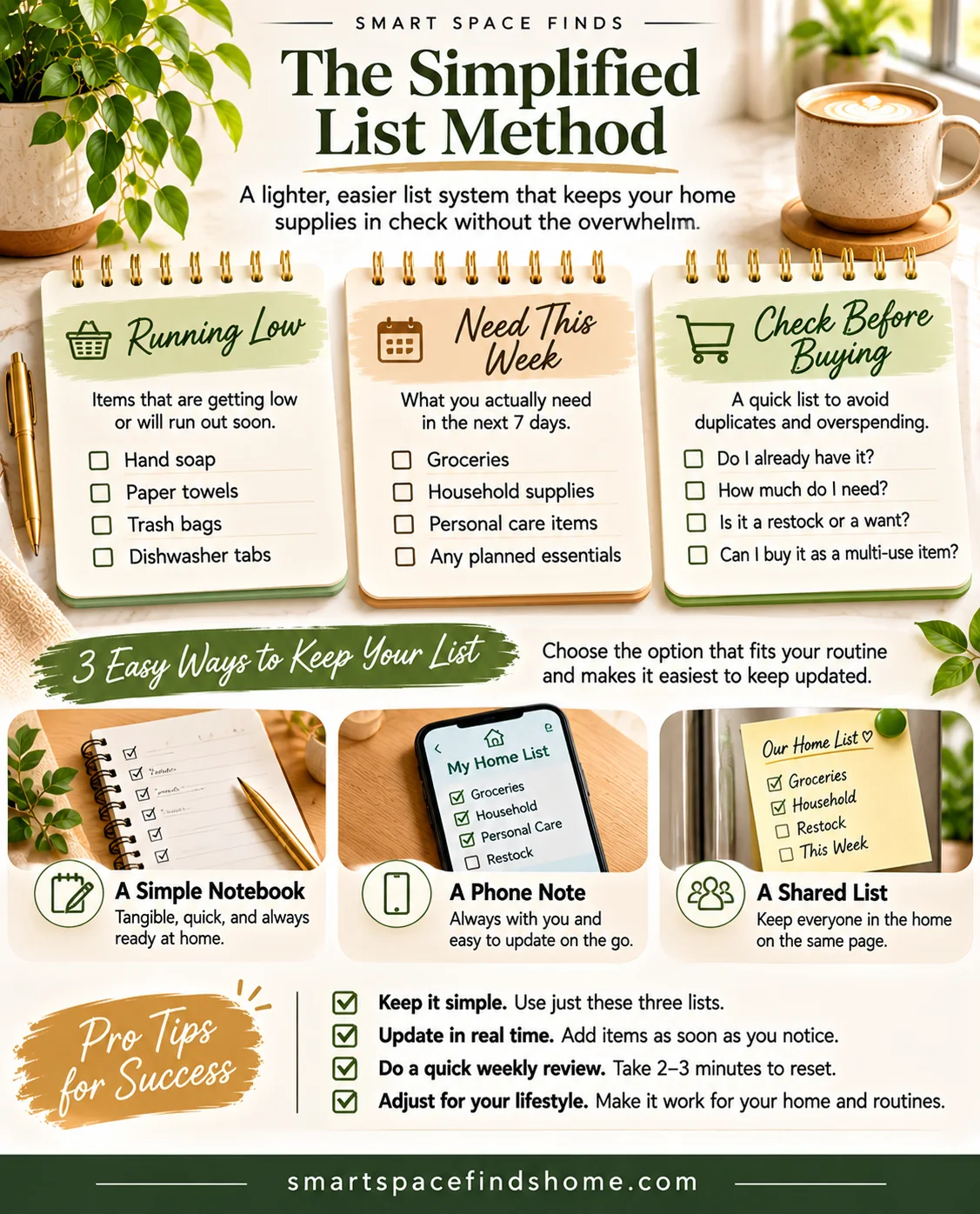
An easy three-part list
Keep one place to capture what has run out, one short section for items needed this week, and—if it genuinely helps—one section for items to check before buying. The last section prevents purchasing a duplicate because something was hidden at the back of a cabinet.
Make shared lists specific
Instead of writing “bathroom stuff,” record “hand soap refill” or “toilet paper, 6 rolls.” A useful list reduces ambiguity; it shouldn’t require someone to send a clarification message from the store. If multiple people shop, agree on where the list lives and how purchased items are removed.
The Simplified Planning Edit
A useful list should be fast to update and easy to find. These are alternatives, not a shopping checklist: a basic notepad may work just as well.
3-Pack Magnetic Dry-Erase Refrigerator Planners
Multiple reusable surfaces for everyday household notes.
Magnetic Dry-Erase Refrigerator Calendars — 3 Pack
A visible shared calendar and list format.
DIYMAG Acrylic Magnetic Refrigerator Calendar Set
An acrylic planning option for a compatible fridge surface.
Small Monthly Whiteboard Calendar
A compact reusable monthly overview.
Brother P-Touch PTD220 Label Maker
Print clear labels for frequently used supply zones.
Brother P-Touch PTD210 Label Maker
An alternative handheld label maker for storage systems.
Brother P-Touch N25BTV3 Bluetooth Label Maker Bundle
Bluetooth label-making option for household categories.
As an Amazon Associate, we earn from qualifying purchases. Product availability, versions, and prices may change.
04 / RESTOCK WITHOUT OVERSTOCK
Create a small, sensible backup zone
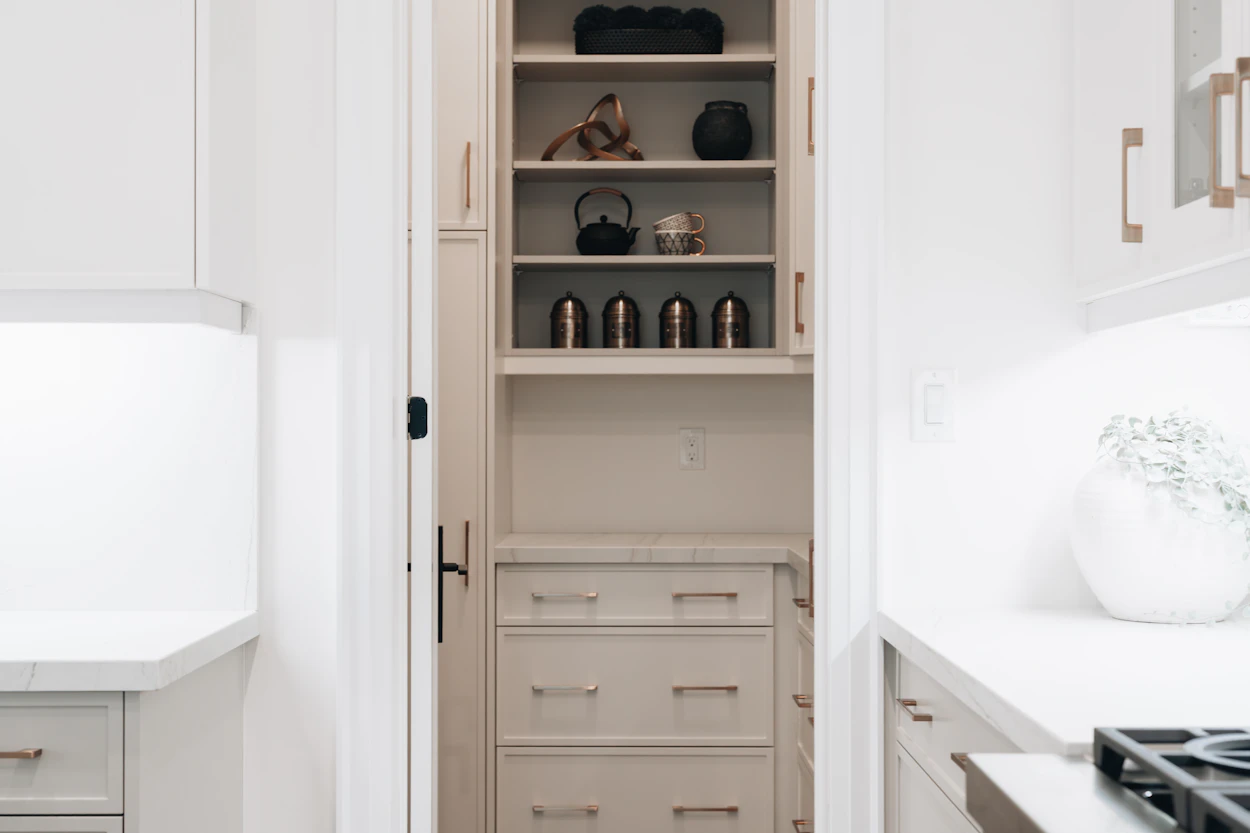
Running out of an essential at the wrong time is inconvenient. But buying bulk quantities of everything can create another problem, especially in a small apartment. A compact backup zone is a designated place for a limited number of frequently used, shelf-stable household essentials—not a reason to store more than you need.
Start with items you go through predictably, such as unopened hand soap, trash bags, paper products, or replacement sponges. Keep backups near the area where they are used when space and safety allow. If your storage is limited, choose a single shelf or small labeled bin rather than spreading supplies across several closets.
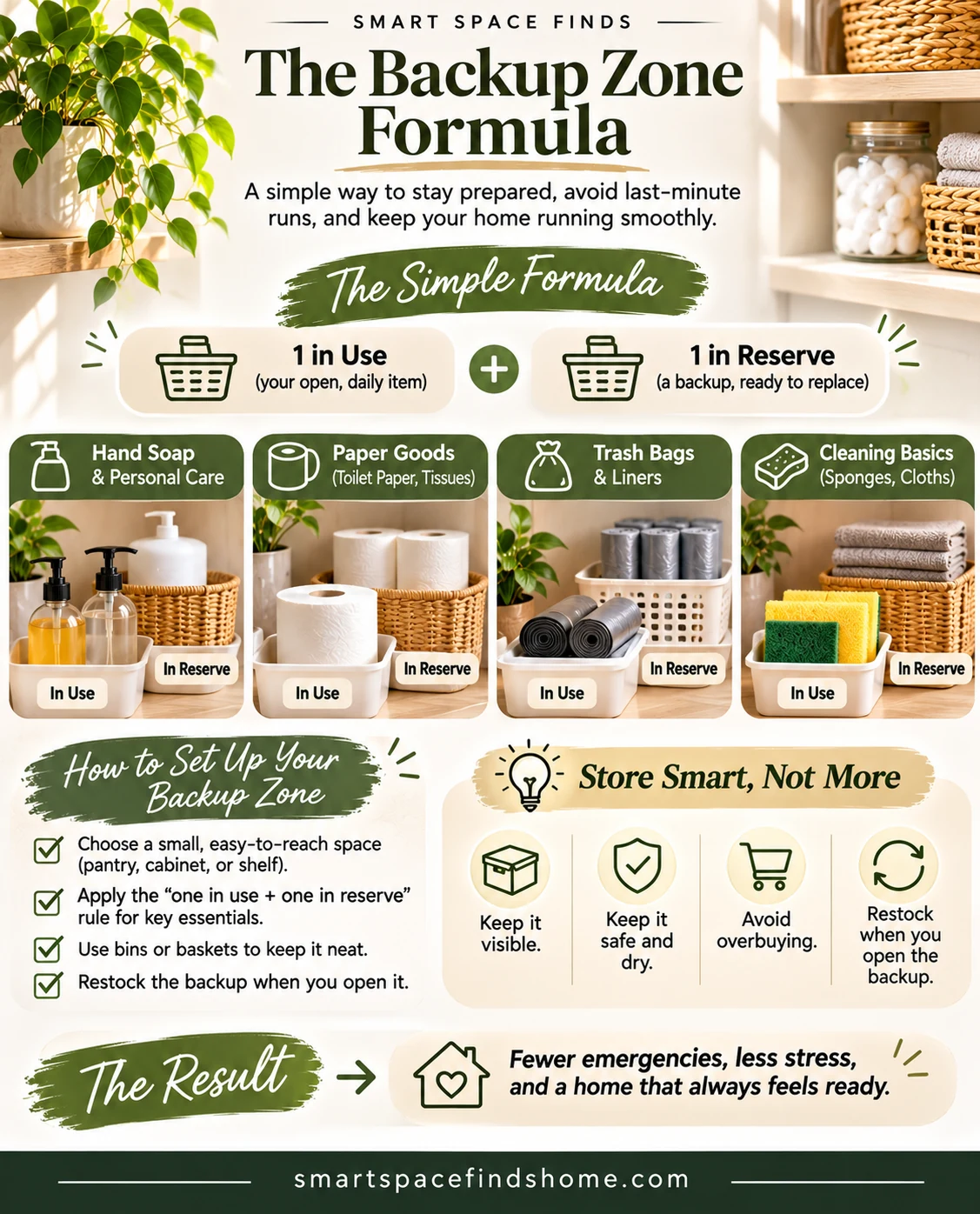
The one-in-use, one-in-reserve idea
For inexpensive essentials you use consistently, keeping one open item and one unopened replacement may be enough. Adjust the quantity to your household size and shopping frequency. There’s no advantage to stocking multiples of a product you rarely use.
Keep inventory visible and safe
Put new stock behind older stock when relevant, check expiration or use-by information where applicable, and avoid storing supplies in damp or excessively hot conditions. Keep chemical products in their original packaging and secured according to their labels. Never stock extra products at the expense of clear walkways or safe access.
If limited space is the challenge, see our small home organization solutions for additional ways to keep storage accessible without adding clutter.
Clear Storage for Everyday Backups
Choose bins based on the available shelf depth and what you genuinely need to keep in reserve. Clear containers can make quantities easier to see.
ClearSpace Clear Plastic Storage Bins
Transparent bins for shelf-accessible supplies.
STORi Bliss XL Clear Storage Bin
A larger open-top clear organizer for grouped basics.
Clear Plastic Storage Bins — 4 Pack
A multi-bin option for separate supply categories.
ReadySpace Open-Front Stackable Storage Bins
Front access to items on shared shelves.
Stackable Clear Storage Bins with Lids
Lidded storage for infrequently accessed supplies.
IRIS USA Flip-Top Small Storage Containers
Small lidded containers for compact essentials.
As an Amazon Associate, we earn from qualifying purchases. Product availability, versions, and prices may change.
Compact Reserve Storage Alternatives
These additional formats serve different shelf sizes and storage preferences. Measure first; a smaller number of well-fitting bins often works better.
IRIS USA Storage Bins with Lids — 6 Pack
Lidded bins for grouped reserve supplies.
IRIS USA 13-Quart Storage Bins — 4 Pack
Medium-sized bins for organized household extras.
IRIS USA Small Clear Cases — 10 Pack
Small cases for items that otherwise scatter.
IRIS USA 6-Quart Clear Storage Bins — 6 Pack
Compact bins for shelves and small closets.
Amazon Basics Collapsible Fabric Storage Bins
Soft-sided bins for suitable dry-storage spaces.
Lifewit Foldable Clothes Storage Bags
Foldable bags for dry, out-of-season soft goods.
As an Amazon Associate, we earn from qualifying purchases. Product availability, versions, and prices may change.
05 / FEWER REPEATED CHOICES
Remove one repeated decision from your daily routine
The most helpful home systems don’t ask you to work harder. They make ordinary moments require less effort.
Not every household problem is a storage problem. Sometimes the friction is deciding what happens next: what to eat for breakfast, what to bring tomorrow, or where to begin a morning cleanup. A flexible default can make the ordinary decision quicker while leaving room to change your mind.
Choose a single recurring moment. For breakfast, that could mean keeping ingredients for two familiar options readily available, rather than designing an elaborate meal-prep plan. For leaving the house, it might mean checking tomorrow’s schedule and placing the required bag near the door. For evening cleanup, choose one five-minute task that makes the next morning easier.
Use a default, not a rigid rule
A default is a convenient starting option. It doesn’t mean every day must look the same. Different work schedules, energy levels, accessibility needs, and family responsibilities call for flexibility. If the routine creates more pressure than it removes, change it.
Make tomorrow easier tonight
Try a two-minute closing check: return keys to their landing place, confirm anything needed for the morning, and write down the one task you don’t want to forget. This is enough for many households. You don’t need a long evening ritual for it to count.
For a related approach, read five ways to make your morning routine easier and five-minute home resets for busy days.
Which change should you try first?
If you’re unsure where to begin, choose based on the inconvenience you experience—not on which idea looks most attractive. These quick matches can help:
- Always searching before you leave? Start with the landing zone.
- Walking between rooms to finish simple tasks? Try task-based storage.
- Buying duplicates or forgetting supplies? Simplify your list.
- Running out of household basics? Build a small backup zone.
- Feeling slowed by the same everyday choice? Create one flexible default.
Optional Tools for a Repeatable Cleaning Reset
When one small cleaning task is part of your routine, a convenient tool can help. Neither mop is necessary to follow this guide; choose according to your floors and existing supplies.
Rubbermaid Reveal Spray Mop Kit
A spray mop with washable pads for compatible floors.
O-Cedar H2prO Flat Mop System
A flat-mop alternative for a regular floor-cleaning task.
As an Amazon Associate, we earn from qualifying purchases. Product availability, versions, and prices may change.
The seven-day ease test: a realistic plan
Rather than changing everything at once, test one idea under normal conditions. You won’t need a spreadsheet, habit tracker, or special purchases. The aim is to see whether a change actually makes your day easier—not whether you can follow a perfect challenge.
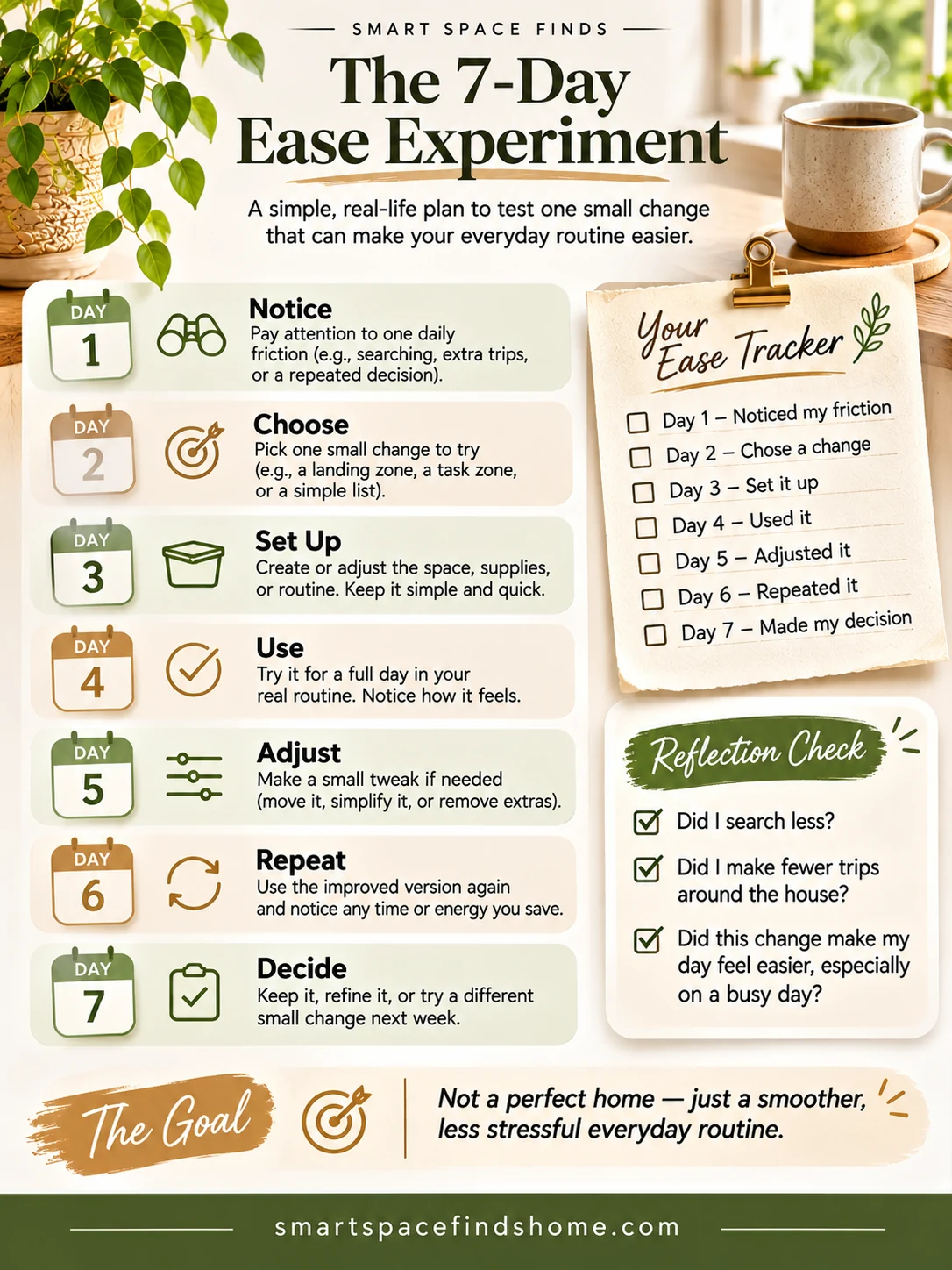
The low-pressure seven-day plan
- Day 1 — Notice: Write down one repetitive annoyance.
- Day 2 — Choose: Pick the smallest change that addresses it.
- Day 3 — Set up: Use existing items and make the new action easy.
- Day 4 — Observe: Notice where the system helps or gets in the way.
- Day 5 — Adjust: Move, simplify, or remove anything awkward.
- Day 6 — Live normally: Let the system work without extra effort.
- Day 7 — Decide: Keep it, revise it, or drop it.
How to tell whether the change is worth keeping
Ask yourself three simple questions: Did I spend less time searching or backtracking? Was the new setup easy to use on a busy day? Did it make the space more comfortable without creating a new chore? You don’t need to record exact minutes or claim dramatic results. If the answer is mostly yes, keep it. If not, simplify the arrangement or try a different approach.
Common mistakes that make home routines harder
- Buying containers before identifying the problem. Start with the task, then decide whether a product is necessary.
- Storing essentials where they look best, not where they’re used. Convenient placement is usually more sustainable than perfect styling.
- Creating too many categories. If returning an item requires several decisions, the system may be too complicated.
- Keeping excessive backups. More inventory can become clutter, waste money, and conceal what you already own.
- Expecting one household system to fit everyone. Account for reach, mobility, age, schedules, shared spaces, and personal preferences.
Low-cost ways to make everyday life easier
Most of these ideas work without shopping. A clean jar can hold pens. A sturdy container can group mail supplies. A recycled notepad can become a shopping list. Rearranging a shelf may eliminate an unnecessary trip. If you do decide to buy something, measure the available space and ask which recurring inconvenience the item solves. A product that doesn’t solve a specific problem is just another object to manage.
Frequently asked questions
What are the easiest ways to make everyday life easier at home?
Start by giving daily essentials a fixed place, keeping supplies close to the tasks they support, using one reliable shopping list, maintaining a small backup zone, and simplifying one repeated daily decision. Pick the idea that addresses a real inconvenience in your routine.
How can I organize my home when I have very little space?
Prioritize accessibility and frequency of use. Use a compact tray, an existing drawer, or a small shelf for essentials, and avoid storing things that don’t serve a clear purpose. Vertical storage can help when installed safely, but you don’t need to maximize every inch.
Do I need to buy organizers to make my home easier to manage?
No. The most useful first step is often moving things closer to where you use them, reducing duplicates, or creating a simple routine with items you already own. Purchase a product only if you have identified a specific need it will meet.
How do I make routines easier without adding another chore?
Keep the change very small and attach it to an existing moment, such as coming home or making breakfast. If it requires reminders, complicated tracking, or constant tidying to maintain, reduce the number of steps.
How long does it take to know if a new organizing system works?
There is no universal timeline. A week of normal use is a practical trial period, not a scientific guarantee. Pay attention to whether the system is convenient on busy days and change it if your circumstances require it.
The takeaway: make the next ordinary day a little easier
A well-organized home isn’t one where every surface looks untouched. It’s one where the things you use make sense in the places you use them. A key tray near the door, a task-ready basket, a reliable list, or a flexible breakfast plan may look modest. That’s the point.
Choose one change, test it in real life, and keep only what earns its place. For more manageable ideas, see our everyday home maintenance habits guide.
Editorial note: These are practical household suggestions, not measured claims about time savings. Storage safety, individual accessibility, and product instructions should always guide your choices.