

SMARTER HOME / SPENDING WELL
A beautiful label, a sleek timer, a luxury notebook: small upgrades can quietly add up. Here’s how to tell when the pricier version earns its place—and when it doesn’t.
There is nothing wrong with loving a well-made everyday object. But the premium version of a household basic isn’t automatically the version that works best for your home. A good purchase should make a real task easier, last as long as you reasonably need it to, or deliver a feature you will actually use. An attractive package alone cannot do that.
This guide considers five ordinary purchases that rarely need an automatic upgrade. Rather than declaring one price point universally right, we’ll separate features worth checking from features you can comfortably skip—and show when spending more can be sensible.
You may be able to save on basic measuring spoons, pantry labels, cleaning cloths, simple notebooks and standalone kitchen timers. Look first at accuracy, durability, cleanability and actual use. Spend more when a real difference—such as legibility, compatibility or safety—solves a problem you’ve experienced.
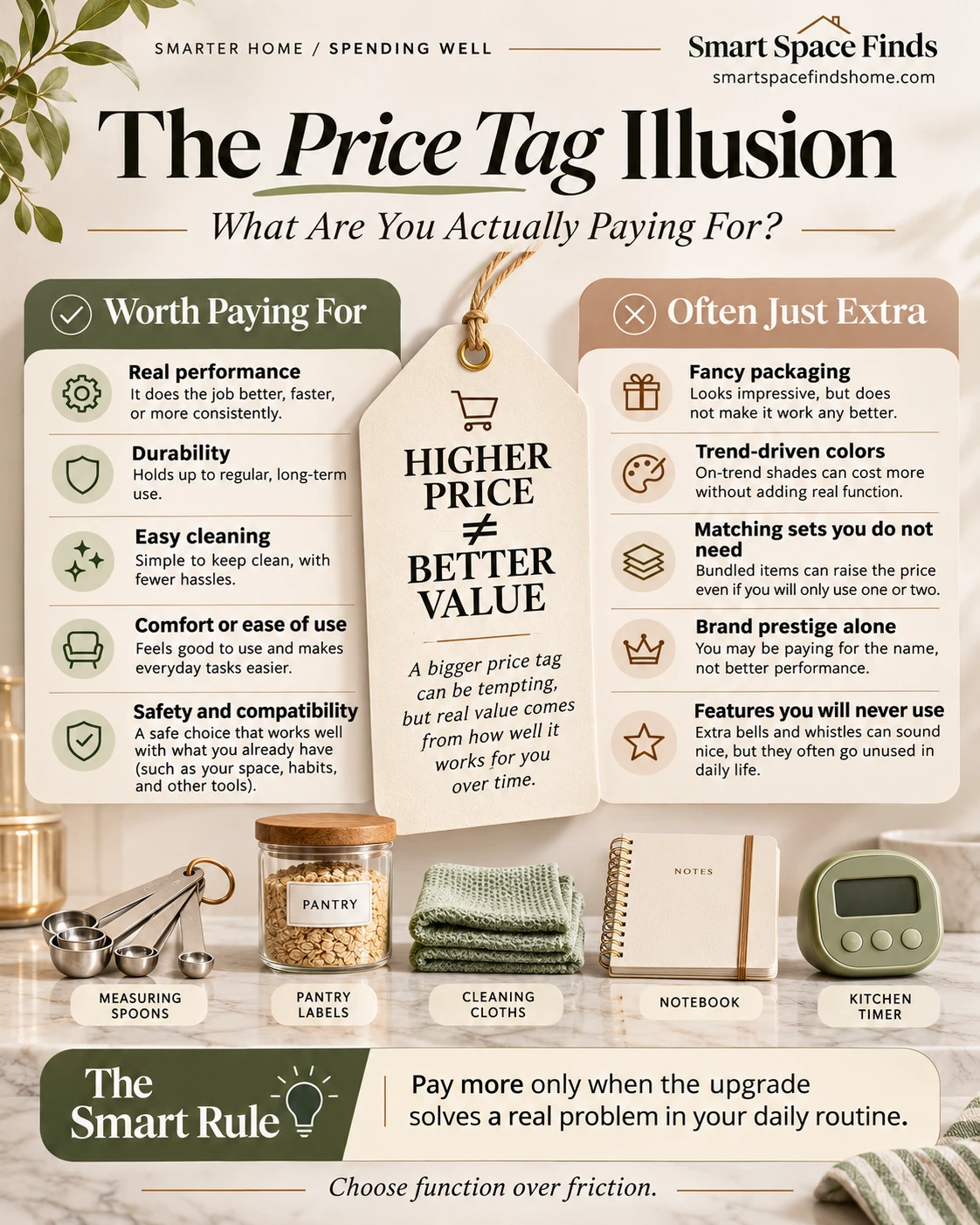
Price vs. Value: What Are You Really Paying For?
A more expensive product may offer improved materials, easier cleaning, stronger construction, a better warranty, or thoughtful accessibility features. It may also simply offer a fashionable color or branding. Those are different kinds of value, and only you can determine which matter in your daily routine.
Before comparing brands, list the two or three qualities you need. For a timer, that might be audible alerts and easy-to-read numbers. For a cleaning cloth, surface compatibility and easy laundering. Once those requirements are met, a higher price needs an identifiable reason to justify itself.
A useful distinction: “cheap” means a low upfront price; “good value” means the total benefit justifies the total cost over the time you use it. The cheapest product that immediately fails is not a bargain. Neither is an expensive product whose extra functions remain untouched.
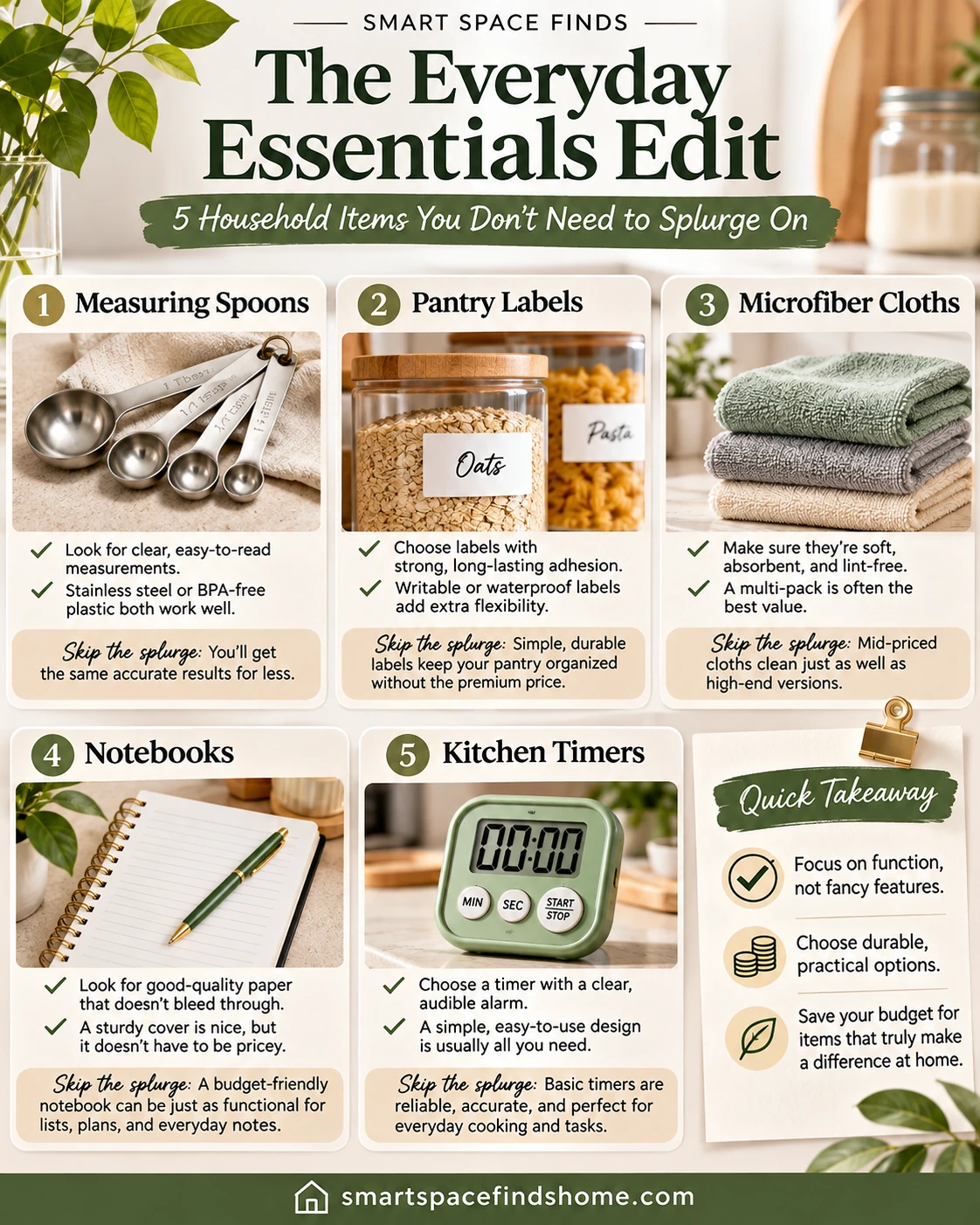
THE CONSIDERED HOME / 01
1. Basic Measuring Spoons
Measuring spoons are small workhorses, not display pieces. For most home cooks, a clearly marked set that measures reliably and fits into common jars is more useful than a large designer set with complicated storage.
What actually matters
Look for clearly legible measurements, comfortable handles, safe food-contact materials, and a shape that makes measuring and washing easy. Check that your set includes the increments your recipes use. If you often work with narrow spice jars, slim spoons may be worth prioritizing.
A modest set already has readable marks, is easy to clean and covers the measurements you use.
You bake frequently, need especially clear markings, prefer a sturdy material that withstands heavy use, or require a specific shape to fit narrow containers.
The smart-buy test: Try using the existing set for one week: do unreadable marks, awkward shapes or missing sizes actually interrupt your cooking? If not, there’s little reason to replace it.
THE CONSIDERED HOME / 02
2. Pantry Labels and Storage Stickers
A cohesive pantry looks lovely in photographs, but organization works only when people can find ingredients quickly. Labels are a tool for clarity—not a requirement to buy a complete matching container system.
What actually matters
Prioritize readable contrast, easy updates, appropriate adhesion for the container surface, and materials that hold up to how you clean and store containers. Include useful dates when needed; don’t let decorative typography make contents harder to identify.
A simple marker, existing masking tape, or basic labels already keep contents and dates clear.
Labels regularly peel in your environment, you need washable or reusable materials, or easy-to-read labeling is important for others who share the space.
The smart-buy test: Label one busy shelf first. If the system makes finding things easier after two weeks, expand gradually rather than buying a full-labeling kit on day one.

THE CONSIDERED HOME / 03
3. Everyday Cleaning Cloths
A large pack of premium-looking cloths is rarely the starting point for a better cleaning routine. The cloth needs to suit the surface, remove the kind of soil you’re tackling and survive regular washing.
What actually matters
Examine fiber type, absorbency, seams, laundering instructions and whether the cloth is appropriate for the particular finish. Some delicate surfaces and screens require specific approved cleaning methods; follow their manufacturers’ guidance.
Basic reusable cloths do the job, wash well, and don’t scratch or leave unwanted lint on your intended surfaces.
You need a specialized cloth for a delicate surface, sturdier construction prevents frequent replacement, or a specific textile performs better for repeated work.
The smart-buy test: Buy for the task rather than the marketing claim. Separate cloths used for different cleaning jobs, wash and dry them appropriately, and replace those that are damaged or no longer clean effectively.
THE CONSIDERED HOME / 04
4. Simple Notebooks and Shopping-List Pads
A notebook can be worth its weight in gold when it captures ideas before you forget them. But the most expensive notebook will not make a list more actionable. For everyday groceries, measurements or household reminders, accessibility and convenience usually win over a collector-worthy cover.
What actually matters
Choose a size that stays where you need it, paper that works with your usual pen, and binding that survives repeated handling. For tear-off lists, see whether you actually use the pages before buying a large decorative set.
You need quick lists and notes, use ordinary pens, and have no special paper requirements.
You need paper suitable for fountain pens, archival notes, heavy daily use or a binding format that supports your workflow.
The smart-buy test: Use an existing notebook until it is finished. If you routinely abandon it because it’s difficult to carry or use, note the reason before shopping for another.
THE CONSIDERED HOME / 05
5. Standalone Kitchen Timers
A timer earns its place when it keeps cooking and multitasking on track. Many kitchens already have a phone, oven or microwave with timing functions, so the first question is whether another device is necessary.
What actually matters
Look for a legible display, simple controls, an alert you can hear, practical placement and reliable power. If you run multiple cooking tasks, consider whether multiple simultaneous timers are truly necessary.
Your phone or appliance timer is easy to operate and already does everything you need.
You need hands-free access, a louder alert, a separate dedicated device, larger controls or multiple timers that your existing setup cannot provide.
The smart-buy test: Run a week of normal cooking using your existing timers. Note any missed alarms or awkward interruptions; buy a standalone model only if it solves a recurring issue.

The smartest purchase is not always an upgrade. Sometimes it’s realizing your current version already works.
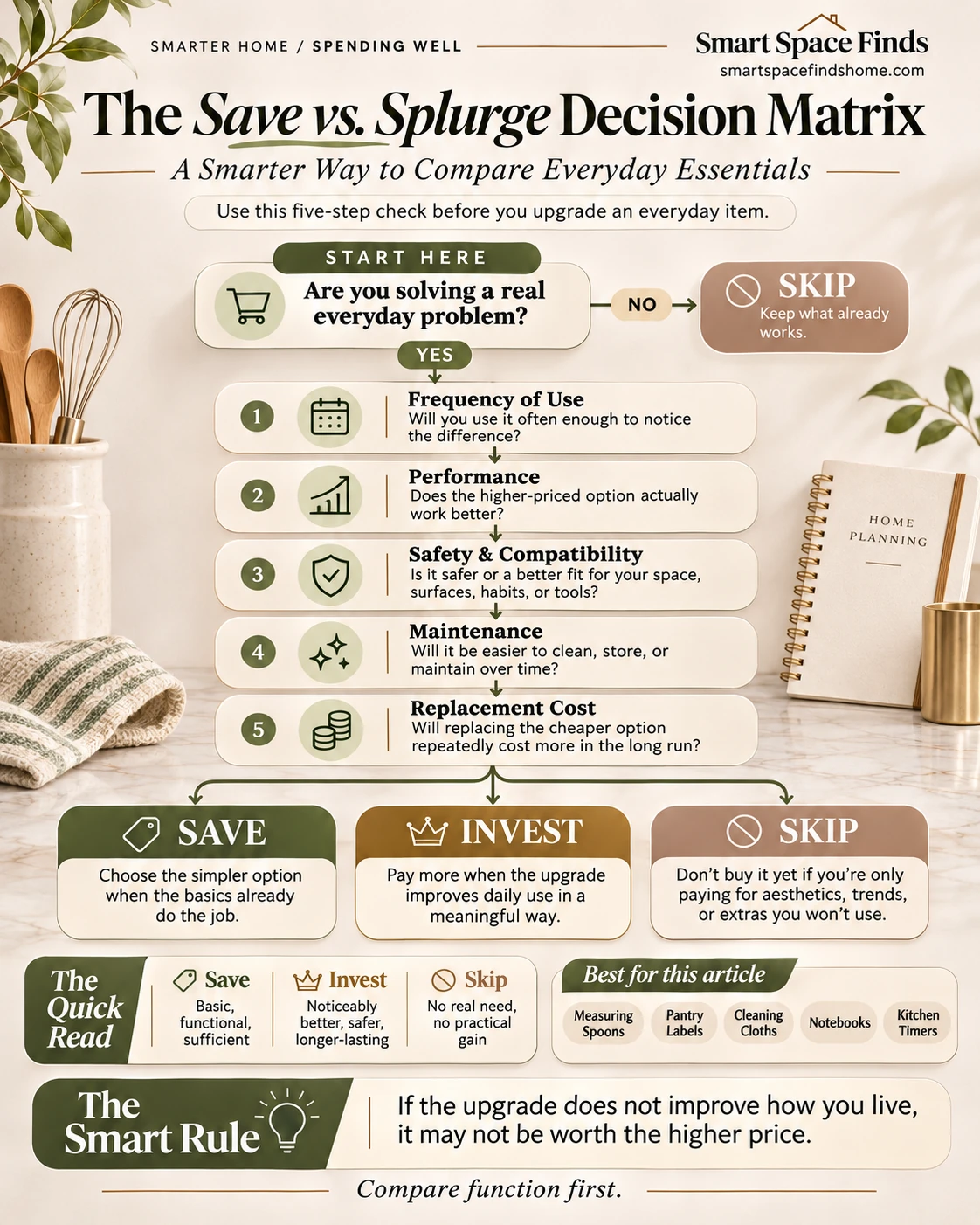
The Save-or-Splurge Matrix
Use this quick comparison before you add an everyday essential to your cart. It keeps the decision focused on observable benefits rather than a brand name or a limited-time promotion.
| Decision factor | Save if… | Spend more if… |
|---|---|---|
| Frequency of use | It’s occasional and the basic version meets your needs. | Heavy use makes durability or ergonomics valuable. |
| Performance | Both options do the required task reliably. | The difference measurably improves the result. |
| Safety & compatibility | Basic option is appropriate for the intended surface or food use. | Special conditions require a suitable, verified specification. |
| Maintenance | It cleans and stores easily without extras. | Higher-quality construction reduces ongoing problems. |
| Replacement cost | The inexpensive version lasts reasonably well. | Repeated failures make a longer-lasting choice cheaper overall. |
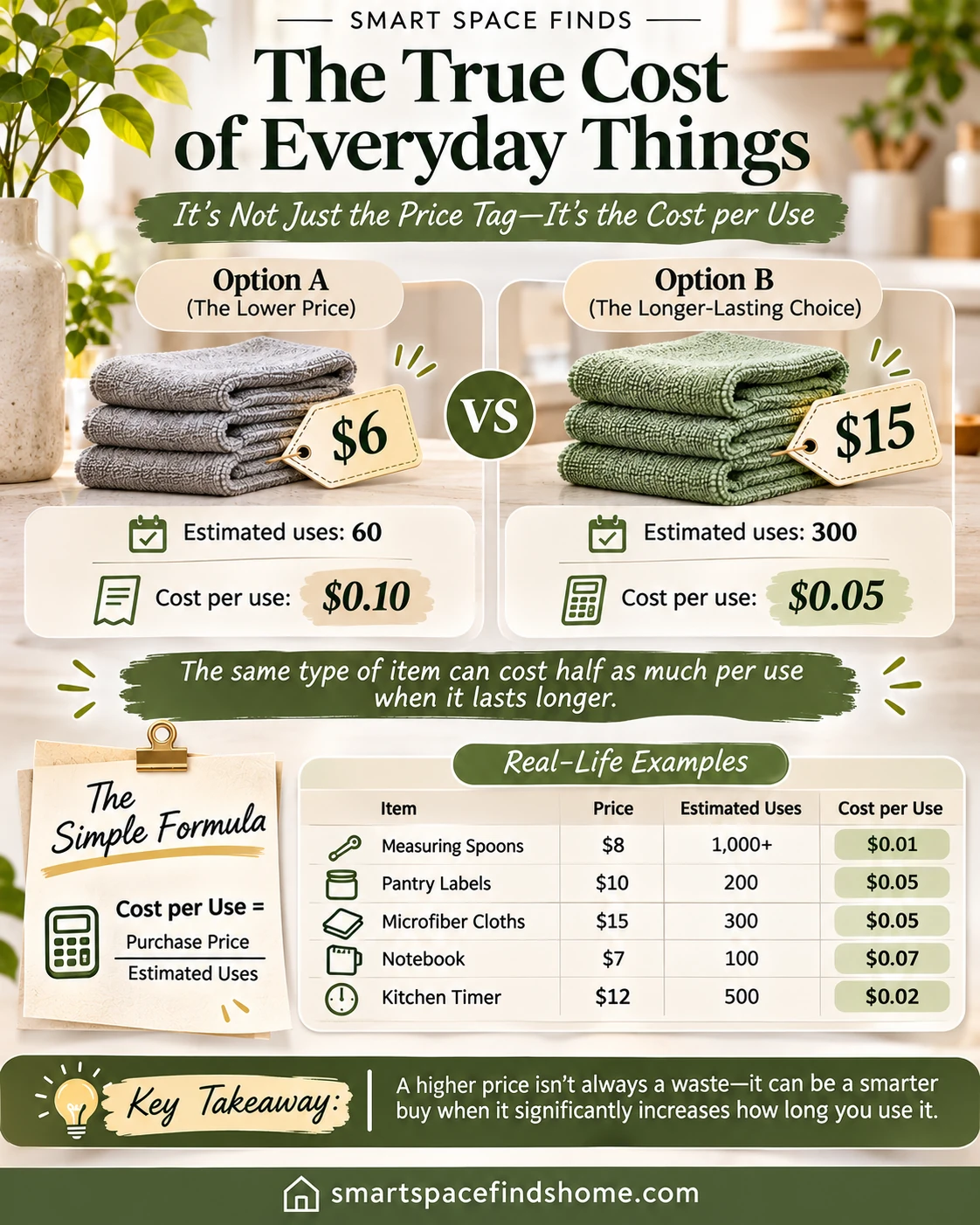
A Simple Way to Compare Long-Term Cost
Estimated cost per use = total purchase and upkeep cost ÷ expected number of uses. The formula is an estimate, not proof of product lifespan. Use realistic assumptions and consider the environmental cost of unnecessary replacement as well.
A $6 item used 60 times costs roughly $0.10 per use. A $15 item used 300 times costs roughly $0.05 per use. If the higher-priced option really lasts five times as long, it can be the better value—despite its bigger price tag. But durability must be supported by real experience or reliable product evidence, not assumed from price alone.
Editor’s Scenario: Two Timers, One Decision
Imagine a $9 timer and a $24 timer, both with clear displays. If the $9 option reliably alerts you while you cook, the extra $15 may purchase features you never touch. But if you routinely miss the quieter alarm and the higher-priced timer has a verified louder alert, that upgrade could be worthwhile. The prices here are fictional examples, not current retail offers.
The question to ask: Which problem does the extra money solve, and how often does that problem occur?
When Paying More Actually Makes Sense
This is not a rule against premium products. Better materials, accessibility, repairability, safety, and comfort can be worth the additional cost. A clear, loud timer can be essential to someone who struggles with quiet alerts; a well-designed measuring spoon can make repetitive work easier for someone with limited grip strength.
For products where safety or health are involved, start with relevant specifications and manufacturer guidance rather than bargain hunting. For low-stakes home basics, the appropriate question is simpler: does the added expense make a meaningful, repeatable difference?
Shop Your Home Before You Shop Online
Make a small inventory of what already works. A roll of removable tape might solve a short-term labeling need. A phone might replace a dedicated timer. A usable notebook may already be in a desk drawer. Reusing things you own avoids both a purchase and the friction of storing another object.
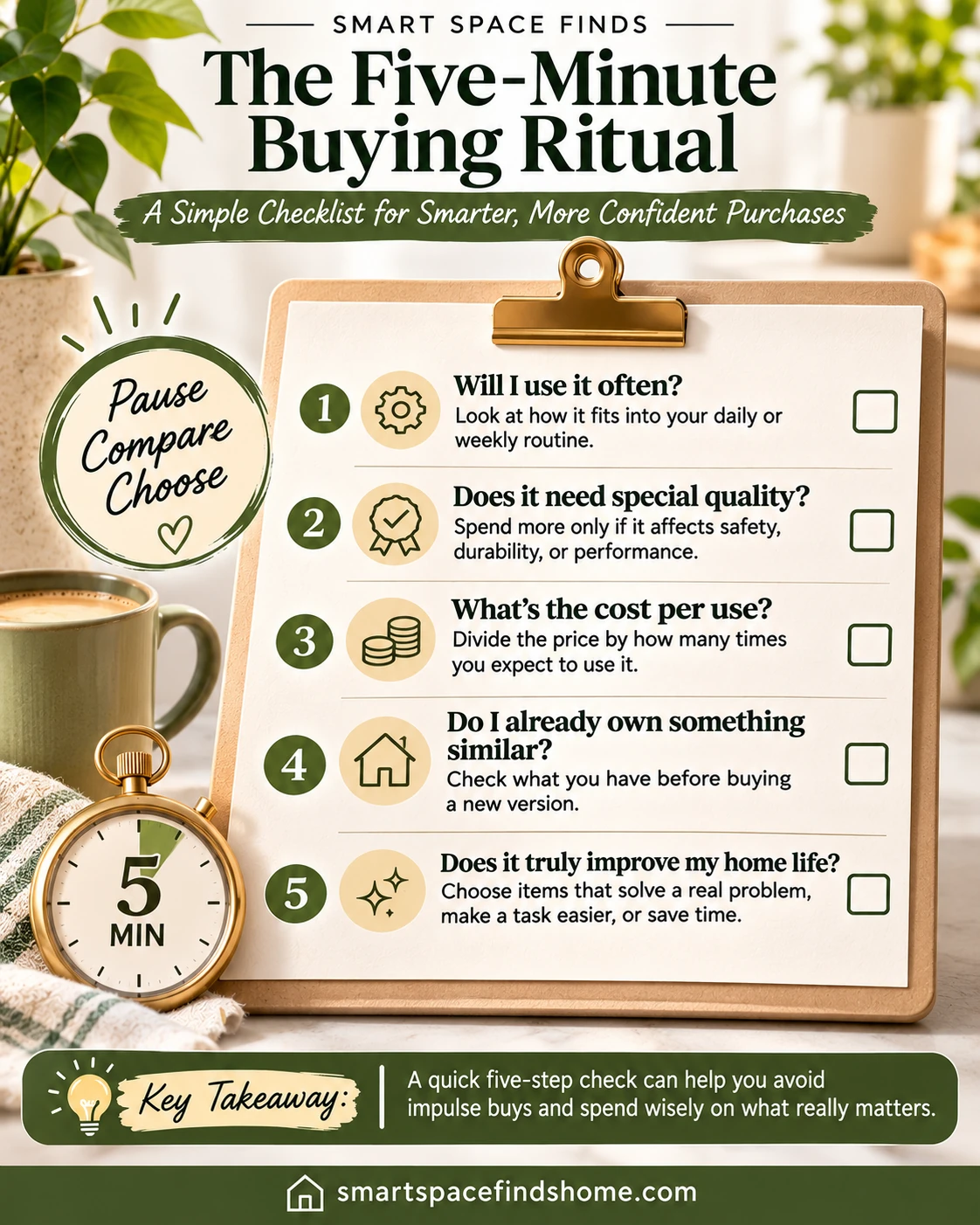
Your 5-Minute Buying Check
Before you buy, check each statement:
If you cannot check the first two, waiting may be more valuable than browsing another product page.
Where to Go Next
Frequently Asked Questions
Is a more expensive household item always better?
No. Evaluate the materials, intended use, construction, safety and useful features. A higher price alone doesn’t show a practical benefit.
What inexpensive kitchen items are often enough for daily cooking?
Basic measuring spoons and straightforward timers can be sufficient when they are easy to read, reliable and appropriate for the job. The right choice depends on your cooking routine.
How do I decide whether to save or splurge?
Identify a recurring problem, compare the features that solve it, and estimate total cost over time. Pay more only for an improvement you expect to use.
Can inexpensive cleaning cloths be as useful as premium cloths?
For many general tasks, yes. Check surface suitability, washability and performance rather than treating price as a quality guarantee.
Should I replace my current kitchen tools with matching sets?
Not unless you have a practical reason. A coordinated look can be enjoyable, but functional tools that already work need not be replaced.
This article compares purchasing criteria, not personally tested product models. Its examples are illustrative, and individual durability varies by material, use, care, and manufacturer.
The Bottom Line
The best everyday purchase is the one that fits your space, meets your actual needs and continues to earn its place. Choose functional quality over unnecessary extras, and remember: saving money can be as simple as keeping something you already own.
Editorial note: This guide provides general purchase-decision advice, not verified current discounts or product endorsements. Check current specifications, offers and suitability before purchasing.