

THE CONSIDERED HOME / SMART SHOPPING
The smartest upgrade isn’t always a more expensive one. It’s a useful, well-chosen object that outlasts the replacements—and that you’ll actually enjoy maintaining.
We all know the inexpensive purchase that didn’t stay inexpensive: the tote with a broken strap, the mop whose refill disappeared, or the bottle with a lid you can’t replace. Yet paying more is not a guarantee of quality, either. The real question is whether a purchase earns its place in your home over time.
In this guide, we focus on five everyday things worth buying once instead of replacing often—not because any item lasts forever, but because thoughtful construction, accessible care and replaceable parts can make repeated purchases less likely. You’ll also find a cost-per-use framework, a side-by-side comparison table and a short decision checklist.
What Actually Makes an Everyday Purchase Worth Keeping?
“Buy it for life” is a useful aspiration, but not an objective product guarantee. Material, assembly, design, intensity of use and access to repairs all matter. A durable object that is awkward to clean, too heavy to carry or impossible to store may be a poor purchase for your lifestyle.
Build quality
Look closely at stress points: hinges, stitching, fasteners, handles, seams and joints. These often tell you more than the finish.
Repairability
Can you replace the worn piece without discarding the whole item? Check actual parts and service availability before buying.
Routine fit
A good item must suit your space, habits, strength, cleaning needs and frequency of use—not an imagined ideal lifestyle.
Total ownership cost
Factor in care, replacement parts, shipping, expected uses and realistic lifespan instead of comparing stickers alone.
Expert product roundups sometimes emphasize long-term first-hand use and ongoing manufacturer support rather than relying on marketing claims alone; WIRED’s long-term product guide is one example of that approach. Warranties deserve a close look, but they are not durability certificates. Compare the covered components, exclusions, claim process and duration. The FTC’s warranty guidance explains why the details matter.
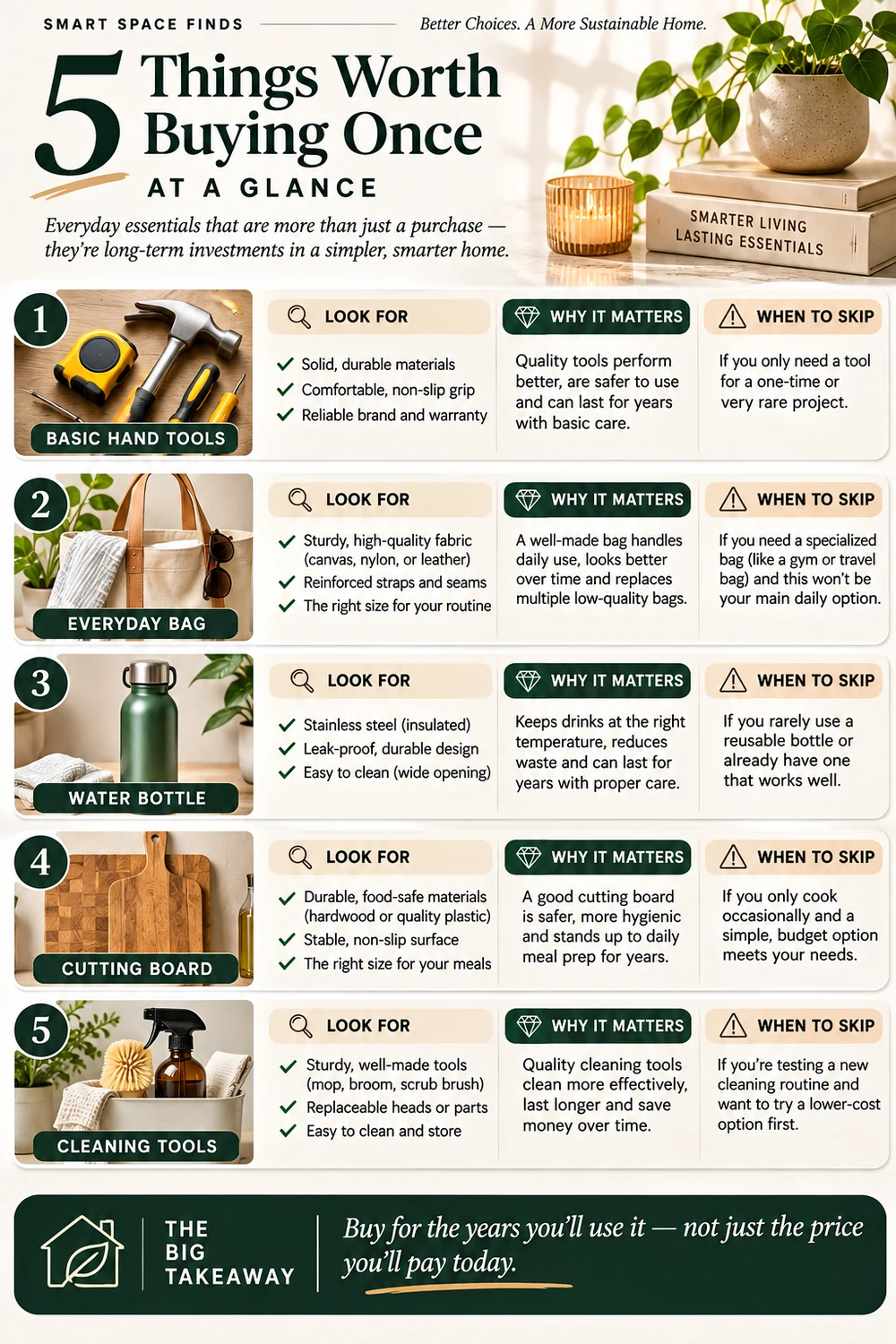
Five Things Worth Buying Once Instead of Replacing Often
01 / The quietly useful investment
1. A small, dependable hand-tool kit
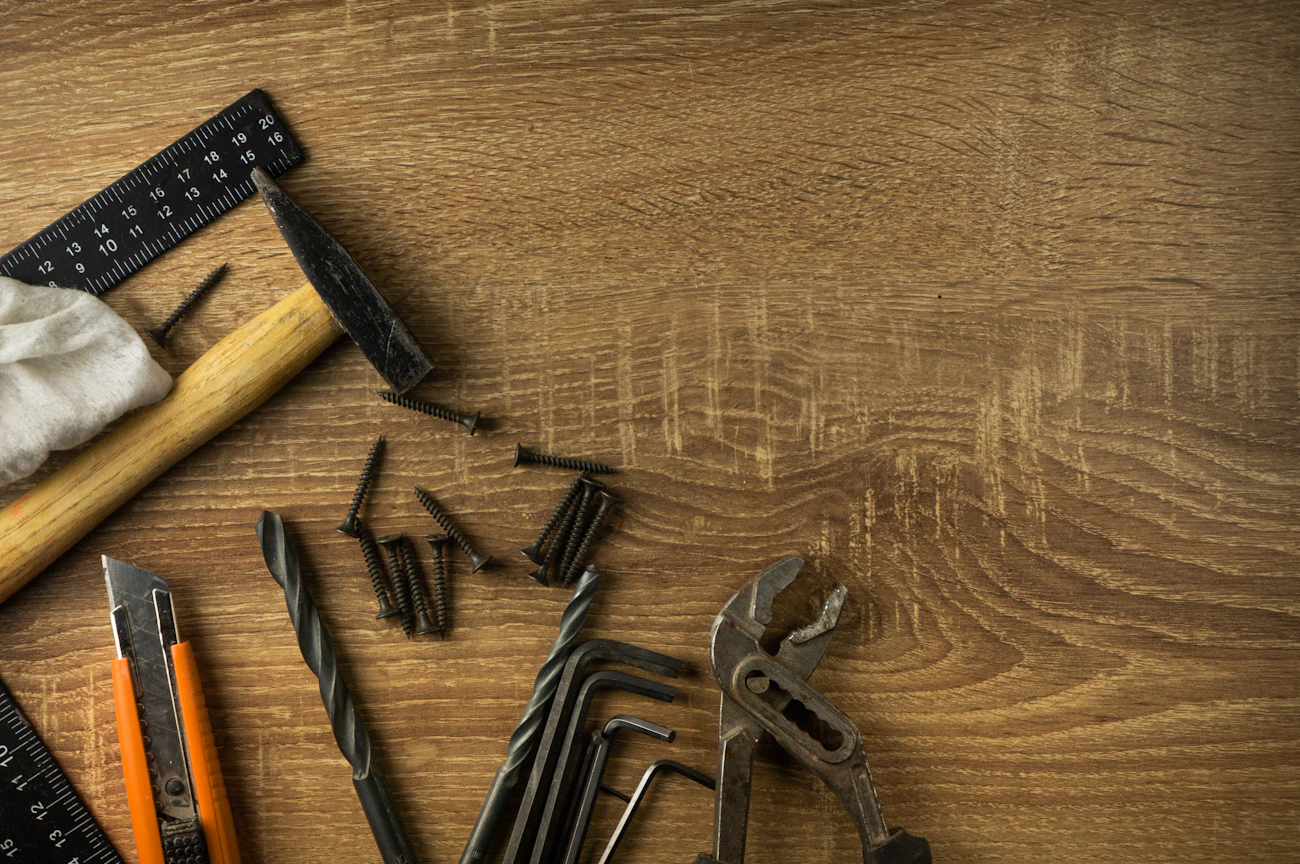
For basic household tasks, a comfortable screwdriver set, tape measure, claw hammer, pliers and a compact adjustable wrench can be more useful than a large, low-grade assortment. Choose the tools you actually need; a 100-piece kit offers little value if you use only four pieces.
Inspect before you buy: grip comfort, firmly seated heads, visible size markings, appropriate tool standards and whether individual pieces can be replaced. Avoid treating any general-use kit as suitable for electrical, structural or other hazardous work.
Make it last: dry tools after use, store them where they won’t rust and never substitute a damaged or unsuitable tool just to finish a job.
02 / The daily companion
The Essential Tool Edit
Thoughtfully chosen tools for common home tasks
Affiliate disclosure: As an Amazon Associate, Smart Space Finds earns from qualifying purchases. At no extra cost to you, purchases through these links may support our independent editorial work. Confirm the model, seller, availability, price and compatibility before ordering.
2. An everyday bag built around how you carry things
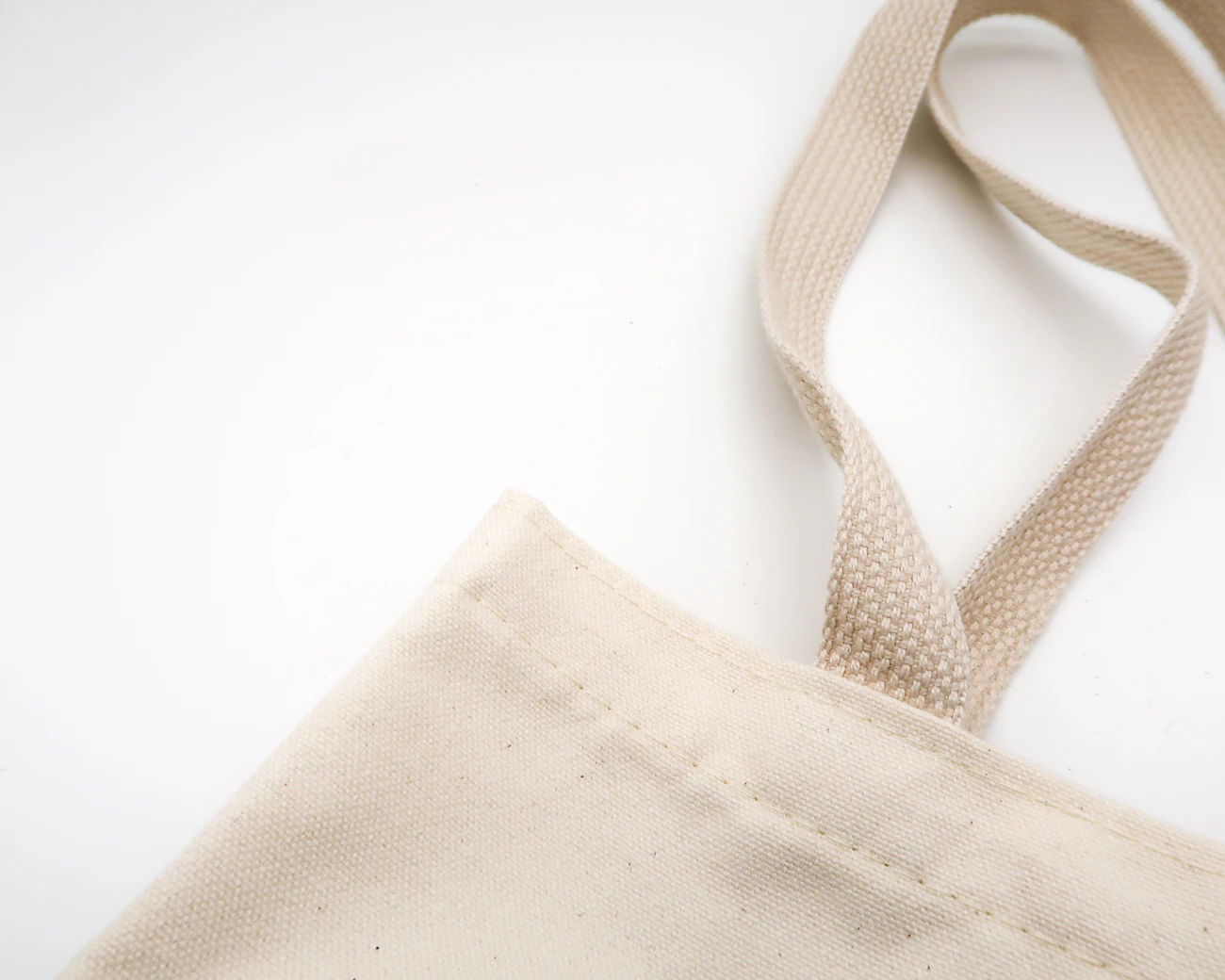
The difference between a bag you keep and a bag you replace often comes down to straps, stitching, zipper quality and comfort under your usual load. Reinforced stress points and an accessible repair service are worth investigating, but fabric type alone cannot prove durability.
Inspect before you buy: reinforced handles, zipper movement, accessible interior, wash or cleaning instructions, weight and whether the straps fit your body. Ask whether broken hardware can be replaced. Pay attention to what your actual commute or grocery run requires.
Make it last: stay within the manufacturer’s recommended load, treat stains promptly and repair small problems before seams separate further.
When to skip: If your current bag is structurally sound, replacing the zipper or strap may deliver better value than buying another one.
03 / The reusable essential
The Everyday Carry Edit
Compare comfort, everyday fit and repair-friendly construction
Affiliate disclosure: As an Amazon Associate, Smart Space Finds earns from qualifying purchases. At no extra cost to you, purchases through these links may support our independent editorial work. Confirm the model, seller, availability, price and compatibility before ordering.
3. A water bottle with replaceable lids and seals
A reusable bottle can be a genuinely practical purchase when you carry water regularly. But an expensive bottle isn’t automatically worth it: the cap, gasket and drinking spout may determine whether the bottle stays useful.
Inspect before you buy: compatible replacement lids, a wide enough opening for cleaning, leak-resistance appropriate to your bag, capacity, weight and manufacturer care instructions. Decide whether insulated or uninsulated construction actually serves your routine.
Make it last: clean bottle components according to the manufacturer’s instructions, dry parts fully and inspect seals for wear. Replace damaged components as recommended.
When to skip: If you already own a washable, leak-resistant bottle, upgrading for a fashionable color rarely improves its usefulness.
04 / The kitchen workhorse
The Reusable Hydration Edit
Compare cleanability, lid compatibility and capacity
Affiliate disclosure: As an Amazon Associate, Smart Space Finds earns from qualifying purchases. At no extra cost to you, purchases through these links may support our independent editorial work. Confirm the model, seller, availability, price and compatibility before ordering.
4. A cutting board that suits your cooking and cleaning habits
Cutting boards are a perfect example of why “buy once” should never override hygiene. A substantial wood board may be worth maintaining for everyday prep, while a dishwasher-compatible board may fit another household better. Neither material eliminates the need for careful cleaning or timely replacement.
Inspect before you buy: a stable work surface, manageable weight, dimensions that fit your counter and sink, finish and care instructions. For wooden boards, check what maintenance the maker recommends. For other materials, confirm temperature and dishwasher guidance.
Make it last safely: wash and dry as directed, avoid cross-contamination and replace boards with deep grooves or damage that cannot be adequately cleaned. USDA guidance recommends replacing excessively worn cutting boards.
When to skip: If an existing board is in good condition and can be cleaned properly, keep using it.

05 / The replaceable-part advantage
The Long-Life Kitchen Edit
Choose a board you can safely maintain
Affiliate disclosure: As an Amazon Associate, Smart Space Finds earns from qualifying purchases. At no extra cost to you, purchases through these links may support our independent editorial work. Confirm the model, seller, availability, price and compatibility before ordering.
5. Cleaning tools with widely available replacement heads
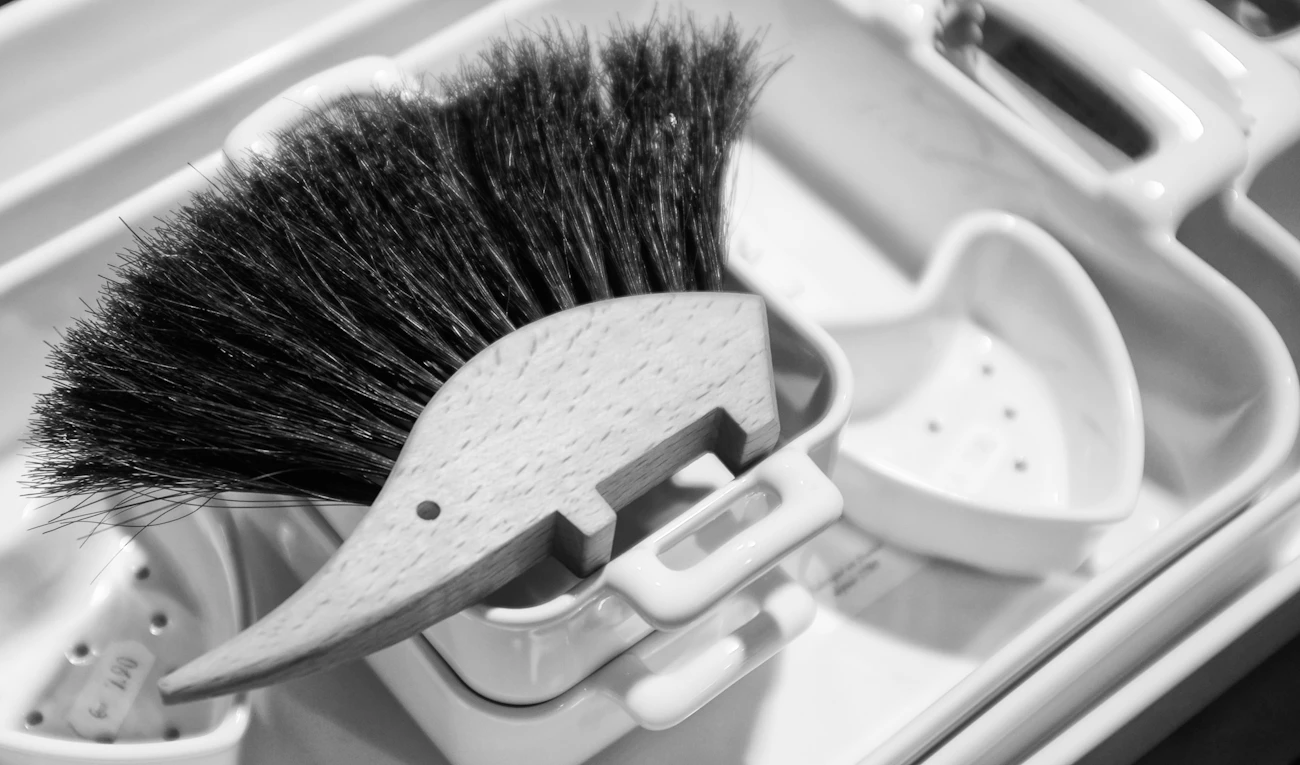
Cleaning equipment often fails economically when a single worn component forces replacement of the whole unit. A mop, brush or squeegee with replaceable heads can be useful—provided the replacement system is genuinely available and reasonably priced.
Inspect before you buy: a secure attachment mechanism, sensible handle length, washable heads where appropriate, head compatibility and replacement prices. Check whether the replacement part is sold separately in the US.
Make it last: clean and dry heads according to instructions, replace only worn consumable parts and store tools away from conditions that damage materials.
When to skip: If refills are proprietary, expensive or regularly out of stock, a simpler universally compatible tool may be a better choice.
The Cleaning Equipment Edit
Find durable systems with realistic refill options
Affiliate disclosure: As an Amazon Associate, Smart Space Finds earns from qualifying purchases. At no extra cost to you, purchases through these links may support our independent editorial work. Confirm the model, seller, availability, price and compatibility before ordering.
Repair Instead of Replace
Check refill compatibility with the model you already own
Affiliate disclosure: As an Amazon Associate, Smart Space Finds earns from qualifying purchases. At no extra cost to you, purchases through these links may support our independent editorial work. Confirm the model, seller, availability, price and compatibility before ordering.
The Everyday Durability Comparison
Use this as a screening tool, not as proof that an individual product will last a particular number of years.
| Category | What to prioritize | Potential hidden cost | When not to upgrade |
|---|---|---|---|
| Hand tools | Comfort, strength, replaceable individual pieces | Tools you rarely use | You can borrow the specialty tool |
| Everyday bag | Strap stitching, zippers, fit, repair support | Hardware or strap repairs | Your existing bag is repairable |
| Water bottle | Cleanability, lids, seals, comfortable size | Proprietary replacement lids | Your current bottle works |
| Cutting board | Stable surface, care fit, safe cleaning | Maintenance and eventual replacement | Current board remains hygienic |
| Cleaning tools | Common refills, strong connections | Expensive replacement heads | Refills are unavailable |
The Real Cost: A Better Way to Compare Two Purchases
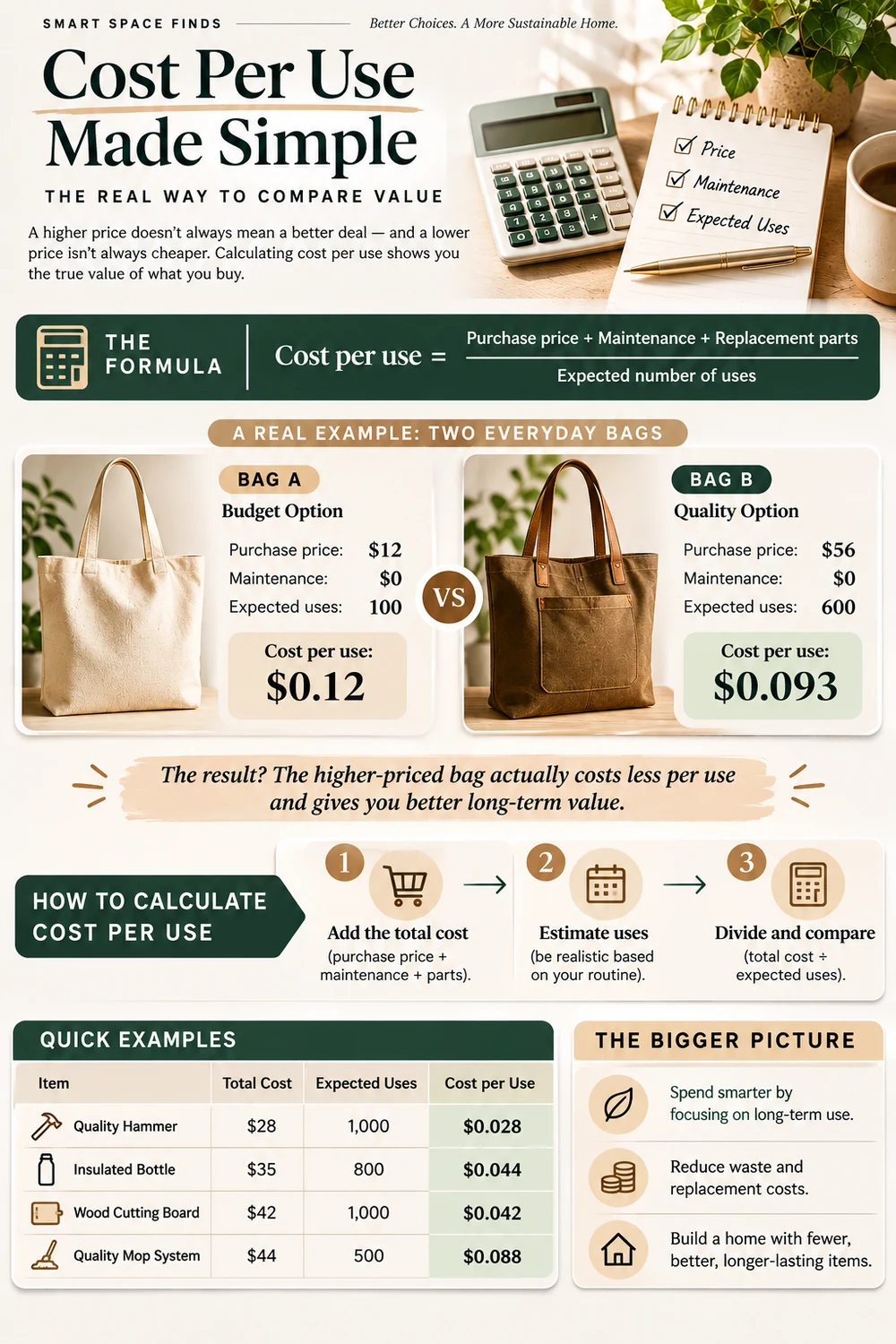
For frequently used items, cost per use makes the price tag easier to interpret. A slightly higher upfront cost can be worthwhile if the product provides many more useful uses, but only when your assumptions are realistic.
An example using hypothetical numbers
Imagine a $12 bag that you expect to use 100 times before replacing it. Its estimated cost is 12¢ per use. Another bag costs $48 and you reasonably expect 600 uses, plus an $8 zipper repair: its estimated cost is about 9.3¢ per use. That doesn’t mean the more expensive bag will achieve that lifespan—the estimate depends on real construction, use and maintenance.
| Illustrative option | Initial + care costs | Expected uses | Estimated cost/use |
|---|---|---|---|
| Inexpensive bag | $12 | 100 | $0.12 |
| Repair-friendly bag | $48 + $8 | 600 | $0.093 |
Numbers above are hypothetical illustrations, not tested product performance, market prices or lifetime claims. Add taxes, shipping and disposal costs when material to your purchase.
Also consider the break-even point
If the upgraded option costs $40 more, ask how many avoided replacements would actually repay that difference. The right answer changes when you use something weekly rather than daily, when parts are unavailable or when the replacement item you already own still works.
The 10-Point Durability Scorecard
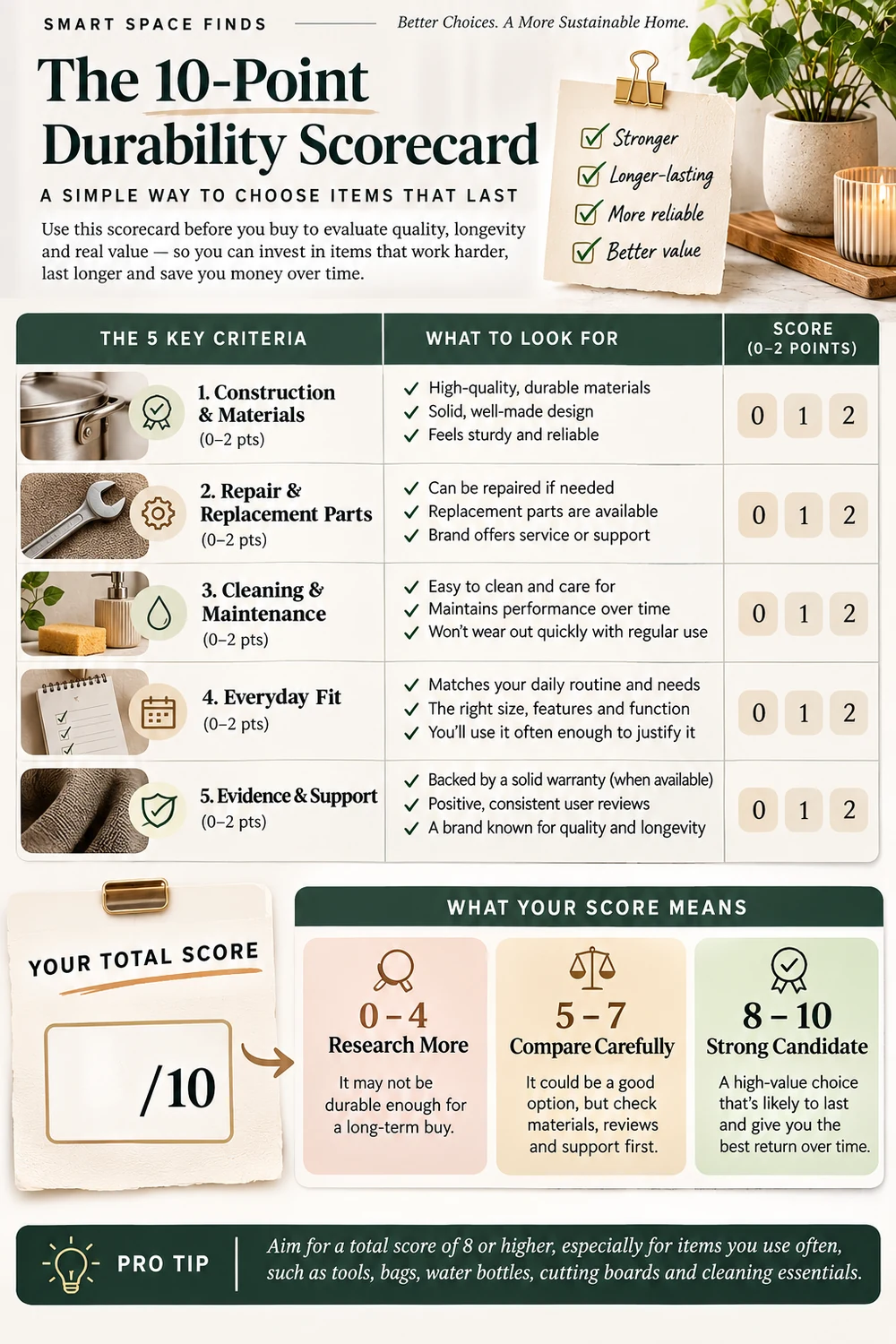
Before comparing specific products, rate each option from 0 to 2 points in each category below. This is a transparent shopping worksheet—not a laboratory rating or an endorsement. It helps you identify information still missing from the listing.
| Criterion | 0 points | 1 point | 2 points |
|---|---|---|---|
| Construction | Key details unclear | Some relevant specifications | Construction and stress points well documented |
| Repair & parts | No practical repair route | Limited repair options | Specific parts or repair services confirmed |
| Cleaning & care | Unsuitable for your routine | Requires some compromises | Realistically easy for you to maintain |
| Everyday fit | Rarely solves your problem | Occasionally useful | Fits a recurring need and your storage |
| Evidence & support | Only marketing claims | Some independent ownership evidence | Specific relevant evidence plus clear support terms |
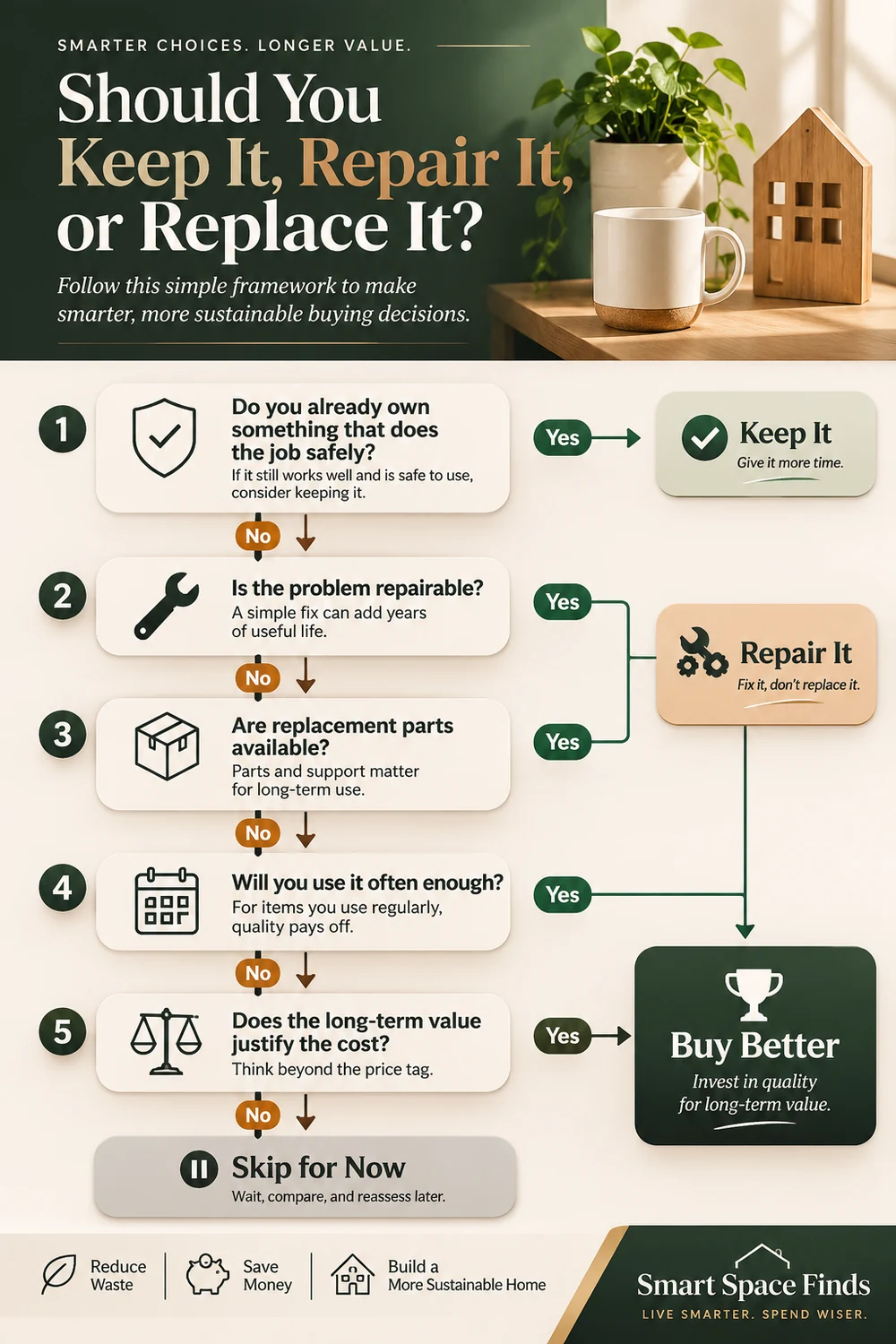
The 60-Second Buy-Once Decision Test
Before opening another shopping tab, answer the following in order. You don’t need a complicated scoring tool to make a clearer choice.
- KEEP: Does the item you already own still do the job safely?
- REPAIR: Is the failure limited to an affordable, replaceable part?
- FIT: Will the upgrade improve a repeated task in your actual life?
- VERIFY: Are the warranty, care instructions and parts genuinely accessible?
- BUY: Does the full expected ownership cost justify the change, without creating a financial strain?
Decision rule: Keep or repair first. Buy only when you can name the specific benefit and the durability evidence you checked.
Where Should You Save—and Where Could You Spend More?
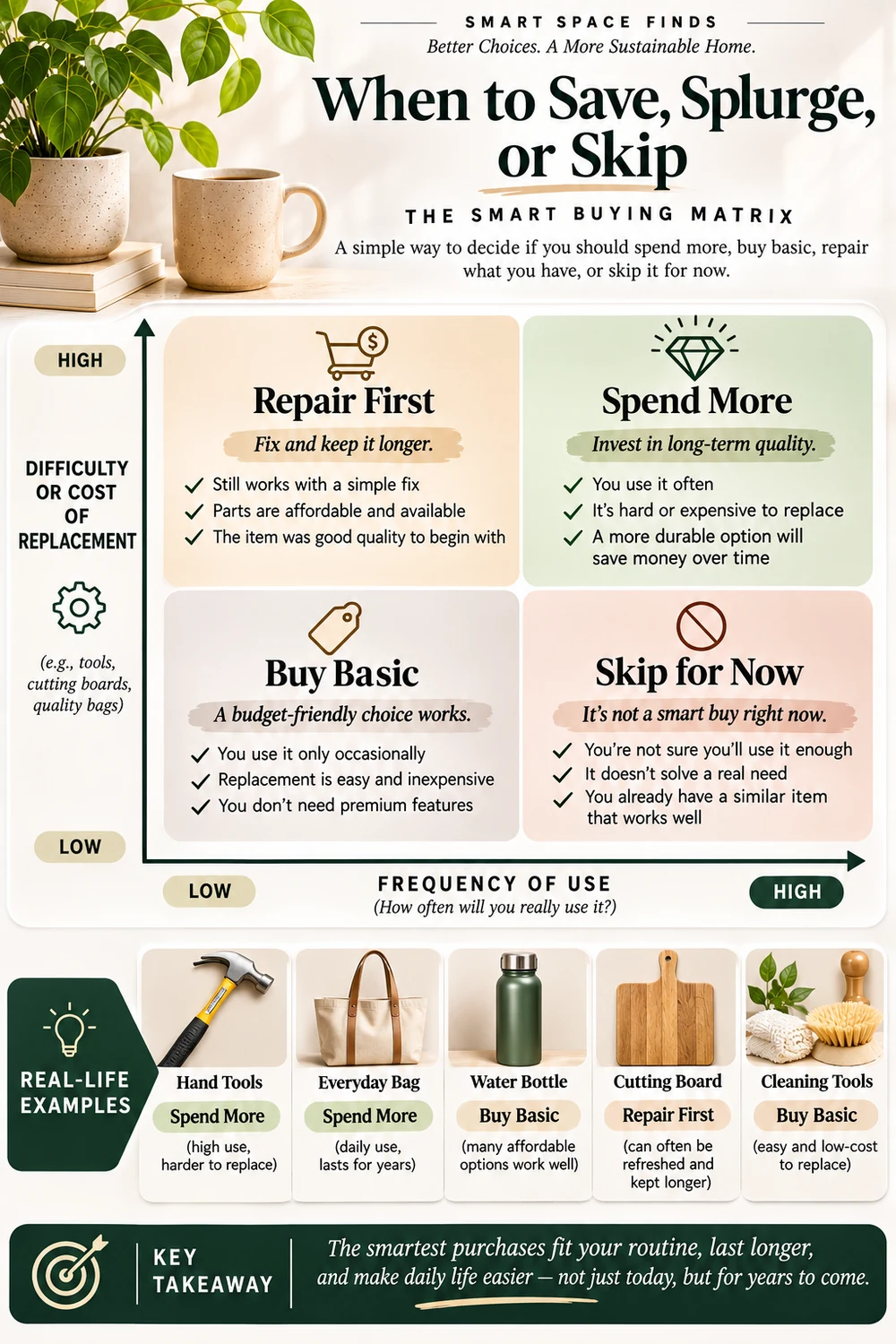
Spending more makes the most sense on high-frequency, difficult-to-replace or easily repairable items where quality differences matter. Spend less on infrequently used tools, trendy colors and decorative upgrades whose main appeal may disappear quickly. For safety-critical products, follow appropriate safety requirements instead of relying on price or aesthetics as shortcuts.
A smaller home adds one more consideration: storage is part of the cost. A tool too bulky to keep accessible will be used less, reducing its value. Consider practical ways to keep a small kitchen counter uncluttered before buying another appliance or countertop accessory.
Care Is Part of the Investment
A simple care routine can protect the value of items you already own. Store tools dry, inspect bag seams, clean bottle seals, maintain cutting boards according to material guidance and check that cleaning refills remain available. Save product manuals and note replacement-part model numbers when you purchase.
For a broader perspective, the EPA’s reducing and reusing guidance highlights reducing consumption and extending product use as practical ways to avoid waste.
Frequently Asked Questions
What products are genuinely worth buying once?
Start with frequently used household categories where construction, care and replaceable parts offer a clear advantage. Basic hand tools, repairable bags, water bottles, suitable cutting boards and refillable cleaning tools are useful categories to evaluate, but no product should be assumed to last forever.
Does buying a more expensive product always save money?
No. A premium price can reflect branding or styling rather than longevity. Compare total cost of ownership, evidence of reliability, repair access and how often you will actually use the item.
How do I tell whether a product is repairable?
Look for named spare parts, accessible repair documentation, replaceable fasteners or components and a realistic repair service. Verify that parts are currently available—not simply promised.
Is a wood cutting board always better than plastic?
No. Different materials suit different cleaning routines. Choose a board you can clean properly and maintain according to the maker’s guidance. Replace any board with damage or grooves that cannot be cleaned adequately.
How can I avoid impulse purchases?
Describe the problem before browsing, check what you own, compare at least two realistic alternatives and wait on nonessential purchases. A useful item doesn’t need artificial urgency to justify itself.
Are lifetime warranties the same as lifetime durability?
No. Warranties define specific contractual coverage and often contain exclusions. Read the duration, covered parts, claim process and any fees carefully.
Before You Shop: The Three-Choice Shopping Edit
Not every category deserves the same budget. Choose one primary item that fixes a frequent frustration, one repair or replacement part that may extend the life of something you own, and one purchase to postpone. This simple exercise keeps a considered home from turning into an expensive collection of “smart purchases.”
For a companion perspective, read five everyday household items you don’t need to splurge on. If you are balancing several priorities, explore ways to stretch a small household budget and when to save versus splurge on home purchases.
Our Editorial Method
This guide compares everyday categories using observable decision criteria: frequency of use, fit, stress points, cleaning, replaceable parts, documented warranty terms and total cost of ownership. We did not conduct laboratory durability testing, personally trial every product on the market or verify live Amazon offers for this article. The dollar examples are explicitly illustrative. We reference consumer guidance and avoid making unverified lifespan promises. Recommendations should be reassessed when specifications and parts availability change.
The Bottom Line: Buy Fewer Things, Choose Better Ones
A well-considered object is not a status symbol. It is something useful that fits your habits, can be cared for and makes everyday life easier long after the excitement of buying it wears off.
Editorial note: This article provides general purchasing guidance rather than independent laboratory product testing. Product availability, prices and repair policies change. No brand-specific durability guarantees are implied.