

THE SMART LIVING EDIT / MONEY & HOME
A limited budget doesn’t have to mean settling for a home that works poorly. When you know which expenses quietly repeat, which purchases genuinely solve daily problems, and which items you can reuse, every dollar can do more. Here are five practical ways to stretch your household budget without turning everyday life into a constant exercise in saying no.
THE QUICK ANSWER
To make a small budget go further: audit recurring costs, compare true unit prices, pause nonessential purchases, repair or repurpose safely, and buy only for a specific need. Start with the step that addresses your biggest recurring frustration—not with a shopping list.
What does “making a budget go further” actually mean?
It isn’t about buying the cheapest version of everything. It’s about getting more usefulness from the money, time, and space you already have. A $12 organizer that does nothing for your daily routine is more expensive in practice than a $25 solution you use reliably for years. And sometimes the most effective home upgrade costs nothing: moving a basket, using a shelf differently, or cancelling a service you’ve stopped using.
Focus on cost, frequency of use, lifespan, storage footprint and maintenance. These criteria help you distinguish genuine value from a bargain that becomes clutter.
1. Audit recurring expenses before cutting everyday comforts
Subscriptions, delivery fees, recurring household supplies and auto-renewing services can become invisible because each charge is relatively small. Review the last two or three months of statements and group recurring payments into essential, frequently used, occasionally used and no longer useful.
For example, two unused $9 monthly subscriptions add up to $216 a year if they continue for twelve months. This is an illustrative calculation, not a promise of savings. Check cancellation conditions and deadlines before changing anything.
- Open recent card or bank statements.
- Highlight repeat merchants and renewal dates.
- Ask whether you still use each service enough to justify it.
- Compare annual versus monthly costs only when the longer commitment is realistic.
- Record one action and its effective date.
Good to know: Don’t cut necessities or useful accessibility, safety or health-related services merely to meet an arbitrary target.
The Consumer Financial Protection Bureau’s spending assessment recommends looking across several months and accounting for irregular costs—not just the easy-to-spot monthly ones.
2. Compare unit prices—and account for waste
A larger container can offer a lower cost per ounce, but it only helps when you use the contents before they spoil and have room to store the package. Compare equivalent units, then consider freshness, storage and household size.
| Option | Package price | Quantity | Unit price |
|---|---|---|---|
| A | $3.60 | 12 oz | $0.30/oz |
| B | $5.00 | 20 oz | $0.25/oz |
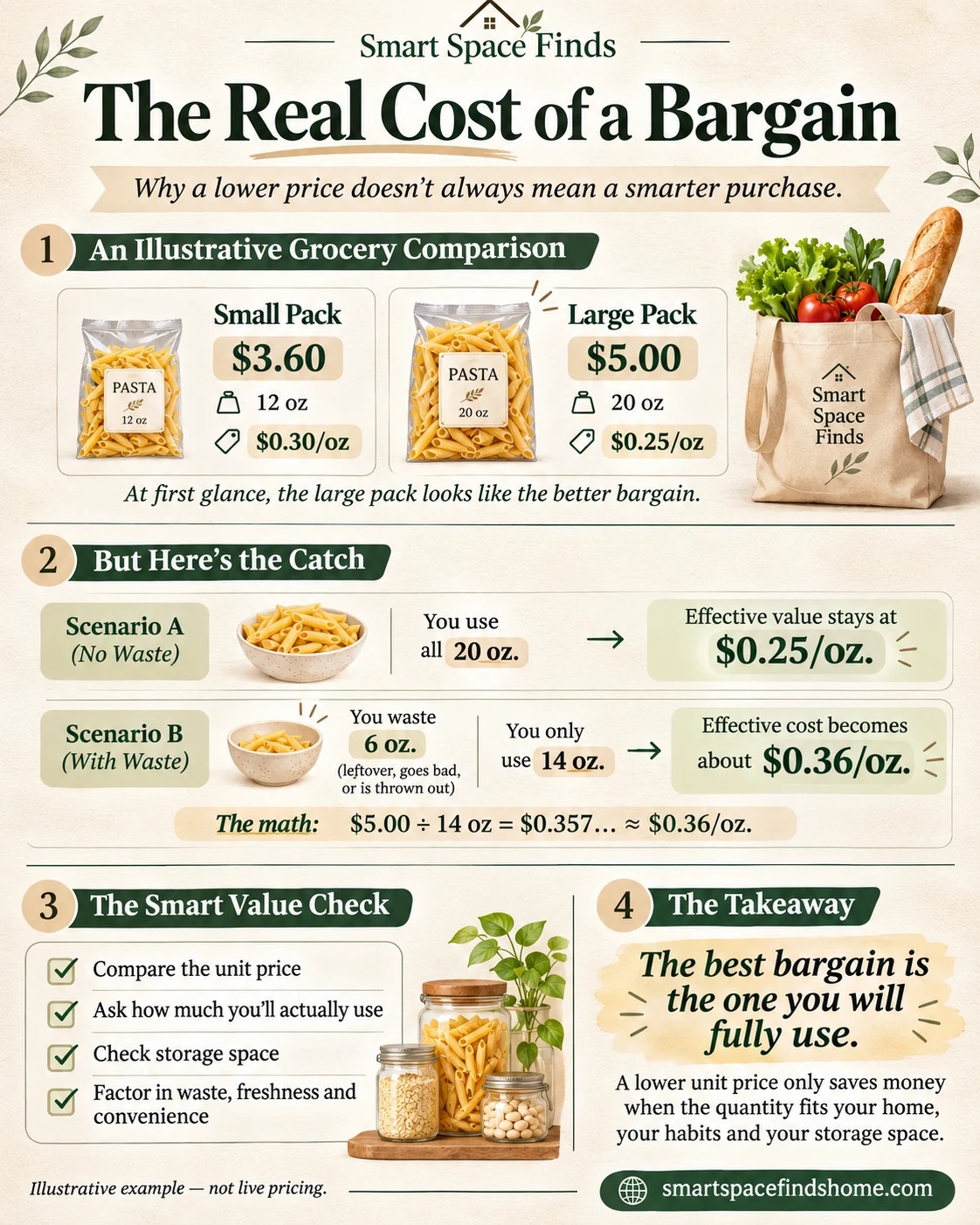
How to calculate it: divide the package price by the amount in the package. Option B has the lower unit price—but if you throw away a large portion, the real value disappears. This principle also applies to detergent, paper goods, refill packs and pantry staples. For more guidance, see Consumer Reports’ guide to unit pricing.
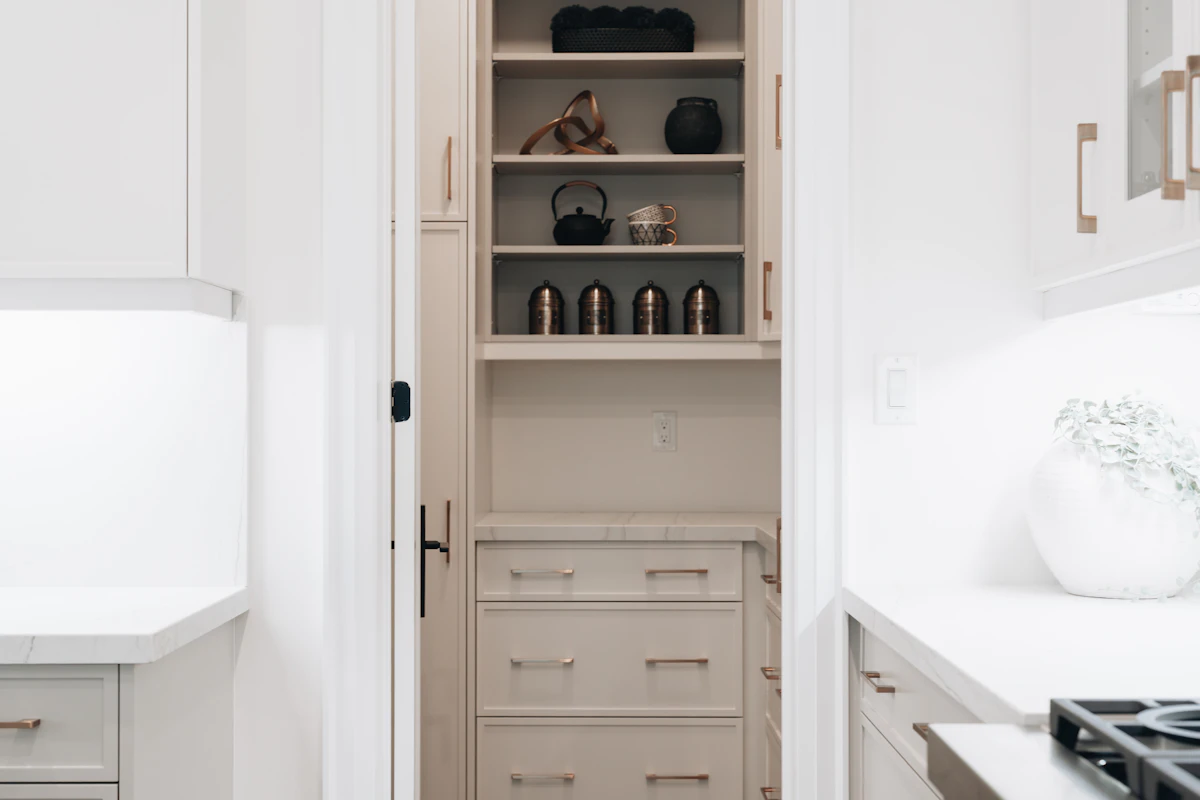
In a small kitchen, check available shelf depth, container height and how frequently you restock before bulk buying. A tidy, visible pantry is a practical savings system because it makes it easier to use food you already own.
The Food Storage Edit
Choose containers only when they solve a recurring food-storage problem; check capacity, pantry space and what you already own.
Affiliate disclosure: As an Amazon Associate, Smart Space Finds earns from qualifying purchases. Product availability and prices can change. Buy only what genuinely suits your space and budget.
3. Give nonessential purchases a realistic waiting period
Before buying a decorative accessory, gadget or duplicate kitchen tool, add it to a “consider later” list. Write down the price, the specific problem it solves and where it will live. Return to the list after 24–48 hours, or longer for a larger purchase.
The purpose is not to delay urgent essentials. It’s to make room for comparison and let short-lived enthusiasm settle. A waiting period is especially useful when you’re shopping after seeing a beautiful room photo or a limited-time promotion.
Item: __________ | Total delivered cost: __________
Problem it solves: __________________________________
Review date: __________ | Alternative I own: __________
For a home decor refresh, first try shifting a lamp, changing the arrangement of books or moving an existing textile between rooms. Interior designers interviewed by Apartment Therapy describe ways to restyle rooms without buying new objects.
4. Repair, rearrange or repurpose before replacing
A broken drawer handle, worn basket label or awkward storage arrangement doesn’t always require a replacement product. Check whether the issue is cosmetic, functional or safety-related. A simple repair can extend an item’s useful life; a different location can make something you already own more convenient.

Try these low-cost home fixes first
- Kitchen: group duplicate utensils and move everyday tools within easy reach before buying another organizer.
- Entryway: repurpose a shallow dish for keys or relocate hooks already in the home.
- Closet: test a different folding method and clear one shelf before ordering dividers.
- Living room: adjust furniture placement and lighting before buying additional decor.
Safety comes first. Leave electrical, gas, structural, hazardous-material and other safety-critical repairs to qualified professionals. For rental homes, check lease terms before drilling or making permanent changes.
The Repair-Before-Replacing Edit
For cosmetic wear and ordinary minor fixes only; seek a qualified professional for electrical, structural or otherwise unsafe repairs.
Affiliate disclosure: As an Amazon Associate, Smart Space Finds earns from qualifying purchases. Product availability and prices can change. Buy only what genuinely suits your space and budget.
5. Buy for a real gap—not for an imagined perfect home
Shopping is most helpful when a specific recurring annoyance is already documented. Rather than browsing a hundred “must-have” products, identify one friction point and describe the outcome you need.
| Daily problem | Try without buying | Consider buying only if… |
|---|---|---|
| Food gets forgotten | Rearrange shelves and label leftovers | A measured clear bin improves visibility |
| Kitchen drawers jam | Remove duplicates and regroup tools | A correctly sized divider solves a repeated issue |
| Keys get lost | Use an existing dish near the door | A renter-safe hook has a clear location |
| Cleaning supplies scatter | Assign one shelf or existing tote | A compact caddy fits the cabinet and routine |
For practical inspiration, explore our guides to versatile kitchen tools for small spaces and bathroom storage in tiny spaces. Always check the actual dimensions, installation method and return terms before purchasing.
The Clear-Space Storage Edit
Visible bins and drawers can reduce duplicate purchases when they make existing supplies easier to find. Measure shelves before choosing a set.
Affiliate disclosure: As an Amazon Associate, Smart Space Finds earns from qualifying purchases. Product availability and prices can change. Buy only what genuinely suits your space and budget.
The five-minute household value worksheet
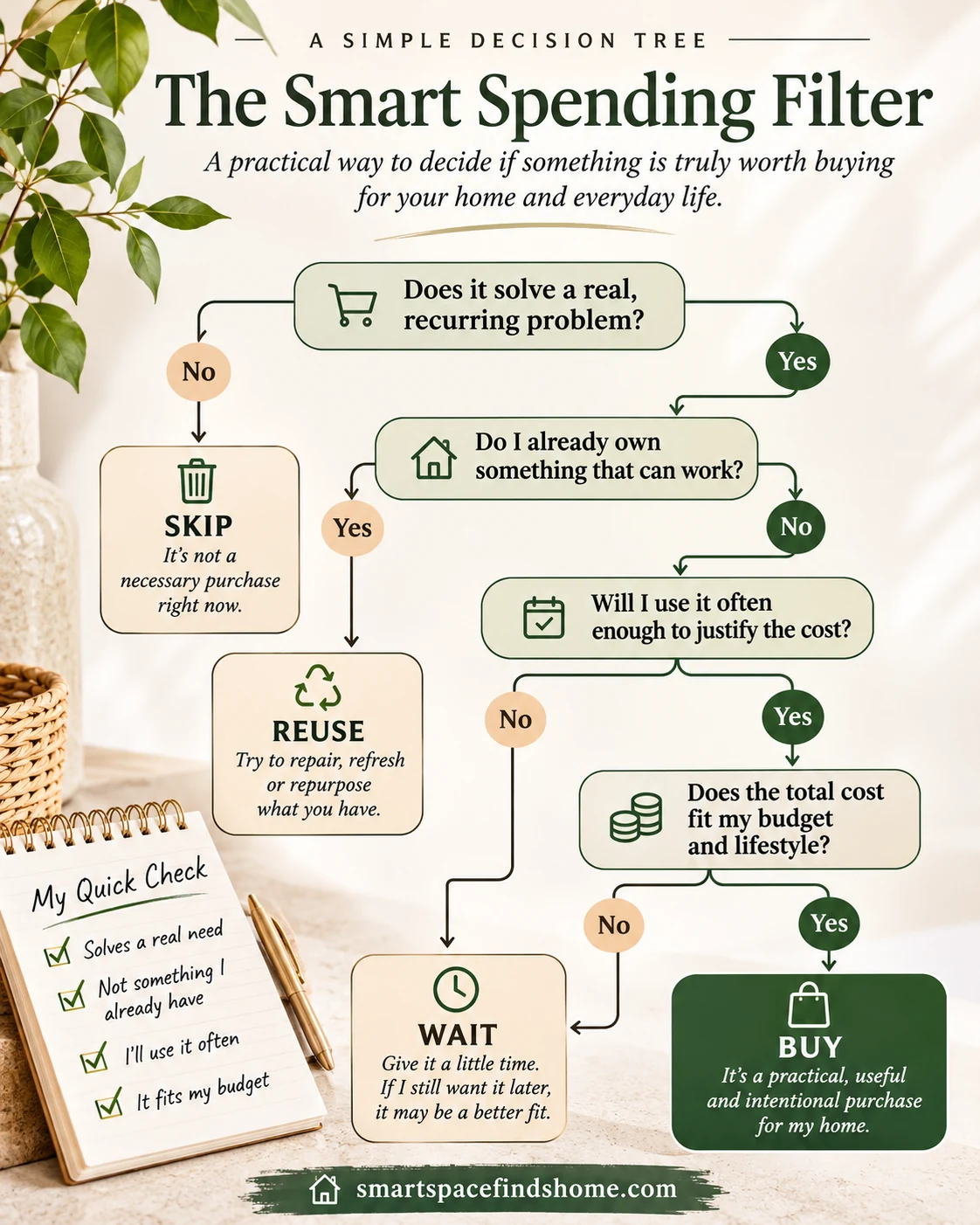
Use this short framework whenever you’re considering a nonessential home purchase. The best answer may be “buy,” “wait,” “reuse” or “skip.”
01 — Define the need. What repeated problem am I trying to solve?
02 — Check what I own. Can something be moved, repaired or repurposed?
03 — Estimate true cost. Include tax, delivery, consumables and upkeep.
04 — Test the fit. Will it physically fit and be easy to maintain?
05 — Decide deliberately. Buy now, revisit on a date or remove from the list.
A simple cost-per-use example
Imagine a $30 item you realistically expect to use 150 times: $30 ÷ 150 = $0.20 per use, before maintenance or replacement costs. That doesn’t automatically make it a good purchase. A lower cost per use matters only when the object is useful, affordable and appropriate for your space.
The Everyday Organization Edit
Start with measurements. Hooks, spice risers and shelf organizers are worth considering only when they fit the space and solve a daily issue.
Affiliate disclosure: As an Amazon Associate, Smart Space Finds earns from qualifying purchases. Product availability and prices can change. Buy only what genuinely suits your space and budget.
Where to spend a little more—and where to save

Choose durability or fit over the lowest sticker price when failure would create substantial inconvenience or a safety concern. Save on purely decorative accessories when you already have objects that can be restyled. For storage, measurement and compatibility matter more than a premium finish. No single shopping rule applies to every household.
The Bigger Storage Investment Edit
These larger organizers are optional, not essentials. Compare size, storage capacity and household needs before spending more.
Affiliate disclosure: As an Amazon Associate, Smart Space Finds earns from qualifying purchases. Product availability and prices can change. Buy only what genuinely suits your space and budget.
A seven-day small-budget reset
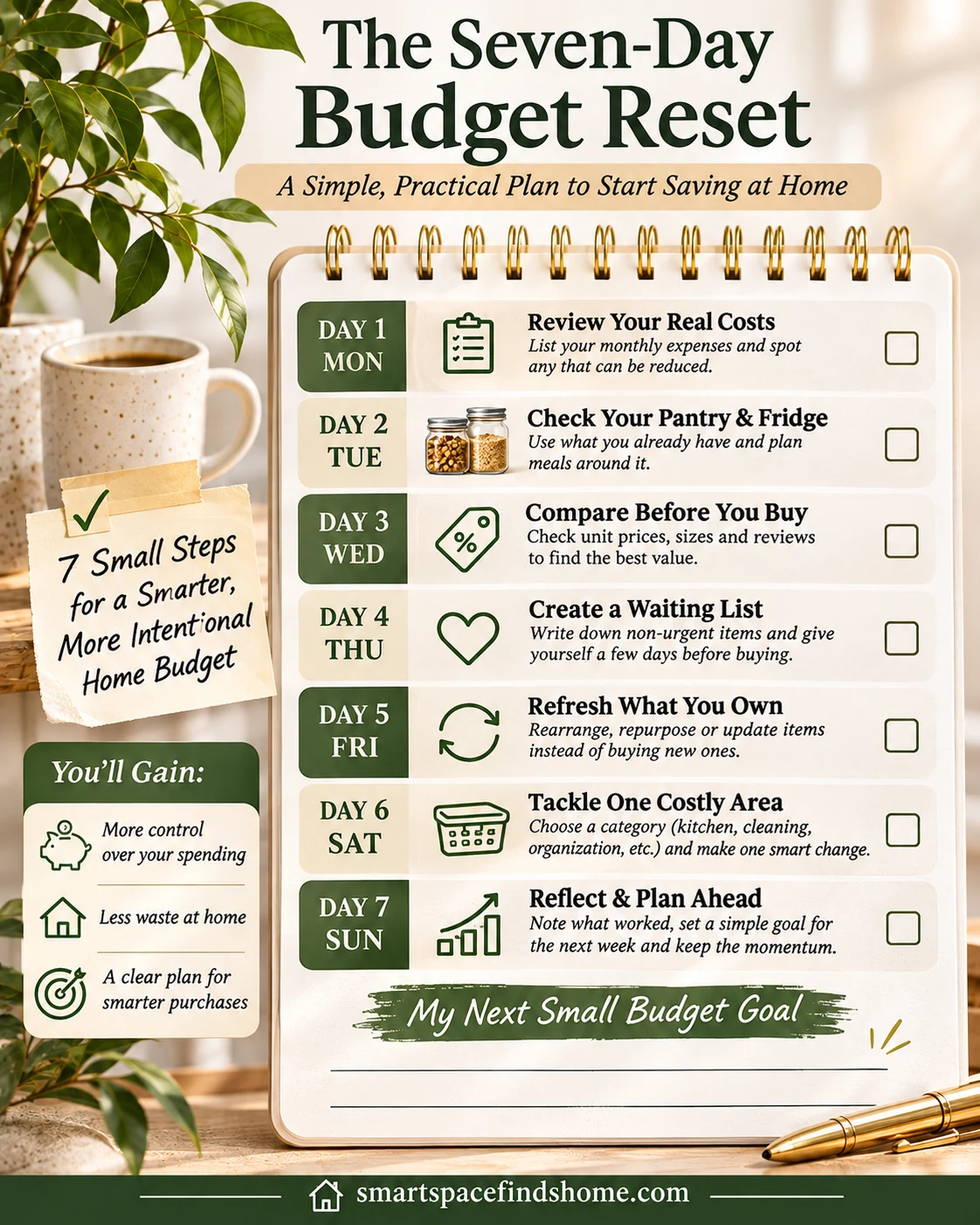
- Day 1: identify three recurring charges.
- Day 2: inspect your pantry and fridge before making a grocery list.
- Day 3: compare unit prices on one regular staple.
- Day 4: create a waiting list for nonessential purchases.
- Day 5: improve one cluttered area using only what you own.
- Day 6: measure a frustrating space and write down its exact problem.
- Day 7: review what helped and choose one habit to keep.
Frequently asked questions
What is the easiest way to stretch a small household budget?
Begin with one recurring expense and one repeated home problem. Small, observable changes are easier to sustain than a total lifestyle overhaul.
Is bulk buying always cheaper?
No. Compare price per equivalent unit, then factor in spoilage, storage space and whether the larger quantity will actually be used.
How long should I wait before an impulse purchase?
A day or two can help for small, nonessential items. For larger purchases, use a longer review period that suits your circumstances. Essentials and time-sensitive needs may require immediate decisions.
How can I decorate a small home on a budget?
First rearrange furniture, restyle items you already own, edit visual clutter and improve the placement of existing lighting. Then purchase only what clearly fills a remaining gap.
Are budget home organizers worth buying?
They can be when they fit the space and remove a recurring inconvenience. Measure first and assess whether reorganizing existing storage would work just as well.
Does buying the cheapest product always save money?
No. Compare quality, expected lifespan, safety, maintenance costs and realistic frequency of use alongside the initial price.
Spend with intention. Make room for living.
The takeaway: make room for what matters
A smart budget is not a punishment. It’s a way to protect your resources for the things that genuinely improve daily life. Start with one recurring expense, one useful comparison and one small home problem. You don’t have to buy anything to begin.
Editorial note: Example prices and calculations are illustrative, not live product offers or individualized financial advice. Verify current prices, terms and product details independently.