
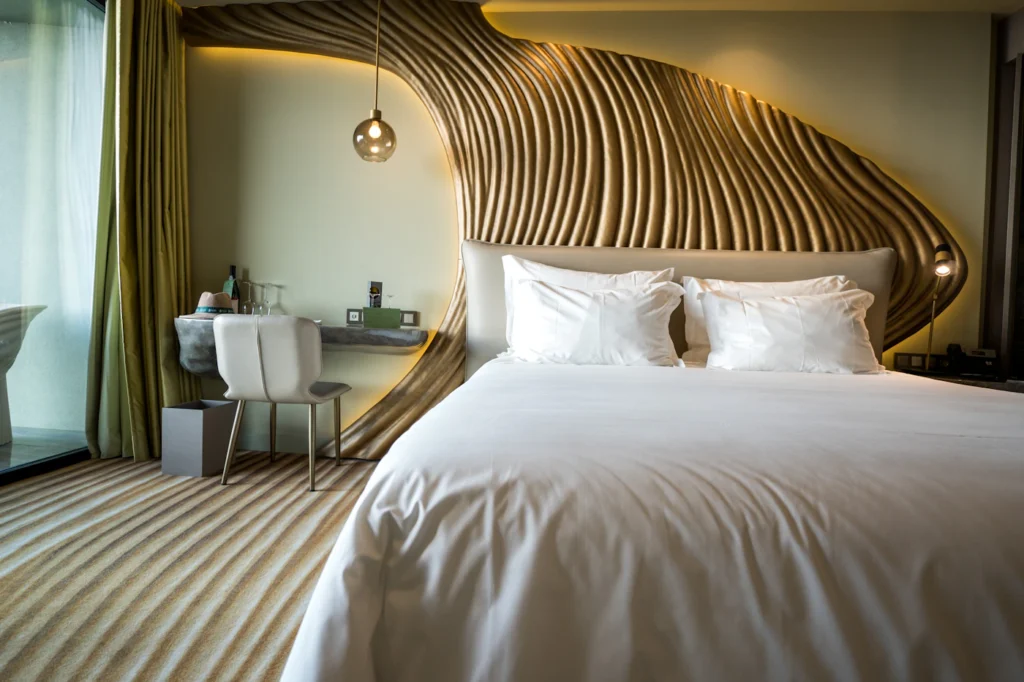
 The Private Boutique Suite — Photography: Antonio Araujo / Unsplash.
THE PRIVATE BOUTIQUE SUITE · DESIGN GUIDE
There is a moment in a beautifully designed boutique hotel when your shoulders drop. You put down your bag, find the reading light without searching for a switch, and notice that the room has already made space for you. The luxury isn’t simply in the furnishings. It’s in how quietly everything works.
You can bring that feeling into your own home without buying a new bedroom set or turning your space into an anonymous showroom. Begin with the experience you want—better rest, a softer evening, an easier morning—and make a few intentional changes around it.
The boutique hotel difference: design for the guest experience
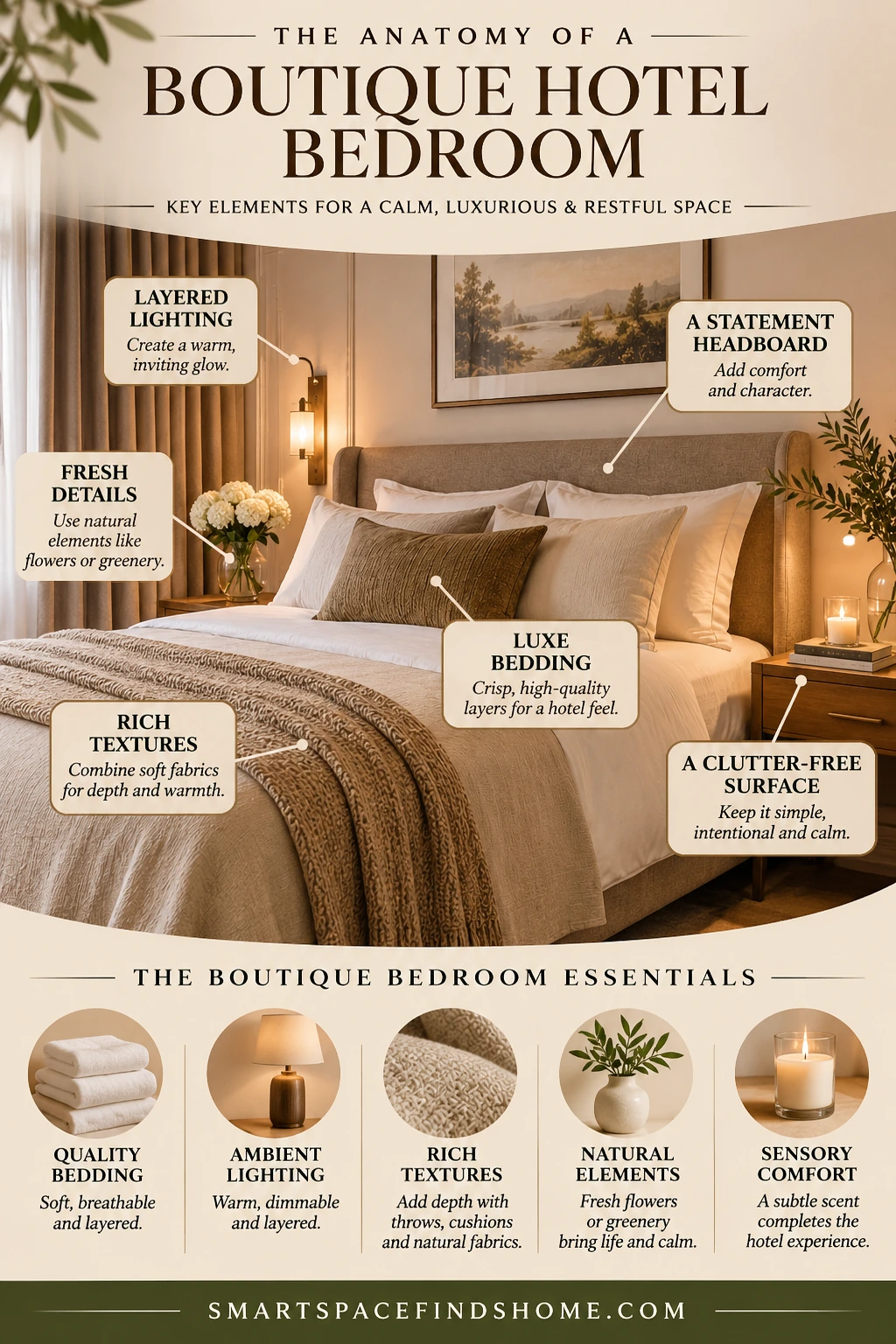 THE BOUTIQUE SUITE FORMULA — Four principles for a beautifully considered room.
Stand at your bedroom doorway for a moment. Instead of asking whether the room looks expensive, ask three questions: Where does my eye settle? Where would I put my belongings? What feels easy—or inconvenient—at bedtime? Your answers are more valuable than a shopping cart full of decorative accessories.
The most convincing boutique bedrooms usually have four qualities: a clear visual focal point, touchable materials, flexible lighting, and practical hospitality. None requires a particular room size.
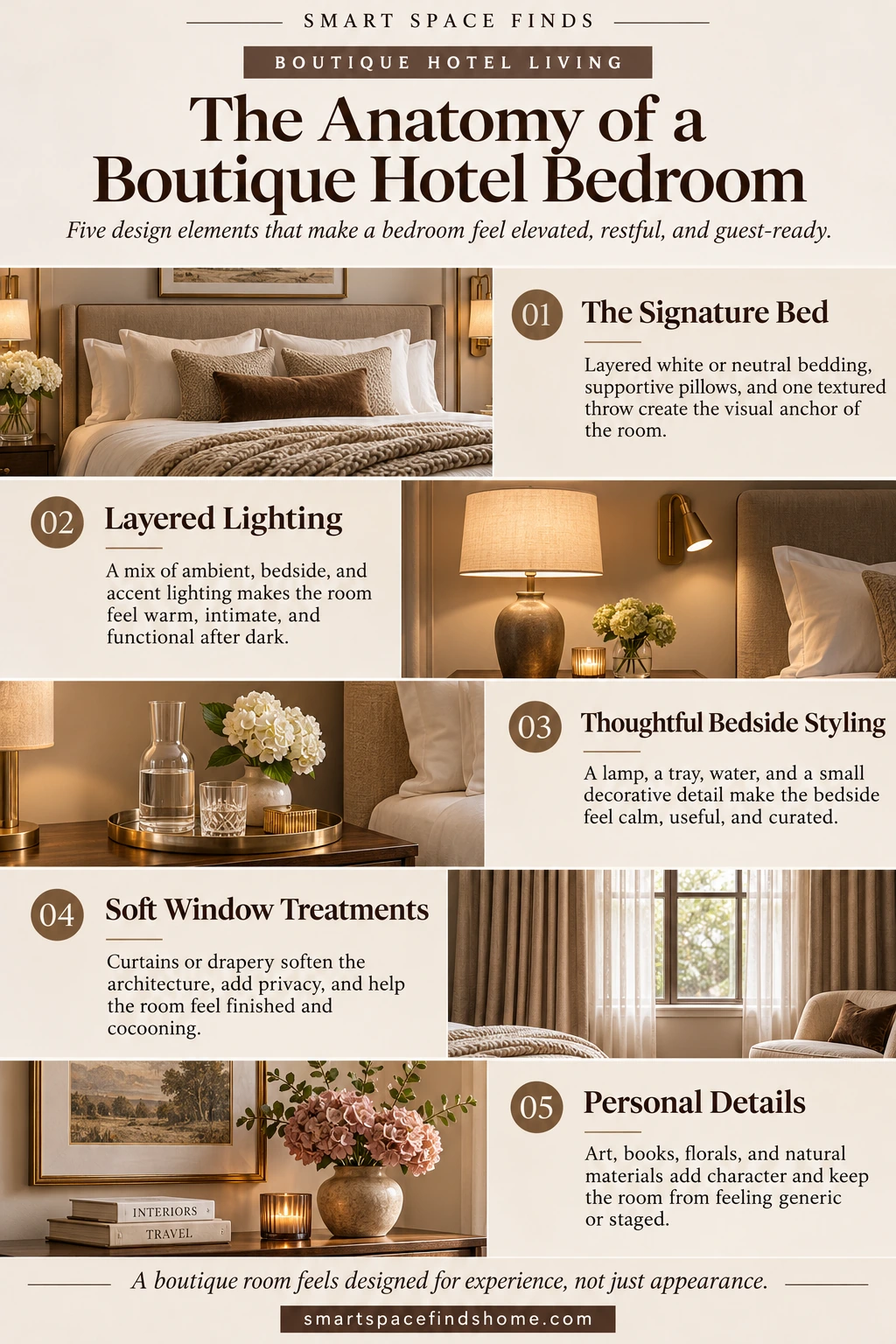 THE ANATOMY OF A BOUTIQUE HOTEL BEDROOM — Five design details that work together.
1. Give the bed the visual lead
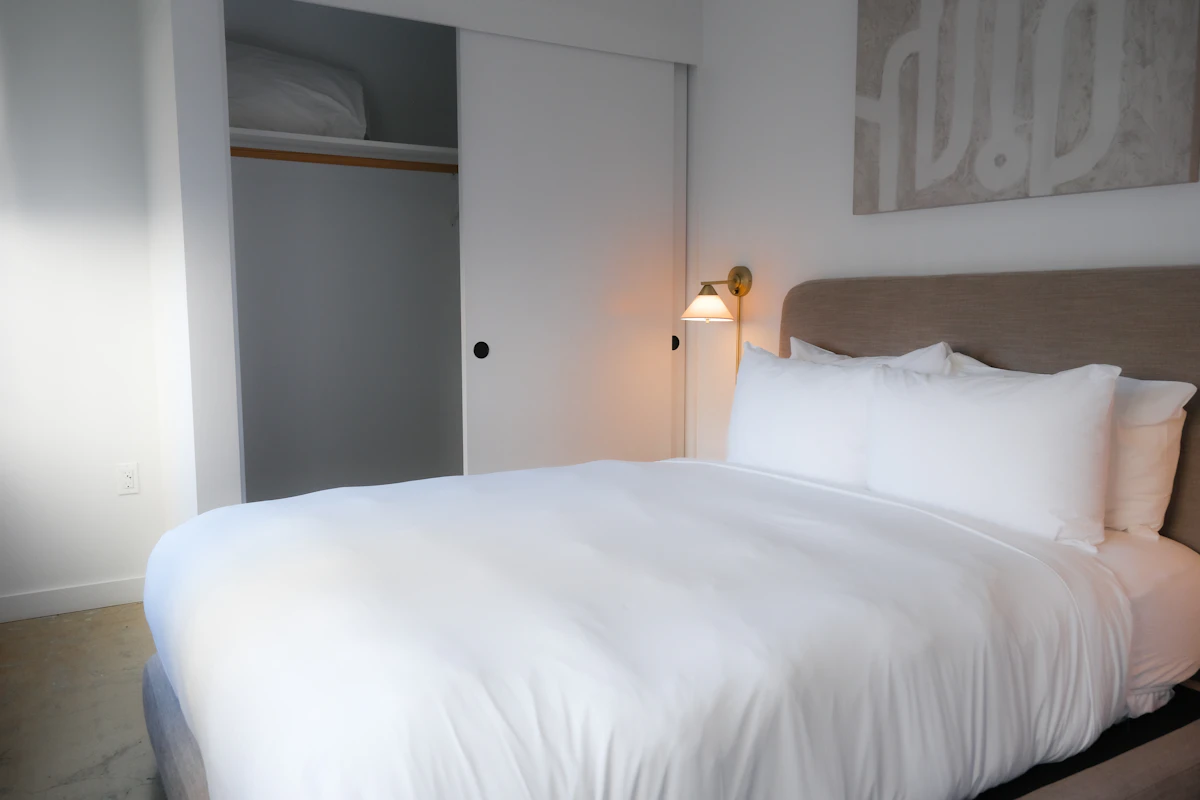 THE LINEN EDIT — Think in layers of comfort, not stacks of decorative pillows. Photo: ubeyonroad / Unsplash.
A hotel-inspired bedroom feels composed when the bed has a clear presence. If possible, center it on the most natural wall, then create breathing room around the edges. In a small room, an asymmetrical layout with one narrow bedside shelf can be better than matching nightstands that block circulation.
Make the bed inviting rather than overdecorated. A washable duvet cover, sheets comfortable against your skin, supportive pillows, and one contrasting throw create depth without an elaborate pile of cushions. Crisp cotton percale feels different from smooth sateen or relaxed linen—choose based on how you sleep and how you do laundry, not claims about a magical thread count.
A simple bedding composition
- Foundation: a fitted sheet that fits your mattress depth and a flat sheet if you like one.
- Volume: a duvet or comforter matched to your climate, with a cover you can wash easily.
- Support: sleeping pillows selected for your preferred sleeping position, not just a photograph.
- Finish: one folded quilt or textured throw at the foot of the bed.
Before you buy: check mattress size, duvet dimensions, care instructions, material composition, and whether a product is a cover or includes the insert.
2. Build a lighting scene, not a single light level
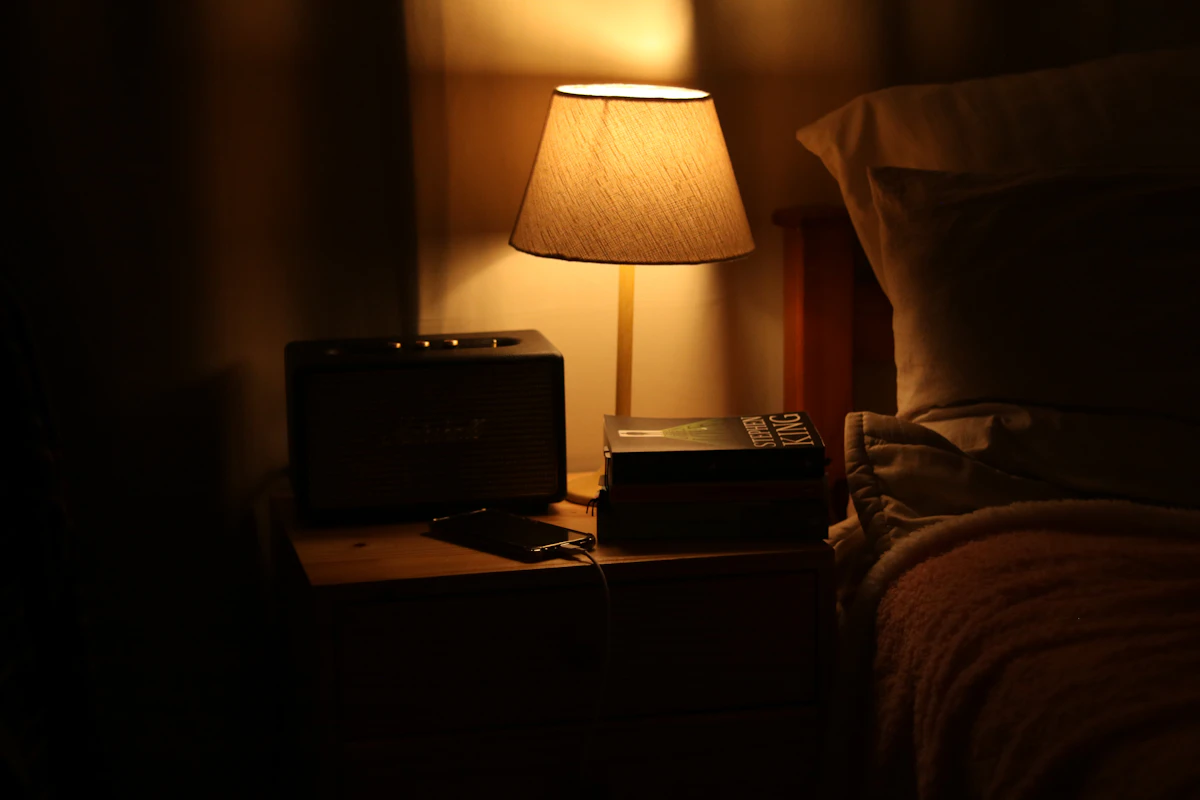 THE EVENING EDIT — A bedside pool of light changes the mood more quietly than an overhead fixture. Photo: Alicia Christin Gerald / Unsplash.
The biggest transformation often happens after sunset. One ceiling fixture can illuminate an entire room but rarely creates the intimacy of a boutique suite. Think in scenes: brighter general light for cleaning, focused light for reading, and a lower ambient glow for winding down.
Try a shaded table lamp or plug-in reading light where you actually sit. Warm-white bulbs can create a cozy evening atmosphere; compare color temperature, brightness, bulb compatibility, and fixture safety before purchasing. Use dimmable bulbs only with compatible dimmers and fixtures.
Small-room solution: a plug-in wall-mounted reading light can free up nightstand space. Route cables safely away from walkways, moisture, and bedding.
3. Design the bedside around what you reach for
Luxury is not reaching around a decorative vase to find your glasses. Keep the surface useful: room for water, a book, a lamp, and a discreet landing spot for small items. A low-profile tray works well when it corrals belongings without monopolizing the table.
Try the one-reach test: lie in bed and check whether your light, water, and everyday essentials are accessible without stretching or moving clutter. If the answer is no, fix that layout before adding another object.
Need a more restful baseline first? Explore our guide to low-effort relaxing bedroom ideas.
4. Treat the window as part of the architecture
Full-looking drapery can soften hard lines and make the room feel finished, but good window treatments should solve a real problem. Do you need privacy during the day, reduced nighttime light, glare control, or simply a softer visual edge?
Measure the window width, mounting space, desired length, and any nearby radiators or vents. Curtains labeled “room darkening” and “blackout” can perform differently depending on fabric, lining, mounting and edge gaps. Sheer panels may be useful for daylight privacy but rarely replace opaque night coverings.
Rental-friendly approach: choose removable or nonpermanent solutions only when your window and mounting hardware can support them safely.
5. Find a palette with warmth and personality
Hotel style need not mean beige everywhere. Choose a quiet base—warm ivory, stone, muted taupe, or a gentle gray—then give the room character through a richer accent: chocolate brown, olive, rust, deep blue, or a softly patinated metal.
Repeat a material or finish in two or three places rather than purchasing a perfectly matched furniture collection. A walnut picture frame can echo a wooden nightstand; a bronze lamp base can connect with a small mirror. Imperfect, collected pieces make a room feel personal.
If you are still finding your colors, use our guide to choosing a home color palette before investing in larger pieces.
6. Add the thoughtful hospitality details people remember
Picture arriving in your own room with an overnight bag. Is there a clear place for it? A free hook for a robe? An outlet that is easy to reach? A spot to put a book without moving decorations?
These are the unglamorous details that make a bedroom feel genuinely luxurious. In a guest room, a stable luggage rack or bench, an empty drawer, and a small note with practical information can matter more than expensive decor. At home, the same principles make daily routines easier.
Use scent sparingly, if at all. Fresh air, clean fabrics and appropriate ventilation are more reliable foundations than strong fragrance, especially when sharing a room with sensitive guests.
The Boutique Suite Experience Audit
Use this quick room-by-room decision framework before purchasing anything. Rate each area from 0 (frustrating) to 2 (already working), then improve your lowest score first.
| Experience | Ask yourself | First low-cost fix |
|---|---|---|
| Arrival | Can I enter and put things down easily? | Clear the path and create a landing spot. |
| Rest | Is bedding comfortable for the temperature? | Adjust layers before replacing everything. |
| Lighting | Can I switch from task light to evening light? | Move an existing lamp closer to the bed. |
| Order | Do essentials have a permanent home? | Empty and reset the bedside surface. |
| Personality | Is there one detail that feels like me? | Display a favorite artwork or object. |
Decision rule: fix what you notice every day before decorating what you notice only in photographs. This makes the result more personal, less wasteful, and easier to maintain.
A 30-minute boutique bedroom reset—using what you own
- Minutes 0–5: remove dishes, packaging, laundry, and visual clutter from the bed zone.
- Minutes 5–12: remake the bed; adjust pillows and fold one available throw at the foot.
- Minutes 12–18: experiment with lamp position and turn off the overhead light.
- Minutes 18–24: simplify the bedside area to the items you genuinely use.
- Minutes 24–30: stand at the doorway, check circulation, and choose just one finishing detail.
Live with the changes for several evenings before shopping. The goal is a room that supports your routines, not a styling exercise that takes fifteen minutes to undo every morning.
Skip the showroom effect
Matching everything, buying excessive cushions and adding decor that makes daily life harder.
Design the real experience
Comfortable bedding, useful lighting, clear surfaces and one personal finishing touch.
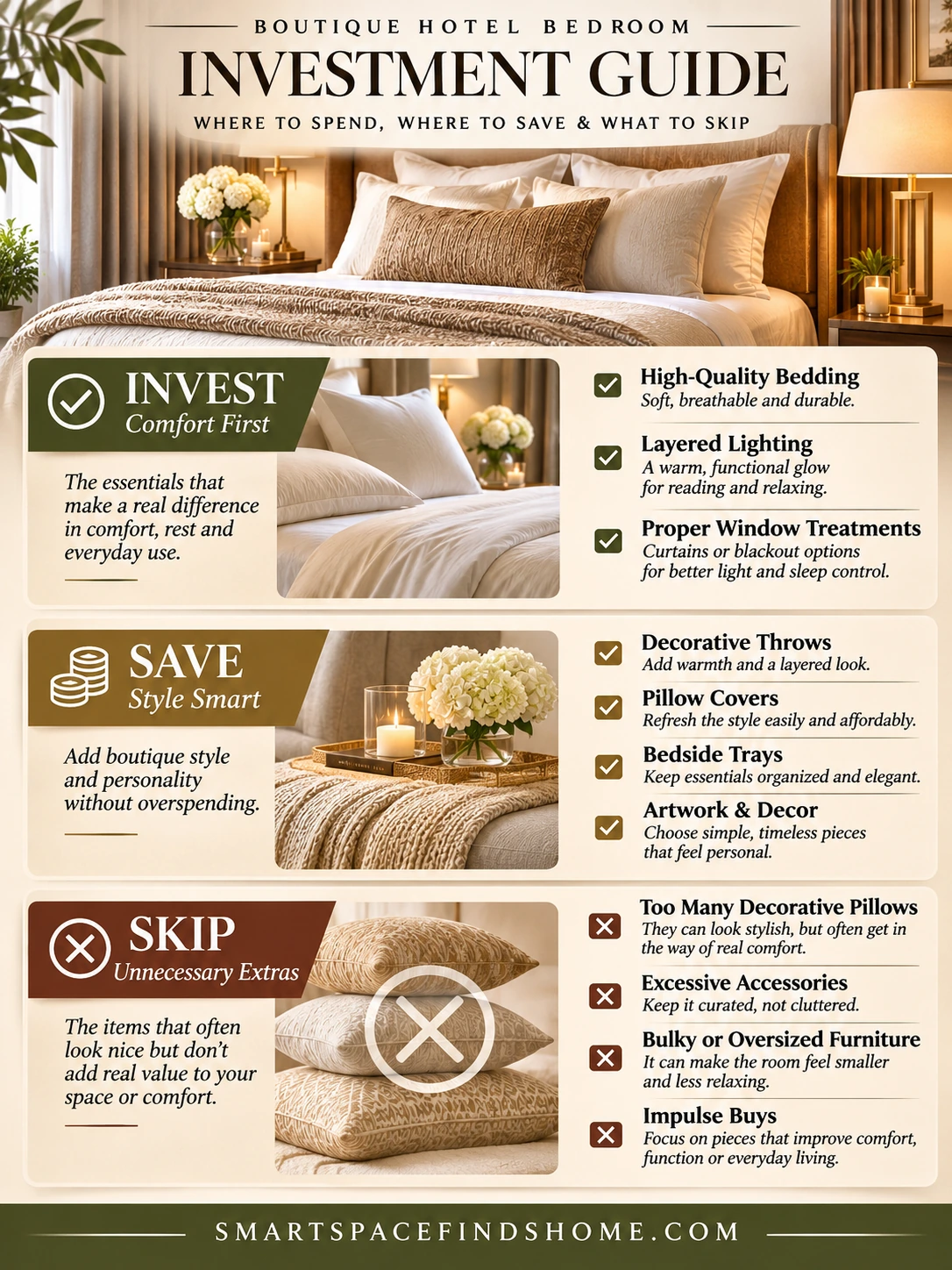 THE INVESTMENT GUIDE — Prioritize comfort, save on styling and skip unnecessary extras.
Where spending makes sense—and where it doesn’t
Prioritize replacements when something has a measurable problem: worn bedding, inadequate task lighting, poor curtain coverage, or nowhere to store daily essentials. Accessories are secondary. A comfortable mattress, correctly sized linens and safe lighting may justify more consideration than decorative pillow covers or matching trays.
For more restraint-driven inspiration, explore our quiet luxury interior design guide. For an adaptable room, our guide to making a small home more comfortable is a useful companion.
THE COLLECTOR’S EDIT / 07
What to buy for a hotel-inspired bedroom—and what to skip
Searches for hotel-style bedroom decor often lead to enormous shopping lists. A better starting point is to match each purchase to a repeated inconvenience. The first column is a buying signal; the second tells you what to check before checking out.
Bed linen that suits your climate
Compare percale, sateen, linen, and microfiber by texture, breathability, cleaning routine, and personal preference. Verify mattress depth, set contents, and care labels.
A bedside lamp you can use
Look for appropriate brightness and light direction, compatibility with your bulb, cord length, and a stable base. Prioritize a reading light if you read in bed.
Window treatments that actually fit
Measure panel width, length, rod projection and light gaps. Decide whether you need blackout, room-darkening, sheers, or a layered combination.
A clear place for essentials
A narrow nightstand, luggage rack, or useful hook can bring more everyday value than another decorative accessory. Check dimensions and load capacity.
Skip by default: decorative pillows you must remove every night, heavily scented accessories for shared guest rooms, and anything that blocks movement or routine cleaning.
COLOR ATELIER / THREE PERSONALITIES
Choose your boutique suite personality
“Hotel-inspired” is not one color scheme. Choose a direction that works with your existing flooring and furniture, then sample colors in the actual room.
The Warm Minimalist
Ivory, oatmeal, smoked walnut. Best for an airy room that still needs warmth.
The Collected Retreat
Sand, muted olive, aged brass. Ideal when vintage objects and tactile finishes tell the story.
The Moody Hideaway
Warm blush, aubergine, charcoal. Designed for an intimate, cocooning evening atmosphere.
Color swatches are conceptual directions, not calibrated paint matches; screen color appearance varies.
THE PRACTICAL PLAN / 08
Before you shop, take these five measurements
A tailored room is usually a well-measured room. Record your mattress width and depth, usable nightstand footprint, window dimensions and mounting clearance, distance to the nearest outlet, and clear circulation space around the bed. Check doors and drawers at full swing before bringing in a bench or luggage rack.
Don’t assume a product described as “hotel quality” indicates a standard of construction or comfort. Prioritize published dimensions, material and care information, manufacturer instructions, and credible reviews.
Frequently asked questions
How can I make my bedroom feel like a boutique hotel on a budget?
Start by clearing the area around the bed, laundering and layering existing bedding, repositioning a lamp and simplifying the nightstand. Buy only when a change solves a recurring problem.
Do boutique hotel bedrooms always use white bedding?
No. White makes a clean, versatile base, but muted earth tones and richer colors can achieve the same composed look. Comfort and easy maintenance matter more than color rules.
How can a small bedroom feel like a luxury hotel room?
Keep circulation clear, use wall-mounted or compact lighting where appropriate, reduce visual competition, and choose textiles with depth instead of adding more furniture.
What should I buy first for a hotel-inspired bedroom?
That depends on the room. If sleep comfort is already good but evening lighting is harsh, a suitable bedside lamp may offer more value than new bedding. Use the experience audit to decide.
The finishing thought
A memorable boutique hotel room doesn’t insist that you admire every object. It gives you permission to settle in. Keep that feeling as your design brief: a welcoming bed, light that suits the hour, room for the things you need, and a few details that belong to you. That is the kind of luxury worth bringing home.