
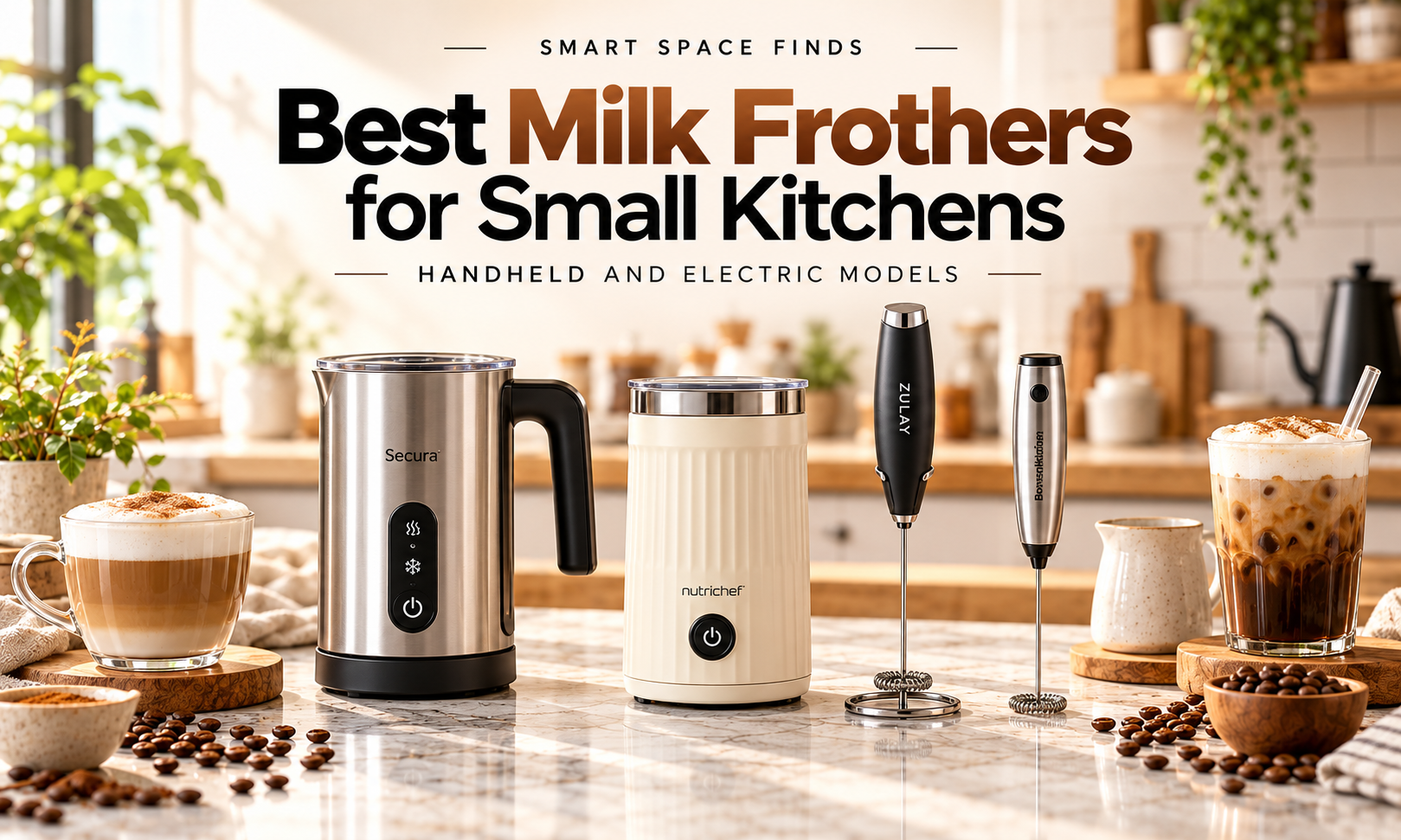
Editorial note: This guide is based on manufacturer specifications and published independent reviews, not hands-on testing by Smart Space Finds. Product configurations and availability can change. The five linked Amazon product listings were matched to their stated models and ASINs at the time of editorial preparation.
Affiliate disclosure: As an Amazon Associate, Smart Space Finds earns from qualifying purchases. If you buy through the product links in this guide, we may earn a commission at no additional cost to you.
A beautifully organized coffee corner is not necessarily a large one. In a small kitchen, every appliance has to earn its place: it should help you make drinks you genuinely enjoy, fit the surface or drawer you have, and be easy enough to clean that you still want to use it on a Monday morning. Milk frothers look like simple accessories, yet the differences between a slender handheld whisk and a countertop automatic jug can change the entire coffee routine.
For someone who only wants a cap of foam on weekend cappuccinos, an inexpensive whisk may be entirely sufficient. A household preparing warm oat-milk lattes each day may find an automatic heater far more convenient. And a home barista hoping to pour latte art needs to think about microfoam texture rather than just the height of the bubbles.
This guide explains the trade-offs, introduces a carefully researched shortlist, and gives you a practical buying checklist—without pretending that one machine is right for everyone.
Quick answer: which type should you buy?
The 30-second decision
Choose a handheld whisk when storage matters most and you can heat milk separately.
Choose an automatic heating frother when you make warm milk drinks frequently.
Focus on fine, pourable microfoam rather than maximum foam volume.
| Your routine | Best starting point | Main trade-off |
|---|---|---|
| Occasional foam, very little storage | Basic handheld whisk | Usually no milk heating |
| Daily hot lattes without a steam wand | Automatic heating frother | Requires counter and outlet space |
| Flat whites and latte-art practice | Microfoam-focused wand or automatic unit | Higher cost or learning curve |
| Multiple milk drinks back to back | Larger-capacity pitcher system | Larger footprint and minimum-fill requirements |
| Iced coffee with a cold-foam topping | Cold-capable automatic model or handheld whisk | Different textures and cleanup routines |
Our editorial starting recommendation: buy for your most frequent drink, not the longest list of modes. In particular, do not confuse “froths milk” with “heats milk,” and do not assume “thick foam” means pourable microfoam.
Handheld versus electric automatic milk frothers
Handheld whisk-style frothers
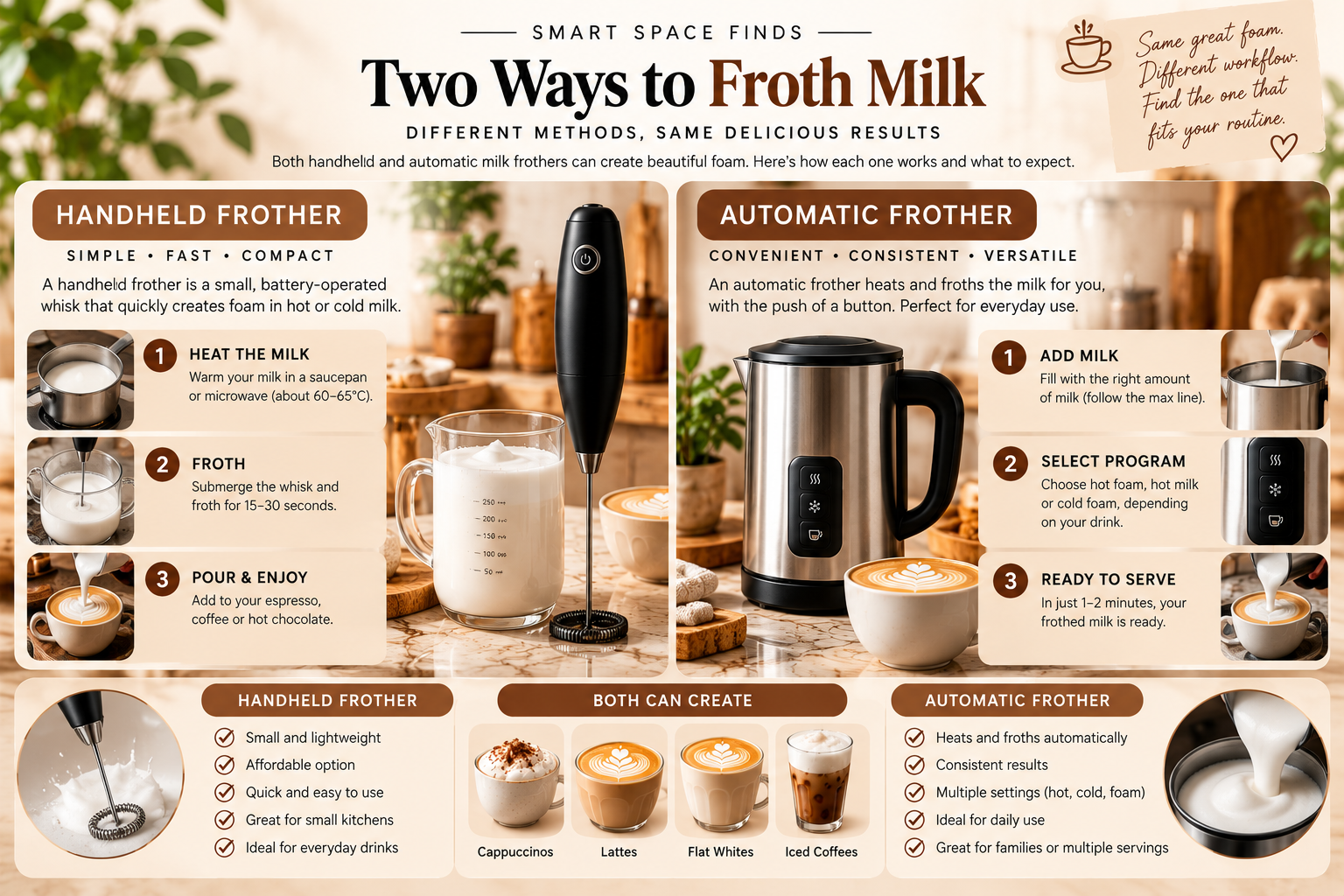
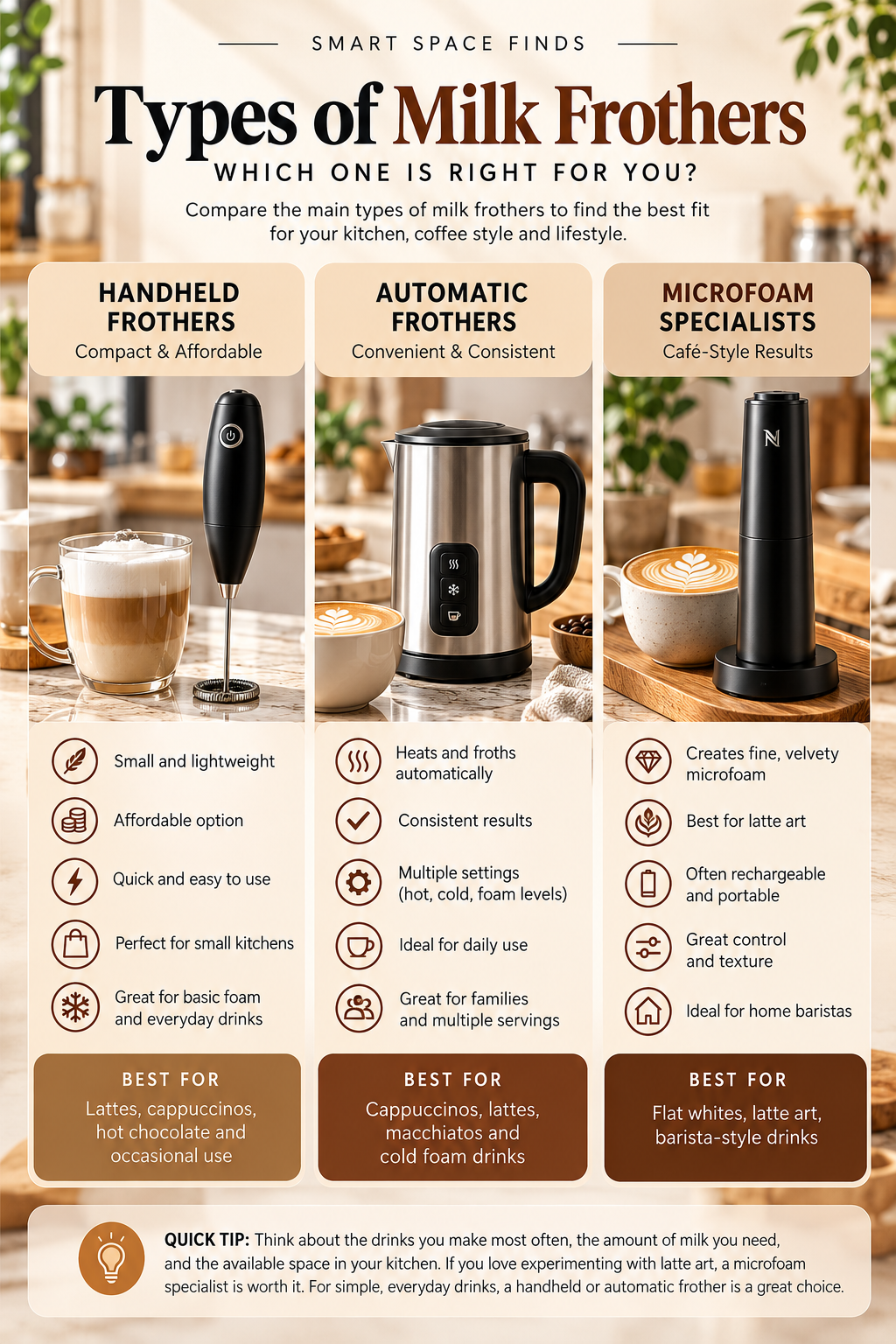
A handheld frother is a compact motorized whisk that spins inside a cup or pitcher. It can incorporate air quickly, and the tool itself often fits in a drawer. It generally cannot heat cold milk: you must warm the milk separately if your drink calls for hot foam. It also needs a suitable vessel with spare headroom so the milk does not splash over the rim. This is the most storage-friendly category for occasional use or a small coffee tray.
Look beyond headline speed claims. A comfortable handle, controllable whisk, easy-rinse head, accessible battery or charging system, and replacement parts may matter more than an advertised RPM figure. If you prepare several drinks consecutively, also consider whether you can comfortably control the wand over repeated uses.
Automatic heating frothers
An automatic frother normally combines a powered base or body with a milk vessel and preset program. Depending on the exact model, it may warm milk, create hot or cold foam, or stir milk for a flatter latte texture. That makes it appealing when convenience matters more than minimal storage. But the appliance has a fixed footprint and the maximum frothing level may be lower than its maximum heating capacity; always read the fill markings and the manual.
Cleaning is critical. Some models have a detachable dishwasher-safe jug; others require careful hand-washing of an integrated interior, lid and whisk. A removable pitcher does not automatically mean every component is dishwasher-safe. Check the manufacturer’s instructions for each part.
Microfoam-focused devices
Microfoam is a fine, glossy texture with small, closely integrated bubbles. It is especially important for flat whites and latte art. A standard handheld whisk can produce an airy cap of foam but may not deliver the smooth pourability that latte art demands. Some specialized handheld devices employ screens or impellers designed for finer texture, while sophisticated automatic units offer settings for adjusting aeration. They often cost more and may require practice.
Our researched shortlist: models worth comparing
How we selected these products: This comparison draws on published manufacturer documentation and independent editorial reviews, rather than hands-on testing by Smart Space Finds. Each product card links to an Amazon listing whose model and ASIN have been checked. Prices, availability, bundled accessories and seller offers may change; confirm the details on the destination listing before buying.
1. Breville the Milk Café (BMF600XL) — for households and customizable hot drinks
The Breville Milk Café is a premium countertop frother with induction heating, an adjustable temperature selector, and separate latte and cappuccino frothing discs. Breville lists a 25-ounce/three-cup vessel capacity, stainless-steel construction, and a dishwasher-safe jug. Its US product specification identifies the BMF600XL version and a 110–120-volt power supply. Do not assume this US unit can be plugged into a European outlet without checking a market-specific version.
It suits people who frequently make several warm milk drinks or enjoy preparing hot chocolate as part of a home café ritual. An independent Guardian review highlights its generous capacity but also notes that the minimum quantity can be more than a solo drinker needs. In a genuinely small kitchen, that is an important caveat: a larger machine may waste counter space and milk if you make only one small cappuccino.
Best fit: households with several milk-drink drinkers. Think twice if: you make one small drink a day or lack storage for the base and jug.
2. Subminimal NanoFoamer PRO GEN-2 — for microfoam enthusiasts
The NanoFoamer PRO is an automatic microfoam-oriented system. Subminimal’s current product information describes adjustable foam programs and flow controllers for tuning different milks, and specifies a compact 12 × 12 × 20 cm body with a 100–220 ml working capacity. The maker sells regional electrical variants, so check the correct plug and voltage before ordering.
This product is interesting because it focuses on texture rather than simply building a large volume of airy foam. That makes it a credible candidate for espresso drinkers who want smooth, pourable milk without learning to operate a steam wand. Its more involved adjustment process is also a reason not to recommend it as the default purchase for a casual coffee drinker.
Best fit: home baristas who enjoy dialing in texture. Think twice if: you prize one-button simplicity above fine control.
3. Instant MagicFroth 9-in-1 — a value-minded automatic option to investigate
Independent roundups have highlighted the Instant MagicFroth 9-in-1 as a practical automatic alternative to premium pitcher systems, particularly for a straightforward hot-and-cold foam routine. However, marketplace names can be confusing: Instant sells more than one frothing appliance and “9-in-1” should never be treated as interchangeable with its simpler four-function machines.
Before buying, confirm the model, minimum and maximum fill markings, detachable parts and cleaning instructions shown in the listing and manufacturer manual. Program names and included accessories can vary across regional versions.
Best fit: shoppers seeking a hands-off daily routine at a more accessible category price. Think twice if: the listing does not clearly identify its generation or included attachments.
4. Subminimal NanoFoamer Lithium — a compact path to finer handheld foam
The manufacturer describes the NanoFoamer Lithium as a USB-C rechargeable handheld tool with two speeds and a proprietary screen-and-impeller design intended for finer microfoam. It is distinct from the battery-powered NanoFoamer V2. The wand is far easier to tuck away than an automatic jug, but it does not eliminate the separate step of warming milk.
This is an attractive compromise for an espresso enthusiast whose kitchen cannot accommodate another powered countertop appliance. It is also an example of why a product comparison should name the exact version: Lithium and V2 differ in power source and controls.
Best fit: a compact setup where latte-art texture matters. Think twice if: you want the machine to heat milk for you.
5. Zulay Kitchen Milk Boss — basic budget handheld category
The Milk Boss is a recognizable entry in the inexpensive handheld-foam category. Its primary advantage is the uncomplicated format: hold a whisk in milk, adjust your technique and clean the small head afterward. This class of product can be more than enough for mixing cocoa, whipping up a quick foam topping or occasionally dressing a morning coffee.
Before choosing a specific Milk Boss listing, confirm the exact model, battery arrangement, included stand, and seller details. Zulay-branded variants and bundles should not be assumed to be identical.
Best fit: occasional users and tight budgets. Think twice if: your dream drink requires warmed, glossy, consistently pourable milk.
What matters most in a small kitchen
1. Measure the stored footprint, not just the appliance width
A countertop product uses more space than its listed width. You need room for a cord, for lifting a lid, and for placing a filled pitcher while serving. If it lives inside a cabinet, measure shelf height and ask whether its base and jug can be stored together. If you choose a wand, check that its stand or charger will not become permanent visual clutter on your coffee counter.
2. Match milk volume to the drinks you actually make
Think in terms of morning habits: a single small cappuccino, two large lattes, or a series of family drinks. More volume sounds attractive, yet a machine’s minimum fill level matters just as much as the maximum. A larger pitcher may require extra milk to operate properly. Never fill above a marked maximum frothing level: foam expands.
3. Decide whether you need heating
For hot cappuccinos, a cold-only whisk means warming milk in a separate microwave-safe vessel or saucepan, monitoring its temperature and then frothing. An automatic heating unit combines those stages. For iced lattes, by contrast, cold-foam capability may matter more than heating. Some models have a cold-stir option rather than a dedicated cold-foam mode, so read the wording carefully.
4. Choose the right texture
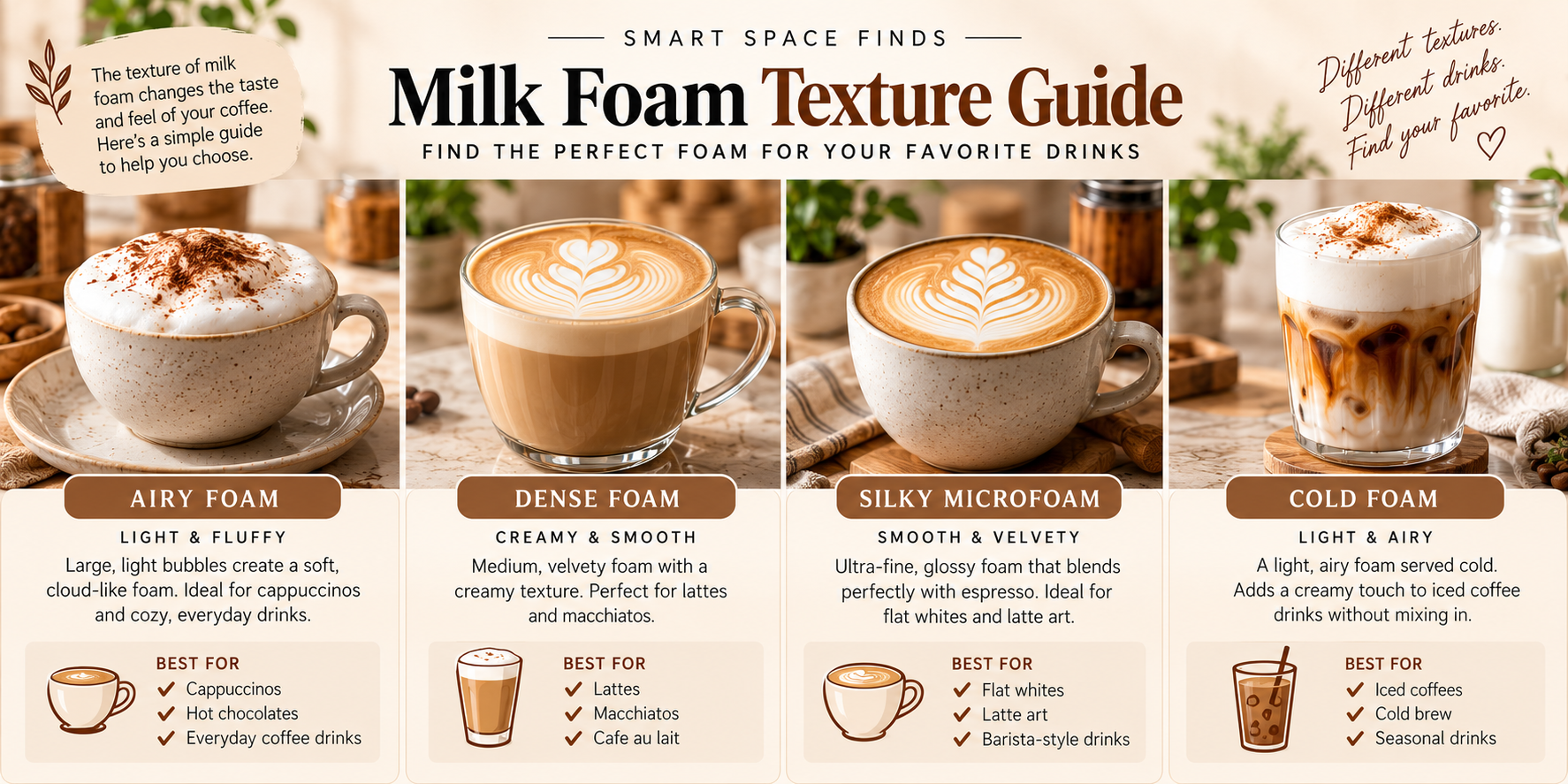
A spoonable cappuccino crown, a silky flat white, and a light cold-foam topping are three different goals. Dense clouds are not necessarily better. If you want to pour patterns, seek independent evidence of fine, integrated microfoam; if you want a thick topping to spoon over cold brew, a standard whisk can often be sufficient.
5. Consider how easy the frother is to clean
The most useful appliance is the one you actually clean immediately. Warm milk leaves a film; sweetened beverages can leave residue around the whisk and lid. Look for easy access to the bottom of the vessel, detachable parts and clear guidance for the electrical components. Do not immerse powered bases or handles unless the product instructions explicitly allow it.
6. Check milk alternatives thoughtfully
Oat, soy and almond beverages are not one uniform product. Different formulations have varying protein, fat and stabilizer levels, and “barista” versions are formulated with foaming in mind. A manufacturer’s claim of compatibility should not be read as a guarantee of the same result with every brand. If you use one particular milk daily, search for independent reviews using that milk and favor a device with texture adjustment.
7. Confirm electrical compatibility and serviceability
An appliance designed for the US market is not automatically suitable for a European household. Verify the exact listing’s voltage, plug, warranty region and access to replacement whisks, discs or seals. This matters especially when researching products across international storefronts.
Milk type and foam: realistic expectations
| Milk | What to expect | Shopping tip |
|---|---|---|
| Whole dairy milk | Often a useful baseline for creamy foam | Compare fine texture, not only volume |
| Lower-fat dairy milk | Can create a lighter, airy foam | Check whether it pours the way you prefer |
| Barista oat milk | Formulated to help foaming, but brands vary | Look for tested plant-milk performance |
| Soy milk | Results depend on formula and drink acidity | Try small batches and adjust technique |
| Almond milk | Can be less predictable across brands | Consider adjustable aeration |
These are broad practical tendencies, not guaranteed rankings. Temperature also affects texture and flavor: heat gently and follow the frother’s operating instructions. If milk appears scalded or starts to smell cooked, reassess your settings rather than assuming more heat creates better foam.
Which frother suits your coffee-making method?
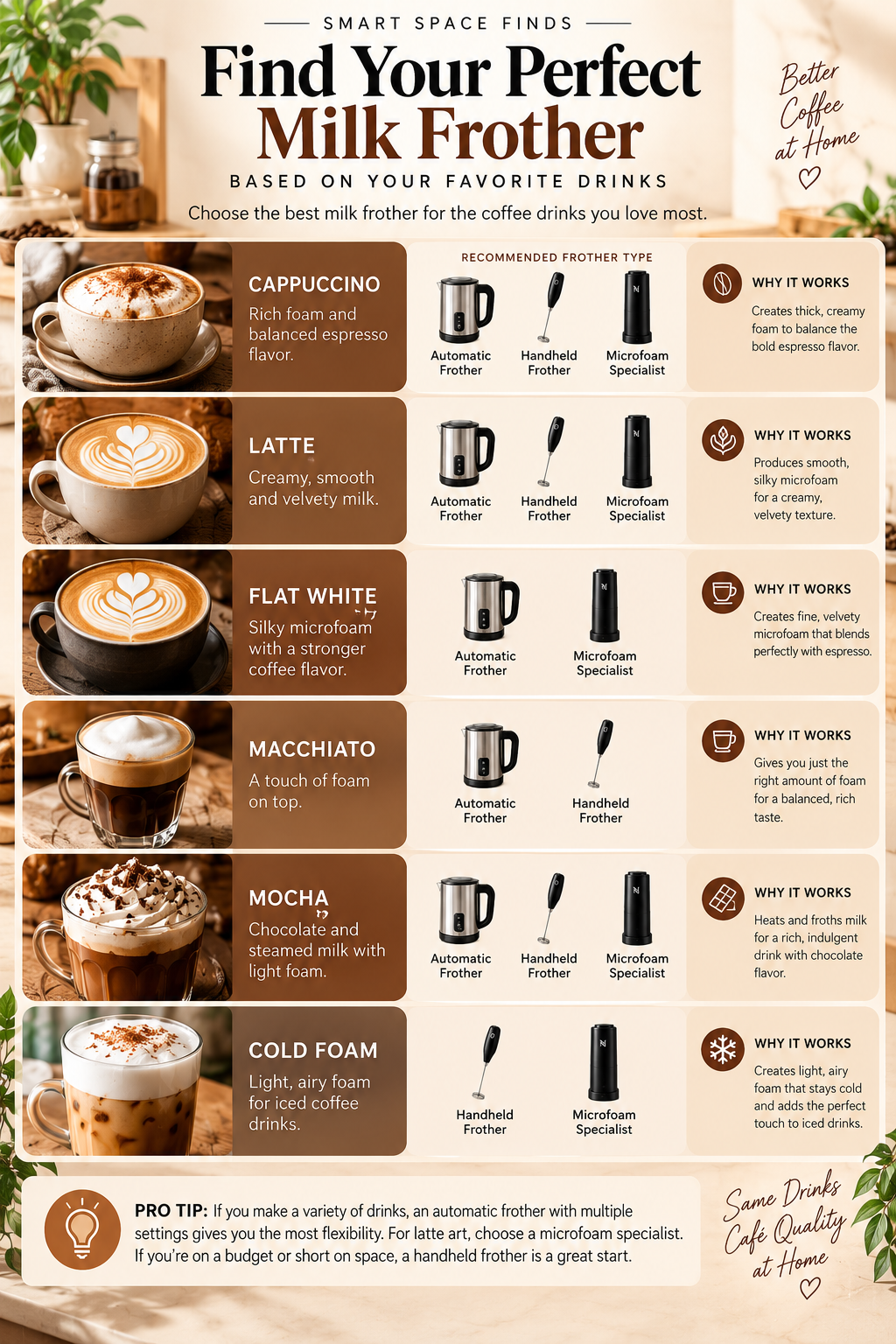
Pod coffee or compact capsule machine
A simple automatic milk frother is usually the easiest complement if your pod machine lacks an integrated milk system. Prioritize a small footprint and consistent single-serving output. If you mainly make iced drinks, a slim handheld unit may be enough.
Manual espresso machine without a steam wand
A microfoam-focused device can make more sense here because it completes a missing part of the espresso workflow. You can grind coffee and prepare the shot while an automatic unit runs, though a handheld system requires separate heating and active technique.
Espresso machine with an effective steam wand
Do you really need to buy another frother? Perhaps not. If your machine’s wand already heats and textures milk to your satisfaction, a second appliance adds cleaning and storage. A separate cold-foam tool might still be convenient for summer drinks, but duplication should be a considered choice.
French press, moka pot or filter coffee
If you like café-inspired drinks but do not make espresso, a handheld whisk provides an inexpensive experiment. An automatic heater is a lifestyle upgrade when you frequently make warm milk-based drinks. Remember that frothing milk cannot transform filter coffee into espresso: drink strength and taste will differ.
Buying checklist: questions to answer before checkout
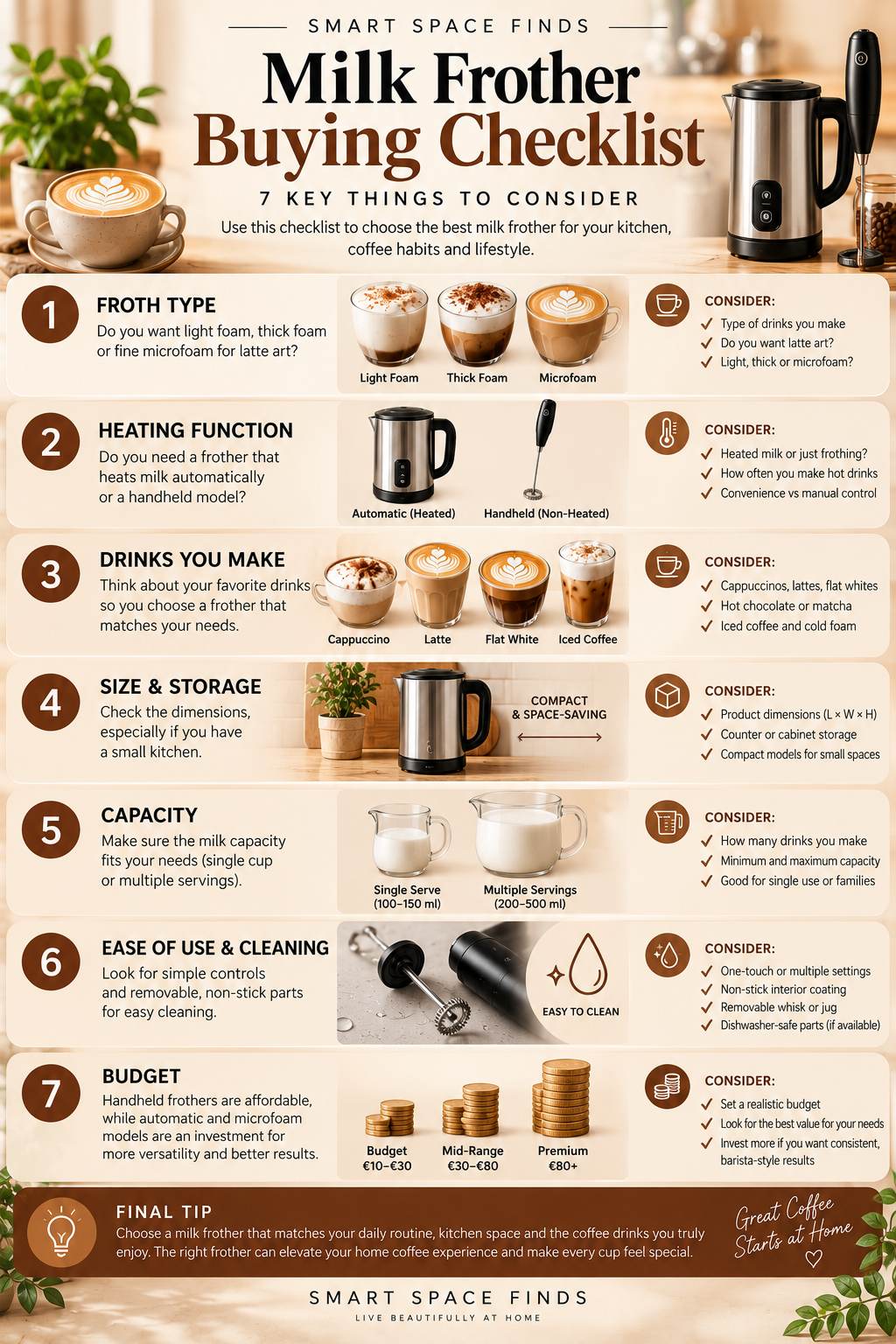
- Drink: cappuccino, flat white, latte, hot chocolate or cold foam?
- Heat: do you want a built-in heater or are you happy heating milk separately?
- Milk: dairy, oat, soy or almond—and has that milk been assessed?
- Serving size: will the minimum and maximum levels suit your cup?
- Storage: where will the machine, cable, lid and accessories go?
- Cleanup: which exact parts are dishwasher-safe?
- Power: correct voltage and plug for your market?
- Model: is the photographed unit the precise version described?
- Support: can you obtain replacement discs, screens or seals?
- Value: will its benefits be used more often than once a month?
Common milk-frother buying mistakes
Buying on looks alone. A sculptural cream-colored appliance may suit your kitchen aesthetic, but that does not mean its vessel suits your preferred drink or that it is easy to wash. Let design be the final filter rather than the first.
Equating more foam with better foam. Big bubbles can make a dramatic photo without creating the smooth mouthfeel needed for a flat white. Check how the foam behaves when poured.
Ignoring minimum-fill lines. A large-capacity jug may be inefficient for one very small drink. Read the manual before you buy.
Assuming all plant milks behave alike. Ingredient formulations change results. Even an excellent frother cannot promise identical results across all brands and recipes.
Buying two tools for the same job. If your compact espresso machine already froths well, first identify a specific missing capability.
Trusting generic marketplace names. Exact model identification is essential when accessories, capabilities and electrical requirements vary by generation and region.
How to keep a milk frother working well
Rinse removable milk-contact parts promptly after each use, following the manual for handling hot surfaces and electrical components. Avoid abrasive scrubbers on coated interiors. Inspect seals, magnetic attachments and removable whisk pieces regularly, and allow everything to dry fully before storage. If a device begins to make unusually coarse foam, first verify that parts are seated correctly and that the milk and fill level are suitable. Do not open or repair powered appliances unless the manufacturer instructs you to do so.
For a tidy coffee station, place only regularly used pieces on the counter. A small tray can keep a cup, spoon and frother together without scattering accessories around the workspace. Store chargers, spare screens and cleaning brushes together in one labeled drawer section.
Frequently asked questions
Are handheld or automatic milk frothers better?
Neither is universally better. Handheld whisks favor low cost and minimal storage; automatic models prioritize hands-off operation and often include heating. Choose based on your daily drink and kitchen space.
Can a milk frother heat milk?
Many automatic jug models can. Most basic handheld whisks cannot. Verify the exact device rather than assuming every electric frother heats.
Can I use a milk frother with oat milk?
Yes, many models can froth oat beverages, but foam quality varies by formulation and appliance. Barista-style oat milk is worth comparing if you regularly make plant-based lattes.
Is a frother enough for latte art?
You need smooth, pourable microfoam and some pouring practice. A specialized microfoam device can help; a very airy handheld-whisk result may be difficult to pour into patterns.
Do I need a separate milk frother if my espresso machine has a steam wand?
Usually not for ordinary hot milk drinks if the wand already meets your needs. A separate frother makes more sense when you want unattended heating, cold foam, or a different workflow.
Can I use a milk frother for hot chocolate or matcha?
Some frothers can stir or blend these drinks, but never add powders or syrups to a device unless its manual permits them. A handheld whisk in an appropriate vessel is often a flexible mixing tool.
What is the best milk frother for a very small counter?
A handheld wand occupies the least permanent counter space. If you need automatic heating, measure the complete appliance, including cord clearance and lid access, before settling on a countertop option.
Are expensive milk frothers worth it?
They can be for people who value adjustable temperature, precise microfoam, larger batches or easier cleanup. They are less compelling if you only want occasional bubbles on coffee.
Final verdict: build the coffee corner around your routine
The most sensible purchase is rarely the device with the most features. For an occasional cappuccino, a humble handheld whisk may be all the luxury you need. For daily warm lattes, an automatic model can simplify mornings. For enthusiasts who enjoy espresso technique and latte art, a microfoam-focused tool deserves a closer look. In a small kitchen, the right choice is the one whose footprint, cleaning routine and texture match how you genuinely make coffee.