
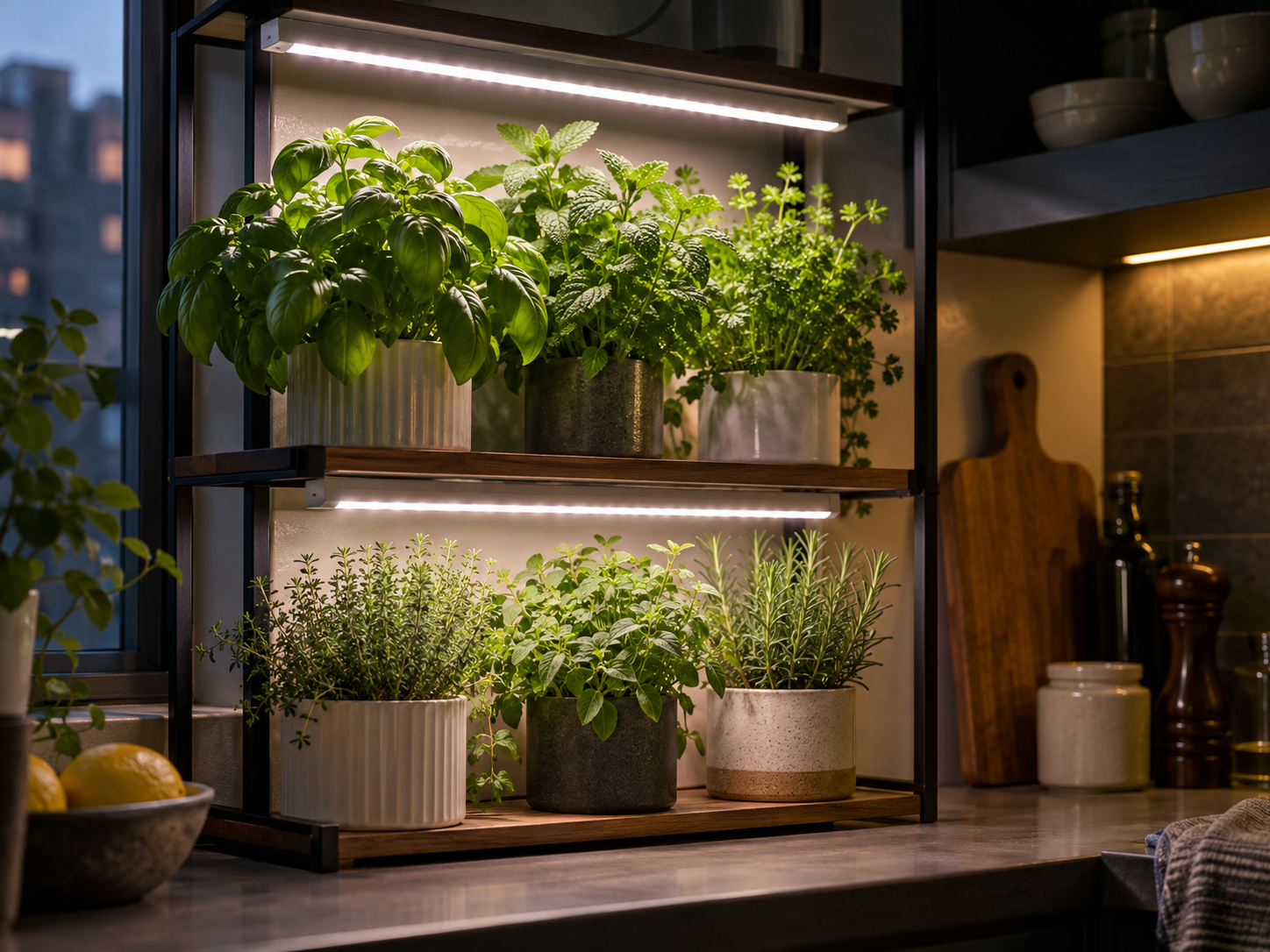
A kitchen windowsill is an attractive place to grow herbs, but it is not automatically a productive one. In a north-facing apartment, a room shaded by neighboring buildings or a dark winter kitchen, a basil plant can become tall and weak even when it is watered correctly. Supplemental lighting gives you more control over where a small herb garden can live.
A grow-light setup does not require a large hydroponic system or a shelf of expensive gadgets. With the right fixture, drainage and care routine, a small section of shelf or countertop can support useful culinary herbs. The following guide explains how to choose plants and equipment, arrange them efficiently, and avoid common mistakes involving water, heat and insufficient light.
START WITH YOUR SPACE
One or two herb pots
Choose a compact, adjustable clip-on LED and keep your preparation counter clear.
Three to six plants
Choose a linear fixture that spreads light evenly across your pots.
Integrated herb station
Compare a self-contained hydroponic garden if convenience matters more than flexibility.
Affiliate disclosure: As an Amazon Associate, Smart Space Finds earns from qualifying purchases. There is no additional cost to you. Product recommendations are editorially selected; prices and availability may change.
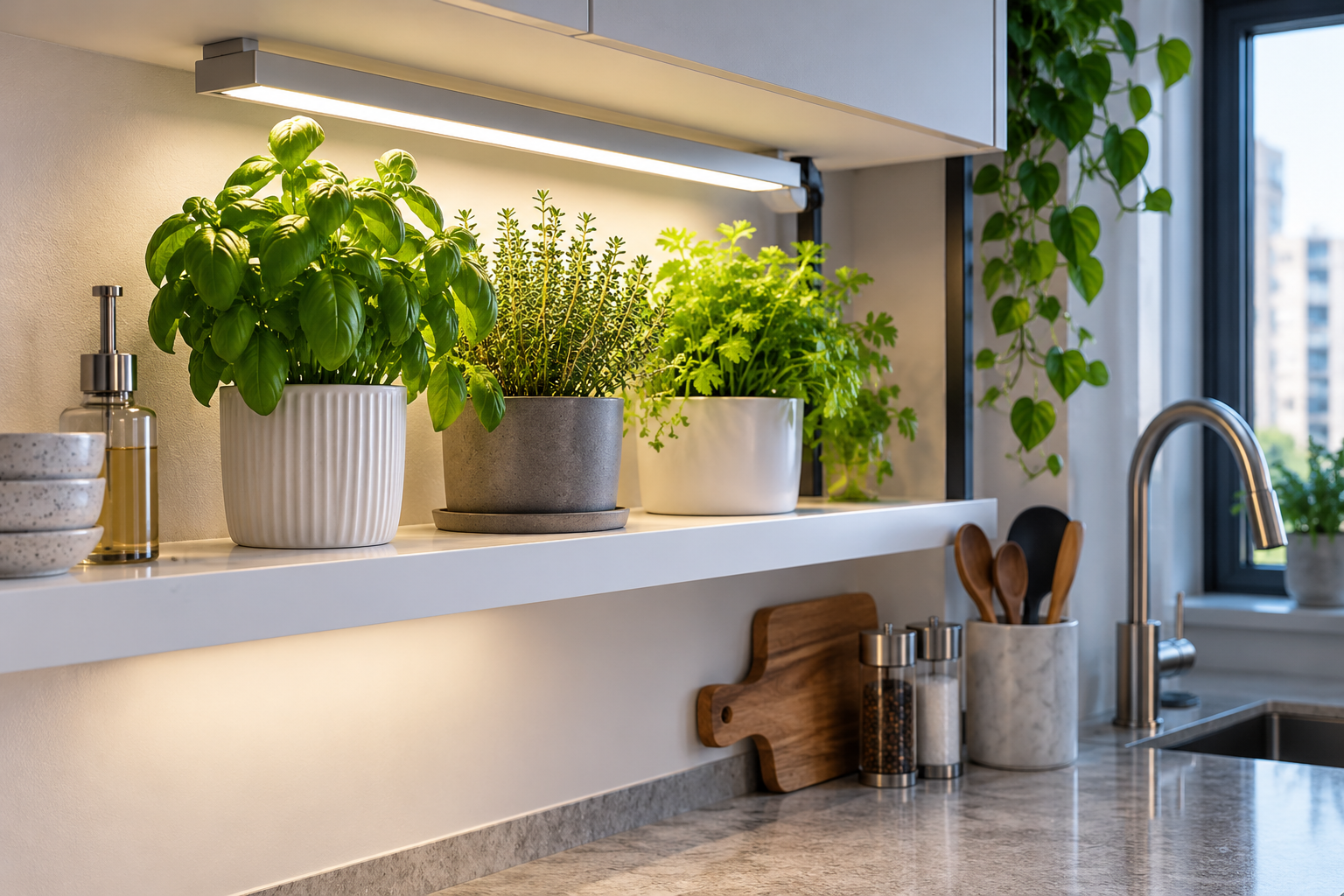
How to Choose the Best Grow Light for an Indoor Herb Garden
Quick recommendation: For one or two small pots, begin by comparing adjustable clip-on full-spectrum LED lights. For a row of herbs on a 2-foot shelf, prioritize a securely mounted linear LED with even coverage. All-in-one hydroponic gardens are a separate, more maintenance-intensive option for readers who prefer not to use soil. No single fixture is best for every dark apartment.
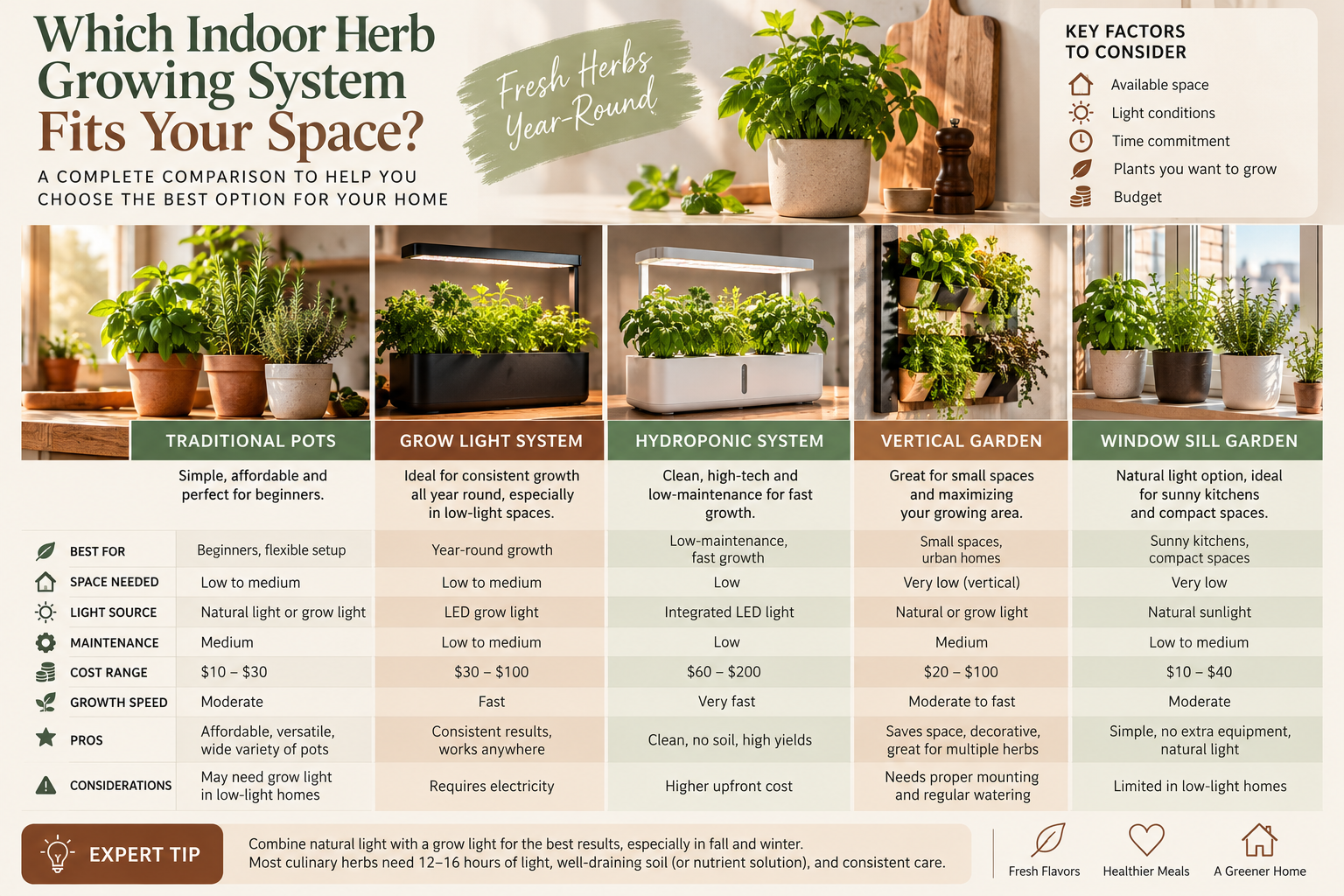
Compare Your Setup Before Shopping
| Grow-light format | Best fit | Main advantage | Main trade-off |
|---|---|---|---|
| Adjustable clip-on LED | One or two small pots | Flexible positioning | Can leave the outer leaves underlit |
| Linear LED bar | Three to six herbs in a row | More consistent shelf coverage | Needs secure mounting |
| Higher-output LED fixture | Dedicated herb shelf with demanding plants | More potential light at leaf level | Glare, clearance, heat and cost |
| Countertop hydroponic system | Self-contained indoor growing station | Integrated lighting and reservoir | Cleaning and consumable costs |
The Grow-Light Buying Checklist
- Coverage: Measure the actual leaf canopy and shelf depth, not just the pot footprint.
- Light output: Prefer independently interpretable manufacturer PPFD measurements at a stated distance to marketing watt-equivalents.
- Spectrum: Balanced white light is often more comfortable in a lived-in kitchen or studio.
- Mounting: Check clamps, brackets, cord length, height adjustability and clearance for growing leaves.
- Timer: Consider a built-in schedule or a separately suitable timer while allowing darkness overnight.
- Safety: Keep plugs, sockets and extension leads away from watering and confirm the manufacturer’s indoor electrical ratings.
- Real total cost: Include shelf hardware, trays, replacement parts and electricity.
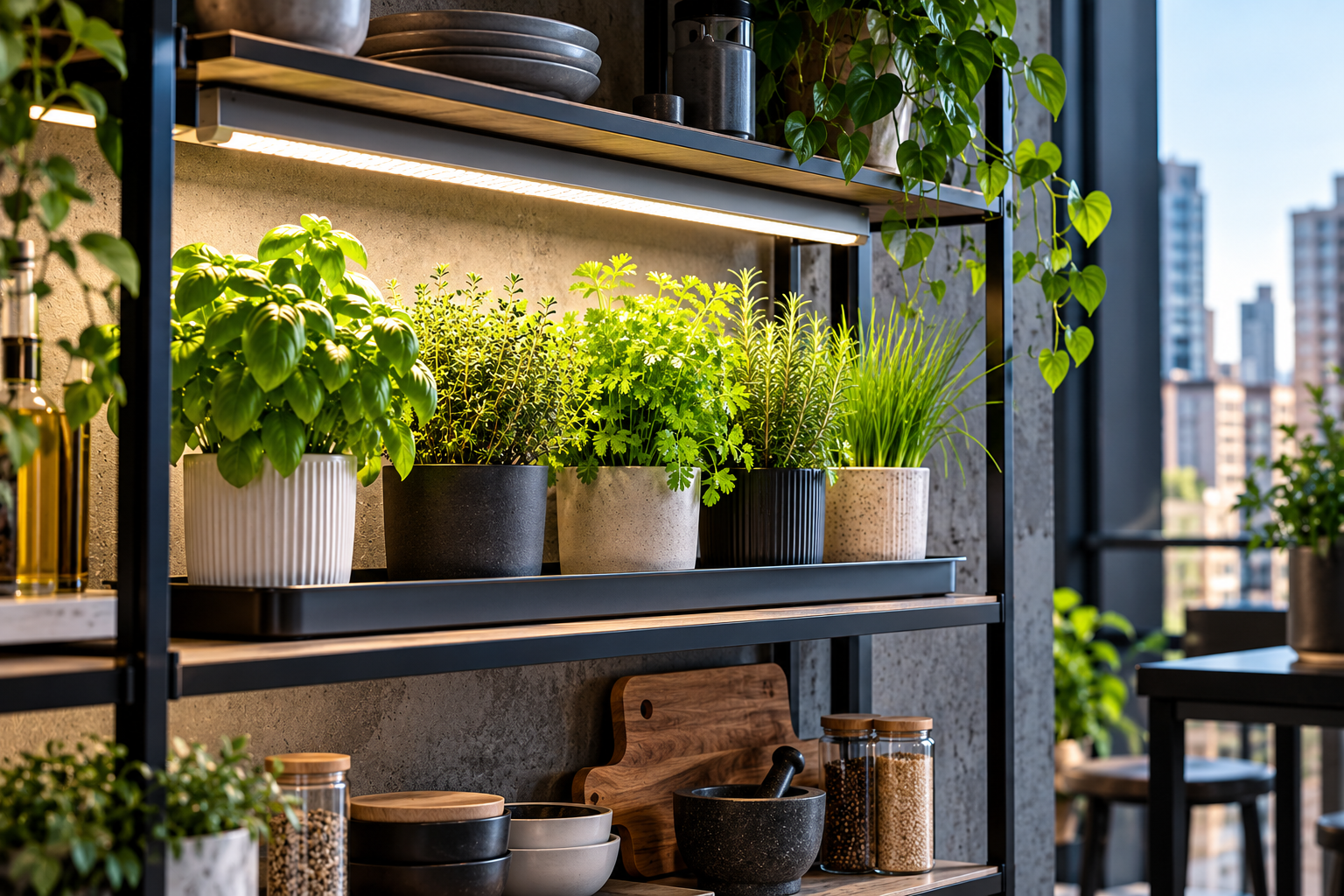
Editorial standards: We checked the destination ASINs for our affiliate links, but pricing, availability and specifications can change. We have not independently tested these fixtures. Our AI editorial scenes are illustrative, not photographs of advertised products.
For a technical explanation of light intensity, duration and fixture placement, see the University of Minnesota Extension guide to indoor lighting.
Shop the Guide: Verified Amazon Grow Lights and Indoor Herb Gardens
Choose by plant count, shelf dimensions, mounting constraints and desired maintenance routine. Prices and stock can change; we do not claim to have personally tested these products.
AMAZON AFFILIATE PICK 1
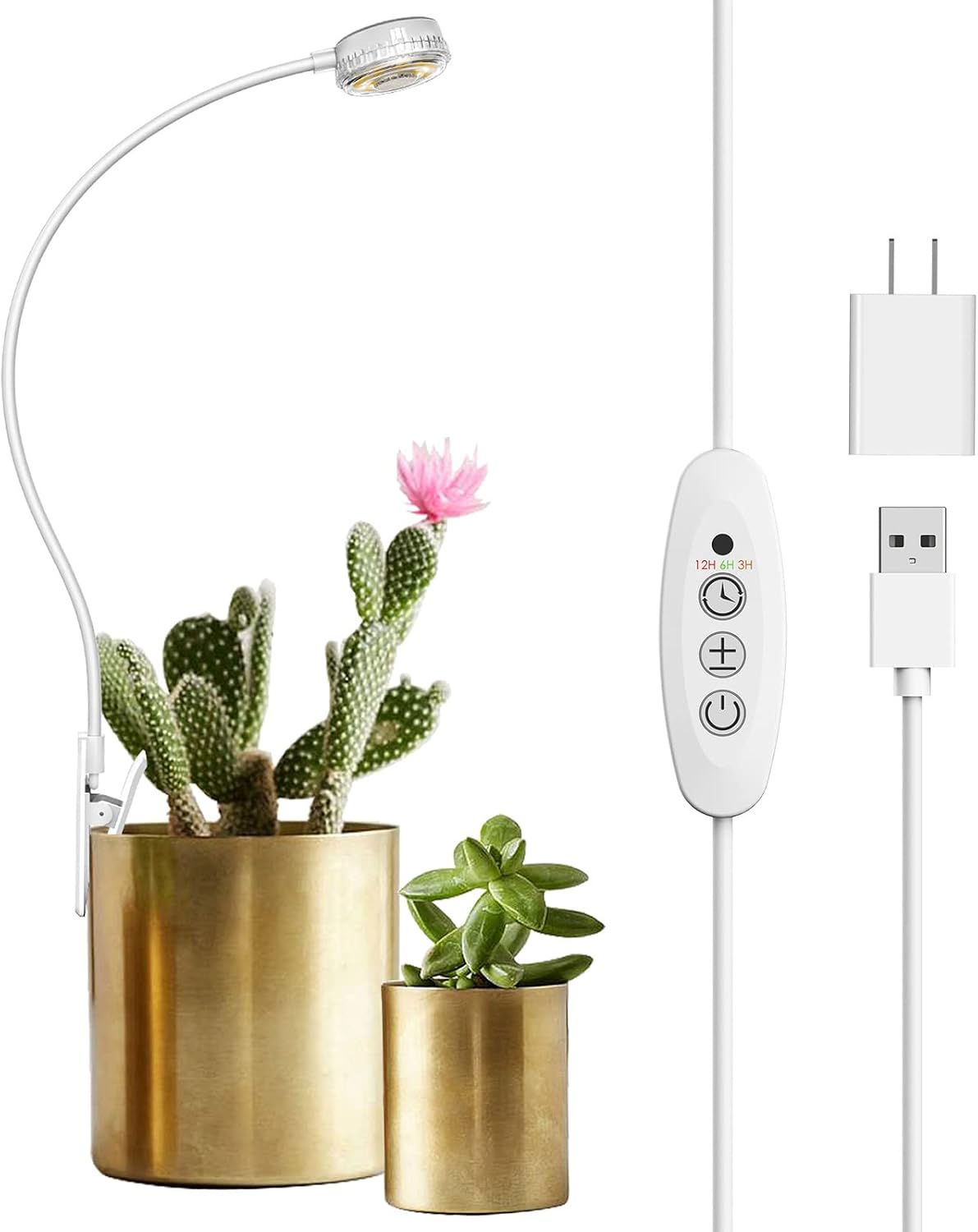
SANSI Pot Clip Grow Light
Compact pot-mounted light for one herb plant; confirm clamp fit and clearance.
Model ASIN: B0BGPLP8LX. Check current specifications, price and availability on Amazon.
AMAZON AFFILIATE PICK 2
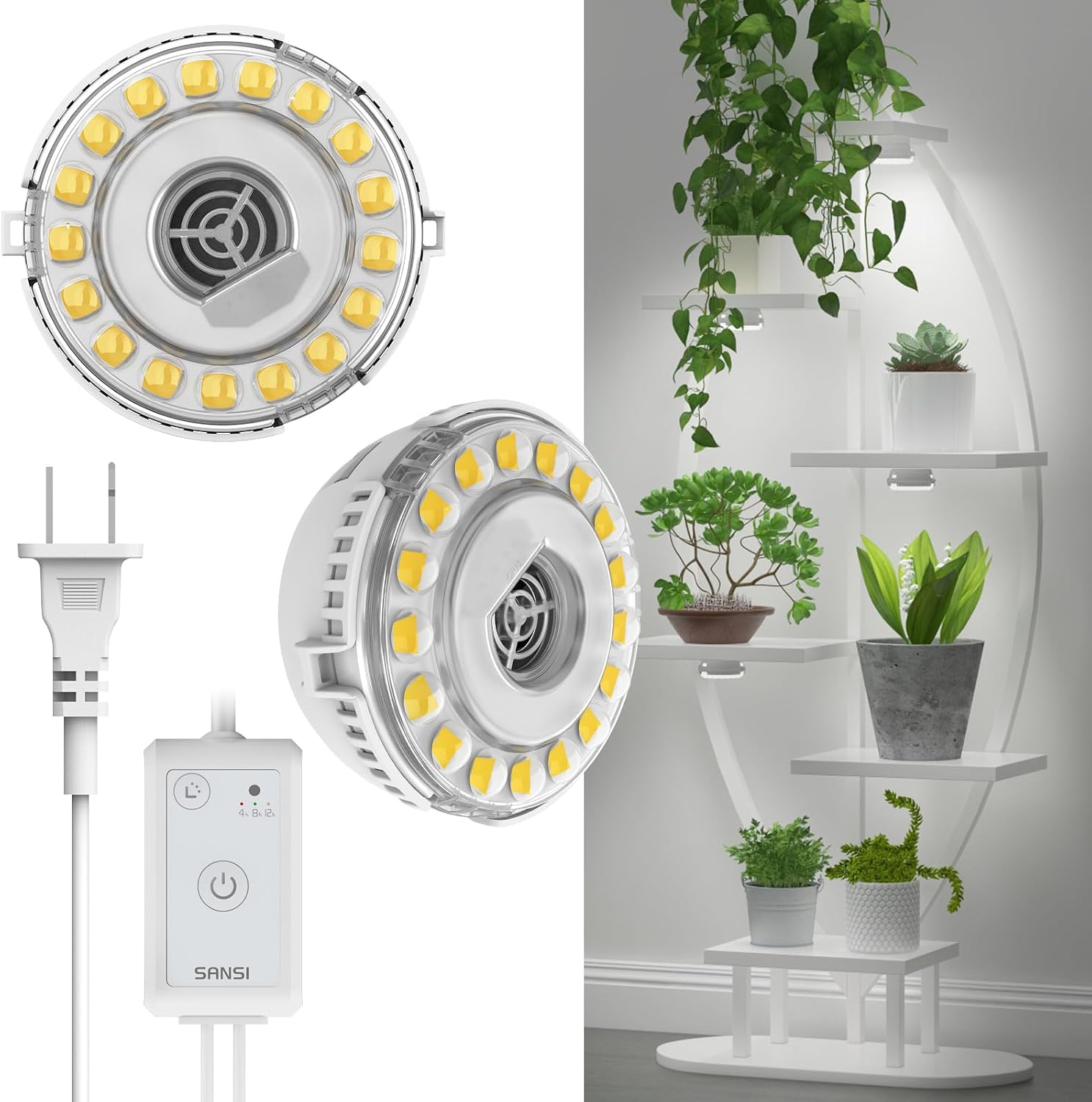
SANSI 10W Puck Grow Light
Two-head stick-on light with adjustable brightness and timer settings; check installation surfaces.
Model ASIN: B0CGZMKK8K. Check current specifications, price and availability on Amazon.
AMAZON AFFILIATE PICK 3
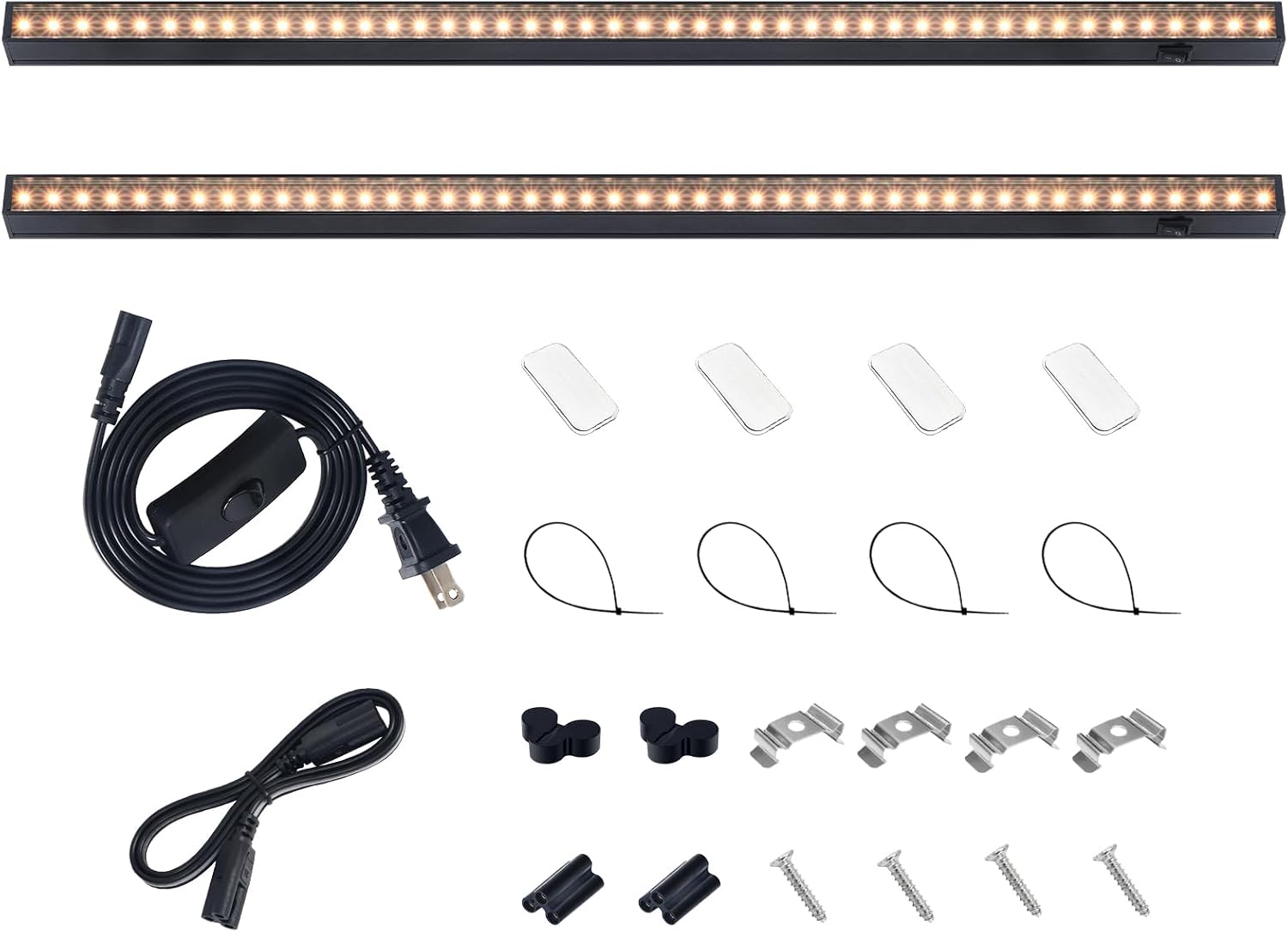
Barrina T5 2FT 2-Pack
Two linear LED fixtures to illuminate a row of pots; plan secure shelf mounting.
Model ASIN: B0DD2W4NYT. Check current specifications, price and availability on Amazon.
AMAZON AFFILIATE PICK 4
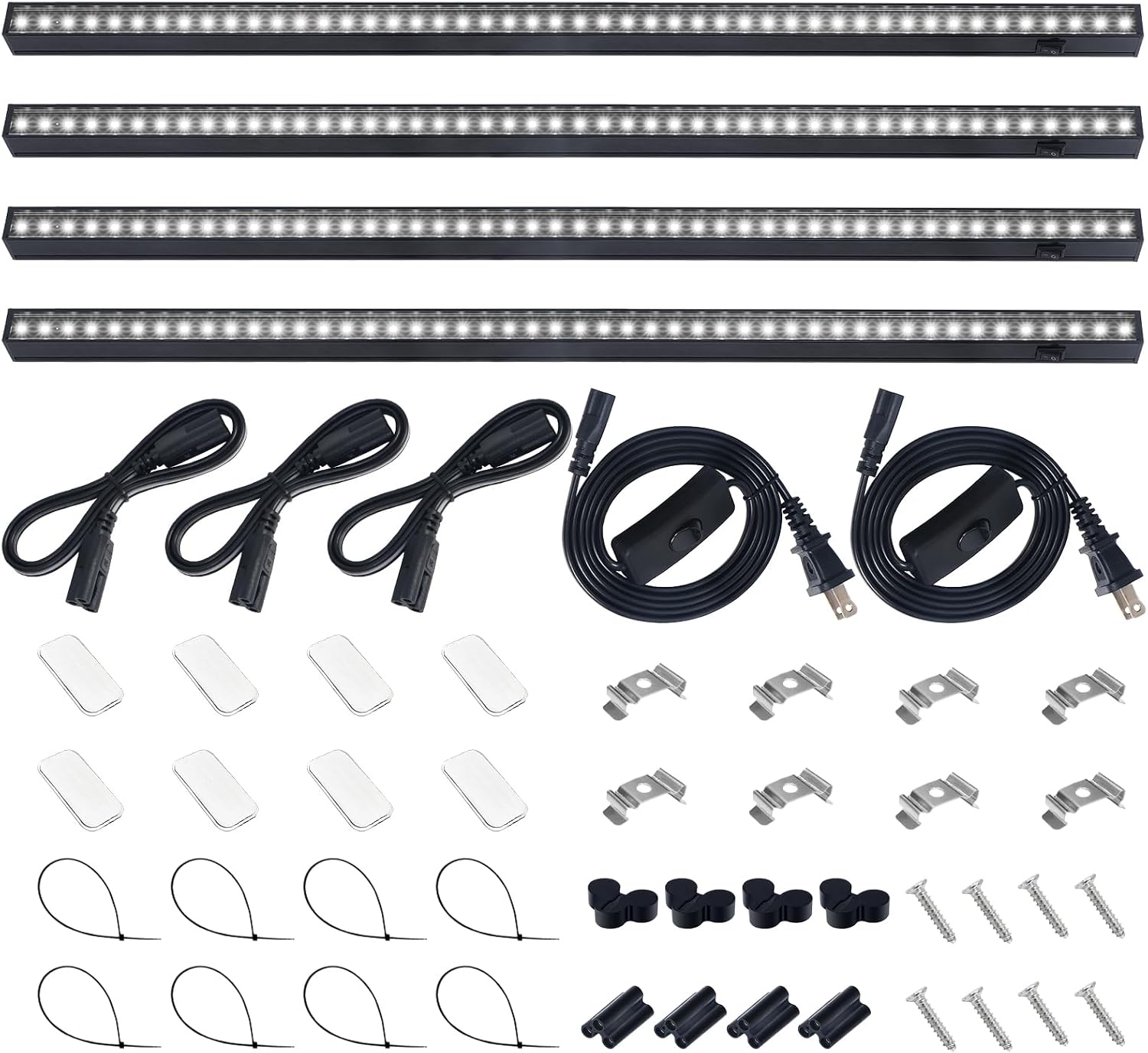
Barrina T5 2FT 4-Pack
A multi-bar kit for a dedicated herb shelf or multiple growing zones.
Model ASIN: B0CHRW8JKM. Check current specifications, price and availability on Amazon.
AMAZON AFFILIATE PICK 5
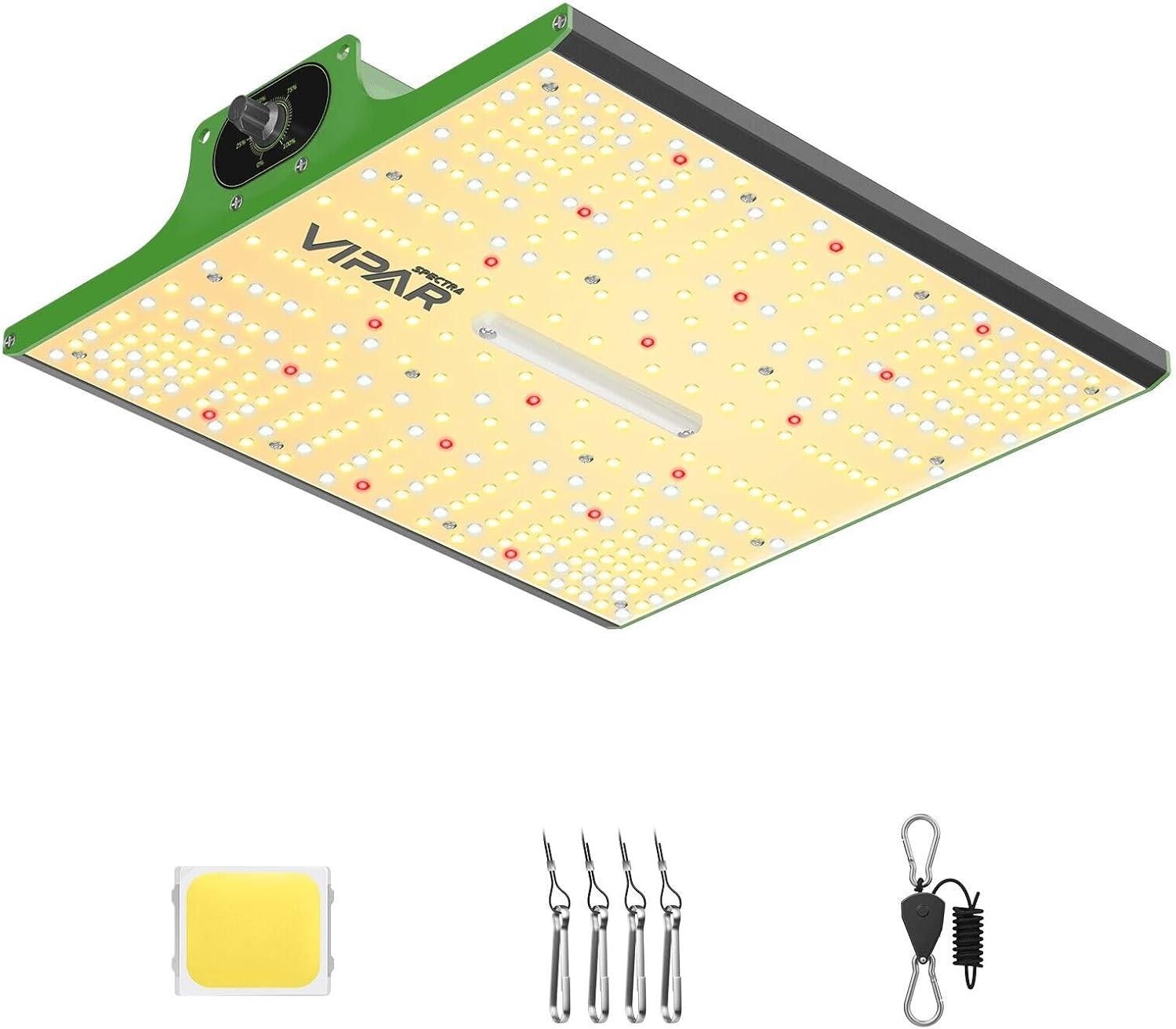
VIPARSPECTRA P600 LED Grow Light
Higher-output fixture for a dedicated setup; check mounting height, glare and power requirements.
Model ASIN: B089NXK3Q2. Check current specifications, price and availability on Amazon.
AMAZON AFFILIATE PICK 6
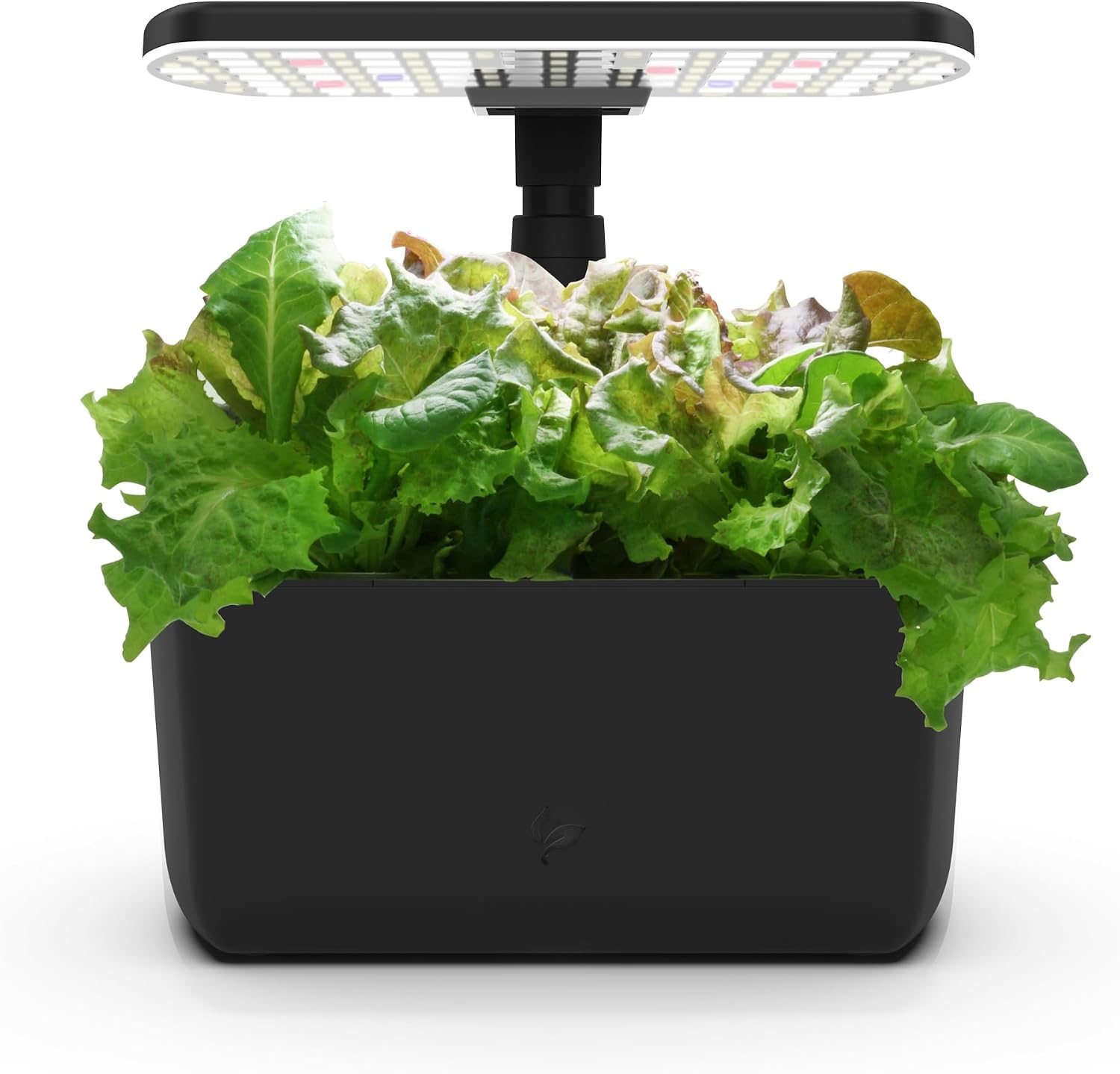
AeroGarden Harvest 2.0
Integrated countertop hydroponic system with lighting and water reservoir.
Model ASIN: B0CTRV8ZBZ. Check current specifications, price and availability on Amazon.
AMAZON AFFILIATE PICK 7
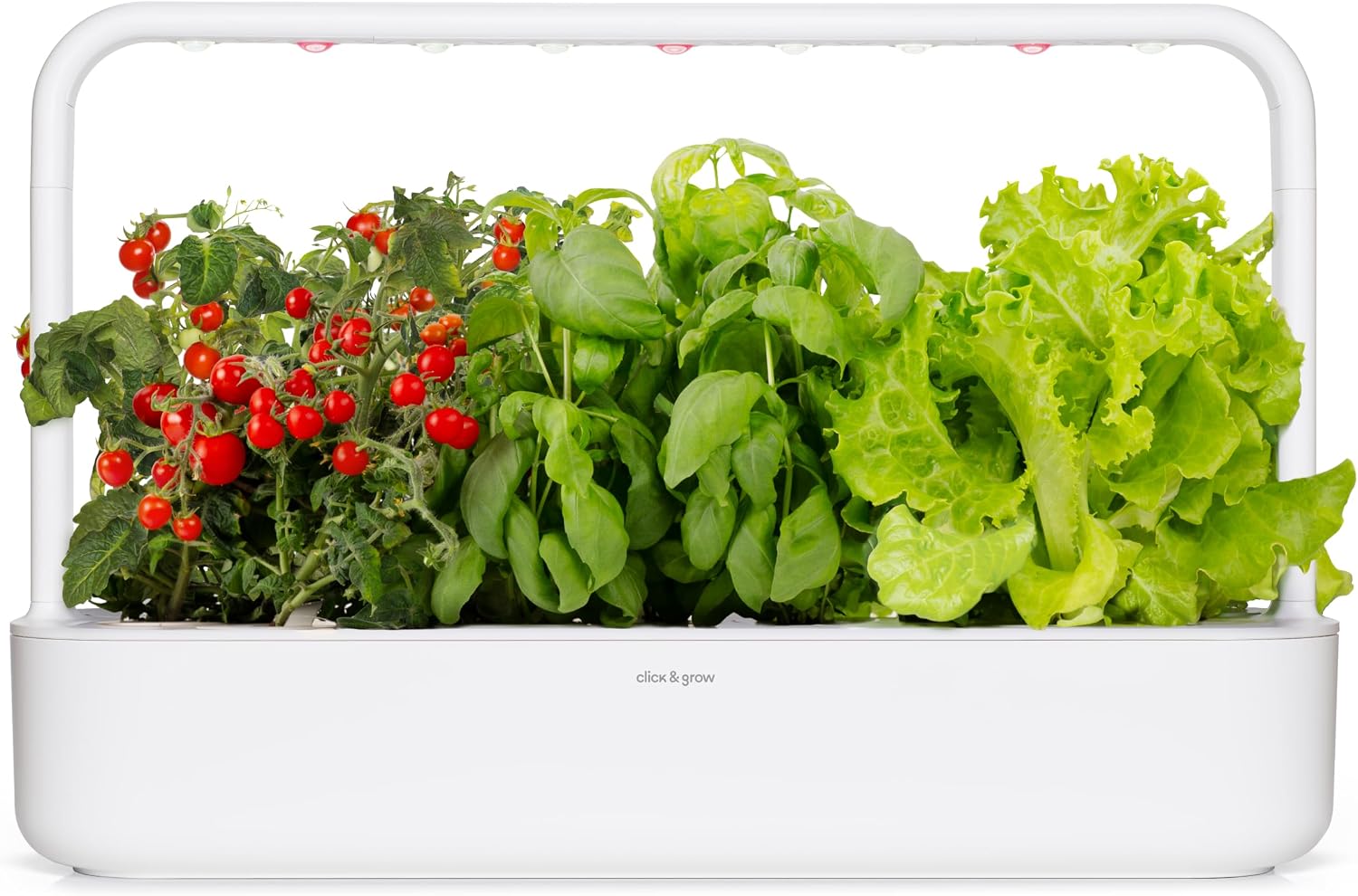
Click & Grow Smart Garden 9
Nine-plant countertop garden for readers prioritizing an integrated system.
Model ASIN: B076CNZKWX. Check current specifications, price and availability on Amazon.
Which Grow-Light Design Works Best?
Use these comparisons to understand trade-offs and match your space to the fixture format. Our recommendations are research-based rather than hands-on laboratory tests.
Barrina T5 2-Foot Full-Spectrum LED Bars
Best potential fit: a dedicated narrow herb shelf. Barrina offers several distinct T5 variants, including 5000K and magnetic mounting options. On one official product page the manufacturer describes 10W per two-foot bar; the number of lights in a package changes the total power. Check the exact bundle, mounting method and coverage before purchase. This format is less convenient for a single movable pot but can suit a row of parsley, chives and basil.
SANSI Compact Clip-On LED Grow Lights
Best potential fit: a movable one- or two-pot arrangement. Compare gooseneck adjustment, stability, power connection and timer features; specifications differ between SANSI models and should not be generalized across the range. A clip-on head may be unsuitable for a broad, crowded shelf.
Barrina One-Foot LED Bars
Best potential fit: very short shelving where a two-foot unit overhangs. Compare measured coverage against a standard-length bar and ensure the mounting surface supports the fixture.
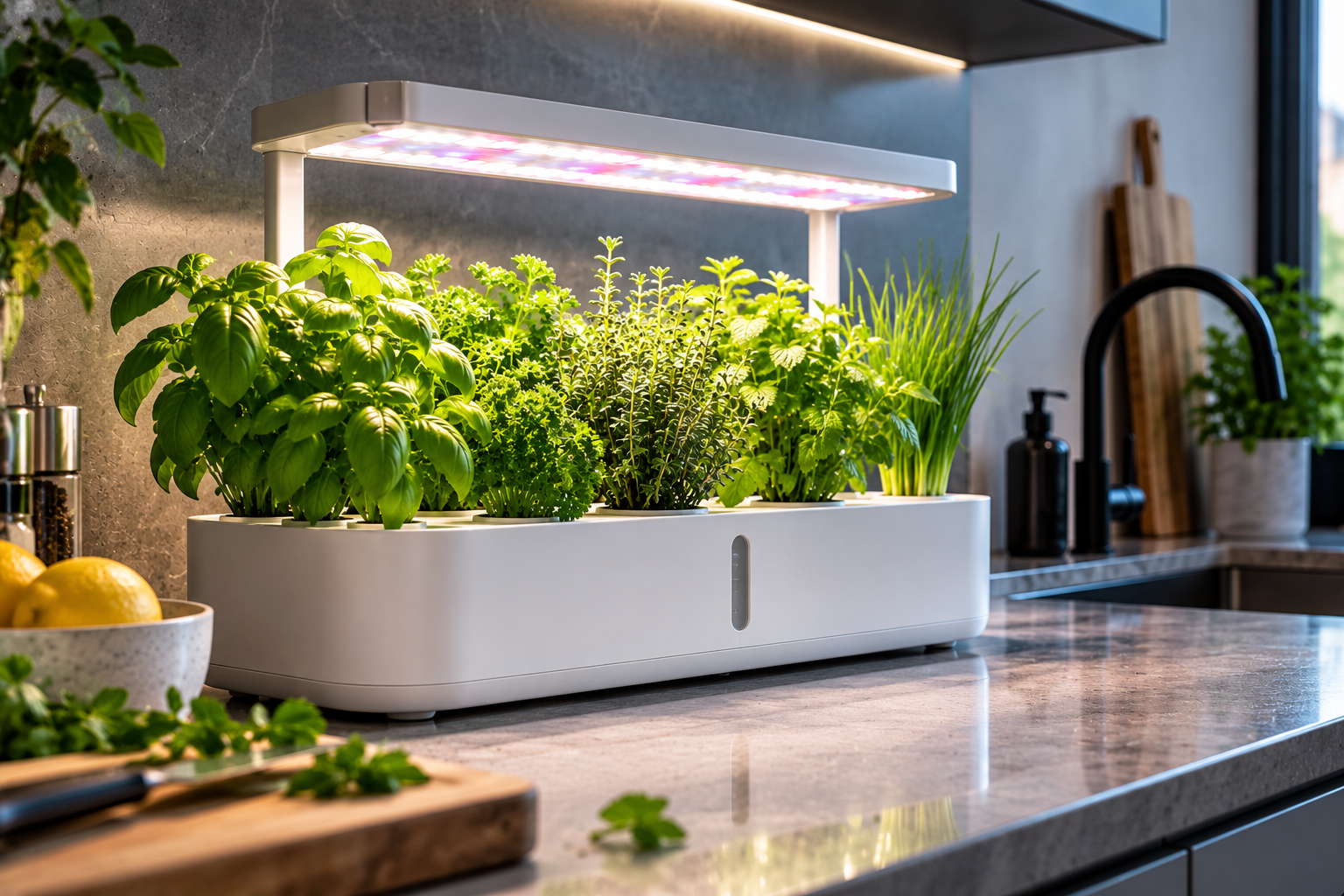
All-in-One Countertop Hydroponic Gardens
Best potential fit: readers who want lighting, reservoir and plant supports in one system rather than separate soil pots. Compare tank capacity, cleaning access, proprietary replacement pods and plant height limits. Check the current model rather than assuming the features of an older version.
What We Would Not Buy Without More Evidence
A generic light advertising extraordinary “equivalent wattage,” without measured coverage or clear electrical specifications, is a poor basis for selecting a productive edible-herb setup. We also avoid treating a decorative desk lamp as a grow light without evidence that it delivers useful photosynthetic light.
AT A GLANCE
Choose Your Indoor Herb Grow-Light Setup
One plant: Start with an adjustable clip-on light and a pot with drainage. Three to six soil-grown herbs: Compare linear lights and use a stable shelf mount. Integrated system: Consider a countertop hydroponic garden if you accept cleaning and replacement supply costs.
Before you buy: measure shelf length, shelf depth, mounting clearance, proximity to an outlet and the space needed as basil grows taller.
Buying Questions: Choosing Your Grow-Light Setup
Is a full-spectrum LED necessary for growing basil indoors?
A purpose-built grow light with appropriate useful light output is a practical choice when daylight is inadequate. The words “full spectrum” alone do not guarantee results; compare canopy coverage, PPFD where available, mounting distance and the recommended daily schedule.
Is a clip-on grow light enough for three herb pots?
Sometimes, but small light heads can leave outer plants in shade. A linear fixture may distribute light more evenly across a row. Choose by the measured footprint and the manufacturer’s guidance, not the number of pots on the packaging.
Are countertop hydroponic gardens better than soil pots?
Not inherently. They combine lighting, a water reservoir and a compact structure, while traditional pots offer flexibility and usually lower equipment complexity. Maintenance routines differ, so compare ongoing cleaning and consumable costs.
How do I keep grow lights from looking harsh in a living room?
Choose an appropriately rated white-light fixture, position it away from eye level and reduce direct glare without blocking the plants. Never cover ventilation openings or enclose an electrical fixture in an unventilated cabinet.
What to Expect From Herbs Under Grow Lights
Indoor gardening is not a substitute for the unlimited light of a summer garden. Different herbs require different amounts of light, and growth depends on temperature, plant variety, water, fertilizer and the quality of the fixture. Parsley, chives, mint, basil, oregano and thyme can all be grown indoors, but basil and Mediterranean woody herbs generally demand more light than a dim decorative plant would.
The Iowa State University Extension guide to indoor herbs identifies light as a frequent limiting factor and recommends supplemental lighting when windows do not supply enough. It also advises separate pots for different herbs, because their watering requirements differ. This is a useful starting point for planning a small, manageable collection rather than buying ten varieties at once.
Choose three herbs before choosing a light
For a first system, try chives, parsley and basil. Chives are compact and useful in savory cooking; parsley can be harvested repeatedly when grown well; basil provides a clear indicator of whether the light and warmth are adequate. If the room stays cool, consider replacing basil with mint or another herb better suited to your conditions. Different varieties may respond differently, so observe growth rather than assuming one setup fits every plant.
Use individual containers instead of a mixed decorative trough. Each species can then be moved closer to the lamp, watered or repotted independently. An overcrowded grocery-store basil pot may contain many seedlings competing for root space; do not expect it to behave like one mature plant. A fresh small herb seedling from a reliable grower may establish more predictably.
Match the light footprint to the shelf
Measure the actual usable growing surface and the distance from it to the intended lamp mount. A narrow shelf of roughly 50–70 cm can hold a modest row of pots, but do not crowd leaves against one another. Plants need airflow and space to grow. Choose a full-spectrum LED grow light that illuminates the entire row, not a tiny decorative bulb focused on one pot.
Product wattage alone does not tell you how much useful light reaches plant leaves. If available, review the manufacturer’s measured coverage area and photosynthetic photon flux density (PPFD) information at a specified distance. Coverage matters: a bright hotspot directly below a lamp can coexist with poorly lit herbs at the ends. Without reliable specifications, start conservatively and adjust using plant response.
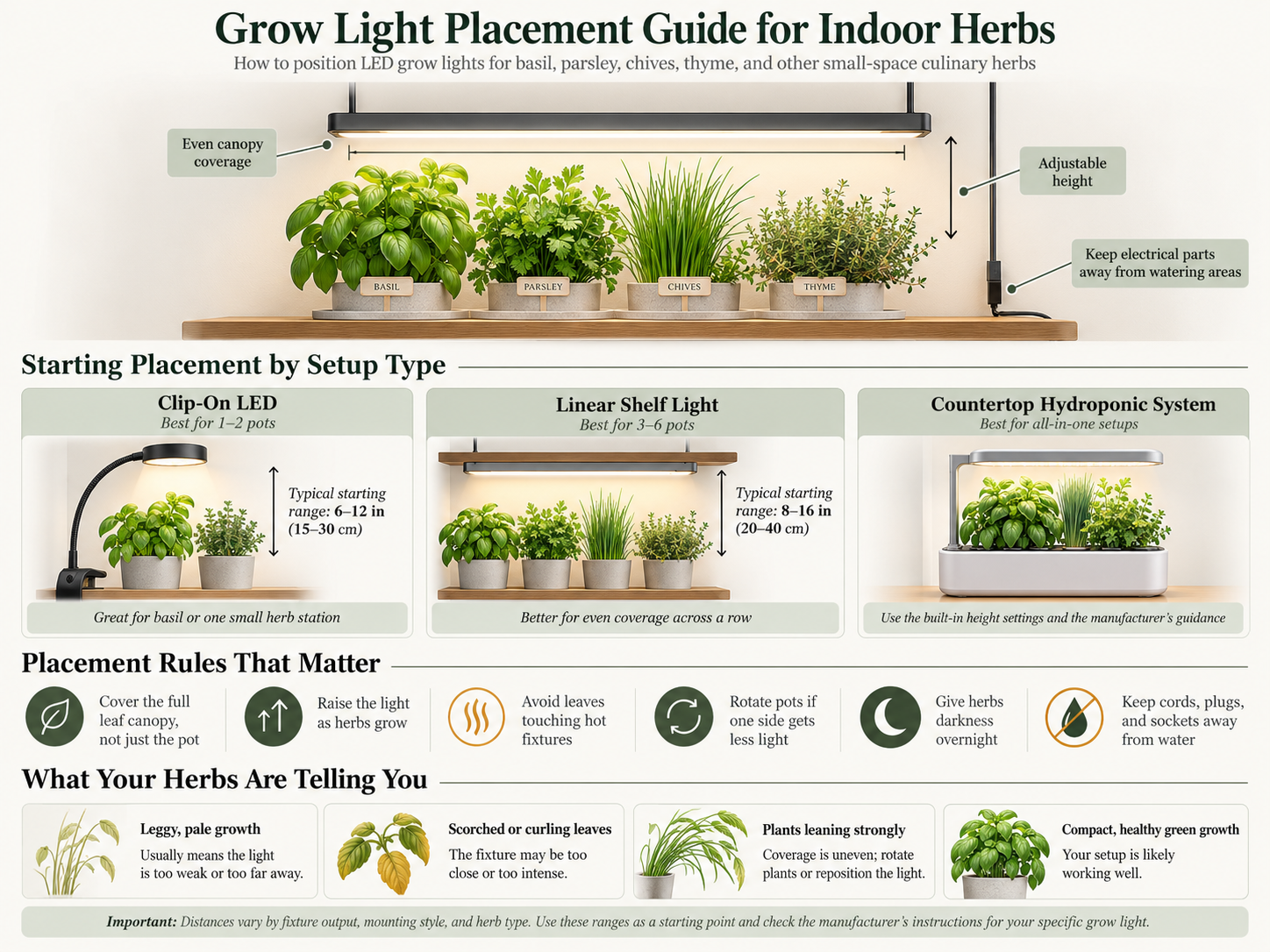
Set the light at a suitable distance
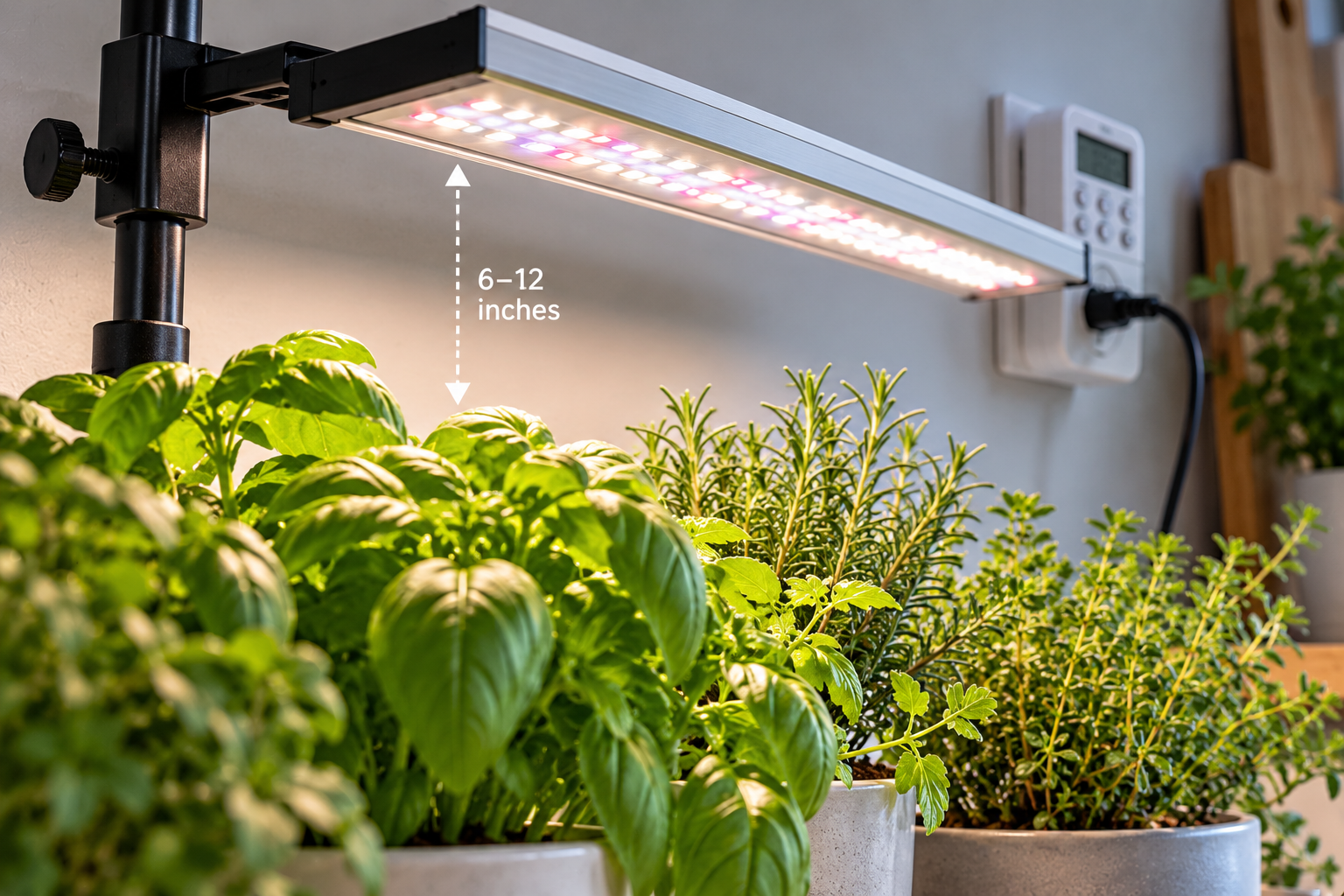
Many extension resources recommend keeping supplemental fixtures relatively close to herbs; Iowa State describes a typical range of 6–12 inches for certain setups, with a timer often running 12–16 hours daily. Treat this as a general extension example, not an instruction for every LED fixture. Modern products vary significantly in intensity and heat output. Always follow the actual grow light’s mounting-height and ventilation requirements, then monitor leaves for stress or stretching.
The plants should not touch the fixture. Do not place an electrical lamp where watering can splash its connectors. Secure the lamp and its power cable so it cannot fall into a watering tray.
Give plants a daily light rhythm
A timer makes indoor gardening more reliable. Choose a repeatable lighting window that fits your household, such as morning through evening, while leaving a period of darkness overnight. Plants do not benefit from a lamp that runs continuously because someone forgot to turn it off. An automatic schedule also prevents the indoor garden from becoming an irritating all-night light source in a studio apartment.
If the herb shelf is in a bedroom or living room, consider a small screen or placement that prevents glare while keeping ventilation. Do not enclose electrical lights inside an unventilated cabinet unless the equipment is specifically rated for that arrangement. Keep lamp labels and operating instructions accessible for future adjustments.
Use drainage-friendly pots and trays
Herbs usually do better when roots can breathe. Select pots with drainage holes and a suitable well-draining potting mix, then set them on a waterproof tray that catches occasional runoff. An attractive cachepot is fine as an outer container, but do not let the plant’s inner pot sit permanently in water. Empty runoff after watering when appropriate for the medium and plant.
Match pot size to root size. Oversized pots may remain wet for too long, while tiny pots dry quickly and demand frequent attention. Start with compact nursery pots, moving to larger containers only as roots and plant growth require. Keep the tray away from timber furniture or add a waterproof barrier to protect surfaces from stains.
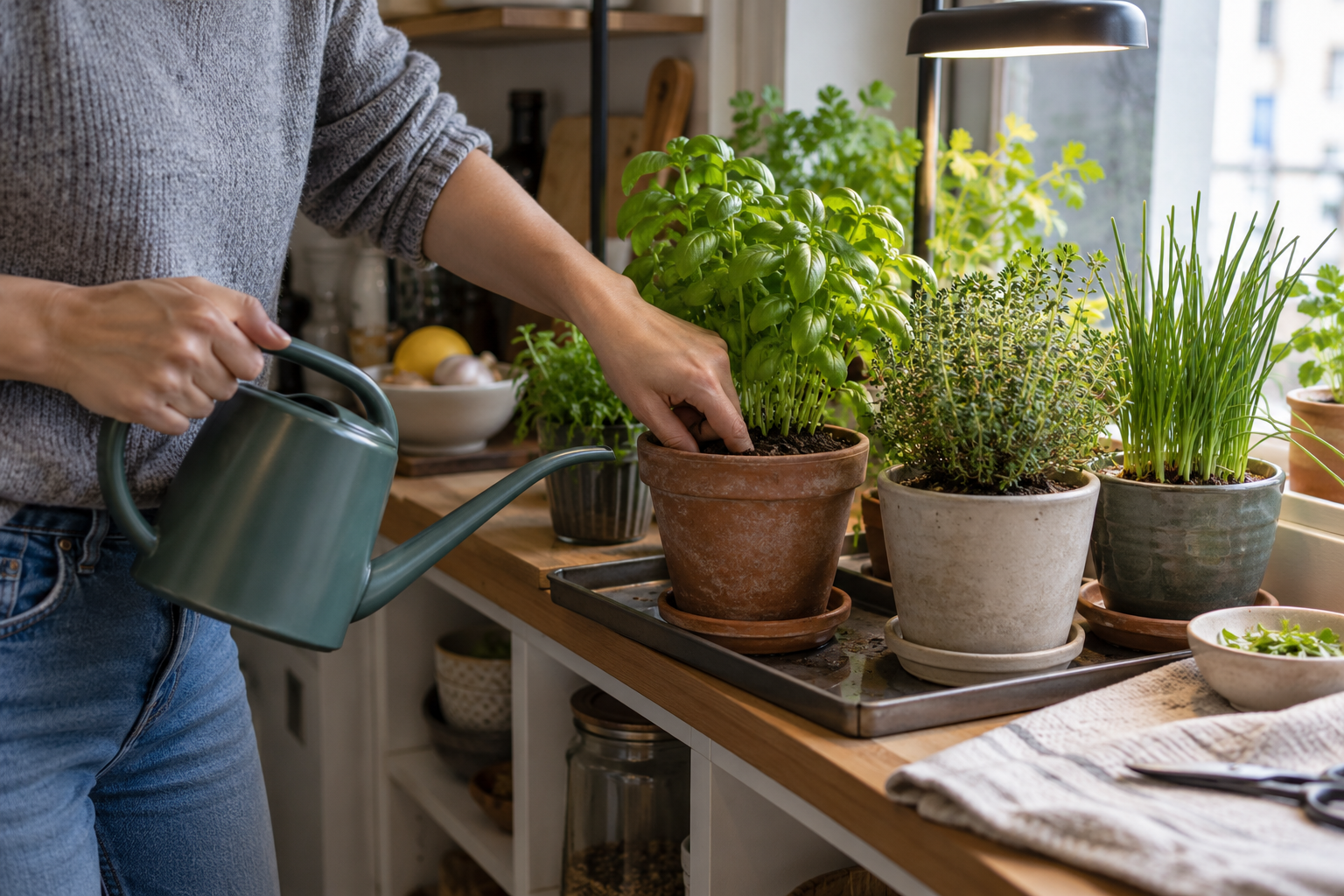
Water according to the plant, not the calendar
Check the potting mix with your finger before watering. Basil generally dislikes becoming completely dry, whereas Mediterranean herbs such as thyme or rosemary often prefer the surface to dry somewhat between watering. Do not give every pot the same amount just because they stand side by side. Yellow leaves may signal excess moisture, insufficient light, nutrient issues or natural aging; diagnose the whole environment before changing everything at once.
Try lifting each pot when dry and after watering. The weight difference becomes a useful practical cue. Always return pots to their waterproof tray and keep the lamp cable outside the wet area. Avoid misting electrical fittings or using waterlogged decorative stones that conceal standing water.
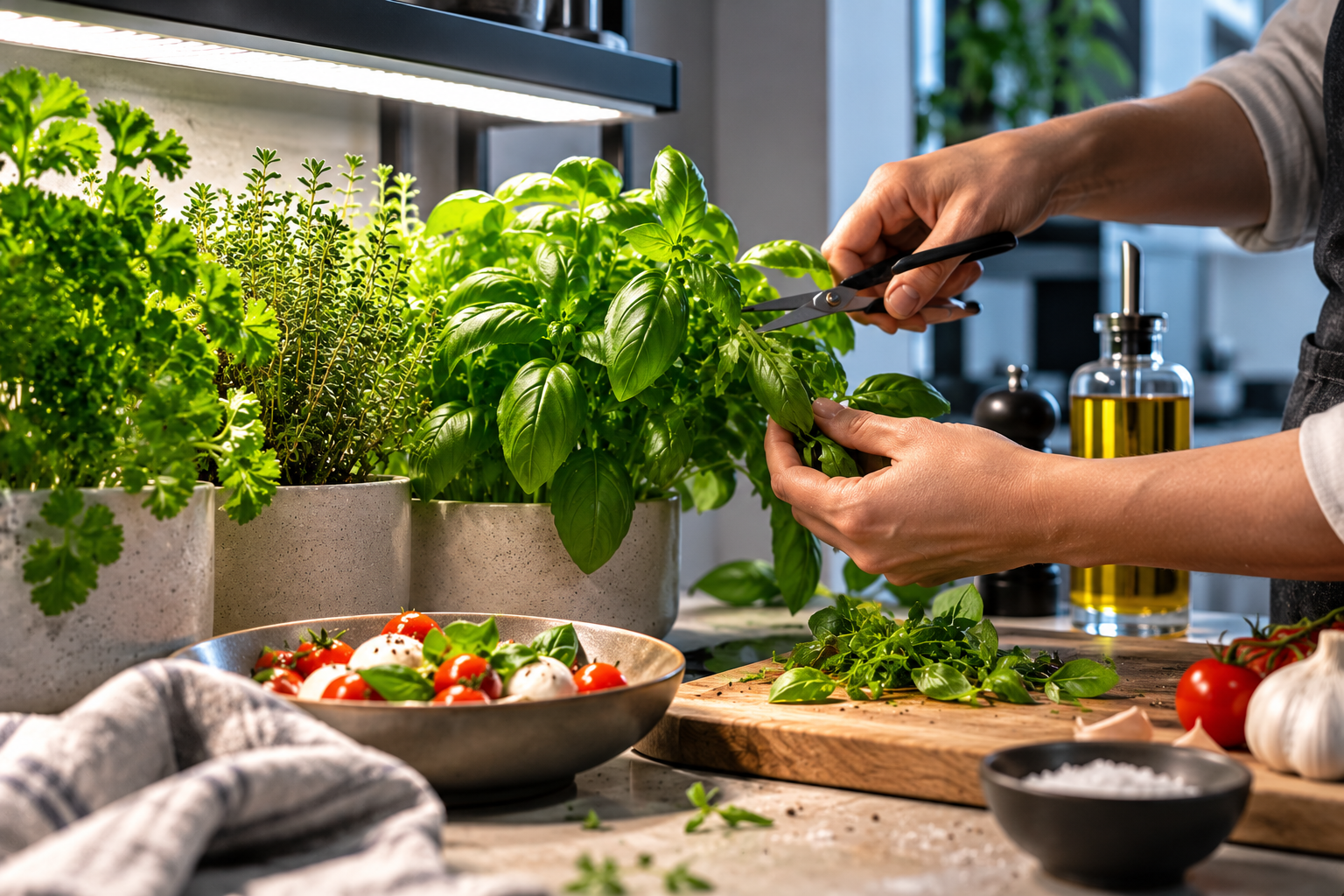
Plan an accessible harvesting routine
The point of a kitchen herb garden is to use the herbs. Harvest gently and often enough to encourage healthy new growth without stripping all leaves from a struggling plant. For basil, remove tips above a healthy node once the plant is established, leaving enough foliage for continued growth. Cut chives with clean scissors and avoid pulling entire plants from the soil. Parsley may be harvested from mature outer stems as new shoots develop in the center.
Wash harvested leaves before cooking. Do not use pesticides or homemade chemical sprays casually on edible plants; follow label instructions and food-safe recommendations if pests appear. Inspect leaves regularly for aphids and other pests, especially when introducing new plants from outside or a shop.
Recognize common failure patterns
Tall, thin stems: the fixture may be too weak, too far away, used for too few hours or covering too wide an area. Check the lamp’s specifications and move one pot within the approved range rather than making abrupt changes to every plant.
Brown, crisp leaf edges: check whether the plant is too close to a strong lamp, too dry, exposed to hot air or accumulating salts from fertilizer. A weak herb may have more than one problem.
Wet soil and fungus gnats: reduce unnecessary watering, improve drainage and remove standing water. Let the medium reach the appropriate moisture level for the species. Yellow sticky traps can help monitor adult gnats, but they do not fix the underlying damp soil.
Pale slow growth: consider light, temperature, pot size and nutrition. Herbs need some nutrients, but heavy fertilization cannot compensate for poor lighting.
Keep the setup compact and safe
A tidy shelf needs a secure lamp mount, drip-protected plant tray and an accessible timer. Keep power strips off the floor where watering could reach them. Route cords so they cannot be pinched by drawers or caught by pets. Follow the electrical equipment’s ventilation and location ratings. For renters, a freestanding shelf with a clamp-mounted compatible fixture can be more practical than drilling into cabinets.
If the kitchen has very little usable countertop, avoid taking over a key chopping zone. A shelf in a bright living-room corner can still supply herbs for cooking. Our windowsill herb guide and small-kitchen workflow tips help you decide whether the kitchen is really the best location.
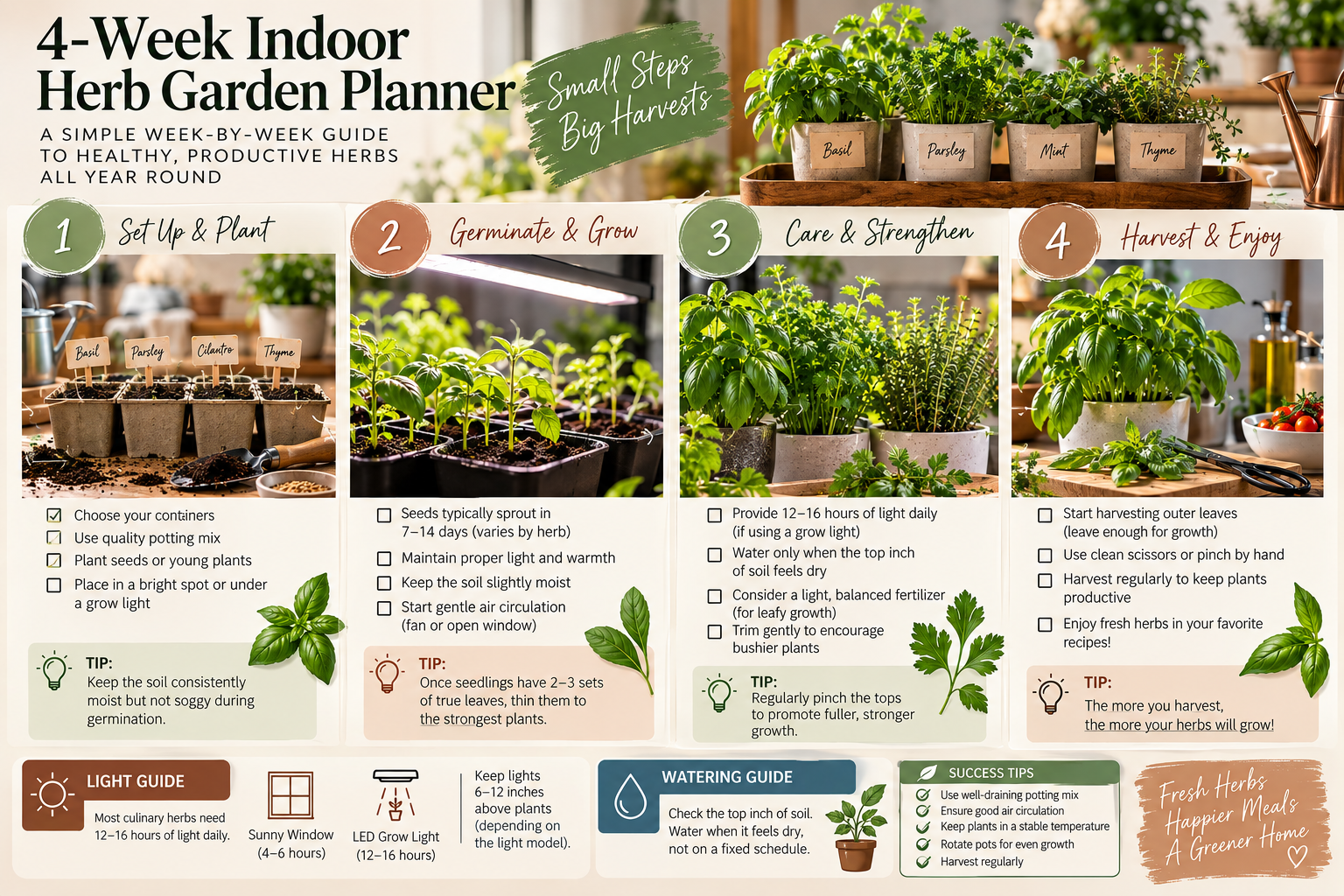
A four-week starting plan
During week one, set up two or three plants, install the light according to instructions, and record the schedule. In week two, check soil daily but water only when needed; observe whether leaves lean or stretch. In week three, adjust spacing and rotate pots if growth is uneven. By week four, harvest small amounts from established plants and note which species is thriving. Keep a photo diary rather than purchasing more gadgets prematurely.
A reliable small herb garden is less about achieving a complicated technical setup and more about repeating a few good habits. Give the plants adequate light, drainage, the right amount of water and enough room to grow, and your dark apartment can still have a useful green corner.
Indoor Herb Growing: Care and Troubleshooting FAQs
Can herbs grow in a windowless apartment?
Yes, some herbs can grow under suitable supplemental grow lights, but performance depends on light intensity, duration and other growing conditions. A decorative household bulb is not necessarily sufficient.
How many hours should a grow light run?
Extension guidance often describes a 12–16-hour daily window for supplemental indoor-herb setups, but always use the manufacturer’s guidance for the fixture and adjust based on plant health.
Which herbs are easiest to start under grow lights?
Chives, parsley and mint can be practical beginner options. Basil is popular but usually needs stronger light and warmth to remain productive.