
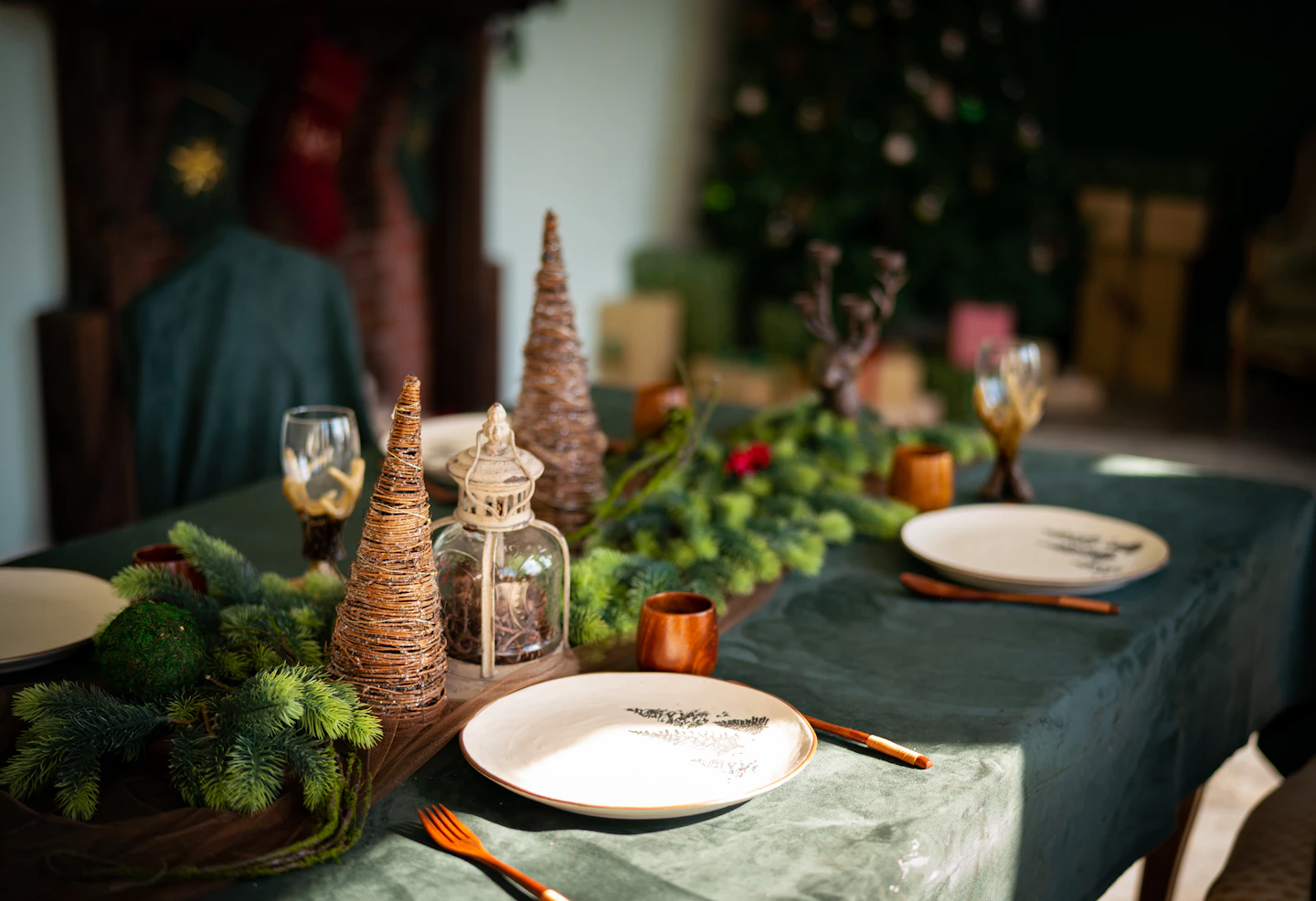
A small dining table can feel more intimate than an elaborate banquet setup. At Christmas, that intimacy is an advantage—until the centerpiece, chargers, decorative napkin rings and serving bowls leave nowhere to put the food. The most inviting table is one that looks beautiful while people are actually using it.
This guide is designed around a real table for four, including square apartment tables and compact rectangular dining sets. It covers an easy measurement method, three distinct decorative directions, low arrangements that allow conversation, and a service plan that keeps hot dishes off crowded surfaces. You can create a thoughtful holiday table with ordinary plates and a handful of deliberate accents.
Christmas table for four: at a glance
- Best foundation: four everyday dinner plates, four cloth napkins, simple glassware and a narrow runner.
- Ideal centerpiece: one low arrangement on a removable tray, kept clear of glasses and serving dishes.
- Color rule: one evergreen or festive accent, one pale neutral and one subtle metallic finish.
- Space-saving approach: serve main platters from a nearby counter.
- Before guests arrive: test all four place settings with the actual serving bowls.
How to set a Christmas table for four, step by step
- Clear and measure. Sit in each chair and check that each diner can reach their glass comfortably.
- Choose a simple base. Use a slim runner or four practical placemats rather than stacking oversized chargers.
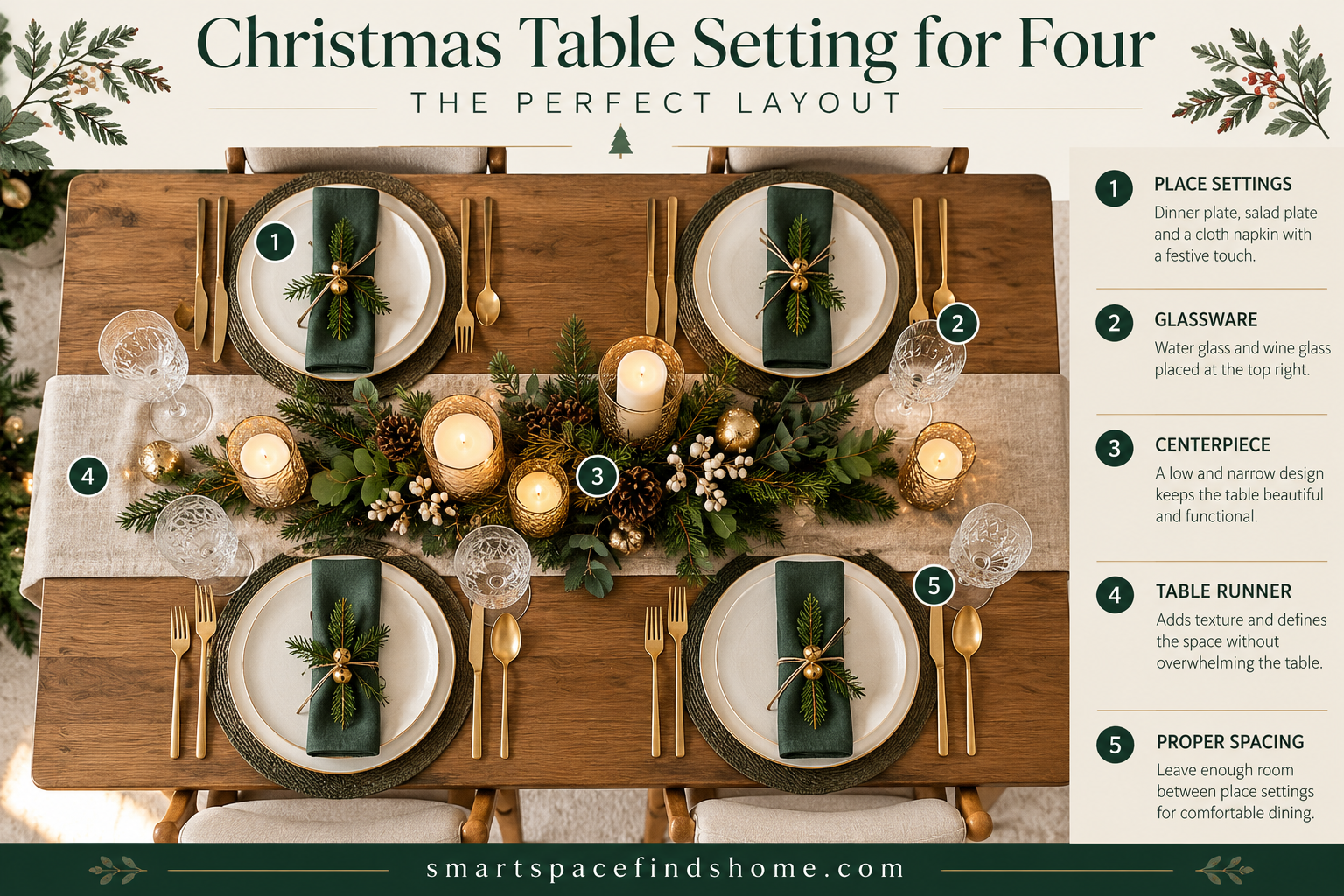
- Arrange four place settings. Position the dinner plate first, fork to the left, knife to the right with blade facing inward and a water glass above the knife.
- Fold the napkins. Use one straightforward fold and repeat it at all four places.
- Add one low focal point. Keep decorations on a tray so they can be cleared instantly for food.
- Rehearse serving. Bring the real platter and water jug to the table and remove anything that crowds them.
Expert styling tip: the 10-minute rehearsal
Photograph the table with four place settings and the largest serving platter before dinner. The camera reveals asymmetry, while a seated test reveals whether the composition is practical. Remove one decorative item if the place settings feel crowded.
Measure the usable table, not just the tabletop
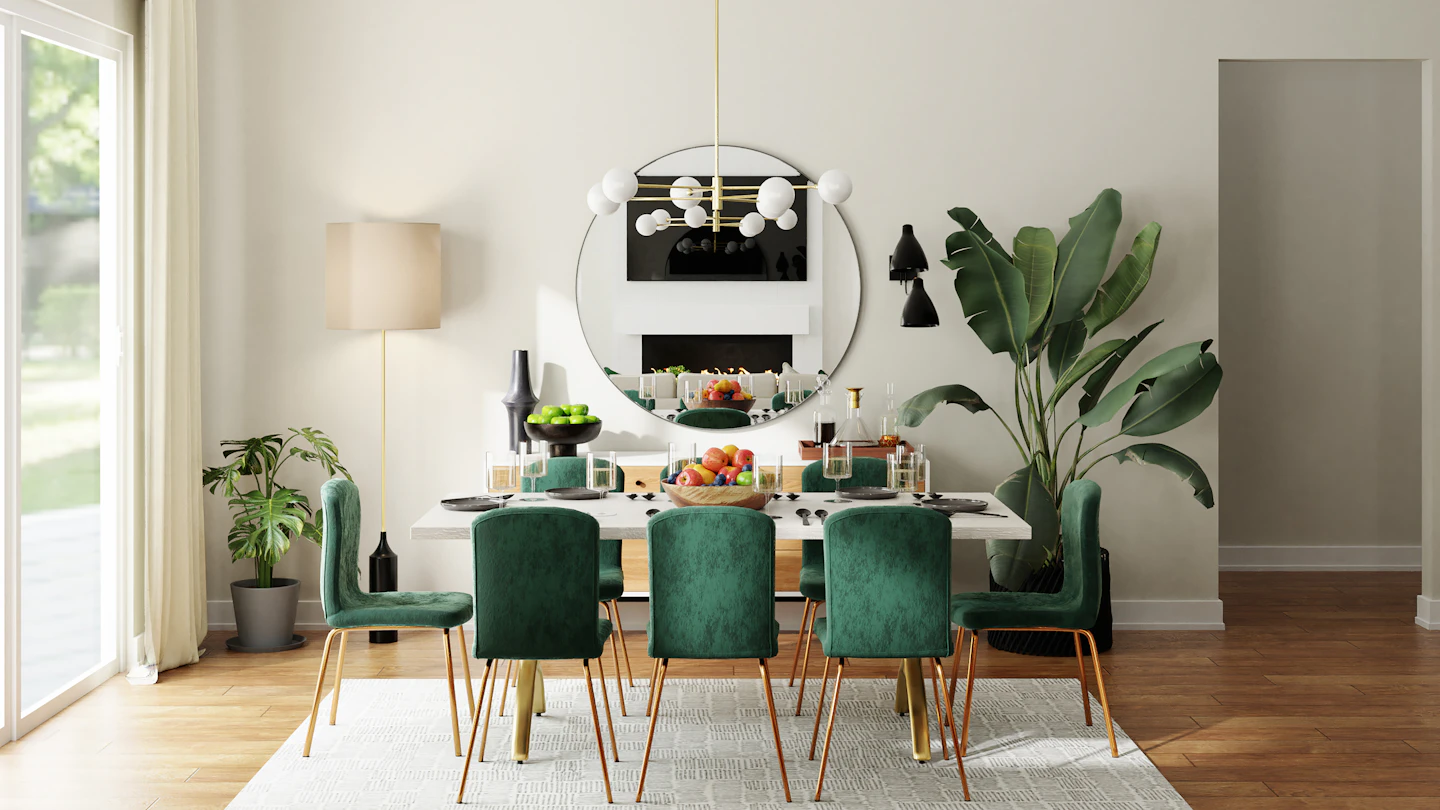
Set out four regular dinner plates, cutlery and drinking glasses before bringing in decorations. Add the serving bowl or platter you expect to use most. Notice where elbows, bread plates and water glasses naturally go. Whatever remains in the center is the true decorating footprint. On a small square table, this may be just enough room for a little vase or a narrow candleholder.
If your table is approximately 75–90 cm wide, do not assume the full central third is available; plate diameter and chair placement vary. Rehearse the actual setting instead. Check whether diners can pull chairs out, pass dishes and place used cutlery down without hitting decorations. That test matters far more than the size of an online centerpiece.
Build the table around one recurring color

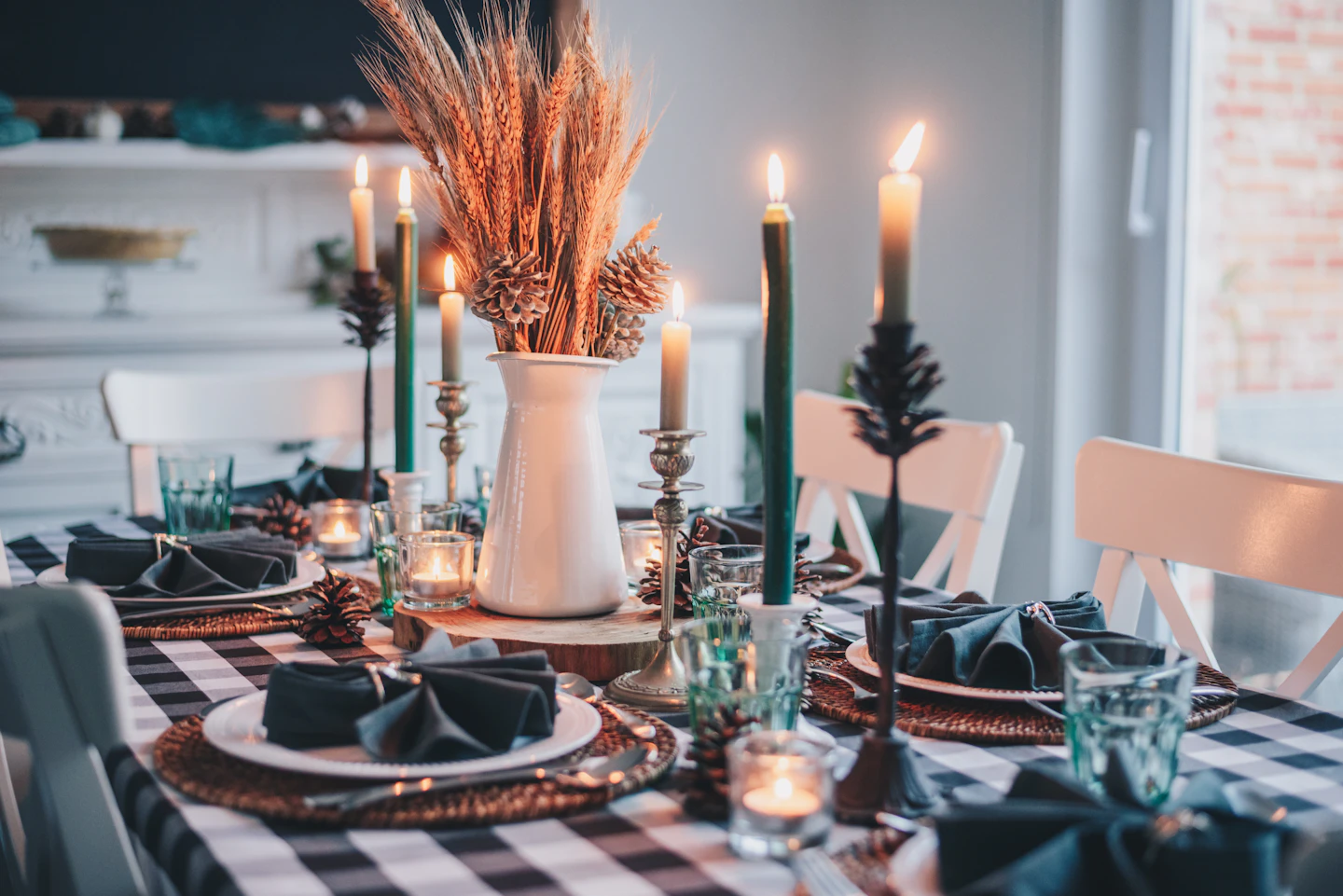
A modest palette prevents a small surface from feeling busy. Choose one holiday color, one neutral and one tactile material. Forest green, cream and woven linen feel natural. Burgundy, warm white and antique brass (see also our burgundy Christmas decorating ideas) are richer. Cinnamon, oat and pine suit a cozy apartment with warm wooden furniture. You do not need a new matching dinner set: neutral plates work beautifully in all three.
Make repetition intentional. If napkins are burgundy, repeat the shade in one narrow ribbon or a small branch of berries at the center. Do not introduce unrelated red, silver and gold accessories merely because they are Christmas merchandise. For decorating the rest of your home in a consistent palette, our cozy Christmas living-room guide offers useful starting points.
Option one: a quiet Nordic table
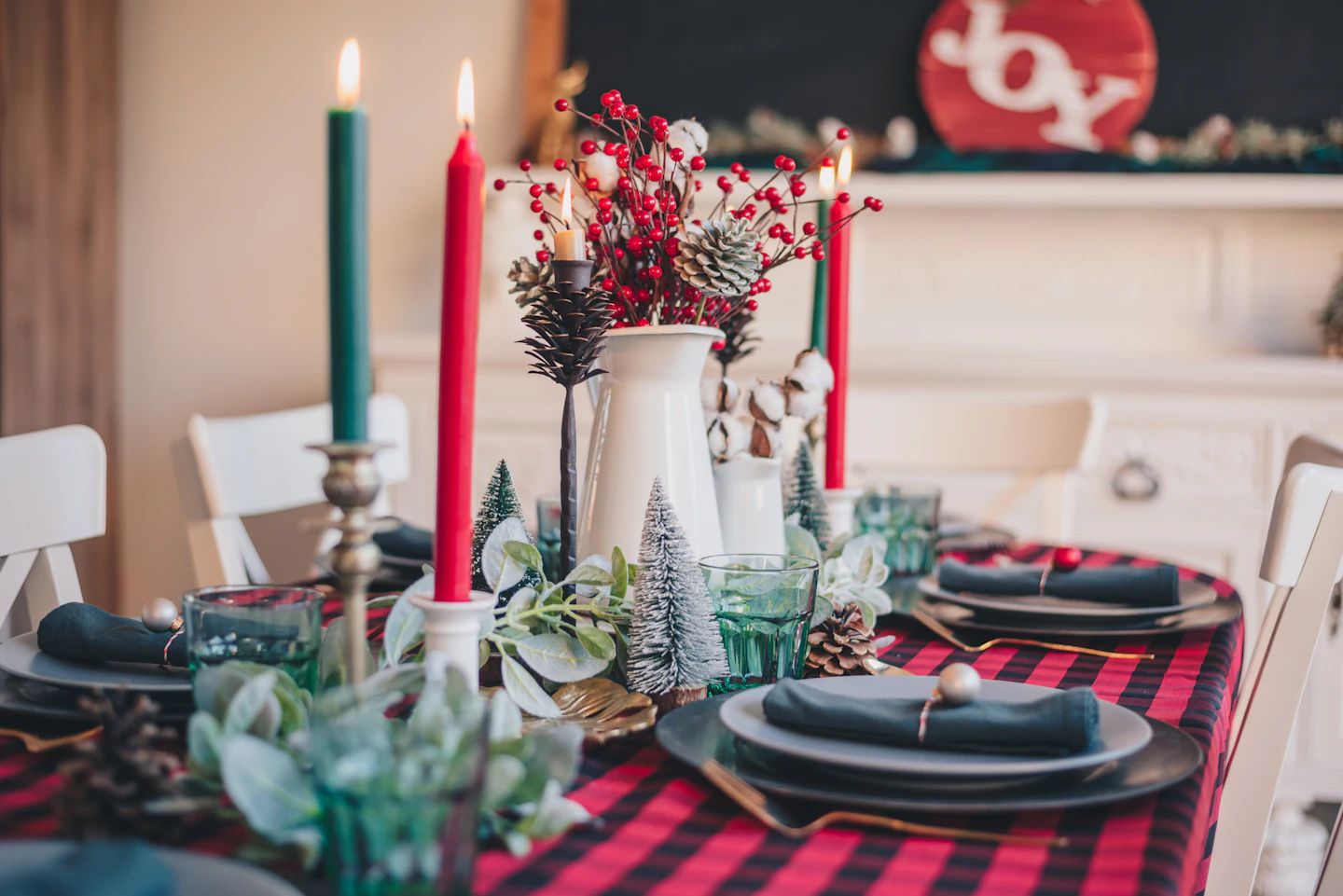
Use a washed linen runner, matte everyday plates and folded cream napkins. Put a short ceramic vase of evergreen in the middle, leaving plenty of open space. A few simple wooden stars can sit beside the vase, but avoid scattering small pieces near food. If you want sparkle, use two compact battery-operated tea lights, positioned so they cannot tip when plates move.
This style works well when the room already contains pale woods and soft textiles. Its strength is restraint: small imperfections in the linen and natural greenery provide the texture. Do not add ten different ornaments to make it “festive enough.” The table is meant to frame the meal and conversation, not compete with them.
Option two: a warm burgundy dinner
Lay individual neutral placemats rather than a large cloth if you prefer easier cleanup. Add burgundy napkins and simple glassware, then tie each napkin with a reusable ribbon rather than a bulky metal ornament. Place a low cluster of faux greenery and two miniature glass baubles on a narrow tray. The tray lets you lift the arrangement away when the main course arrives.
Brass-colored cutlery can be beautiful, but it is not necessary. Warm light reflecting through ordinary clear glasses often provides enough visual richness. Keep burgundy accents off serving surfaces where dyes or fabric fibers could contact food. Wash napkins before use if the care label recommends it.
Option three: a playful family table
For a table shared with children, use a washable cloth or wipe-clean mats and assign each person one simple paper name card. Decorate with a tiny central paper house and a short row of unbreakable ornaments secured inside a shallow dish. Avoid small loose parts for younger children and keep hot serving dishes away from edges.
A low creative element can double as an activity: invite family members to write a short holiday message on the back of each name card. Keep art supplies off the dining surface once the food is served. The memory becomes part of the setting without requiring more decorations to store afterward.
Choose a centerpiece with three practical rules
First, keep it low enough that people can see one another. Second, keep it stable when the table is bumped. Third, make it easy to remove in one motion. A long branch extending into plates fails the first and second rules; a dense bowl filled with fragile glass fails the third. Low ceramic vessels, a narrow tray or a single clipped evergreen arrangement are more dependable.
Avoid poisonous or irritating plants where food is served, and keep all fresh greenery well away from flames. Open candles and trailing ribbon are a poor combination. Flameless candles are usually the simpler choice when table space is limited. Check that any electrical decorations are suitable for indoor use and do not obstruct diners.
The serving-bowl test
Set out the actual food containers on the empty table a day in advance. If the centerpiece has to be moved before every dish is served, give it a designated landing spot on a sideboard or windowsill. A removable centerpiece is not a failure—it is an elegant way to keep the eating area functional.
Set each place without over-layering
Start with a plate, knife, fork, water glass and a neatly folded napkin. Add a second glass only if guests genuinely need one. Charger plates can look impressive, but on a tiny table their extra diameter may crowd neighboring settings. Try placing two chairs opposite two chairs rather than four at corners when the table shape permits; circulation and elbow room are the priorities.
A handwritten name card makes an ordinary place setting feel planned. Keep text large enough to read under evening lighting. If you want a festive touch, tuck a small rosemary sprig beneath the napkin ring, but ask about fragrance sensitivity and keep herbs clean and away from food contact if they are purely decorative.
Plan where the food will actually go
Many apartment dining tables cannot hold four settings and several platters at once. Serve from a nearby counter or sideboard and bring the meal in courses or individual portions. Keep hot serving dishes on appropriate heat-resistant stands and away from flammable fabric. If a meal involves gravy, bread and sides, assign each item a location in advance instead of trying to improvise in a crowded room.
A buffet station does not need special furniture. Clear one safe section of kitchen counter, protect it from heat and arrange serving utensils in the order guests will need them. Keep the sink and cooking area functioning. Our tiny-kitchen meal-prep routine can help reduce last-minute clutter before guests arrive.
Finish the room, not just the tabletop
A small table benefits from a warm backdrop. Switch on a shaded lamp, clear visual clutter from the nearby shelf and let the centerpiece complement existing cushions or curtains. Avoid strong scented candles while guests are eating. A festive playlist at a conversational volume and soft lighting can do more for atmosphere than another pile of ornaments.
If photographing the result for Pinterest, take one wider image showing the table’s real size and seating clearance, then a second detail photograph of one place setting. Do not crop so tightly that an impractical arrangement appears functional. Honest scale is more useful to readers recreating the idea.
A simple setup timeline
The evening before, wash linens and glasses, gather vessels, and test serving bowls on the table. On the day, set the neutral base first and prepare the centerpiece away from food. Add the napkins and name cards shortly before guests arrive. Once everyone sits, shift the movable tray if necessary and focus on serving the meal. Save a photo of the final practical arrangement to repeat next year.
A Christmas table for four can be elegant precisely because it is small. Leave enough space for real conversation, good food and the ordinary movements that make people comfortable.
Quick comparison: three Christmas table looks
| Look | Palette | Best for | One focal detail |
|---|---|---|---|
| Nordic simplicity | Winter pearl, sage, wood | Small apartments | Low ceramic vase |
| Evergreen elegance | Deep green, ivory, champagne | Adult dinner for four | Folded cloth napkins |
| Playful family | Ivory, red accents, pale green | Families with children | Paper place cards |
Budget vs. premium: where to spend
Budget: Keep the everyday plates and glasses, add washable napkins and cut greenery in a vessel you already own. Spend on one repeated detail rather than four different ornaments.
Premium: Upgrade the napkin texture, the quality of the runner or a versatile low ceramic centerpiece. Avoid buying an entire seasonal dinnerware set for a table this small.
Five Christmas table mistakes to avoid
- Blocking eye contact with tall branches, candles or florals.
- Using oversized chargers that eliminate elbow room.
- Mixing too many decorative colors on a compact surface.
- Placing loose glitter, fragile decorations or unsafe greenery close to food.
- Forgetting space for the water jug, bread and serving utensils.
Before you buy: a practical checklist
- Measure the usable table with four plates and glasses in place.
- Check runner dimensions and washing instructions.
- Choose napkins that can be washed and reused beyond Christmas.
- Confirm that a candle or vase has a stable, compact footprint.
- Prioritize food-safe, easy-clean materials for anything near serving dishes.
- Check delivery timing, return conditions and product dimensions before ordering.
Disclosure: As an Amazon Associate, Smart Space Finds earns from qualifying purchases. This does not change the price you pay.
Frequently asked questions
What can I use as a centerpiece on a tiny Christmas table?
Try one low ceramic vase, a shallow tray of greenery or two battery-operated candles. Choose something stable, easily removable and narrow enough to leave space for food.
Can I decorate without a tablecloth?
Absolutely. Plain plates, cloth napkins and a single accent color are sufficient. Placemats are often easier to wash and can preserve the appearance of a nice wooden tabletop.
How do I serve Christmas dinner at a small table?
Keep full platters on an adjacent safe counter, serve in courses or individually, and avoid oversized charger plates. Test the layout with actual serving bowls before guests arrive.