
The Wardrobe Edit / A No-Buy Style Field Guide
There is a particular kind of closet frustration: plenty of clothes, three familiar outfits, and the feeling that something is missing. Often the missing piece is not another purchase. It is a way to see what you already own differently.
This is a practical guide to upgrading your personal style without buying new clothes. We will turn underused pieces into wearable combinations, improve fit and finish, and create a small system that makes getting dressed feel easier. No prescribed aesthetic, mandatory capsule size, or fantasy wardrobe required.
First, define what “better style” means for your actual week
A polished outfit that cannot survive your commute, workplace, weather, or schedule is not a practical improvement. Before touching the hangers, write down your most common situations: perhaps office days, home days, errands, dinners, or weekends outside. Your wardrobe should serve the life you have, not the life in someone else’s lookbook.
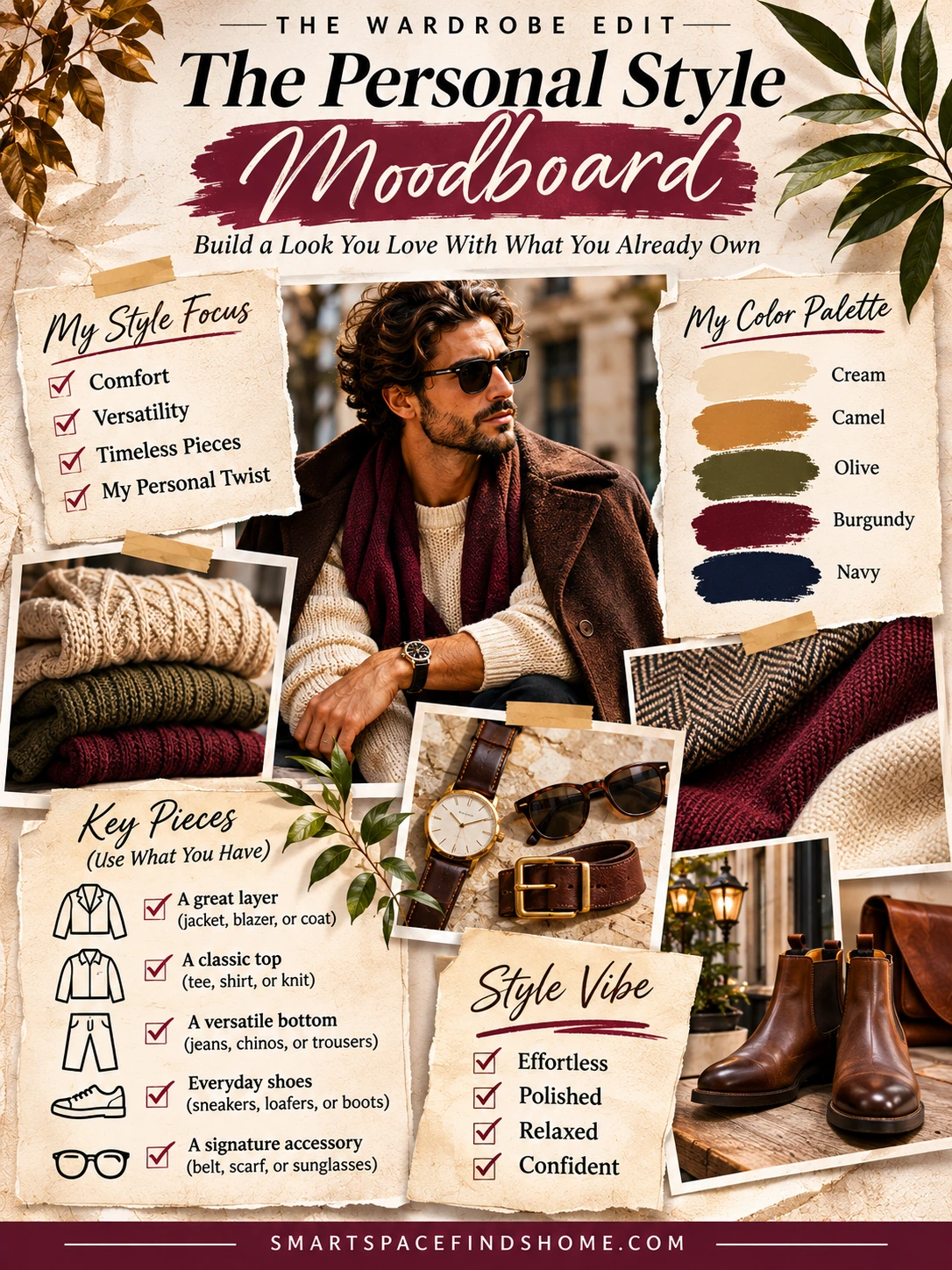
Choose three words that describe how you want your clothes to feel or look: relaxed, sharp, expressive; soft, minimal, practical; or classic, colorful, easy. They are prompts, not rules. If a favorite outfit does not fit your words, revise the words—not your personality.
The 10-minute closet reset
- Pull out five pieces you wear repeatedly.
- Choose three that you like but rarely wear.
- Put one week’s realistic occasions on paper.
- Identify the single frustration you want to solve: fit, variety, comfort, or getting-ready time.
Do not declutter everything yet. Your first job is discovery, not subtraction.
THE FRUSTRATION
“I have nothing to wear.”
You keep buying interesting tops, but every morning you reach for the same bottoms. Your closet offers many pieces but few complete combinations.
THE EDITORIAL REFRAME
“I need three easy combinations.”
Choose one dependable bottom and style it with three different tops and two suitable layers. Save only the combinations that pass your comfort test.
1. Build three outfit formulas from clothes you own
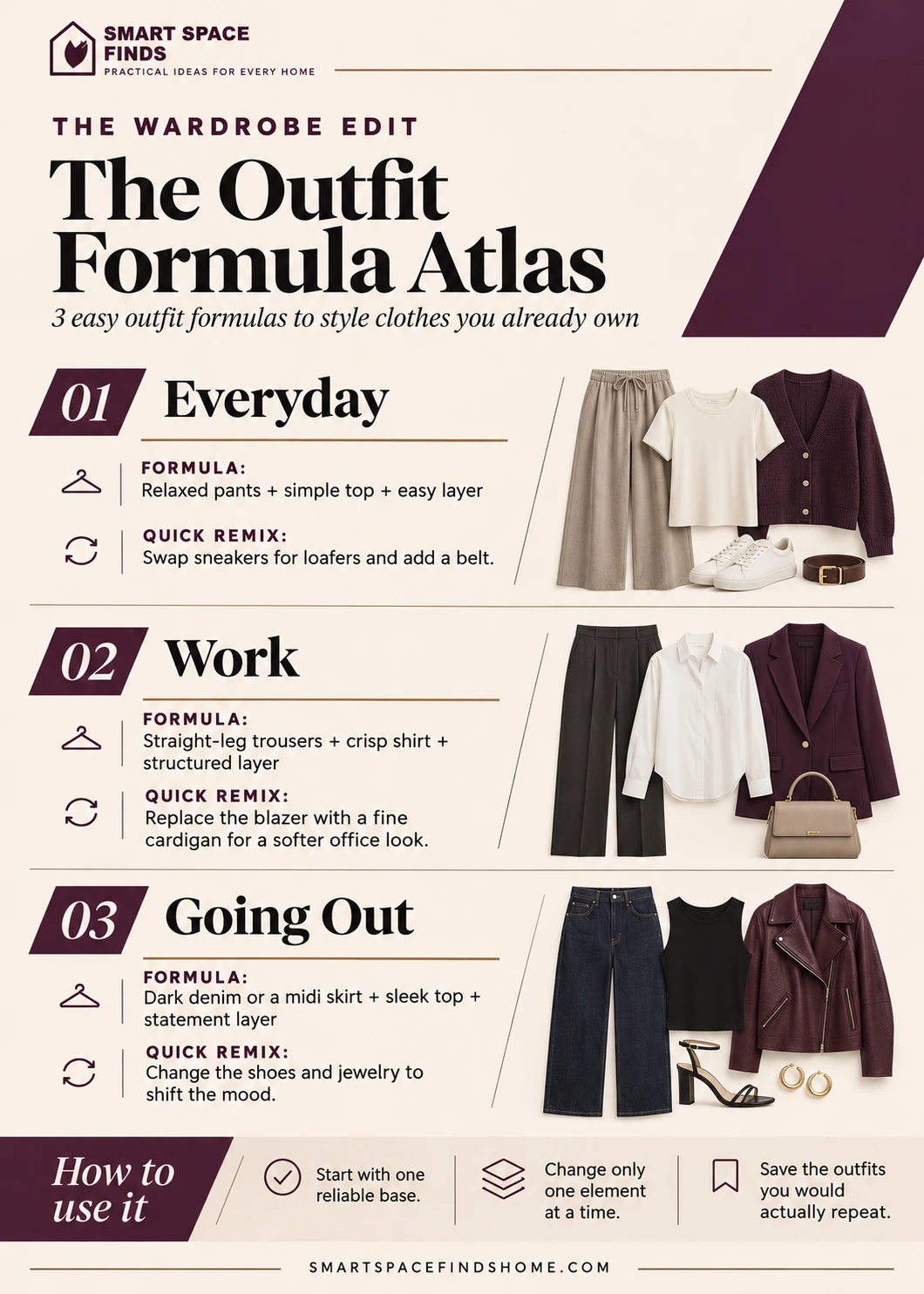
An outfit formula is a repeatable combination of clothing roles, not a rigid list of products. Instead of “my black jeans, cream shirt, and brown jacket,” think “straight-leg bottoms + easy top + structured layer.” Swapping any of those roles produces another look without starting from scratch.
Three formulas worth trying
| Occasion | Formula | One easy remix |
|---|---|---|
| Everyday | Relaxed pants + favorite top + comfortable shoes | Swap the top or add an open shirt |
| Work or smart casual | Clean-cut bottoms + simple layer + one structured piece | Change sneakers to loafers if appropriate |
| Going out | Favorite base + interesting texture + one accent | Trade an accessory or outer layer |
Try this: Lay each formula on your bed, photograph the complete look in consistent daylight, then substitute one item at a time. The photograph is a memory aid—not a beauty test. Save only combinations you would genuinely wear for several hours.
Why it works: You are reusing an outfit structure while changing its parts. You can develop a recognizable personal style without wearing an identical uniform.
ONE PIECE · THREE REAL-LIFE OUTFITS
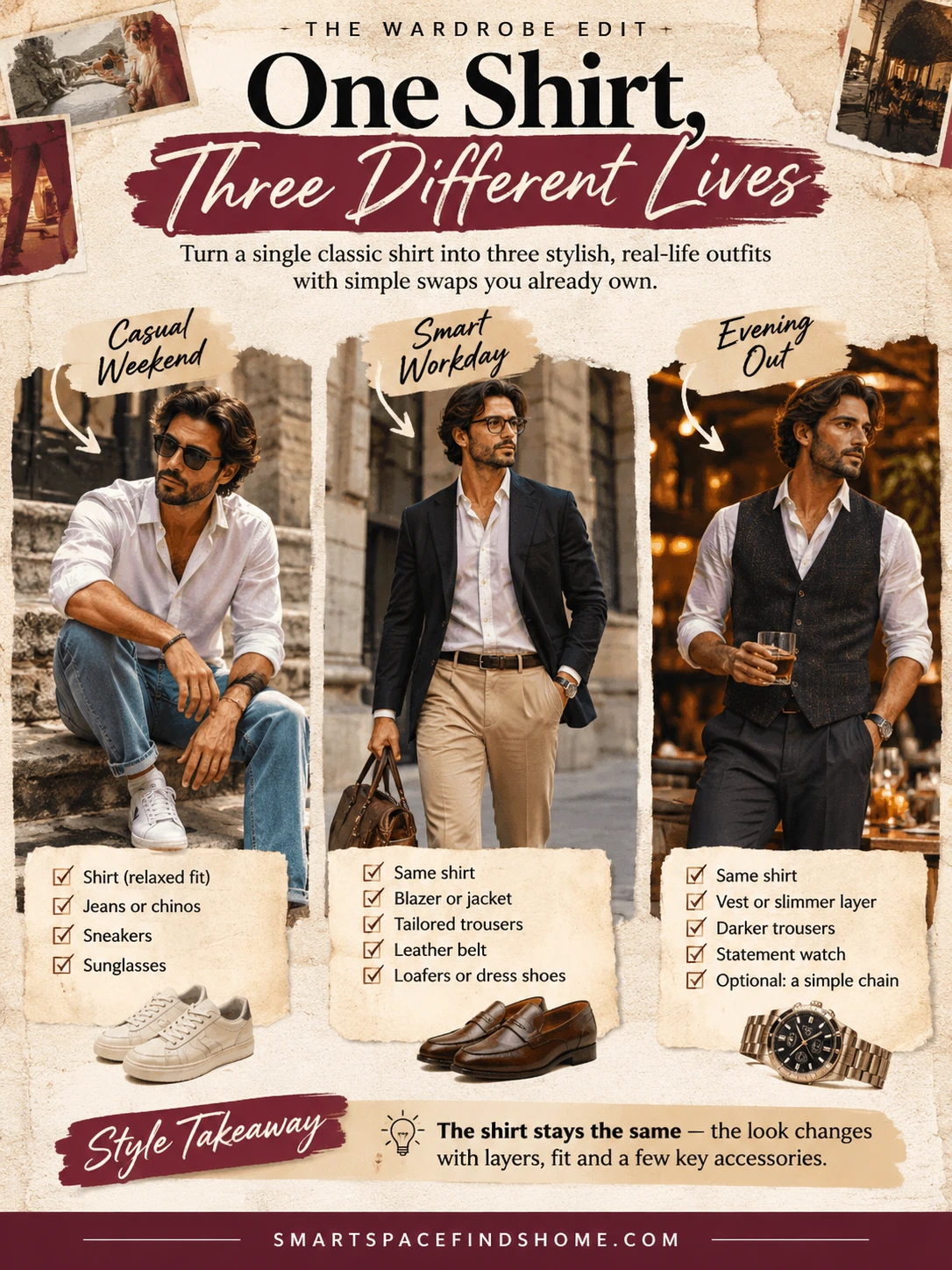
How to Restyle One Button-Down Shirt for Three Different Days
A useful exercise is to keep one familiar piece and change its context. The descriptions below are outfit templates, not a list of clothes you must own.
Open layer
Wear the shirt open over a comfortable tee with casual bottoms. Roll the sleeves if practical.
Clean lines
Button it, adjust the tuck, and pair it with your usual work-appropriate pants or skirt.
Evening texture
Try a different bottom, add a familiar accessory, and switch shoes if the occasion allows.
Reader test: Which version looks good and feels right after sitting and walking for ten minutes? Save that version to your outfit album.
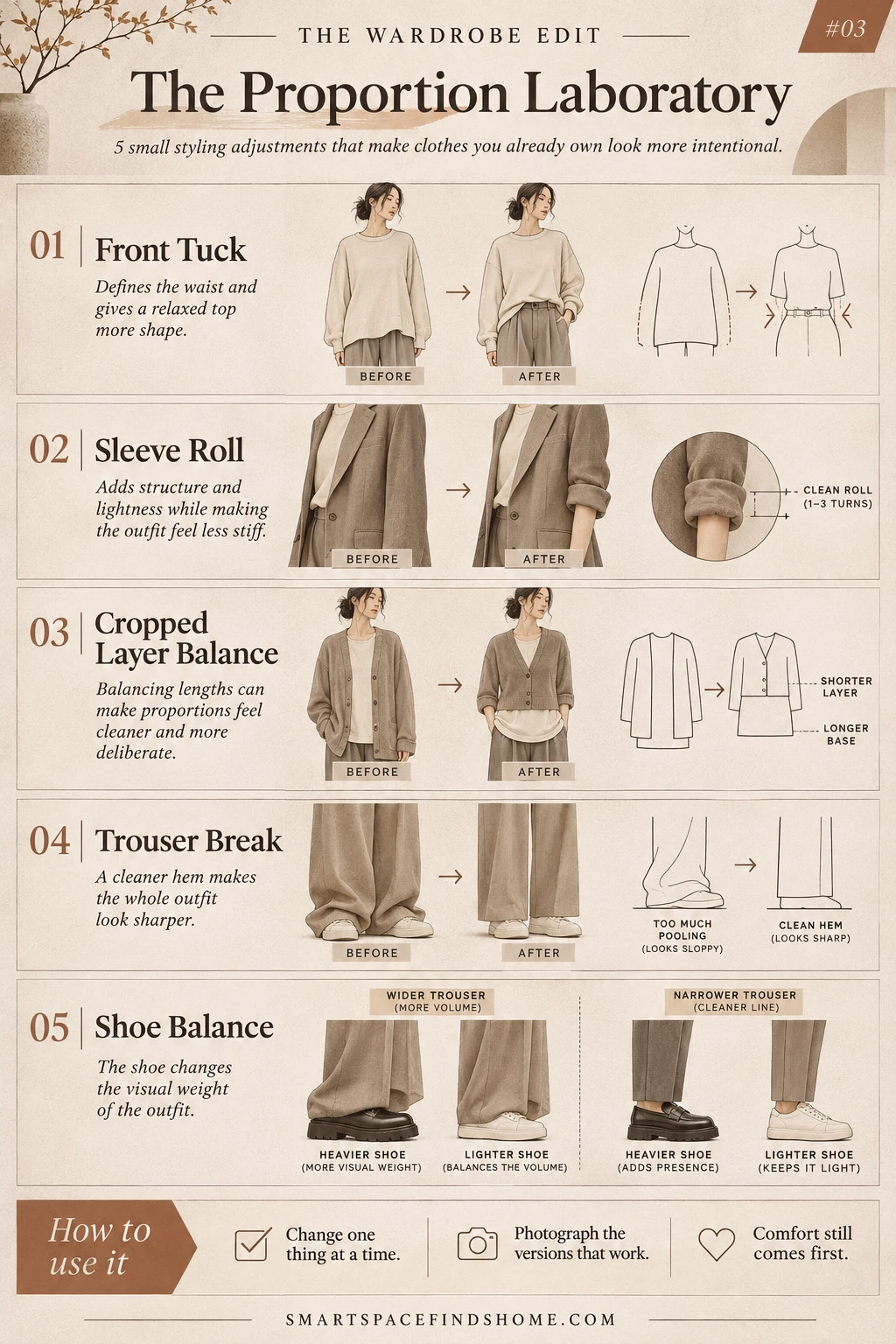
2. Improve fit and proportion before buying replacements
Fit is not a body-type verdict. It is about whether a garment moves with you, sits where you want it to sit, and creates the outline you prefer. Tiny changes can make familiar clothes feel more deliberate.
Five adjustments to test in the mirror
- Change the tuck: Try untucked, fully tucked, or a modest front tuck. Notice where the outfit visually begins and ends.
- Shift the layer: Leave a shirt open over a tee, remove a bulky middle layer, or roll the sleeves neatly.
- Change shoe shape: Compare two pairs already in your closet; one may balance a wide trouser or long hem better.
- Check the hem: See whether pants pool awkwardly or sleeves interfere with your hands.
- Walk and sit: A look that only works while standing still is not yet a finished outfit.
If a useful piece needs altering, obtain a tailoring estimate and evaluate the fabric, construction, sentimental value, and how often you expect to wear it. A small hem alteration may be worthwhile; reshaping a complicated jacket may not be. Do not assume tailoring always costs less than replacement.
Can you sit comfortably? Raise your arms? Walk without constant readjustment? Does the outfit work with the shoes and outerwear you actually use? If the answer is no, fix the friction before chasing a more impressive photograph.
THE WARDROBE EDIT · SMART FINDS
Repair Before You Replace
Small repairs and accurate measurements can keep useful pieces in rotation.
R03 · REPLACEMENT
SINGER 07230 Sewing Basket with Sewing Kit
An organized kit with needles, thread and repair tools for small clothing fixes.
R01
Coquimbo Portable Sewing Kit, Black
Portable basics for loose buttons and minor repairs.
R02
Marcoon Basic Sewing Kit
Everyday sewing essentials for simple fixes.
R04
FIVEIZERO Seam Rippers, 4-Piece Set
Tools for removing unwanted stitches carefully.
R05
GDMINLO Soft Tailor Measuring Tape, 60 inch
Measure hems and alterations before tailoring.
Affiliate disclosure: As an Amazon Associate, Smart Space Finds earns from qualifying purchases. Product details, price and availability may change. Check the listing and variant before purchasing.
3. Restore the pieces you already love
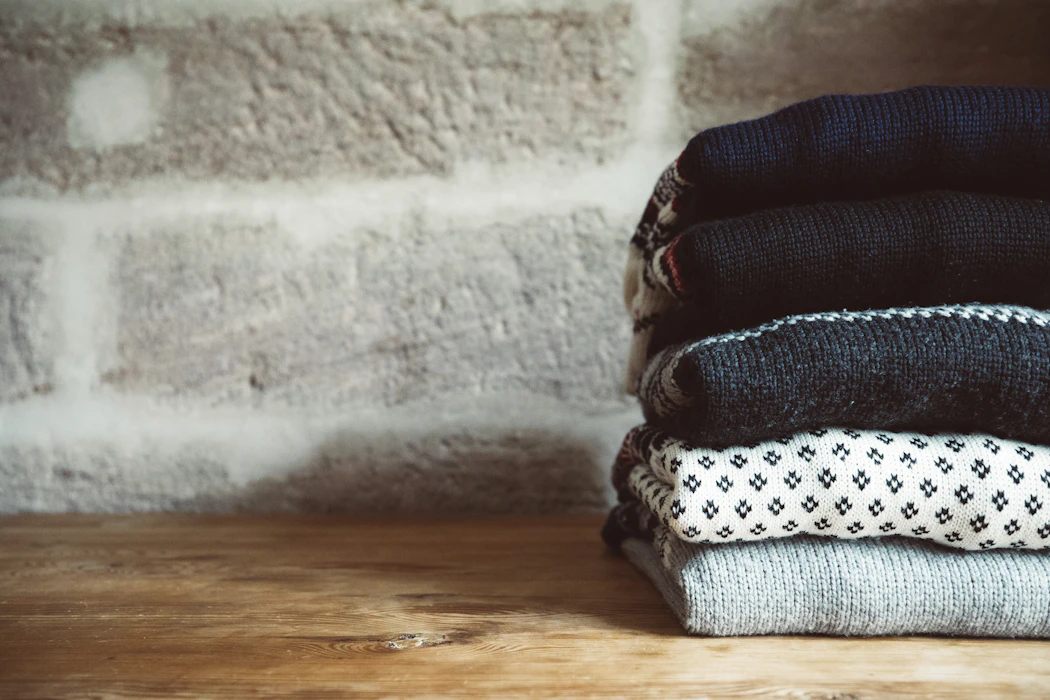
Sometimes the difference between “tired” and “intentional” is a repaired button, a clean shoe, or knitwear stored properly. Clothing care is a style tool because it makes the outfits you already chose look considered.
THE WARDROBE EDIT · SMART FINDS
Steam, Smooth & Finish
Choose a fabric-safe finishing tool only when wrinkles are a recurring obstacle.
S01
HiLIFE Handheld Clothes Steamer, 240 ml
Handheld steaming for compatible garments.
S02
Jack & Rose Travel Steamer & Iron 2-in-1
Compact travel-oriented steaming and pressing.
S03
BEAUTURAL Foldable Portable Clothes Steamer
Foldable option for smaller storage spaces.
S04
BLACK+DECKER Easy Steam Compact Iron
Traditional pressing for suitable fabrics.
S05
OGHom Travel Steamer and Iron 2-in-1
Two-in-one finishing option for travel routines.
Affiliate disclosure: As an Amazon Associate, Smart Space Finds earns from qualifying purchases. Product details, price and availability may change. Check the listing and variant before purchasing.
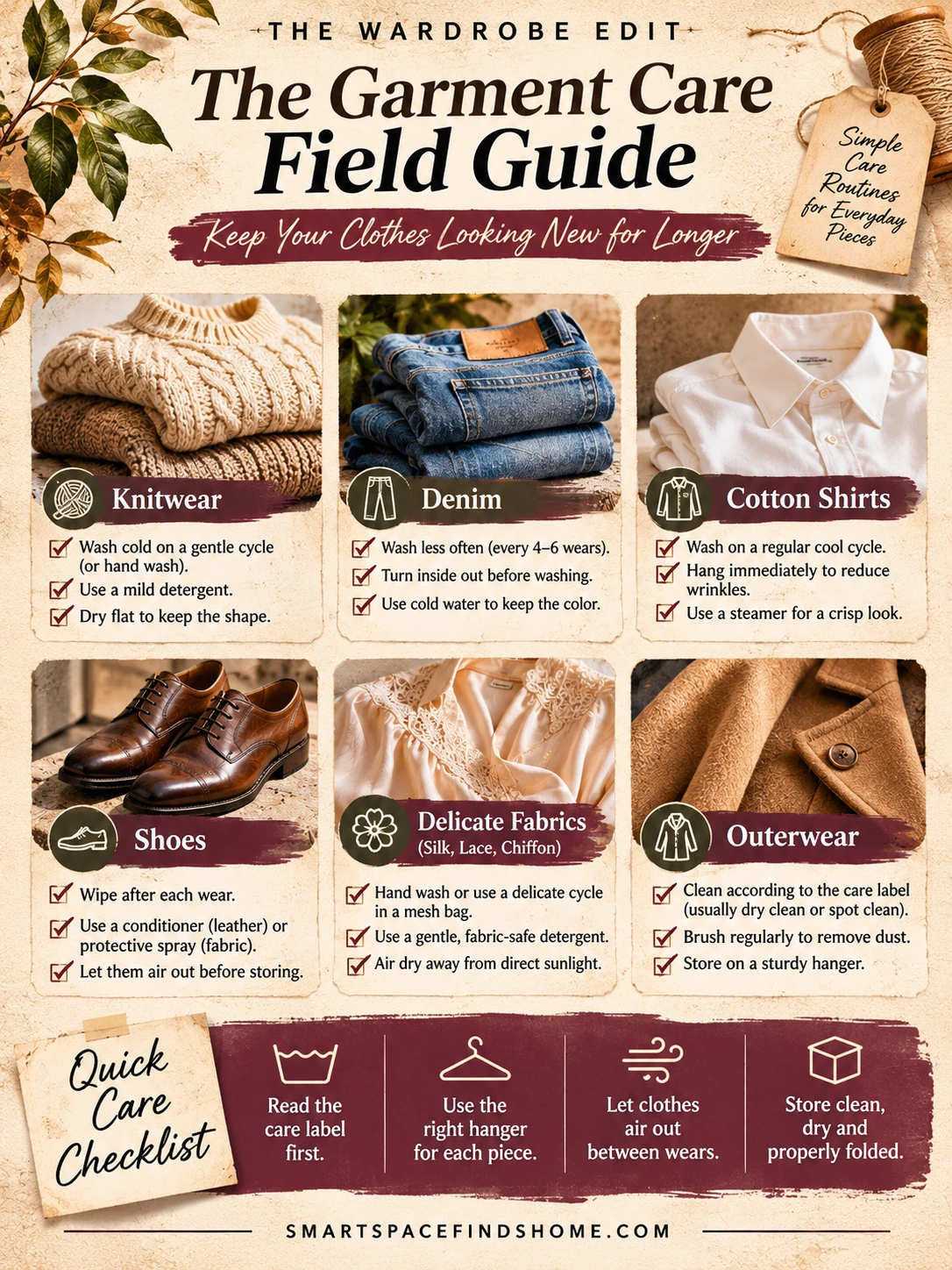
A small maintenance routine
- Read each garment’s care label before washing, steaming, or applying stain treatment.
- Remove lint or loose hair with an appropriate brush; test delicate fabrics first.
- Repair loose buttons and small seam issues promptly, or take the item to a professional.
- Clean shoes with methods recommended for their material; suede, leather, canvas, and synthetics differ.
- Fold knits that stretch on hangers, and let recently worn clothing air appropriately before storing.
Decision rule: Keep, repair, alter, or responsibly pass on an item according to its condition and actual usefulness. Do not treat “donate everything” as a prerequisite to developing style.
THE WARDROBE EDIT · SMART FINDS
Protect Your Clothes in the Wash
Consider mesh protection where care labels allow; no bag makes an unsafe wash cycle safe.
L01
Muchfun Honeycomb Mesh Laundry Bags, 3-Pack
Mesh protection for compatible laundry items.
L02
Fine Mesh Lingerie Laundry Bags, 3-Piece Set
Gentle containment for suitable delicate items.
L03
Polecasa Mesh Laundry Bags, 3-Pack
Another option for sorting washable items.
L04
Honeycomb & Fine Mesh Laundry Bags, 4-Pack
Mixed mesh styles for different garments.
L05
Handy Laundry Collapsible Mesh Hamper, 2-Pack
Collapsible hamper for sorting and laundry trips.
Affiliate disclosure: As an Amazon Associate, Smart Space Finds earns from qualifying purchases. Product details, price and availability may change. Check the listing and variant before purchasing.
THE STYLE CLINIC · PRACTICAL TROUBLESHOOTING
The Outfit Rescue Desk: What to Change When a Look Feels Off
Before blaming your wardrobe, identify the actual friction. Try the smallest fix first and keep anything that feels like you.
Try a different tuck, adjust where a layer ends, or swap to shoes that balance the hem. Keep the silhouette you actually enjoy.
Wear a tailored layer open over a casual base or replace one dressy element with a relaxed piece you own.
Add contrast through texture, a favorite accessory, a patterned layer, or a more expressive shoe.
Sit, walk, bend and test it with outerwear. Prioritize movement and comfort over a static photograph.
Editorial principle: style improvements should be repeatable, comfortable and reversible—never a demand to change your body.
THE WARDROBE EDIT · SMART FINDS
Refresh What You Already Own
For removing lint and surface fuzz before you decide a piece needs replacing.
C01
BEAUTURAL Fabric Shaver & Lint Remover
Refresh suitable knits and upholstery; test first.
C02
Scotch-Brite Everyday Clean Lint Roller, 3-Pack
Quick lint pickup before leaving home.
C03
Swihauk Extra Sticky Lint Rollers, 600 Sheets
Bulk sheets for frequent outfit touch-ups.
C04
Polardo Lint Rollers, 5-Pack
Keep a roller handy for everyday fabric debris.
C05
ChomChom Reusable Pet Hair Roller
Reusable pet-hair cleanup on suitable textiles.
C06
Extra Sticky Lint Roller, 400 Sheets
A replenishable option for regular lint removal.
C07
WulaWindy Extra Sticky Lint Roller, 4-Pack
Multi-pack for closet, entryway and travel bag.
Affiliate disclosure: As an Amazon Associate, Smart Space Finds earns from qualifying purchases. Product details, price and availability may change. Check the listing and variant before purchasing.
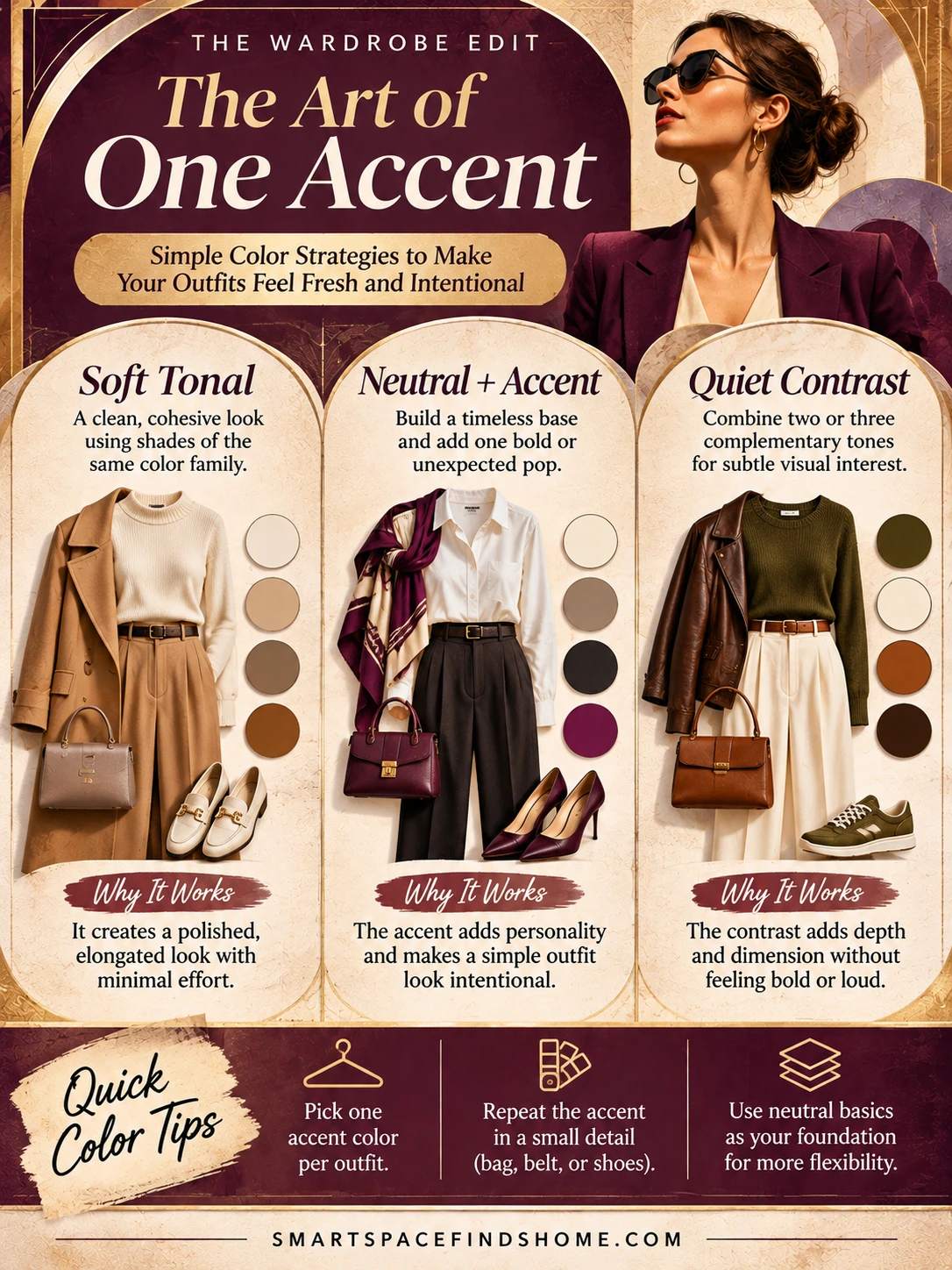
4. Give every outfit one clear focal point
An outfit can look more cohesive when one detail has room to stand out. That focal point could be an inherited watch, patterned scarf, unusually shaped belt, bright socks, statement glasses, a jacket texture, or a color already present elsewhere in the look.
Start with your simplest wearable outfit. Add one item with character and look again. If the result feels cluttered, remove something rather than adding more. This is not a rule against maximalism: expressive outfits can have multiple features, but they still benefit from a deliberate visual rhythm.
Three no-buy color moves
Soft tonal
Sand + camel + chocolate
Neutral + accent
Ivory + navy + brick red
Quiet contrast
Olive + cream + charcoal
- Tonal: Combine nearby shades, such as olive and forest green, rather than expecting identical color matching.
- Neutral plus accent: Let one existing color provide the surprise.
- Repeat a small detail: Echo a color or texture once elsewhere—without needing exact accessories.
Photograph two versions: with and without the detail. Choose the one you enjoy wearing, not simply the version that looks more dramatic on screen.
THE WARDROBE EDIT · SMART FINDS
Shoe Shape & Outfit Finish
Shoes can change the balance of a familiar outfit. Choose care tools only for compatible footwear.
F03R · REPLACEMENT
Jason Markk Essential Kit — Shoe Cleaner & Brush
A two-piece cleaning kit for suitable footwear; follow product directions and check material compatibility.
F01
eachway Adjustable 2-Way Shoe Stretcher
Adjustable stretcher for suitable shoes; avoid forcing delicate materials.
F02
EchoDone Adjustable Shoe Shapers, 5 Pairs
Help selected shoes retain shape between wears.
Affiliate disclosure: As an Amazon Associate, Smart Space Finds earns from qualifying purchases. Product details, price and availability may change. Check the listing and variant before purchasing.
5. Track your real outfits for seven days—and learn from them
Shopping inspiration reveals what catches your attention. Your wear history reveals what works. For one normal week, record your outfit, where you wore it, whether it was comfortable, and whether you would repeat it. A note on your phone is enough.
| Daily note | Ask yourself |
|---|---|
| Ease | How long did I take to decide? |
| Comfort | Did I adjust anything repeatedly? |
| Context | Was it right for the weather and situation? |
| Repeatability | Would I happily wear this again? |
At the end of the week, spot recurring combinations. Which pants were easiest to style? Which shirt always felt wrong? What remained unworn because it was out of sight, wrinkled, uncomfortable, or suited to a different season? These distinctions matter more than an arbitrary closet count.
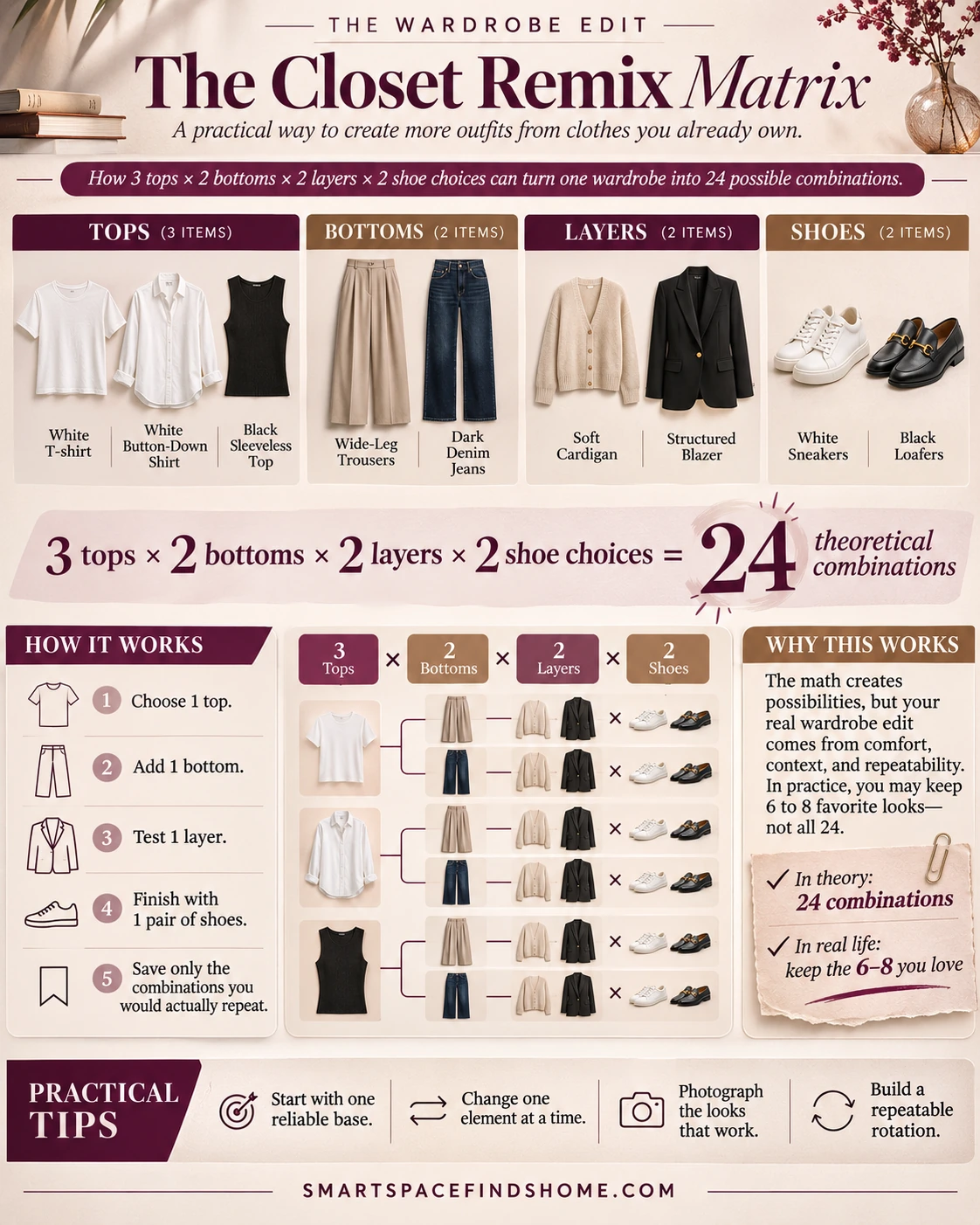
The closet remix matrix: create more outfits without adding clothes
Here is a simple experiment with garments you already own. Pick three tops, two bottoms, two layering pieces, and two pairs of shoes. In theory that is 24 combinations (3 × 2 × 2 × 2), but not all will suit the weather, fit comfortably, or look good together. The point is not to force 24 outfits. It is to discover the six or eight that genuinely work.
- Choose your favorite starting item.
- Try it with both bottoms.
- Test each suitable layer and shoe option.
- Save photographs of successful combinations.
- Name them by use: “Tuesday office,” “rainy-day errands,” “weekend dinner.”
A small, edited album beats an overwhelming folder of outfits you will never wear.
Before-and-after: what an authentic style upgrade looks like
Before: A person owns several good pieces but always chooses the same easy jeans-and-tee combination. Their favorite button-down sits unworn because it feels too formal.
After: They wear that shirt open over the same tee, adjust the sleeve length, clean the shoes they already like, and save two alternative combinations for different occasions. No purchase was necessary; the difference was styling knowledge and a faster decision system.
This is an illustrative scenario, not a claimed client transformation. A successful outcome is one you can repeat on an ordinary Wednesday.
How to make the new system work in a small closet
Even an excellent outfit formula fails when the key pieces are buried. Keep current-season, regularly worn items visible; group pieces by category or by the outfits you actually use; and reserve a small accessible area for your week’s looks. You need not buy matching storage containers to do this.
For the physical side of an edited wardrobe, explore our small closet organizer guide. If you want a separate approach to care and refreshes, see wardrobe upgrades without shopping. For the broader question of aesthetic identity, read how to find your personal style. These are complementary steps, not replacements for the outfit-building process here.
THE WARDROBE EDIT · SMART FINDS
Make Your Closet Easier to Use
Visibility beats buying more. Storage only helps when it solves an existing friction point.
O01
Amazon Basics Slim Velvet Hangers, Black 50-Pack
Slim hangers to keep frequently worn items visible.
O02
Amazon Basics Slim Velvet Hangers, Ivory 30-Pack
Alternative finish for a coordinated rail.
O03
Vtopmart Adjustable Drawer Dividers, 12-Pack
Create separate zones for small clothing categories.
O04
Velvet Multi-Pants Hangers, 3-Pack
Group compatible trousers within limited hanging space.
O05
Cedar Space Aromatic Cedar Blocks, 16 Pieces
Aromatic cedar for suitable dry storage spaces.
O06
Woodever Cedar Blocks, 56 Pieces
Larger cedar assortment for storage organization.
O07
Vtopmart Clear Drawer Organizer Trays, 25 Pieces
Visible compartments for accessories and small essentials.
Affiliate disclosure: As an Amazon Associate, Smart Space Finds earns from qualifying purchases. Product details, price and availability may change. Check the listing and variant before purchasing.
THE 2-MINUTE OUTFIT DECISION TOOL
What Should I Wear From My Closet Today?
Where am I going, and what will the weather be like?
Which comfortable favorite can I build around?
What one swap makes this outfit more useful or interesting?
The exit rule: If the look passes the comfort and context test, stop adjusting. Getting dressed should not become another endless project.
When should you actually buy something?
A no-buy exercise should reveal real gaps rather than forbid purchases indefinitely. Consider buying only when a piece would solve a recurring, documented problem—and when repair, alteration, borrowing, or using an existing alternative is not a better choice.
- Can you name the specific outfit or occasion the item would serve?
- Can you combine it with at least three things you own?
- Does it fit your body, care preferences, budget, and daily life?
- Have you checked whether you already own a workable version?
For a more detailed guide to spending selectively, see timeless personal style on a budget.
The Style Editor’s Notebook · A Practical Filter
The Four-Question Wearability Check
A promising outfit can look wonderful on a hanger and still fail in real life. Use this mini scorecard before you save a look to your weekly rotation. It is a personal reflection tool—not a scientific rating.
Can I sit, reach and move without constant adjustment?
Does this work for today’s weather, place and activity?
Does it feel like me, rather than someone else’s costume?
Could I recreate it quickly with clean, accessible pieces?
How to use it: If one answer is no, adjust that specific issue before changing the entire outfit. If a look passes all four, photograph it and give it an easy label you will remember.
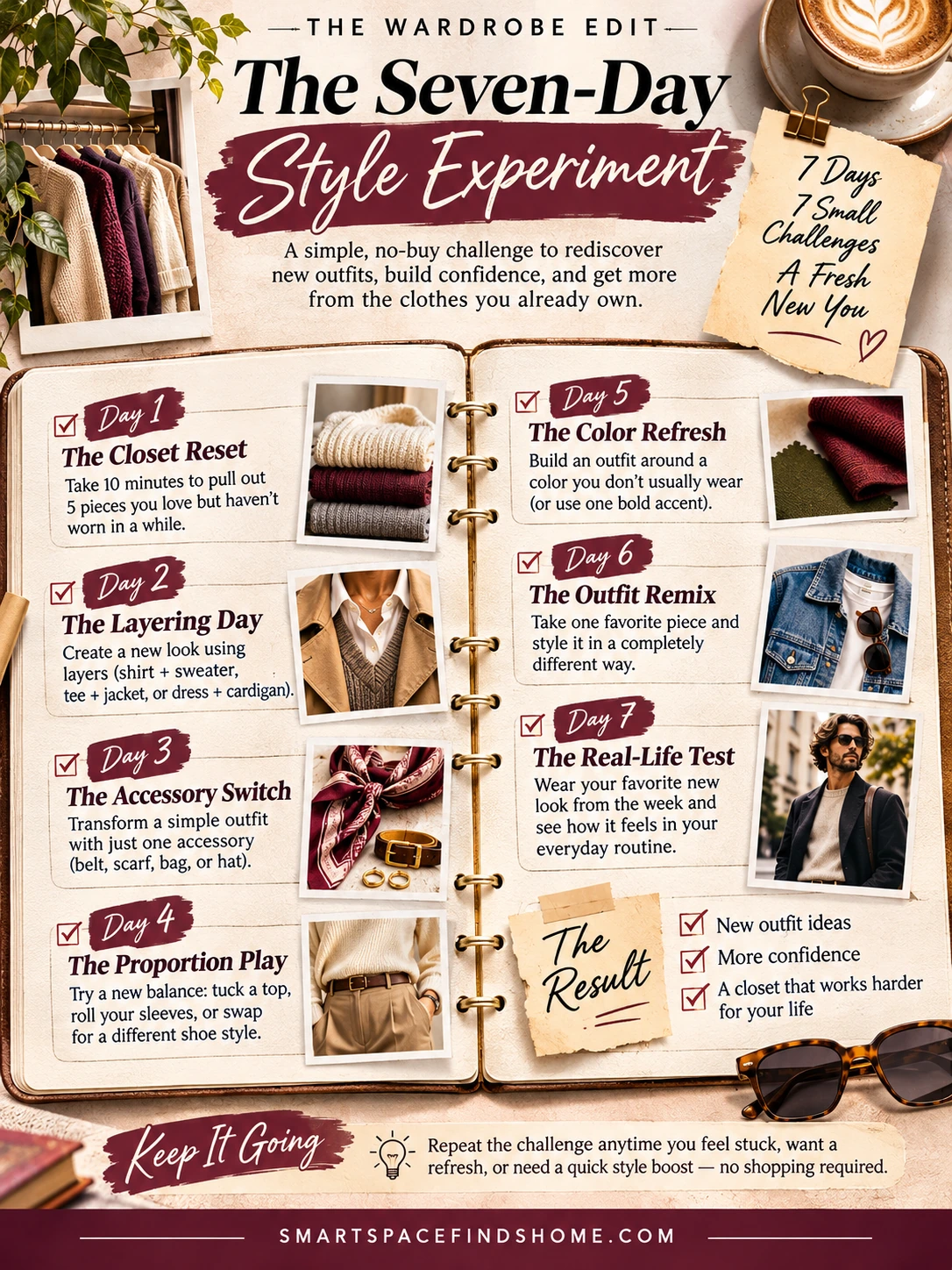
Your seven-day no-buy style challenge
- Day 1: Identify five reliable pieces and define your three style words.
- Day 2: Build and photograph three outfit formulas.
- Day 3: Adjust tucks, layers, hems, and shoes.
- Day 4: Care for two pieces that need attention.
- Day 5: Restyle one neglected garment for a real occasion.
- Day 6: Repeat your strongest outfit with one variation.
- Day 7: Review comfort, ease, and what you want to wear again.
Remember: style experiments are reversible. You do not need to discard clothes, follow a trend, or buy equipment to complete this challenge.
Frequently asked questions
How can I improve my style without buying clothes?
Start with outfit formulas, explore different proportions, repair neglected pieces, and use accessories or colors you already own. Record your favorite complete outfits so you can recreate them easily.
What if I have lots of clothes but nothing to wear?
Often the difficulty is combining and finding clothes, not the absolute number of garments. Choose a small subset of visible, comfortable pieces and build complete outfits for your actual weekly activities.
Do I need a capsule wardrobe?
No. A capsule is one optional organizational method. You can enjoy variety and still create a short rotation of dependable combinations within a larger wardrobe.
Can this approach work for any gender or aesthetic?
Yes. The process focuses on fit, comfort, outfit structure, and personal preference. The examples are adaptable to different clothing categories and styles.
Should I throw away items I have not worn recently?
Not automatically. Occasionwear, seasonal clothing, sentimental pieces, and changing circumstances can explain infrequent use. Assess each item individually rather than relying on a universal deadline.
How long does a closet remix take?
You can make one useful combination in ten minutes. A week-long experiment gives you more reliable evidence about comfort and repeatability without requiring a full wardrobe overhaul.
The final edit: style is what survives real life
A closet can be beautifully curated and still fail its owner every morning. The more interesting goal is a wardrobe that makes sense when you are tired, in a hurry, heading to work, or leaving for an unplanned evening. Begin with what is already there. Choose one outfit, improve one detail, wear it for a full day, and learn what deserves to become part of your personal signature.