
Home maintenance habits should make daily life easier, not create another exhausting checklist. Small, repeatable actions can help you spot moisture problems earlier, spend less time searching for supplies, and take better care of everyday surfaces and equipment. The goal is not a spotless home. It is a home that feels simpler to look after.
Short on time? Start with just one of the five habits below. Several can fit into things you already do, while safety equipment and specialized maintenance still require the attention, timing, and qualified help they deserve.
5 easy home maintenance habits at a glance
- Handle spills and moisture early instead of leaving them for later.
- Give damp rooms a way to dry after showers and cooking.
- Check care instructions before cleaning or maintaining an item.
- Put frequently used essentials back where you need them.
- Keep one simple calendar for recurring home checks.
The simplest place to begin: Choose the habit that would remove the most repeated annoyance from your week. You do not need to adopt all five.
START HERE · 30-SECOND GUIDE
Not sure where to start? Find your easiest first step
Choose the issue that sounds most familiar. Each link takes you to a practical step below.
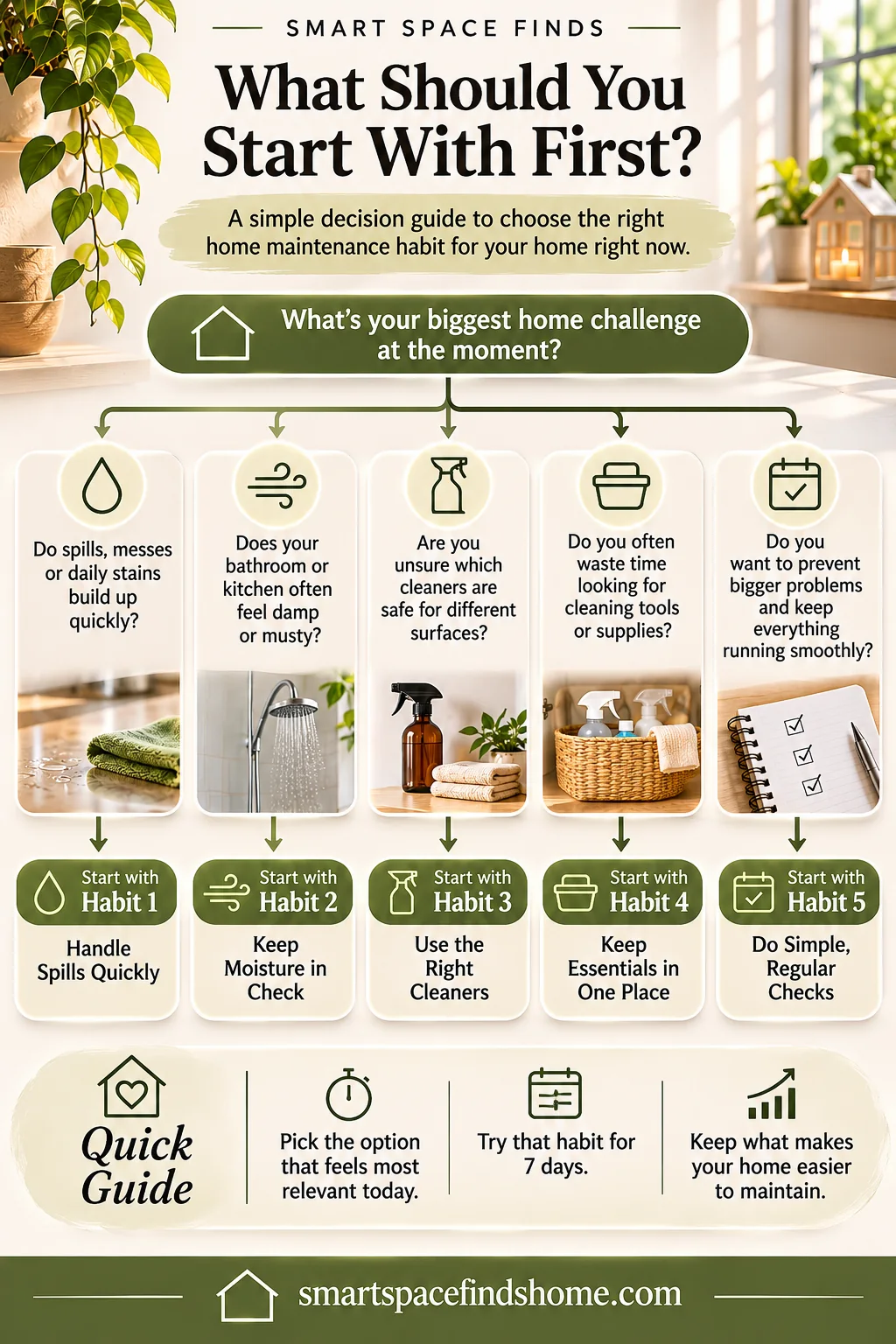
- Water or spills keep appearing — Identify the source and respond safely.
- Bathrooms or kitchens stay damp — Review ventilation and moisture control.
- I worry about using the wrong cleaner — Check care instructions first.
- I waste time looking for supplies — Give essentials one practical home.
- I forget recurring checks — Use manufacturer-guided reminders.
No sign-up, purchase, or tracking is required to use this guide.
Why small home maintenance habits work better than a long to-do list
A long maintenance checklist asks you to remember, decide, and begin a new task every time. A small routine can remove some of those decisions. For example, noticing water around a faucet becomes a prompt to dry it and check whether it returns; putting the cleaning cloth back after wiping the counter makes it easier to find next time.
Behavioral research suggests repetition in a consistent context can help actions become more automatic over time. However, the evidence is largely drawn from health behaviors, so it should not be treated as proof that these exact household routines will become automatic—or that everyone needs the same number of days. A systematic review of habit formation found substantial differences among people and behaviors.
For home care, the useful principle is practical: make the next step obvious, safe, and easy enough to repeat. You can change the routine whenever your home or circumstances change.
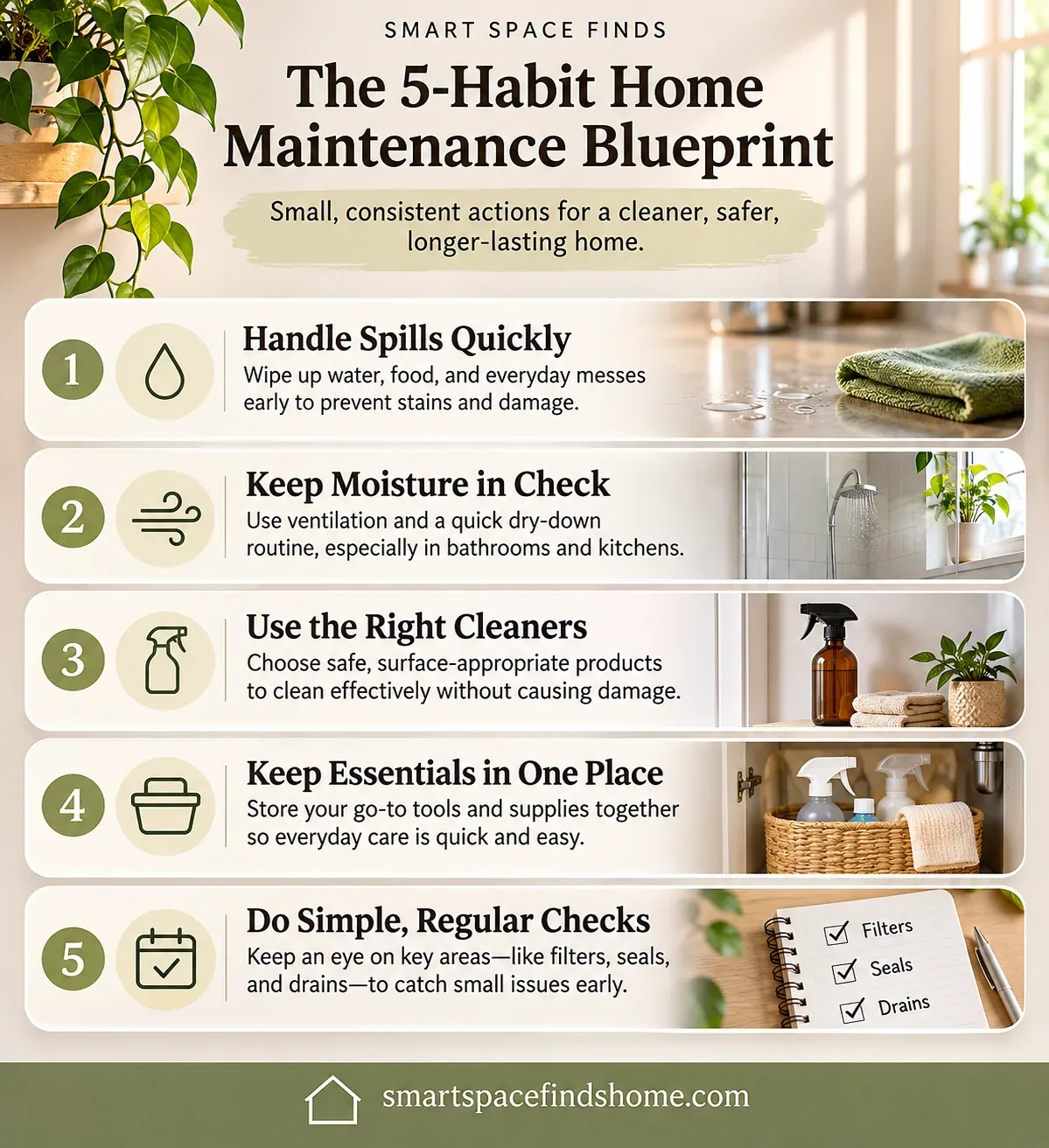
1. Deal with spills and unexpected moisture when you notice them
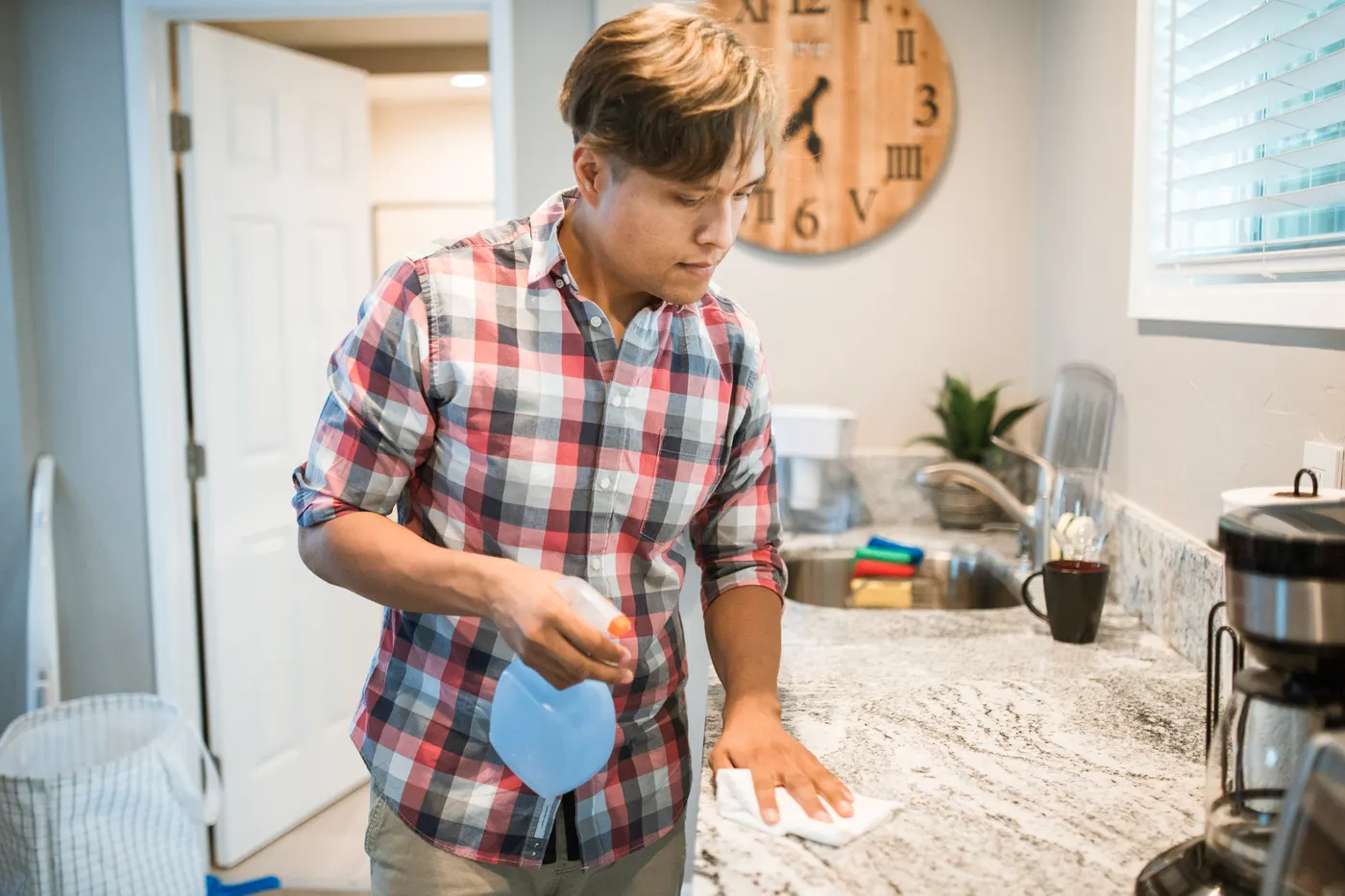
A spilled drink, damp cabinet bottom, or small puddle near the sink is easier to investigate when you first see it. Wipe up minor spills using the method appropriate for the surface, then look for a recurring source of water.
Make it easy to act
Keep a suitable cloth or other basic cleaning supply in an accessible, safe location. After using a sink or counter, glance at the area where water tends to collect. If the same spot gets wet repeatedly, treat that as a clue—not merely another place to wipe.
Know when a quick wipe is not enough
Persistent leaks, damp drywall, swelling cabinets, water near electrical equipment, or suspected contaminated water need more than a cleaning habit. Stop the source when safe, avoid electrical hazards, and seek appropriate professional help. The U.S. Environmental Protection Agency (EPA) advises drying wet areas promptly, generally within 24–48 hours, and addressing the moisture source to reduce mold risk. That window is guidance for prompt response, not a guarantee that mold cannot develop.
Easy cue: When you finish using the sink, check the area where splashes usually land.
2. Help bathrooms and kitchens dry out after use
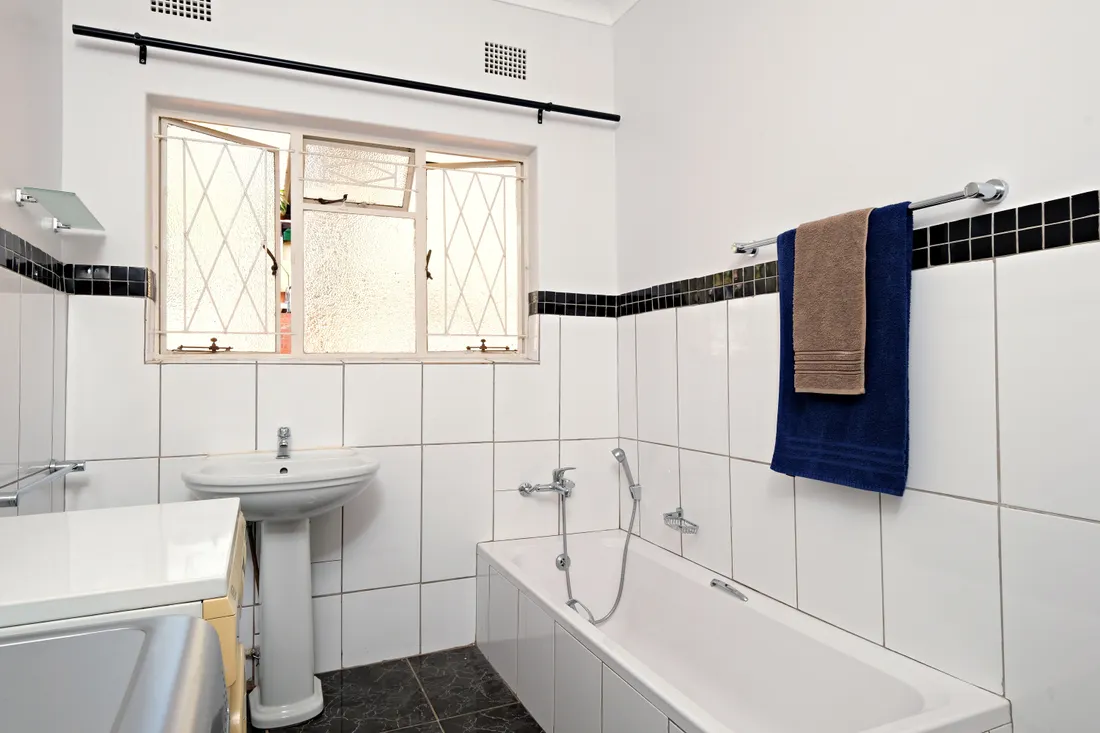
Warm showers and cooking add moisture to indoor air. When that moisture lingers, condensation can collect on windows, walls, and other cool surfaces. A simple after-use ventilation habit can help, provided the ventilation is appropriate for your home and weather conditions.
Build the habit around something you already do
After a shower, run a working bathroom exhaust fan as recommended for your setup, and leave the space arranged so surfaces can dry. While cooking, use a properly vented range hood where available. If opening a window is safe and useful, that may help too—but outdoor humidity, smoke, security, and building conditions matter.
Look for signs the room needs more attention
Repeated condensation, peeling finishes, a persistent musty odor, or visible mold warrants attention to the underlying moisture problem. The EPA recommends keeping indoor relative humidity below 60%, ideally 30–50% when feasible. If moisture persists despite ordinary ventilation, investigate the cause rather than relying on fragrance or surface cleaning.
Easy cue: Make ventilation part of finishing a shower or cooking session, not a separate chore to remember later.
3. Read the care instructions before trying a new cleaning method
The fastest cleaning trick is not always the safest one. Stone countertops, finished wood, sealed floors, upholstery, appliance filters, and painted fixtures may require different products and methods.
Use a 30-second decision rule
Before using an unfamiliar cleaner or attempting maintenance, ask: What is this surface or appliance made of? What does its label or manual recommend? Is the task within my ability to do safely? Check the product instructions and test a recommended method on a discreet spot when appropriate.
Never mix cleaning chemicals, particularly bleach with ammonia- or acid-containing products. Follow label directions for dilution, protective equipment, ventilation, and storage. Electrical, gas, HVAC, plumbing, and other specialized repairs should be handled by qualified professionals when required.
Keep instructions easier to find next time
Save manuals and care instructions in one labeled folder or digital location. A photo of a model number can help you retrieve the correct document later. For a small home, one reliable reference location is more useful than a complex filing system.
Easy cue: Before a new product touches a surface, check its instructions first.
4. Return everyday tools and supplies to one practical home
Searching for a screwdriver, microfiber cloth, flashlight, or replacement battery turns a two-minute task into a frustrating detour. Assigning each frequently used item a predictable home reduces searching and makes it easier to notice when supplies are missing.
Organize for use, not for appearance
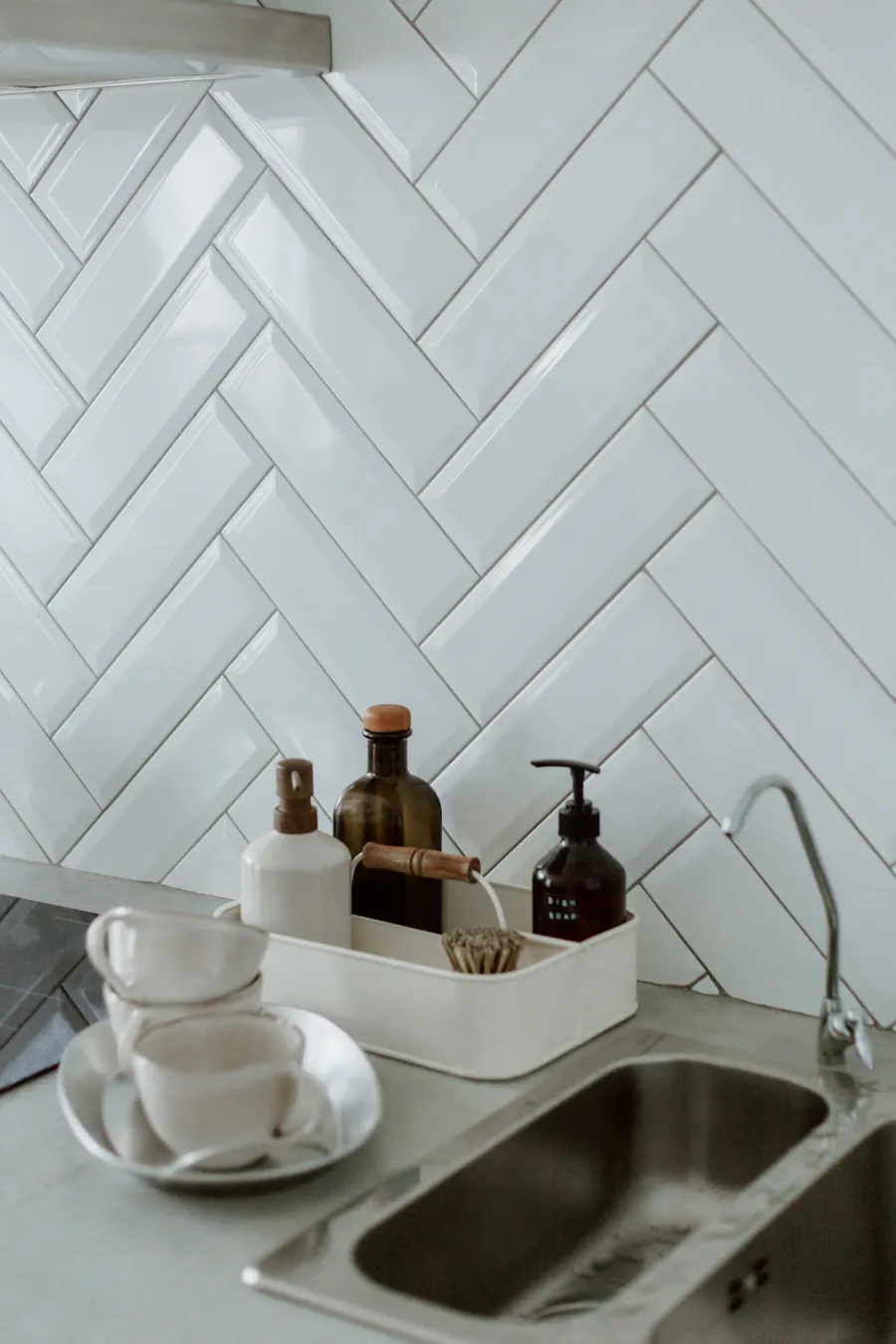
Start with what you already own. Put routine cleaning supplies close to the area where they are used, provided they remain secured away from children and pets. Keep tools together, but store sharp or hazardous items safely. Labels can be plain words; matching containers are optional.
Ask one question: Can I put this back with one straightforward movement? If the answer is no, the location may be inconvenient. Adjust it rather than blaming yourself for forgetting.
For a more detailed setup, see how to organize cleaning supplies in a small home. If the daily clutter begins at the door, an entryway drop zone for apartments without a hall offers another practical starting point.
Easy cue: When a task is finished, return the tool before you move on.
5. Give recurring home checks a simple, realistic schedule
Some home care tasks cannot be handled in the moment. Smoke and carbon monoxide alarms, appliance filters, leaks under fixtures, and other equipment may need periodic inspection or service. Their timing depends on the device, manufacturer, local requirements, and your home’s conditions.
Build one small maintenance calendar
Choose a calendar or reminder system you already use. Add only tasks that matter for your home, with the correct interval copied from the manufacturer’s guidance or applicable safety requirements. Include the location of the manual or service contact when useful.
- Safety equipment: Follow current manufacturer and local guidance for testing, batteries, replacement, and servicing smoke and carbon monoxide alarms.
- Appliances and HVAC: Check the equipment-specific cleaning, filter, and professional service instructions; do not assume every filter follows the same schedule.
- Water-prone areas: Look for recurring dampness or changes around visible fixtures, without dismantling plumbing or working near live electrical systems.
For renters, document concerns and report building-system problems through the landlord or property manager, consistent with your lease and local rules. A reminder is not a substitute for professional inspection or required maintenance.
Easy cue: Attach each recurring check to a calendar you already review, not a separate app you may forget.
The seven-day, one-habit home experiment
Important: This is a seven-day trial to see whether a routine is useful; it is not a claim that a lasting habit forms in seven days. Keep, adapt, or discard the routine based on your experience.
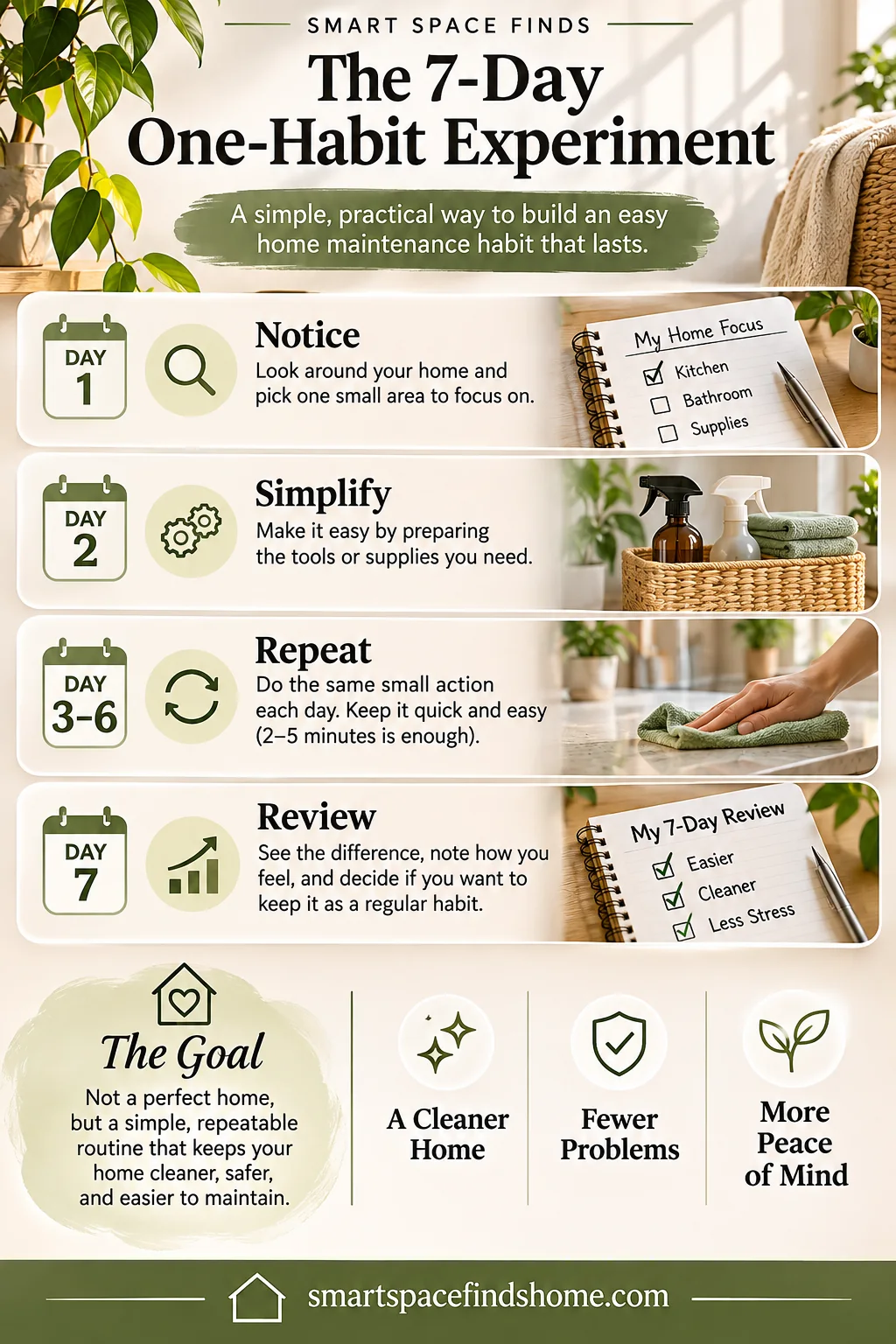
You do not need a complete household overhaul to discover what helps. Try this low-pressure test with one ordinary, safe habit.
- Day 1 — Notice: Write down one repeated inconvenience, such as searching for a cloth or finding water around a sink.
- Day 2 — Simplify: Remove a step. Relocate an existing item or choose a more obvious cue.
- Days 3–6 — Repeat when the cue occurs: Try the small action when it naturally fits. Skip it when it does not; no catch-up session is necessary.
- Day 7 — Review: Did it reduce searching, make a task simpler, or help you notice a problem earlier? Keep, change, or discard the habit based on your experience.
A useful result is not necessarily a perfect streak. You can miss a cue, change the routine, or decide it is not worth keeping. Seven days offer a simple chance to assess convenience; they are not a scientifically established habit-formation deadline. Safety-related maintenance must still happen on its required schedule.
How to choose the right habit for your home
If moisture is your recurring problem, start with the first or second habit and prioritize fixing its cause. If searching and clutter slow you down, start with the fourth. If maintenance dates slip your mind, use the fifth. If you worry about damaging a surface, begin with the third.
Households with children, pets, mobility needs, shared spaces, or rental restrictions may need different arrangements. The best routine is the one that fits those realities, not the one that looks most impressive online.
Frequently asked questions
What is the easiest home maintenance habit to start with?
Choose one action linked to an activity you already do, such as checking for splashes after using the sink or returning a tool after use. Start with the most persistent inconvenience in your own home.
How much time should daily home maintenance take?
There is no universal daily quota. These habits are designed to fit around normal activities, but some inspections and repairs require dedicated time or professional help. Safety-critical tasks should never be rushed to meet an arbitrary time target.
Do I need to buy organizers or maintenance gadgets?
No. Start by relocating existing supplies, simplifying storage, and keeping manuals accessible. Purchase something only if it solves a clearly identified need and suits your space and budget.
How long does it take to form a home maintenance habit?
There is no established timeline for these five household habits. Research on other behaviors finds wide variation in how automatic habits become. Focus on whether a routine is useful and repeatable rather than a fixed number of days.
What should renters handle themselves?
Routine cleaning and safe, permitted care are often reasonable starting points. Report leaks, electrical problems, suspected mold, faulty building systems, or tasks assigned to the property manager according to your lease and local rules. Do not attempt work that requires authorization or specialist training.
What if I miss a day?
Nothing needs to be made up. Return to the routine when its usual cue appears, or simplify it if it repeatedly proves inconvenient.
A calmer home starts with one less decision
Choose the single habit that would make tomorrow easier. Place the supply where it belongs, save the manual you keep searching for, or put one important maintenance check on your calendar. That is enough for a first step.