
THE PERSONAL STYLE ATELIER THE EVERYDAY EDIT
Finding your personal style isn’t about becoming someone else. It’s about noticing what already feels like you—and making it easier to get dressed that way.
Maybe your closet is full, but your favorite outfits are always the same few combinations. Maybe every saved outfit looks beautiful on your screen, yet feels unfamiliar when you put it on. Or perhaps your taste has changed, while your wardrobe still reflects a version of your life that no longer fits.
Here is the reassuring part: you don’t need a shopping spree, a rigid aesthetic, or an entirely new wardrobe to find your signature everyday style. You need a clearer picture of what you actually wear, what you genuinely enjoy, and what your days ask of your clothes.
This guide walks you through seven practical steps, three repeatable outfit formulas, a simple wardrobe edit, and an original seven-day style experiment. Start with what you own. Keep what works. Let your signature style emerge from real life.
THE EDITOR’S SUMMARY
To find your personal style, identify the outfits you already love wearing, choose three words that describe how you want to feel, notice recurring fits and colors, build a few everyday outfit formulas, and test them in real life before buying anything new. Your signature style should reflect your lifestyle—not just your inspiration board.
01 / UNDERSTANDING YOUR STYLE
What Is a Signature Personal Style?
A signature style is the recognizable collection of clothing choices you return to because they suit your preferences, your body, and your daily routine. It might show up in your favorite silhouettes, a recurring color palette, a particular texture, or one small detail you wear often.
It is not necessarily minimalist, timeless, expensive, or even consistent from one day to the next. A person who loves tailored trousers on weekdays and oversized knits on weekends can have a coherent personal style. The connecting thread is intention, not uniformity.
Think of personal style as the intersection of three things: what you like, what feels good, and what works for the life you live. If one is missing, the outfit may photograph well but remain unworn.
Personal style vs. an aesthetic
An aesthetic is a visual reference point—perhaps relaxed coastal layers, romantic vintage pieces, or sharp contemporary tailoring. Personal style is how you interpret those references in your own closet. You can borrow from several aesthetics without needing to fit neatly into any of them.
Trends can provide ideas, but they do not have to give you instructions. Pinterest’s 2026 trend reporting describes a move toward curating influences rather than simply copying them. Treat that as permission to experiment selectively, not as a reason to follow another new formula. Explore Pinterest’s trend research.
02 / THE PERSONAL STYLE METHOD
THE ATELIER TOOLKIT / 01
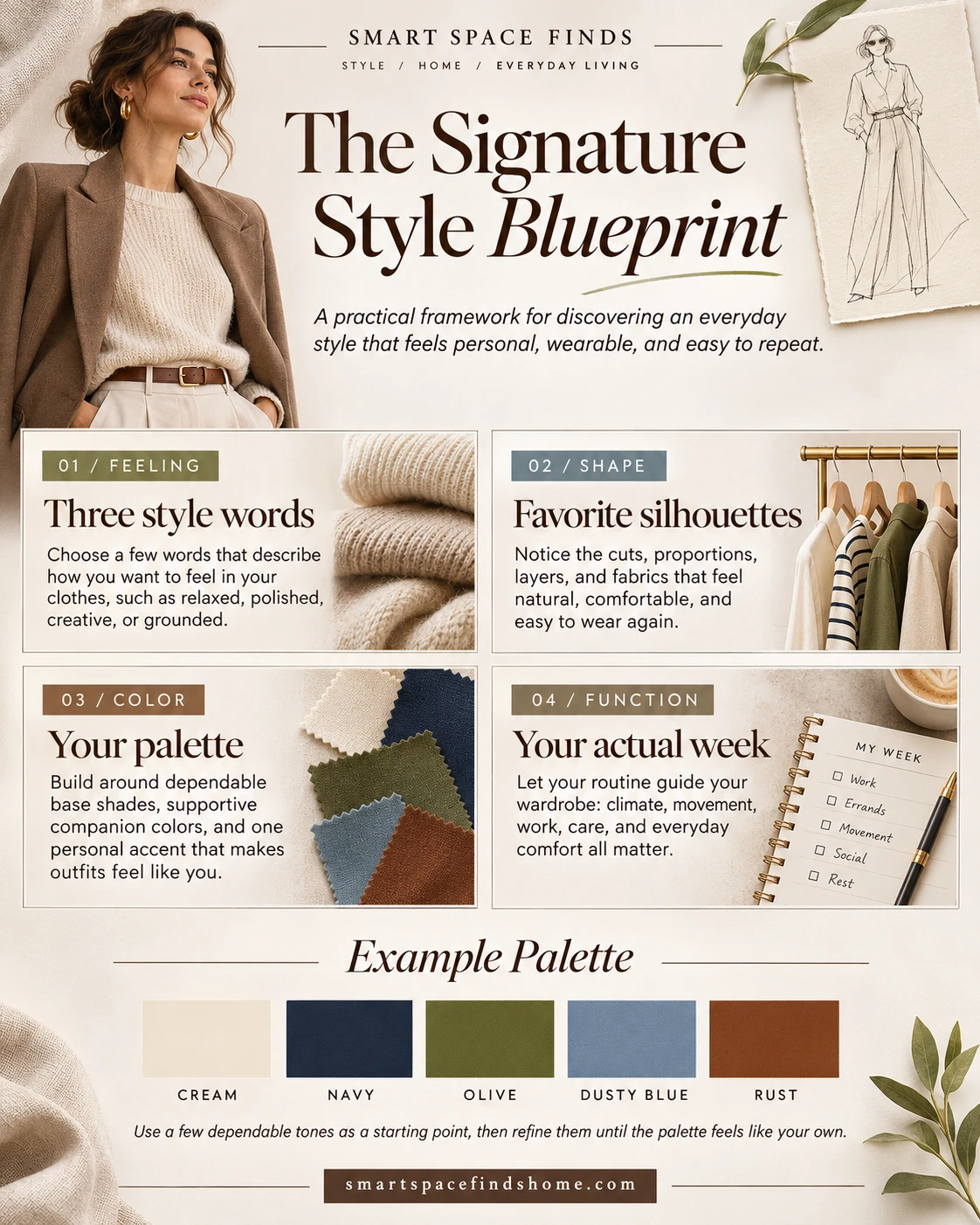
The Signature Style Blueprint
A useful wardrobe starts where personal preference meets real life. Use these four building blocks as an editable starting point—not as rules about what you should wear.
01 / FEELING
Three style words
Choose qualities you want to experience: grounded, easy, refined, colorful, playful.
02 / SHAPE
Favorite silhouettes
Notice the cuts, proportions, layers and materials that feel comfortable to repeat.
03 / COLOR
Your palette
Combine familiar base shades with complementary colors and a personal accent.
04 / FUNCTION
Your actual week
Account for climate, mobility, laundry, work, social plans and everyday comfort.
AN EXAMPLE PALETTE — NOT A PRESCRIPTION
Cream + navy as dependable bases, olive + blue for variety, rust as an accent. Swap any shade until the combination feels like you.
THE ATELIER TOOLKIT / 02
The Personal Style Discovery Check-In
This four-question self-check is intentionally open-ended: it is not a personality test and there is no algorithm deciding your identity. Open each question, choose what genuinely sounds like you, and note your pattern at the end. No account, email or data submission is required.
01. What makes an outfit feel successful?
A. Moving comfortably all day
B. Feeling composed with clean, intentional lines
C. Expressing an interesting detail or unexpected combination
02. Which item do you reach for most?
A. A soft layer with an easy fit
B. A reliable structured piece
C. Something distinctive in color, print or texture
03. What matters most when getting dressed?
A. Comfort and minimal effort
B. Versatility and a put-together feeling
C. Freedom to experiment with a personal accent
04. What would you like more of in your wardrobe?
A. Easy pieces that work in different settings
B. Well-coordinated foundations
C. More expressive combinations of what I already own
Read your direction
Mostly A — Relaxed & Effortless: begin with breathable textures, ease of movement and repeatable layers.
Mostly B — Modern & Polished: start with clear lines, dependable fits and considered finishing details.
Mostly C — Creative & Expressive: experiment with color, texture, pattern and a recurring statement detail.
A mix? That’s useful too. Blend the directions—for example, relaxed silhouettes with one polished layer. You decide what fits your life.
Accessible interaction: tap a question to expand or collapse it. Your responses stay with you; the article does not collect them.
How to Find Your Personal Style in Seven Steps
1. Start with the clothes you actually wear
Before you look for inspiration, look at your own behavior. Pull out five outfits or individual pieces you repeatedly reach for. They may not be the most fashionable or expensive things you own—and that is precisely why they are useful evidence.
Ask: What makes these pieces easy to wear? Is it the relaxed waist, the neckline, the fabric, the color, the length, or the way they work with your shoes? Which garments stay in rotation because they are comfortable, easy to care for, and suited to your schedule?
Try this: Photograph three outfits you enjoy wearing. Write one sentence under each: “I like this because…” Look for the repeated reasons, not just the repeated items.
2. Choose three words that describe how you want to feel
Three style words create a useful decision filter without turning your identity into a rulebook. Choose words with practical meaning for you: easy, polished, playful; soft, understated, modern; or structured, expressive, comfortable.
Make each word specific. “Polished” might mean clean lines and shoes that feel intentional. “Relaxed” might mean breathable fabric and room to move. “Creative” might mean color, texture, or a surprising accessory.
Try this: Write your three words on a note. For each, list one garment you already own that expresses it. If a word doesn’t connect to anything you actually wear, reconsider it.
3. Learn your favorite silhouettes, not someone else’s rules
Notice proportions that feel natural: straight-leg jeans, wide-leg pants, cropped jackets, softly draped shirts, fitted knits, or oversized layers. There is no universal silhouette that looks “best” on everyone; mobility, confidence, climate, sensory comfort, and personal preference all matter.
Compare two outfits made from similar colors but different shapes. You may discover that you prefer volume on top and a narrower bottom, or the reverse. That preference can become a dependable starting point.
Try this: Test one familiar proportion against one new one, using clothes you own. Move, sit, walk, and spend time in each. Judge the whole experience, not just the mirror.
4. Build a color palette that makes getting dressed easier
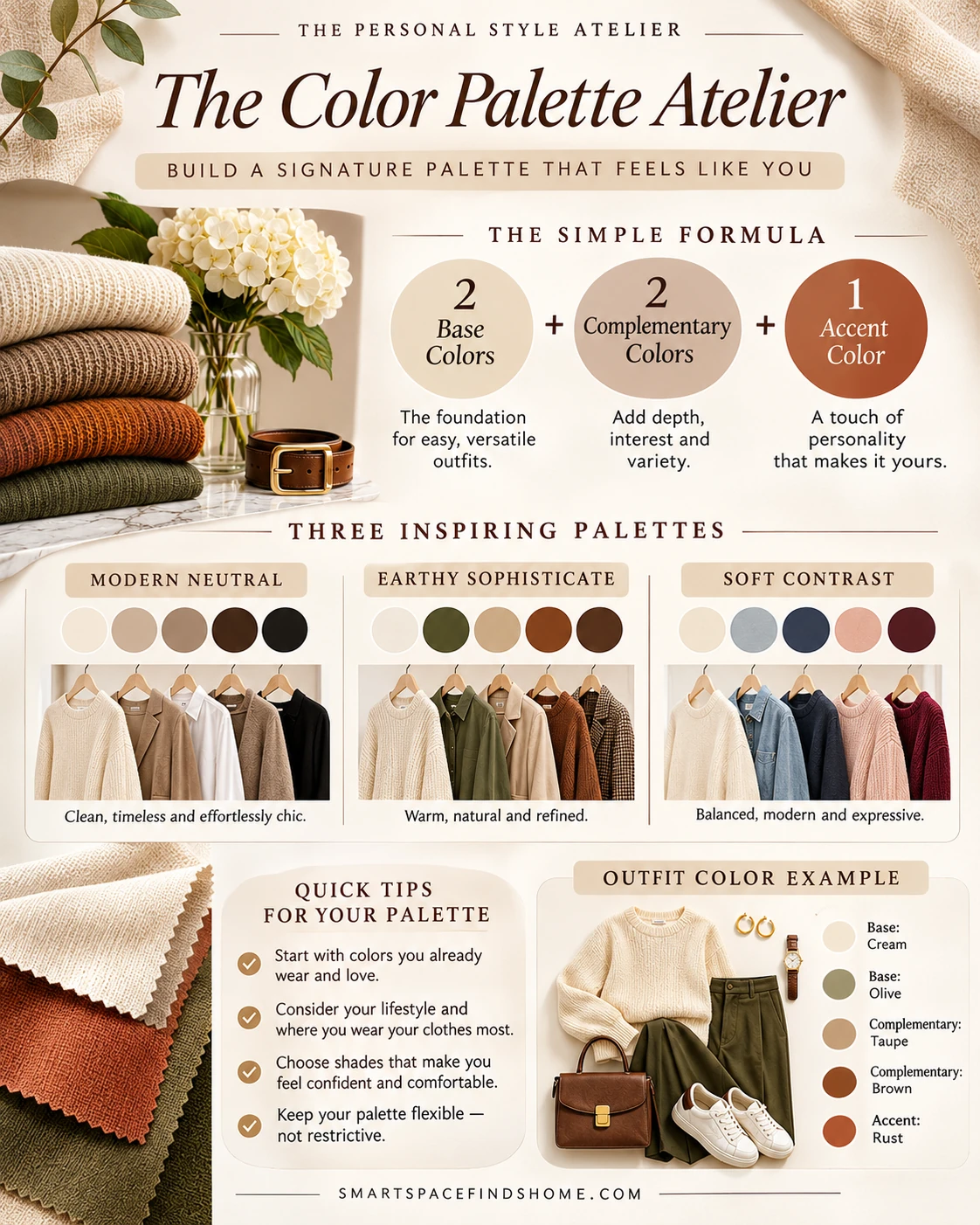
A personal color palette is simply a group of shades you enjoy wearing together. It can be neutral, vibrant, muted, contrasting, or mixed. You do not need a professional color analysis or a prescribed seasonal category to begin.
One accessible option is to identify two dependable base colors, two complementary colors, and one accent. For example: navy and cream as bases, olive and pale blue as companions, with rust as an accent. This is an organizing exercise—not a rule that your entire wardrobe must match.
Try this: Arrange your favorite garments by color in natural daylight. Which combinations do you instinctively reach for? Photograph two color pairings that feel easy and one unexpected pairing worth exploring.
5. Find your signature details
Many memorable styles rely on details rather than dramatic clothing: rolled sleeves, a particular belt width, small jewelry, a woven bag, visible socks, a favorite neckline, a scarf, or the way layers fall together.
The best signature detail is something you enjoy repeating—not something that makes daily life harder. A simple recurring accessory can provide continuity even when the rest of your outfit changes.
Try this: Choose one detail you already own and wear it in three different combinations. Keep it if the repetition feels natural; leave it behind if it feels like a costume.
6. Create everyday outfit formulas
An outfit formula is a combination of categories that you can repeat with different garments. It reduces the need to invent an entirely new outfit each morning while still leaving room for personality.
Think in proportions and functions: a relaxed top plus structured pants, a simple base plus one expressive layer, or a fitted piece balanced with something looser. The point is a flexible template, not a uniform.
Try this: Build two or three combinations from clothes you already have. Take a photo of each and note which situations it suits: errands, work, travel, casual evenings, or days when comfort is the priority.
7. Test, adjust, and let your style evolve
Your wardrobe is meant to support your life, not demand that your life adapt to it. A beautiful outfit that requires constant adjusting, uncomfortable shoes, or impractical care may be better as occasional inspiration than as an everyday signature.
Pay attention to comfort, usefulness, enjoyment, and repeatability. Your preferences may change with your work, health, climate, budget, interests, or season of life. That is refinement—not failure.
Try this: Wear your most promising combinations for a full day before making a purchase. Note one thing to keep and one thing to change.
03 / THE OUTFIT EDIT
THE PERSONAL STYLE ATELIER / CURATED TOOLS
The Everyday Outfit System
Organize versatile pieces you can combine again and again. Choose only what fills a real need in your wardrobe.
B06R2 / ATELIER FIND
Richards Homewares Acrylic Shelf Dividers — 4-Pack
Keep sweaters, handbags and folded clothes neatly separated on existing shelves.
B01 / ATELIER FIND
Lifewit Adjustable Drawer Dividers 5-Pack
Give your repeat outfit pieces a clear home.
B02 / ATELIER FIND
Vtopmart Adjustable Clothes Drawer Dividers 12-Pack
Keep folded clothing grouped by category.
B03 / ATELIER FIND
DIMJ Foldable Fabric Drawer Organizers — Beige 12-Pack
Soft compartments for smaller garments.
B04 / ATELIER FIND
Vtopmart Clear Drawer Organizers 25-Piece
See small styling essentials at a glance.
B05 / ATELIER FIND
WOWBOX Clear Drawer Organizers 25-Piece
Modular trays for daily accessories.
Affiliate disclosure: As an Amazon Associate, I earn from qualifying purchases. Product selection should always suit your needs and available space.
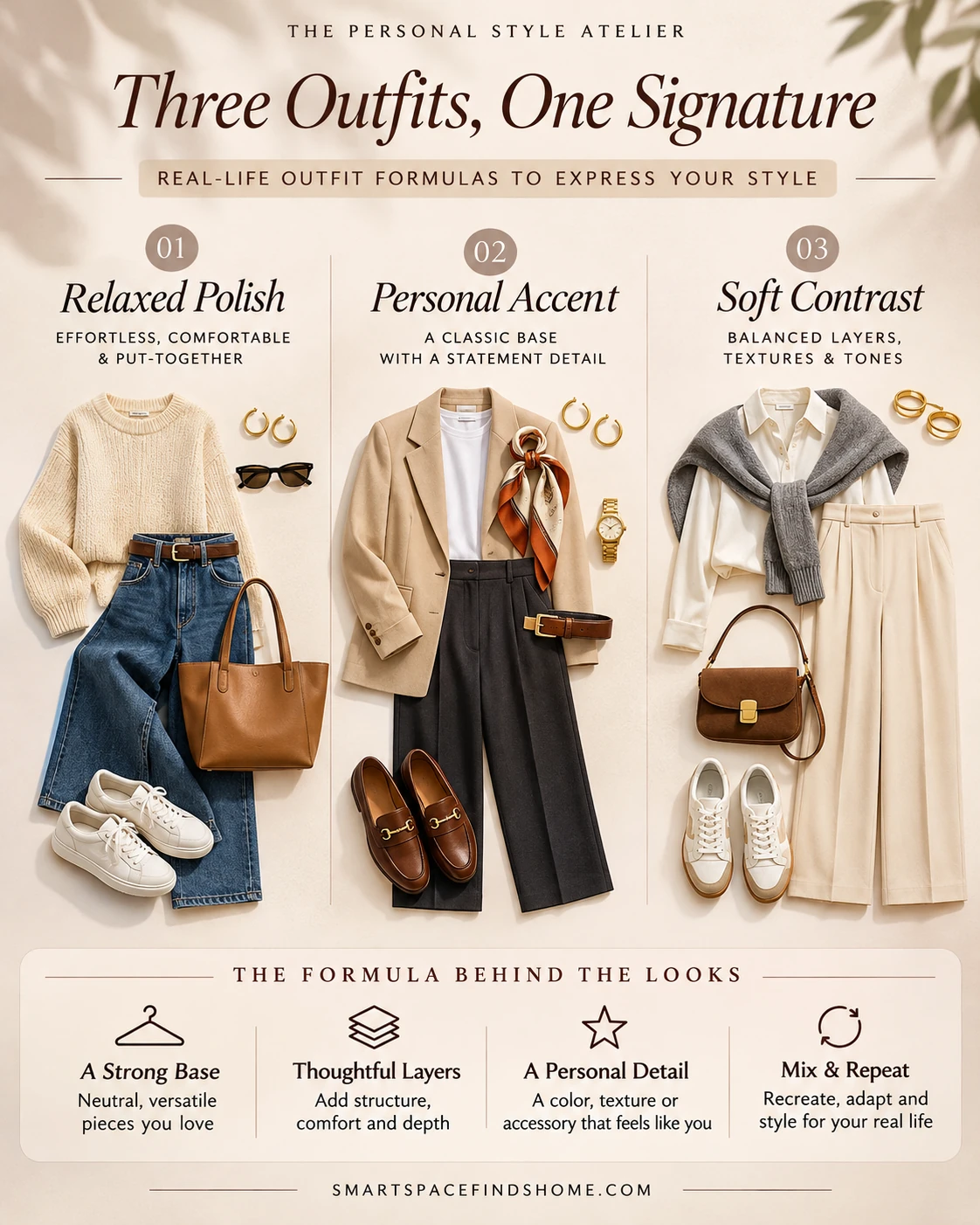
Three Everyday Outfit Formulas to Make Your Own
These examples are starting points, not a universal capsule wardrobe. Adapt the cuts, coverage, colors, and footwear to your own preferences and needs.
01 / THE RELAXED POLISH
Comfortable straight-leg trousers + simple knit or tee + clean structured layer + everyday shoes.
Why it works: ease and definition in one repeatable combination.
02 / THE PERSONAL ACCENT
Familiar neutral base + one distinctive accessory, color, print, or texture.
Why it works: personality without rebuilding the whole outfit.
03 / THE SOFT CONTRAST
Roomy shirt or sweater + a contrasting silhouette + practical finishing layer.
Why it works: interesting proportions with room to move.
A note on personal fit: These formulas are gender-inclusive and intentionally flexible. Substitute a dress, skirt, tunic, shorts, or other preferred garment. The useful principle is the relationship between pieces, not the exact item named.
THE WARDROBE REFINEMENT
THE PERSONAL STYLE ATELIER / CURATED TOOLS
The Shoe & Finishing Edit
Choose accessible storage for the shoes you actually wear. Choose only what fills a real need in your wardrobe.
C01 / ATELIER FIND
Simple Houseware 24-Pocket Shoe Organizer
An easy-access option for a narrow closet.
C02 / ATELIER FIND
Amazon Basics 24-Mesh-Pocket Shoe Organizer
Vertical pockets that keep shoes visible.
C03 / ATELIER FIND
Lifewit Under-Bed Shoe Storage 2-Pack
Put less-used shoes away neatly.
C04 / ATELIER FIND
Kitsure 3-Tier Stackable Shoe Rack
Open shelving for your regular footwear.
C05 / ATELIER FIND
UVIAHOMI 10-Tier Over-Door Shoe Organizer
Higher-capacity storage for a larger collection.
Affiliate disclosure: As an Amazon Associate, I earn from qualifying purchases. Product selection should always suit your needs and available space.
THE ATELIER TOOLKIT / 03
The Real-Life Outfit Matrix
A signature style works across more than one kind of day. Use this matrix as a flexible reference, substituting pieces that suit your climate, mobility, preferences and dress code.
| YOUR DAY | EASY BASE | SIGNATURE DETAIL |
|---|---|---|
| Work or study | Comfortable trousers + simple top | One structured layer |
| Weekend | Familiar jeans + easy knit | A preferred color or texture |
| Travel | Layerable, practical separates | Your signature accessory |
| Casual evening | One trusted outfit formula | Different shoes or an expressive accent |
The useful test: If one piece works for several real situations, it may deserve more space in your wardrobe than a trend-driven purchase that only works in a photograph.
The 15-Piece Wardrobe Remix (Optional)
Want a creative constraint without committing to a strict capsule wardrobe? Pick up to 15 garments you already own, including the layers you rely on most. Shoes, accessories and weather-specific essentials can stay outside the exercise if that is more practical.
Try an illustrative selection: five tops, four bottoms, three layering pieces, and three versatile alternatives suited to your everyday life. Assemble a combination for an ordinary day, one for a different setting, and one you would not have considered before. Photograph the results so you can repeat the useful ones.
There is no ideal wardrobe size or required number of outfits. This is a reversible styling exercise, not an invitation to discard clothes or buy a predetermined list.
THE PERSONAL STYLE ATELIER / CURATED TOOLS
Start With What You Own
Keep favorite pieces visible before shopping. Choose only what fills a real need in your wardrobe.
A01 / ATELIER FIND
Amazon Basics Velvet Hangers — Black 50-Pack
Keep daily garments visible on a consistent rail.
A02 / ATELIER FIND
Amazon Basics Velvet Hangers — Ivory/Silver 50-Pack
An alternate finish for a cohesive wardrobe.
A03 / ATELIER FIND
Utopia Home Velvet Hangers — Black 50-Pack
An alternative hanger set for frequently worn pieces.
A04 / ATELIER FIND
YOUDENOVA 6-Shelf Hanging Closet Organizer — Grey
Vertical shelves for folded wardrobe basics.
A05 / ATELIER FIND
MAX Houser 6-Tier Hanging Organizer — Grey
Additional folded-clothing space without a new dresser.
A06 / ATELIER FIND
Lifewit Clear Window Over-Door Organizer — Grey
Easy-to-identify pockets for accessories.
A07 / ATELIER FIND
SpaceAid Bamboo Drawer Dividers With Inserts
Separate your most-used wardrobe essentials.
Affiliate disclosure: As an Amazon Associate, I earn from qualifying purchases. Product selection should always suit your needs and available space.
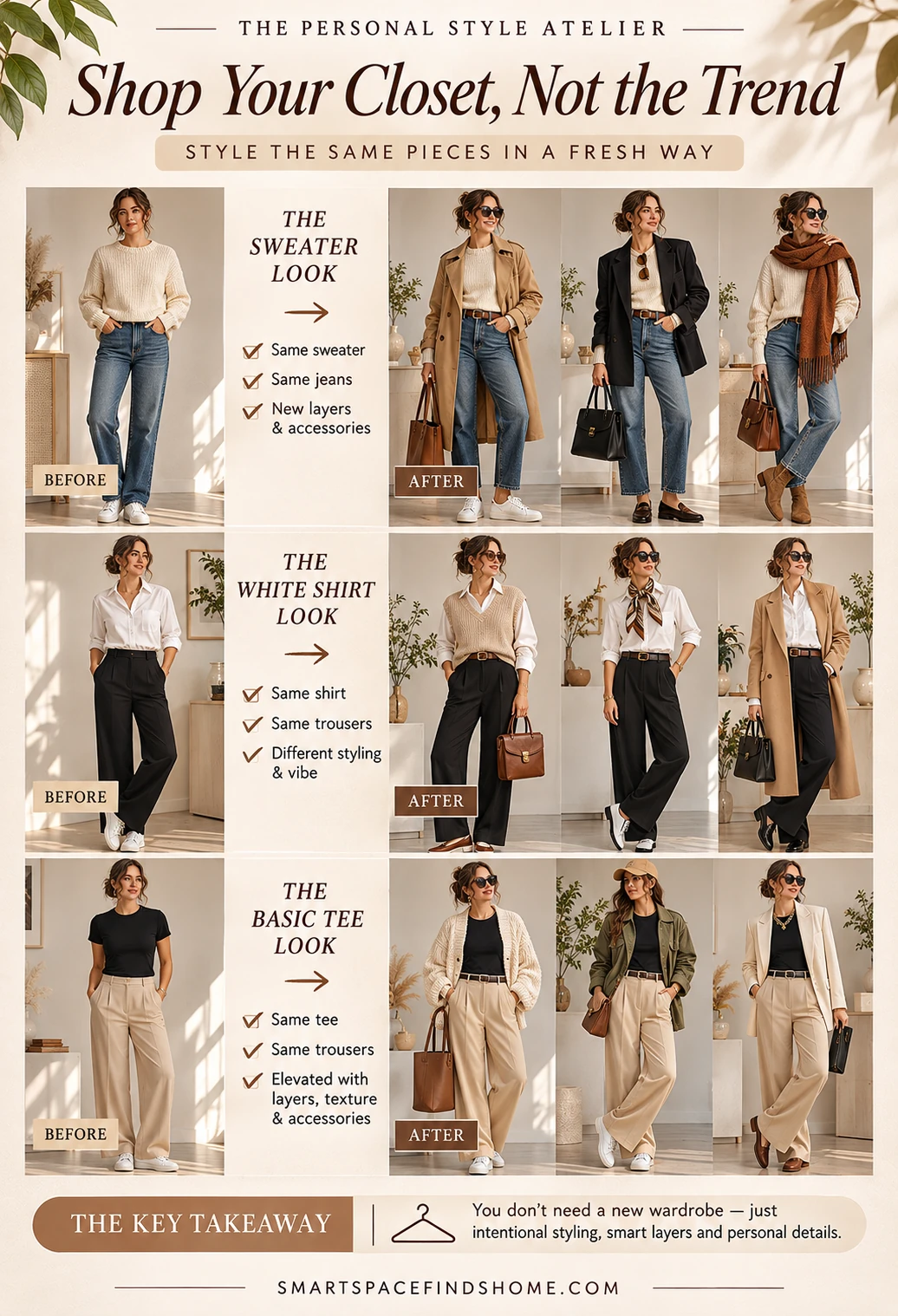
The Thoughtful Wardrobe Edit: Shop Your Closet First
When your closet feels crowded but your options feel limited, the answer isn’t automatically more clothing. A focused wardrobe edit can help you see the possibilities already there.
Use four simple categories
- Wear often: pieces you consistently enjoy and find useful.
- Try again: pieces you like but haven’t styled successfully yet.
- Needs attention: garments that need cleaning, repair, tailoring, or seasonal storage.
- Ready to release: pieces you no longer want or need, when you’re comfortable donating, reselling, recycling, or passing them along.
Start with one small section—a shelf, a drawer, or a category of tops. Pulling everything out at once can make a manageable project feel overwhelming.
A five-question filter before buying something new
- Can I build at least three outfits with it using what I own?
- Does it fit my actual routine and local weather?
- Will I realistically wear and care for this material?
- Am I drawn to the piece itself—or only to the photograph or trend?
- Could something already in my closet serve the same purpose?
A “no” doesn’t mean a purchase is wrong. It simply tells you where to think more carefully. There is no perfect item count, mandatory capsule size, or ideal spending level.
THE STYLE ATELIER RULE
Before you add one new thing, discover three new ways to wear something you already own.
04 / THE SEVEN-DAY EXPERIMENT
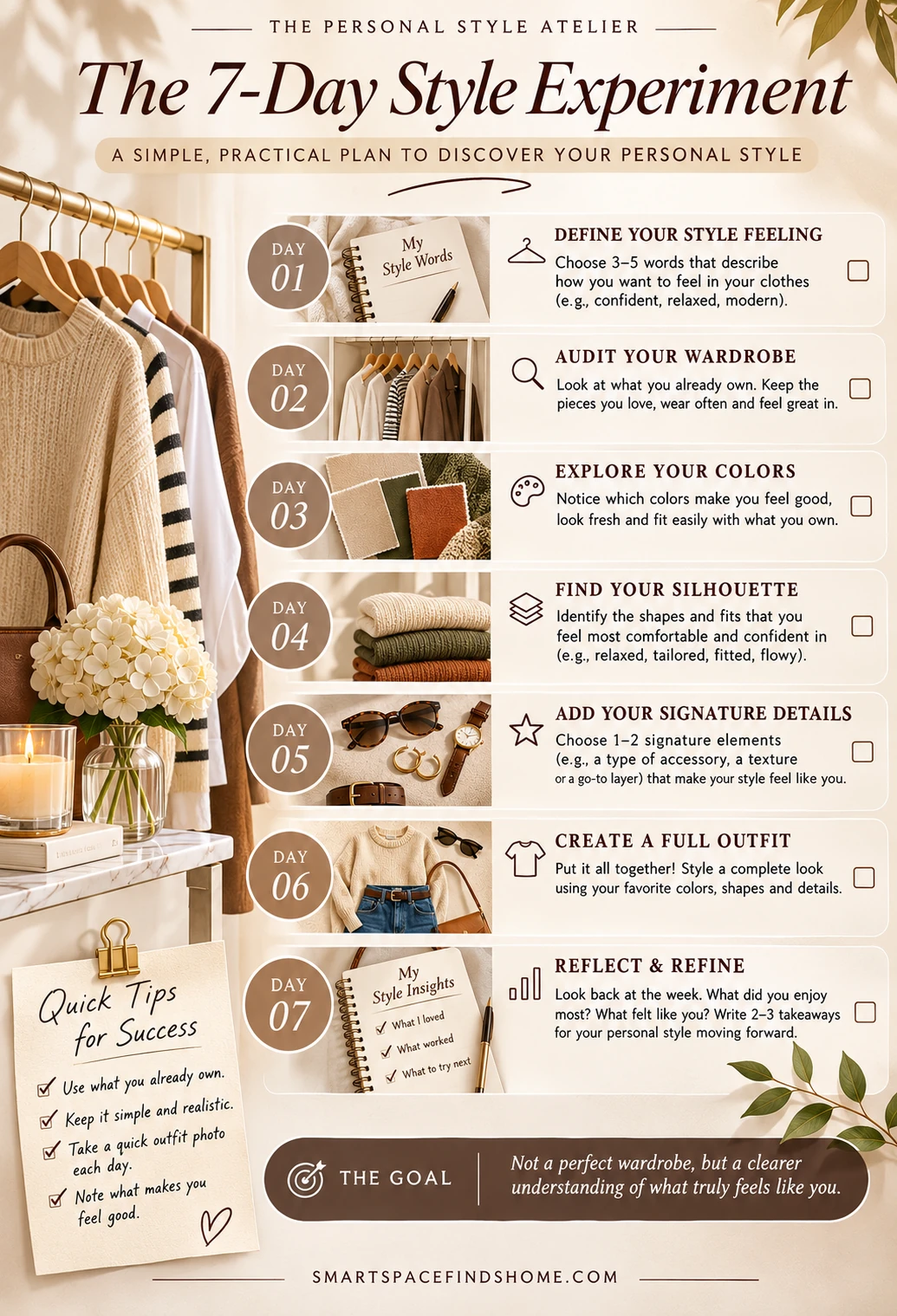
The 7-Day Signature Style Experiment
Use this low-pressure experiment to make decisions based on experience rather than imagined versions of yourself. You don’t need to document it online, buy anything, or follow the days perfectly. Adjust the exercise to what feels manageable.
| Day | Small experiment | What to notice |
|---|---|---|
| 01 | Choose three words that describe how you want to feel | The mood you want your clothes to express |
| 02 | Review the clothes you own and wear most | Which pieces already work for your life |
| 03 | Explore favorite colors and combinations | Colors you enjoy and can repeat |
| 04 | Choose one or two signature details | Accessories, textures or finishing touches |
| 05 | Experiment with shapes and silhouettes | Which proportions feel comfortable |
| 06 | Create one complete everyday outfit | How the pieces work together |
| 07 | Reflect on your week and refine | What you enjoyed and would repeat |
How to know what worked
For each day, use a quick personal check: Was I comfortable? Did the outfit work for what I actually did? Did I enjoy how it expressed me? You can use a simple yes/not yet answer instead of a numeric score. This is a reflection tool, not a scientific assessment.
At the end of the week, identify three details worth repeating and one idea that sounded appealing but didn’t fit your life. That small distinction is a meaningful result.
THE ATELIER TOOLKIT / 04
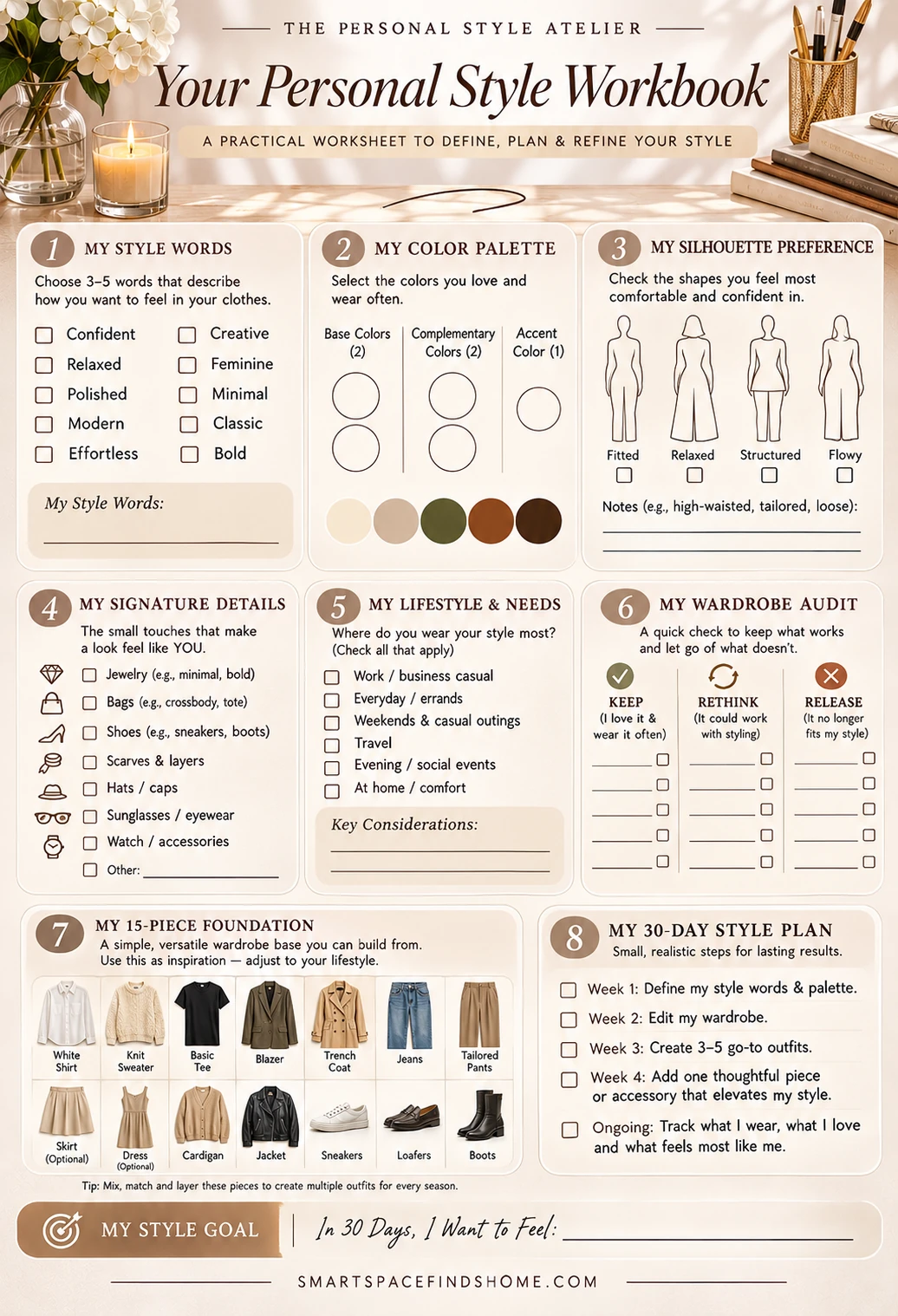
Your Personal Style Workbook
Save this worksheet, copy it into a notebook, or print this section using your browser’s print option. It is designed to help you capture what you learn during the seven-day experiment—without signing up or sharing personal information.
My three style words
1. __________________ 2. __________________ 3. __________________
The things I wear most often
My three repeat favorites: ______________________________________________
My outfit formula
An easy base + a comfortable layer + my personal detail: ____________________
My real-life requirements
Climate, comfort, movement, care and dress code: ___________________________
At the end of the week
Three things worth repeating: ___________________________________________
One styling idea to rethink: _____________________________________________
One real wardrobe gap (only if there is one): ______________________________
Optional: Turn this into a 30-day style practice
Week 1 — Notice: Complete the seven-day experiment and record what you enjoy wearing.
Week 2 — Repeat: Rewear your two favorite outfit formulas in different settings. Note comfort and ease.
Week 3 — Refine: Try new combinations using underused pieces before considering a purchase.
Week 4 — Keep what works: Choose your most useful details, update your wardrobe gaps list, and give everything a practical home.
Go at your own pace. This is an optional creative routine, not a validated assessment or a deadline.
Printing tip: In most browsers, open Print (Ctrl+P or Cmd+P), then select the pages you need. This is an on-page worksheet, not a separate downloadable PDF.
KEEP EXPLORING AT SMART SPACE FINDS
A personal style is easier to enjoy when your surroundings support it. Explore small closet organization ideas, make your morning routine easier, or find ways to make your home feel less cluttered.
THE PERSONAL STYLE ATELIER / CURATED TOOLS
Care for the Pieces You Love
Maintain familiar clothes before replacing them. Choose only what fills a real need in your wardrobe.
D01 / ATELIER FIND
Conair Turbo ExtremeSteam 1875W Garment Steamer
Refresh suitable fabrics before wearing.
D02 / ATELIER FIND
BEAUTURAL Foldable Handheld Clothes Steamer 120V
Compact care for suitable garments.
D03 / ATELIER FIND
Scotch-Brite Everyday Clean Lint Roller 3-Pack
Lift surface lint from suitable clothing.
D04 / ATELIER FIND
Muchfun Honeycomb Mesh Laundry Bags 3-Piece
Separate appropriate delicate items during washing.
Affiliate disclosure: As an Amazon Associate, I earn from qualifying purchases. Product selection should always suit your needs and available space.
How to Find Your Personal Style on a Budget
A tight budget doesn’t make personal style less achievable. In fact, using your existing clothes can make your preferences easier to see because you’re not constantly introducing new options.
- Try a different combination of two familiar pieces before purchasing something similar.
- Change styling rather than the garment: sleeves, layering, tucking, accessories, or shoe choice.
- Care for clothes you enjoy so they remain useful longer; always follow fabric-care instructions.
- Consider alterations, secondhand shopping, swaps, or borrowing only when they fit your needs and budget.
- Keep a short “real gaps” list rather than purchasing directly from an inspiration image.
Style is not measured by the price of your clothes. The goal is a wardrobe that makes you feel at home in your choices.
THE PERSONAL STYLE ATELIER / CURATED TOOLS
Give Signature Details a Home
Keep personal accessories easy to find and repeat. Choose only what fills a real need in your wardrobe.
E01 / ATELIER FIND
BAGSMART Two-Sided Hanging Jewelry Organizer
See favorite jewelry and finishing pieces together.
E02 / ATELIER FIND
BAGSMART Foldable Travel Jewelry Organizer
Pack a few signature accessories neatly.
E03 / ATELIER FIND
VLANDO Small Travel Jewelry Case — Beige
A compact home for smaller jewelry pieces.
E04 / ATELIER FIND
bussdis 2-Tier Velvet Bracelet Display
Make wrist accessories easier to compare.
Affiliate disclosure: As an Amazon Associate, I earn from qualifying purchases. Product selection should always suit your needs and available space.
How to Build a Personal Style Mood Board Without Copying Someone Else
Inspiration boards are useful when you treat them as a collection of clues instead of a shopping list. Save images that genuinely attract you, including colors, fabric textures, interiors, art, travel photography, and outfits. Then ask what connects them.
Look for repeated qualities—softness, contrast, structure, texture, simplicity, or playful details. If you save a beautifully styled outfit, separate the mood from the merchandise. Perhaps you love the loose silhouette, not the designer jacket; the rich burgundy, not the exact handbag.
Build two small columns: “What I love in this image” and “How I can interpret it with what I own.” This turns visual inspiration into personal decisions rather than pressure to purchase.
Seven Personal Style Mistakes That Make Getting Dressed Harder
Copying a complete look instead of learning why you like it
Borrow the color relationship, proportion, or overall feeling. Adapt the rest to your body, comfort, and routine.
Buying for an imagined lifestyle
Consider how often a garment will fit your real week. A beautiful occasion outfit is not a substitute for comfortable everyday clothing.
Trying to choose one rigid aesthetic
Your taste can contain opposites. A consistent approach to fit or color can make eclectic pieces feel connected.
Confusing expensive with personal
Cost and brand recognition do not establish whether something is right for you.
Ignoring fabric and maintenance
Check how a piece feels, moves, washes, and fits your available time for care.
Decluttering too aggressively
Keep a temporary “revisit” group for uncertain pieces. You don’t have to make every decision in one afternoon.
Expecting immediate certainty
Personal style develops through repetition and gentle experimentation. You can change your mind without starting over.
THE PERSONAL STYLE ATELIER / CURATED TOOLS
The Closet Refresh
Adapt storage to your actual space and seasons. Choose only what fills a real need in your wardrobe.
F05R2 / ATELIER FIND
Command Medium Designer Hooks — 6-Pack
Give lightweight everyday accessories a convenient place without drilling.
F01 / ATELIER FIND
Sakugi Rolling Clothes Rack With Mesh Shelf
Temporary hanging space for outfit planning.
F02 / ATELIER FIND
Simple Trending Rolling Clothes Rack
Flexible storage during a wardrobe edit.
F03 / ATELIER FIND
Cozy Essential Vacuum Storage Bags 20-Combo
Store suitable off-season textiles.
F04 / ATELIER FIND
Fygrip Vacuum Storage Bags 20-Combo
An alternative for seasonal soft-goods storage.
Affiliate disclosure: As an Amazon Associate, I earn from qualifying purchases. Product selection should always suit your needs and available space.
Make Your Wardrobe Easier to Use, Not Just Better to Look At
Personal style is easier to practice when you can see and reach the clothes you like. Group related pieces, keep frequent-use items accessible, and give accessories a predictable place. Even a modest closet can become more useful with a thoughtful layout.
Before investing in storage products, measure your available space and work with the organizers you already have. Choose solutions based on access and functionality—not how perfect they look in a photograph. That simple principle connects personal style to the larger Smart Space Finds philosophy: make everyday spaces work for real life.
05 / THE ESSENTIAL QUESTIONS
Frequently Asked Questions About Finding Your Personal Style
How do I find my personal style if I don’t know what I like?
Start with three outfits you feel comfortable wearing. Notice repeated shapes, textures, colors, and details. Choose a few descriptive words and test one small change at a time. Your existing preferences often provide better clues than a large inspiration board.
How long does it take to develop a signature style?
There is no fixed timeline. A seven-day experiment can help you notice patterns, but personal style continues to evolve with your lifestyle and preferences. Aim for useful progress, not a deadline.
Can I have more than one personal style?
Yes. Your wardrobe may include different moods for work, weekends, travel, and special occasions. Shared colors, silhouettes, or signature details can connect those looks without making them identical.
Do I need a capsule wardrobe to find my style?
No. A capsule wardrobe is one organization approach, not a requirement. A signature style can work with a small, large, minimal, colorful, or eclectic wardrobe.
Can I change my personal style without buying new clothes?
Often, yes. Experiment with different combinations, layering, accessories, proportions, and the pieces you have overlooked. If you identify a genuine gap later, you can shop more intentionally.
What if my style changes with my age, job, or body?
That is completely reasonable. Adapt your wardrobe to your current needs, mobility, climate, preferences, and comfort. You don’t owe consistency to your past self.
How is a signature style different from following fashion trends?
A trend is an idea that gains attention. Your signature style is your personal way of selecting, adapting, or ignoring those ideas. You can enjoy trends without letting them dictate your entire wardrobe.
What are the easiest pieces to start with?
Start with whichever items you wear most often—perhaps pants, dresses, shirts, comfortable shoes, or everyday layers. The best starting category is the one that has the greatest effect on your real routine.
“A personal style is not a shopping list. It is a collection of choices that feel right to repeat.”
THE PERSONAL STYLE ATELIER
The Final Edit: Recognizable, Comfortable, and Entirely Your Own
A signature style doesn’t arrive when your wardrobe finally looks like someone else’s mood board. It becomes clearer when you understand why you keep returning to certain pieces—and give yourself permission to build on those preferences.
Choose a few words. Notice what you love. Repeat what makes daily life easier. Leave space for curiosity and change.
Your next step: Pick one favorite outfit from your closet today. Write down three reasons you love wearing it. Those three reasons may be the beginning of your signature style.