
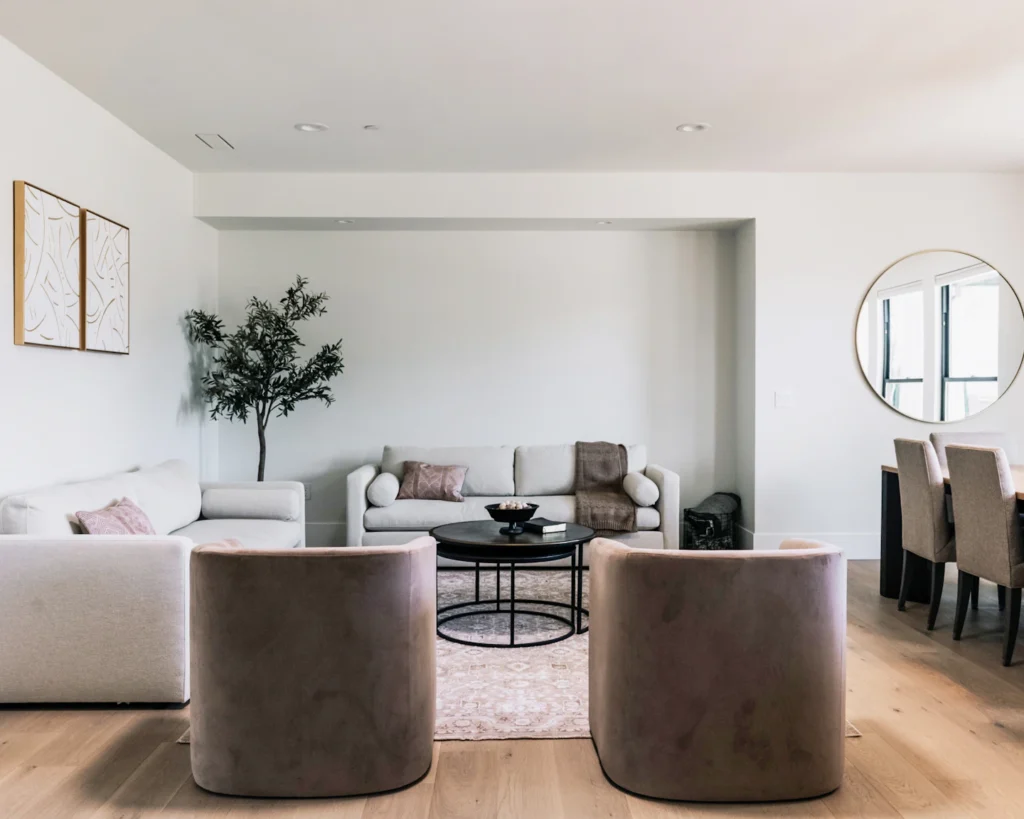
SMART SPACE FINDS · THE HOME STYLE EDIT
A home can feel quietly luxurious without being expensive, empty, or anything less than personal.
Quiet luxury interior design is less about spending and more about the details you experience: comfortable seating, well-placed lighting, harmonious colors, inviting textures, and pieces that work well in daily life. This complete guide translates the aesthetic into specific choices for real U.S. homes, rentals, and smaller apartments.
01 / THE QUIET LUXURY EDIT
What is quiet luxury interior design?
Quiet luxury creates visual richness through shape, workmanship, softness and restrained details instead of conspicuous branding. It overlaps with warm minimalism, but it does not require a home to be bare or neutral. A favorite vintage chair, deep olive cushion, or personal book collection may make the space more compelling.
The most useful distinction: minimalism asks how much you can remove; quiet luxury asks how thoughtfully the room comes together. You can keep color, memory and character. A room is not successful merely because it photographs well.
02 / THE QUIET LUXURY EDIT
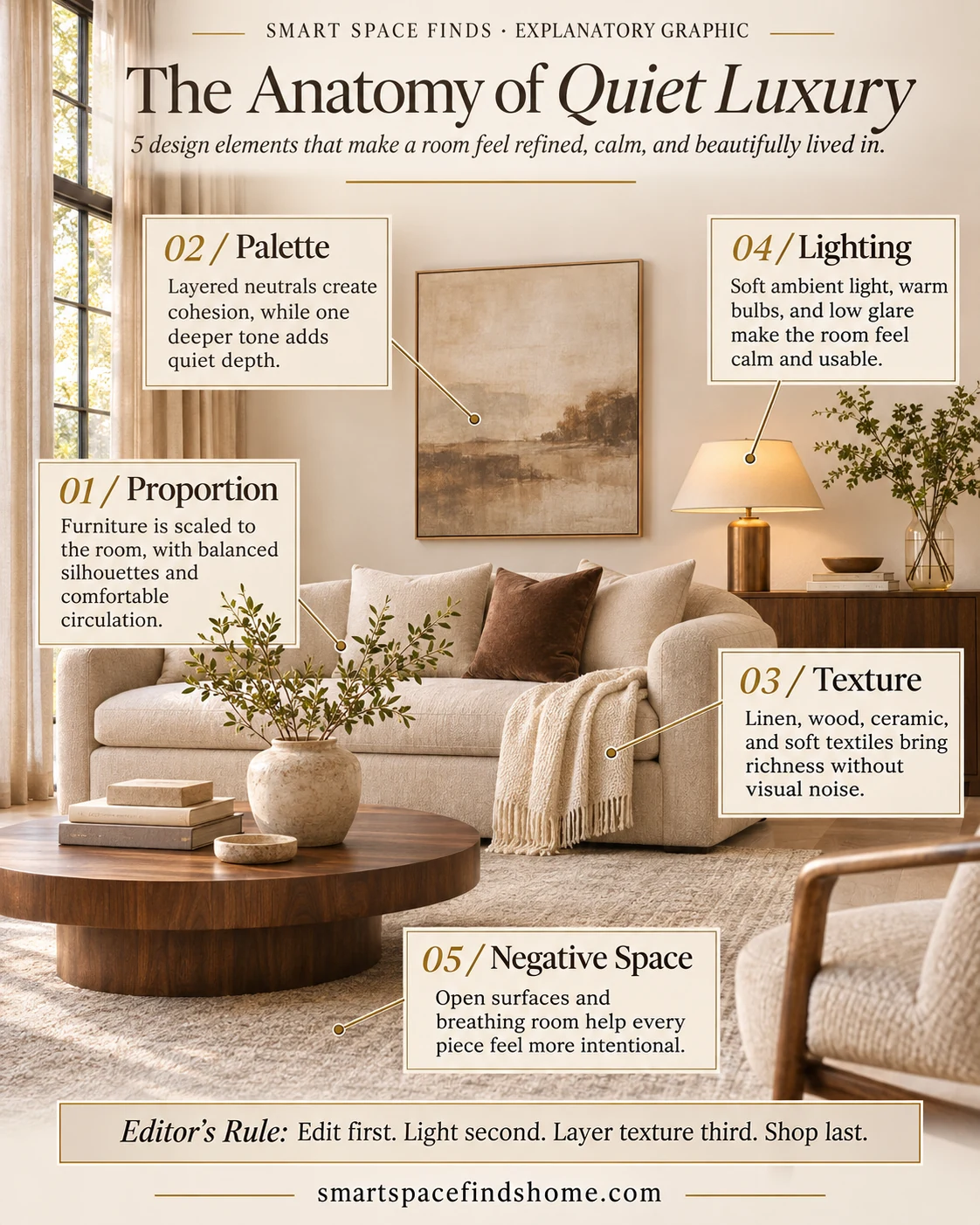
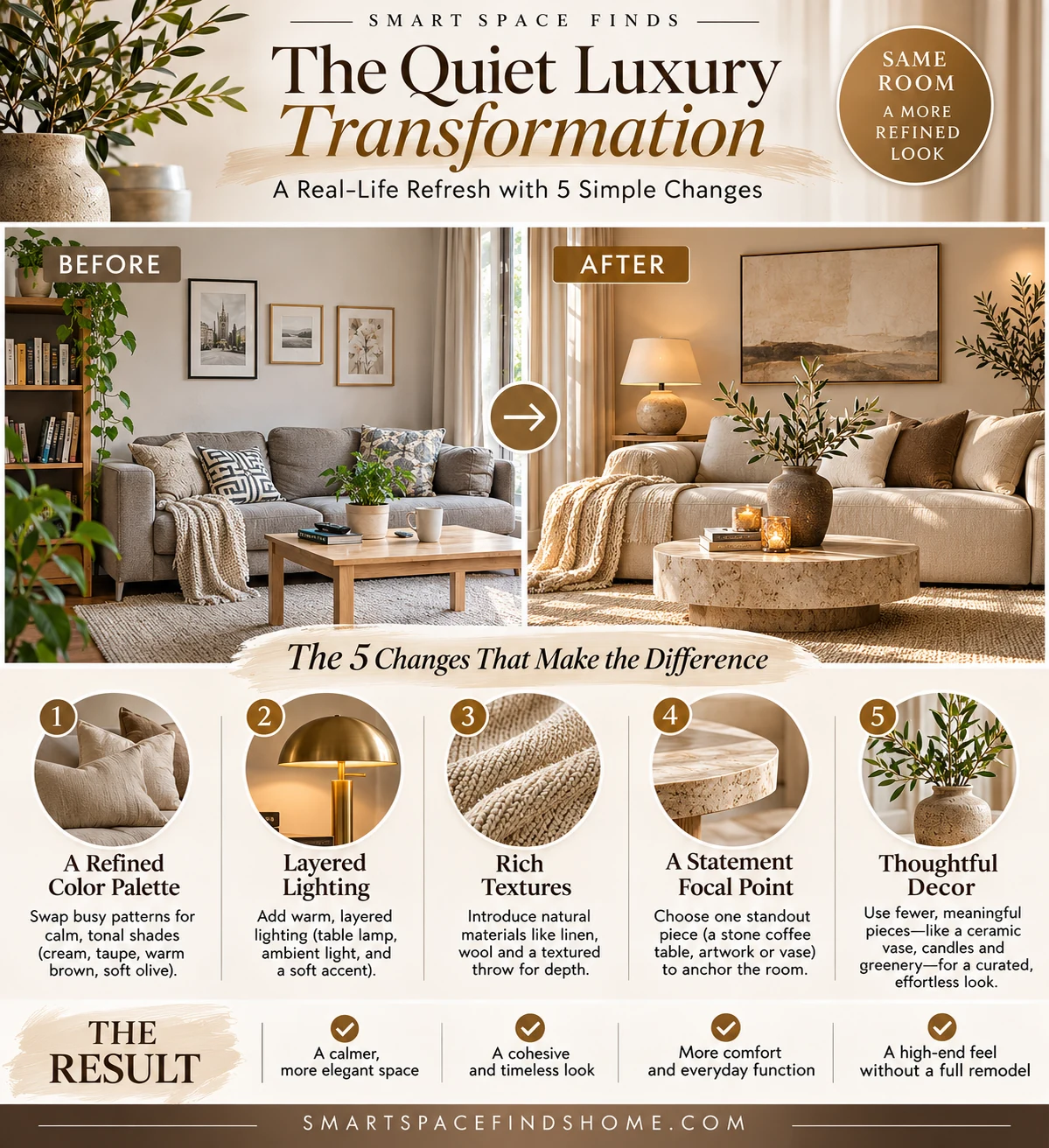
The five decisions that make a room feel considered
1. Edit visual noise, not personality
Photograph the room from the doorway. Spot competing tabletop objects, distracting cords, or items that have no practical home. Organize these before buying a new accessory. Preserve sentimental objects; the goal is clarity rather than emptiness.
2. Build around the room you already have
Pick an existing floor, sofa, or wall tone as your foundation. Add a nearby supporting tone and one darker anchor. Sample colors next to the actual materials in morning and evening light. A palette should support existing furniture instead of forcing you to replace it.
3. Add contrast through touch
Try a woven cushion against smooth upholstery, a matte bowl on wood, or a cotton throw against a structured chair. Compare washability, durability and texture in person if possible. Natural fibers are not automatically better for every household.
4. Layer lighting by use
Begin with a safe, practical reading or task light. A shaded table lamp or indirect lighting can soften atmosphere, while kitchens, workspaces and circulation paths still need adequate visibility. Warm-white light around 2700K is one option for relaxing areas, not a rule for every task.
5. Check proportion before decor
Measure real dimensions, traffic paths, and clearances. A properly sized rug, comfortable chair placement, and table that leaves room for a cup often do more than adding several small decorative objects.
03 / THE QUIET LUXURY EDIT
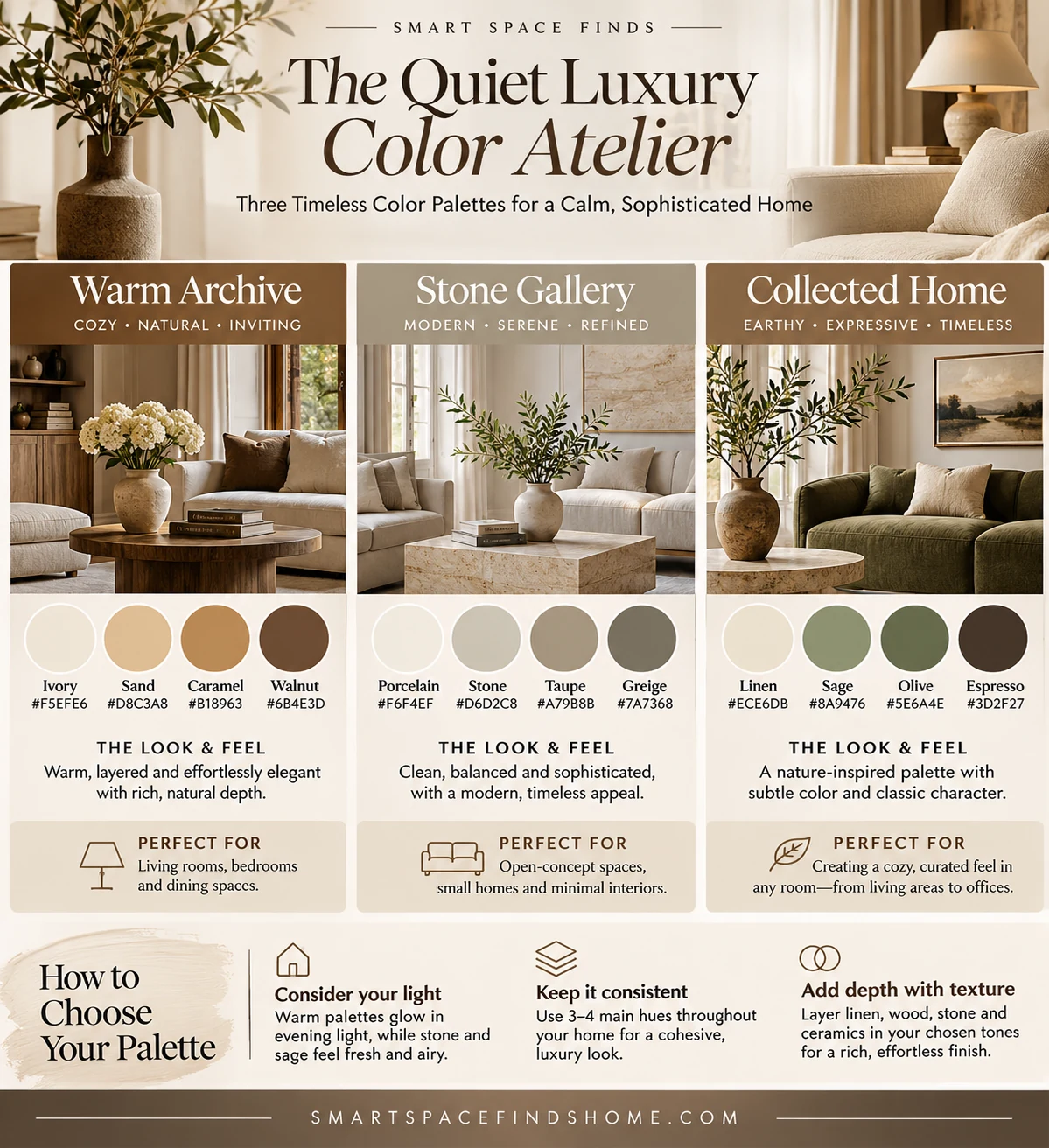
The color atelier: three ways to get the look
Think in relationships rather than a compulsory beige formula. These swatches are inspiration, not exact paint matches; test physical samples in your own light.
The Warm Archive
Oatmeal, oak, dark walnut and olive: inviting and grounded.
#f0e7d9 · #d0bda6 · #7b6148 · #575542
The Stone Gallery
Chalk, mushroom, taupe and charcoal: calm and architectural.
#eeece4 · #b9b4aa · #7c7065 · #34383c
The Collected Home
Ivory, clay, burgundy and botanical green: elegant with personality.
#f6e9d4 · #b88a69 · #704a46 · #4c5945
For a step-by-step color process, visit How to Choose a Color Palette for Your Home.
04 / THE QUIET LUXURY EDIT
The room-by-room design edit
Living room: start with the anchors
Review sofa position, rug size and lighting first. Keep a sound sofa and experiment with cushions or a throw rather than replacing furniture. Use one tray to organize a coffee table if it improves function; leave room for books and drinks.
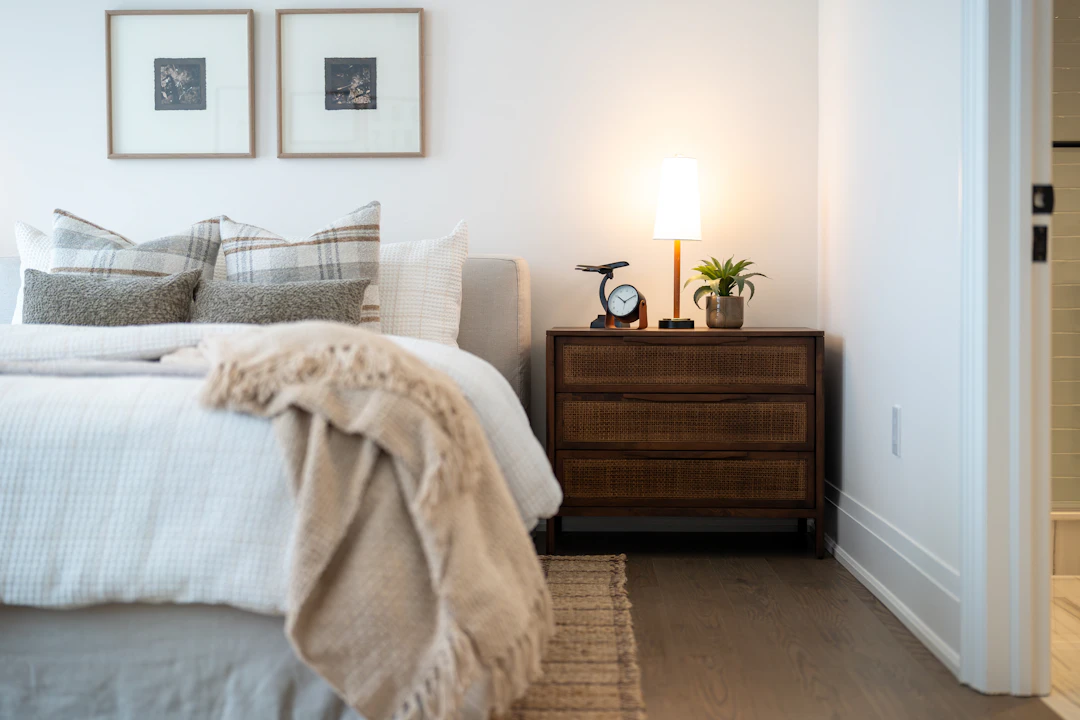
Bedroom: comfort is the luxury
Choose bedding for climate, care and personal temperature preference. Keep bedside essentials within easy reach and avoid excessive decorative cushions. Use suitable curtains for privacy and light control.
Entryway: refine the daily arrival
Create a predictable home for keys, bags and shoes. A washable mat, compact hooks and a small catchall can make a stronger first impression than another ornament.
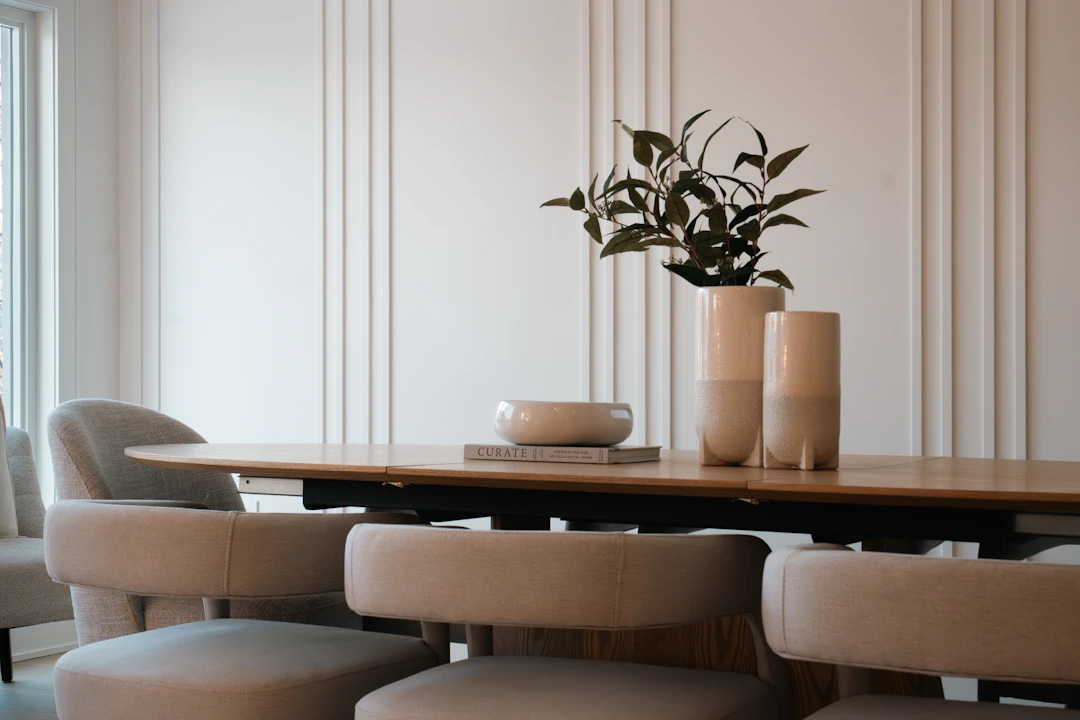
Kitchen and dining: useful objects are beautiful
Prefer accessible storage and clear food-preparation zones. A serving board, washable linens, simple ceramics and one low centerpiece can look cohesive without getting in the way.
Bathroom: one visual rhythm
Group daily products in a cleanable tray, choose towels for function, and protect cosmetics and medications according to storage instructions. Keep the counter useful.
For compact rooms, see How to Make a Small Home Feel More Comfortable and How to Make Your Home Feel Less Cluttered.
DESIGN DIAGRAM / LAYERS OF A CONSIDERED ROOM
Existing wall, floor and largest furniture tone.
A darker accent, varied silhouettes, and texture.
Useful layered lighting, comfort and restraint.
Start with the foundation. If a room feels unfinished, diagnose the missing layer instead of buying several accessories.
05 / THE QUIET LUXURY EDIT
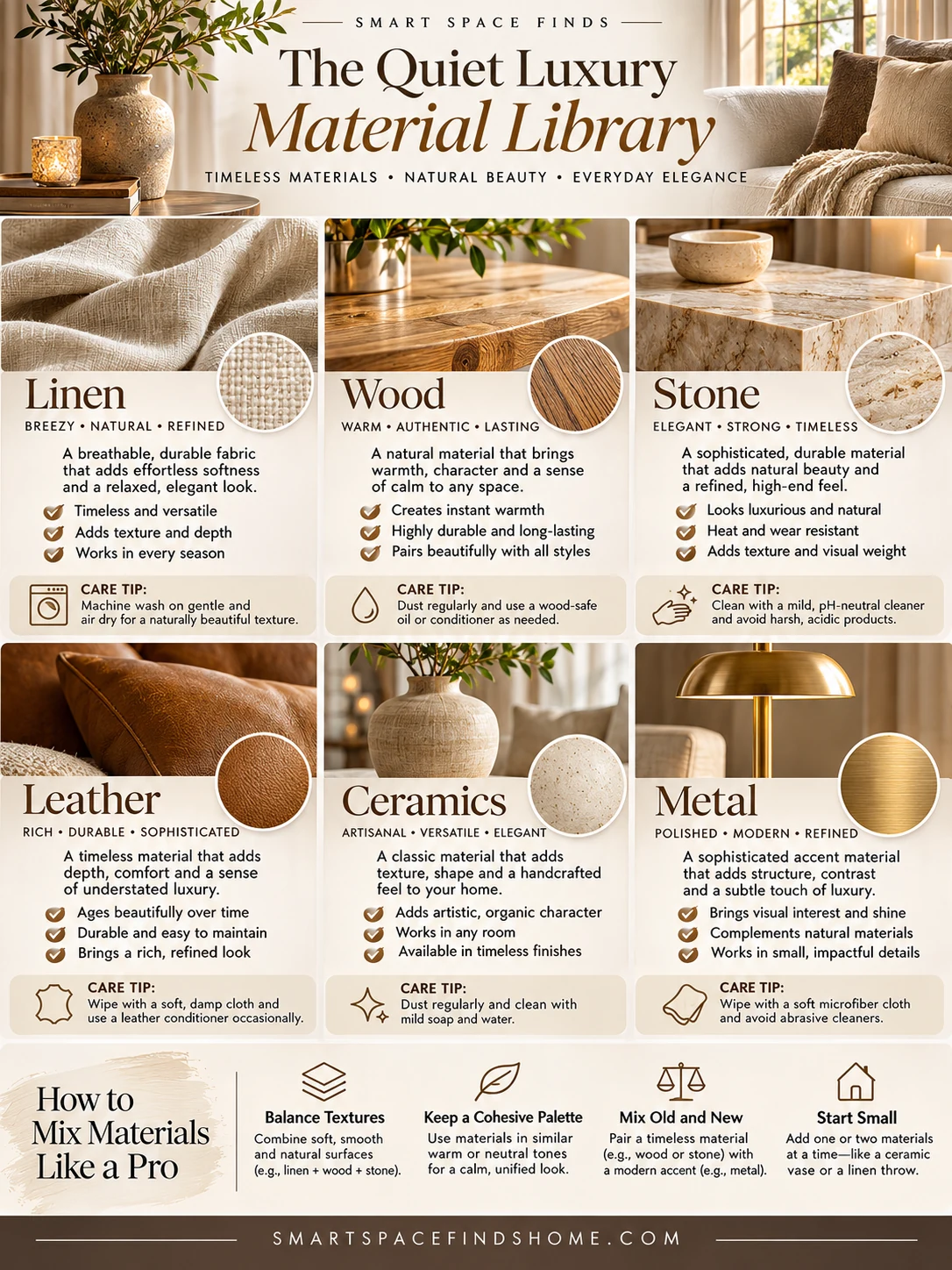
The tactile materials library
Judging a surface requires more than a photograph. Compare texture, maintenance, construction, glare, stability and how the material ages.
06 / THE QUIET LUXURY EDIT
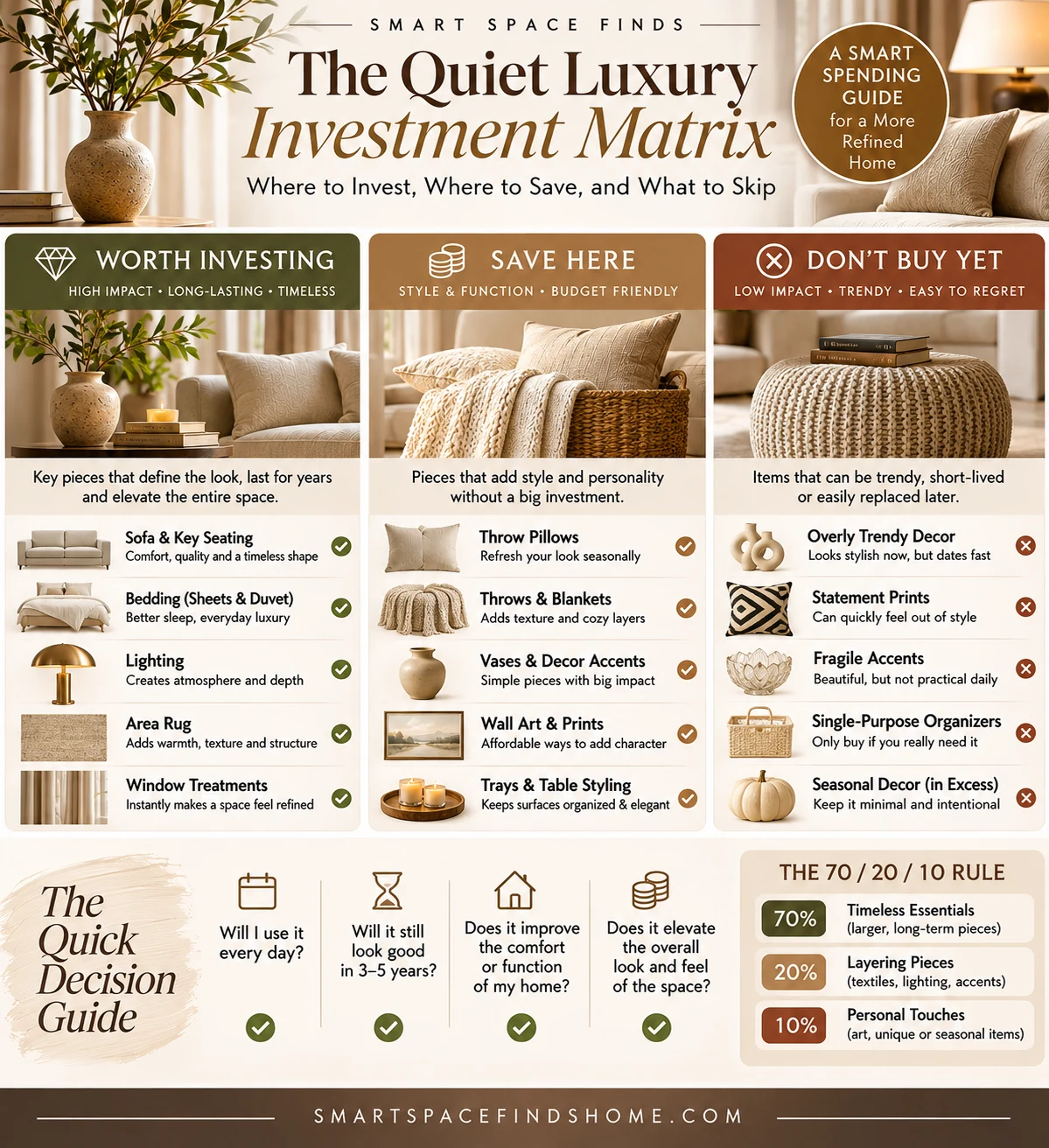
Spend well, save often—and sometimes buy nothing
A good buying decision should solve an actual discomfort or fit problem. Use this matrix to evaluate where construction or care makes a difference.
| Category | Prioritize | Lower-cost alternative |
|---|---|---|
| Seating | Comfort, dimensions, durability | Keep a good sofa; update washable covers |
| Lamps | Electrical safety and useful light | Move an existing lamp |
| Curtains | Privacy, fabric care, sizing | Simple compatible panels |
| Rugs | Correct size, grip, cleaning | Reposition rug or add appropriate pad |
| Decor | Meaning, usefulness, maintenance | Restyle what you already own |
| Storage | Easy access and daily routine | Reassign baskets or trays |
07 / THE QUIET LUXURY EDIT
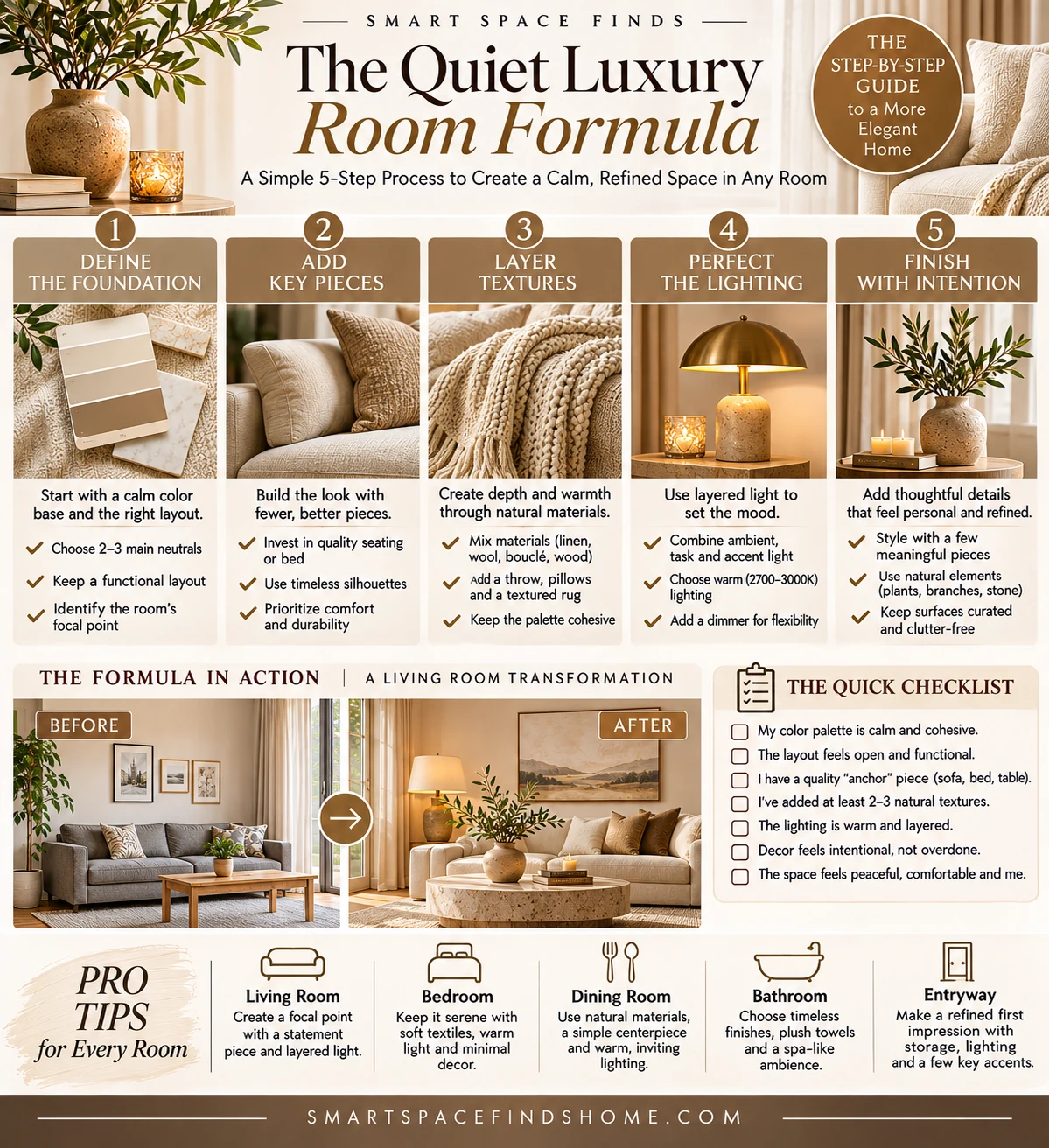
The design decision workbook
Use these expandable, no-download checklists while measuring or comparing a product. They need no external scripts.
The four-question buy-or-skip test
Ask: Does this item solve a real problem? Does the exact size fit? Do I know how to care for it? Would I want it without the luxury label? Any unknown answer is a reason to pause and research.
The color-testing checklist
View real samples against your floor and sofa, in daylight and evening light. Check undertones, wood colors, and the adjacent fabric.
The measurement checklist
Record width, depth, height, door and delivery clearances, room circulation and manufacturer measurements. For lamps check table and seated eye height; for rugs check furniture footprint.
The rental-friendly upgrade plan
Test portable lamps, rearranged furniture, removable textiles and freestanding storage first. Follow the lease and manufacturer guidance before any drilling, mounting or permanent change.
08 / THE QUIET LUXURY EDIT
The 20-minute no-spend quiet luxury reset
Photograph the room; name one friction point.
Edit one surface without removing useful essentials.
Move a lamp, chair, throw or tray you already own.
Check function; note one unresolved problem.
Live with the adjustment for several days before spending. The best upgrade will be the one that makes your routine feel easier and your space more inviting.
THE EDITOR’S PRIVATE NOTEBOOK
The design decisions that prevent expensive mistakes
A refined home is usually the result of fewer better decisions—not more purchases. Work through these practical checkpoints before changing a room.
Name the room’s focal point. Reduce nearby distractions, not everything you love.
Sit, reach, walk and clean. A lovely room should pass all four tasks.
Compare care labels, finish and long-term use before believing a luxury claim.
If your existing object works, could positioning or styling solve the problem?
Small-room proportion rules worth testing
For living rooms, use painter’s tape to outline a rug or coffee table before ordering. Compare furniture placement to real walkways, door swings and usable seating. For lamps, test the shade height while seated to avoid direct glare. For curtains, measure the actual window, mounting position and desired hem. These tests matter more than a universal one-size-fits-all rule.
A realistic design budget in three passes
- Free: edit surfaces, reorganize storage and reposition existing furnishings.
- Low commitment: test a textile, shade or practical tray with reliable return terms.
- Investment: replace a failing high-use item only after measuring, researching materials and comparing total cost.
The best result is not a shopping basket; it is a home that works better for the people living there.
09 / THE QUIET LUXURY EDIT
The questions worth asking
Is quiet luxury the same as minimalism?
No. They can overlap, but quiet luxury emphasizes tactile quality, comfort and considered details; minimalism is more explicitly about reducing objects.
Does quiet luxury have to be beige?
No. Deep green, terracotta, navy and burgundy can create a beautiful, restrained room when thoughtfully coordinated.
Can quiet luxury work in a small rental?
Yes. Use reversible layouts, soft lighting, proportionate furniture and practical storage; check lease restrictions.
What should I purchase first?
Only an item that solves a persistent, measurable need. If the room works well already, you may not need to buy anything.
Is quiet luxury still relevant in 2026?
Yes as a practical design approach, although design reporting increasingly embraces deeper colors, vintage character and more personal interiors. Avoid treating any single trend as permanent.
How can a home feel more expensive without spending more?
Improve layout, remove functional friction, soften lighting and arrange existing favorite objects with care.
THE FINAL EDIT
A beautiful home is lived in, not tiptoed around.
Keep what you love, refine what interrupts your day, and make every new purchase earn its place.
Editorial transparency: Individual Amazon products are not represented as verified, available or personally tested. Product modules will be added after exact listing checks, with disclosures alongside each module. Photograph: GoodLifeConstruction / Unsplash.