
Design Intelligence / Small Details, Better Living
The smartest home upgrades do not always announce themselves. A softer edge, a less reflective surface, or a hook in the right place can quietly change how a room works every single day.
We tend to judge design by what we can photograph: the color palette, the furniture silhouette, the perfect shelf. But a truly successful room also makes ordinary actions feel easier. You can walk through it comfortably, see what you need, and put things away without inventing a new routine.
This guide explores five everyday design choices with unexpected benefits—and, importantly, their limitations. Each includes a real-life scenario, an inexpensive way to test the idea, and a practical decision rule. No renovation required.
Start with the small inconvenience you repeat most often. If you bump into a table corner, reconsider its shape or position. If daylight reflects into your eyes, experiment with a low-glare finish. If a shelf is always half-empty, adjust its height. If a step disappears visually, improve visibility and have its safety assessed. If jackets end up on chairs, give them an accessible landing spot.
The Everyday Design Dividend: What Makes a Small Detail Worth It?
Think of a design decision as a tiny investment you experience repeatedly. The payoff is not necessarily resale value or an impressive before-and-after photo. It may be less friction, better visibility, adaptable storage, or a more intuitive routine.
- What specific everyday problem does this change solve?
- Will I notice the benefit more than once a week?
- Can I test it before buying or installing anything?
- Does it preserve clearances, accessibility, and product safety?
A small change earns its place when its usefulness survives ordinary life—not only a styled photo.
Chapter I — Five quiet upgrades
Make the room work harder so you don’t have to.
Every idea below includes its benefit, best use, a small real-world test, and the tradeoff worth checking before you commit.
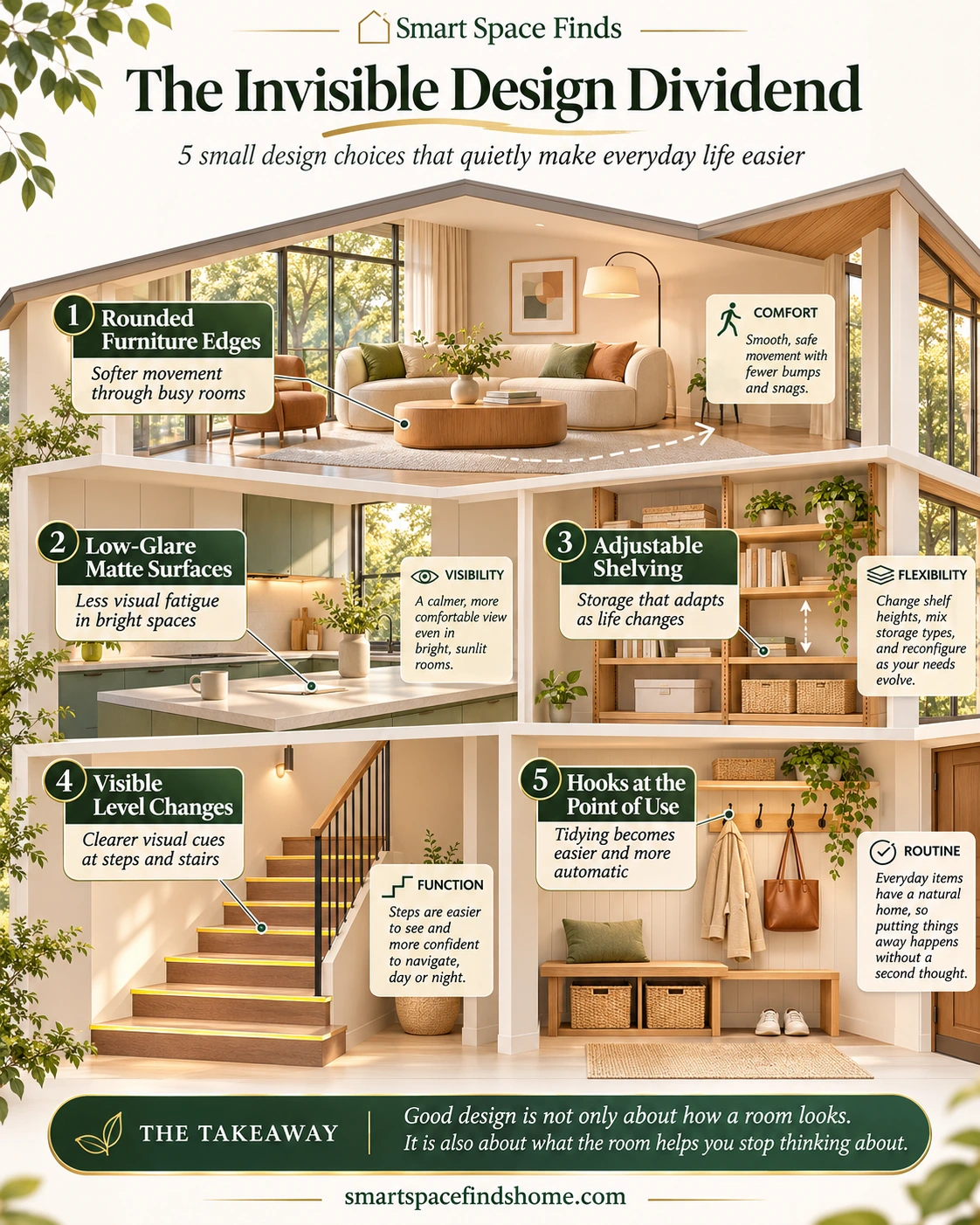
1. Rounded Furniture Corners Make Busy Rooms Easier to Navigate
The hidden benefit: a gentler interaction between furniture and the paths people actually take.
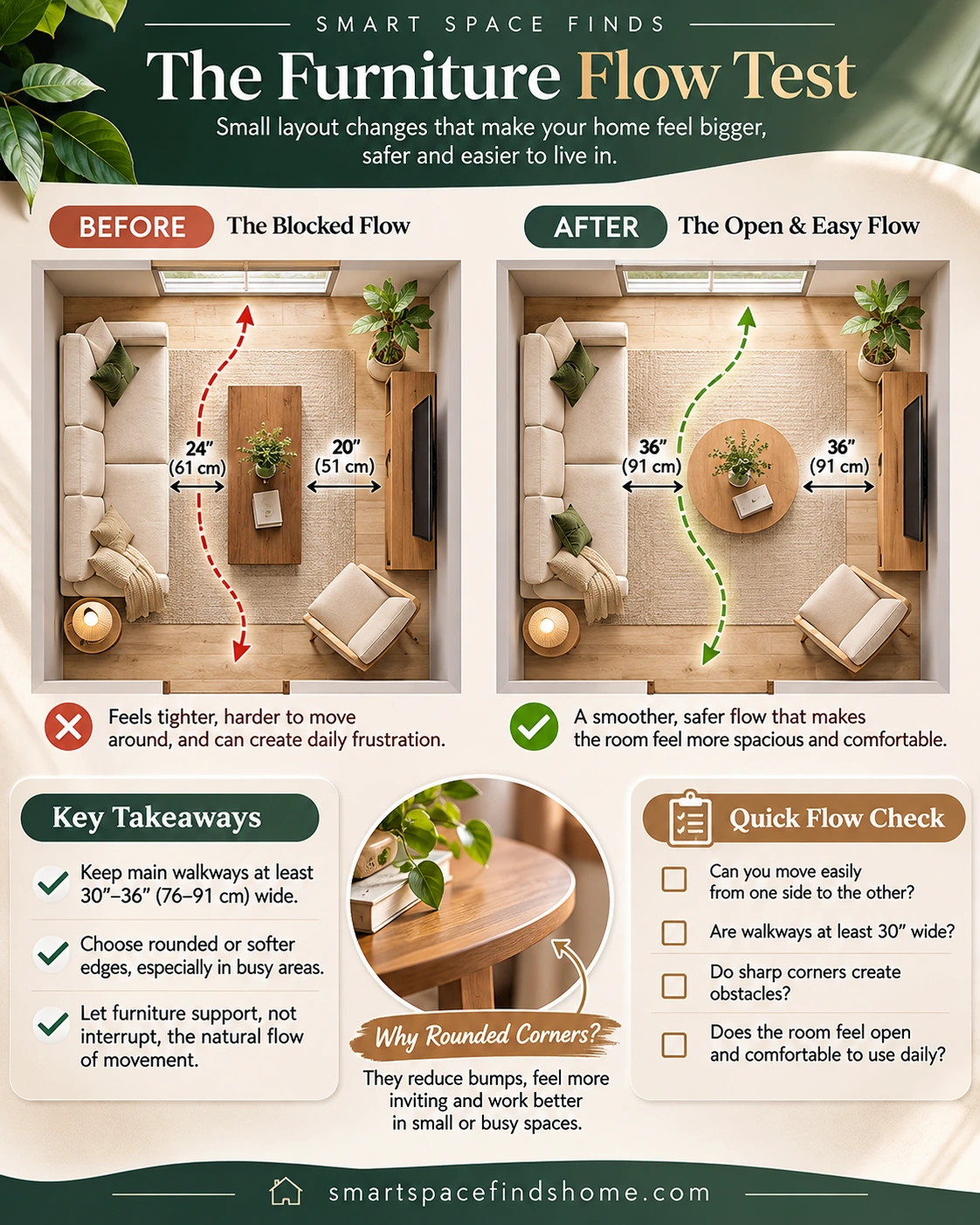
Picture a narrow living room where the route from the sofa to the kitchen cuts past the coffee table. A sharp, projecting corner occupies attention every time someone passes. A round or softly radiused table may feel more forgiving during incidental contact, although it does not eliminate injury risk.
Where the detail works best
Prioritize pieces that sit near circulation paths: coffee tables, console ends, narrow dining tables, and bedside furniture beside a doorway. A rounded table may also soften a visually crowded room, but it still needs enough usable surface and stable legs.
Try it before you buy
Place painter’s tape on the floor to mark the footprint of a replacement table. Walk your normal route while carrying laundry or a mug, without deliberately squeezing sideways. If the problem remains, the issue is likely clearance or placement, not corner shape. Measure the available passage first.
Watch out: rounded furniture is not childproof. Tall furniture still needs appropriate anchoring; table stability, material, edge profile, and product construction matter.
Rounded Furniture That Makes Small Rooms Easier to Navigate
Choose shapes and footprints that leave your real walking routes clear. Check product dimensions before ordering.
A compact round side table for tight sofa-side spaces.
Rounded tabletop with a second tier for everyday essentials.
A softer silhouette that combines a side table and basket storage.
Small accent table for a narrow seating area.
A wider centerpiece with a rounded edge and lower shelf.
A round coffee table option with an additional storage function.
A compact coffee table footprint for smaller rooms.
Affiliate disclosure: As an Amazon Associate, Smart Space Finds earns from qualifying purchases. Links in this section are affiliate links. Product availability, pricing and variations may change.
2. Matte Finishes Help Bright Rooms Feel Visually Calmer
The hidden benefit: reducing distracting reflected light where you read, cook, work, or move.
A sunlit kitchen can look stunning in a photo and still be uncomfortable when a glossy cabinet or desktop throws bright reflections toward your eyes. A matte or low-sheen surface can scatter reflections more diffusely, although the result depends on the finish, room lighting, and viewing angle.
Where to use low-glare materials
Consider a work surface facing a window, a frequently used desk, cabinet fronts opposite strong daylight, or flooring that appears mirror-like in direct sun. Combine the finish decision with shade control and task lighting instead of expecting paint alone to solve glare.
The daylight sample test
Hold two finish samples in the actual room at morning, noon, and evening. Look at each from seated and standing positions. Check reflected brightness, fingerprints, cleaning instructions, and durability—not just color. In kitchens and bathrooms, choose finishes rated for the relevant moisture and cleaning demands.
Tradeoff: some matte materials show oils or scuffs and may need manufacturer-specific care. Lower sheen does not automatically mean easier maintenance.
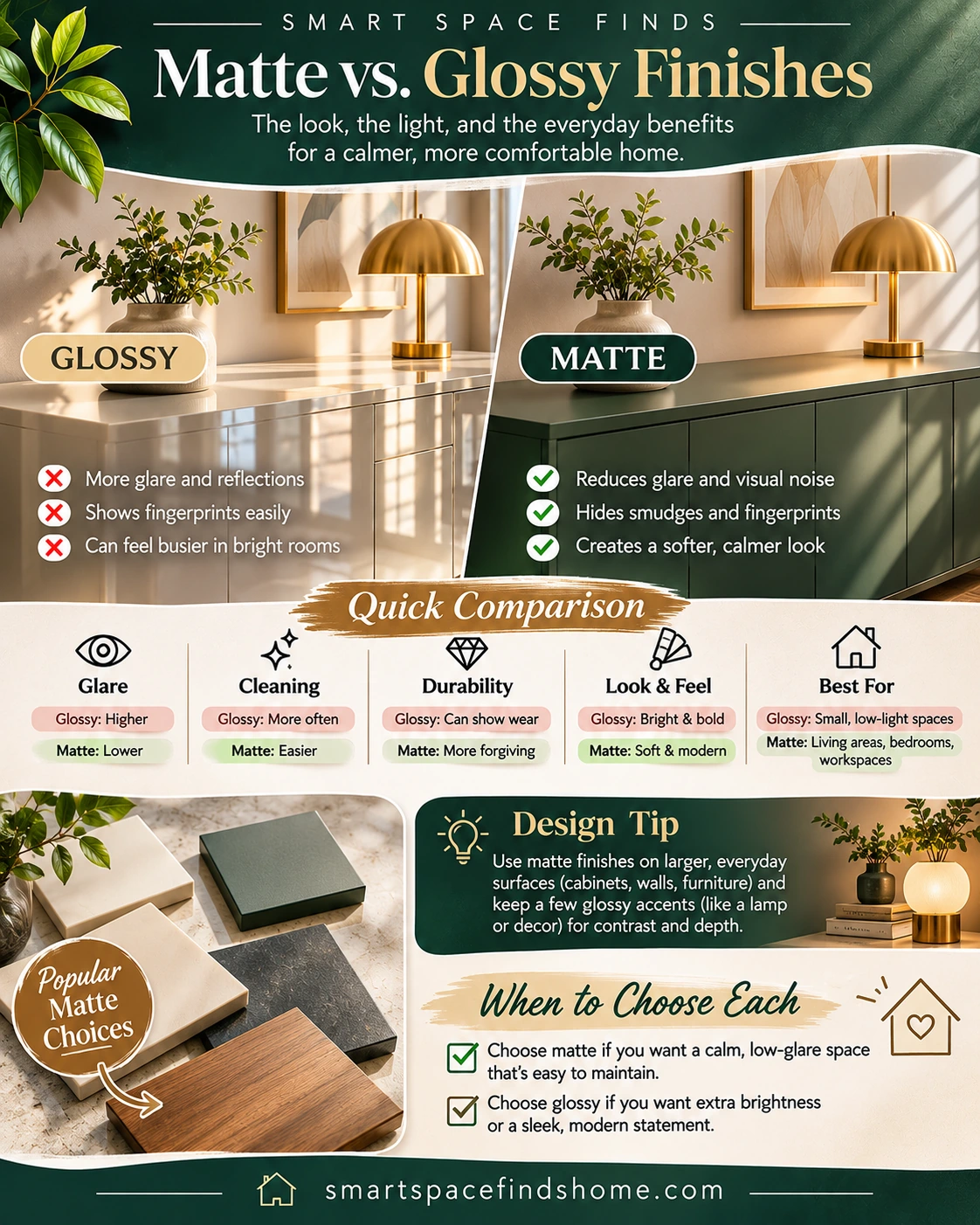
Low-Glare Everyday Surfaces
Test a finish in your own lighting. A matte-looking accessory can reduce harsh reflections, but durability and cleaning depend on its actual material.
An easy-to-place desk covering to soften the workspace visually.
A textured mouse surface for everyday desk use.
A removable-looking liner for a quieter cabinet surface.
A grip-textured liner for shelves and drawers.
Affiliate disclosure: As an Amazon Associate, Smart Space Finds earns from qualifying purchases. Links in this section are affiliate links. Product availability, pricing and variations may change.
3. Adjustable Shelving Lets Storage Grow With Your Life
The hidden benefit: capacity that responds to changing possessions instead of forcing possessions into a fixed layout.
Those evenly spaced rows of shelf-support holes may look like an unremarkable manufacturing detail. They are one of the simplest ways to make a closet or cabinet more adaptable. Moving a shelf can create space for taller cereal containers, shorter stacks of folded towels, or easy-to-reach everyday dishes.
The three-zone shelf method
Daily zone: frequently used items at comfortable reach. Occasional zone: less-used items slightly higher or lower. Reserve zone: lightweight backstock in the remaining space, provided access is safe. Adjust shelf positions around the objects—not the other way around.
A practical five-minute reset
Remove one shelf’s contents. Group items by height and use frequency. Reposition only the shelf that creates the most wasted vertical space, then return items in frequency order. Before loading it, confirm that all support pins are fully seated and the unit is stable.
Watch out: respect the manufacturer’s load limits, correct pin type, span, and anchoring requirements. A shelf’s weight capacity may vary with its width and support arrangement.
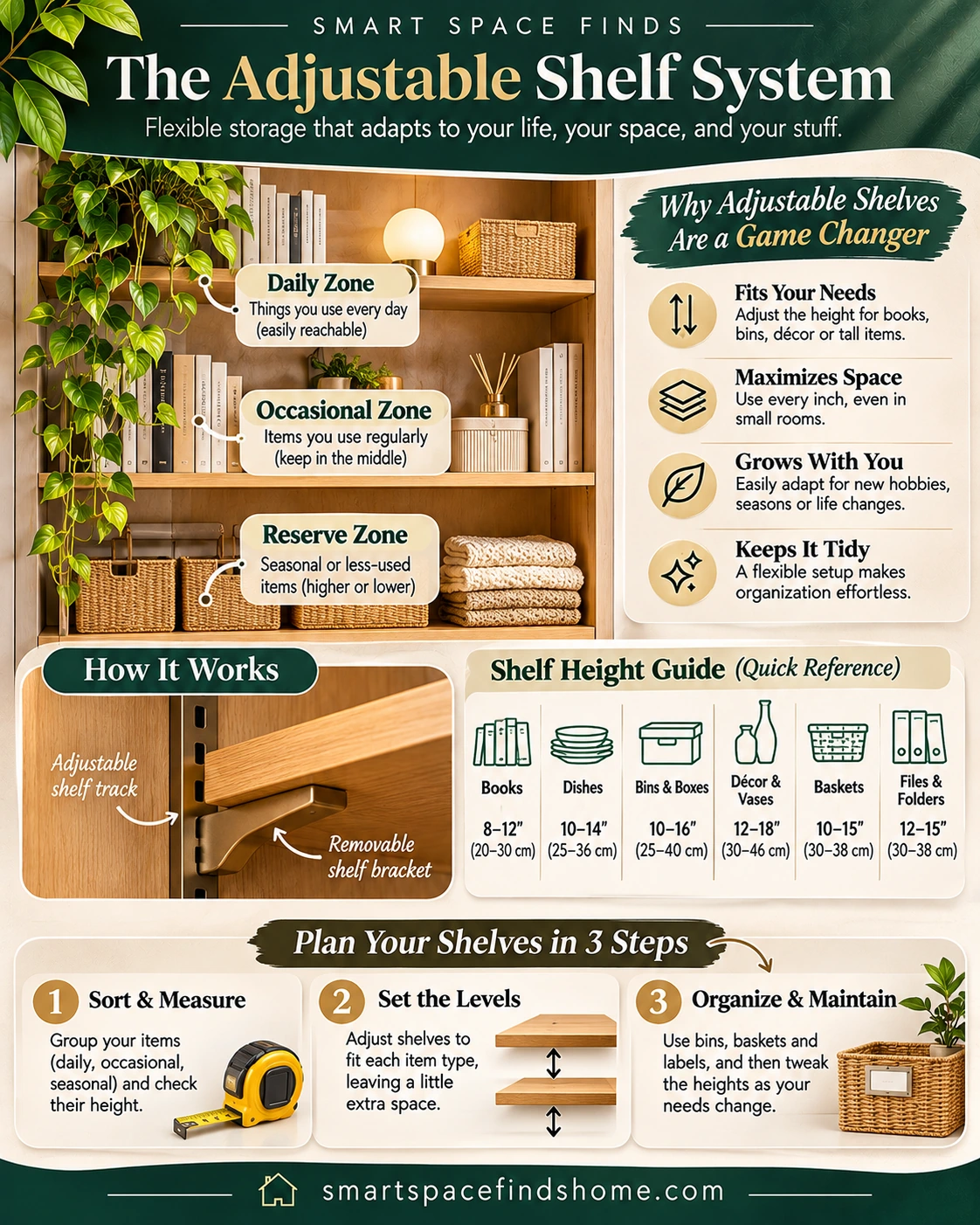
Flexible Shelving and Practical Storage
Choose adjustable systems for changing needs, then group items by frequency of use. Always follow mounting and load-limit guidance.
Adjustable shelf planning for closets and utility storage.
A configurable closet storage system with movable components.
Stackable baskets for sorting clothing and small essentials.
Vertical storage for a larger shoe collection.
Small bins for customizable drawer zones.
Cut-to-fit shelf lining for organizing cabinet surfaces.
Affiliate disclosure: As an Amazon Associate, Smart Space Finds earns from qualifying purchases. Links in this section are affiliate links. Product availability, pricing and variations may change.
4. Clear Visual Contrast Helps You Notice Changes in Floor Level
The hidden benefit: a clearer visual cue about where one walking surface ends and another begins.
In a beautifully neutral interior, a stair edge can blend into the next surface. Light, shadow, flooring patterns, and low-contrast materials can make transitions harder to read. Purposeful contrast at step edges or between adjoining elements can improve visibility, especially when paired with consistent, adequate lighting.
Designing contrast without visual clutter
Think deliberate rather than dramatic: a clearly defined tread edge, a distinguishable handrail, or lighting that reveals rather than obscures the stair geometry. Choose secure, appropriate materials and avoid decorative strips that introduce a trip or slip risk. For a new or altered staircase, defer to applicable codes and qualified professionals.
The standing-and-seated visibility check
Inspect the transition in daylight and after dark, including from the direction people normally approach. Look for glare, shadows, indistinct edges, and uneven illumination. If the stairs are difficult to distinguish, treat this as a genuine safety issue—not a DIY styling challenge.
Safety first: visual contrast is an additional cue, never a substitute for correctly built stairs, suitable slip resistance, sound handrails, and proper lighting.
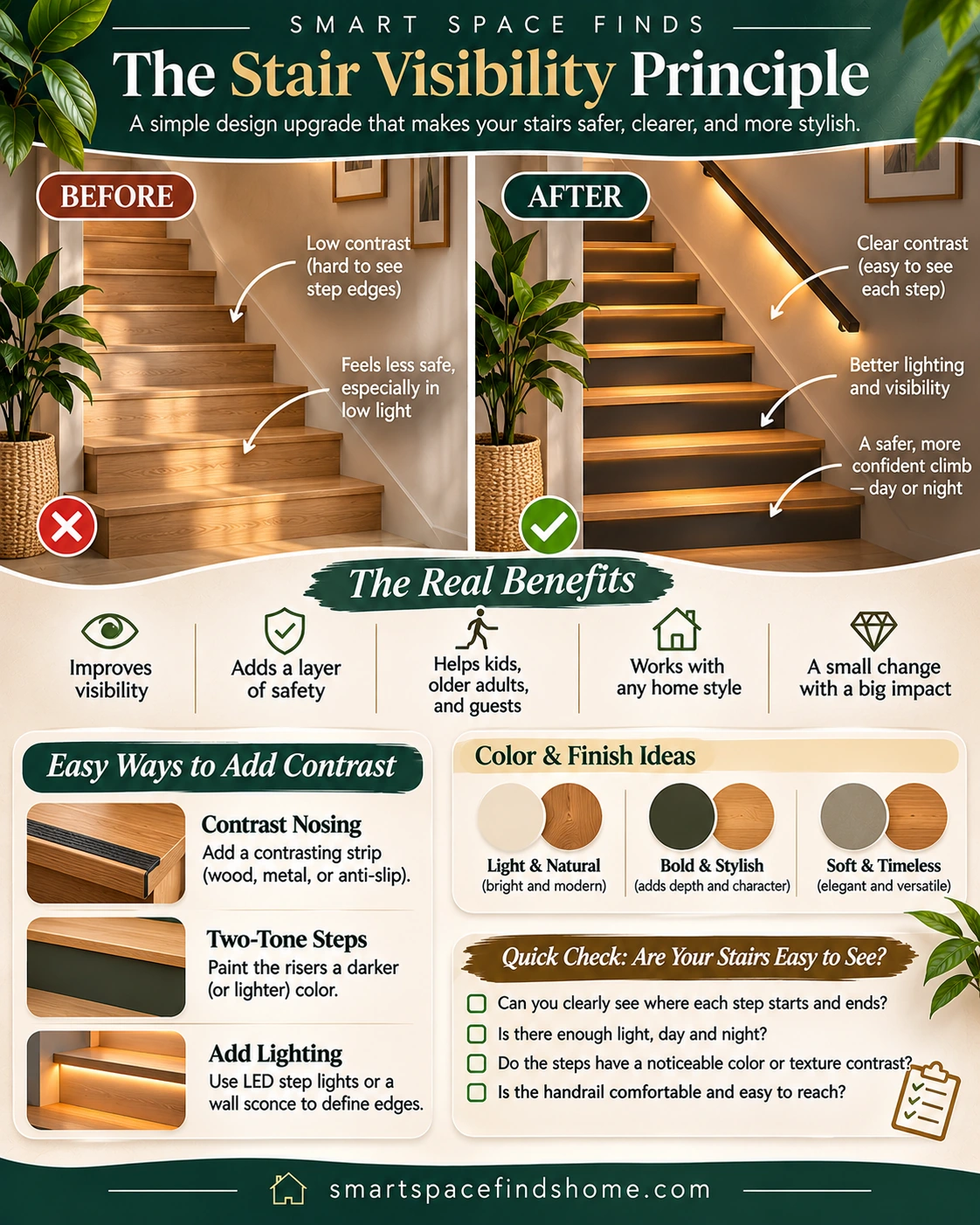
Lighting and Visibility for Stairs and Hallways
These are optional visibility and surface products, not a substitute for safe stair construction, sufficient permanent lighting, secure handrails, or applicable building requirements.
Rechargeable motion-activated auxiliary lighting for suitable indoor spaces; not a replacement for permanent stair lighting.
Rechargeable auxiliary light for a suitable indoor location.
A second auxiliary lighting option with a different form factor.
Low-level guidance lighting for a nearby outlet.
A surface-specific traction option; check compatibility and installation.
Tread-edge treatment with a visual cue; confirm fit and grip.
Textile stair coverings that require a secure, suitable fit.
Affiliate disclosure: As an Amazon Associate, Smart Space Finds earns from qualifying purchases. Links in this section are affiliate links. Product availability, pricing and variations may change.
5. Hooks Within Easy Reach Can Make Tidying More Automatic
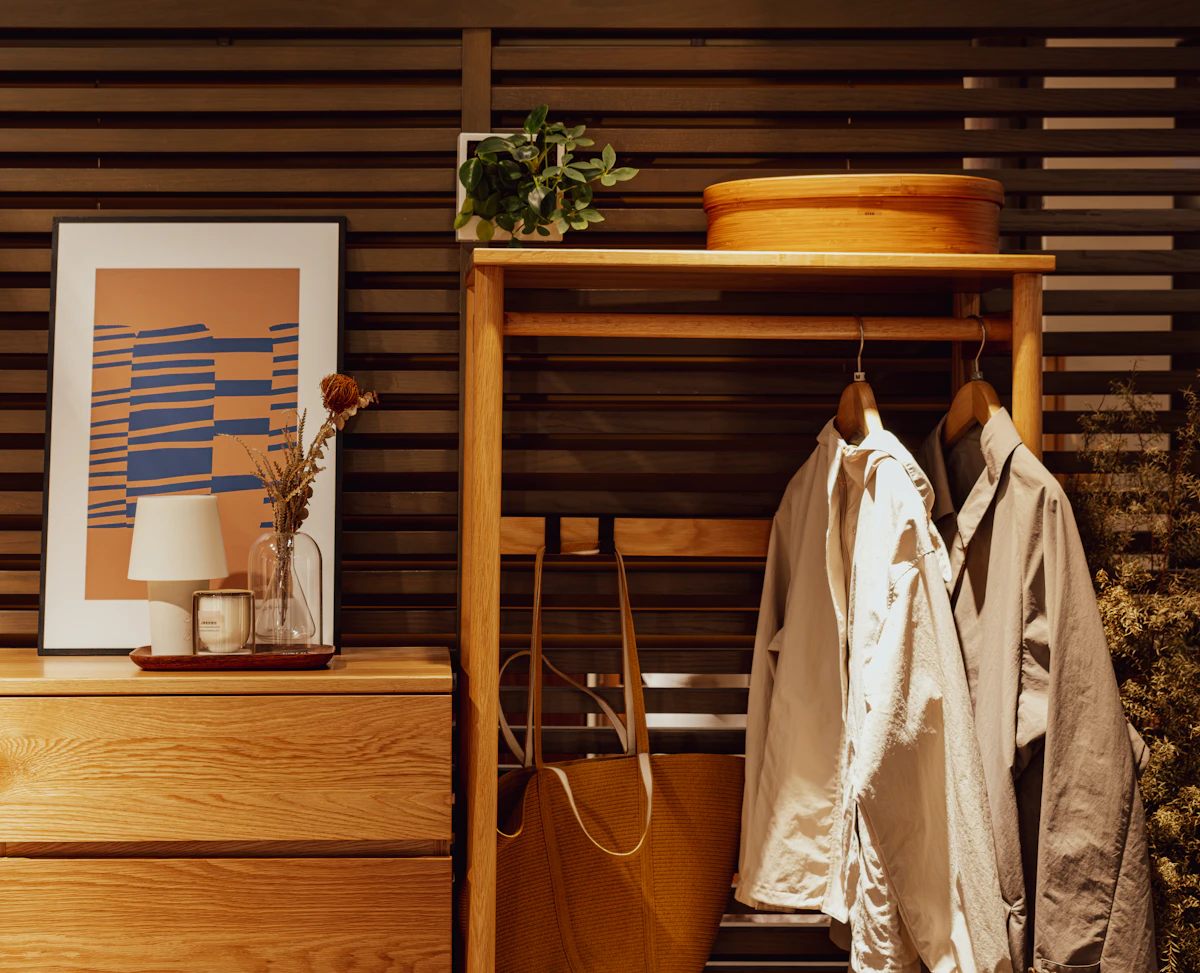
The hidden benefit: putting an object away requires fewer decisions and fewer steps.
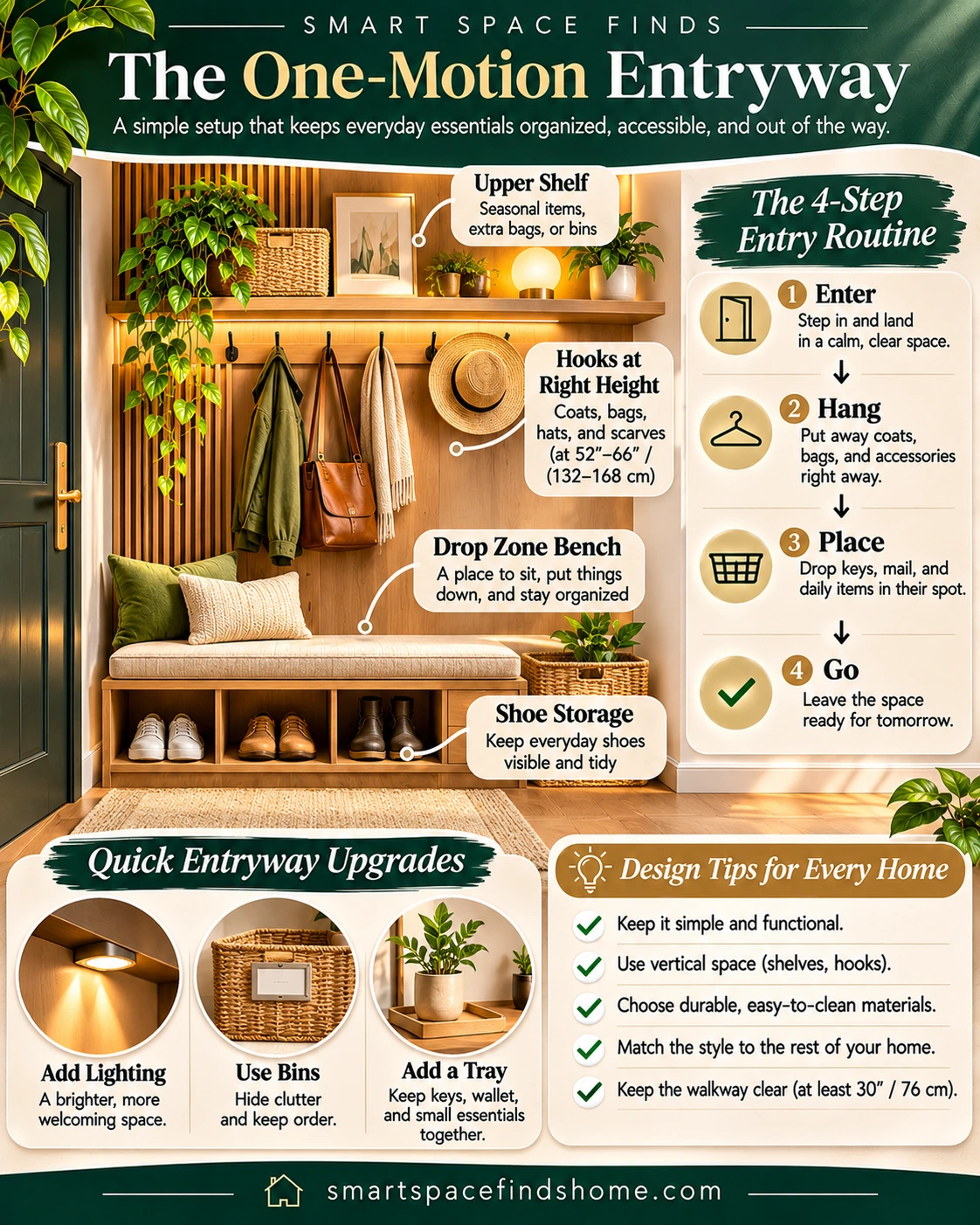
When a coat lands on the sofa every night, the problem may not be motivation. The nearest sensible storage point may simply be too far away. A well-placed hook gives one recurring action a convenient home.
Build a one-motion drop zone
Observe where you naturally stop when entering the home. Place the everyday item—bag, coat, dog leash, or reusable tote—near that point, provided it does not obstruct a door, walkway, electrical equipment, or emergency exit. Match the hook’s load rating and mounting method to the object and wall material.
The seven-day behavior test
Before installing anything permanently, try a suitable removable or freestanding solution in an unobstructed location. Notice whether the item is actually returned there each day. If not, move the storage closer to the action rather than adding more labels or elaborate organizers.
Tradeoff: an overloaded row of hooks quickly becomes visual clutter. Reserve it for true daily-use objects and keep bulk storage elsewhere.
The invisible design checklist
Entryway Hooks That Simplify the Drop Zone
Put bags, keys and outerwear near where they are naturally used. Choose load ratings, door clearance, and wall compatibility carefully.
Adhesive hooks for appropriate lightweight essentials.
Small-item hanging for keys and light accessories.
No-drill hook placements for a compatible door.
A multi-hook solution for hats and lightweight outerwear.
Grouped hanging positions on an interior door.
A warmer wood-finish hook rail for a designated drop zone.
Protective-coated hanging points in a light finish.
A light-finish alternative for door-mounted organization.
A dark-finish over-door hook option.
Affiliate disclosure: As an Amazon Associate, Smart Space Finds earns from qualifying purchases. Links in this section are affiliate links. Product availability, pricing and variations may change.
What does a well-designed room let you stop thinking about?
You stop steering around a sharp corner. You stop tilting your screen to escape glare. You stop rearranging an entire cabinet to reach one item. You stop squinting at an unclear change in floor level. You stop asking where the keys belong.
That is the luxury of functional design: less mental effort devoted to ordinary tasks, with no sacrifice in beauty.
Design by Constraint: Five Questions Before You Spend
The best design upgrade is often the one that respects your home’s limits. Use this decision filter before buying a replacement, installing hardware, or committing to a new finish.
Test movable furniture and reversible storage before drilling or repainting. Check your lease and surface compatibility.
Protect a comfortable route through the space first. Added storage is not an upgrade if it narrows circulation.
Notice differences in reach, height, grip and habits. A solution that works for one person may fail another.
Rearrange, test, reuse and measure first. Buy only when the no-cost experiment reveals a persistent need.
Before and After: Three Small-Space Scenarios
A living room that feels like an obstacle course
Before: a rectangular coffee table sits directly in the path between the sofa and the kitchen. Better: move it away from the route or test a smaller round silhouette. Check: can two household members pass comfortably during a normal evening? Do not assume a curved table solves a fundamentally undersized walkway.
A sunny corner that looks better than it functions
Before: a shiny work surface catches afternoon light at eye level. Better: adjust desk orientation or window shading and compare finish samples. Check: is the actual work task more comfortable at the times the room is used?
An entryway that becomes a daily dumping ground
Before: the bag goes on the dining chair because the closet is across the room. Better: test a hook or compact landing zone at the natural stopping point. Check: after seven days, are bags consistently put away without reminders?
Which Design Detail Should You Fix First?
| Everyday frustration | Try first | Measure success by |
|---|---|---|
| Bumping a table while passing | Reposition or test a rounder footprint | Comfortable, unobstructed movement |
| Annoying window reflections | Move light source or test low-sheen sample | Reduced glare during actual tasks |
| Wasted cabinet height | Reset one adjustable shelf | Items easier to reach and retrieve |
| Hard-to-see stair edge | Evaluate lighting and professional remedies | Consistent, safe visibility |
| Clothes accumulating on chairs | Test one properly placed hook | The item returns there naturally |
Field notes · A test you can actually use
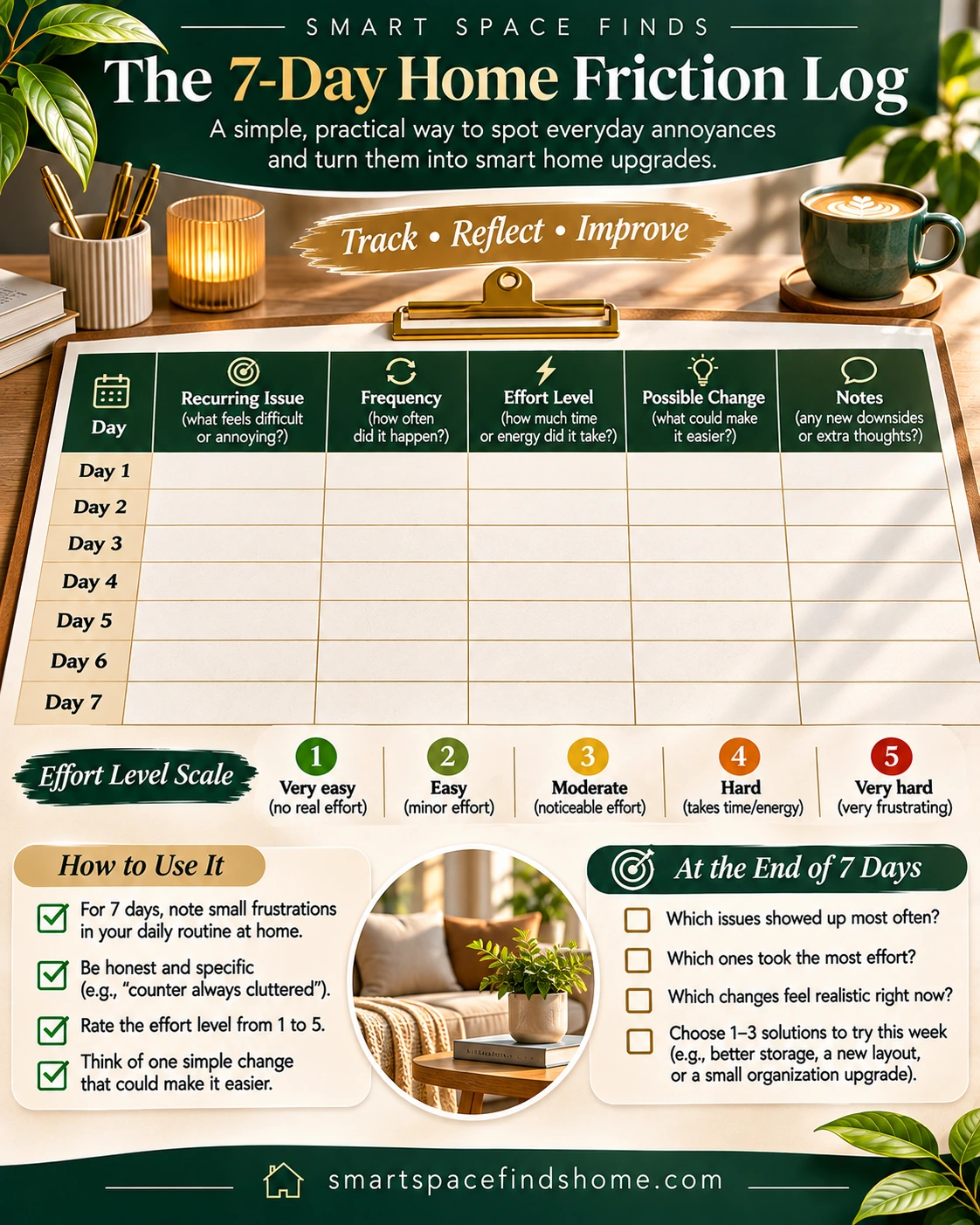
The 7-Day Home Friction Log
A beautiful design idea should make a measurable difference on an ordinary Tuesday. Give your proposed change one week, and compare life before and after.
| Track | Before | After 7 days |
|---|---|---|
| What slows you down? | One sentence | Still happening? |
| How often? | Daily tally | New tally |
| How much effort? | Easy / moderate / difficult | Same scale |
| New downsides? | Existing constraints | Cleaning, clutter, clearance, safety |
The decision rule: Keep the change only if it reduces the original friction without creating a bigger problem. This is a practical household observation—not a scientific experiment or a safety certification.
A 15-Minute Home Design Audit You Can Do Today
- Minutes 0–3 — Notice. Walk through your most-used rooms as you normally would. Identify a repeated collision, reach, reflection, or cleanup problem.
- Minutes 3–6 — Locate. Find the exact point of friction, such as the desk’s reflective edge or the closet’s inaccessible shelf.
- Minutes 6–10 — Test. Move a non-structural item, mark a furniture footprint, group cabinet contents, or try a temporary storage spot.
- Minutes 10–13 — Check constraints. Confirm clearance, secure mounting, load limits, accessibility, and manufacturer instructions.
- Minutes 13–15 — Choose. Keep the change, revise it, or reject it. Write down one measurable improvement to reassess after a week.
Before shopping, try repositioning one piece of furniture, changing one shelf height, testing a different light angle, or relocating an everyday object. If that removes the frustration, the design improvement is already working.
When a Design Idea Is Worth Buying—and When It Isn’t
Not every attractive solution deserves a shopping cart. Evaluate the whole cost of ownership: the amount of floor space it occupies, whether it is easy to clean, whether installation is reversible, and what happens when your routine changes.
Buy / adapt / skip
Buy when a tested layout change solves a recurring inconvenience and the product meets your measurements, maintenance needs, and safety requirements.
Adapt when moving furniture, adjusting a shelf, changing daylight control, or relocating storage provides nearly the same benefit.
Skip when the change only photographs well, blocks movement, demands constant upkeep, or introduces a new risk.
How to Avoid Clever-Looking Design Mistakes
Design advice is most useful when it names a boundary. A rounded edge cannot compensate for a blocked passage. Matte paint cannot repair inadequate lighting. An adjustable shelf cannot exceed its rated load. Contrasting stair details cannot fix defective stairs. And a hook that blocks a door is not convenient storage.
Use the three-part filter: observable benefit, realistic installation, and no new hazard. Choose changes based on the room’s actual users, including children, guests, and anyone with mobility or vision considerations.
Frequently Asked Questions
What is the most useful small design change for a tiny apartment?
Start with the single most frequent obstacle. For many compact homes, improving circulation around furniture or making everyday storage easier to reach delivers more value than adding another decorative item.
Are rounded furniture corners safer?
They can be more forgiving during minor bumps than sharp edges, but safety depends on the whole product and setting. They do not prevent falls, tipping, or injuries.
Is a matte finish always better than a glossy finish?
No. Matte finishes may reduce some distracting reflections, while glossy finishes can be desirable for other aesthetic or cleaning needs. Compare samples in the actual light and follow product care guidance.
How do I make existing shelves more practical?
Group items by frequency and height, reposition adjustable shelves within the manufacturer’s design, and place frequently used objects where they are comfortably accessible. Never improvise overloaded or unsupported shelves.
Can paint or tape make stairs safe?
Visual cues can improve the visibility of a level change, but appearance alone cannot establish safety. Stair geometry, secure surfaces, lighting, handrails, and code-compliant construction must all be considered.
How can I make home organization easier without buying more bins?
Put storage closer to where an action happens, make frequently used objects accessible, and remove unnecessary steps. Test that placement for a week before purchasing hardware.
The Final Edit: Design for the Moments Between the Photos
Beautiful rooms deserve to work beautifully, too. The most enduring design details are often modest: a table you can comfortably pass, a surface that does not distract, a shelf that adapts, a transition you can clearly see, and a hook that meets you where you already are.
Choose one recurring friction point this week. Test one thoughtful change. Keep only what makes life easier.