
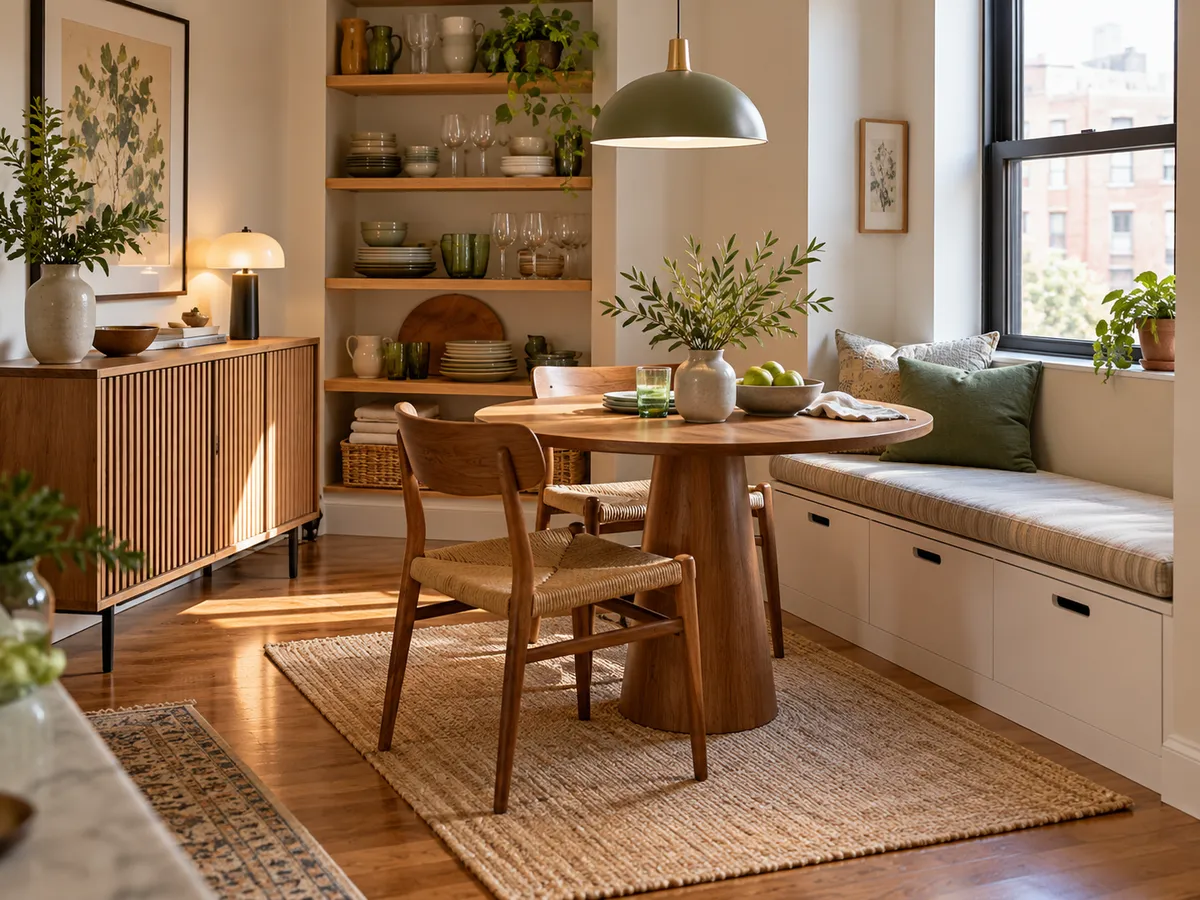
The definitive practical field guide
Compact dining storage should create room to live, not just room to store. This guide helps you measure a tight dining area, choose between slim sideboards, narrow cabinets, storage benches and bar carts, and organize every dish without blocking the chairs.
Designed for U.S. apartments, studios, breakfast nooks and combined living–dining rooms. You’ll find illustrative dimensions, room layouts, safety considerations, side-by-side comparisons and a buying checklist you can use before spending a dollar.
Measure the dining zone before you buy anything
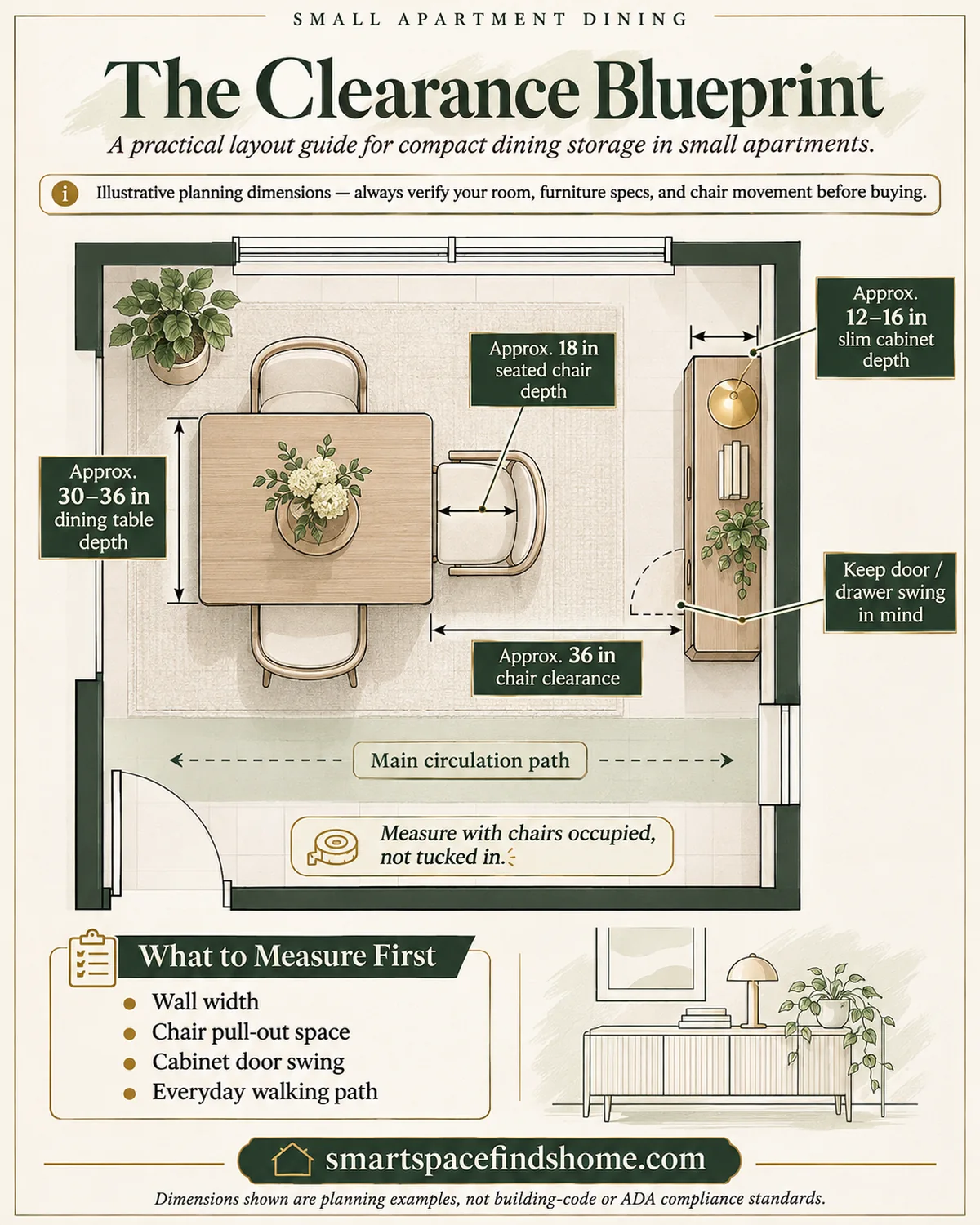
The best compact dining storage is the piece you can actually use when people are sitting down. A room that accommodates a cabinet with the chairs tucked in may become frustrating once a chair is pulled out, a drawer opens, or two people move through at the same time.
- Record the wall. Measure available width, baseboards, outlets, heat registers and window height. Note if the wall is uneven.
- Map the occupied table. Pull out every chair as though someone were eating. Mark their occupied footprint on the floor using painter’s tape.
- Test the route. Walk from kitchen to table carrying a serving plate. Check doorway swings and any route used frequently.
- Add opening space. Tape out the cabinet’s depth including open doors and fully extended drawers.
- Measure the objects. Note the diameter of your largest plates, tallest glasses and width of oversize platters; compare these to usable interior dimensions, not just the product’s exterior.
The Clearance Rule
As a useful starting point, plan for approximately 36 inches behind a dining chair where circulation needs to remain comfortable; busier or accessible routes may require more. This is a planning heuristic, not a universal building-code or ADA compliance rule. The real test is your actual chair, user needs and path of travel.
Small-room formula: usable wall-to-table distance minus occupied-chair depth minus desired walking clearance equals the maximum storage depth for that location. If the result is negative, do not force a sideboard into the plan: use an existing cabinet, another wall or lightweight movable storage instead.
Compact dining storage dimensions: a practical comparison
Listings often say “narrow” or “small-space,” but those labels have no standard dimension. Use the ranges below only for initial screening, then verify the exact product specification and door clearance.
| Storage type | Screening dimensions | Ideal contents | Common compromise |
|---|---|---|---|
| Extra-shallow cabinet | 8–12 in deep | Napkins, mugs, shallow dishes | Full-size dinner plates may not fit |
| Slim sideboard | 12–16 in deep | Everyday tableware, linens | Doors need additional opening room |
| Compact buffet | 14–18 in deep | Serving bowls, larger dishes | Footprint can dominate a narrow nook |
| Small bar cart | Approx. 12–18 in deep | Trays, napkins, bottles | Wheel movement and visual clutter |
| Storage bench | Depends on seating plan | Infrequent linens and place settings | Opening lid may require people to move |
| In-cabinet organizers | Match inside shelf | Plates, cups and flatware | Needs existing sound cabinetry |
Important: cabinet width and depth alone never establish fit. Verify interior shelf depth, shelf height, hinges, handle projections, load limits, overall height and delivery-path dimensions. When stacking items, use the manufacturer’s supported weight capacity—not a guess.
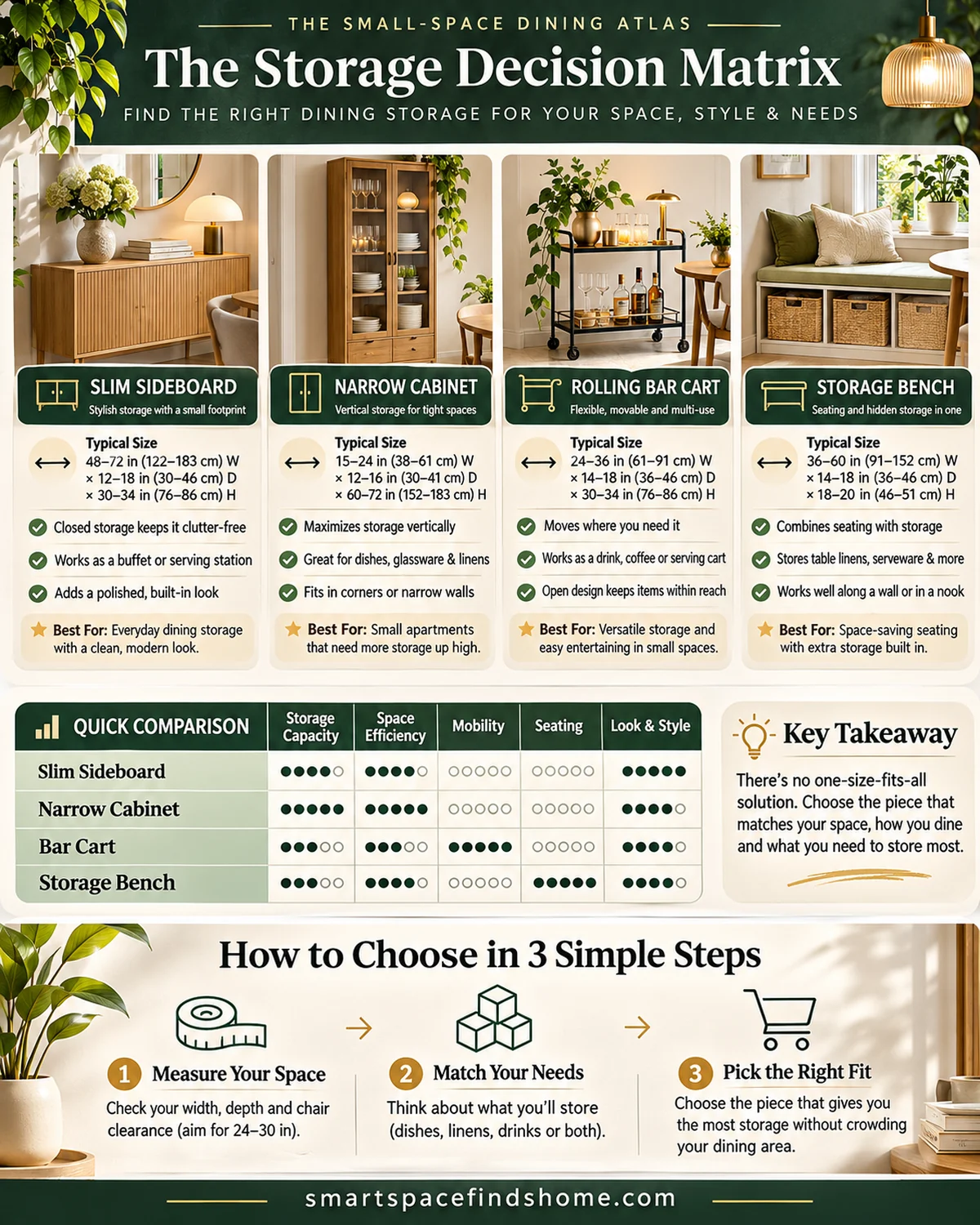
Which storage piece actually fits your apartment?
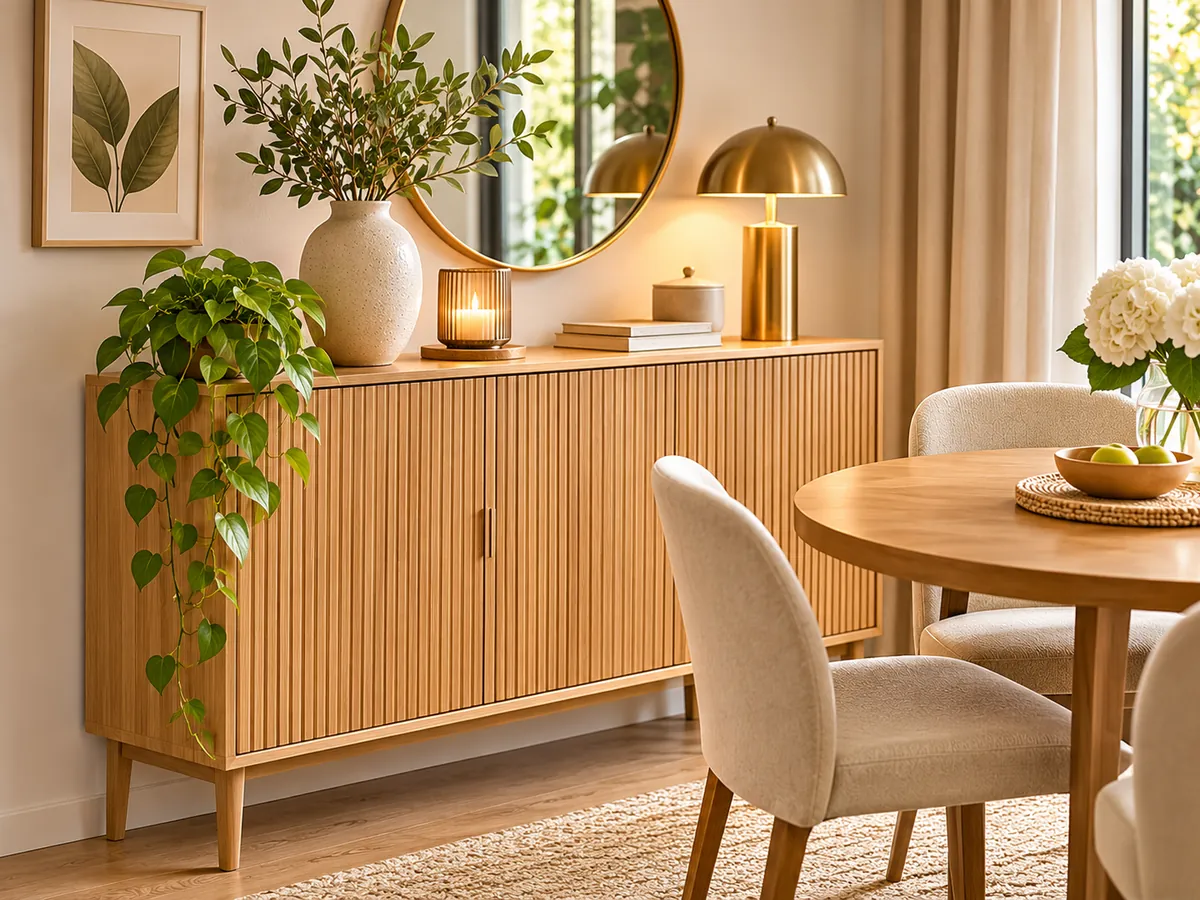
Closed slim sideboard
Best when: dishes and mismatched packaging need to disappear. Choose adjustable shelves and solid cabinet construction. Measure both swing clearance and the route behind occupied chairs.
Narrow freestanding cabinet
Best when: you have one short wall or an awkward corner. Prioritize low or well-anchored furniture rather than an unstable tall tower.
Lockable-wheel bar cart
Best when: entertaining is occasional and the cart can park outside a walkway. Keep heavier pieces low and lock wheels whenever parked.
Bench with a hidden compartment
Best when: seating is required anyway. Reserve the compartment for infrequent dry linens, not things needed halfway through dinner.
Drawer and shelf organizers
Best when: you have enough cabinetry but poor organization. Shelf risers, plate stands and drawer trays often outperform adding another piece of furniture.
Wall shelves, only where appropriate
Best when: installation is permitted and hardware is rated for the wall and load. Never trust adhesive shelves with heavy dishes or glassware.
Editorial verdict: if storage will be visible from your sofa, one calm, closed cabinet usually creates a cleaner visual impression than three exposed organizers. But if chair clearance is tight, skip the cabinet and improve the storage you already own.
Organize dishes, linens and serving pieces by how often you use them
A dining cupboard should function like a small, intuitive service station. Frequency is a better organizing principle than color, trend or matching baskets.
| Zone | Contents | Where to place them | What to avoid |
|---|---|---|---|
| Everyday | Plates, bowls, glasses, napkins | Easy-reach, stable shelves | Deep stacks and fragile overhead storage |
| Serving | Platters, trays, pitchers | Lower or middle shelves with proper support | Balancing large ceramics upright unsecured |
| Occasional | Extra place settings, holiday linens | Less prominent but dry and accessible storage | Buying a large cabinet for rarely used items |
| Portable | Coasters, condiments, placemats | One washable meal caddy | Leaving supplies permanently on the dining table |
Use vertical space without creating unstable piles
One shelf riser can separate stacks of plates from lightweight bowls, provided the base is nonslip and the loaded unit stays within its rated capacity. For platters, only use a purpose-built divider that fully supports their weight and shape. Stand fragile glassware on a level surface where it cannot fall during normal cabinet use.
Build the five-minute reset into the design
Give each item a specific return location. Keep a clear tabletop except for one easy-to-remove centerpiece, and use a portable tray for everyday meal accessories. If a cabinet requires unloading three other objects to put one plate away, the layout is not finished.
Five compact dining layouts and what works in each
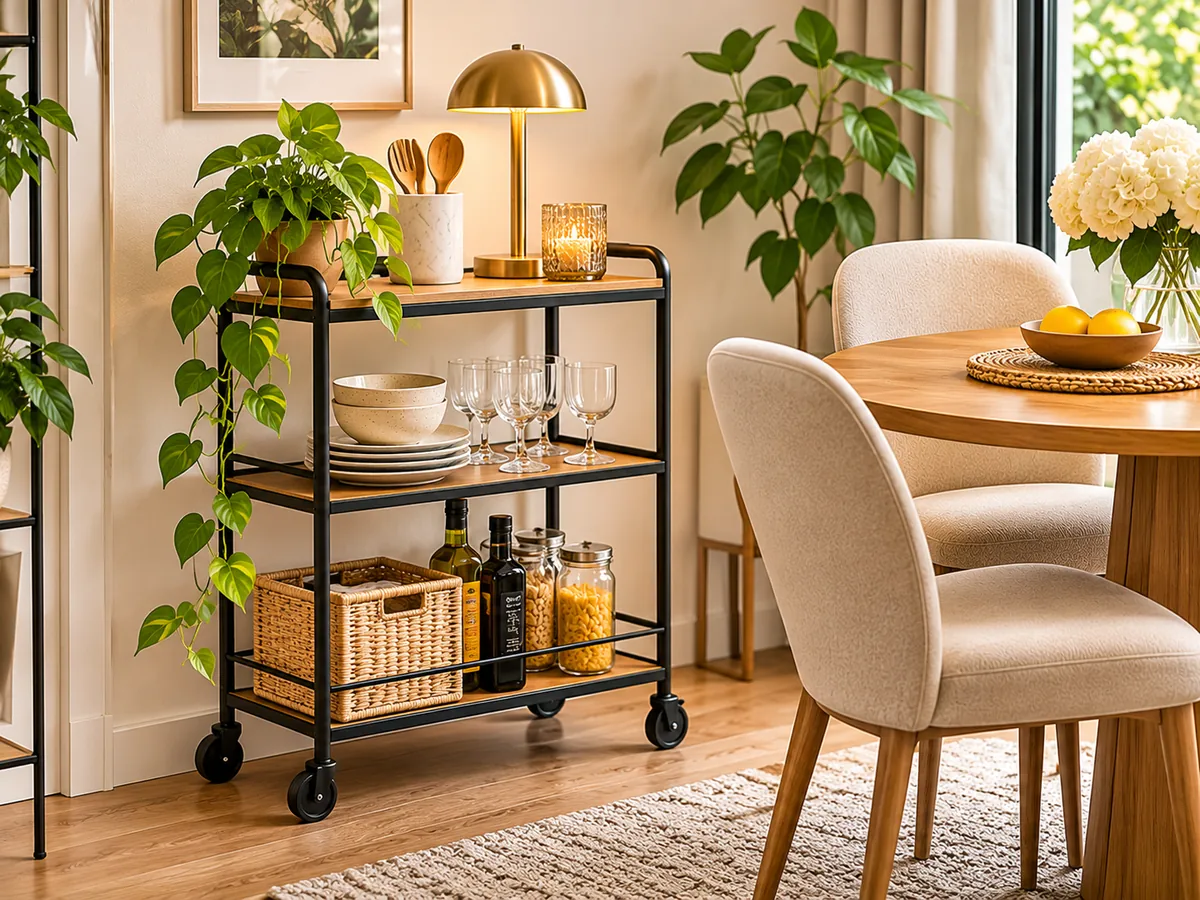
1. Dining table beside the living-room sofa
Choose a closed, furniture-like piece with a finish that relates to the media console or coffee table. Keep tabletop decorations minimal and avoid tall shelving that creates a wall between the two functions. A low sideboard may visually connect both zones.
2. Two-person dining nook against a wall
Measure the chair path first. If a cabinet crowds the aisle, mount lightweight organizers only when permitted or place linens in an existing kitchen drawer. The smallest piece is often no additional piece.
3. Galley kitchen with an eat-in corner
Do not compete with kitchen-door swings or appliance-clearance requirements. A shallow end-wall cabinet might work, but shelf risers in existing kitchen storage are often more useful than a trolley blocking the work triangle.
4. Studio apartment with a fold-down table
Test the table fully extended and folded. Store leaves, chairs and placemats away from hinges and moving mechanisms. A compact cart may be useful if it has a permanent parking spot, rather than sitting in the deployment zone.
5. Shared dining-and-work table
Create two kits: one slim work caddy for chargers and paper, and one wipeable meal caddy for coasters and napkins. Switching functions should require only a few deliberate moves. Don’t let the cabinet become an office overflow bin.
Renter-friendly dining storage without unsafe shortcuts
“No drilling” is a preference, not a reason to ignore stability. Freestanding furniture can be suitable for rentals, but some tall or top-heavy items require wall anchoring. Follow the manufacturer’s anti-tip instructions; if your lease prohibits the required installation, choose a different product rather than using an improvised adhesive substitute.
- Prefer reversible organizers: shelf inserts, drawer dividers, trays and freestanding low cabinets.
- Protect floors: check furniture feet for felt or protective pads suitable for your floor type.
- Plan for moving: check assembled weight, staircase access and whether the product can be safely disassembled.
- Be realistic about adhesive systems: use only for lightweight items within the adhesive manufacturer’s specified load and surface limits.
- Ask before drilling: landlord rules, wall materials, hidden utilities and fastener requirements vary.
For more reversible small-apartment ideas, see our renter-friendly shelf styling guide.
Where to spend—and where not to
Price does not automatically indicate useful capacity. Think in tiers of need rather than shopping by an arbitrary dollar threshold.
No-furniture refresh
Declutter duplicate serveware, consolidate linens, use an existing shelf and add only the dividers that solve a specific problem. The highest-value first step is often measuring, not buying.
Small organizer investment
Add a tray, properly sized drawer organizer or rated riser after checking internal shelf measurements. Buy one solution, use it for a week, then reassess.
One anchor piece
Choose a shallow cabinet with good hardware, supported shelves and a useful interior. Compare delivery, return and assembly terms—not simply the product photo.
Flexible entertaining setup
Consider a stable, lockable-wheel cart only if it serves meals and parks cleanly. Avoid buying a trendy bar cart solely as a decorative surface.
Value test: would the proposed product replace two existing clutter points, protect chair clearance and be easy to put away after dinner? If not, reconsider the purchase.
The 12-point compact dining storage buying checklist
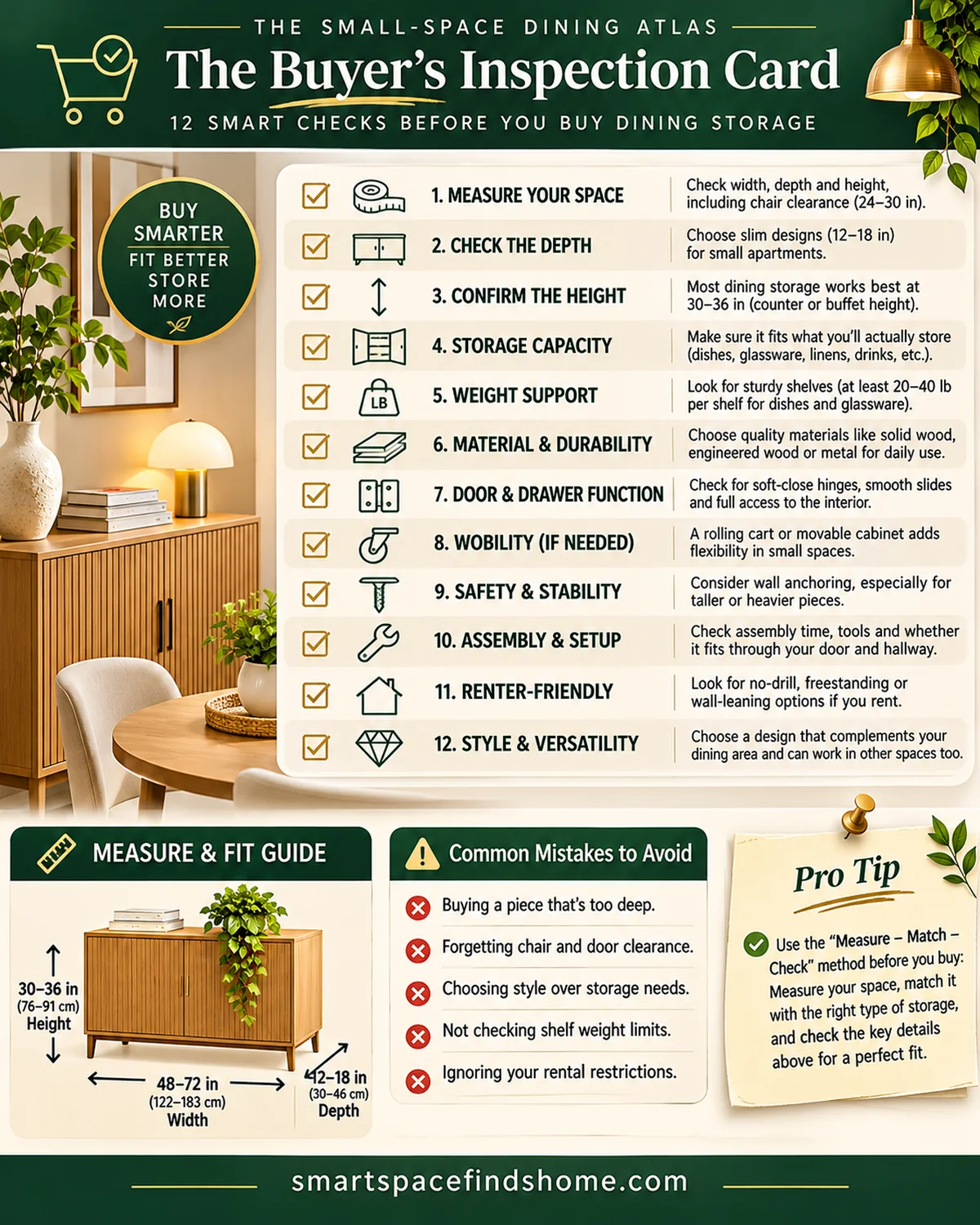
- Exterior width and depth: confirm the exact assembled footprint.
- Interior usable depth: make sure your largest dishes really fit.
- Open-door space: check drawers, hinges and handles.
- Seat circulation: test clearance with chairs occupied.
- Shelf load rating: verify weight capacity for actual dish stacks.
- Tip resistance: follow the installation and anchoring instructions.
- Material suitability: consider moisture, cleaning and wear resistance.
- Assembly effort: verify tools, time, assistance and accessible instructions.
- Adjustability: removable or adjustable shelves may add real flexibility.
- Delivery path: confirm doors, elevators, stair turns and packaging size.
- Returns and replacement parts: review seller and manufacturer policies.
- Exact configuration: verify finish, color, dimensions and included hardware rather than relying on a listing’s default photo.
A note on product recommendations
We don’t label a product “tested,” “verified” or “best overall” without the evidence to support that claim. The shopping picks above are linked to specific Amazon US variants after redirect and listing checks. Prices and stock can change without notice, so recheck the chosen finish, dimensions and current seller before ordering. We prioritize suitability and safety over unsupported product rankings.
Nine mistakes that make small dining rooms feel smaller
- Buying a sideboard before pulling out the chairs.
- Using exterior cabinet depth as if it were usable interior depth.
- Picking open shelving for every mixed household item.
- Stacking heavy serving dishes above eye level.
- Buying a wheeled cart that has no safe parking place.
- Using adhesive fittings for heavy dishes or glassware.
- Ignoring wall-anchoring instructions on tall furniture.
- Filling the dining tabletop with permanent decor and trays.
- Buying matching organizers before reducing duplicate tableware.
The recurring pattern is simple: storage should make movement and everyday use easier, not just create an attractive still-life for a photo.
How to make dining storage look intentional, not improvised
A small apartment benefits from visual continuity. Choose one dominant material already present in the space—light oak, walnut, painted ivory or charcoal—and repeat it carefully. Keep hardware unobtrusive, maintain a few inches of breathing room around the piece where possible, and choose a cabinet height that respects nearby windows and sight lines.
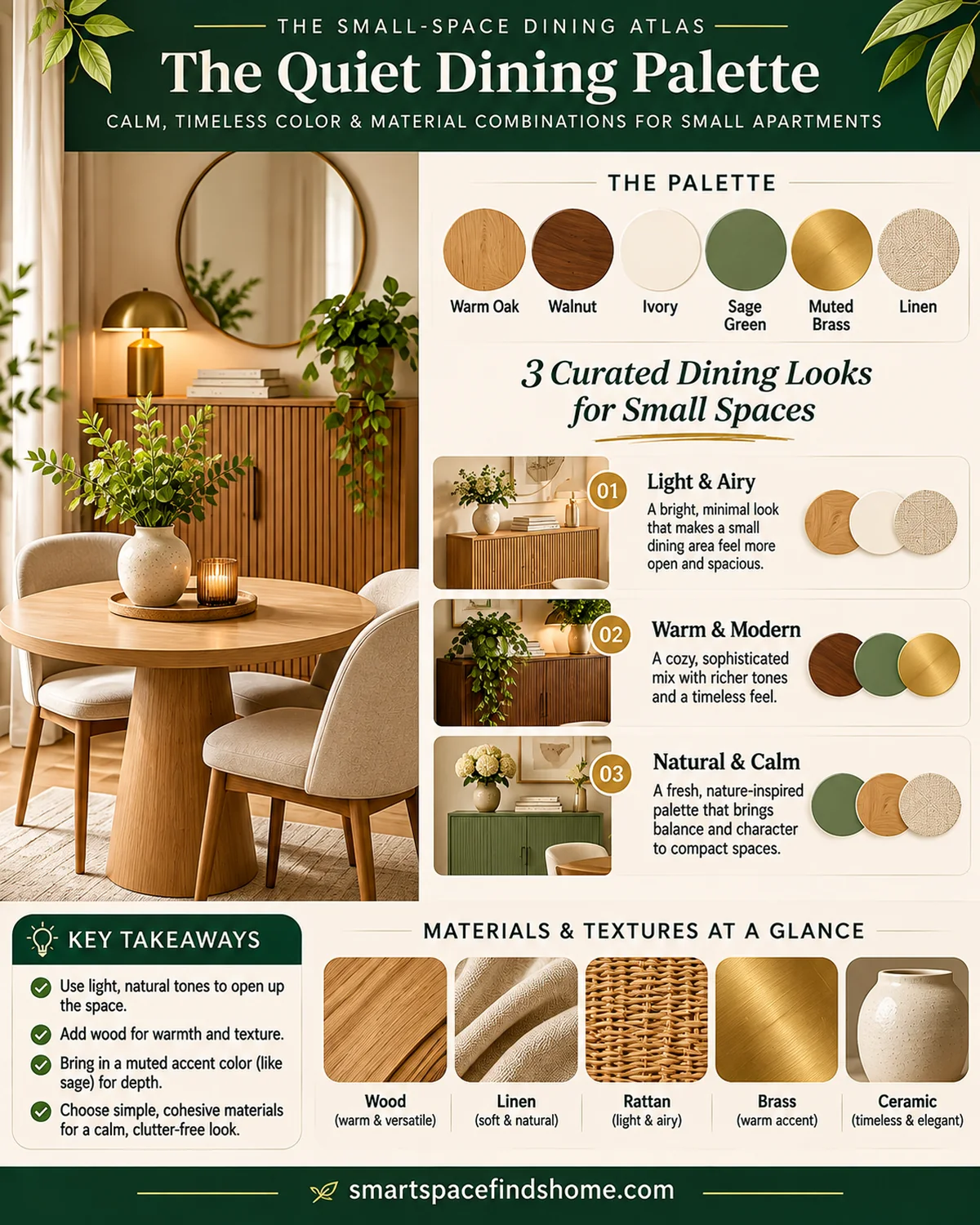
The 70 / 20 / 10 styling edit
As a simple visual planning device rather than a design law, try approximately 70% calm surfaces, 20% useful objects and 10% decorative accents across the visible dining-storage composition. The goal is not a precise ratio but an uncluttered focal point.
Make the cabinet work from two directions
If the dining zone opens into the living room, look at the cabinet both from the dining chair and from the sofa. Closed doors can conceal practical pieces; a single tray or bowl can give the top a sense of intention without consuming serving space.
For adjacent rooms, explore our guides to small living room storage and compact breakfast stations.
The 30-minute dining storage audit
If you need an immediate improvement, begin with this no-purchase test before researching furniture.
- Minutes 0–5: remove non-dining items from the tabletop and collect scattered dining supplies.
- Minutes 5–10: sort everyday dishes from rare-use items; note chipped items that need safe disposal or replacement.
- Minutes 10–15: count table linens and identify duplicate trays or platters.
- Minutes 15–20: measure clearances with dining chairs pulled out.
- Minutes 20–25: photograph your usable shelves and note their interior dimensions.
- Minutes 25–30: choose one storage intervention—declutter, reorganize, add an insert or shortlist a properly sized cabinet.
Review the result after a week of actual meals. If the table stays clear and dishes return to their locations easily, the design is working. If not, identify the one repeated friction point before buying anything else.
Frequently asked questions about small dining storage
How deep should a narrow dining sideboard be?
Many compact models are advertised around 12–16 inches deep, but there is no universally correct depth. Measure the area with chairs occupied and verify the product’s internal measurements before buying.
Can a 12-inch-deep cabinet hold dinner plates?
Sometimes. Plate diameter, cabinet back and door thickness, hinge placement and usable shelf depth all matter. Do not assume that a nominal 12-inch exterior depth means a 12-inch plate will fit.
What is the best storage for a studio apartment dining table?
Start with existing drawers and a portable meal caddy. If you need more space, a shallow cabinet or lockable-wheel cart can work when it does not obstruct a folding table, chair movement or walking route.
Is a buffet or bar cart better for a small room?
A closed buffet conceals dishes and linens more effectively. A cart is easier to move and useful for occasional serving. The better choice depends on contents, cart parking space and circulation.
Where should rarely used guest dishes go?
Place them on a secure, lower-priority shelf or in a separate stable cupboard, reserving easy-reach dining storage for everyday items.
How do I store serving platters without stacking them?
Use a stable, correctly sized divider rated to hold the items, or store them flat on a supported shelf. Avoid unsecured vertical stacks of heavy ceramics.
Is wall-mounted dining storage renter-friendly?
It can be with landlord approval and correct wall-specific hardware. Adhesive products should not be treated as a substitute for a properly rated shelf carrying heavy dishes.
What if a sideboard blocks a dining chair?
Do not squeeze it into place. Reduce cabinet depth, move storage to another wall or reorganize existing shelves. Comfortable chair movement takes priority over adding storage capacity.
How do I organize a dining table used as a desk?
Keep one portable kit for work supplies and another for meals. Store each kit off the table between uses so the tabletop has a clear reset point.
Can I use a storage bench instead of a sideboard?
Yes, if the bench provides safe, comfortable seating and its compartment opens without moving people or blocking circulation. It is best for infrequently used lightweight textiles.
Buy less. Measure better. Make every inch earn its place.
The strongest small dining room is not the one with the most cabinets. It is the one where your chairs move easily, dishes have a logical home, and the table is ready for meals. Start with circulation, assign storage zones, and buy furniture only for a confirmed need.
Editorial transparency: dimensions in this article are planning examples, not product-specific claims or accessibility specifications. Furniture should be installed and loaded according to its manufacturer’s instructions. No furniture in this guide is represented as hands-on tested.
More useful reading: multifunctional furniture for studio apartments · one-wall kitchen storage · small kitchen countertop organizers.