
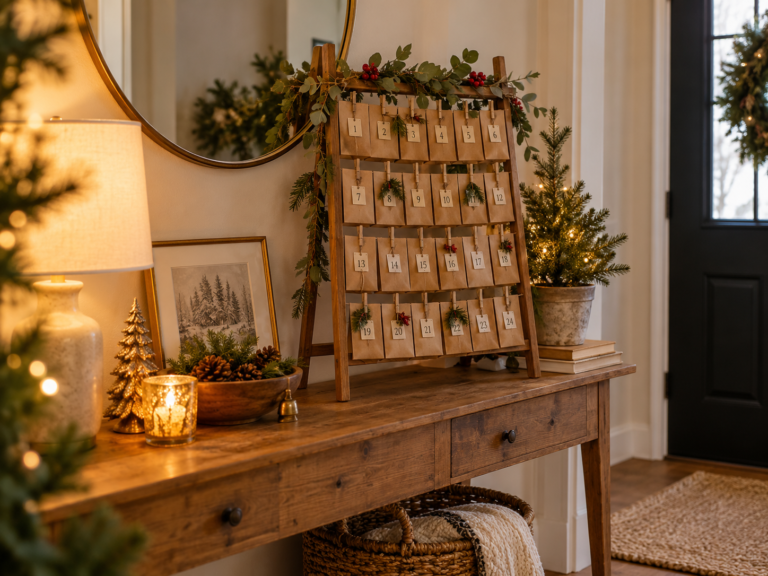
SMALL-SPACE CHRISTMAS · THE EDITORIAL GUIDE
No fireplace mantel? No problem. A beautiful Advent calendar can live on a narrow wall, a closet door, a refrigerator, a bookshelf—or inside one little box. The secret is to design around the space you already have, not to make room for another oversized decoration.
This practical guide brings together 12 Advent calendar display ideas for small spaces without a mantel, plus renter-friendly setup tips, a comparison chart, a simple DIY project, size-planning advice, color palettes and 24 low-clutter fillers. Whether you live in a studio apartment or simply want a more intentional holiday display, you can keep the daily countdown delightful without sacrificing usable space.
Where can you put an Advent calendar without a mantel?
Try a narrow wall banner, a framed envelope board, an interior door organizer, magnetic refrigerator envelopes, two small shelf baskets or a compact tabletop card box. For renters, start with an existing shelf, hook or door and use only appropriately rated, surface-compatible mounting products.
12 display ideasNo-mantel solutionsLow-clutter DIY
Choose your display · 12 display ideas · Easy DIY tutorial · 24 fillers · Frequently asked questions
Affiliate disclosure: As an Amazon Associate, Smart Space Finds earns from qualifying purchases. Some product links in this guide are affiliate links, at no additional cost to you.
Choose the right Advent calendar for your space
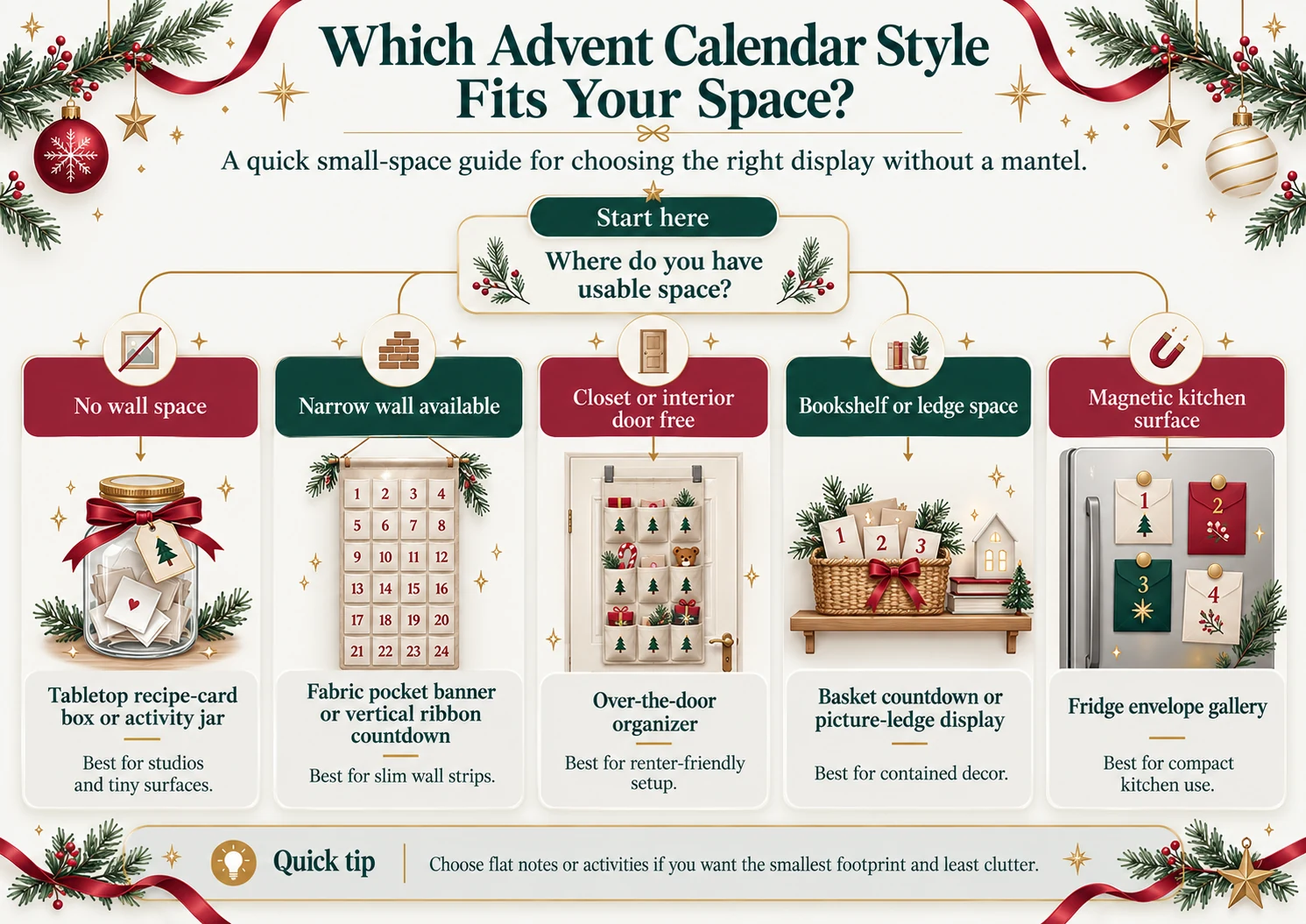
Start with two questions: what will each of the 24 days contain, and which surface can you comfortably access each morning? Flat notes suit slim wall and door displays; small wrapped gifts call for stronger support and greater depth. The table below is a planning guide, not a substitute for checking the dimensions and load limits of a specific product.
| Display | Best for | Typical contents | Installation |
|---|---|---|---|
| Fabric pocket banner | Narrow wall | Notes, tiny treats | Suitable hook or existing rail |
| Framed envelope grid | Blank wall or dresser | Flat cards | Supported frame |
| Recipe-card box | Very small studio | Activity prompts | No hanging |
| Over-door organizer | Closet door | Lightweight parcels | Door-compatible hanger |
| Magnetic gallery | Magnetic refrigerator | Envelopes | Magnets; adult supervision as needed |
| Bookshelf baskets | Existing shelving | Notes and wrapped treats | No wall installation |
Choose a narrow vertical wall or door display.
Use a card box, jar, or stable bookshelf basket.
Select fabric pockets, paper envelopes, or ribbons.
Choose a tested, stable container rather than overloading wall hooks.
12 beautiful Advent calendar display ideas without a mantel
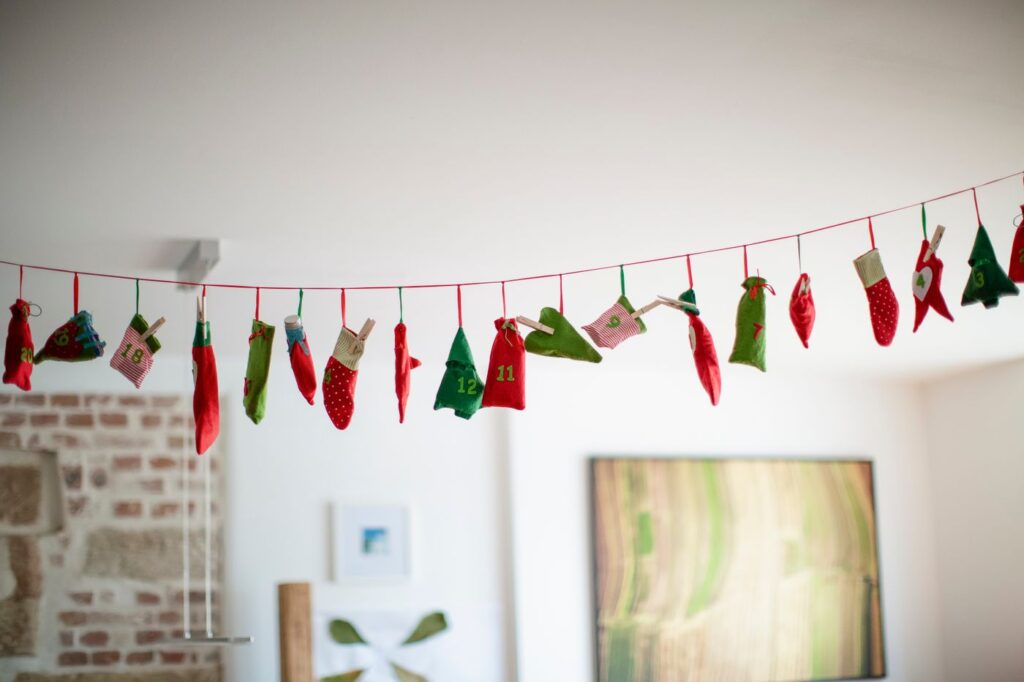
These ideas range from barely-there paper displays to more decorative reusable pieces. Each works best when the installation is safe, the numbers are readable and your daily routine remains convenient.
Slim fabric pocket banner
BEST FOR: Narrow walls and reusable decor
Choose a hanging calendar with shallow numbered pockets. In a narrow entry or bedroom, a tall format often works better than a broad 24-pocket rectangle. Measure the actual height from hook to tassel, plus the depth of its filled pockets. Keep the heaviest contents in lower pockets only if the whole installation is safely anchored, and do not let children tug on the banner. Cotton canvas or linen in a neutral shade folds almost flat after Christmas.
Framed envelope grid

BEST FOR: Flat gifts and a polished wall display
Reuse a frame or shallow memo board and arrange 24 matching mini envelopes in a four-by-six grid. Mark their positions in pencil on removable backing paper before attaching anything. The frame should be sufficiently supported for its weight, and envelope removal should not shift the entire arrangement. Choose legible numerals and leave a small margin between rows so each day can be opened independently.
Tabletop recipe-card box
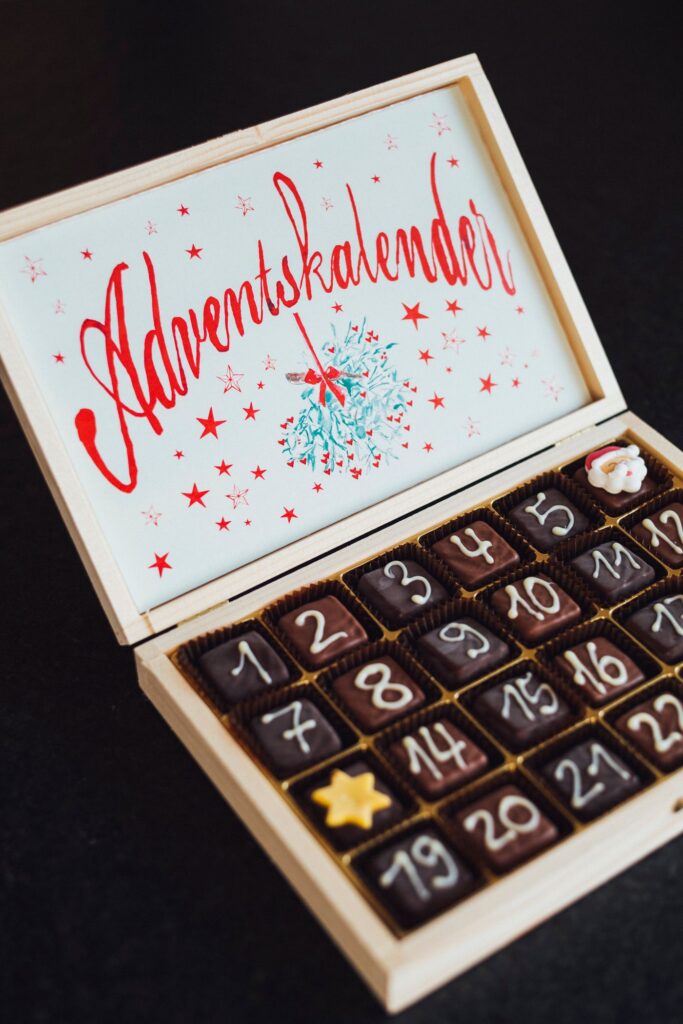
BEST FOR: Studios with no available wall space
Place 24 numbered cards upright in a compact recipe-card box on a dresser, side table, or bookshelf. A few inches of depth can be enough when the surprises are messages rather than objects. Move each used card to the back so the next day remains visible. Avoid cooking and sink zones, which expose paper to grease and moisture.
Single vertical ribbon countdown
BEST FOR: Very narrow wall strips
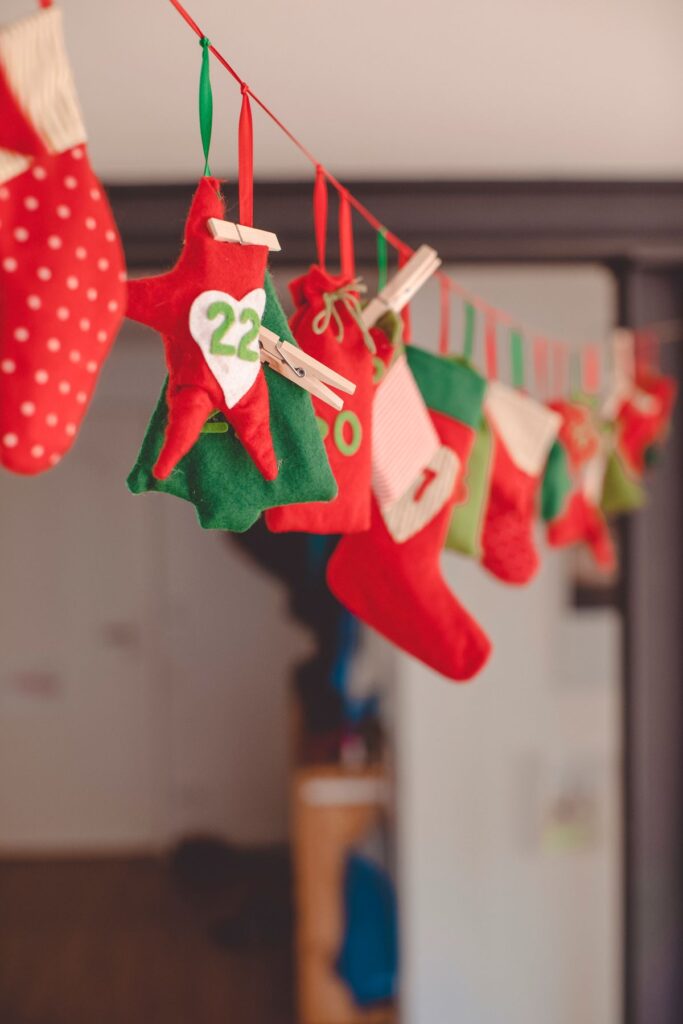
Suspend a sturdy length of grosgrain ribbon from an appropriate wall hook and attach flat envelopes with small clips. A single ribbon minimizes horizontal spread, but make sure the pieces do not overlap so heavily that the numbers become difficult to find. Test the filled weight and keep ribbons and cords away from young children and pets.
Over-the-door pocket organizer
BEST FOR: Closet and bedroom doors
A slim fabric organizer lets a closet door do double duty. Check the top clearance and door swing before committing; some over-door hooks prevent doors from closing and can scratch painted frames. Make sure no pouch catches the handle or hits the wall. Use flat notes or wrapped lightweight treats instead of bulky parcels.
Bookshelf basket countdown
BEST FOR: Homes with existing open shelves
Put envelopes 1–12 in one small basket and 13–24 in another, then position both on a stable, accessible shelf. This keeps the Advent display contained and avoids introducing another piece of furniture. Leave room to lift envelopes out without moving books and protect the shelf from any leaking treats.
Magnetic refrigerator gallery
BEST FOR: Kitchens with a magnetic metal surface
If your refrigerator door is magnetic, use 24 small paper envelopes held with appropriately strong magnets. First check that magnets attach securely to the actual appliance surface; some stainless-steel fronts are nonmagnetic. Keep items clear of handles, seals, and frequently gripped edges. Small loose magnets can be hazardous if swallowed, so this is an adults-only setup where young children have access.
Existing peg rail display
BEST FOR: Entryways with hooks already installed
An existing sturdy peg rail can support lightweight envelopes or tiny fabric pouches hung on short ribbons, provided it is rated for the added load. Reserve the hooks still needed for coats and everyday belongings. Avoid long dangling cords in circulation routes and keep the calendar shallow enough not to snag bags.
Picture ledge paper village
BEST FOR: Homes with a spare ledge
Fold small numbered paper houses that conceal activity prompts, then place them on a securely mounted picture ledge. This creates a charming architectural vignette without building an entire village across the dining table. Use paper-only contents so the houses remain light and stable; never allow them to project beyond the ledge edge.
A shallow corkboard or pegboard
BEST FOR: Renters who already own a board
Clip or pin numbered envelopes to a board rather than directly to the wall. The board can lean securely on existing furniture or hang using hardware suitable for the wall and loaded weight. Plan the layout before filling to avoid tight pockets. If leaning it, use a stable position rather than assuming it cannot slide.
A lightweight decorative branch
BEST FOR: Natural and Scandinavian interiors
Suspend numbered paper tags from a short, lightweight branch installed on appropriate supports. Keep the hanging lengths controlled so tags do not tangle or sweep into furniture. Avoid brittle branches, sharp ends and places where people brush past. Paper prompts work far better than glass ornaments or heavy little gifts.
Portable Advent activity jar
BEST FOR: The tiniest rooms and no-drill homes
Fold 24 numbered activity cards into a lidded jar or compact container. This is the least demanding option: it needs no hanging system, can be moved instantly and is easy to pack away. Keep the container on a stable surface and use paper instead of small loose treats in households with young children.
How much room do you actually need?
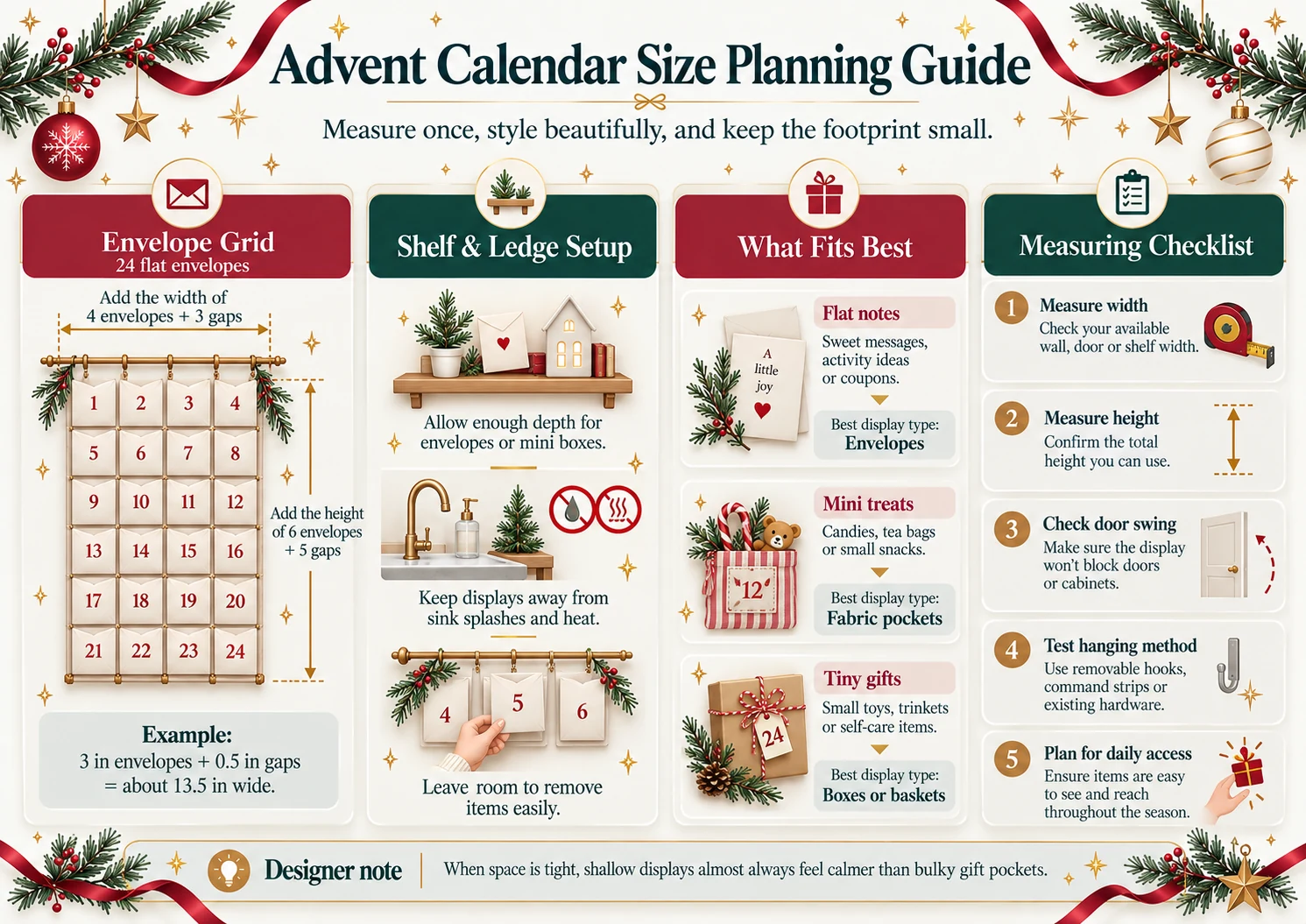

Instead of guessing, cut paper templates to the dimensions of your envelopes or pockets and tape them temporarily to the intended area. A grid of four columns by six rows requires the width of four envelopes plus three gaps and the height of six envelopes plus five gaps. For instance, envelopes 3 inches wide and 2 inches tall with half-inch gaps would occupy about 13.5 inches by 14.5 inches before adding outer margins or a frame. Those figures are an illustrative layout calculation, not a recommended product size.
Check practical clearances: can the closet door still open? Will someone brush against the display? Can a child reach an unsafe small item? Is the hook compatible with the wall finish and rated for the actual filled weight? Test the whole installation before December 1.
Use height instead of spreading across furniture.
Choose flat cards and envelopes where circulation is tight.
Let 24 repeated elements provide the decoration.
Favor pieces that fold or nest into one box.
Easy DIY: a refined 24-envelope Advent board
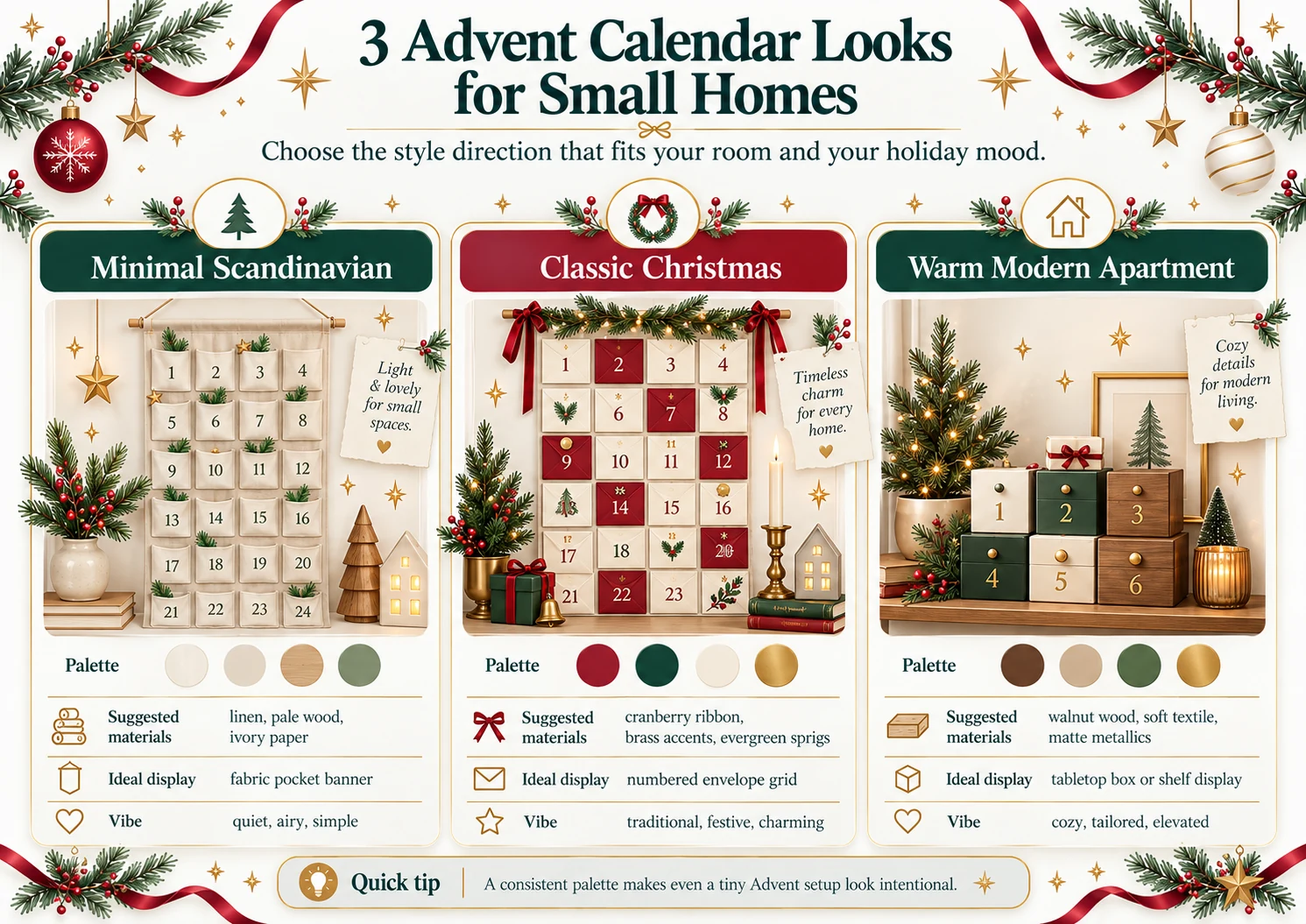
This project is a good place to start if you want a personalized countdown without buying a large seasonal centerpiece. It suits notes, vouchers, recipes, memories and family activities.
Gather: 24 small matching envelopes, thick backing paper or a lightweight board, number stickers or a marker, a ruler, pencil, removable tape for layout testing and a suitable secure support if you plan to hang the completed board. Use a stable freestanding frame when you cannot safely hang it.
- Choose the location. Pick an accessible wall or shelf away from heat, cooking splashes, and busy doorways.
- Measure the display. Mock up a four-by-six arrangement with the real envelopes. Allow room to remove and replace each one.
- Create a consistent look. Number the envelopes 1–24 with the same lettering style and one accent color.
- Fill before attaching. Add lightweight messages and check that the contents do not strain the paper or backing.
- Secure and test. Attach the envelopes to the backing; then support the entire piece safely and test the action of opening several dates.
- Make storage effortless. Save the backing, reusable envelopes and spare labels together after the holidays.
Three understated Christmas palettes
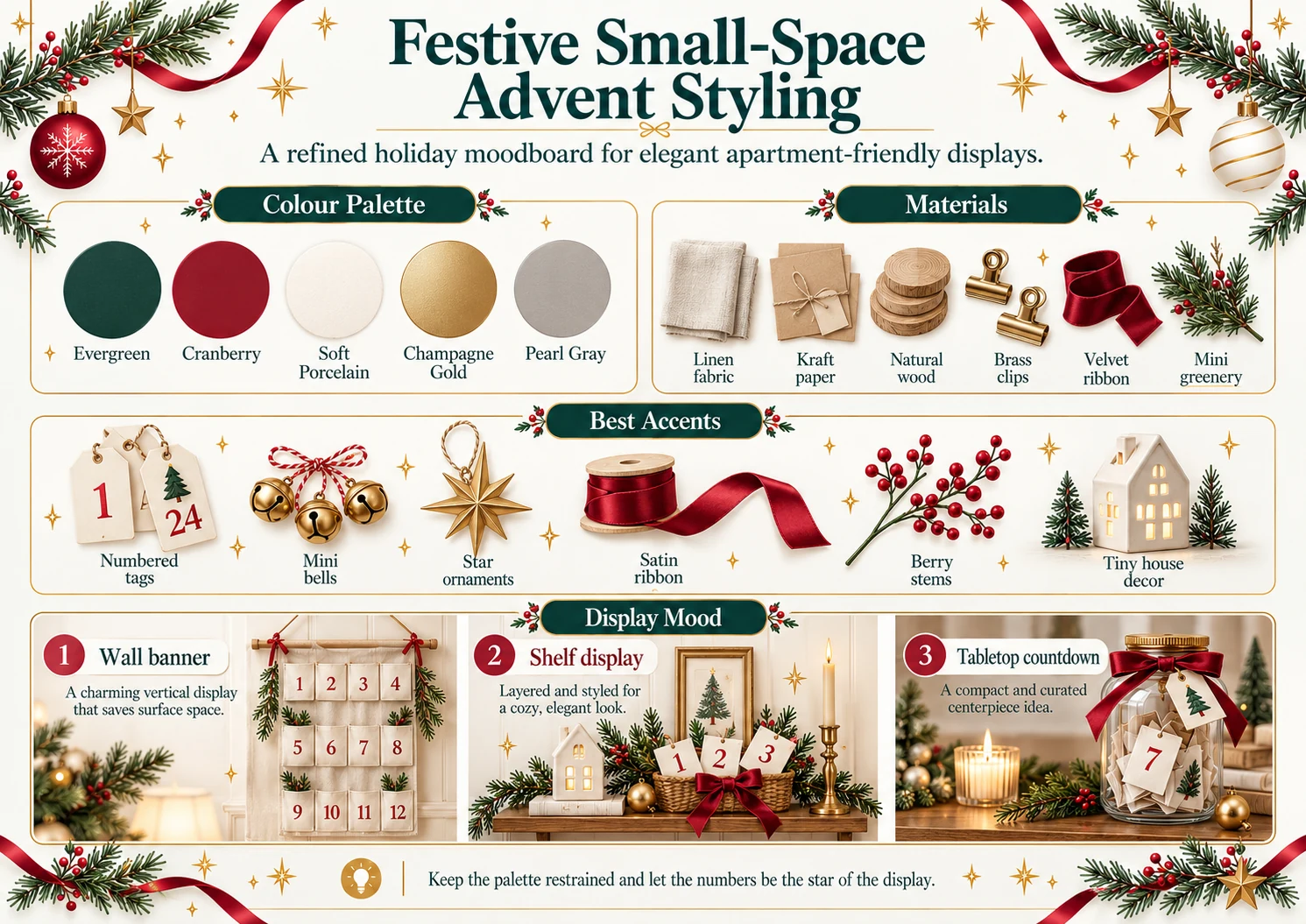
Color restraint matters more when a display already contains 24 visual elements. Repeat the paper, numbers and ribbon texture across the entire calendar, then introduce one small seasonal accent.
Forest & parchment
Burgundy & linen
Modern winter neutrals
24 Advent calendar fillers that do not create clutter
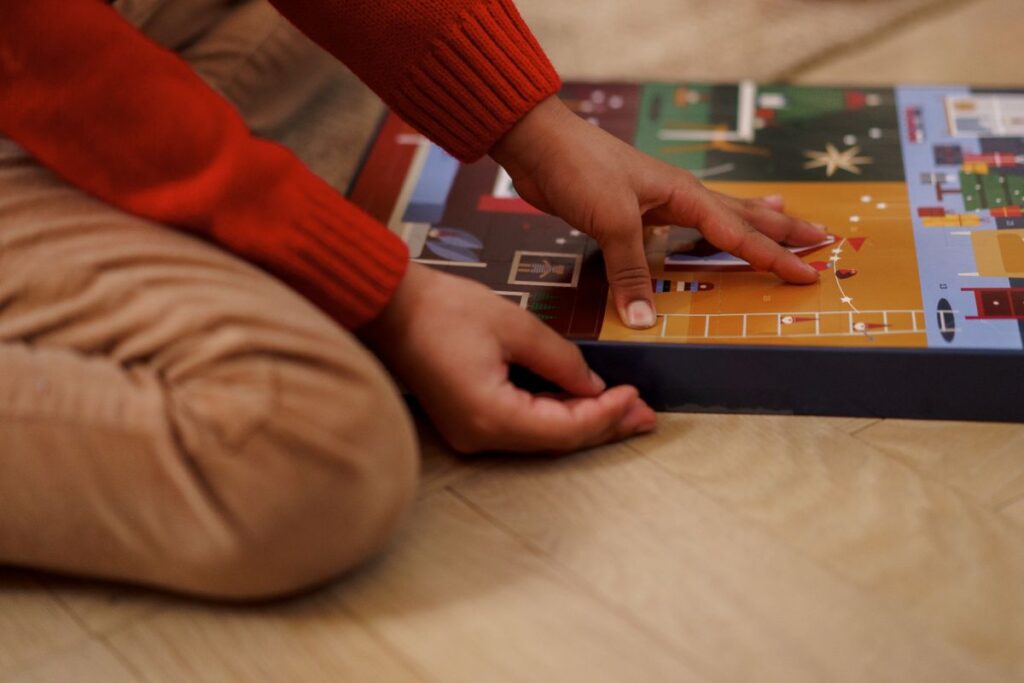
You do not need 24 purchased trinkets. A note-only calendar can turn the countdown into small experiences, many of them free. For busy households, mix quick moments with weekend activities.
For toddlers or pets, avoid leaving candy, batteries, magnets, small toys or long loose strings within reach. If a treat is unsuitable for your household, simply place a clue in the calendar and store the actual item safely elsewhere.
Renter-friendly installation: what to check
“No drilling” should never mean “no safety checks.” Adhesive products can fail on textured, recently painted, damp or unsuitable surfaces, and removal can affect paint. Read the actual manufacturer’s directions and weight ratings, including any wait time before loading. Consider an existing secure picture hook or a freestanding frame instead of adding new adhesive hardware.
Never secure a calendar to electrical outlets, radiator pipes, unstable trim or fixtures not designed to take its weight. Avoid long cords near cribs and doorways, and keep walkways clear. If a calendar requires a step stool to use daily, relocate it.
Make the calendar part of the room—not another layer of clutter
A good small-apartment display replaces decoration instead of being piled on top of it. If you choose a visually detailed envelope grid, remove competing objects from the same wall or shelf. Use a single evergreen sprig, one ribbon or a coordinated stack of cards rather than additional figurines, garlands and signs.
For an adjacent seasonal project, see our guides to Christmas window decor without drilling, Christmas decor for small living rooms, uncluttered kitchen countertop styling, and Christmas decoration storage in small apartments.
What to buy—and what you probably already own
Before shopping, check whether you have a picture frame, paper envelopes, sturdy basket, small clips, an existing peg rail or recipe-card box. Reusing one of these is often cheaper and more practical than buying a dedicated calendar. If you do purchase supplies, prioritize construction quality, actual dimensions, ease of daily access and how small the display packs away. Any future featured product recommendations should be clearly identified and checked for availability.
Frequently asked questions
Where can I hang an Advent calendar without a mantel?
Try a narrow wall, an existing hook or peg rail, a suitable closet door, or a securely mounted board. If hanging is not practical, a tabletop card box or bookshelf basket works just as well.
What is the best Advent calendar for a tiny apartment?
A small card box or vertical envelope display takes minimal space. The best choice depends on whether you have a clear shelf, an appropriate mounting surface, and what each day’s surprise contains.
How can I make an Advent calendar without drilling?
Choose a freestanding frame, shelf baskets, a portable jar or a stable tabletop box. Some surface-compatible removable hooks may work for lightweight displays when their instructions permit it.
How can I fit 24 gifts in a small Advent calendar?
Use notes or clues that lead to gifts stored separately, or choose tiny lightweight fillers. Measure the largest contents before purchasing a 24-pocket calendar.
What can I put in an Advent calendar besides candy?
Activity cards, music prompts, favorite memories, kind acts, recipes, reading suggestions and small handwritten notes are inexpensive and avoid accumulating clutter.
How do I store a reusable Advent calendar afterward?
Empty it completely, fold fabric pieces flat, place cards and clips inside a labeled pouch, and store fragile parts in a small protective box with your other seasonal decor.
Make room for the ritual, not the clutter.
An Advent calendar should bring a moment of anticipation to everyday life. Start with the space you have, choose a repeatable layout, keep the contents light, and design something you will be delighted to use again next December.
Editorial note: Any installation measurements above are illustrative. Always follow the mounting product’s instructions and account for your actual wall, load and household safety needs.