
THE INTENTIONAL LIVING EDIT · EVERYDAY LUXURY
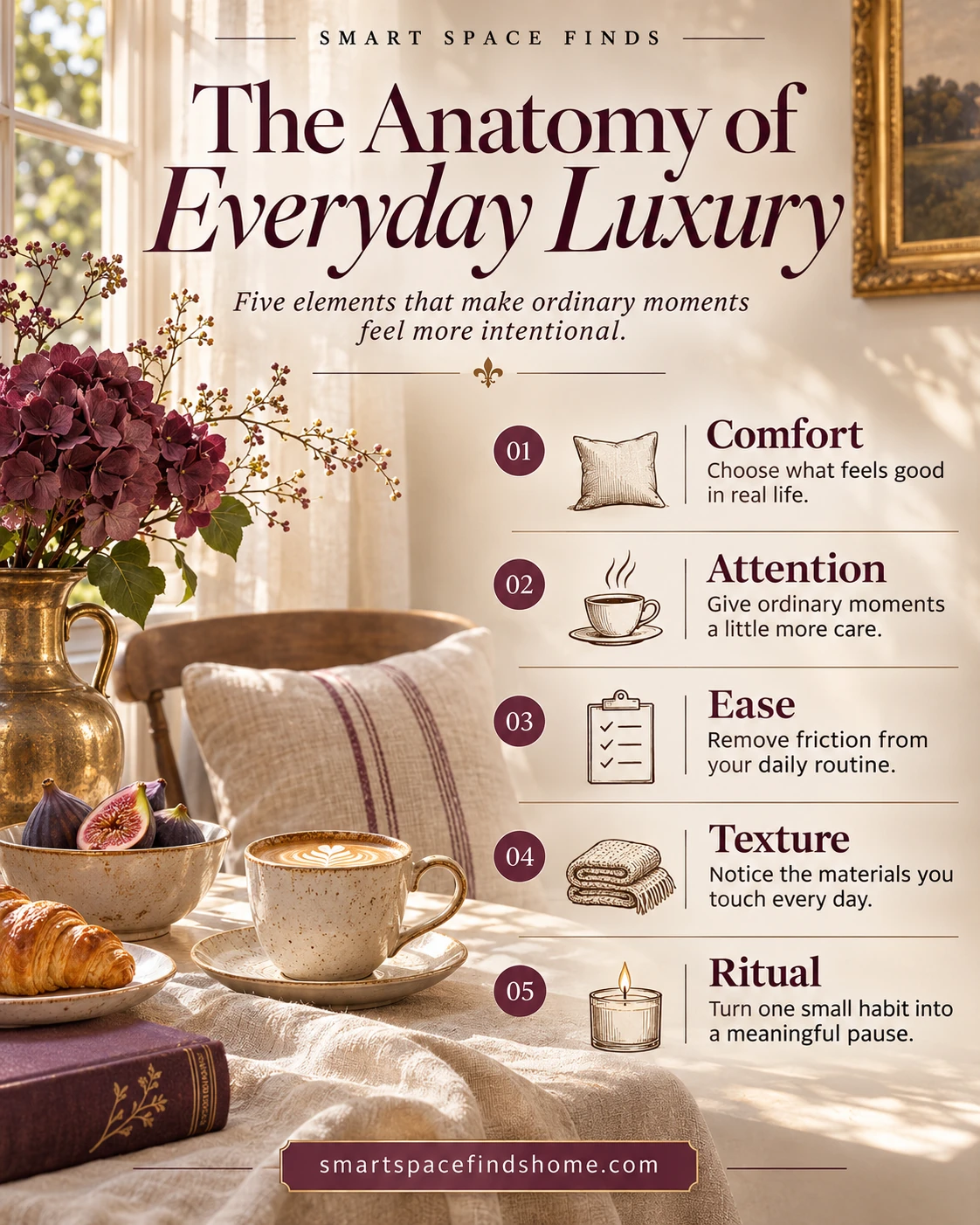
Everyday luxury on a budget starts with better function, not more shopping. It is about making the hours you already live feel more comfortable, considered, and distinctly yours. Start with one small ritual, improve one frequently used touchpoint, and remove one recurring annoyance before buying anything new.
Shopping transparency: This guide prioritizes no-buy changes. Optional product suggestions appear only where they may solve a specific problem. As an Amazon Associate, Smart Space Finds earns from qualifying purchases at no additional cost to you.
THE SMART SPACE FINDS FIELD GUIDE · 15 MINUTES
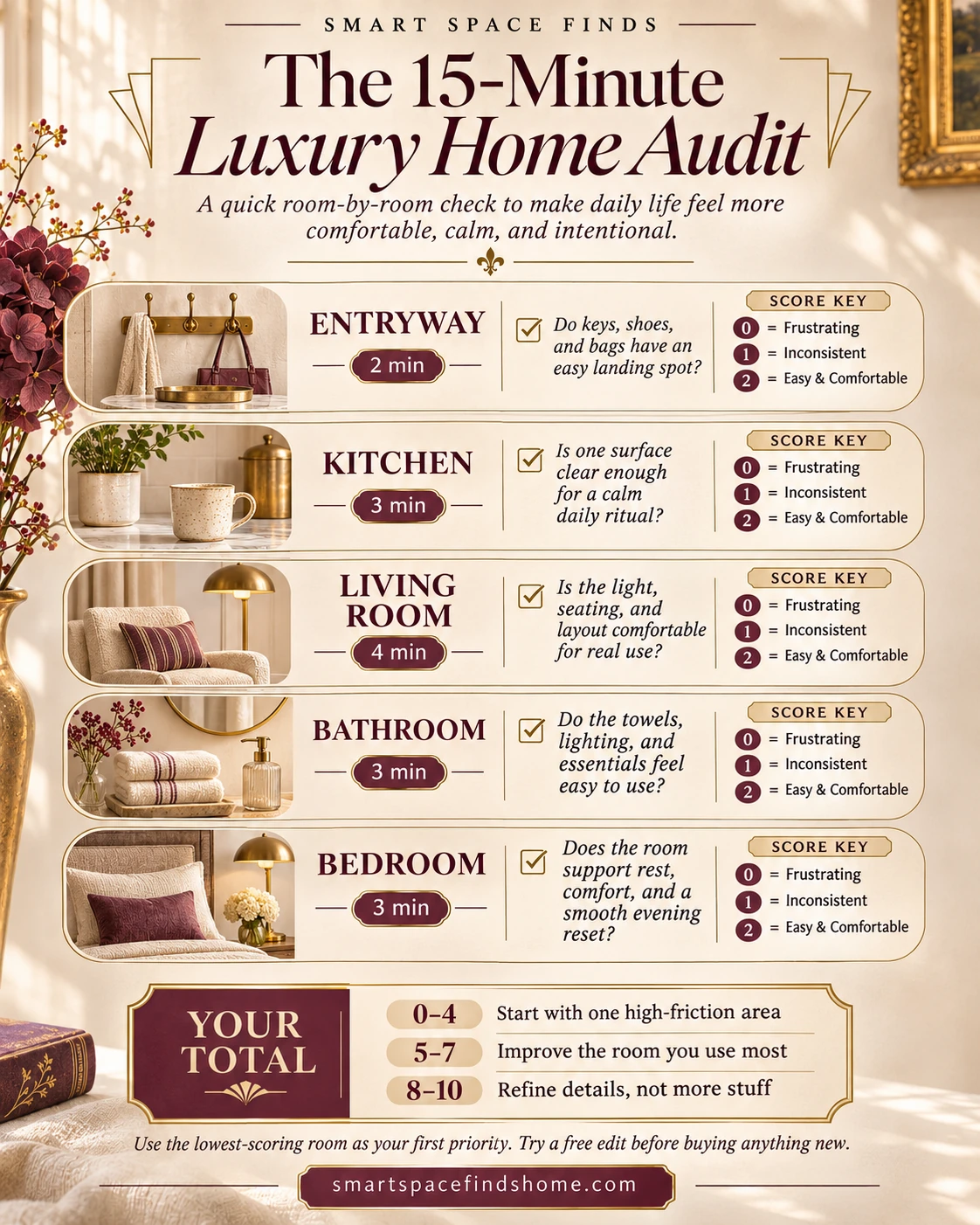
The 15-minute everyday luxury home audit
Walk through the areas you use every day. Score each one 0 if it regularly frustrates you, 1 if it works inconsistently, or 2 if it already feels comfortable and easy. This is a personal prioritization tool—not a validated wellbeing scale. You can start without spending a dollar.
Can you put down your bag, find keys, and move freely?
Is the spot for a daily drink or meal easy to use?
Can you sit comfortably with suitable light and reachable essentials?
Are towels accessible, dryable, and pleasant to use?
Is your bedside setup functional and your bedding comfortable?
Five ways to make everyday life feel more luxurious
Instead of adding more objects, pay attention to five aspects of daily life: time, touch, food, atmosphere, and ease. Each one offers a free starting point and an optional improvement only when it solves a real need.
01 / TIME
Protect one unhurried moment in the morning
You don’t need an elaborate routine. You need one repeatable pause. Open the curtains, use the mug you actually like, and sit down for the first few sips. If mornings are hectic, make this a two-minute ritual rather than a 30-minute obligation.
Try it tonight
Place your preferred cup where you’ll see it. Clear the spot where you want to sit. In the morning, spend your first two minutes with the drink instead of scrolling.
02 / TOUCH
Give everyday textures more attention
The things you touch frequently—sheets, towels, slippers, a chair, a favorite blanket—shape the experience of a room far more often than purely decorative accessories. Start by laundering and caring for what you own, then assess the actual fit and feel.
Choose by comfort, not a luxury label
Check fabric care, grip, breathability, fit, and how an item feels after regular use. A beautiful pillow that doesn’t support your preferred sleeping position is not an upgrade. A plush towel that never dries in your bathroom may be less convenient than a lighter one.
THE COMFORT-OVER-CLUTTER EDIT
Textiles & Everyday Comfort
Replace only what no longer works. Comfort, laundry care, dimensions and fit are more important than labels.
Affiliate disclosure: As an Amazon Associate, we earn from qualifying purchases. Product prices, variants and availability may change; check the current Amazon listing before purchasing. We recommend trying a no-cost improvement first.
03 / TASTE
Make ordinary meals feel like an occasion
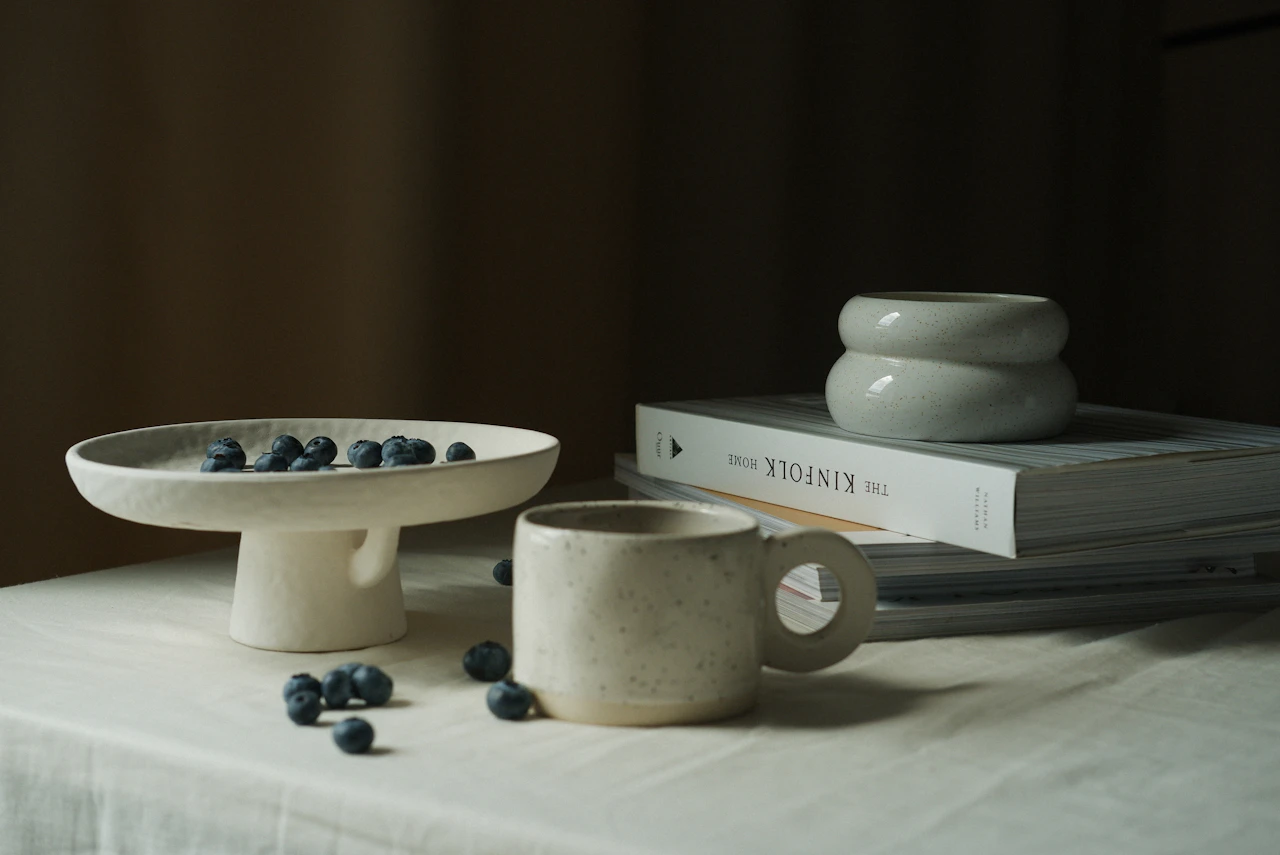
You don’t need restaurant ingredients for a satisfying table. Put your regular lunch on a plate, pour water into a glass, and sit somewhere pleasant. A folded napkin, a small bowl of fruit, or a playlist can make an everyday meal feel more intentional.
The three-detail table
Pick just three details: a clean surface, a plate you like, and one comfortable place to sit. Keep preparation shorter than the meal itself. If you live with others, invite conversation without making everyone perform a formal dinner.
THE CONSIDERED TABLE EDIT
Coffee, Tea & Everyday Table
Use your favorite existing dishes first; these are selected alternatives for worn-out or missing essentials.
Affiliate disclosure: As an Amazon Associate, we earn from qualifying purchases. Product prices, variants and availability may change; check the current Amazon listing before purchasing. We recommend trying a no-cost improvement first.
04 / ATMOSPHERE
Design the evening around light, sound, and calm
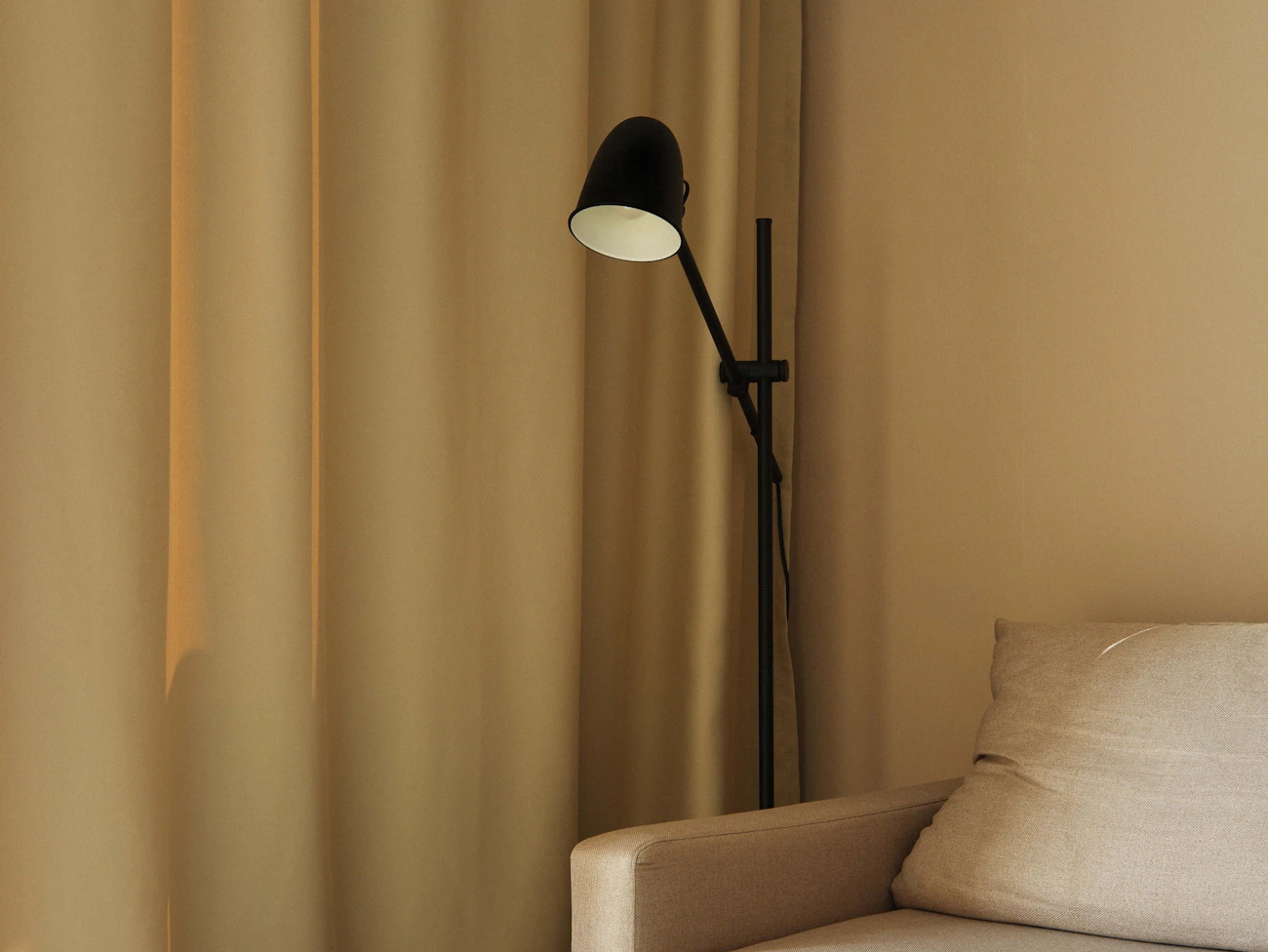
Atmosphere works best when it serves what you’re doing. A task lamp helps with reading; a softly lit corner makes conversation more welcoming; quieter background sound may help you transition out of work mode. Keep adequate illumination for cooking, stairs, and other safety-sensitive tasks.
A lighting reset in three steps
- Switch off unnecessary competing lights.
- Turn on one properly rated lamp near the activity.
- Test whether the room feels comfortable without straining your eyes.
Choose bulbs and fixtures according to their stated compatibility and safety ratings. If you rent, start with plug-in lighting rather than rewiring. For a practical explanation of warm versus cool light and choosing the right brightness for different rooms, consult the U.S. Department of Energy lighting guidance.
THE WARM LIGHT EDIT
Layered Lighting for Real Life
Prioritize safe, suitable lighting for the task. Verify size, bulb base, power requirements and switch compatibility.
Affiliate disclosure: As an Amazon Associate, we earn from qualifying purchases. Product prices, variants and availability may change; check the current Amazon listing before purchasing. We recommend trying a no-cost improvement first.
05 / EASE
Remove one little obstacle you face every day
Some of the most convincing luxuries are invisible. Keys have a home. Your charger reaches the bedside table. The towel hangs where it can dry. The entryway lets you put your bag down without moving three other things. These adjustments make daily life more fluid.
Choose the friction you experience most often
Notice the point where your routine stalls—searching for your keys, moving clutter to make breakfast, or reaching for a lamp across the room. Change that one setup, then test it for several days.
THE FRICTION-FREE EDIT
Entryway & Everyday Order
Make things easier to find before buying additional storage. These products are options only when a specific need remains after rearranging.
Affiliate disclosure: As an Amazon Associate, we earn from qualifying purchases. Product prices, variants and availability may change; check the current Amazon listing before purchasing. We recommend trying a no-cost improvement first.
THE EDITOR’S NOTE / 01
A room can look beautiful and still make daily life harder. The most rewarding upgrade is the one you genuinely notice.
Our approach: improve the experience first, style the result second. No purchase required.
The everyday luxury formula: more feeling, less effort
A useful way to think about affordable luxury is comfort + attention + ease − upkeep. This is an editorial decision framework, not a scientific measurement: a change works when you enjoy it often and can maintain it without strain.
THE NO-BUY HOME EDIT
Room-by-room luxury fixes you can actually use
Choose the row that matches your lowest-scoring space. Start with the free edit before considering anything new.
$0 edit: Give keys one consistent landing spot and remove an unused object from the walking path.
Only consider buying: a correctly sized hook or tray if you truly lack a place for essentials.
$0 edit: Keep your favorite mug and everyday tools in the easiest-to-reach places, not the prettiest shelves.
Only consider buying: a replacement item that removes recurring preparation friction.
$0 edit: Move a lamp nearer to where you read and bring out a blanket you already love.
Only consider buying: better task lighting if the existing setup is inadequate.
$0 edit: Clear the counter, place clean towels within reach, and let them dry fully between uses.
Only consider buying: a useful towel or storage replacement, after checking airflow and space.
$0 edit: Place water, a book, and your charger within safe reach; remove items competing for bedside space.
Only consider buying: a comfort upgrade that solves a persistent issue after fit and care checks.
The two-minute everyday luxury audit
Do this before shopping. It takes less time than comparing products and gives you a much clearer idea of what, if anything, you need.
- Notice: Choose a moment you experience at least three times a week.
- Name: Identify what makes it rushed, uncomfortable, or inconvenient.
- Edit: Try one no-cost change: rearrange, clean, simplify, or make something easier to reach.
- Repeat: Live with the change for a few days and keep it only if it genuinely helps.
Example: Your evening tea feels chaotic because the counter is crowded. Before purchasing a tea station, clear a single section of the counter and keep your cup and tea nearby. If the problem disappears, you’ve already made the upgrade.
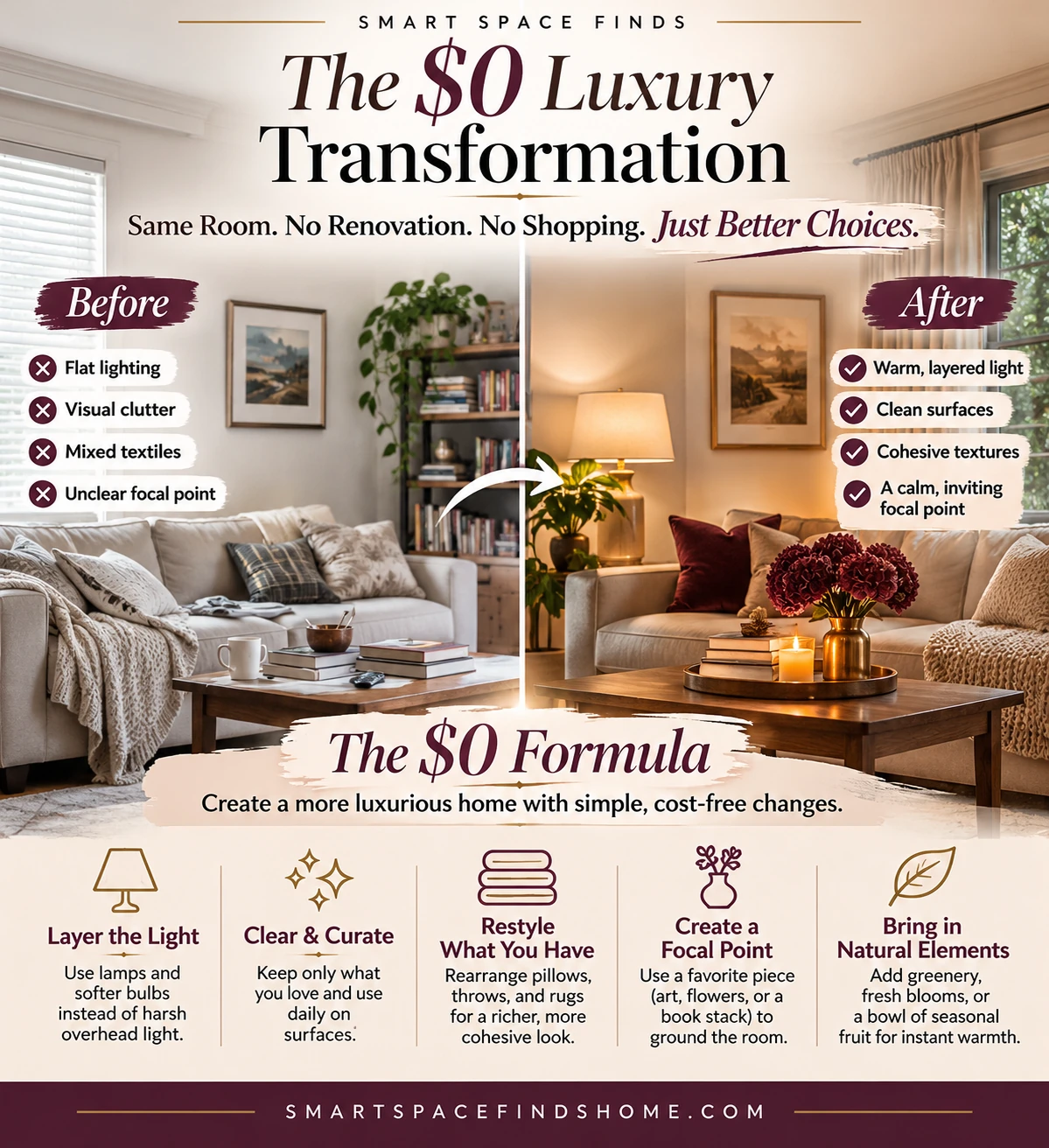
BEFORE / AFTER · AN ORDINARY EVENING
Small edits, a completely different experience
The cluttered evening
Overhead light only. Chargers tangled beside the couch. Favorite blanket hidden in a closet. Tea made standing up.
The considered evening
Reposition an existing lamp. Give the charger a home. Bring out the blanket. Sit down with your tea for five minutes.
This is an illustrative no-buy transformation, not a claim that a particular arrangement works for every home.
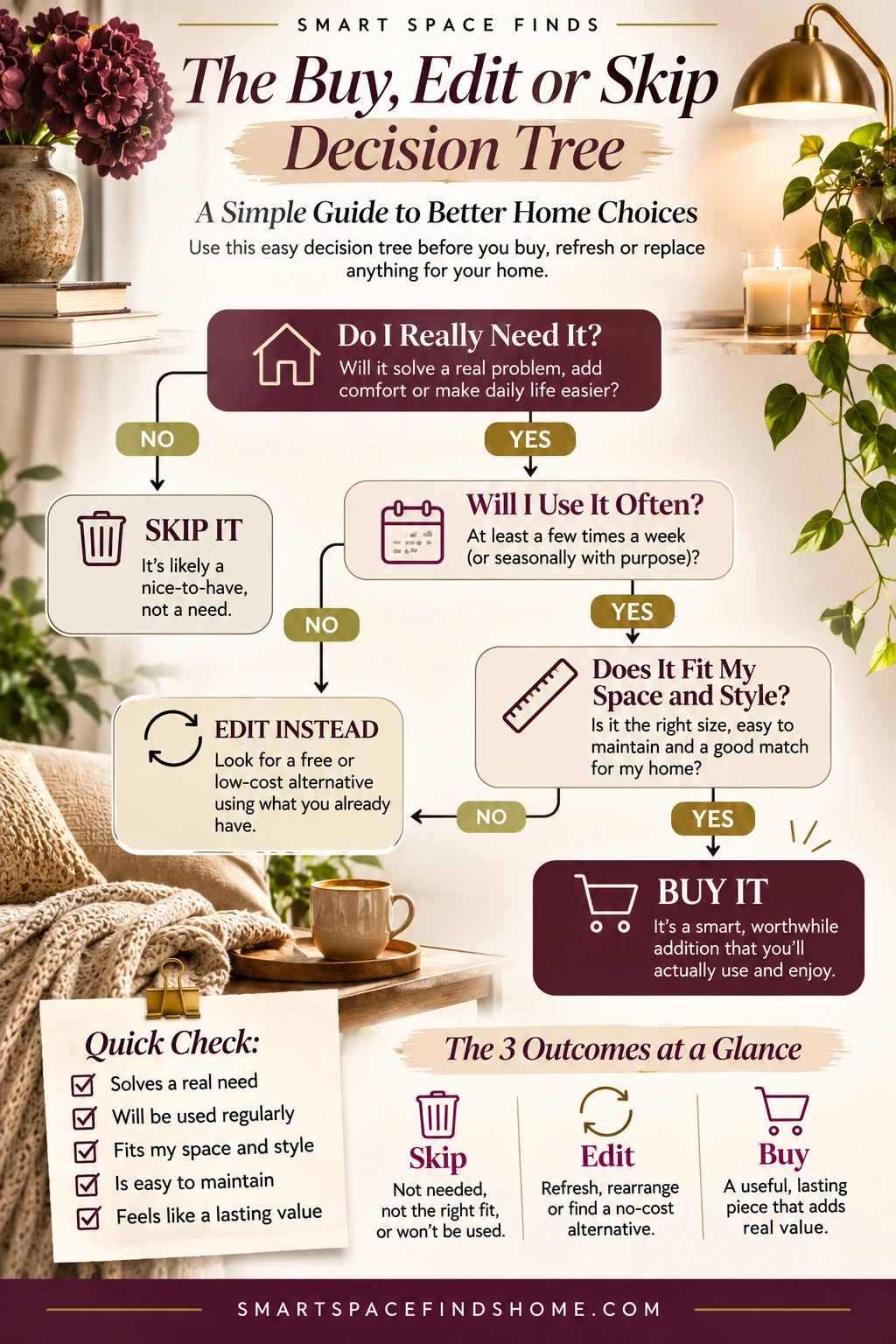
The keep, edit, or buy decision tool
Use this simple table when a beautiful product catches your eye. The best outcome is not always a purchase.
| Ask yourself | If yes | If no |
|---|---|---|
| Do I experience this problem regularly? | Continue | Save the money |
| Can I improve it using what I own? | Try that first | Continue |
| Will the item fit and be easy to maintain? | Compare options | Rethink the purchase |
| Can I comfortably afford it? | Consider buying | Wait without guilt |
For a higher-priced replacement, compare useful life, maintenance, return policy, measurements, and realistic frequency of use. A product can be beautiful and still be wrong for your household.
THE USEFUL-UPGRADE EDIT
Small Functional Upgrades Worth Evaluating
These are considered only after a no-buy edit has failed to solve a recurring problem.
Affiliate disclosure: As an Amazon Associate, we earn from qualifying purchases. Product prices, variants and availability may change; check the current Amazon listing before purchasing. We recommend trying a no-cost improvement first.
Where to start, depending on your budget
| Budget | Best first move | Avoid |
|---|---|---|
| $0 | Rearrange your reading corner, use favorite dishes, remove one recurring obstacle | Buying organizers before editing clutter |
| Under $25 | Replace one truly worn everyday basic if needed; costs vary by retailer | Decorative duplicates |
| $25–$75 | Evaluate a frequently used textile or suitable task-lighting improvement | Assuming price guarantees comfort |
| $75+ | Prioritize a repeated comfort or function problem and compare specifications | Purchasing purely for a luxury aesthetic |
These are planning bands, not verified product prices or recommendations to spend.
THE EVERYDAY LUXURY SELECTOR / 02
What feels least comfortable today?
Prepare one pleasant, repeatable pause the night before.
Check seating, textiles, reach, and fit before considering replacements.
Reduce competing lighting and noise while keeping tasks safely lit.
Identify the underlying problem and compare a free edit first.
The seven-day everyday luxury experiment
Choose one tiny action each day. Nothing in this challenge requires you to buy a product.
At the end, ask: Did it feel better? Was it easy? Would I repeat it? Three yeses matter more than an attractive before-and-after photo.
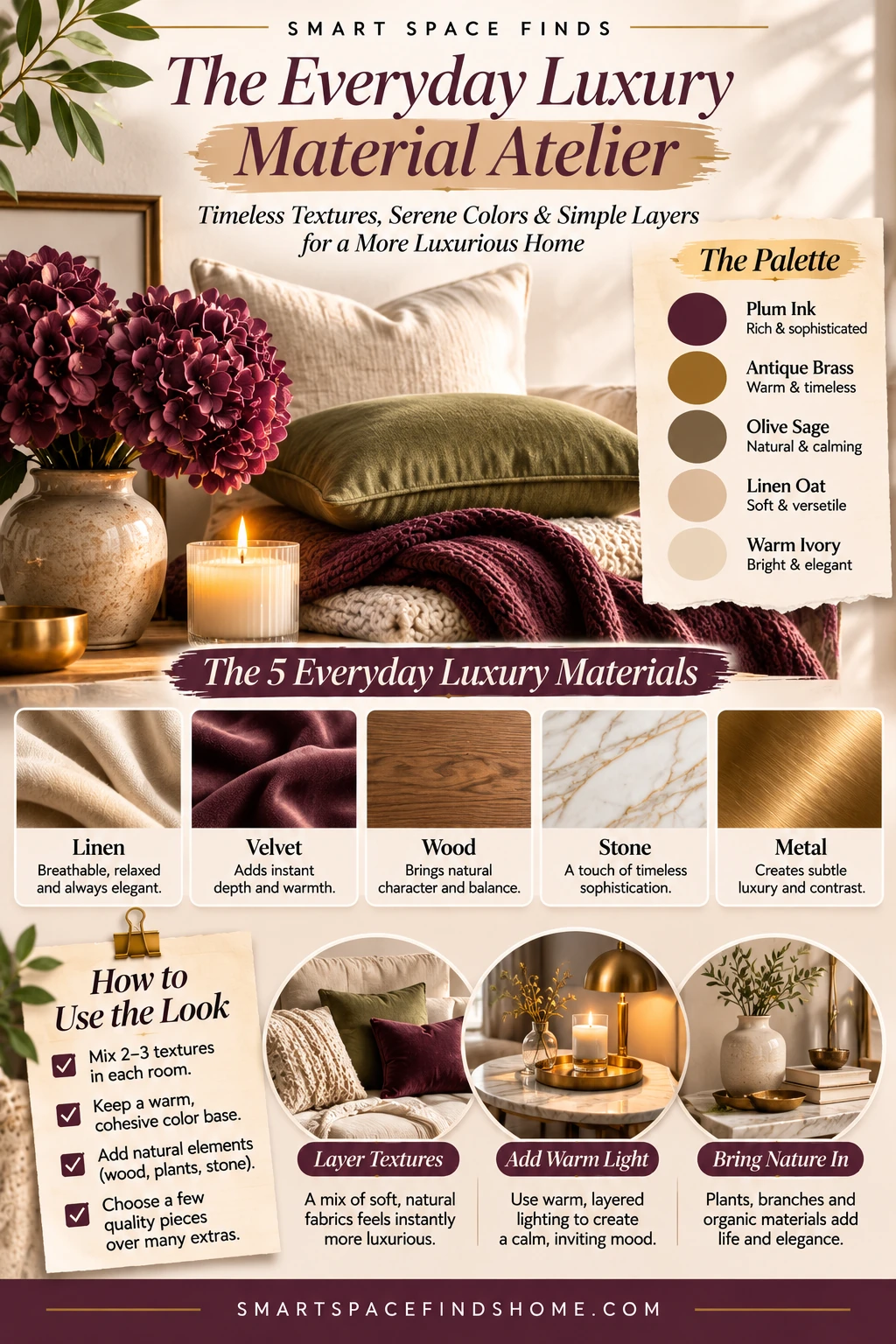
THE MATERIAL ATELIER / A VISUAL EDIT
One elevated palette, five everyday materials
The richest-looking home isn’t necessarily the most expensive. Balance one grounded dark shade with warm neutrals and honest, easy-care surfaces. This is a flexible color-story, not a requirement to repaint or shop.
Use what you own: a neutral towel, an old wooden tray, a dark ceramic mug, a green leaf, and a warm lamp can create the same visual balance without matching brands or buying a collection.
How to make a small space feel more luxurious
In a small apartment, luxury is often less about adding a decorative object and more about protecting useful space. Start with a clear path through the room, one uninterrupted surface, and a comfortable place for a daily ritual. Reposition rather than multiply furniture, and make every object earn its storage footprint.
For renters: use movable lamps, washable textiles, trays, and freestanding organizers rather than assuming you can change hardwired fixtures or permanent finishes. Measure before adding anything.
Three mistakes that make everyday luxury feel like work
Buying the photograph. A styled vignette may hide cords, storage needs, or the work of maintaining it. Adapt the idea rather than copying the purchase list.
Adding complicated rituals. If your “luxury morning” requires 20 extra minutes you do not have, shorten it until it fits real life.
Confusing expensive with comfortable. Branding and price do not tell you whether an object fits your body, home, habits, or budget.
What to measure before making an upgrade
Use five checkpoints: frequency (how often you use it), fit (measurements and personal comfort), care (cleaning and maintenance), space (what it occupies), and cost (the complete cost, including replacement parts or care). If an upgrade fails two or more checkpoints, revisit the no-buy option.
Explore the idea further
For an interiors-focused approach, explore our quiet luxury interior design guide. If you’re interested in atmosphere rather than daily routines, see how to create a boutique hotel atmosphere at home. For intentional purchases, read how to choose beautiful everyday objects worth investing in. For a dedicated morning ritual, visit our at-home café guide.
Frequently asked questions
How can I make my everyday life feel luxurious without spending money?
Begin with a repeated moment: sit down for coffee, use your favorite dishes, adjust lighting you already own, or clear a frequently used surface. Focus on comfort and ease rather than recreating a photograph.
What makes a home feel luxurious on a budget?
A home often feels more considered when it is comfortable to use: good light for the task, thoughtfully placed essentials, usable surfaces, and textiles that suit your preferences. Expensive finishes are not required.
Are little luxuries the same as self-care?
They can overlap, but everyday luxury is broader. It might be a calmer entryway, a thoughtfully served meal, or a seat positioned near natural light—not necessarily a wellness routine.
What should I upgrade first?
Start with the thing you use most frequently that also causes real discomfort or inconvenience. Try a free adjustment first, then evaluate whether replacing anything is justified.
How do I avoid buying unnecessary home accessories?
Identify the problem before choosing a product, measure your space, consider care and storage, and wait before nonessential purchases. If a no-buy adjustment solves the problem, keep the savings.
How do I make small daily rituals last?
Make them short enough for your busiest day. Attach a ritual to something you already do, remove extra preparation, and stop if it begins to feel like another obligation.
OUR EDITORIAL METHOD
How we selected the ideas
This guide is an editorial framework developed around daily frequency, physical comfort, maintenance, space constraints, and affordability. The room scores and budget bands are illustrative planning tools, not scientific tests or independently measured outcomes. We do not claim to have tested specific products or measured psychological benefits. Recommendations prioritize reusing what you own and transparent tradeoffs.
For more inspiration-led rituals, read 5 Little Luxuries That Make Everyday Life Feel Special. This guide focuses instead on diagnosing friction and making targeted home improvements.
The final edit: make room for what you actually enjoy
The richest-feeling days rarely depend on a flawless home. They often come from ordinary things that work well: a comfortable chair, a pleasant meal, gentle light, and less rushing. Begin with one small change you can repeat. Keep the parts that make your day better—and let the rest go.