

You do not need a new wardrobe to feel differently about getting dressed. Sometimes the change comes from noticing a jacket you have stopped reaching for, repairing a favorite sweater or putting the clothes you actually wear where you can see them. A thoughtful wardrobe refresh without buying clothes is less about owning fewer things and more about making the pieces you own easier to wear. The first change is not a purchase—it is a clearer view of what already belongs in your everyday life.
This guide combines five realistic wardrobe upgrades with outfit formulas, an easy closet map and a seven-day test. No compulsory capsule wardrobe, arbitrary item count or perfect before-and-after photo required.
How to Refresh Your Wardrobe Without Buying Clothes
A no-buy wardrobe refresh is a deliberate reset of how you see, style, maintain and store clothing you already own. Unlike a shopping-led makeover, it begins with existing pieces. Unlike a strict capsule wardrobe, it does not require a particular item count, neutral palette or aesthetic. The goal is a closet that supports your actual life.
This works particularly well when you repeatedly wear the same handful of outfits, forget what is stored behind other items or assume an outfit needs one new purchase to look complete. It will not fix garments that no longer fit comfortably or suit your daily requirements; those need a different, more honest decision.
1. Rediscover What You Actually Wear
Begin with a small, visible category—your everyday tops, work clothes or the shelf that always becomes a pile. Pull out only that group. Trying to empty an entire closet on a busy evening often creates a larger mess than the one you wanted to solve.
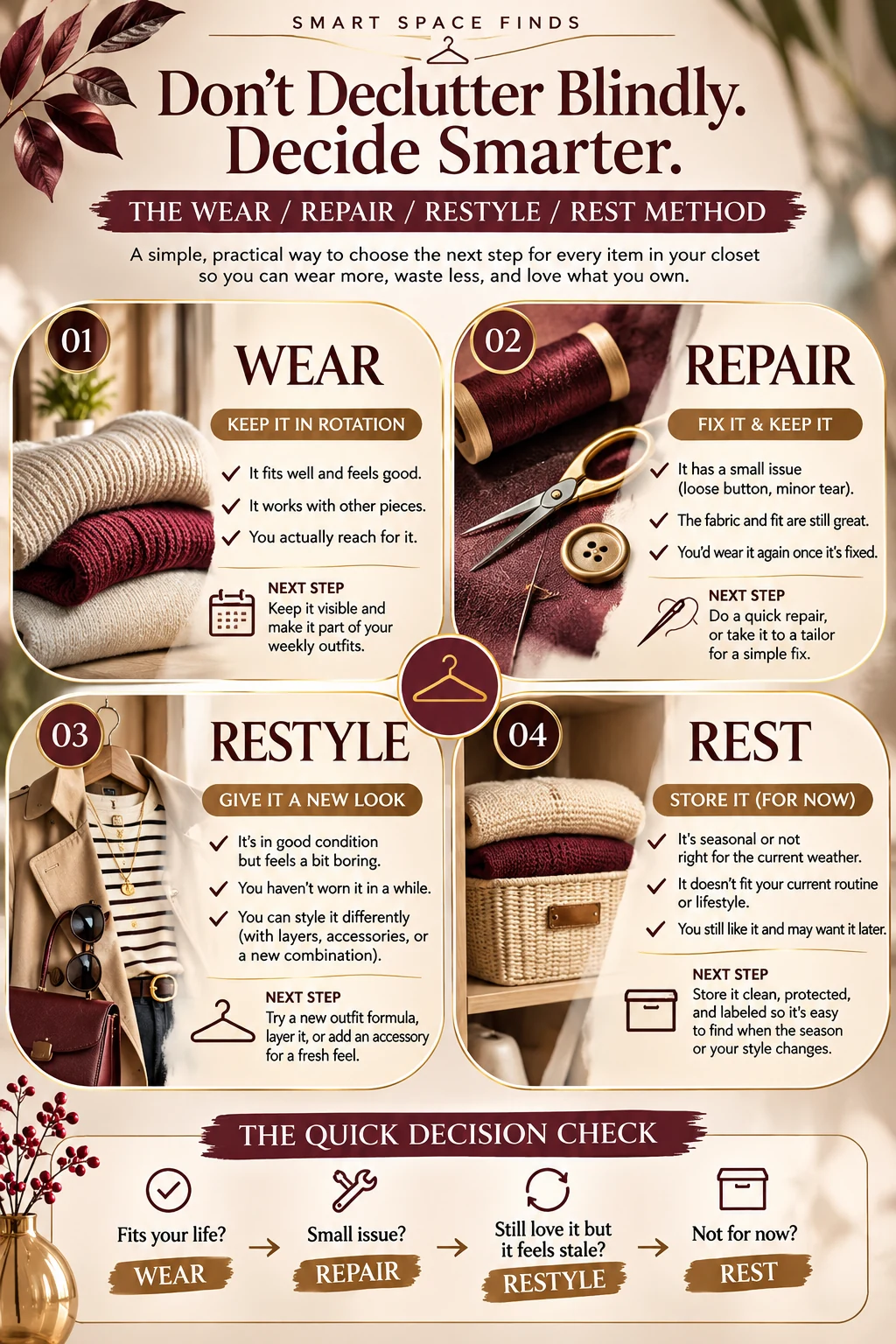
Use the Wear / Repair / Restyle / Rest decision
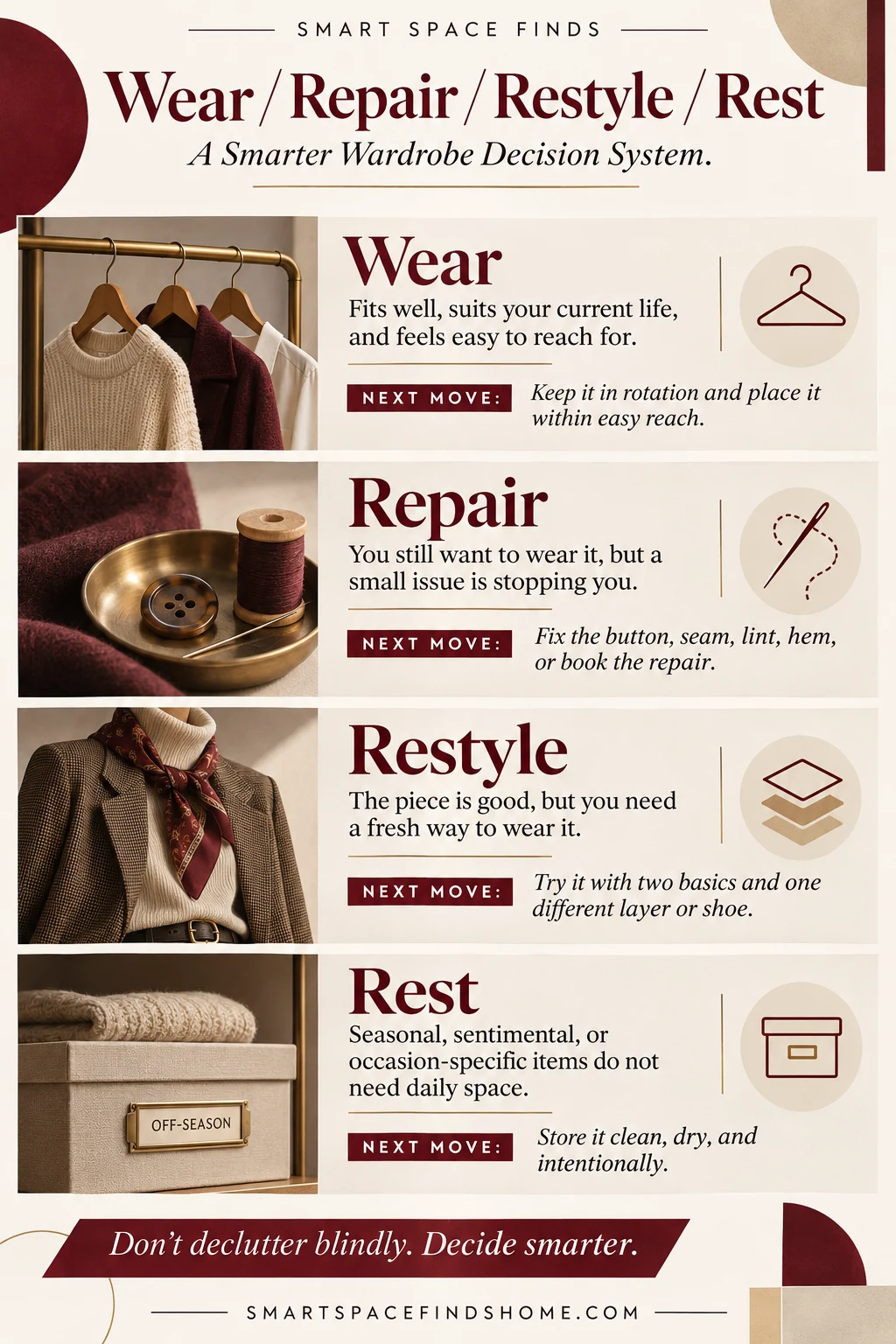
Wear: Items that fit your current life and feel comfortable. Place them within easy reach. Repair: Pieces you genuinely want to wear but cannot because of a loose button, damaged seam or similar issue. Restyle: Good pieces you rarely reach for because you cannot picture an outfit. Rest: Out-of-season, sentimental or occasion-specific clothing that deserves proper storage rather than daily visual space.
For an item you have not worn, ask: “Does it fit and feel right now? Where would I realistically wear it next month? What would I pair it with?” A clear answer gives you a useful next step. An uncertain answer is not a command to throw the garment away.
Make a realistic keep-or-store decision
Separate what you wear from what you feel you should wear. A wardrobe built for an imagined lifestyle is often frustrating in practice. Uniforms, accessibility needs, climate, body changes and personal comfort matter more than a trend-driven checklist.
2. Make More Outfits From the Same Clothes
New combinations are usually a more convincing refresh than a rearranged color gradient. Rather than assembling isolated outfits, look for a small set of pieces that work together across your real activities.
Try the 3 × 3 outfit experiment
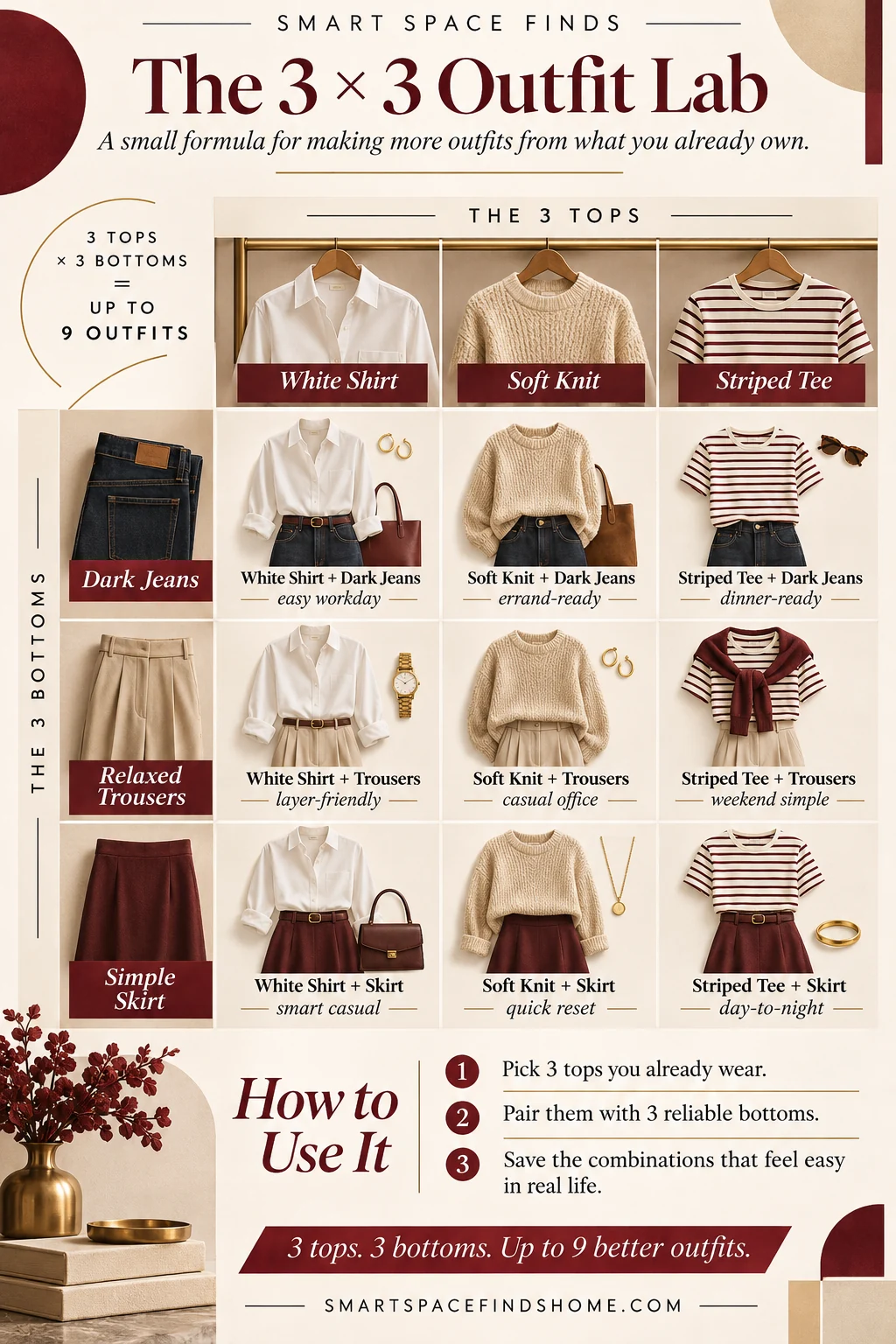
Choose three tops and three bottoms you already own. A white shirt, a knit and a striped tee might pair with dark jeans, relaxed trousers and a skirt. On paper, this creates up to nine pairings; in real life, some may not suit the weather, fit or occasion. That is useful information, not a failure.
Illustrative pairings, not nine guaranteed outfits. Keep only combinations you would actually wear.
Put on the promising combinations, move around and check them in ordinary light. Save a quick phone photo of the ones that feel good. An outfit album can be more useful than a complicated wardrobe app, particularly on rushed mornings.
Build a formula rather than a fashion rule
Try a simple structure: base + layer + finishing detail. For example, jeans and a tee become work-ready with a structured jacket you own, or more relaxed with a cardigan. Swap shoes or accessories already in your closet. The purpose is to explore proportions and function—not to force every garment into a minimalist aesthetic.
For a deeper look at identifying repeatable combinations, see our guide to finding your personal style and our timeless personal style guide.
3. Restore the Clothes You Already Love
An outfit can feel neglected because of a missing button, persistent lint, wrinkled fabric or shoes that have not been cleaned—not because the clothing is outdated. Choose small, reversible improvements before replacing an item.
The practical garment-care edit
Affiliate disclosure: As an Amazon Associate, Smart Space Finds earns from qualifying purchases. These optional links may generate a commission at no additional cost to you.
The Fix-First Edit
Optional tools for restoring what you already own. Always follow garment care labels before applying heat or using a fabric shaver.
A small tool for appropriate garments with surface pilling.
A full-size garment steamer for items whose labels permit steaming.
Compact 120V-only alternative; check fabric and electrical requirements.
Basic mending supplies for loose buttons and simple repairs.
Quick removal of lint from compatible clothing.
Affiliate disclosure: As an Amazon Associate, Smart Space Finds earns from qualifying purchases. These optional links may generate a commission at no additional cost to you.
Start with the care label. Check fabric composition and the manufacturer’s washing, drying and ironing instructions before treating a stain or applying heat. A sweater comb may be appropriate for some knits, but aggressive de-pilling can damage delicate fibers. Steamers should not be used indiscriminately on heat-sensitive materials, leather or trims.
For buttons and minor loose seams, use the correct needle and thread, or set a realistic repair appointment. For an expensive, structured or delicate garment, a skilled tailor or cleaner may be the safer choice. A repair is only valuable when it makes a garment wearable and is proportionate to its condition.
Protect the condition you have restored
Allow clean garments to dry completely before storing them. Fold heavy knits rather than stretching their shoulders on unsuitable hangers. Give garments enough room for airflow, and avoid packing damp textiles into airtight containers. Always choose storage appropriate to the fabric and local conditions.
4. Change the Styling Details, Not the Shopping List
The difference between an outfit that feels routine and one that feels intentional can be surprisingly small. Roll a sleeve neatly, adjust the length of a layer, try a shirt tucked or untucked, or bring back a belt or scarf you stopped using. Experiment with pieces you already own before considering anything new.
Use contrast with intention
Try one relaxed item with one more structured item, or pair a textured knit with smooth trousers. A fitted top may balance wider bottoms; a long layer can change the visual line of a familiar combination. These are options to test, not universal rules about body shapes.
Take a photo from the same viewpoint for two variations and compare comfort, movement and how appropriate each feels for the day. The winner is the version you are happy to wear for hours—not necessarily the more polished photo.
5. Organize Your Closet Around the Decisions You Make
An attractive closet is not automatically a useful one. Organizing only by rainbow colors can hide the things you need every morning. Instead, plan around frequency of use, garment type, climate and the amount of hanging or shelf space available.

Create three visibility zones
The Visibility-First Closet Edit
Choose one organizing fix for a real storage problem rather than buying a complete new system.
Uniform, slim hangers for a large hanging section.
A smaller hanger bundle if you need fewer replacements.
A velvet-hanger alternative with a trouser bar.
Clip hangers for skirts and trousers where suitable.
Transparent separation for stacks of folded clothes.
Alternative dividers for shelves, purses, and accessories.
Affiliate disclosure: As an Amazon Associate, Smart Space Finds earns from qualifying purchases. These optional links may generate a commission at no additional cost to you.
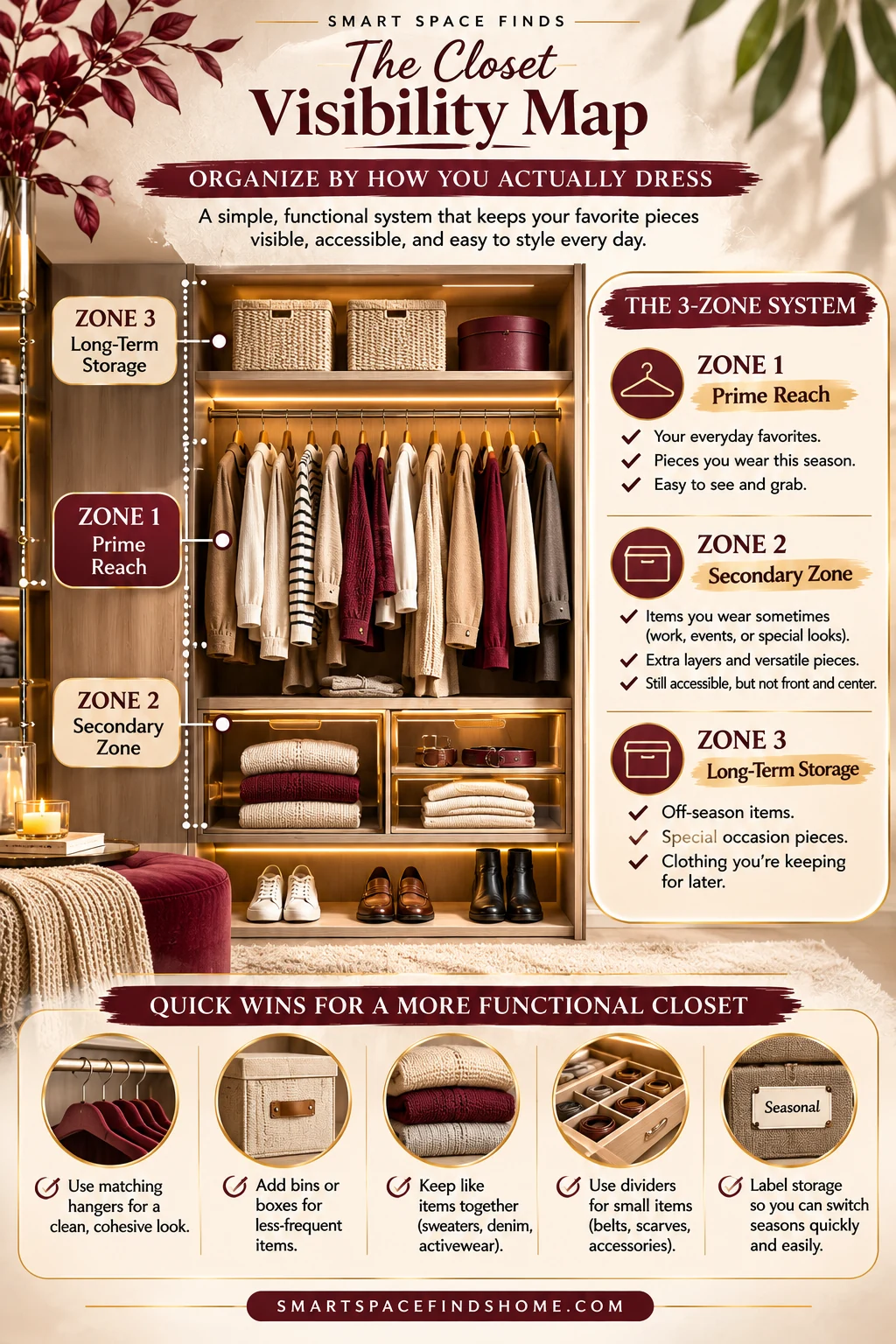
Put the clothes used most often between comfortable eye and hand height where possible. Keep heavier items on stable shelves rather than creating overloaded hanging rails. For shared closets, label zones according to the people who use them, not a single “ideal” system.
If storage space is the main challenge, our small closet wardrobe reset and shelf-divider and folding guide cover more detailed setups. These are optional improvements; start by changing placement before buying organizers.
The Wardrobe Friction Index: Find the Fix That Matters Most
Before investing energy in an aesthetic overhaul, identify where your wardrobe actually slows you down. A beautiful rail does not help if your favorite shirt is constantly waiting for repair, and a perfect outfit grid does little if your work clothes are hard to find. This simple editorial self-check prioritizes everyday function over a staged result.
Mark each statement that sounds true on most weekdays. Then make your first change in the area with the most checks. This is a practical reflection tool, not a clinical or scientific score.
□ I cannot see my most-worn clothes. □ Clean pieces are difficult to put back.
First fix: move frequently worn pieces into one easy-return zone.□ I forget useful pairings. □ I regularly reject outfits after putting them on.
First fix: build three reliable outfits and photograph them.□ I avoid favorites because of minor damage. □ Care tasks keep piling up.
First fix: create a small, visible repair queue and complete one item.□ My clothes reflect a past routine. □ Comfortable, suitable outfits are hard to find.
First fix: create a current-life outfit rotation without forcing old pieces to fit.Three real-world outfit recipes to try today
The weekday uniform: Start with your most comfortable bottoms and a reliable top. Change the layer and footwear for the day’s activity. The neglected favorite: Pick one piece you love but rarely wear, then pair it with two dependable basics instead of shopping for a perfect match. The weather-ready variation: Take a familiar outfit and test a warmer or lighter layer you already own. Keep the recipe only if it works for your actual climate and movement.
The 30-Minute No-Buy Wardrobe Reset
Affiliate disclosure: As an Amazon Associate, Smart Space Finds earns from qualifying purchases. These optional links may generate a commission at no additional cost to you.
Use this short version when you have limited time or energy. You are not trying to redesign your entire closet in half an hour—you are making tomorrow easier.
A REALISTIC HALF-HOUR PLAN
- 0–5 min: Pick one category and identify your actual frustration.
- 5–12 min: Sort into wear, repair, restyle or rest.
- 12–20 min: Test two or three useful outfit combinations.
- 20–25 min: Resolve one simple care issue or schedule a repair.
- 25–30 min: Move favorites to prime reach and photograph one complete outfit.
Should You Buy Anything After the Reset?
Affiliate disclosure: As an Amazon Associate, Smart Space Finds earns from qualifying purchases. These optional links may generate a commission at no additional cost to you.
The honest answer may be no. If you repeatedly discover a genuine gap—a winter layer that is no longer protective, shoes unsuitable for your commute or a garment that cannot be reasonably repaired—consider that specific need rather than browsing for a general refresh.
Before purchasing, ask: Is there a usable alternative in my closet? Would a repair or alteration solve the issue? Will this item serve several real outfits or activities? Can I afford it without disrupting a higher priority? Is secondhand or borrowing appropriate? Do not buy storage products merely to accommodate clothing you do not use.
The Seven-Day Wardrobe Reality Check
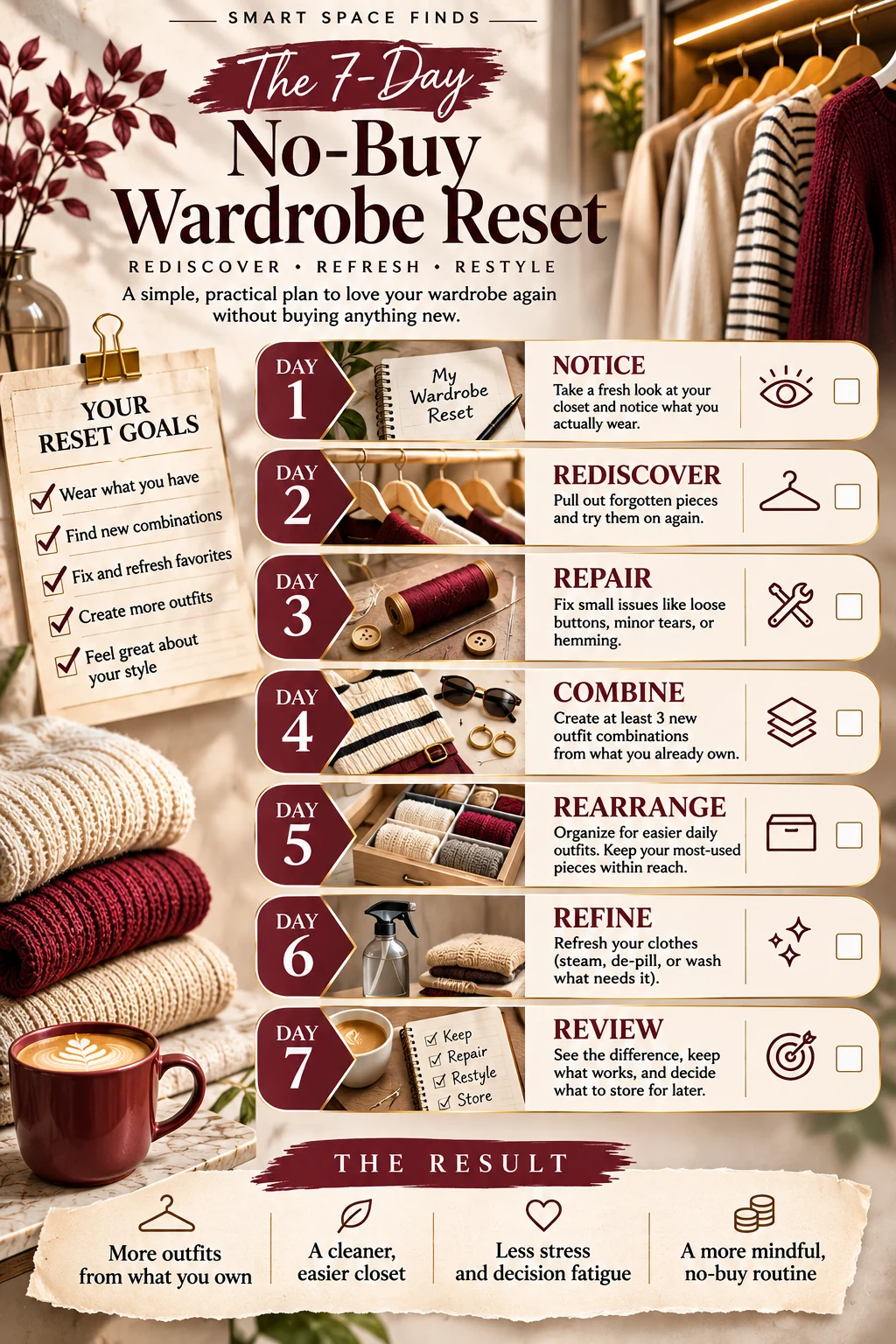
For one ordinary week, save a quick note after getting dressed. Count how often you reached for the same pieces, whether choosing an outfit became easier, whether a repaired item returned to use and what still slowed you down. A longer-term system succeeds through repeated use, not one exceptionally tidy photograph.
Day 1–2: Which pieces became visible again?
Day 3–4: Which outfit formula felt most useful?
Day 5–6: Which storage choice reduced friction?
Day 7: What will you keep, adjust or undo?
The Wardrobe Troubleshooting Desk: Find Your Real Problem
Not every closet problem needs the same fix. Use the situation that sounds most like your week, then try the smallest useful intervention before changing anything else.
How to Make the Reset Work for Your Life
If you share a closet
Give each person’s frequently worn clothes a visible, reachable zone. Agree on where clean laundry returns and where repairs wait. A system that requires one person to maintain everyone’s clothing will often fail, however attractive it looks on day one.
If your schedule, body or mobility changes
Prioritize easy fastenings, comfort, accessible shelf heights and clothing that meets your current needs. You are allowed to change what “a good wardrobe” means. Avoid storing essential items high overhead or making a daily system depend on heavy lifting.
If you live in a small apartment
Use the prime-reach area for this week’s clothes. Store off-season pieces clean and dry in existing drawers, spare shelving or suitable under-bed space. Leave enough room to retrieve an item without emptying a whole container; accessibility is more valuable than maximum packing density.
Wardrobe Care: Trusted Guidance, Not Guesswork
Affiliate disclosure: As an Amazon Associate, Smart Space Finds earns from qualifying purchases. These optional links may generate a commission at no additional cost to you.
Clothing care depends on the fabric, construction and finish of each garment. Start with its care label before washing, drying, ironing or applying heat. Sort garments by the instructions they actually require, allow clean pieces to dry fully before storage and fold heavier knitwear when hanging could stretch it. Test unfamiliar products cautiously and avoid aggressive treatments on delicate materials. For structured, expensive or easily damaged pieces, professional care may be a better investment than trial and error.
Your seven-day assignment, one decision at a time
Wardrobe Refresh Mistakes Worth Avoiding
Discarding too quickly: You do not need to eliminate sentimental items or clothes for a different season. Buying organizers before sorting: A new container may just hide an unchanged problem. Ignoring fabric requirements: Incorrect heat, cleaning or storage can cause damage. Imitating a capsule wardrobe that does not fit your life: Your wardrobe should reflect your actual work, weather, personal needs and preferences. Judging only by photographs: A wearable outfit matters more than a visually perfect flat lay.
Frequently Asked Questions
How can I refresh my wardrobe without buying new clothes?
Start by finding overlooked items, creating new combinations, repairing small defects and rearranging your most-worn clothes so they are easy to reach. Try the changes for a week before considering purchases.
Can I do this with a very small closet?
Yes. Work one section at a time and favor visibility over extra products. Put daily pieces in easy reach and move seasonal items to suitable secondary storage.
How do I create new outfits with clothes I already own?
Choose three tops and three bottoms, test their combinations, then change one layer, shoe or accessory at a time. Keep a small photo album of combinations you would genuinely wear.
Do I need a capsule wardrobe?
No. A capsule can help some people, but this method has no mandatory item count or palette. A practical wardrobe can include color, occasion wear, cultural clothing and sentimental garments.
What if my clothes no longer fit?
Prioritize comfort, health and your current body. Store meaningful pieces if you want to keep them, explore alterations when practical and do not treat an old size as a standard you must return to.
Should I buy closet organizers or garment-care tools?
Only when a repeated problem remains after no-buy adjustments. Use the storage and care products you already own first, and consider any new purchase based on a specific need.
The Final Edit
The best wardrobe upgrade may be remembering what you love, bringing one neglected piece back into use or making tomorrow morning a little easier. Start small, test the result and give your existing clothes another chance to work for you.
More from Smart Space Finds: Explore our small closet organizer guide only if your current setup genuinely needs extra capacity.