
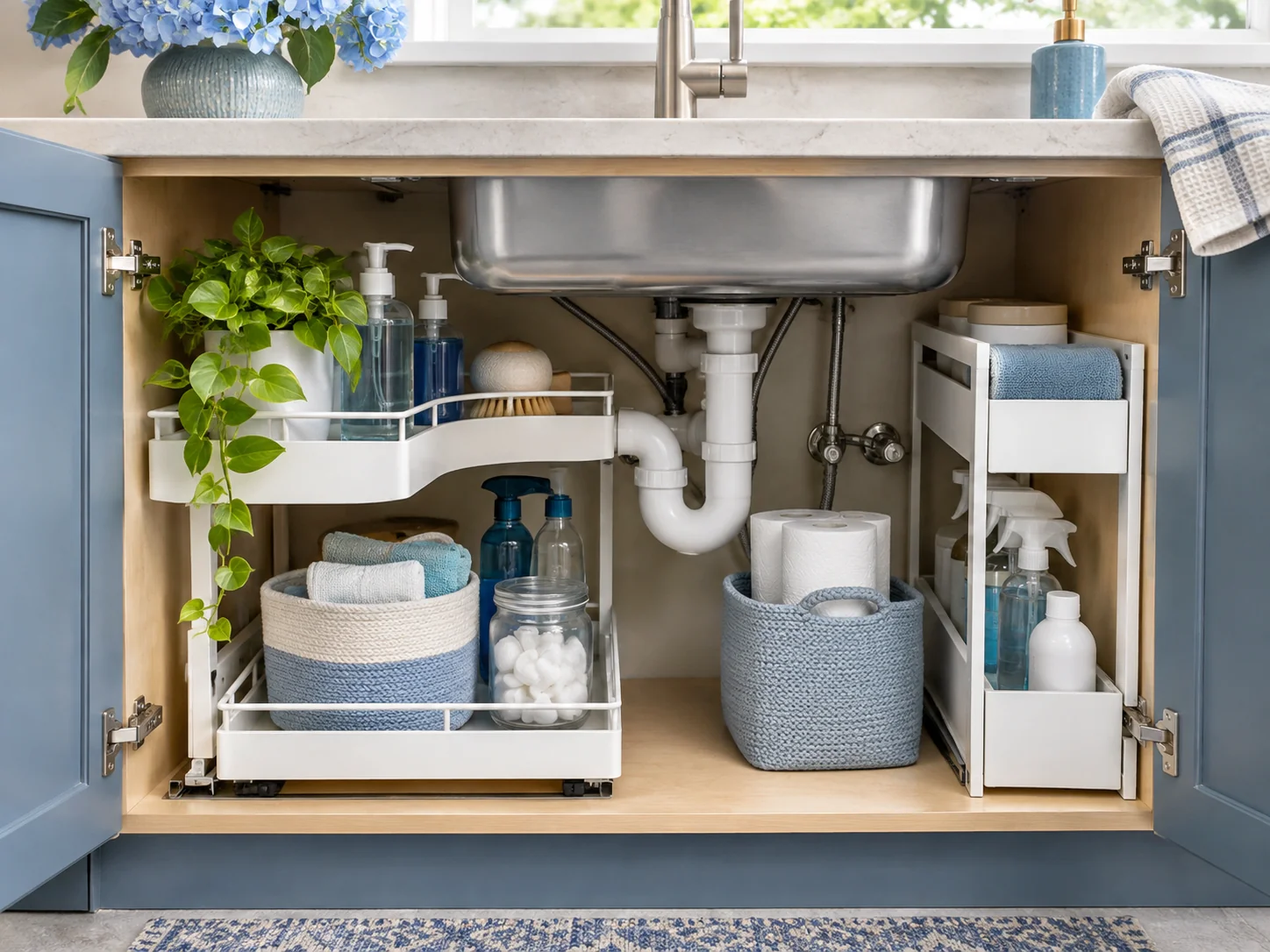
Explore 17 Amazon product listings across L-shaped organizers, expandable shelves, sliding drawers, compact vanity storage and protective cabinet mats. Learn to measure around P-traps, garbage disposals and tight cabinet openings before choosing a fit.
Measure the cabinet before comparing products
Remove loose objects temporarily and note the cabinet’s actual inner width, depth and height. Measure three separate widths—at the front, beside the waste trap and toward the rear—because supply lines and hinges often reduce the space available to a sliding system. Record the position of water shutoff valves, the drainage trap and any filtration device. A product that fits the external cabinet dimensions may still catch on a hinge or press against a pipe. Use cardboard to test the footprint before ordering.
If shopping online, examine the product’s assembled dimensions and the clearance required to extend drawers. Do not rely only on photographs showing an ideal empty cabinet. Check material, stated load rating, assembly requirements and return conditions. A two-tier unit that opens fully may be more useful than a taller system whose upper tray collides with the waste pipe.
Understand materials and moisture exposure
Under-sink cupboards can become damp from condensation, splashes or undetected leaks. Choose organisers made from materials suitable for a potentially moist environment and inspect their joints and coatings regularly. Metal components may corrode if finishes are damaged; wooden pieces may swell without adequate protection. Washable plastic can be practical, but make sure the organiser remains sufficiently rigid when loaded.
Place absorbent materials or leak indicators only where they do not obstruct plumbing access, and investigate any persistent wetness promptly. A tray may contain small spills but should not conceal a leaking connection. If you discover moisture damage or an ongoing leak, address the source rather than hiding it behind new baskets.
Keep cleaning products and children in mind
Do not turn the cabinet into an uncontrolled collection of hazardous household chemicals. Keep products in their original labelled containers, follow the manufacturer’s storage instructions and secure access where children or pets may reach them. Never mix cleaners or decant them into food or drink bottles. If bleach is used, remember that mixing it with acid or ammonia-containing products can release dangerous gases.
Organise by actual task while keeping incompatible substances and food-contact items appropriately separated. Place heavier containers on stable lower surfaces and avoid exceeding tray capacities. Check that accessing a bottle does not require reaching behind the pipes or pulling on plumbing. A safe cabinet is easy to inspect, not just tidy.
Test the organiser with everyday routines
Before considering the project finished, load the chosen trays with the actual items you use. Open the door fully, pull every drawer out and reach the valve without unloading the whole cabinet. Watch whether tall spray bottles catch on the shelf above, whether the unit shifts as you pull it and whether handles are comfortable to grip.
After a week, assess the system again. If an item remains awkward to reach, move it closer to the front or choose a different container. Some under-sink spaces work better with two independent shallow bins than one complicated frame. The right organiser is the simplest one that protects access to plumbing and makes everyday cleaning supplies easier to retrieve.
Under-sink organizer selection matrix
Measure the interior at three heights because plumbing reduces usable space unevenly. Record the pipe footprint, door hinges, valve access and any water filtration unit. Product dimensions describe the outer frame, not always the usable storage area. Before purchasing, check the seller’s current measurements, materials and return policy. Never install an organiser that loads or displaces plumbing, and never obstruct access to a shutoff valve.
| Problem or zone | Practical response |
|---|---|
| U-shaped shelving | Works around some central pipe arrangements |
| Sliding drawer system | Check hinges and full extension clearance |
| Expandable shelf | Measure around supply lines and shutoffs |
| Stackable bins | Choose if pipes leave usable open sections |
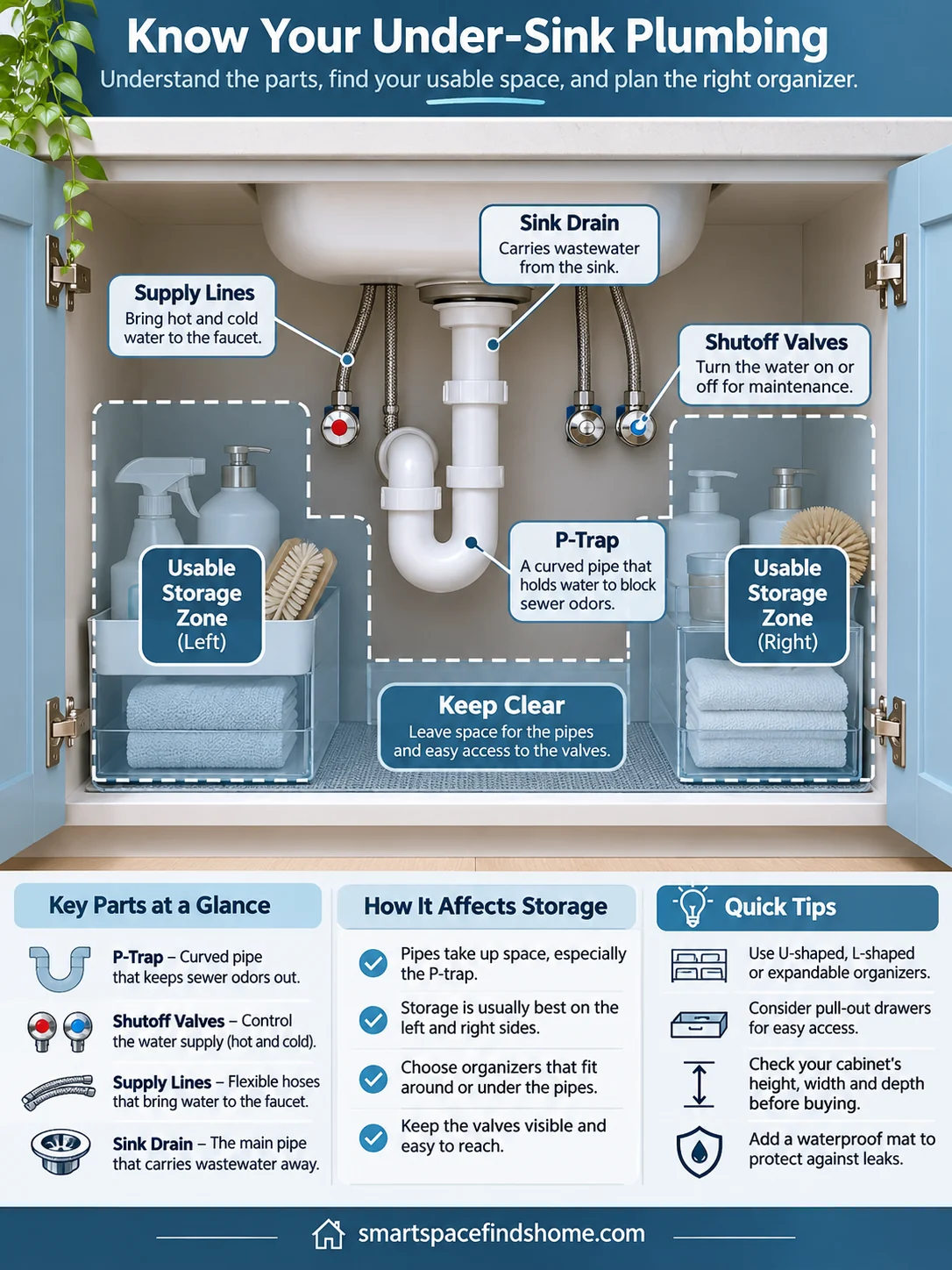
Finding the best under-sink organizers for cabinets with pipes starts with an awkward truth: the drain, P-trap, supply lines and sometimes a garbage disposal occupy different positions in every kitchen. A shelf that looks perfect in a product photo may block a valve or fail to clear the door opening. Instead of promising one universal solution, this guide compares multiple organizer styles and 17 specific product listings, with exact-fit checks before you buy.
Updated October 9, 2027. Product dimensions and stated features were checked against manufacturer information and specialist retailer specifications. We have not tested these products ourselves. Prices and stock can change; check the seller before ordering.
Editorial and affiliate disclosure: Some links elsewhere on Smart Space Finds may earn us a commission. The product links in this comparison lead to manufacturers or product-information pages and are not represented here as commission-paying links.
Start here: match the organizer to your plumbing layout
The six measurements that prevent expensive buying mistakes
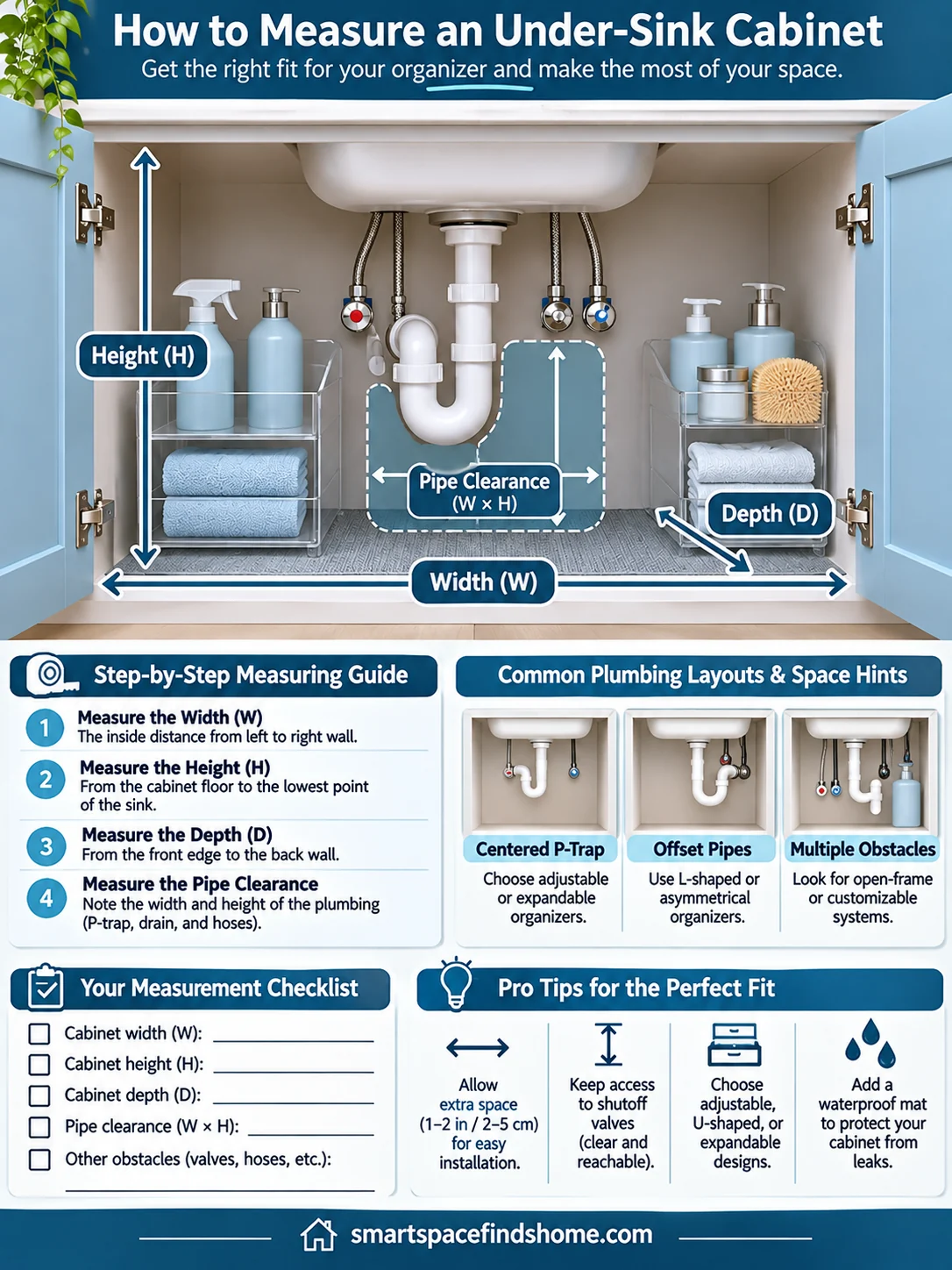
- Clear door opening: Measure between hinges, face-frame edges and door stops. This is often narrower than the cabinet interior.
- Floor-level width: Measure the unobstructed side-to-side span where the organizer’s feet will rest.
- Usable depth: Measure from the closed-door plane to the rear obstruction, accounting for the door closing against handles or baskets.
- Lowest height: Measure from the floor to the lowest obstruction, which may be the basin, P-trap, garbage disposal or hose loop.
- Pipe offset: Record the drain’s distance from the left and right interior walls, and its front-to-back position.
- Pull-out travel: Check that a drawer can pass the door hinge, cabinet lip and any protruding plumbing throughout its entire movement.
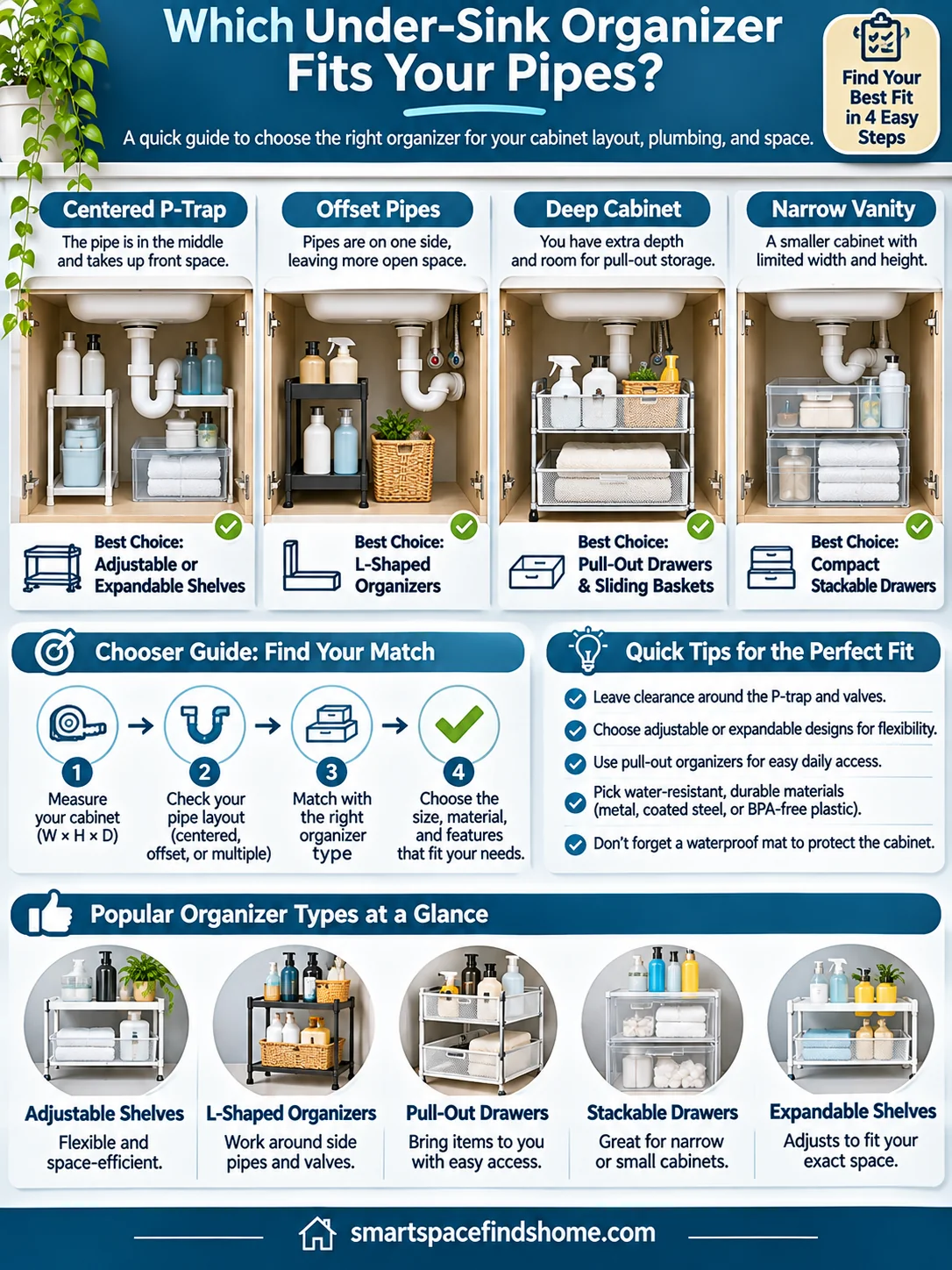
Under-sink organizer styles compared
| Style | Best application | Plumbing advantage | Main trade-off |
|---|---|---|---|
| L-shaped sliding rack | Offset drain or clear side zone | Partial upper tier can avoid piping | Orientation and sliding clearance matter |
| Expandable U-shaped shelf | Centered drain | Adjustable panels create a pipe opening | May obstruct valves at the back |
| Narrow pull-out drawer | Deep cabinet with clear side strip | Reaches stored items without leaning inside | Door frame and front lip may block travel |
| Rolling caddy | Renters and cleaning supplies | Removable; no permanent attachment | Needs a clear rolling path |
| Turntable | Open circular side zone | Provides access without a full slide | Requires complete rotation clearance |
| Removable bins | Highly irregular pipe arrangement | Can be grouped around obstacles | Less vertical storage |
| Door-mounted rack | Very shallow cabinet floor | Keeps central floor clear | Must not hit pipes when door closes |
Buying criteria: what matters beyond the product photograph
Real storage space versus external dimensions
Compare the internal tray dimensions, not just the assembled rack size. A wide frame can have narrow usable baskets, and a raised handle can prevent the cabinet door from closing. For spray cleaners, check the actual vertical room between shelves with the bottle trigger attached.Steel, coated wire or washable plastic?
Powder-coated metal can be rigid and stable, although damaged coating may allow corrosion in damp cabinets. Plastic baskets are easy to wipe but can flex under heavy bottles. Wood and bamboo should be kept away from ongoing moisture. Choose materials based on the cabinet’s humidity and the load, not only appearance.Sliding stability and installation
Review whether the product is freestanding, adhesive-mounted or screwed to the cabinet floor. Freestanding drawers should not tip when extended with normal contents; anchored systems need a suitable mounting surface. For rental homes, removable caddies, turntables and adjustable shelves are generally easier to reverse.Maintenance and safe storage
Keep access to shutoff valves and plumbing connections. Do not store cleaning chemicals where children or pets can reach them; follow label instructions and use secure storage as appropriate. Store detergent pods according to their packaging instructions. Never place an organizer so that it conceals signs of moisture or presses against supply lines.Practical setups for four common cabinet problems
Small bathroom vanity with a central trap
Start with two washable narrow bins on either side of the trap. If there is a clear upper region, test an adjustable shelf with panels removed around the drain. Put daily-use toiletries at the front and reserve rear storage for infrequent, moisture-resistant supplies.Kitchen cabinet with a garbage disposal
Place one slim pull-out or rolling caddy on the side without the disposal. Measure the entire travel path, including the disposal’s outlet pipe. Keep electrical components and service access unobstructed. If the available clearance is extremely limited, use shallow bins rather than forcing a two-tier rack.Rental apartment with no-drill restrictions
Choose a removable caddy or turntable, then place a washable protective tray on the cabinet floor if appropriate. Avoid permanent adhesive if the finish is delicate. The complete arrangement should be removable for leak inspection without tools.Deep cabinet with hard-to-reach supplies
Use a sliding system only when the door opens wide enough for full extension. If the door geometry blocks a drawer, consider lift-out bins with front-facing handles. Label their contents by use—everyday cleaning, sponges and backup supplies—so nothing gets lost behind the P-trap.Five-minute fitting checklist before checkout
- The product’s exact variation matches your measured opening, depth and height.
- The cabinet door can close and open while the organizer is loaded.
- The organizer avoids every drainpipe, supply line, hose and electrical component.
- The entire drawer or rolling path clears hinges and the cabinet-floor lip.
- Water shutoff valves remain reachable without dismantling the installation.
- Heavy products stay low, within the manufacturer’s stated load limit.
- Cleaning chemicals remain securely stored in their original containers.
- Returns and assembly requirements are acceptable if fit is uncertain.
THE SMART SPACE FINDS FIELD GUIDE · 2027
A better fit starts with the pipes, not the product.
Don’t buy another organizer that fits the cabinet but collides with the P-trap. Use the measurement system, plumbing-first comparison and installation tips below to choose storage that remains practical after the doors close.
DESIGN YOUR STORAGE AROUND REAL PLUMBING
Find your cabinet layout
Use the physical position of the drain and valves as your starting point. These are fit-based suggestions, not claims that any particular product is universally compatible.
Go adjustable
Consider an expandable shelf with removable slats or matching slim bins on both sides of the P-trap. Leave valves visible.
Use an L-shape
An L-shaped organizer may reclaim side space when the upper tray avoids pipes. Verify left/right orientation.
Keep it narrow
A single-level caddy or side-zone pull-out is often more realistic than a tall central shelf.
EDITOR’S FIT RULE
Measure twice: once for the organizer at rest, and again for the entire path it travels when opened.
Common under-sink organizing mistakes to avoid
Even the best-looking under-sink organizer can underperform when the cabinet has a central P-trap, raised base lip, deep basin or exposed shutoff valves. The most expensive mistake is shopping by the cabinet’s exterior dimensions. Internal frames, pipes, hinges and an inset door can all reduce usable storage. Confirm the actual model dimensions and measure clearance in three dimensions before purchasing.
Ignoring the cabinet’s door geometry
Pull-out drawers and rolling caddies require a clear exit path, not merely a space large enough to sit on the cabinet floor. Open the door to its normal maximum angle. Measure the clear opening after accounting for concealed hinges and face frames. Then simulate the front-to-back travel of the drawer with a cardboard footprint. A perfectly sized organizer can still be impossible to extend if the door opening is too narrow.
Using every inch of height
Under-sink shelves must coexist with plumbing that may curve downward and toward the rear wall. Keep a safe, accessible margin around water supply lines, drains and filters. Do not force a shelf against a hose to squeeze in a second tier. Always prioritize unobstructed access for inspection and maintenance over maximum theoretical storage volume.
Mixing items that should be stored separately
Divide contents into useful zones: everyday tools, sealed backups and products requiring secure storage. Follow each cleaner’s label instructions, keep chemicals in original packaging, and prevent access by children or pets. Under-sink storage can be convenient, but convenience should never override storage guidance on the product itself.
Under-sink organizer ideas for renters and small apartments
Renter-friendly under-sink storage favors reversible solutions. Freestanding baskets, washable modular bins, small turntables and rolling caddies can usually be lifted out for leak checks without removing hardware. They also move more easily between apartments with different plumbing layouts. Avoid permanent adhesive or drilling unless permitted by your tenancy and appropriate for the cabinet finish. Check that a removable mat does not trap standing water beneath it.
For a narrow vanity, group tall bottles in one stable, easily lifted container and use a second shallow bin for smaller items. In deeper kitchen cabinets, place frequently used supplies near the front, with seldom-used backups at the rear only when they can still be retrieved safely. If the P-trap divides the available floor into two uneven spaces, choosing two different-sized containers may be more space-efficient than forcing symmetry.
SMART SPACE FINDS · SMALL-SPACE STRATEGY
Clear access beats crowded capacity.
Your goal is not to fill every gap. It is to create storage you can reach, clean, inspect and maintain without tugging at plumbing or unloading the entire cabinet.
Best Under-Sink Organizers for Pipes: 17 Verified Amazon Product Pages
The following 17 product links were checked against their final Amazon ASIN destinations. Product names and variants were matched to the submitted links. Fit is never guaranteed: measure your cabinet and plumbing before ordering. These are researched selections, not hands-on tests; prices and availability can change.
L-Shaped & Pipe-Friendly Organizers
Best for cabinets with offset drains and pipes that leave a clear side zone. Check the orientation of every upper tray before choosing a model.
| Product | Best use | Fit priority |
|---|---|---|
| REALINN L-Shaped Pull-Out, Black, 1 Pack | Strong all-round option | Offset drain; compact single unit |
| REALINN L-Shaped Pull-Out, Black, 2 Pack | Two matching storage zones | Both cabinet sides have usable clearance |
| REALINN L-Shaped Pull-Out, White, 2 Pack | Light-finish multipack | Two clear side zones; white finish |
| REALINN Height-Adjustable, White, 1 Pack | Flexible vertical layout | Cabinet height varies around plumbing |
Adjustable & Expandable Under-Sink Shelves
Expandable shelving helps when a centered P-trap divides the cabinet. Adjust the shelf width and openings before placing anything near pipes or shutoff valves.
| Product | Best use | Fit priority |
|---|---|---|
| SimpleHouseware Expandable Shelf, Silver | Flexible shelving system | Centered plumbing; silver finish |
| SimpleHouseware Expandable Shelf, White | Bright cabinetry | Same adjustable concept; white finish |
| SimpleHouseware Expandable Shelf, Bronze | Dark-finish alternative | Same adjustable concept; bronze finish |
| Sevenblue Height-Adjustable, 2 Pack | Adjustable dual-unit setup | Sufficient height and floor clearance |
Pull-Out & Sliding Cabinet Organizers
Sliding designs make the back of a cabinet easier to reach, but only if the door opens wide enough and the drawer travels without hitting the frame.
| Product | Best use | Fit priority |
|---|---|---|
| Kitstorack L-Shaped Sliding Organizer, 2 Pack | Metal sliding design | Clear extension path around pipes |
| Sevenblue Sliding Organizer, 3 Pack | Multipack sliding system | Several narrow, accessible zones |
| Vtopmart Pull-Out Under-Sink Organizer, 4 Pack | Clear pull-out drawers | Bathroom or kitchen side compartments |
| Ukeetap Pull-Out Organizer, Black, 2 Pack | Compact removable pull-outs | Short cabinet or vanity opening |
Compact Bathroom & Vanity Storage
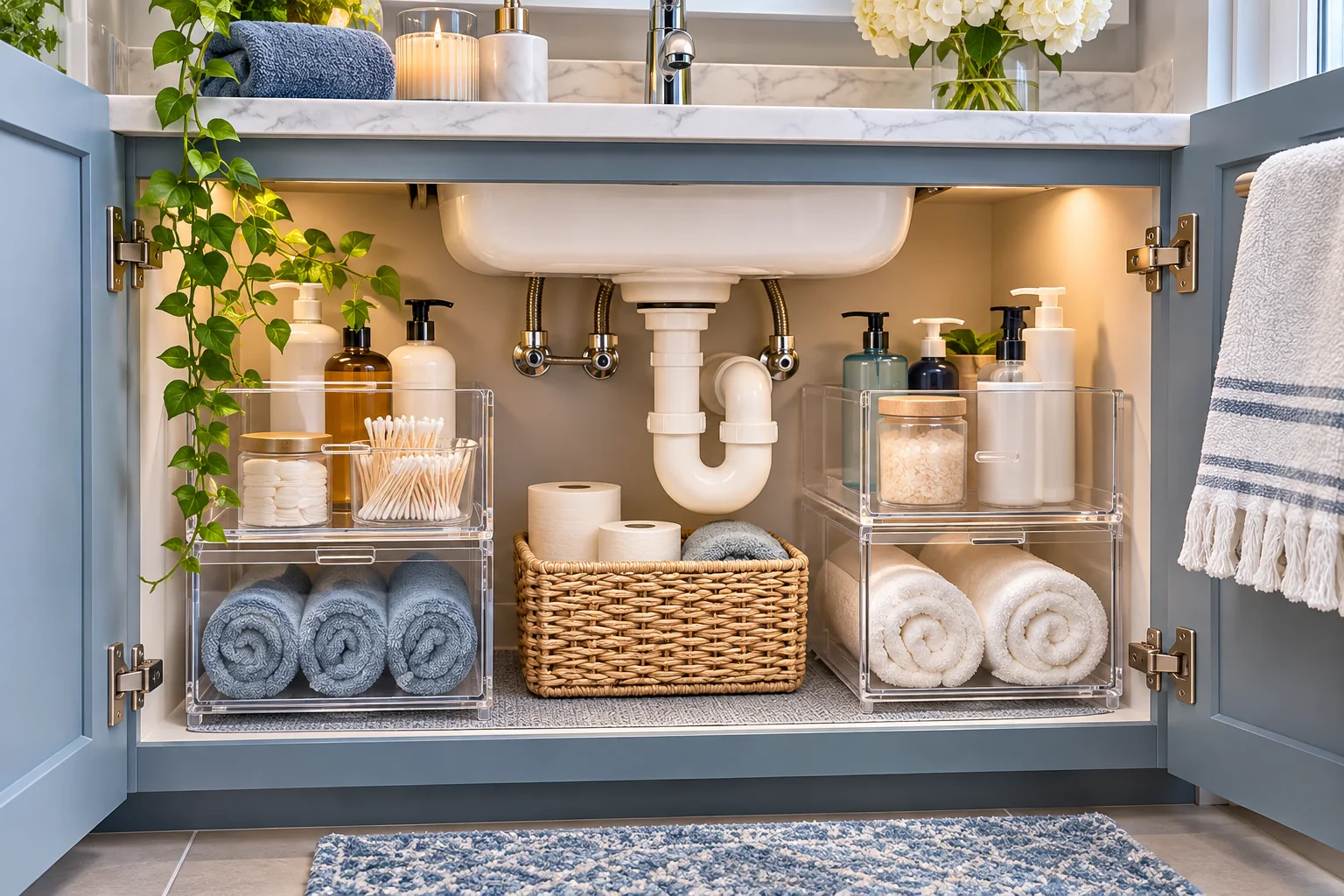
Transparent stackable organizers can work well in small vanity cabinets when the drain occupies the middle and toiletries fit along the sides.
| Product | Best use | Fit priority |
|---|---|---|
| Delamu Stackable Pull-Out Organizer, 2 Pack | Divided bathroom storage | Small toiletries; clear side zone |
| Vtopmart Small Clear Stackable Drawers, 4 Pack | Narrow clear storage | Shallow vanity sections |
| Vtopmart Large Clear Stackable Drawers, 4 Pack | Larger bathroom compartments | Wider clear space away from P-trap |
Waterproof Under-Sink Cabinet Mats
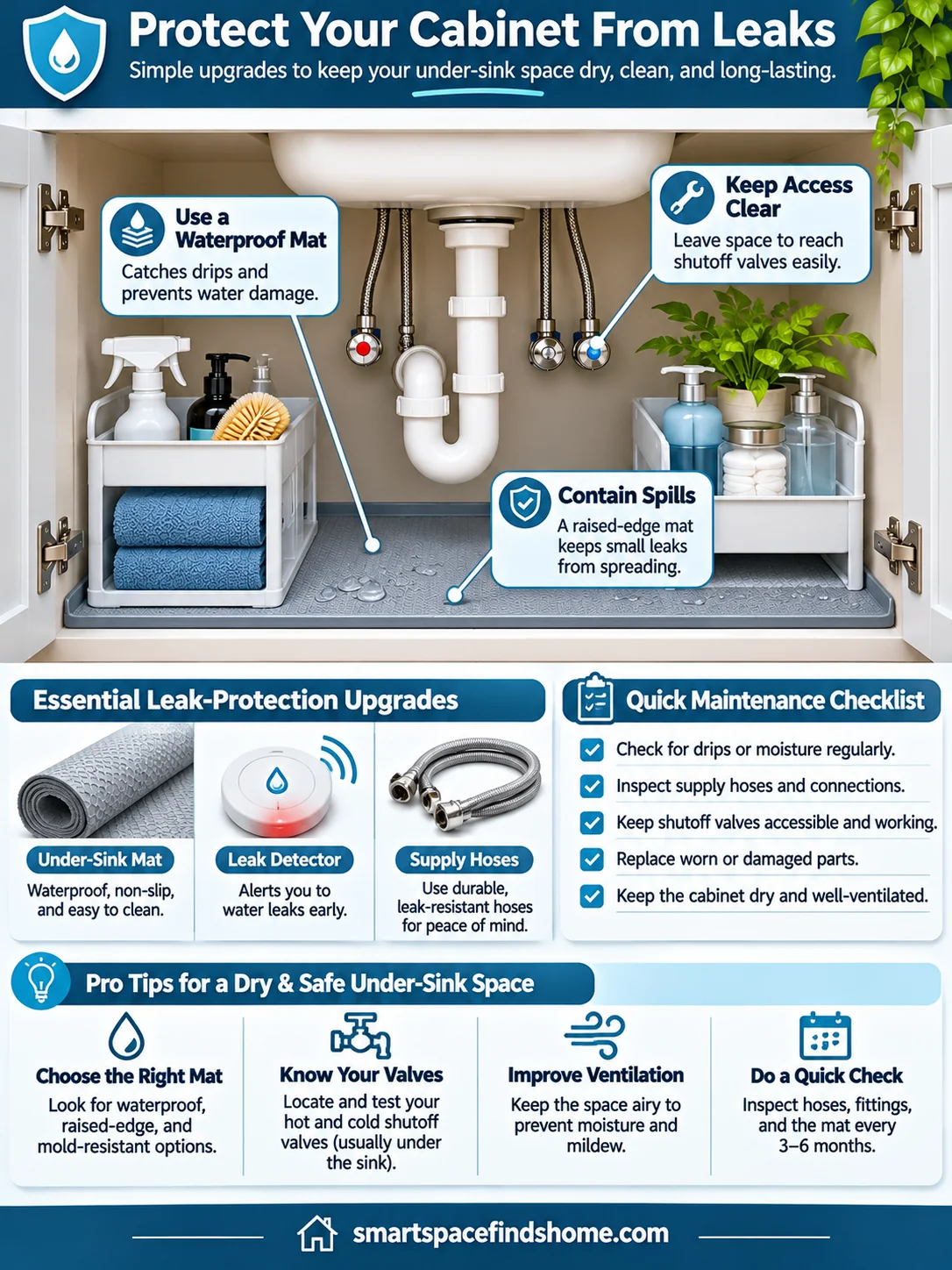
These are protective accessories, not organizers. Select a mat by exact cabinet floor measurements and ensure it can be lifted for inspection and cleaning.
| Product | Best use | Fit priority |
|---|---|---|
| Jin&Bao Waterproof Under-Sink Mat | Protective silicone liner | Cabinet floor dimensions |
| SIKADEER Waterproof Under-Sink Mat | Alternative protective mat | Cabinet floor dimensions |
Editorial note: The REALINN and SimpleHouseware entries include color and pack-size variations; these are alternatives within the same organizer families, not separate performance-tested winners. Manufacturer specifications take precedence over editorial descriptions.
Measure a cabinet with pipes before buying
- Clear opening width: measure between hinges, stiles and door stops—not just from outer wall to outer wall.
- Usable depth: measure from the closed door plane to the back panel, then subtract any pipes or hoses in the organizer’s path.
- Lowest overhead point: include the sink basin, disposal, P-trap and water connections when measuring usable height.
- Moving clearance: test drawer travel, rolling path or a complete turntable circle using a cardboard template.
- Service access: leave enough room to reach shutoff valves and inspect for leaks.
A useful trick is to sketch the cabinet from above. Mark the drain in the center, water lines near the rear wall and any disposal to one side. Then draw the organizer’s actual footprint—not the box dimensions. This five-minute exercise can prevent an expensive mismatch.
Which storage style works for your cabinet?
Plumbing down the middle: compare narrow rolling caddies on either side of the trap or a correctly oriented L-shaped organizer. Garbage disposal on one side: use the opposite side for a slim caddy or turntable if the full footprint is clear. Renter with limited depth: choose a removable bin or caddy over a mounted system. Cabinet packed with refills: move surplus products elsewhere first; organization cannot compensate for a blocked service area.
Safety and maintenance: what not to do
Do not hide an active plumbing leak under a waterproof mat. Dry the cabinet and repair the source first. Never combine household cleaning chemicals, and keep them in their original labeled containers. A tray can capture ordinary drips from a bottle, but it is not a substitute for checking pipes. Inspect the cabinet periodically and keep plumbing accessible.
Frequently asked questions
Can a two-tier organizer fit around a garbage disposal?
Sometimes, but only when the organizer’s geometry and full pull-out travel clear the disposal. A product labeled ‘under sink’ is not automatically compatible with your plumbing layout.
Which organizer is easiest for renters?
A removable caddy or turntable avoids screw holes. Even tool-free organizers should be measured against hinges, cabinet lips and the plumbing.
Do I need a 12-inch-wide cabinet to use a 12-inch turntable?
You need more than a nominal 12-inch opening if anything obstructs its rotational path. Measure the clear floor area and allow your bottles to rotate without striking pipes.
Should I store food or paper goods under the sink?
A kitchen sink cabinet is vulnerable to moisture and spills. Keep food and moisture-sensitive paper goods in a dry pantry or another suitable storage location.
Final verdict
For offset plumbing, start by comparing the REALINN L-shaped organizers and check tray orientation. For centered drains, explore the SimpleHouseware expandable shelves. In deep cabinets, consider Kitstorack or Sevenblue sliding organizers, provided the drawer has full extension clearance. In smaller vanities, the Delamu or Vtopmart drawer units may be easier to position. Always measure the cabinet before ordering; when your cabinet is mainly full of consumables. The best organizer is the one that fits your measured cabinet safely.
Keep organizing: Read our nine practical under-sink organization ideas, small-kitchen space-saving guide, and bathroom storage ideas for tiny spaces.