

When an apartment has no hallway, the living room can become a place for shoes, bags and keys. A compact landing zone creates a reliable routine beside the door while keeping the room comfortable and the exit clear.
Small-space design guide
No hallway? You can still create an intentional entryway.
A successful apartment entryway drop zone needs just three things: a predictable landing spot for keys, a safe place for everyday bags, and contained space for daily shoes. Design around the door swing and your real habits before you buy furniture.
Best starting point: Measure first, choose a no-drill or wall-mounted layout, then add only storage you can keep tidy in two minutes.
Step 01
Measure
Check usable depth, door swing and clear walking space.
Step 02
Choose
Match storage to the wall, rental rules and daily essentials.
Step 03
Simplify
Keep daily items accessible and reset the zone each evening.
How to Build a Drop Zone Without a Hallway
Define the Landing Spot
In an apartment where the front door opens directly into the living room, the first challenge is to prevent bags, keys and shoes from spreading across the sofa and dining table. Find a narrow area close to the door but clear of its swing. A drop zone needs space for only the objects used at every arrival and departure. Observe the household for a week: where do keys land, which shoes remain by the door and what needs charging or checking before leaving? Build the system around those habits rather than a large hallway furniture set.
Protect the Door Clearance
Open the front door completely and mark the safe walking route to the main room, kitchen and any required exit. Avoid benches and cabinets that narrow the entry when doors or drawers are open. Even a narrow console can make grocery deliveries awkward if it projects too far into the path. Measure the wall, skirting boards and available depth before ordering furniture. Test a cardboard footprint, then walk through while carrying a bag. A good drop zone keeps the first few steps into the home simple and safe.
Keep Keys on One Predictable Hook
Keys are easiest to find when they have one consistent home, ideally away from the outer reach of a door or window. A small dish on a stable shelf is an alternative where wall hooks are not permitted. Do not attach heavy objects to an adhesive hook with an insufficient load rating. Keep spare keys stored securely rather than openly labeled with an address. If several people share the home, assign a clearly separated spot for each set. The goal is to stop the daily search without turning the wall into a dense display of hooks.
Create a Practical Bag Zone
Choose one sturdy hook, narrow shelf or freestanding stand appropriate for the bags most often carried. A daily tote needs less space than a heavy backpack with a laptop. Keep shoulder straps off the floor and away from door handles, but avoid hanging several loaded bags from a lightweight fitting. If you use a bench, ensure its top remains available for sitting rather than being permanently covered by belongings. Secondary bags can go in a bedroom closet. The first landing zone should hold today’s necessities, not every handbag or backpack in the household.
Manage Shoes With a Realistic Limit
A door-opening living room often lacks space for a full shoe cabinet. Keep one or two daily pairs per person in a shallow tray or suitably sized slim rack, moving seasonal and occasional footwear elsewhere. Measure how far shoes project into the walking path. Avoid unstable vertical stacks that can topple when a pair is removed. If rainy weather is common, include a waterproof boot tray and clean beneath it regularly. Small entries look calmer when shoes are organized by actual use instead of displayed as a permanent collection.
Separate Wet and Dry Items
Raincoats, wet umbrellas and damp footwear should not share a closed basket with dry wallets, scarves or paperwork. Create a washable catch area for moisture and move garments to a suitable drying location if there is not enough ventilation by the door. A shallow tray handles drips more effectively than a decorative fiber basket. Inspect flooring for trapped water and follow furniture material care instructions. Once everything is dry, return accessories to their everyday places. Moisture management matters even when the entry occupies only one wall of the living room.
Use a Narrow Console Carefully
A shallow console can define the entrance visually and hold a key dish, mail tray and perhaps a small lamp. Check its internal and external measurements, stability and whether any drawers open into the path. Tall furniture may need manufacturer-specified anti-tip securing. Do not load the top with decorative objects that must be moved every time someone comes home. A compact shelf and hooks may work better than a console when the room is exceptionally tight. Furniture should support arriving home with full hands, not make it more difficult.
Keep Mail Out of the Living Room
Loose envelopes, receipts and flyers quickly make a drop zone feel messy. Provide one small incoming paper tray, then set a recurring time to sort its contents. Recycle unwanted mail, file important documents in a secure location and move bills to an appropriate system. Do not keep sensitive identity papers beside the front door. A one-inbox rule works better than separate baskets for every type of paperwork. The drop zone is a temporary landing point, not a permanent archive or office.
Plan Charging Without Unsafe Cords
Some households want a charger near the entry for headphones, a phone or a bicycle light. Only add a charging location where there is a suitable outlet and a stable dry surface. Keep cords away from the door swing and walking path, and do not run ordinary power cables under mats or rugs. Follow device charging instructions and keep batteries away from excessive heat. If no safe outlet is available, move charging to another room rather than stretching an extension cable across the entrance. A tidy charging setup is worthwhile only when it is safe.
Add a Mirror When It Serves a Purpose
A compact mirror can be useful for a final check before leaving and may visually brighten the entry. Position it where it cannot be struck by the opening door or heavy bags. Use appropriate secure mounting or a stable freestanding design. Avoid placing fragile mirrors on a narrow shelf where they could slide. The mirror does not need a surrounding collection of ornaments. One useful object is enough to make the landing area feel intentional while preserving wall and floor space for daily routines.
Make the Drop Zone Rental Friendly
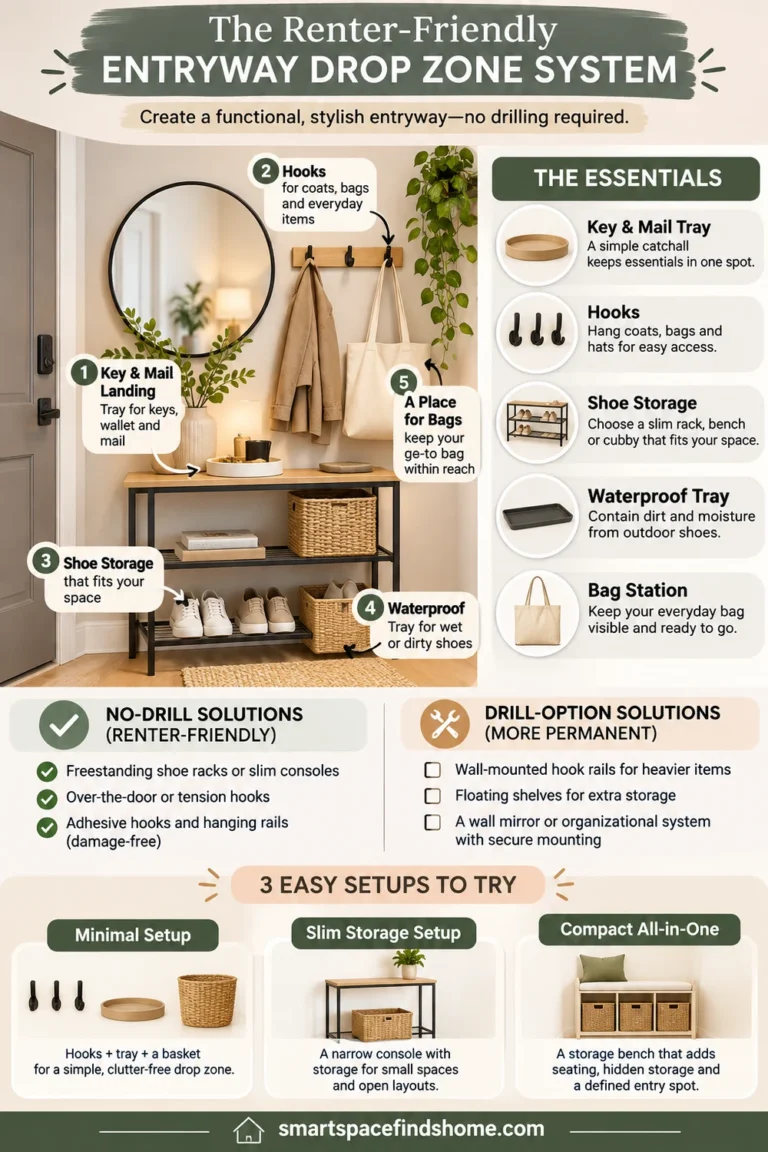
If drilling is restricted, choose stable freestanding furniture, a small surface tray and manufacturer-approved removable solutions suitable for the actual load. Check landlord rules before attaching rails or hooks. Over-door organizers can be helpful, but must allow the door to close and its seals to work properly. Protect flooring underneath stands and photograph the original condition. A reversible design is successful only if it stays practical over time and does not endanger visitors or damage the rental property.
Use a Two-Minute Reset
At the end of each day, return keys, empty the mail tray of rubbish and move extra shoes out of the entry path. Hang bags and remove damp clothing to an appropriate drying area. Once a week, wipe the key dish and sweep grit from the floor. Check that no accessories have expanded beyond their allotted space. If objects repeatedly collect on the dining table instead, relocate the landing tray to a more natural position rather than blaming household habits. An effective drop zone should become almost automatic.
01 / Layout solutions
Choose the Best Drop Zone for Your Floor Plan
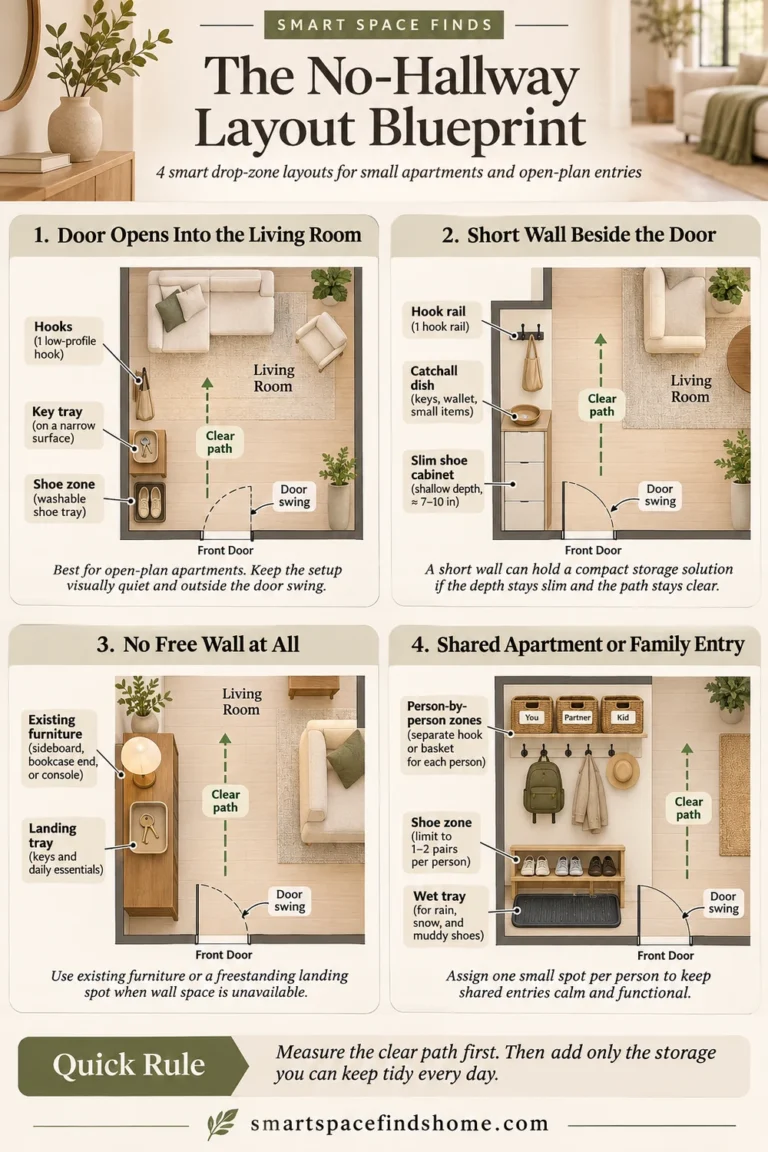
Start with your available depth, not with furniture you like. Measure the clear wall width, how far the front door swings, and the path people take with groceries or a stroller. Use painter’s tape to test a proposed footprint before buying anything. Keep all required exit routes and door operation unobstructed.
1. Door Opens Straight Into the Living Room
Keep the landing zone visually quiet: a small key tray on existing furniture, one low-profile hook if the mounting surface and load permit it, and a washable shoe tray tucked outside the walking route. Avoid creating a bulky second furniture wall.
2. Only a Short Wall Beside the Door
Try a shallow wall shelf with a catchall dish or a narrow, stable shoe cabinet that fits the actual available depth. Double-check baseboards, outlets, hinges, and how far cabinet doors or drawers extend when opened. Secure tip-prone furniture according to its manufacturer instructions.
3. No Free Wall at All
Use the end of an existing bookcase, a corner of a sideboard, or a stable freestanding tray near the natural route into the room. Do not hang loaded organizers on fire-rated or shared-access doors where they interfere with hardware, latching, or seals.
4. Shared Apartment or Family Entry
Assign each person one clearly defined hook or container and a realistic limit for daily shoes. Add a separate washable wet-weather landing area, and put overflow bags and off-season footwear in a closet.
02 / The buying edit
What to Buy: Small Entryway Drop Zone Essentials
Buy only the pieces that solve recurring problems. The ideal setup is usually a combination of one landing surface, one reliable place for bags or keys, and one contained shoe area—not a full entryway furniture set.
| Product type | Best for | Before buying |
|---|---|---|
| Key tray or catchall | Rentals and zero-wall entries | Non-slip base; easy-clean finish; secure placement |
| Removable lightweight hooks | Keys and light accessories | Actual substrate, removable adhesive instructions, verified load limit |
| Wall-mounted hook rail | Coats and bags where drilling is permitted | Correct anchors, stud location and combined rated load |
| Slim shoe rack or cabinet | Keeping daily footwear contained | Closed-door and open-door depth, tipping risk, shoe size |
| Waterproof boot tray | Rainy climates and wet shoes | Raised edges, cleanable surface, floor ventilation |
| Narrow console or wall shelf | A defined landing surface | Depth, clearance, secure mounting, drawer swing |
| Small mail sorter | Incoming papers only | One easy-access compartment; no exposed private documents |
Shopping rule: never assume a “slim” product will fit. Compare its listed product dimensions with your taped floor plan, including room to pass when the unit is in use. Product availability, finishes, and dimensions can change; verify the exact Amazon US listing before purchasing.
Curated Amazon US finds · 1 of 3
Everyday Drop Zone Essentials
Small-format landing spots and hooks for keys, everyday bags and accessories. Check mounting rules, door clearance and the load rating before buying.
Affiliate disclosure: As an Amazon Associate, Smart Space Finds earns from qualifying purchases. Product availability and specifications may change; confirm the exact option on Amazon before ordering.
Lwenki Key Holder with Shelf
Wall-mounted key organizer with a small landing shelf.
Product A01 · ASIN B09ZRT5QPG
Command Medium Designer Hooks — 2-Pack
Removable-hook option for compatible surfaces and lightweight items.
Product A02 · ASIN B0000CFLYU
Umbra Sticks 5 Wall Hook
Fold-away wall hook design; appropriate mounting required.
Product A03 · ASIN B005M8YWOK
Optish Over-the-Door Hooks
Black over-door organizer with 12 hooks; check door thickness and closure.
Product A04 · ASIN B0BR8SX468
pickpiff Self-Adhesive Metal Hooks
Matte-black adhesive hooks; follow surface and load instructions.
Product A05 · ASIN B0CYGW31BV
Hanobe Round Wooden Decorative Tray
Wood-look catchall tray for keys, wallet and small accessories.
Product A06 · ASIN B09LQB2PR2
Three Practical Starter Setups
Minimal No-Drill Setup
Use a washable tray on existing furniture, a small boot tray, and a freestanding bag holder only if stable and outside the exit route. This minimizes wall damage and unnecessary purchases.
Compact Wall Setup
Pair a securely installed hook rail with a narrow shoe organizer and a tiny key shelf. Place each piece at a comfortable reach height without crowding switches or the door handle.
Discreet Designer Setup
Choose one shallow closed shoe cabinet in a finish that coordinates with the living room, a simple mirror placed clear of the door swing, and a small concealed catchall. Concealed storage works only when its doors and drawers can open safely.
Curated Amazon US finds · 2 of 3
Compact Shoe Storage & Wet-Weather Solutions
Keep daily shoes contained without making the doorway feel like a storage aisle. Measure usable depth and any drawer opening clearance.
ROMGUAR CRAFT 3-Tier Bamboo Shoe Rack
Open bamboo shoe organization for a dedicated wall section.
Product B01 · ASIN B0C3R76MWB
SONGMICS 3-Tier Metal Shoe Rack
Multi-tier metal rack for everyday footwear; check the unit width.
Product B02 · ASIN B08MJMN4Q9
BORNOON 3 Flip-Drawer Shoe Cabinet
Closed flip-drawer storage; secure against tipping as instructed.
Product B03 · ASIN B0CBRBVL61
VINGLI Fluted 2-Drawer Shoe Cabinet
Fluted-front shoe storage for an entry visible from the living room.
Product B04 · ASIN B0F1CCMGRD
Matace Rubber Boot Tray
Washable wet-shoe tray; verify dimensions and whether it lies flat.
Product B05 · ASIN B095SKKQ96
WATANIYA PET Small Boot Trays — 2-Pack
Pair of compact raised-edge trays for wet footwear.
Product B06 · ASIN B09ZL86Q1J
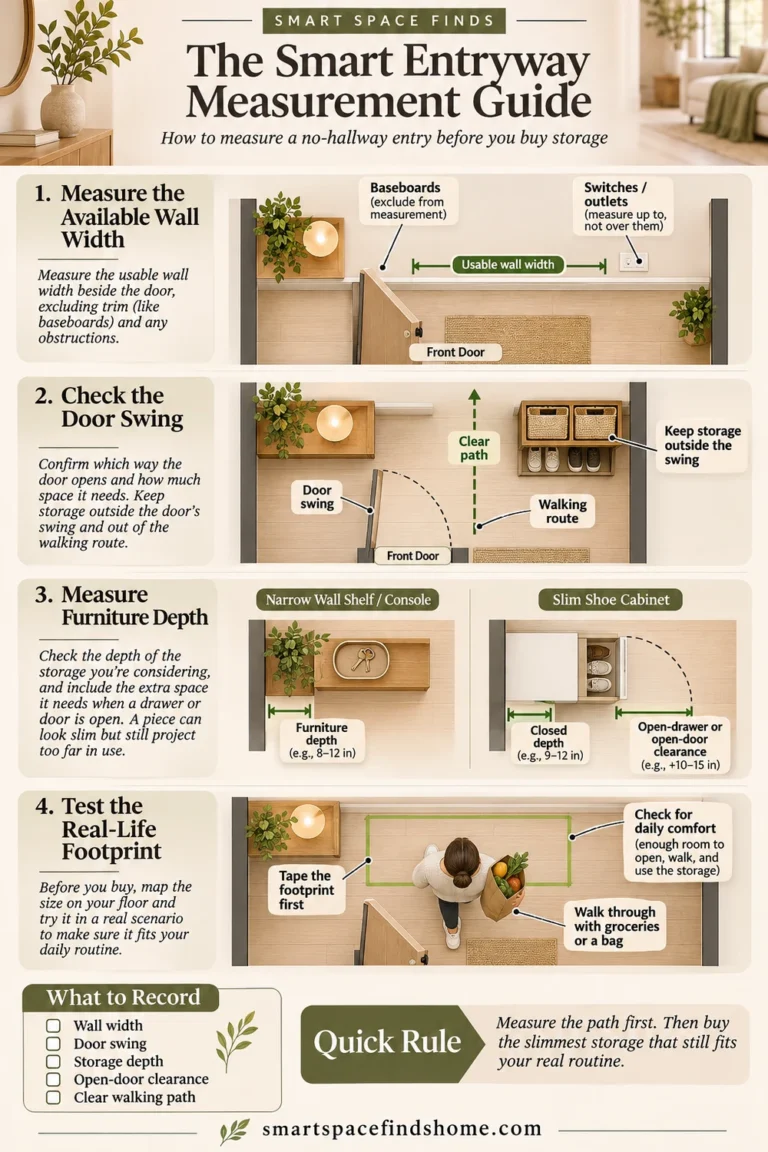
Small Entryway Dimensions: Measure Before You Shop
There is no universal console depth that works in every apartment. Start by measuring the usable wall section and the clear passage with the front door opened fully. Record baseboard projection, door hardware, switches, vents, and the space required to open any cabinet front.
- Wall width available: ____ inches
- Maximum usable furniture depth: ____ inches
- Door swing clearance: ____ inches
- Space remaining when drawers or doors open: ____ inches
- Daily shoes and bags to store: ____
Check your building’s applicable access and egress requirements rather than treating any generic clearance number as a code-compliant minimum.
Curated Amazon US finds · 3 of 3
Narrow Consoles & Space-Saving Entryway Furniture
For apartments with sufficient wall width and an unobstructed route: avoid bulky pieces and check their actual assembled dimensions.
HOOBRO Narrow Console Table BF75XG01
Slim console for a key tray or small catchall.
Product C01 · ASIN B09NL1RH4D
HOOBRO Console with 2 Fabric Drawers BF72XG01
Entryway console with concealed drawers for daily essentials.
Product C02 · ASIN B0C1P1XWCT
SONGMICS Bamboo Shoe Bench ULBS604W01
Shoe bench for entries wide enough to allow comfortable sitting.
Product C03 · ASIN B088D76W2H
VASAGLE LIRY Narrow Console with 3 Drawers
Long shallow console; appropriate for entries with more wall width.
Product C04 · ASIN B0F7R8PK7G
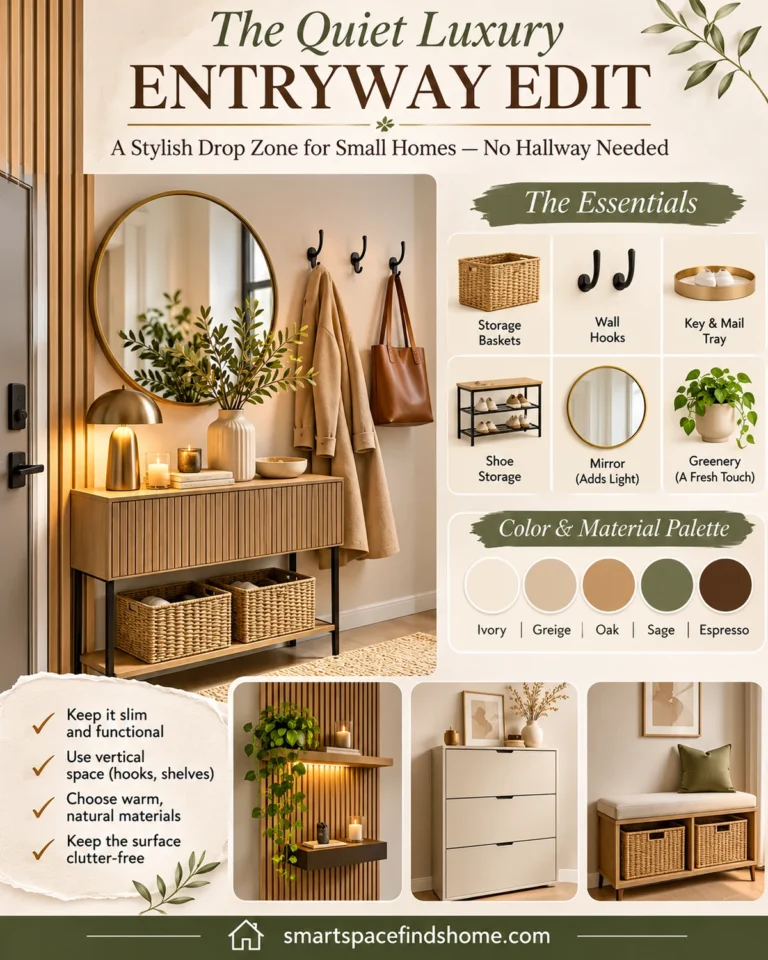
How to Make a Visible Entryway Look Calm
Because the entry is part of the living room, storage should look like an intentional extension of the room—not a separate mudroom squeezed into it. Repeat one wood finish from existing furniture, use a restrained palette of warm white, oak, and charcoal, and limit the top surface to a tray plus one useful item. Closed storage hides visual noise, but only if it does not block the walking route or make everyday shoes difficult to reach.
Use a single mirror to reflect light where it can be safely mounted. Give frequently used objects an obvious home; put occasional accessories in a closet. A small apartment entryway is successful when it is easy to use with one hand while carrying groceries, not just when it photographs beautifully.
Common Drop Zone Mistakes to Avoid
- Buying a console before measuring: A slim product photo cannot tell you whether a drawer will block the route.
- Using adhesive hooks for loaded backpacks: Match the actual weight, wall surface and manufacturer’s installation instructions.
- Storing every pair of shoes at the door: Keep everyday pairs only and rotate seasonally.
- Mixing wet shoes and papers: Keep washable wet-weather storage separate from dry items.
- Building a decorative display instead of a system: Keep the essentials immediately accessible, with no need to rearrange ornaments.
- Ignoring children and pets: Secure tall furniture, avoid easily toppled accessories and keep small items appropriately out of reach.
Five-Minute Installation Checklist
- Open the door fully and confirm an unobstructed route to the exit.
- Check furniture depth with drawers and doors open, not just closed.
- Identify the wall material and follow the manufacturer’s fastening and load instructions.
- Keep heavy bags off unverified adhesive hooks.
- Place wet shoes on a washable tray rather than against absorbent furniture.
- Test the setup with normal groceries, backpacks, and daily traffic.
- Store spare keys and sensitive mail away from public view.
For related small-space ideas, explore our home organization guides, small-space planning ideas, and curated Amazon Finds.
03 / Your questions answered
Frequently Asked Questions
How do you create an entryway when the front door opens directly into the living room?
Choose one compact spot immediately beside the door, outside its swing and the walking route. A catchall tray, a safe location for bags and a small shoe tray are often enough. Use the same finishes as nearby living-room furniture to keep the transition visually cohesive.
What furniture works best for a narrow apartment entry?
Try existing furniture first. If you need a new piece, compare shallow consoles, compact shoe cabinets or wall shelves using their real dimensions, including clearance when doors or drawers open. Stable furniture and correct anti-tip installation are essential.
Can I make an apartment drop zone without drilling?
Yes. Use a stable catchall tray on an existing shelf, a washable shoe tray, and freestanding storage sized for the available footprint. Removable hooks are suitable only for compatible surfaces and loads, following the product directions and rental rules.
Where should shoes go in an apartment without a hallway?
Reserve space for the everyday pairs actually worn. A shallow washable tray or compact rack can work if it stays clear of the exit route. Store seasonal and occasional footwear elsewhere, and dry wet shoes before putting them in enclosed storage.
How do I keep an entryway drop zone organized every day?
Give keys, bags and shoes one assigned place each, cap the amount of storage, and do a two-minute reset in the evening. If objects repeatedly land somewhere else, move the catchall to match the household’s natural routine.
Is a narrow console table always a good idea?
No. In a very small entry, a console may obstruct movement even if marketed as slim. Tape out its footprint and test the route with the door open and groceries in hand. A shelf or an existing sideboard may be the better solution.
More Small-Space Organization Ideas
Continue with 10 genius storage ideas for small spaces, discover closet shelf dividers and folding systems for off-season accessories, or see small living room media storage to keep shared living areas clutter-free.
Editorial note: Recommendations are based on practical spatial planning and safe installation principles. Always measure your apartment, follow manufacturer instructions and applicable building requirements, and verify product specifications before purchase.