
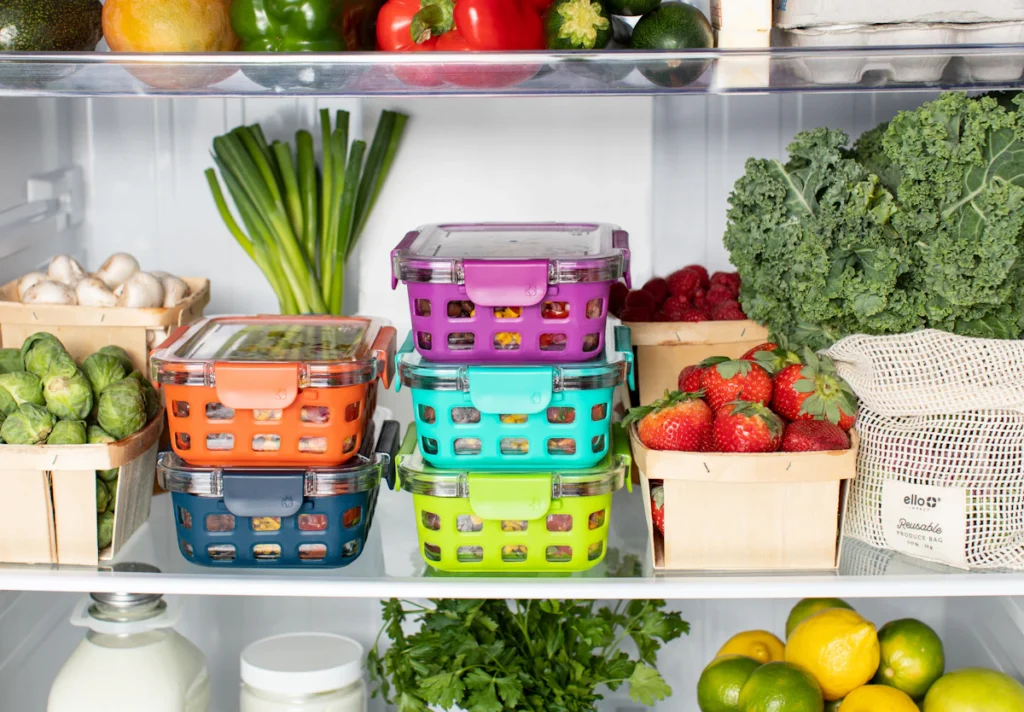
A small refrigerator can be easy to maintain without a full collection of matching organizers. The most useful system prioritizes food safety, visibility and realistic weekly routines. These ideas explain where to place ingredients, how to reduce forgotten leftovers and which accessories actually earn their space.
THE SMALL-SPACE EDIT • KITCHEN ORGANIZATION
A Fridge That Works Harder, Not Fuller
The best small fridge organization system keeps food cold, raw ingredients separated, everyday essentials visible, and enough flexible room for actual groceries. Start with the safe storage map below—then add organizers only where they solve a recurring problem.
Start With a Realistic Fridge Reset
An organized refrigerator should make food safer to store, easier to find and more likely to be eaten before it spoils. Start by taking out one shelf at a time, rather than leaving perishable food at room temperature while you redesign the entire appliance. Check use-by dates, discard food that is no longer safe and clean surfaces according to the manufacturer’s care instructions. Keep chilled food cold during the process. Once the shelves are dry, put back only what belongs in the refrigerator. Do not buy storage bins yet: an honest inventory shows how much space is really needed and which foods repeatedly get forgotten.
Check Temperature Before Thinking About Styling
The foundation of refrigerator organization is temperature control. Use the appliance’s instructions and a refrigerator thermometer to check that the compartment stays at 40°F (4°C) or below; for many households, aiming slightly below this limit provides a practical margin. Freezers should be maintained at 0°F (-18°C) or below. Temperature can fluctuate with frequent opening, warm groceries or an overloaded appliance. Avoid blocking the air vents and leave room for circulation. Never assume that a visually tidy shelf guarantees safe temperatures. If your refrigerator struggles to remain cold, investigate the appliance or arrange servicing rather than rearranging baskets alone.
SMART SPACE FINDS · CURATED AMAZON FINDS
Food-Safe Temperature Tools
A refrigerator thermometer is the most useful first purchase: storage bins cannot compensate for incorrect temperatures.
ESCALI AHF2 · D01
Glass Refrigerator / Freezer Thermometer
Tube · suction cups
Dedicated fridge thermometer to monitor storage conditions.
RIY · D02
Digital Refrigerator / Freezer Thermometer
White · LCD · max/min
Easy-to-read digital monitor for refrigerator temperatures.
TAYLOR · D03
Analog Refrigerator / Freezer Thermometer
5925N · 6-count pack
Bulk multi-pack option; confirm you actually need six thermometers.
As an Amazon Associate, Smart Space Finds earns from qualifying purchases. Check dimensions, current availability and product details before ordering.
Create Zones That Match the Refrigerator
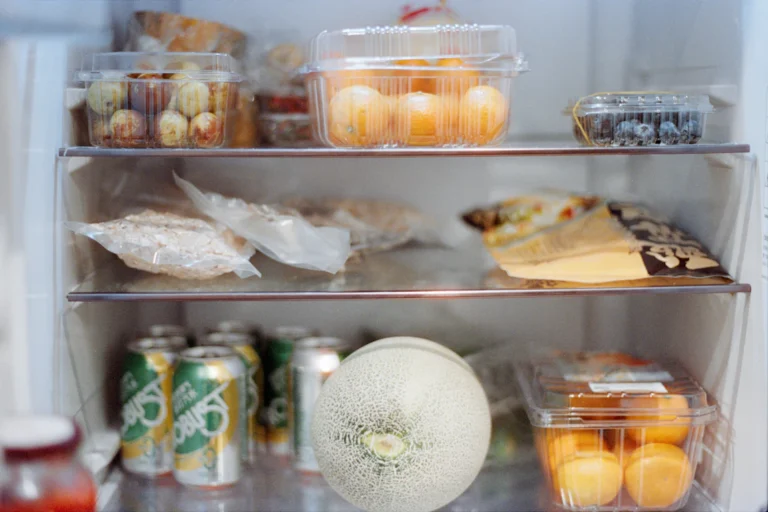
Instead of copying a uniform arrangement from social media, work with the refrigerator’s actual shelves, drawers and temperature guidance. Give ready-to-eat leftovers one easy-to-reach area, group dairy products together and use produce drawers for foods suited to their humidity settings. Reserve the most accessible space for items used every morning, but do not move temperature-sensitive products to a warmer location merely for convenience. Keep a small space for an upcoming meal so its ingredients do not disappear behind jars. Simple zones are easier to maintain than an elaborate system requiring every package to fit into a matching container.
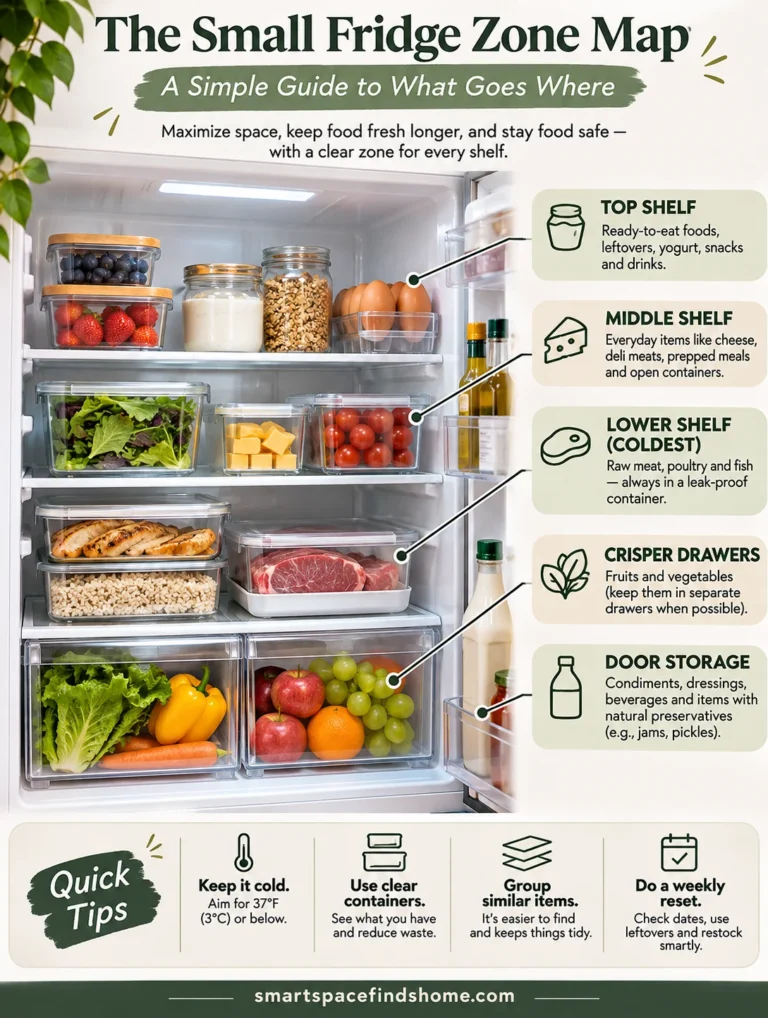
Practical reference • Save this chart
Where Should Everything Go in a Small Fridge?
Exact temperatures vary by appliance. Follow your refrigerator manual, use a thermometer, and place high-risk foods where cold temperatures are reliably maintained. The layout below is a practical starting point—not a claim that every refrigerator has the same coldest shelf.
| Fridge zone | Best use | Safety / space tip |
|---|---|---|
| Upper shelves | Ready-to-eat food, sealed leftovers | Keep visible; label cooking dates |
| Middle shelves | Milk, yogurt and frequently used chilled ingredients | Use a verified cold interior shelf, not convenience alone |
| Protected lower area | Sealed raw meat, poultry and seafood | Use a leakproof tray below ready-to-eat food |
| Crisper drawers | Produce suited to the drawer’s humidity | Separate produce where appropriate; avoid crushing greens |
| Door shelves | Condiments and suitable beverages | Typically less temperature-stable than interior shelves |
Food-safety reference: FDA refrigerator temperature guidance.
Store Raw Meat and Seafood Without Drips
Raw meat, poultry and seafood need careful separation from foods that will be eaten without further cooking. Keep them in sealed, leak-resistant packaging or a washable tray, typically on a low shelf where leaks cannot drip onto ready-to-eat food. Follow the refrigerator design and manufacturer guidance where a dedicated meat drawer is provided. Do not place a raw chicken package above salad greens, cooked food or desserts. Wipe spills immediately and wash hands and surfaces after handling raw products. For longer storage, freeze items promptly according to food-safety guidance rather than leaving them in the refrigerator for an uncertain number of days.
Give Vegetables and Fruit the Right Space
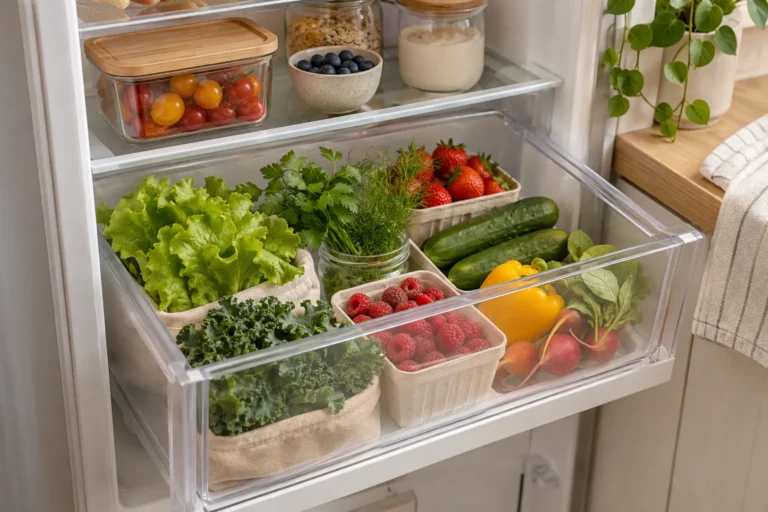
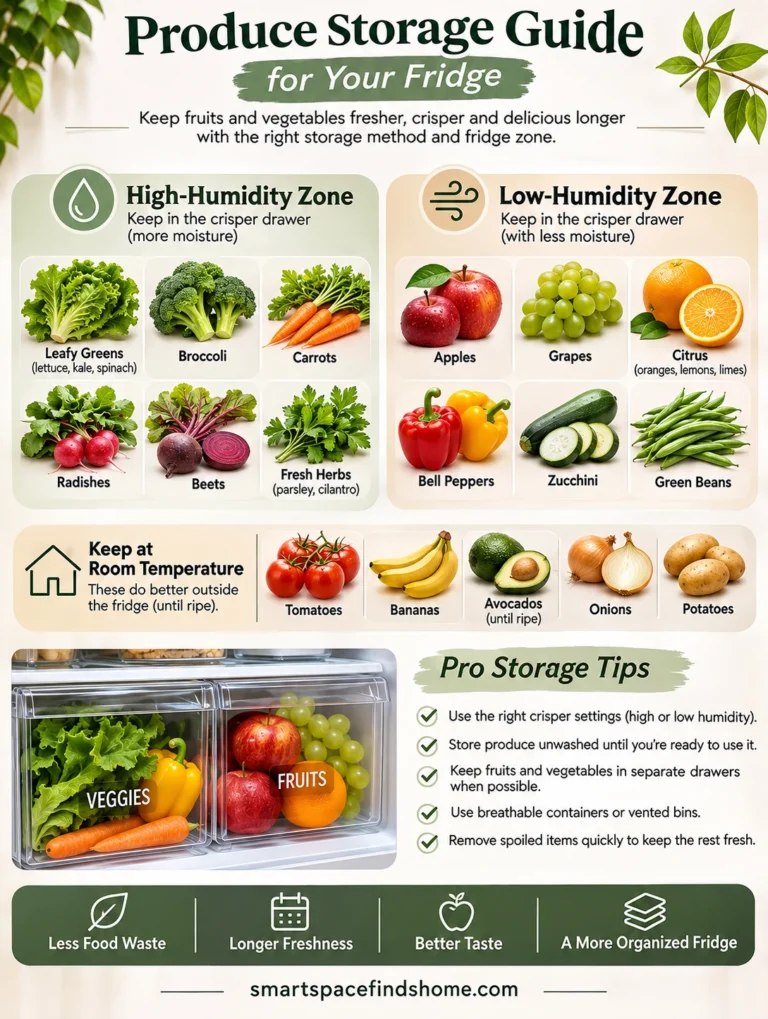
Crisper drawers help manage humidity, but they do not keep produce fresh indefinitely. Check the drawer controls and the needs of the food you buy most often. Leafy greens often benefit from higher humidity, while some fruits store better in lower-humidity conditions. Remove damaged produce, avoid crushing tender vegetables under heavy packages and leave enough space to inspect what remains. Some fruits release ethylene that can accelerate the ripening of sensitive neighbors; separating those foods can help. Wash produce when you are ready to use it, or dry it thoroughly before storage if you choose to wash ahead. Not every fruit or vegetable belongs in the refrigerator, so use appropriate storage guidance.
Freshness notes / keep what you buy
A Simple Produce Storage Cheat Sheet
The goal is not to refrigerate everything: different fruits and vegetables need different humidity, airflow and ripening conditions. Use the guidance below as a starting point, then follow packaging instructions for prepared or cut produce.
High-humidity drawer
Leafy greens, broccoli and many tender vegetables. Remove damaged leaves and keep excess moisture from pooling.
Low-humidity drawer
Apples and selected fruits that release ethylene. Separate from produce that ripens or spoils faster around them.
Outside the fridge
Whole potatoes and onions generally prefer appropriate cool, dry storage; unripe bananas typically ripen at room temperature.
Important: Cut fruit, prewashed packaged greens and other ready-to-eat perishables require prompt refrigeration according to their labels. Never rely on a decorative produce chart over product-specific safety instructions.
SMART SPACE FINDS · CURATED AMAZON FINDS
Fresh Produce & Crisper Storage
Choose produce savers only if they fit your drawers and the foods you buy regularly.
RUBBERMAID FRESHWORKS · B01
Medium & Large Produce Saver Containers
Clear · 8-count
Ventilated produce containers; verify dimensions for your drawers.
RUBBERMAID FRESHWORKS · B02R
Medium Tall Produce Saver
Clear · 12.7-cup
Tall produce container for selected fruit and vegetables.
As an Amazon Associate, Smart Space Finds earns from qualifying purchases. Check dimensions, current availability and product details before ordering.
Use Clear Bins Only When They Solve a Problem
Transparent refrigerator bins can work well for small cheese portions, snacks or neatly grouped ingredients, but they should not block cooling vents or prevent shelves from being cleaned. Measure shelf width, depth and usable height before buying. Choose food-safe containers that are easy to lift and wash, and leave space around them for airflow. A large deep bin that hides everything at the back may increase food waste rather than reduce it. Avoid decanting foods solely for appearance: original packaging can provide important dates, handling directions and allergen information. Use labels for homemade preparations and transfers, but retain information needed for safe storage.
Make a Visible Eat-First Area
The simplest way to reduce waste is to create a small, clearly marked eat-first section for food that should be used soon. Put suitable leftovers, opened products and ingredients planned for tomorrow’s dinner where they are easy to notice. Check dates and follow food-safety rules rather than assuming that everything in an eat-first basket remains safe. Label cooked leftovers with the preparation date, and consult reliable storage-time guidance for the particular food. During meal planning, inspect this section before adding items to your shopping list. A compact container or a consistent shelf position is enough; the purpose is visibility, not a decorative label collection.
Do Not Treat the Door Like the Coldest Shelf
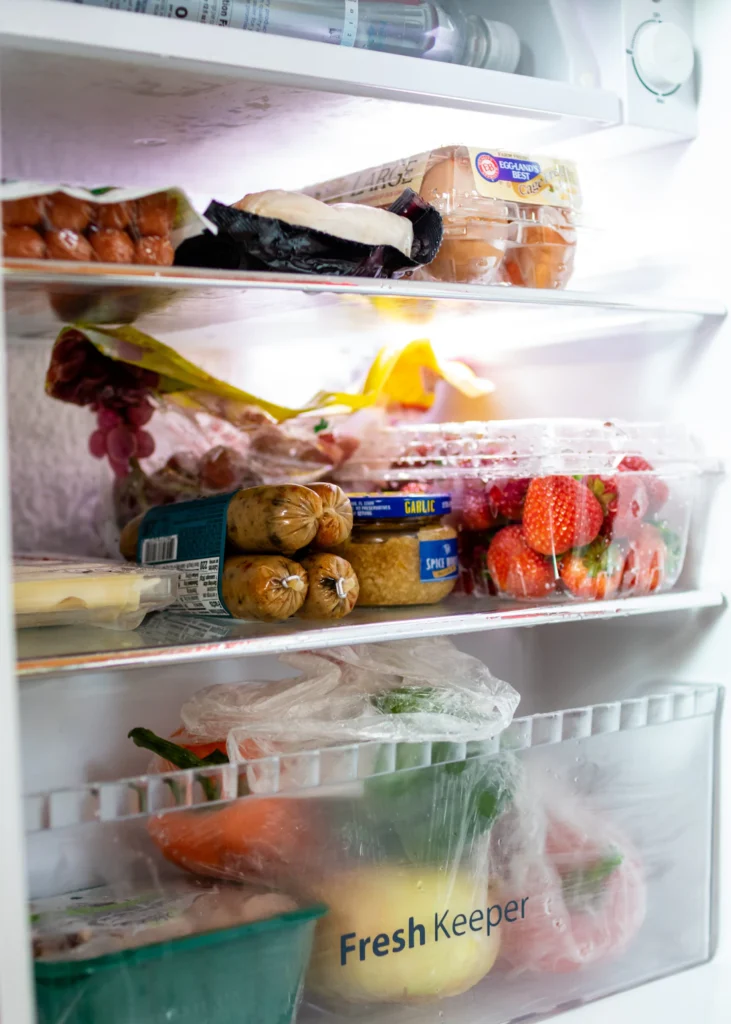
The refrigerator door usually experiences more temperature variation than the interior. It is often suitable for condiments and certain beverages, depending on packaging instructions, but it is not automatically the best place for every perishable item. Follow the manufacturer’s recommendations and local food-safety guidance for milk, eggs and other temperature-sensitive foods. Keep bottles stable, avoid overloading door shelves and make sure seals close cleanly. A door organizer that prevents the door from closing properly is counterproductive. If you frequently struggle to find mustard or sauces, sort them into a few categories and remove duplicates before buying another rack.
SMART SPACE FINDS · CURATED AMAZON FINDS
Clear Bins That Earn Their Space
Group similar foods into a few easy-to-pull-out bins instead of filling every inch of the fridge.
UTOPIA HOME · A01R
8-Pack Clear Fridge Organizer Bins
Clear · 8-piece set
Clear bin set for grouping groceries. Check shelf dimensions.
IDESIGN LINUS · A02
Clear Fridge & Freezer Storage Bin
Clear · 11.5 × 6 × 3.5 in
Easy-grip bin for snacks, small packages and daily essentials.
SIMPLE HOUSEWARE · A04R
2-Pack Clear Refrigerator Organizer Bins
Clear · 12 × 6 × 3.4 in
Two narrow bins to keep small items visible.
ICASA · A05
Stackable Refrigerator Organizer Bins
Clear · 6-pack with chip clips
Multi-bin option for larger shelves; do not block airflow.
As an Amazon Associate, Smart Space Finds earns from qualifying purchases. Check dimensions, current availability and product details before ordering.
Measure Before Buying Refrigerator Organizers
Small refrigerators vary dramatically in usable depth. A bin advertised for refrigerators may be too long once the door shelves close, or too tall to pull out beneath a fixed shelf. Measure each compartment with the door open, then check clearance when closed. Account for protruding temperature controls, lighting and vents. Removable shelf risers may improve visibility in some models, but a wire rack can also make taller foods difficult to store. Buy one or two inexpensive organizers first and test them through an ordinary week. Returning to open shelves may be the better solution if the containers turn cleaning into a chore.
THE SMART BUYING GUIDE
Which Fridge Organizers Are Actually Worth Buying?
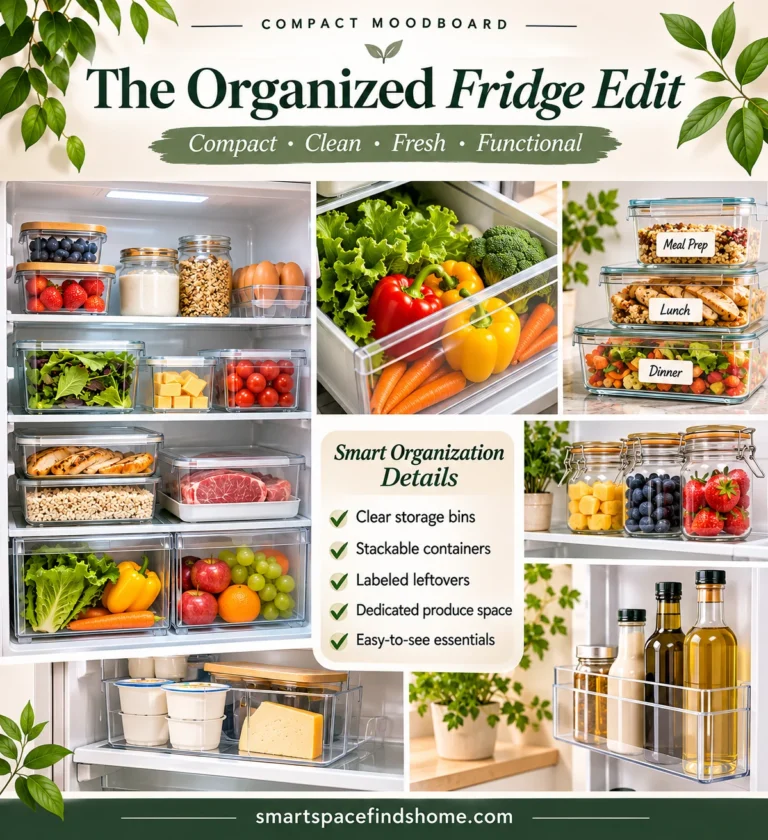
Choose organizers by the job they do—not by how good a matching set looks in a photo. Measure usable shelf width, depth, and vertical clearance with the door closed. Allow for hinges, light housings and cold-air vents.
| Organizer | Best for | Skip it if… |
|---|---|---|
| Shallow clear bin | Snacks, individual yogurts, packaged food | It blocks visibility or airflow |
| Leakproof low tray | Contained raw meat packages | It cannot be sanitized easily |
| Shallow airtight leftovers box | Rapid cooling and stackable meal prep | It’s too large for a typical serving |
| Appliance thermometer | Checking true refrigerator temperature | You already have a reliable verified reading |
Before checkout: measure twice, check material and care instructions, confirm handle clearance, and buy one organizer first. A matching ten-piece set rarely solves ten separate problems.
SMART SPACE FINDS · CURATED AMAZON FINDS
Leftovers, Meal Prep & Food Labels
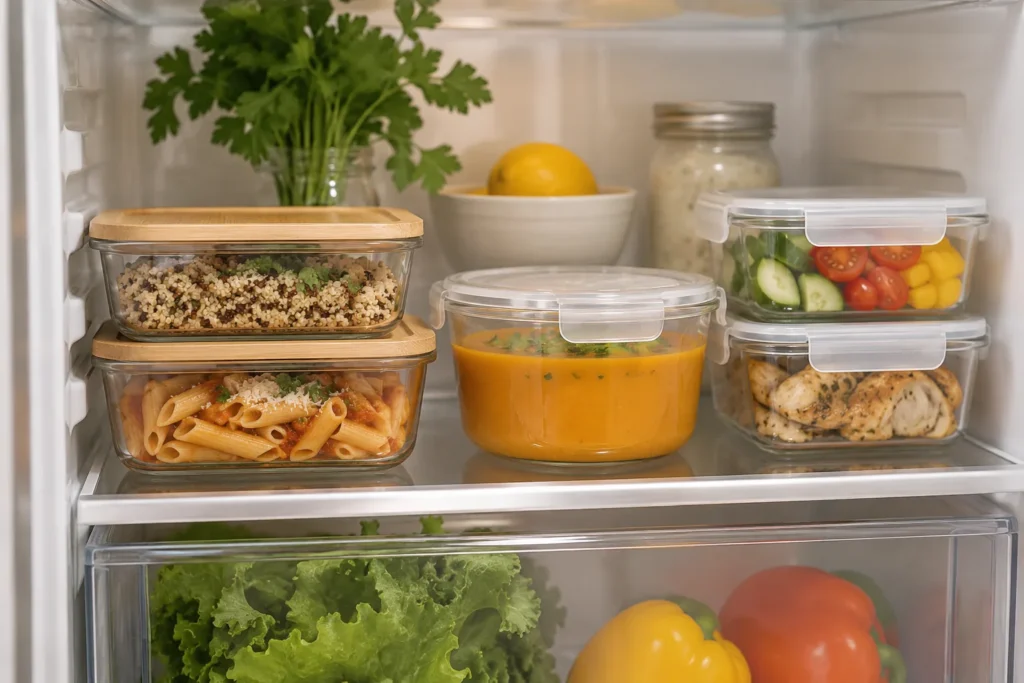
Covered containers and date labels make prepared food easier to see, rotate and use safely.
RUBBERMAID BRILLIANCE · C01
Glass Food Storage Containers
Clear · 9-count glass set
Premium glass containers for prepared meals.
RUBBERMAID BRILLIANCE · C02R
Plastic Food Storage Containers
Clear · 3.2-cup · 5-count
Stackable clear containers for compact leftovers.
OXO GOOD GRIPS · C03
Smart Seal Glass Rectangle Container
Glass · 8-cup
Larger glass option for family portions.
OXO GOOD GRIPS · C04R
Smart Seal Mini Glass Storage Set
Glass · 4-piece · 4-oz
Mini containers for dips, sauces and small sides.
LLIKED · C06
Dissolvable Food Date Labels
Blue · 250 labels · 2 × 2 in
Mark meal preparation dates to help rotate leftovers.
As an Amazon Associate, Smart Space Finds earns from qualifying purchases. Verify dimensions, current availability and details before buying.
Food Safety and Leftovers: The Quick Rules
Keep the refrigerator at 40°F (4°C) or below and freezer at 0°F (-18°C) or below. Refrigerate perishable food within 2 hours, or within 1 hour above 90°F. Divide large batches into clean shallow containers for faster chilling. Most cooked leftovers should be eaten within 3–4 days or frozen; different foods have different safe storage windows, so check the specific guidance.
Label formula: dish name + date cooked + optional “eat by” reminder. Keep the information visible, but never use a label to extend a food’s safe storage period. If storage conditions or safety are uncertain, discard the food.
Authoritative references: CDC food safety · FoodSafety.gov cold storage chart · USDA leftovers guidance.
A Five-Minute Weekly Fridge Routine
Choose a consistent day before grocery shopping to inspect the refrigerator. Check the eat-first area, remove spoiled food, wipe small spills and move older safe products to the front without ignoring date labels. Look beneath produce and behind bottles for forgotten items. Make a shopping list based on what is already available, and avoid filling the appliance beyond its usable capacity. Once a month, clean removable components according to the manufacturer’s instructions and inspect the door gasket for crumbs or damage. This modest routine usually matters more than a full reorganization every few months. It also prevents duplicate buying in a small household.
DESIGN FOR REAL LIFE
The Best Layout for Your Refrigerator Type
Apartment top-freezer
Keep ready-to-eat food visible, dedicate a protected lower area to raw proteins, and reserve one flexible shelf-height for larger grocery packages.
Counter-depth fridge
Favor shallow, easy-to-remove organizers over deep bins. Make a front-row “eat first” spot so nothing disappears behind bottles.
Mini fridge
Use only temperature-verified areas for perishables. Avoid overcrowding and check that the door closes and vents remain unobstructed.
The 80/20 principle: dedicate most space to groceries you buy every week, while keeping a genuinely flexible section for takeout, a pot of soup, or unexpected leftovers.
SMART SPACE FINDS · CURATED AMAZON FINDS
Optional Space-Saving Fridge Accessories
Only add extras that fit the actual fridge; measure clearance and leave room for airflow.
OXO GOOD GRIPS · E01
Fridge Egg Holder with Removable Tray
Clear · holds 20 eggs
Egg bin for shelves; keep eggs in properly chilled areas.
YOUCOPIA · E02
RollDown Egg Dispenser
Gravity-fed · 12–14 eggs
Compact dispenser with rolling egg access.
COPCO · E03R
2-Tier Non-Skid Lazy Susan
White/gray · 12-inch · two tier
Measure height carefully; suitable for only larger shelf openings.
IDESIGN · E04
9-Inch Lazy Susan Turntable
Clear · 9-inch
Compact rotating access for jars and condiments.
SORBUS · E05R
Stackable Soda Can Organizer
Clear · 2-pack with lids
Horizontal can storage for suitable fridge dimensions.
VTOPMART · E06
Stackable Water Bottle Organizer
Clear · 3-pack
Bottle rack better suited to spacious shelves or pantry storage.
As an Amazon Associate, Smart Space Finds earns from qualifying purchases. Verify dimensions, current availability and details before buying.
Three Layout Examples for Small Households
For a studio apartment with a narrow refrigerator, allocate one shelf to prepared meals and breakfast items, a lower protected area for raw ingredients and the drawers to produce. For a couple who cook most evenings, dedicate a compact zone to ingredients for the next two meals and keep leftovers visible at eye level. In a shared apartment, a small labeled basket per person may work for packaged snacks, while raw foods and temperature-sensitive items still need appropriate placement. These are starting points, not universal rules. The appliance design, number of users and foods stored should determine the final arrangement.
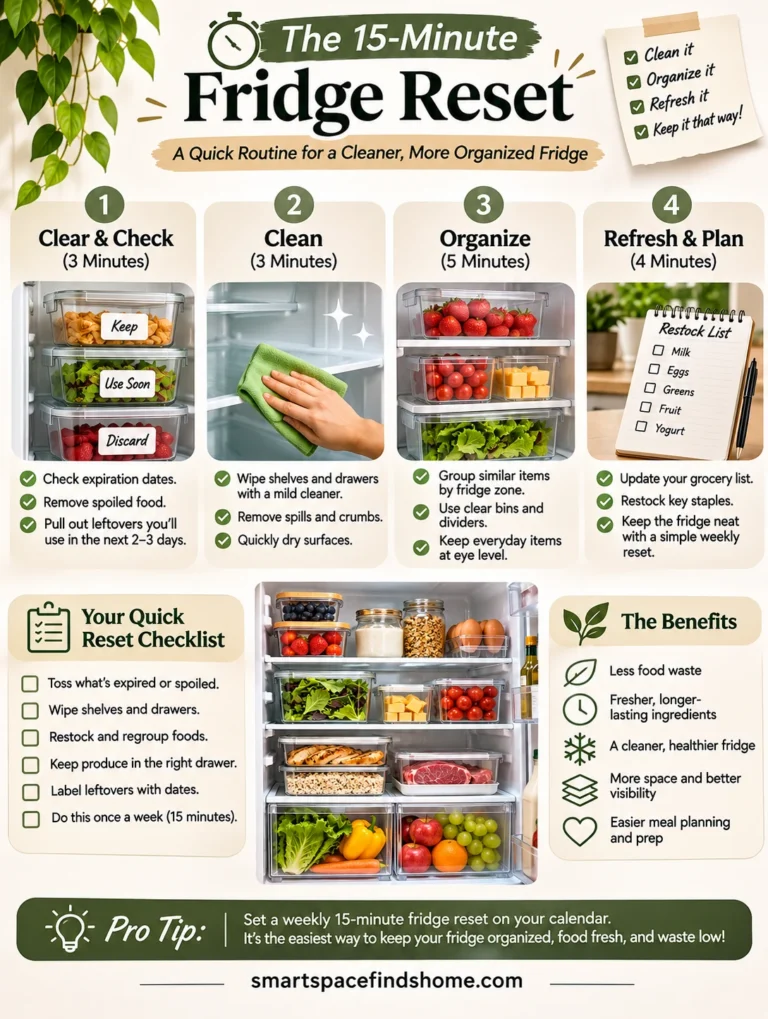
THE 15-MINUTE RESET
Your Small Fridge Organization Checklist
- Check the thermometer: 40°F / 4°C or lower.
- Discard unsafe or spoiled food and inspect dates.
- Clean one shelf at a time; keep perishables chilled.
- Put raw proteins in sealed packaging and a low leakproof tray.
- Sort dairy, ready-to-eat meals and produce by safe storage needs.
- Move older safe foods to the front; create an “eat first” area.
- Date cooked leftovers and plan to use or freeze them promptly.
- Check vents, seals, and door clearance before closing.
- Write a shopping list from what is already inside.
You do not need a photogenic refrigerator to have a more functional one. Visibility, food safety and a repeatable routine make the difference.
Common Refrigerator Organization Mistakes
One mistake is filling every shelf with matching plastic bins, leaving too little room for taller ingredients or cold-air circulation. Another is transferring products into unmarked jars and losing use-by dates. Storing raw meat above ready-to-eat meals can create a cross-contamination risk. Keeping everything pushed toward the back encourages forgotten leftovers, while overcrowding the door can affect proper closing. Avoid treating the refrigerator as a display cabinet: safe storage and easy cleaning matter far more than color coordination. Even a beautiful arrangement needs flexibility for a large pot of soup, holiday leftovers or a bigger grocery shop.
Frequently Asked Questions
What should go on the top shelf of a small refrigerator?
Use the space for foods suited to that shelf’s conditions, often ready-to-eat items or leftovers, while following your appliance’s guidance and keeping raw foods safely separated.
Do refrigerator bins keep food fresher?
Bins help with grouping and visibility, but they do not replace temperature control, proper packaging or food-safety practices.
How often should I reorganize my fridge?
A five-minute weekly inspection and regular cleaning usually prevent the need for frequent full resets.
Should milk and eggs go in the fridge door?
For reliable cold storage, place temperature-sensitive dairy and eggs on an interior shelf that stays consistently cold. Door shelves experience more temperature changes when opened. Always follow packaging directions and your refrigerator manual.
What is the best way to store leftovers in a small fridge?
Use clean, shallow, covered containers; promptly refrigerate food within the recommended time limits; label the date; and keep ready-to-eat items away from raw-meat drips. Plan to use most cooked leftovers within three to four days or freeze them.
Are clear refrigerator organizers worth it?
They are useful when they keep small packages together and make food easier to see. Measure each shelf first and avoid bins that block vents, trap hidden food, or make cleaning difficult. One or two practical bins often outperform a large matching set.
How do you organize a mini fridge without overcrowding it?
Check the temperature with a refrigerator thermometer, use only suitable storage zones, keep the airflow path clear and choose compact containers. Small dorm and studio refrigerators may have uneven temperatures, so never assume every area is safe for the same foods.
How can I make more space without buying anything?
Remove expired or unsafe products, combine only compatible packages safely, use existing drawers properly and stop buying duplicates.
For more small-kitchen systems, explore our tiny kitchen meal prep station and small pantry organization guide. Start with safety and a simple eat-first zone; add accessories only when they make that routine easier.