
A narrow hallway does not need a dramatic renovation to feel inviting. The right combination of warm light, thoughtful placement and simple automation can make coming home easier—without crowding the floor or changing the wiring.
Start with the route you actually walk: open the door, put down your keys, remove your shoes and head toward the living space. Note where you fumble for a switch or cast a shadow over the floor. These small moments tell you where smart lighting will help most.
At a glance: the best first move
Already have a ceiling fixture? Try a compatible dimmable smart bulb or smart switch, after checking the fixture and circuit. No convenient outlet? A rechargeable, motion-activated light can illuminate a closet or secondary zone. Long, dark corridor? Use more than one gentle light source rather than one harsh point of light.
1. Choose the right type of smart lighting
A smart bulb is often the simplest way to add a warm arrival scene to a ceiling fixture or table lamp. It may use Wi-Fi, Bluetooth, Zigbee, Thread or a manufacturer’s bridge. Some can operate independently; others need a hub for remote access or automation. Always verify the exact model.
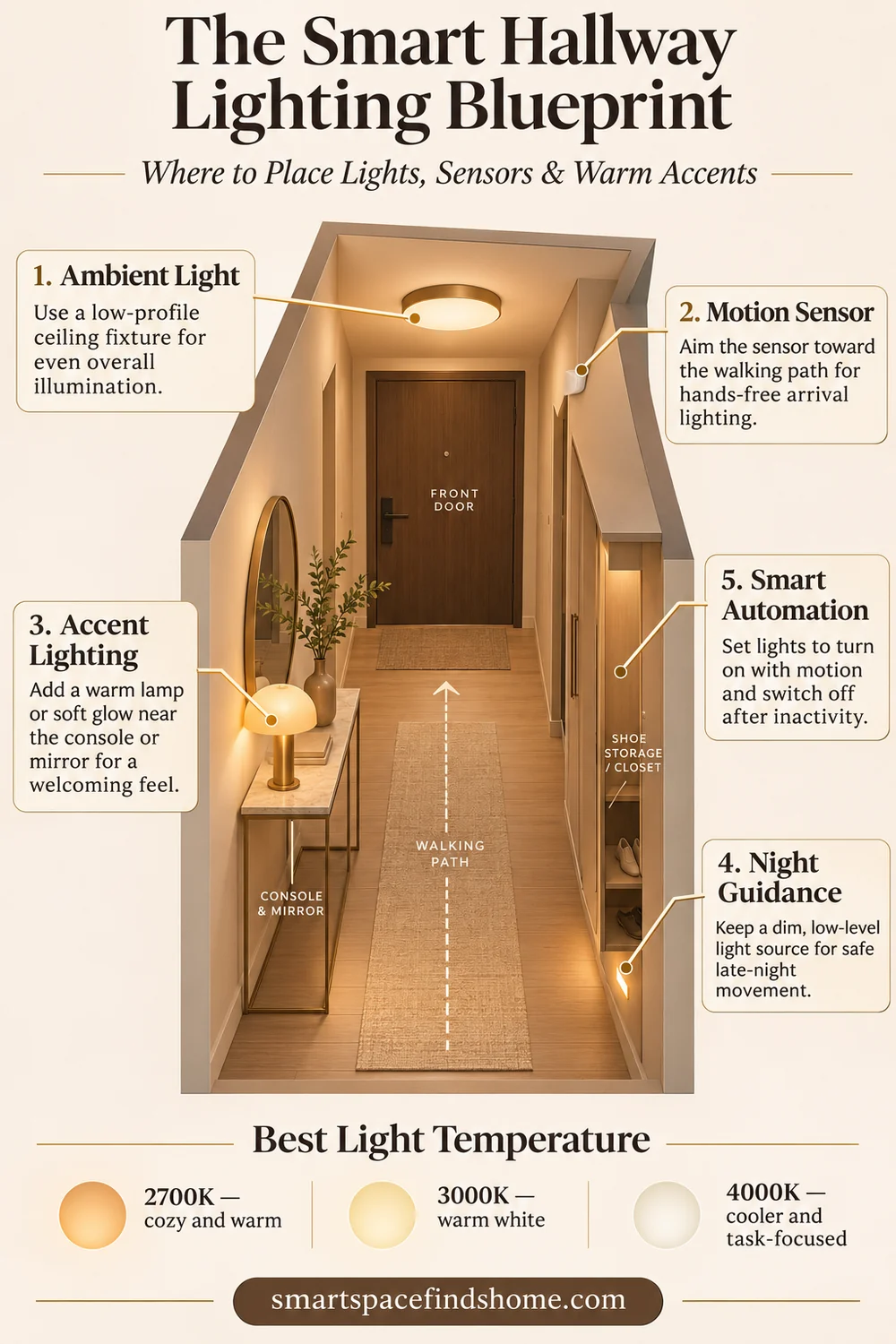
A motion-triggered light is useful when your hands are full. For dependable coverage, orient the sensor toward the walking path rather than the front door itself. Test the delay before switching off; a very short timer can leave someone standing in the dark.
Battery-powered or rechargeable bars and puck lights work well inside an entry closet, beneath a floating shelf or beside a shoe-storage unit. They are typically task or accent lighting, not a replacement for a hallway’s primary illumination.
2. Four layouts that work in real apartments
A. Very narrow hallway: keep the floor clear
Use a flush-mounted ceiling fixture with a dimmable lamp, or a low-profile light where permitted. Avoid deep wall sconces at shoulder height. Place motion sensing so it detects someone approaching along the corridor, not through a passing doorway. Keep light fixtures, furniture and cables outside the walking route.
B. Small entryway with a console
Combine a soft ceiling light with a compact table lamp on a stable console. The ceiling source handles navigation; the lamp makes the space feel welcoming. If the console is too narrow, skip the lamp and use the ceiling fixture alone.
C. Long hallway with two ends
For a long corridor, the goal is even coverage. Two gentle pools of light may be more comfortable than one bright spot at the center. If using sensors at both ends, confirm your app or hub supports the necessary routines. Test movement in both directions and make sure the lights do not turn off mid-walk.
D. Doorway without a nearby outlet
Choose a rechargeable fixture with a secure, reversible mounting method, if the surface and product instructions allow. Put it where you can reach it to recharge and where an opening door will not strike it. A standalone motion light is usually simpler here than a multi-device smart-home setup.
3. Warm versus cool light: what actually looks good?
Color temperature is expressed in kelvins (K). For most residential entryways, warmer white light feels comfortable and flattering. A cooler setting may help when sorting mail or finding something in a bag, but a high-intensity cool beam can make a tiny hallway feel clinical.
Brightness matters as much as color. There is no universal lumen target for every corridor: length, wall color, ceiling height, fixture distribution and available daylight all change the result. Begin with a dimmable setting that lights the walking surface without glare, then adjust after sunset. For night guidance, aim for a noticeably lower output than the daytime or arrival scene.
Three scenes worth saving
Arrive home: soft warm lighting when the door opens or motion is detected. Evening passage: a lower, steady level so the corridor is comfortable without lighting the entire apartment. Late-night route: very dim warm light, limited to the path you need.
4. Make automation work without surprises
Choose whether your light should react to a schedule, a motion sensor, a door sensor, or a combination. A useful entry routine might turn on a warm light after sunset when movement is detected, then turn it off after several minutes of inactivity. Set an appropriate manual override for guests and cleaning.
Plan for household realities: pets can trigger sensors, mirrored walls may change detection, and some lights stop responding to apps when someone turns off the wall switch. Smart bulbs generally need continuous power to stay connected. A smart switch may solve that problem, but electrical installation and neutral-wire requirements vary; wiring should be assessed by a qualified electrician and must comply with local rules.
| Connection | What to check | Potential limitation |
|---|---|---|
| Wi-Fi | 2.4 GHz requirements, signal strength, app support | Network reliability and cloud dependence vary |
| Bluetooth | Range and remote-control requirements | Automations may require another device or hub |
| Zigbee | Compatible bridge/coordinator and ecosystem | Usually needs a hub |
| Thread / Matter | Exact Matter certification, controller and border-router needs | Feature support may differ among ecosystems |
Before purchasing, check whether the exact product works with your preferred setup—Apple Home, Google Home, Alexa or another platform. “Works with Matter” does not automatically mean every vendor-specific feature is available in every app.
5. Renter-friendly installation and safety
- Prefer existing lamp sockets and freestanding lights before adding holes, permanent adhesives or new electrical wiring.
- Check that removable strips are approved for the fixture weight, wall finish and application; removal can still damage paint.
- Keep leads away from door swings, thresholds and walking surfaces. Do not route cords under rugs or through doors.
- Never block exits, smoke alarms, sprinklers, ventilation or access to the electrical panel.
- Check ceiling and wall clearances and allow ventilation for fixtures that become warm.
- Charge battery lights as instructed, use compatible chargers and stop using swollen or damaged batteries.
- Do not use decorative rechargeable lights as required emergency lighting. Maintain dependable primary illumination.
For hardwired fixtures or switches, consult your landlord and a qualified electrician. Never modify wiring without appropriate permission and expertise.
Affiliate disclosure: Smart Space Finds may earn a commission from qualifying purchases made through Amazon links, at no additional cost to you. As an Amazon Associate I earn from qualifying purchases.
6. Your 20-minute lighting plan
- Walk the path at night. Identify where the floor, lock, console or closet is hardest to see.
- Check existing fixtures. Record bulb base, dimmer type, power access and any building restrictions.
- Pick one layer. Primary ambient light first, then accent or task lighting only if needed.
- Set a warm scene. Start around 2700–3000K if the fixture supports it, and dim to a comfortable level.
- Test the motion route. Walk from both ends; adjust sensor direction and shutoff delay.
- Review safety. Check door clearance, cable paths, secure mounting and reliable manual operation.
- Live with it for a week. Adjust timing and brightness before buying another device.
Frequently asked questions
What is the easiest smart lighting upgrade for a renter?
A compatible smart bulb in an existing lamp or fixture is often the least disruptive option. A standalone rechargeable motion light works for secondary zones without outlets. Always confirm installation and compatibility.
Are motion-sensor lights good for narrow hallways?
Yes, if the detection angle covers the route and the shutoff time is long enough. Test for missed detections and accidental activation before depending on the routine.
Should an entryway use warm or cool light?
Warm white, commonly around 2700–3000K, is a versatile starting point for residential entryways. Personal preference, natural light and task needs may change the best setting.
Do I need a hub for smart hallway lights?
Not always. Some Wi-Fi and Bluetooth products work directly with an app. Zigbee and some advanced automation setups need a compatible hub or controller. Check the exact product specifications.
Will smart bulbs work with my existing dimmer?
Not necessarily. Many smart bulbs are designed to be dimmed by software and may flicker or fail on conventional wall dimmers. Check both the bulb and dimmer manufacturer’s compatibility guidance.
What happens if Wi-Fi goes down?
It depends on the device and automation architecture. Some lights continue to work from a normal switch or local control, while certain remote functions and routines may stop. Verify offline behavior before buying.
Keep exploring small-space lighting
For a softer living space, see our cozy bedroom lighting ideas. For compact rooms without nearby outlets, explore cordless table lamps for small apartments. If you want a better entrance overall, visit our small entryway makeover guide.
The bottom line: Great hallway lighting is not a wall of gadgets. It is a clear, safe route, flattering light at the right height and automation that makes daily life easier.