
A beautiful wardrobe isn’t a shopping list. It’s a collection of clothes that fit your real life, feel unmistakably like you, and earn their place through repeat wear. Here’s how to build yours—without spending a fortune.
To build a timeless personal style on a budget: identify your five most-worn outfits, name the silhouettes and colors you repeat, create three reliable outfit formulas, care for what you own, and buy only to solve a recurring wardrobe gap. Timeless does not mean expensive, neutral, or trend-free.
Timeless personal style on a budget starts with what you wear, not what you wish you wore. The outfit you reach for on an ordinary Tuesday is often more revealing than a folder of aspirational photos. You know it fits, you can move in it, and it works for your schedule. That is the foundation of timeless personal style: clothes you choose repeatedly, not clothes that merely look impressive on a hanger.
A timeless wardrobe doesn’t have to be beige, minimalist, expensive, or built from a prescribed list of “must-haves.” It can include bright color, vintage finds, sneakers, dramatic jewelry, or a favorite printed shirt. What makes it coherent is the relationship between the clothes, your preferences, and your actual days.
Wear more. Experiment first. Buy last.
Before buying a “better basic,” ask whether you already own something that performs the same job. Before replacing a garment, see if cleaning, mending, altering, or styling it differently would solve the problem.
1. Start With a Closet Audit, Not a Shopping Cart
The fastest way to learn what suits you is to study the clothes you already use. Pick five outfits you genuinely enjoyed wearing recently—not necessarily your most photographed looks—and write down what each has in common.
- Silhouette: Do you repeat relaxed trousers, straight-leg denim, defined waists, boxy shirts, or soft knits?
- Comfort: Which fabrics, waistbands, necklines, and shoes remain comfortable after several hours?
- Color: Which shades make it easy to combine your favorite pieces?
- Context: Which outfits actually suit your work, weather, commute, home life, and social plans?
- Maintenance: Which items can you realistically wash, store, and care for?
Put questionable items into three groups: wear now, repair or restyle, and reconsider later. You do not have to make a ruthless donation pile in one afternoon. Keeping an item temporarily while testing how it works is more useful than discarding it only to buy a similar replacement. If physical storage is the obstacle, our small-closet folding and shelf-divider guide offers practical ways to see and maintain the clothes you already own.
Photograph five outfits over the next week. Beneath each photo, finish this sentence: “I like wearing this because…” Your repeated answers—not somebody else’s capsule wardrobe—will reveal your most reliable style ingredients.
What actually makes getting dressed difficult?
Instead of rating your style, identify the source of friction. Give each question a simple yes or no. This is a personal reflection tool, not a scientific test.
Your next action: Start with the category that receives the clearest “yes.” Fix a recurring problem before buying another garment. Two identical yes/no counts aren’t a diagnosis; use them to guide a small experiment.
The Considered Closet
Organize what you own before buying more. Choose the storage method that suits your garments and available space.
Slim flocked hangers for compatible everyday garments; check suitability for heavier pieces.
Alternative 50-pack for an organized, coordinated hanging section.
Smaller pack for a partial closet refresh; not an additional essential.
Separate stacks of folded garments where shelf dimensions allow.
Protect less frequently worn garments in compatible hanging storage.
As an Amazon Associate, I earn from qualifying purchases. Product links above are affiliate links.
2. Find Your Style DNA in Three Specific Decisions
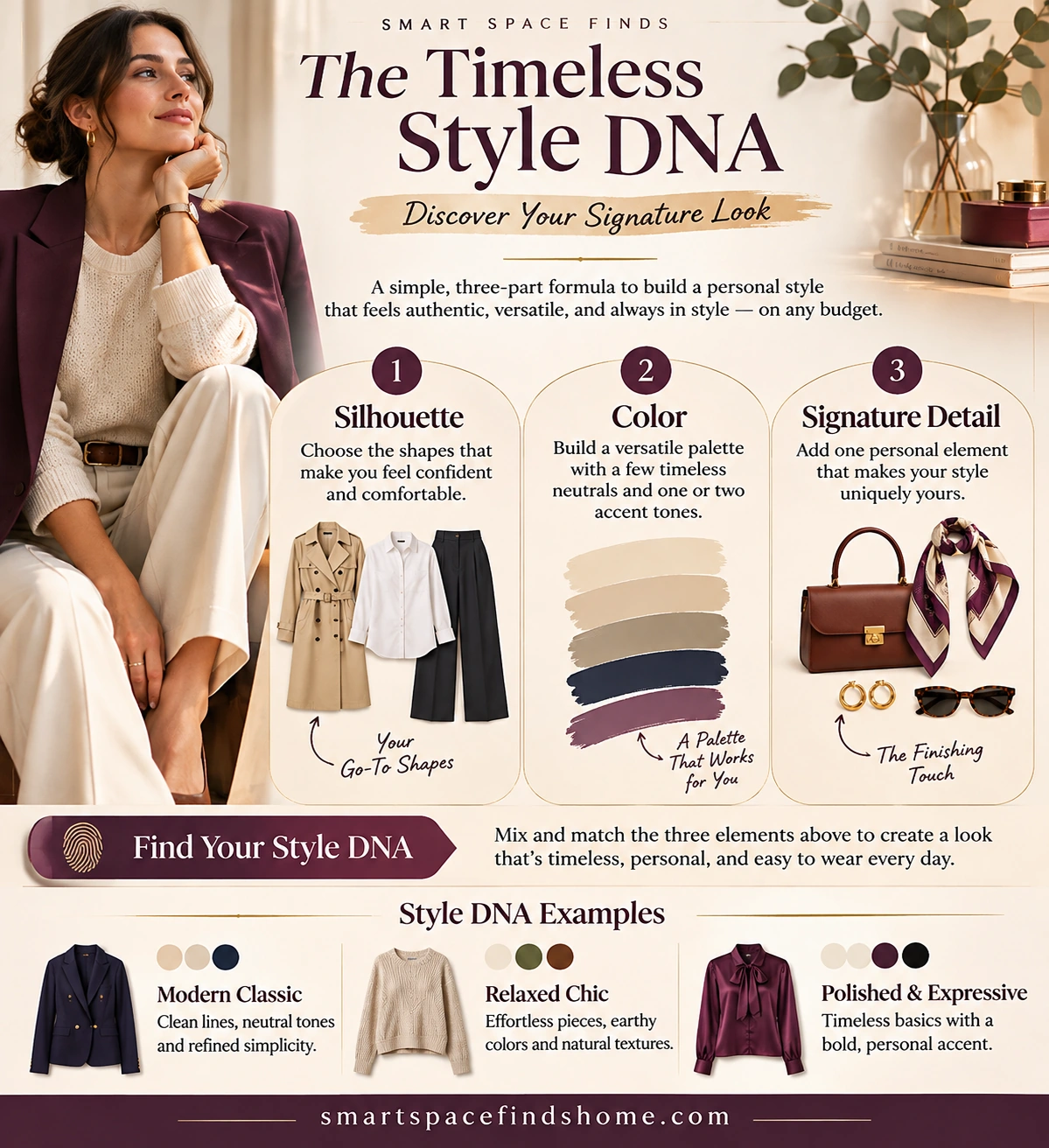
Labels like “classic,” “romantic,” and “minimal” can be helpful, but they can also flatten a personal wardrobe into a trend category. Instead, develop a short style brief using three decisions.
Choose your silhouette language
Examples: relaxed and tailored; fitted and fluid; structured with easy layers. Think about proportions rather than a rigid body-type rule.
Choose your color relationship
Start with two or three colors you actually wear, then add one accent you love. A flexible palette is a coordination tool, not a ban on expressive shades.
Choose a signature detail
That might be a striped knit, silver jewelry, loafers, a textured belt, a vibrant scarf, or an oversize shirt. One recognizable detail is often enough.
Example style brief: “Relaxed tailoring, navy/cream/denim, and colorful vintage scarves.” Another could be “Soft layered shapes, earth colors, and bold sneakers.” Both are personal; neither requires designer labels.
For a broader exploration of style identity, see our guide to finding your personal style. This article focuses on applying that identity to your closet and budget.
3. Build Repeatable Outfit Formulas—Then Make Them Your Own
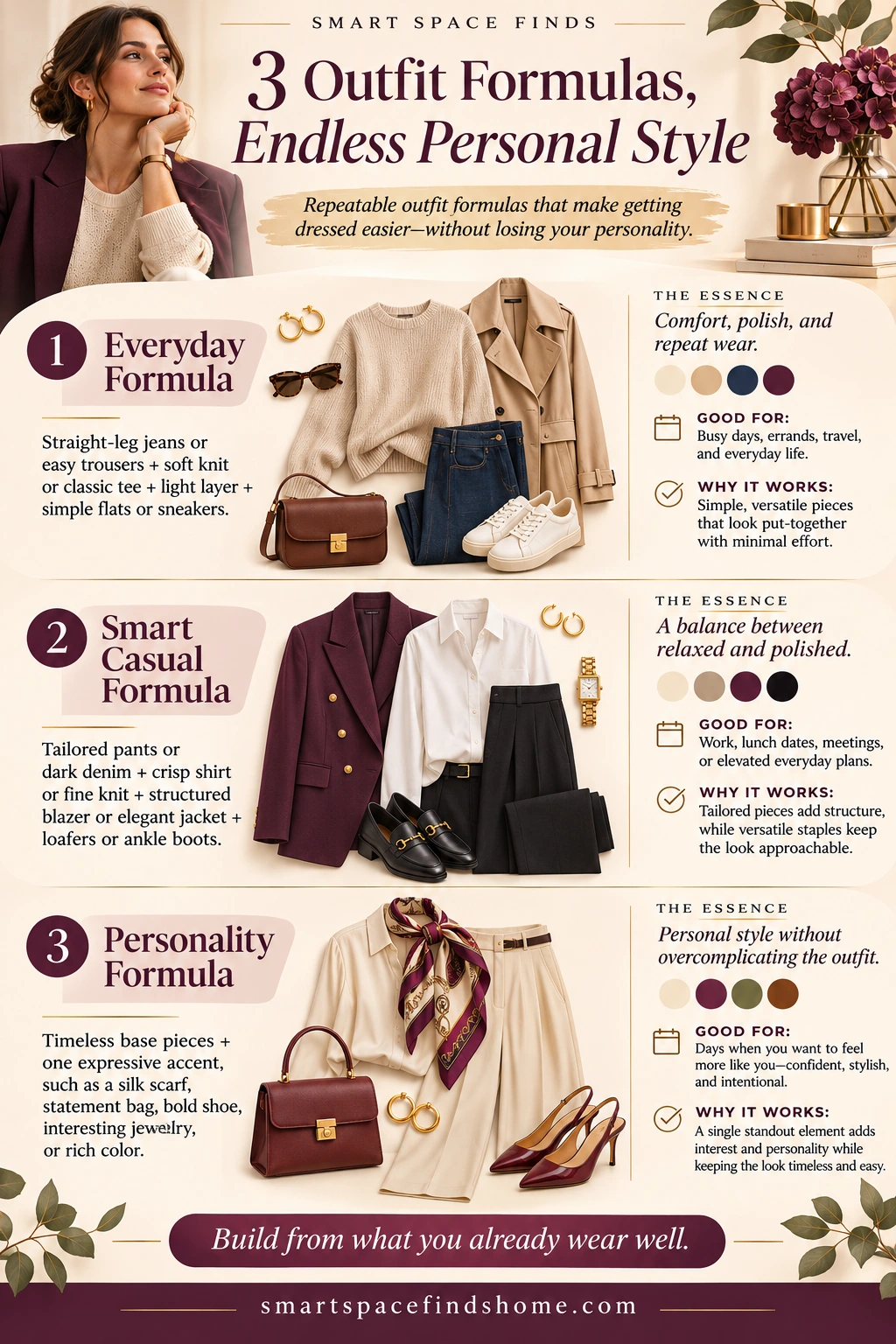
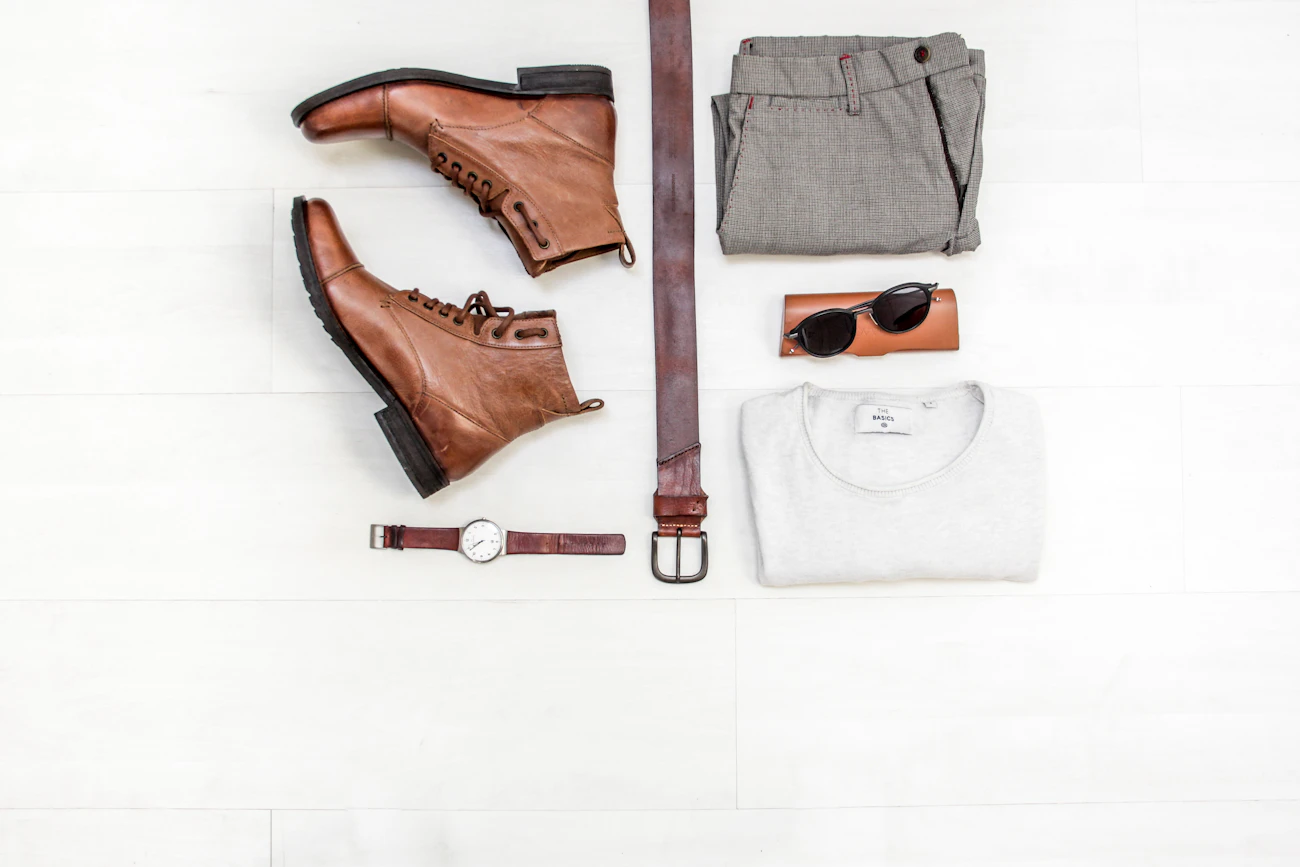
An outfit formula is a combination that works reliably, not a uniform you must wear forever. Save three or four combinations for different parts of your week. Repeating a useful formula reduces decision fatigue while leaving plenty of room for experimentation.
Easy base + intentional layer
Comfortable jeans or trousers, a favorite top, and a cardigan, jacket, or overshirt. Change the footwear or accessory to shift the mood.
Relaxed piece + sharper piece
Try an unstructured knit with tailored pants, or a crisp shirt with worn-in denim. Contrast keeps a look from feeling overly planned.
Familiar outfit + one expressive accent
Wear an outfit you trust and add one color, pattern, piece of jewelry, or thrifted detail that feels distinctly yours.
Reusable base + thoughtful styling
Instead of buying a complete look for one event, test whether a change of shoes, bag, accessories, or layer makes an existing piece work.
What if you love color, patterns, or changing trends?
Keep them. Timeless style should be durable in your life, not frozen in time. A distinctive printed jacket that you wear for years may be a more sensible purchase than a neutral blazer you never reach for. Use your outfit formulas as a foundation, then let your taste evolve.
4. Prioritize Fit, Fabric, and Care Before Brand Names
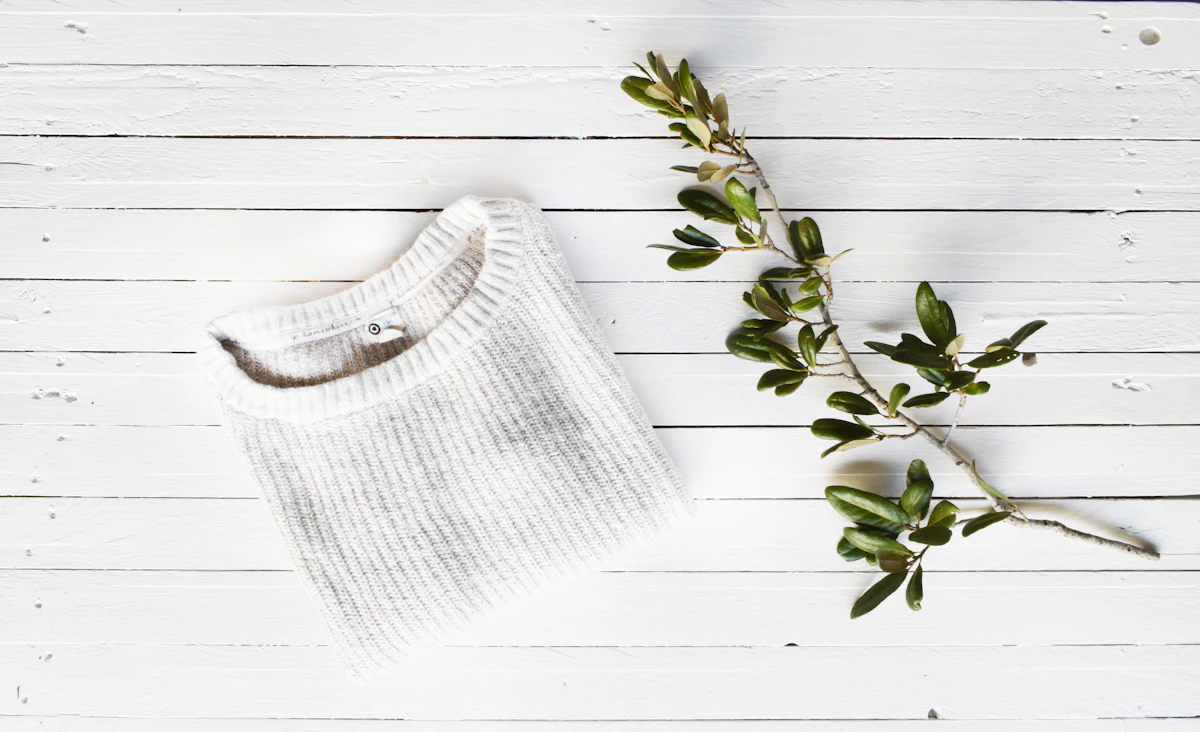
A garment doesn’t become a good purchase just because it is labeled premium. Check how it behaves on your body and what maintaining it will require.
Fit: the movement test
Sit, walk, reach, and bend. Does the garment pull, twist, ride up, pinch, or need constant adjustment? Look at shoulder seams, waist placement, sleeve length, and where hems fall. Tailoring can sometimes transform a piece—but get an actual alteration quote before assuming a bargain can be rescued cheaply.
Look for intact, even seams and securely attached buttons. Uneven finishing isn’t always fatal, but loose construction deserves scrutiny.
Check how opaque, breathable, substantial, or stretchy it is for its intended use. Thickness alone does not guarantee quality.
Sit, raise your arms, and walk. Great-looking clothes that need constant adjustment are unlikely to become favorites.
Check cleaning instructions, fiber content, and alteration needs before paying. Factor those costs into the purchase.
Fabric: the practical inspection
Read the fiber label and care instructions. Feel the fabric, examine stitching and seam finishes, check transparency in daylight, and consider breathability, weather, and laundry needs. No single fiber is automatically ideal for everyone: wool may offer warmth but require careful care; cotton can be easy to wear but vary widely in weight and finish; synthetics can offer stretch or performance but may be uncomfortable in some climates. Assess the specific garment.
Care: the overlooked style upgrade
Clean shoes, a properly stored knit, fixed buttons, removed lint, and a pressed shirt can change the appearance of clothes you already own. Always follow the garment’s care label. A small repair kit, suitable lint remover, or appropriate steamer may be worthwhile when it solves a recurring problem—but avoid buying tools for maintenance tasks you rarely do.
Before replacing an item, check: Can it be washed correctly, depilled safely, repaired, altered, conditioned, or worn in a new combination? If the answer is yes, test the lower-cost fix first.
The Wardrobe Rescue Edit
Try a thoughtful garment-care fix before replacing a favorite item. Always test tools on a safe area and follow care instructions.
For appropriate pilled fabrics; use gently to avoid damage.
Alternative fabric shaver for compatible knits and garments.
Remove loose lint and hair from suitable surfaces before an outfit.
Care option for smooth leather footwear of a matching color; patch-test first.
As an Amazon Associate, I earn from qualifying purchases. Product links above are affiliate links.
5. Use a Better Spending Filter: Cost Per Wear
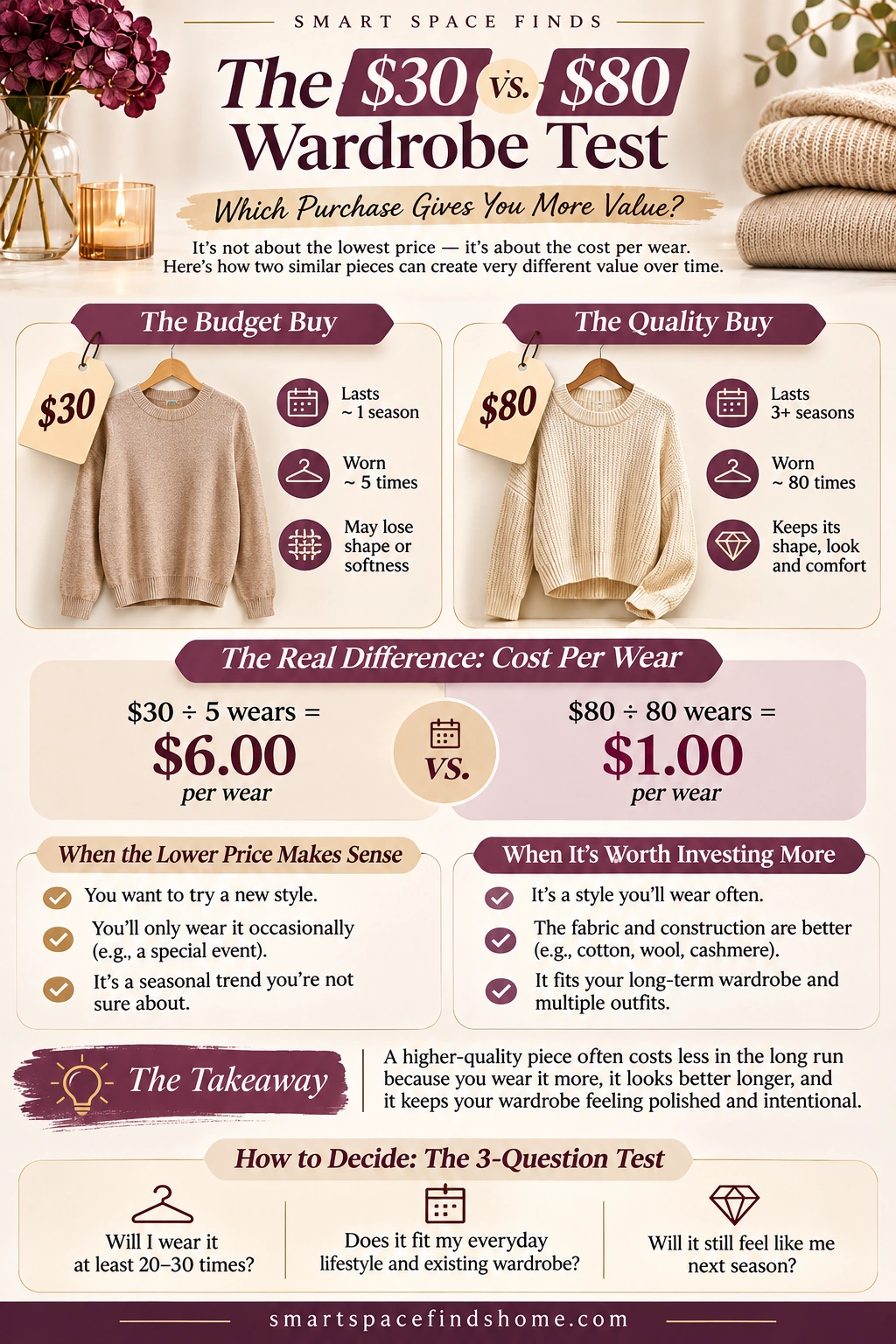
The price tag tells you what you pay today. Cost per wear asks how much that purchase costs across its realistic use. Divide the total cost, including necessary alterations, by the number of wears you genuinely expect.
$80 ÷ 80 wears = $1 per wear
$30 ÷ 5 wears = $6 per wear
The pricier item is the better value only if the estimated use actually happens. Cost per wear does not measure comfort, affordability today, repairability, or personal joy by itself.Illustrative values, not product offers or predictions. Bars compare estimated cost per wear only. If neither purchase fits the budget, neither is the right choice.
Do not use the formula to rationalize an unaffordable purchase. A low theoretical cost per wear cannot make an item fit your current finances. Likewise, something inexpensive that you already love and use may need no upgrade at all.
The five-question purchase test
- Real-life test: Can I name three ordinary occasions when I will wear it?
- Combination test: Does it work with at least three pieces I already own?
- Comfort test: Would I wear it for a full day, not just for a mirror photo?
- Care test: Can I maintain it without an ongoing expense or inconvenience I resent?
- Budget test: Can I pay for it comfortably—and would I still want it without the sale or trend?
If several answers are no, save the photo and wait. A wishlist is a tool, not an instruction to purchase.
Before you buy it, take the longer way around.
Is something genuinely missing, or is the outfit simply styled the same way every time?
Make two new combinations and try a low-cost repair, swap, or alteration quote.
Can the candidate item serve at least three actual settings in the next month?
Review cost, care and returns; wait until the decision still makes sense without a promotional deadline.
The Care & Longevity Edit
Choose gentle cleaning, drying and crease-care tools based on the fabrics you actually wear.
A ventilated flat-drying surface for knitwear that needs to dry lying down.
A set of mesh bags for suitable delicates; follow wash labels.
Alternative 6-piece configuration rather than an additional required purchase.
Compact crease-care option for garments whose labels permit steaming.
As an Amazon Associate, I earn from qualifying purchases. Product links above are affiliate links.
6. Where to Save, Where to Invest, and When to Skip
Occasional accents
Borrow, swap, thrift, or restyle accessories and trend experiments before buying something new.
High-use, hard-to-replace needs
Well-fitting shoes for long walking days, weather-appropriate outerwear, or tailoring that makes frequently worn clothes useful—if the budget supports it.
Almost-right favorites
Loose buttons, minor seams, wrinkling, worn laces, simple alterations, or a styling problem rather than a missing item.
Fantasy versions of your life
Clothes bought for imagined routines, difficult-care fabrics you dislike, or duplicates that solve no new problem.
Secondhand shopping can expand your options without requiring every piece to be new. Check condition, sizing measurements, return terms, and any necessary cleaning or alterations. For new purchases, compare construction and comfort rather than assuming a particular price point guarantees quality.
Fix First, Replace Later
Small repairs can rescue useful garments. One kit is usually enough to get started.
Basic portable notions for simple hand-sewing jobs.
Alternative compact sewing kit for small repairs and travel.
A roomy sewing basket with a removable organizer and included notions for simple repairs; an alternative to compact kits.
As an Amazon Associate, I earn from qualifying purchases. Product links above are affiliate links.
7. The Budget Wardrobe Gap List
Not every item missing from a style-inspiration photo is a gap in your wardrobe. A genuine gap creates repeated friction. Keep a short note with three columns: problem, no-buy solution, and possible purchase.
| Recurring problem | Try first | Buy only if needed |
|---|---|---|
| Outfits never feel finished | Repeat a favorite belt, scarf, or jewelry piece | One versatile accessory |
| Work pants fit poorly | Get a tailoring estimate; test another pairing | A better-fitting replacement |
| Too many colors don’t coordinate | Build three outfits around your most-worn shades | Nothing unless a specific gap persists |
| Clothes look tired | Follow care labels; repair, clean, and store correctly | A specific care tool or replacement if beyond repair |
Keep this list for at least two weeks. If a problem disappears after restyling, you’ve saved money and learned something useful about your wardrobe.
Complete these before your next clothing purchase:
- My three most comfortable silhouettes are ______, ______, and ______.
- My most repeatable colors are ______, ______, and ______.
- The pieces I reach for weekly are ______, ______, and ______.
- My next true wardrobe gap is ______ because ______.
- I can try ______ before buying anything new.
The outcome: One clear personal style brief and a shopping list based on needs, not inspiration overload.
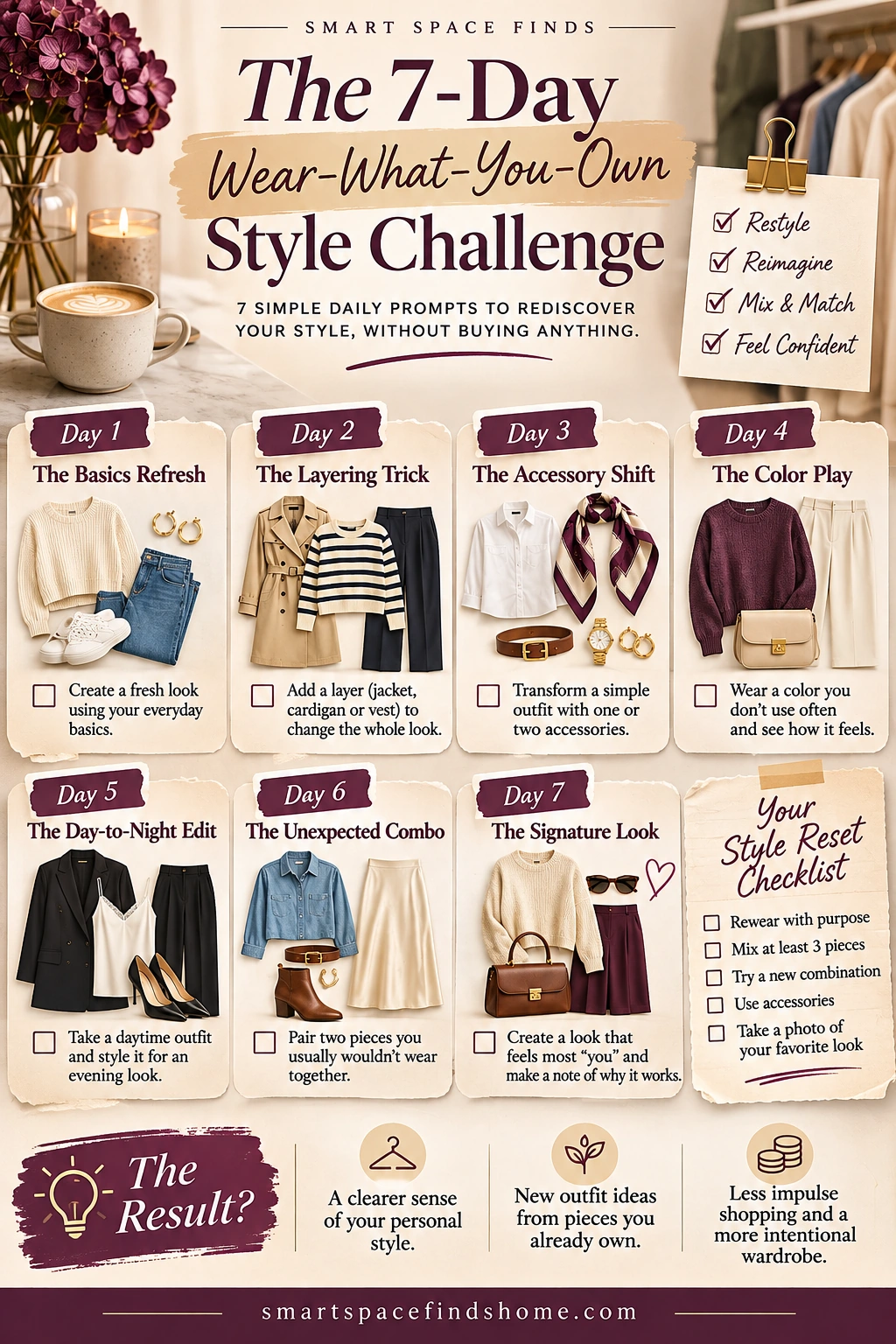
One Week, Seven Outfits, Zero Required Purchases
Try these prompts with your current closet. Photograph what you actually wear; keep only the combinations that feel comfortable in real life. If a prompt doesn’t fit your dress code or climate, adapt it.
The insight: Your favorite combinations are useful evidence for your personal style brief—and a more reliable shopping filter than any preset capsule list.
The Worthwhile Upgrade
Only upgrade if you already have a repeated need and the tool fits your space, care routine and budget.
Higher-capacity steaming option for frequent garment care; check fabric guidance.
Wood blocks for a wardrobe storage routine; do not assume pest elimination.
Alternative cedar assortment for closets and drawers.
Aromatic cedar rings for compatible hangers and clothing storage; a different format from cedar blocks or sachets.
As an Amazon Associate, I earn from qualifying purchases. Product links above are affiliate links.
8. The 30-Day Personal Style Reset
This is an experiment, not a shopping challenge. You can complete it without spending anything.
Observe
Wear and photograph five reliable outfits. Note comfort, silhouette, color, and circumstances. Don’t purchase anything for the experiment.
Recombine
Make three new combinations from what you already own. Try a different layer, proportion, or accent.
Repair and refine
Address one practical issue: mend a button, clean footwear, store knits better, or price an alteration.
Decide deliberately
Review your outfit photos and the gap list. Only consider purchases that solve a recurring need and pass your budget test.
Your one-sentence style brief: “I feel most like myself in ______ silhouettes, ______ colors, and ______ details, for the days I actually live.”
Write it somewhere accessible. Use it as a gentle guide—not a rule that prevents you from enjoying fashion.
9. Common Mistakes That Make a Budget Wardrobe More Expensive
- Buying an entire capsule at once: You may replace perfectly useful pieces with slightly different versions.
- Equating timeless with neutral: Colors you never enjoy wearing will not become practical just because they coordinate on paper.
- Ignoring the cost of upkeep: Special cleaning, alterations, and storage can add up.
- Shopping because of a discount: A reduced price is still wasted money if the garment is rarely worn.
- Buying for a fantasy schedule: Consider how often your calendar actually calls for the outfit.
- Confusing repetition with boredom: Rewearing a favorite outfit is evidence that it works.
Frequently Asked Questions
How can I look stylish on a very small budget?
Start with fit, comfort, garment care, and three outfits made from clothes you own. Identify recurring frustrations before spending. Repairs, altered proportions, and fresh combinations may make a bigger difference than another purchase.
Do I need a capsule wardrobe to have timeless style?
No. A capsule can be a useful organizational method, but it is not required. You can have a colorful or eclectic wardrobe and still buy thoughtfully, wear things repeatedly, and maintain a cohesive personal style.
How many clothes should a timeless wardrobe have?
There is no universal number. Your climate, laundry access, dress codes, hobbies, body needs, and preferences determine what is practical. Measure usefulness rather than chasing an arbitrary item count.
What clothes are worth investing in?
Prioritize what you wear frequently, find hard to replace, and genuinely need—potentially comfortable shoes, climate-appropriate outerwear, or reliable workwear. “Investing” means choosing appropriate quality within your budget, not buying designer labels.
Can trendy clothes be part of a timeless personal style?
Absolutely. If you love wearing an item and can combine it with your wardrobe, it may stay relevant to you long after a trend passes. Test unfamiliar looks by restyling, borrowing, or choosing secondhand before spending heavily.
Is cost per wear a reliable way to decide?
It is a helpful estimate, not a guarantee. Expected wears may not happen; fit, maintenance, comfort, and your current budget matter just as much. Use it alongside the five-question purchase test.
How do I find my personal style when my taste keeps changing?
Keep a stable base of outfits that serve your everyday life while giving yourself room to experiment with accessories, layers, and secondhand pieces. Your style is allowed to evolve.
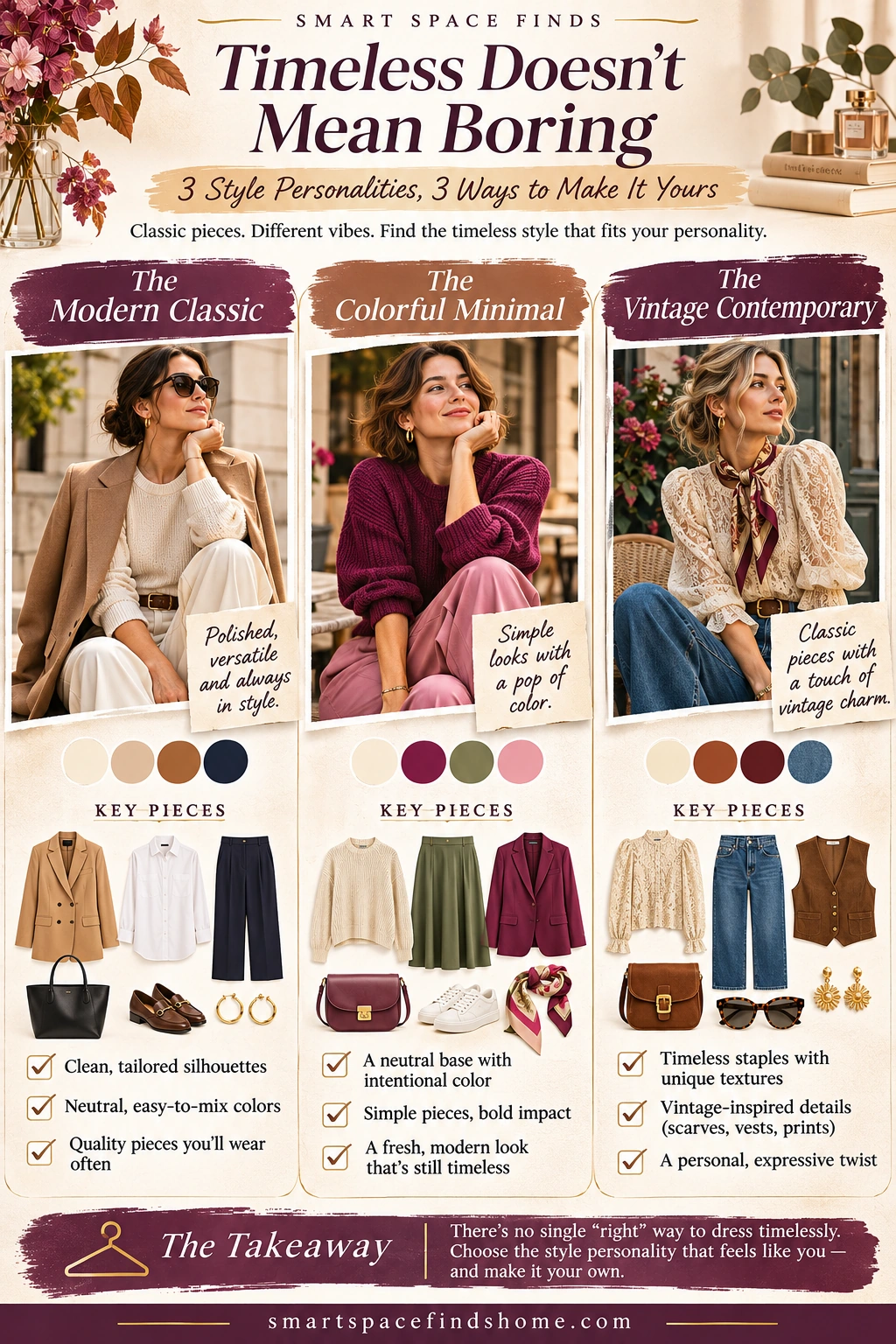
The Last Word: Repeat What Works
Timeless personal style is not the absence of trends, color, or personality. It is a wardrobe built through attention: noticing what you love to wear, taking care of it, and refusing to let a photograph or sale decide what you need. The most elegant change you can make this week may be to wear a favorite outfit again—with one thoughtful adjustment.