
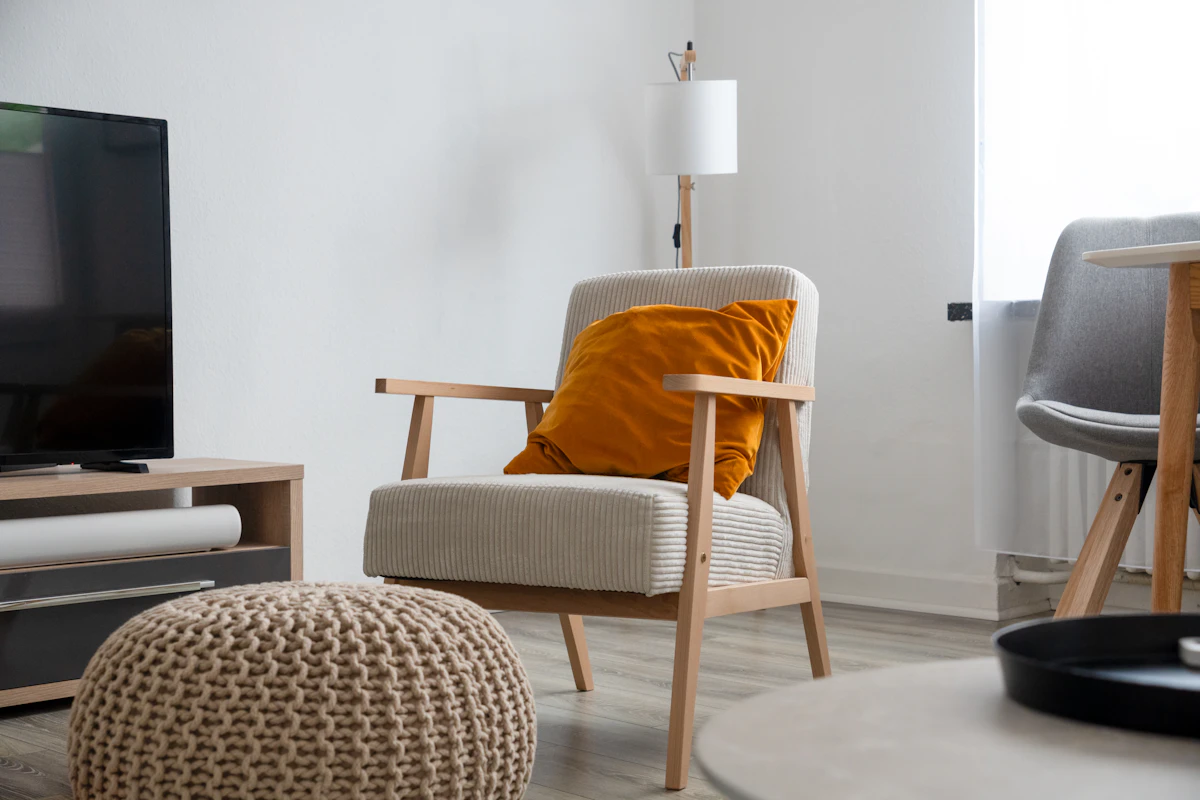
That overlooked spot beside the sofa, bedroom window or hallway wall has potential—but only if it makes everyday life better. Here is how to transform an unused corner with the right purpose, realistic measurements and a little design restraint.
You do not need a renovation, a matching furniture set or a stack of decorative accessories to make an empty corner feel considered. The best unused corner ideas begin with a simple question: What would you genuinely enjoy doing here? Reading for ten minutes, charging your laptop, enjoying a morning coffee or finally putting everyday clutter away are all worthwhile answers.
Below, you will find five different directions, an at-home decision framework, sizing and lighting checks, no-buy alternatives, and a weekend plan. Think of this as a small-space design guide rather than a shopping list.
Start With a 5-Minute Corner Audit
Before choosing furniture, make the corner work on paper. Measure its usable width and depth, not just the walls; open doors and drawers, walk through the room, and check whether a chair will need room to pull out. Look for outlets, natural light, heating vents, uneven floors and anything that cannot be moved.
Mark your proposed furniture footprint on the floor with painter’s tape or sheets of paper. Walk past it, open nearby doors and sit in a borrowed chair before buying. A piece that fits the measurements can still interrupt how the room functions.
| Check | Why it matters | What to do |
|---|---|---|
| Floor footprint | Furniture must fit and stay usable | Measure width, depth and furniture projection |
| Walking path | Doors and circulation need room | Test the layout at full scale; follow applicable clearance and egress rules |
| Daylight | Determines comfort and plant choices | Observe morning and afternoon conditions |
| Power and lighting | Work and reading need practical illumination | Locate outlets; avoid exposed cables in traffic areas |
| Wall and floor | Shelving or cabinets may require fixing | Check material, rental restrictions and anchoring requirements |
THE SMART SPACE FINDS FIELD GUIDE / NO. 01
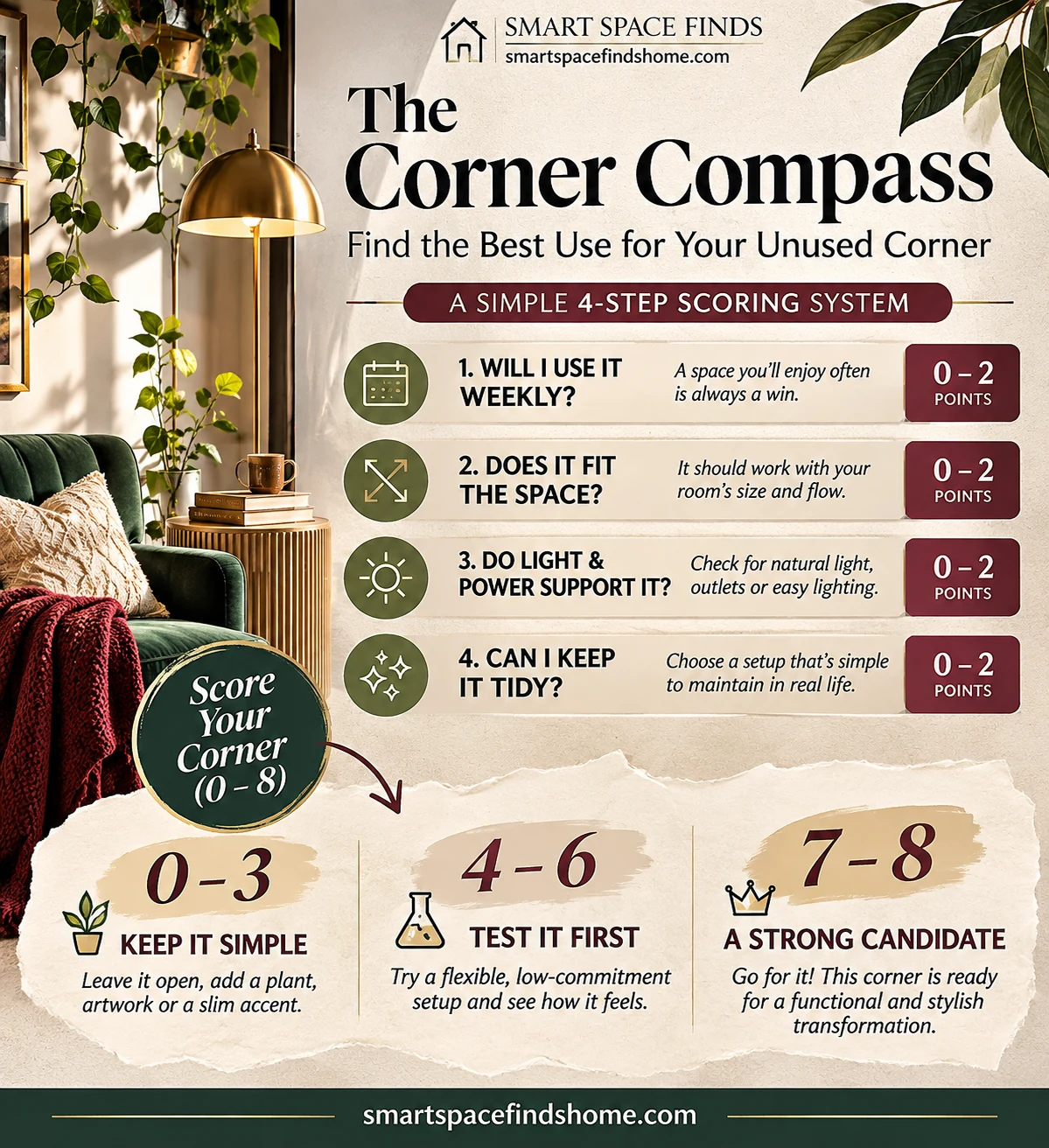
The Corner Compass
Before choosing a makeover, score each idea using four honest questions. Give each answer 0, 1 or 2 points.
- Would I use it weekly? Never = 0; sometimes = 1; often = 2.
- Does it fit with room to move? No = 0; maybe = 1; comfortably = 2.
- Does the light and power support it? No = 0; with adjustments = 1; yes = 2.
- Can I keep it tidy easily? No = 0; with effort = 1; yes = 2.
7–8: strong candidate. 4–6: test a temporary version. 0–3: try a simpler use or leave the corner open. A low score is useful information—not a failure.
What Should You Do With an Empty Corner?
The easiest way to choose is to match the corner with an activity that is currently inconvenient elsewhere in your home. Use the table below as a starting point—not a rulebook.
| Your corner | Try this | First priority |
|---|---|---|
| Bright and quiet | Reading nook or plant vignette | Comfort and controllable light |
| Near an outlet | Compact work or hobby station | Ergonomics and cable management |
| Narrow and often passed | Shallow storage or a single artwork | Keep the route clear |
| Bedroom corner | Morning ritual or getting-ready spot | Soft lighting and a clear surface |
| Very tight or oddly angled | Sculptural lamp or intentional open space | Avoid visual and physical crowding |
One underrated option: Leave it empty. Negative space gives a room breathing room and often helps a strong piece of furniture or artwork stand out. An empty corner is not automatically a design problem.
Five Unused Corner Ideas Worth Trying
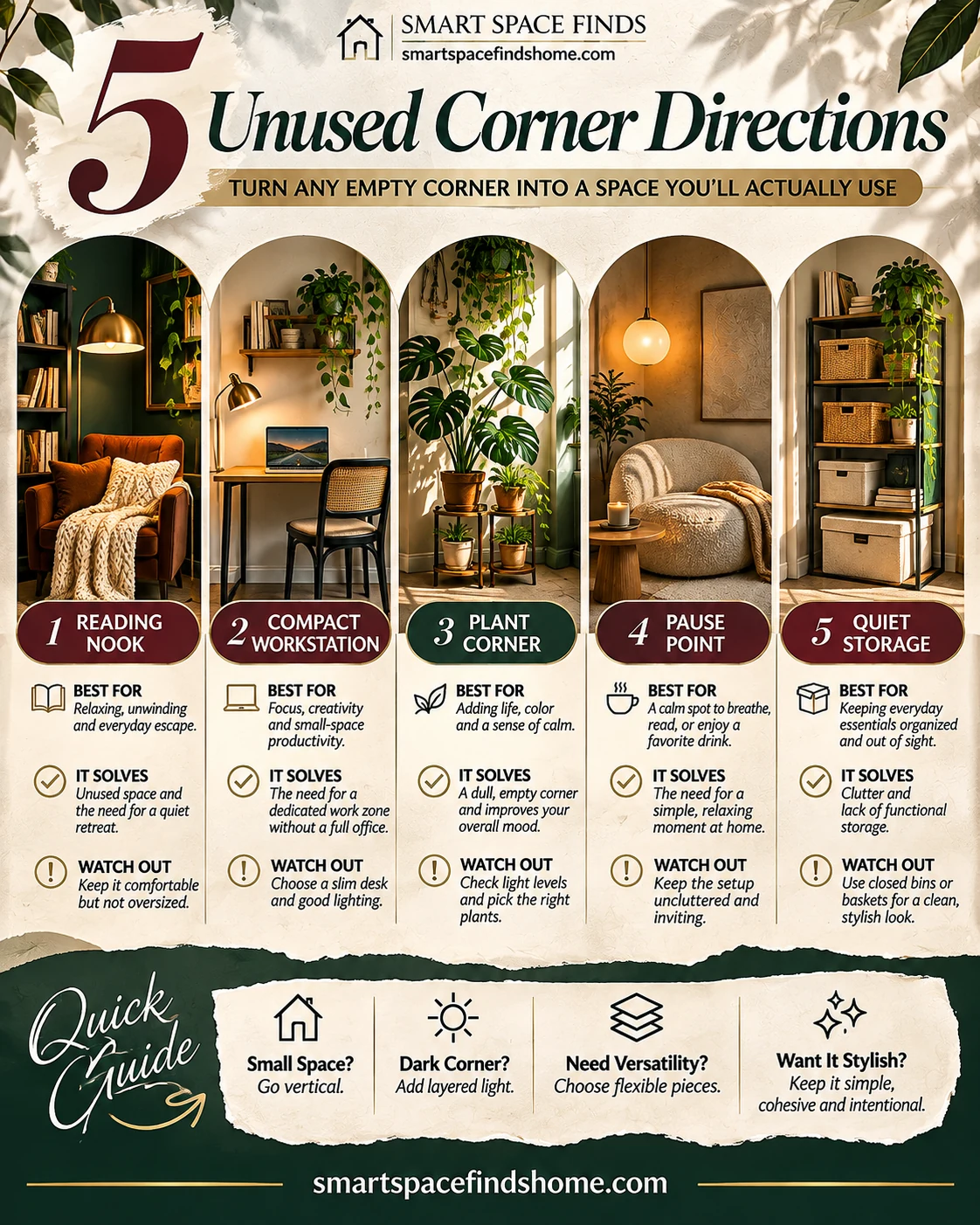
1. Make a Reading Nook You Will Actually Use
Start with the seat, not the accessories. Choose a chair you can comfortably sit in for more than a few minutes; then add a directional lamp and a reachable spot for a book or drink. In a tight layout, a small wall-mounted ledge may serve you better than a full side table.
Best for: living rooms, bedrooms and quiet window corners. Try it without buying: move an existing chair and lamp into position for one week. Watch out for: glare, an impractical reading angle and a chair that blocks a drawer or doorway.
Design detail: repeat one color or material from the larger room—such as an oak finish or a muted green cushion—so the nook feels connected rather than staged. For a deeper layout guide, explore our small-apartment self-care corner ideas.
2. Build a Compact Workstation Without Turning the Room Into an Office
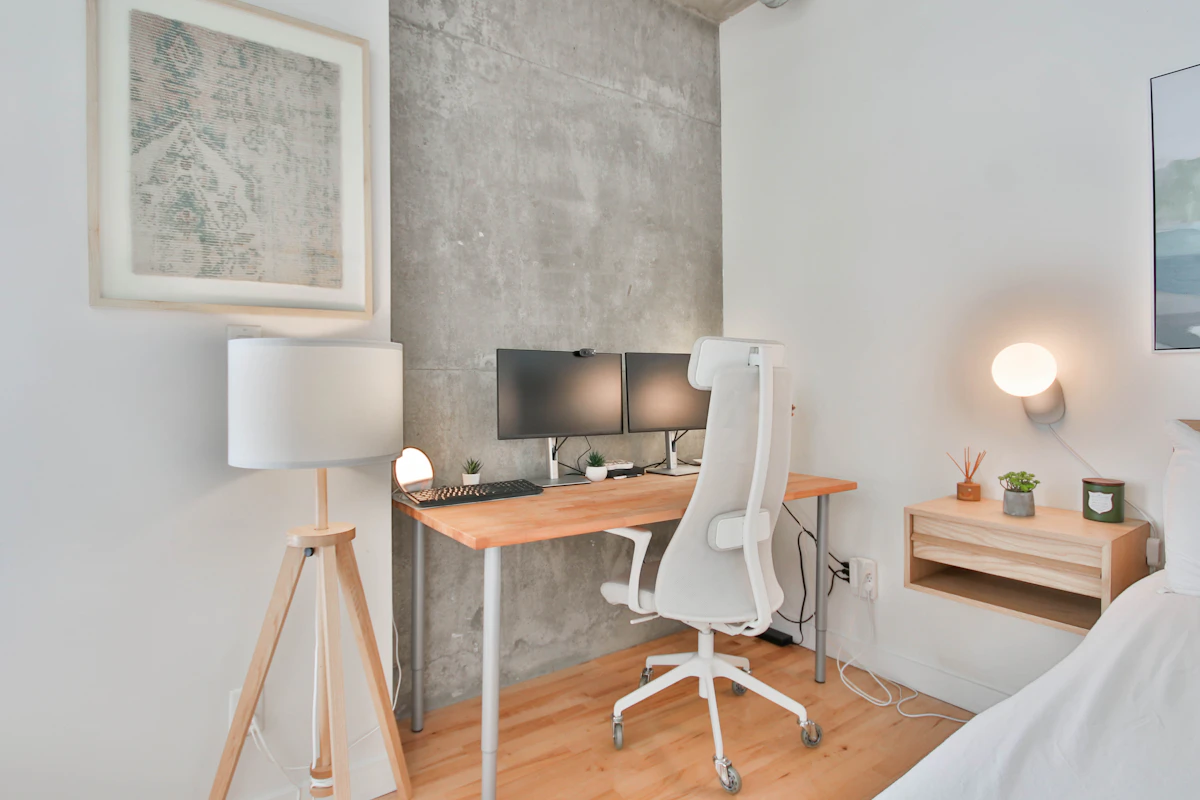
A desk is only a good solution when the corner supports the work you do. A shallow surface can suit occasional laptop tasks, while long work sessions require better attention to chair support, screen position, legroom and task lighting. Choose the arrangement around the equipment you use, not the desktop styling in a photo.
Best for: spare bedrooms, living rooms and studio apartments with accessible power. Try it without buying: test a temporary table where the desk might go. Watch out for: dangling charging cords, insufficient chair clearance and glare on your screen.
If this becomes a daily workstation, the full functional desk setup guide covers more practical upgrades.
3. Create a Plant Corner Based on Light, Not Looks
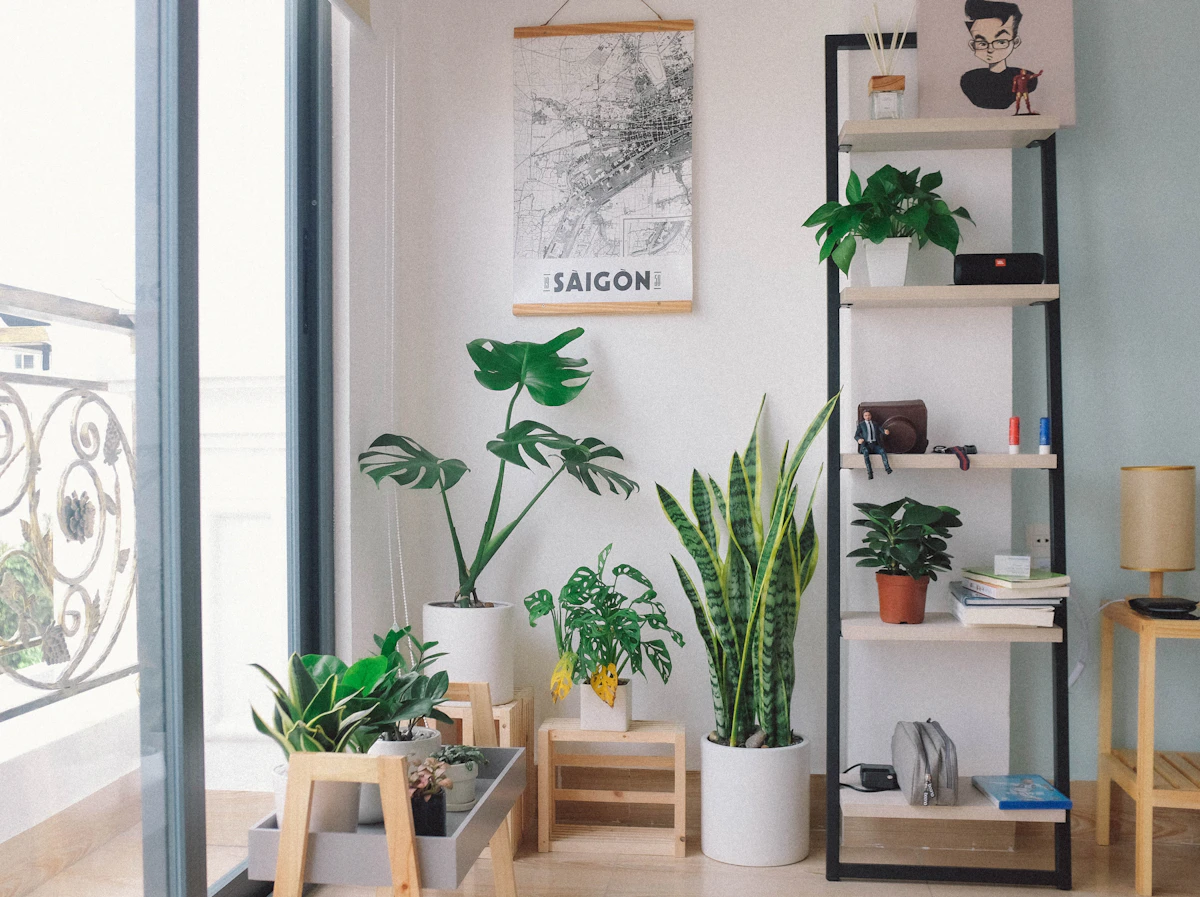
A well-placed plant can soften architectural edges and add height. Start with one healthy plant or a small coordinated group at different heights. Observe where direct sun falls, whether the space gets cold drafts, and whether the pots drain safely onto the floor.
Best for: corners with suitable natural light and room to water plants. Try it without buying: relocate a plant you already own and observe it for several weeks. Watch out for: species that are unsafe for pets, soggy flooring and plants blocking vents or windows.
4. Create a Small Pause Point for Your Morning or Evening
Not every corner needs to perform a major task. A simple seat, comfortable textile and low-glare lamp can make a place for a cup of tea, journaling or ten quiet minutes after work. Use one personal object—a framed photograph, favorite book or handmade ceramic—to give it character.
Best for: bedrooms and quiet living room edges. Try it without buying: shift an existing stool and add a cushion. Watch out for: placing fragile objects where they can be knocked over or making the area hard to clean.
For a complementary approach, see our guide to cozy evening ideas at home.
5. Give an Awkward Corner a Quiet Storage Job
The most beautiful transformation is sometimes one that makes clutter disappear. A slim cabinet, narrow bookcase or well-chosen basket can absorb the things you currently leave on the nearest chair. Put frequently used items within easy reach, and use closed storage if visible objects make the room feel busy.
Best for: narrow living rooms, bedrooms and entryway-adjacent spaces. Try it without buying: rearrange a shelf or reassign an existing basket. Watch out for: unstable tall furniture, overloaded shelves, inaccessible drawers and blocked passageways. Secure tip-prone furniture according to its instructions and the wall type.
The Magazine Edit: Make the Corner Feel Designed, Not Filled
Many corner makeovers go wrong because every element competes to be noticed. Give the spot one anchor, one light source and one personal detail. These are design roles, not three mandatory purchases. A substantial chair may already be the anchor; a small wall sconce may already supply the light.
One anchor: chair, narrow cabinet, desk or statement plant. One layer of light: reading lamp, ambient lamp or existing daylight. One sign of personality: art, a textile or an object you genuinely love. Stop there, live with it, and add only what is missing.
Choose proportion before color
A petite chair may be more comfortable in the room than a broad lounge seat, even if both technically fit. Before ordering, compare the item’s actual dimensions with your taped outline. Narrow corners often benefit from slim legs, rounded silhouettes and more visible floor—not necessarily miniature furniture.
Layer light for its purpose
Reading calls for a directed source, relaxing benefits from soft indirect light, and work requires light positioned to minimize glare and shadows. Bulb color and brightness are personal preferences: test with the lamp you already have before purchasing new lighting.
Make the corner belong to the room
Repeat a material, accent color or shape found elsewhere. If the living room has warm wood and cream textiles, the corner might echo that palette with a light oak ledge and one woven cushion. Cohesion matters more than matching sets.
Unused Corner Ideas by Room
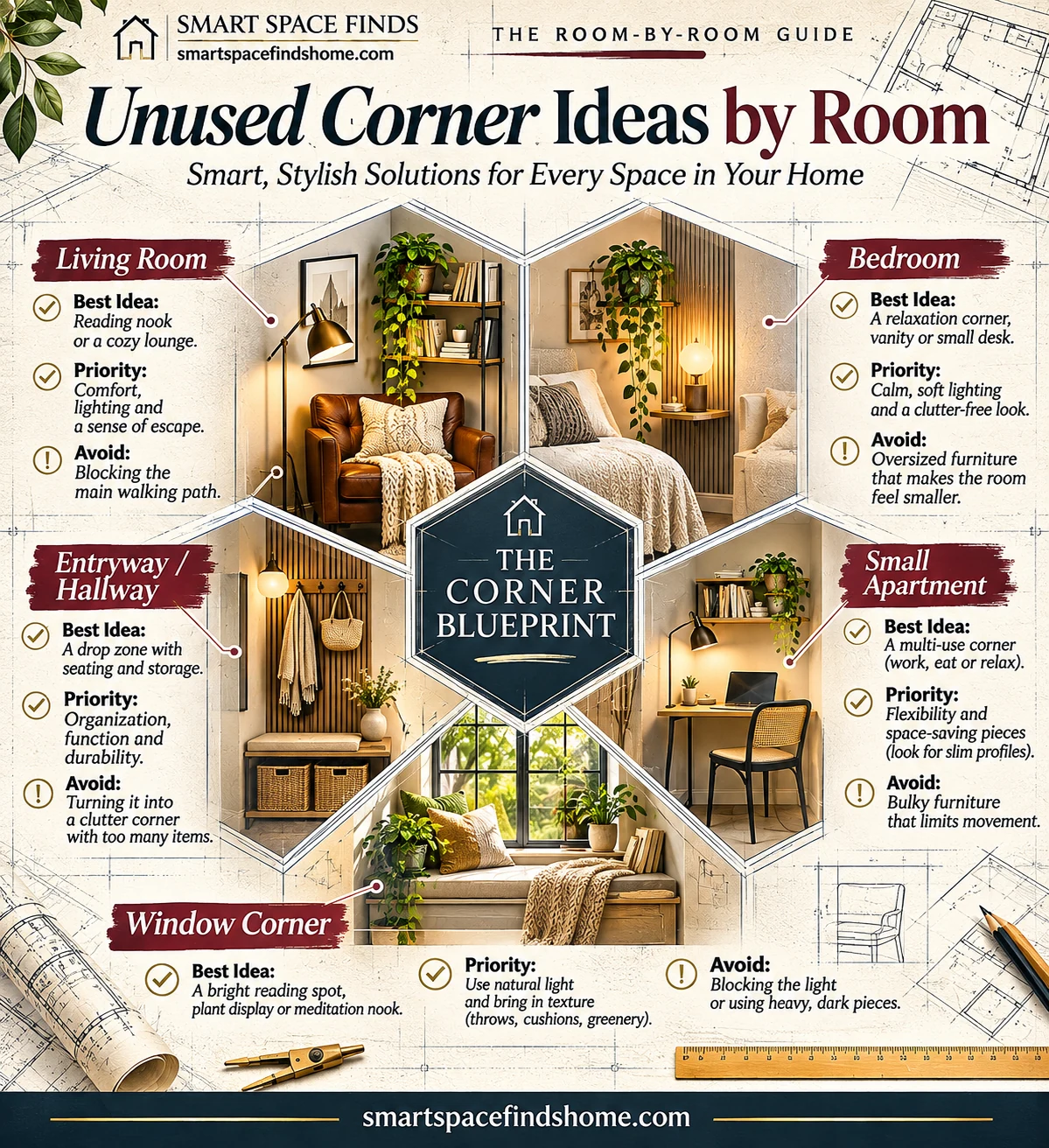
A good idea in one room may be inconvenient in another. Use the room’s existing routine as the deciding factor, then borrow the smallest design move that supports it.
For an empty corner beside the sofa, try a floor lamp and compact chair if you want another place to sit. If the room already has plenty of seating, a single framed artwork, sculptural lamp or slim closed cabinet may look more intentional. Keep the passage between furnishings clear.
A quiet chair for tomorrow’s outfit, a reading spot or a low-profile vanity can work beautifully—but do not turn the corner into a second clutter magnet. Choose a purpose that supports your morning or bedtime routine and keep clothing off the floor.
In a narrow transition area, visual simplicity matters more than squeezing in a full furniture piece. A shallow shelf, a small wall hook arrangement where permitted, or one vertical artwork can add function without occupying much floor space. Never narrow a required exit route.
What about a corner that is too small for furniture?
Think vertically: a carefully hung picture, a narrow wall-mounted light or a single decorative object on an existing ledge can give it presence. Another option is to leave it open and let a nearby chair, curtain or plant create the visual balance. For renters, favor reversible choices that do not damage walls.
Three Corner Layout Scenarios to Test Before Buying
Scenario A — Window-side corner: place the seat where natural light is useful but does not glare directly into your eyes; test curtains and shadows at different times of day.
Scenario B — A corner near the sofa: angle a compact chair slightly toward the conversation area instead of pushing every piece flat against two walls. Check the resulting walking route.
Scenario C — An odd alcove: measure its width at multiple heights and test a freestanding solution before considering fitted storage. Sloping ceilings and skirting boards can change the usable dimensions.
Illustrative planning note: There is no universal “perfect corner size.” Product dimensions, the resident’s mobility needs, local safety rules and intended use determine what will work. The painter’s-tape test is more reliable than a generic measurement copied from a photograph.
Smart Spending: What to Reuse, Fix or Buy

Before shopping, sort every possible addition into three groups. Reuse what already solves the problem. Fix what would work with better placement or lighting. Buy only the missing piece that improves daily use.
| If the problem is… | Start here | Consider buying only when… |
|---|---|---|
| Corner feels cold or unfinished | Move a chair, plant or existing lamp | Lighting or seating is genuinely absent |
| Reading feels uncomfortable | Test seat position and lamp angle | The seat or light remains unsuitable |
| Clutter keeps returning | Remove duplicates; assign a home for daily items | You lack appropriately sized storage |
| Work surface is inconvenient | Adjust equipment, layout and glare | A safe, ergonomic surface cannot be made from what you own |
Affiliate product recommendations will be added only after the specific items, variants and destination links have been reviewed. There is no reason to interrupt a practical article with irrelevant products.
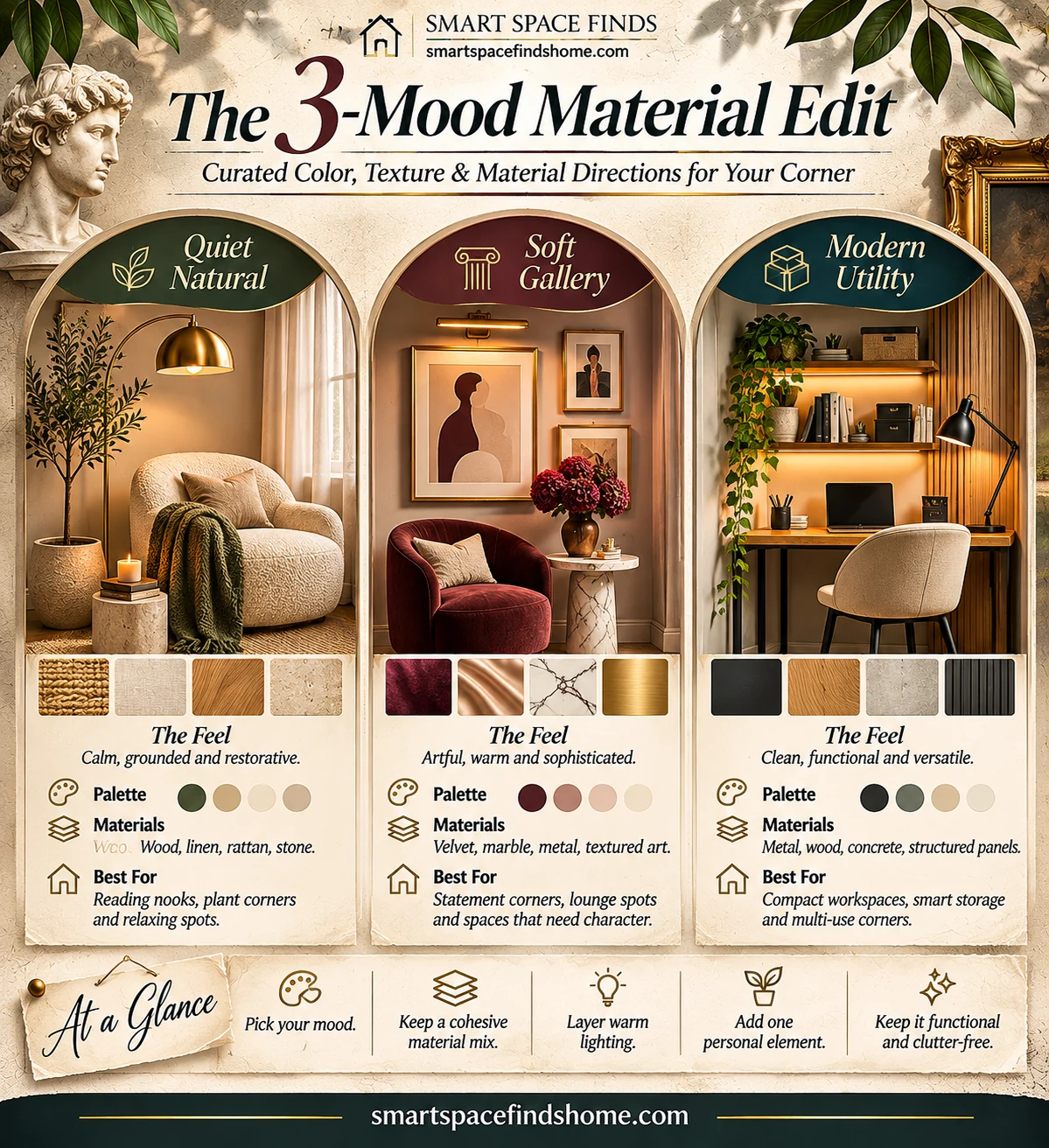
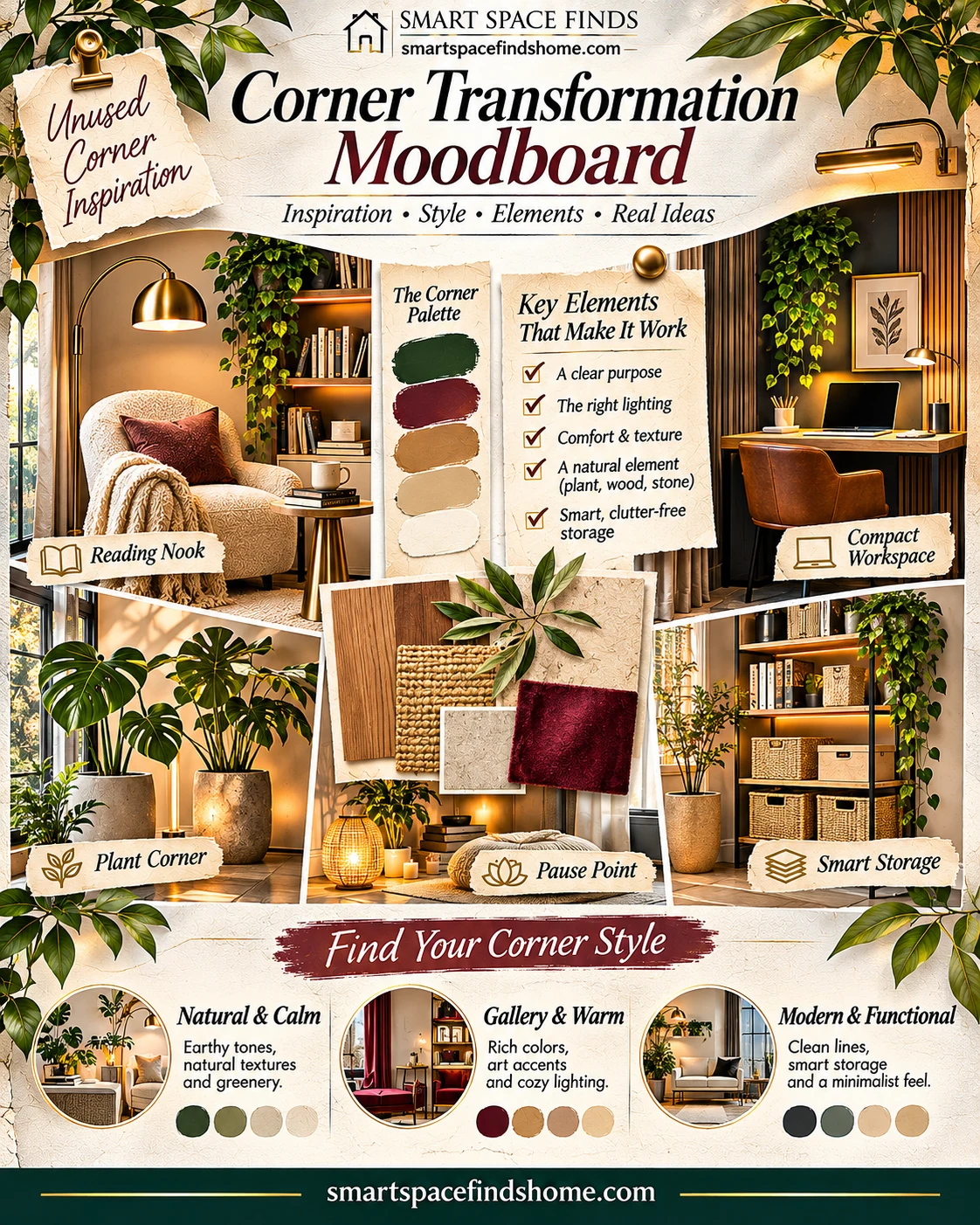
Pick a feeling, then choose the details.
Oak · sage · linen. Ideal for a calm reading or pause point.
Oxblood · muted bronze · cream. Beautiful for a single artful focal point.
Forest · stone · ivory. Suits a tidy desk or discreet storage.
Choose one palette from colors you already own. The swatches are illustrative, not a requirement to repaint or shop.
A Weekend Plan to Transform an Empty Corner
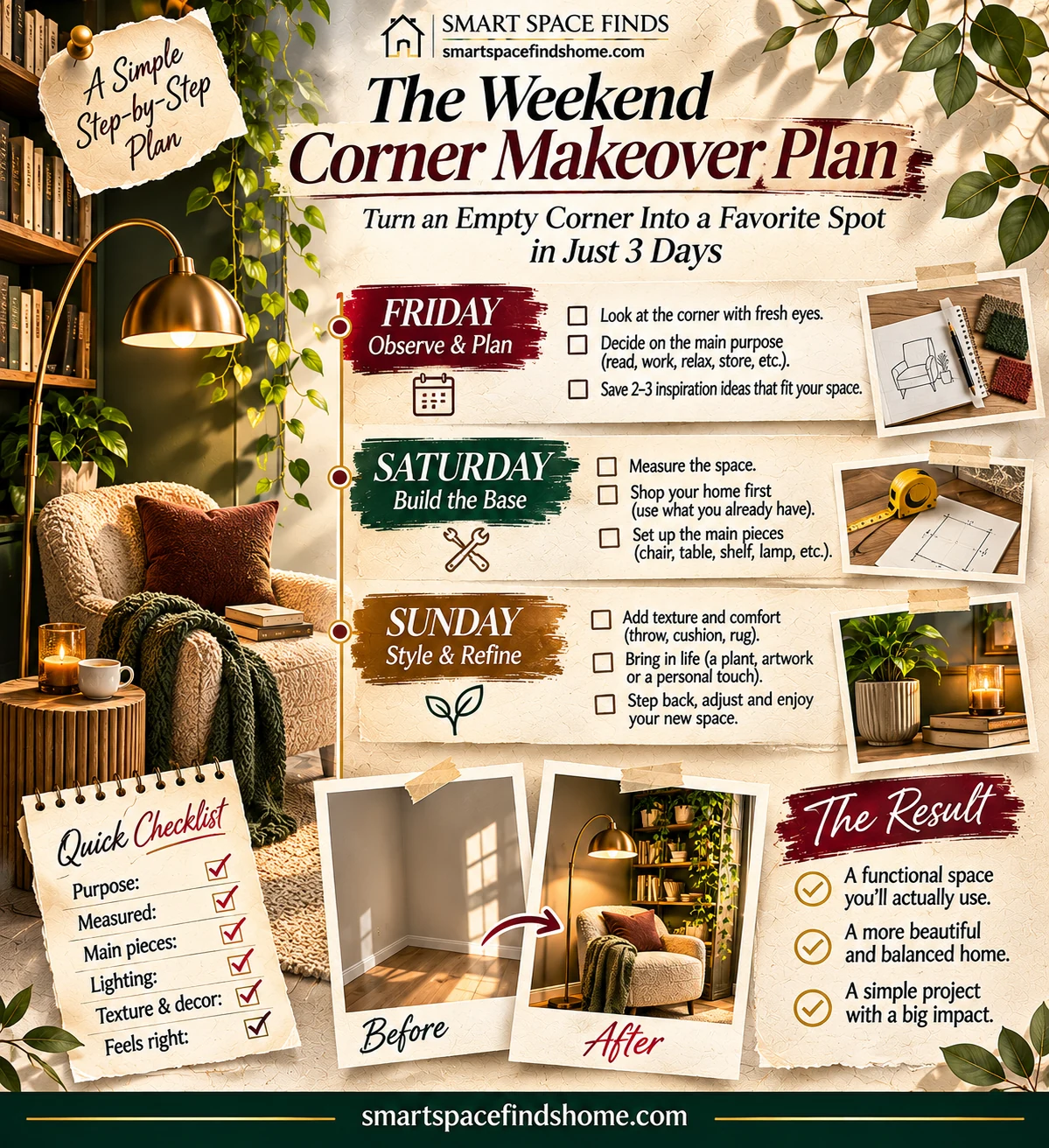
- Friday: Observe. Take a photo, note what the corner currently collects and define one job you want it to do.
- Saturday morning: Measure. Record width, depth, nearby door movement, outlets and daylight. Tape out possible furniture positions.
- Saturday afternoon: Shop your home. Move one anchor piece and make the space usable without a purchase.
- Sunday: Refine. Improve the light, adjust the seat or storage and remove anything that blocks movement or feels decorative-only.
- One week later: Evaluate. Did you use it? Did it reduce frustration? Can you clean around it? Keep what works and reverse what does not.
Photograph the space from the same angle in similar daylight. A fair comparison tells you more about the change than contrasting a messy nighttime photo with a professionally styled daytime one.
Common Corner Decorating Mistakes
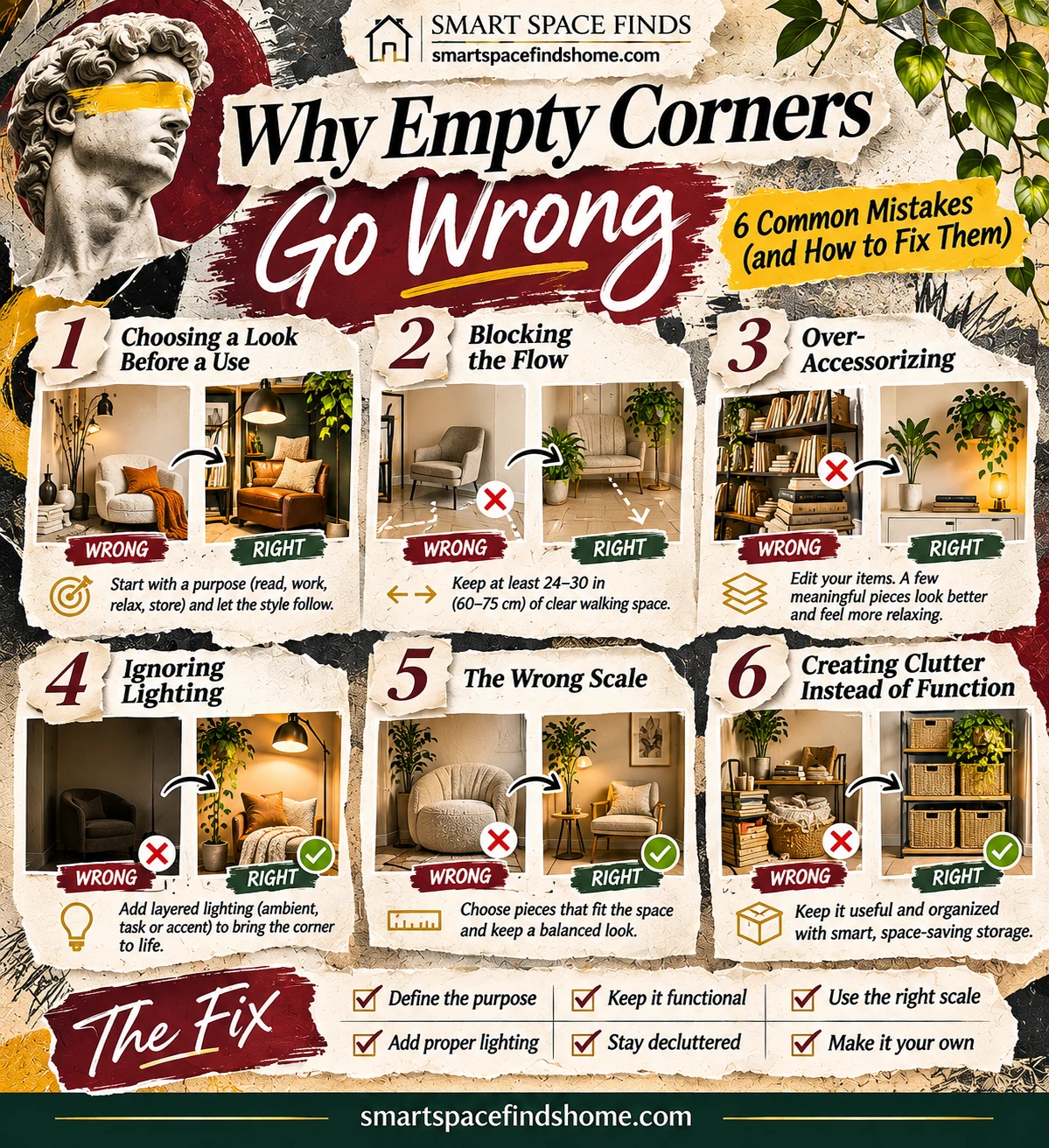
- Choosing a look before a use: a picture-perfect vignette that never gets used adds little value.
- Blocking circulation: even a narrow piece can crowd a doorway or route through a room.
- Buying too many small objects: several tiny accessories can look busier than one useful anchor.
- Ignoring lighting and power: a beautiful desk without comfortable illumination is not a good workstation.
- Overlooking maintenance: dusty decor, inaccessible storage and plants you cannot care for become chores.
- Assuming every corner needs filling: intentional negative space can be the most elegant decision.
Frequently Asked Questions
How do you decorate a very small empty corner?
Use a single element that stays within the available footprint—a slim lamp, piece of artwork, narrow shelf or appropriately sized plant—and preserve the walking path. If the corner feels better empty, leave it open.
What can I put in an awkward living room corner?
A compact reading chair, accent lamp, slim closed cabinet, plant or small table can all work. Choose based on circulation, light, storage needs and the furniture already in the room.
How can I decorate an empty corner without buying anything?
Rearrange a chair, move an existing lamp or plant, rotate art, edit clutter and try a new furniture layout. Test the setup for a week before deciding what is missing.
Can I turn a bedroom corner into a workspace?
Yes, if the desk footprint, lighting, chair movement and cables can be accommodated safely. Occasional laptop use and an eight-hour workday have different ergonomic demands.
How do I make a corner look cozy without clutter?
Prioritize one comfortable texture, warm or well-directed light and a personal detail. Leave clear floor and surface space so the vignette feels calm and is easy to maintain.
Should every empty corner be decorated?
No. Negative space can improve the room’s balance, preserve movement and keep the design from feeling crowded.
The Final Edit
Your favorite corner probably will not begin with a shopping cart. It will begin with noticing what is missing from the way you live—somewhere comfortable to read, a surface for a task or storage that makes the day easier. Give the corner one purpose, test the arrangement and let the room tell you what it needs next.