
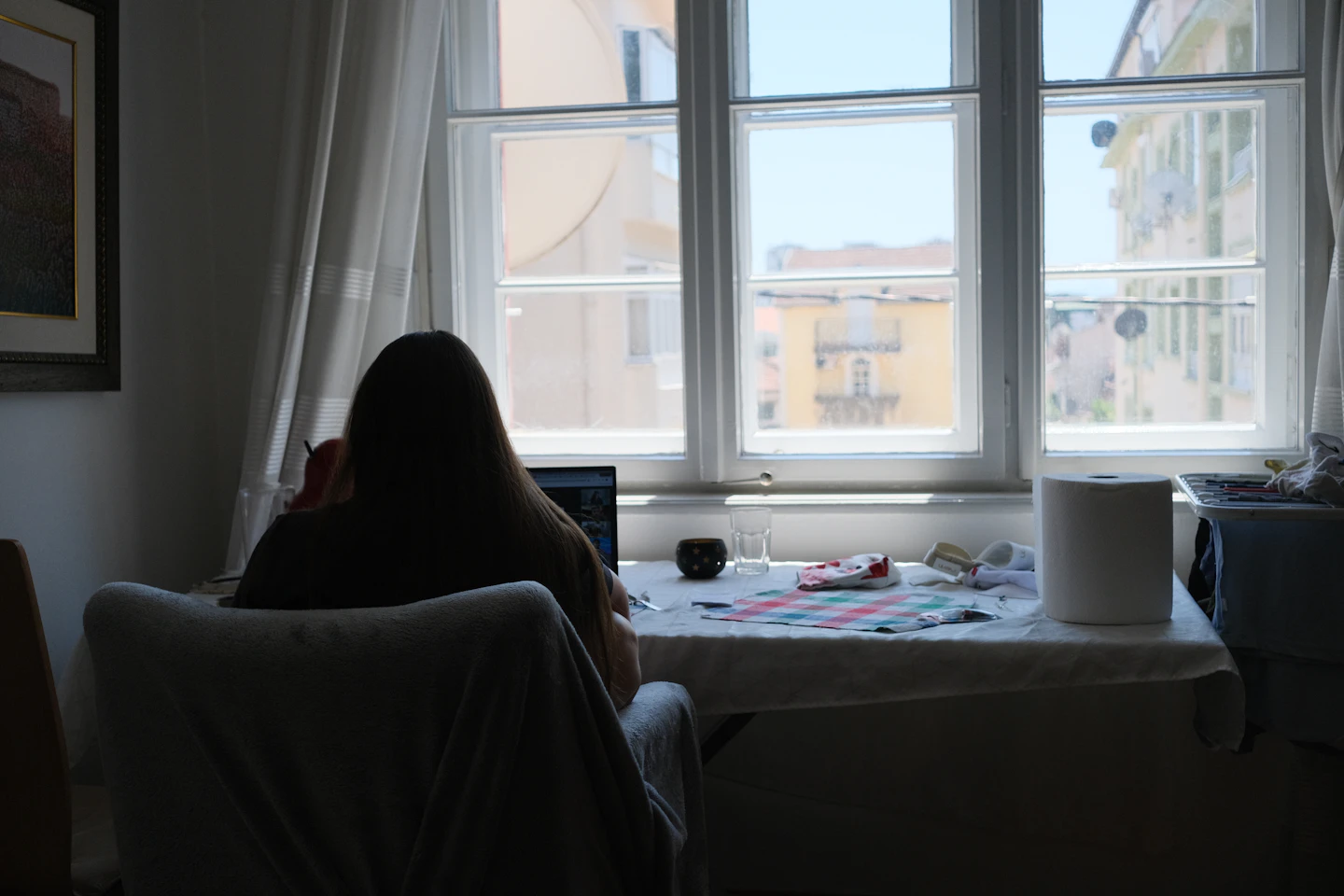
THE EVERYDAY LIVING EDIT / HOME & HABITS
You do not need a 5 a.m. alarm, a color-coded planner, or an entirely new personality to make everyday life feel easier. Often, the best routine refresh begins with one small change to the way your home supports you.
If mornings involve a frantic search for keys, small chores keep interrupting your day, or the evening never quite feels like a break, this guide offers five realistic fixes you can try in the home you already have. Start with one. Keep what works. Let the rest go.
Quick answer: How do you refresh your daily routine?
Identify one repeating frustration, make the next action easier, and test the change for seven ordinary days. Set up tomorrow’s essentials, create a short focus window, group one recurring task, store supplies where you use them, or introduce a gentle end-of-day cue. None requires a purchase.
First, find the part of your day that feels harder than it should.
Before you buy an organizer or redesign your schedule, observe one ordinary day. Notice where you pause, search, backtrack, put something off, or have to make the same decision again. This is your friction point. A useful change should address that point—not just look impressive in a photograph.
| Repeated frustration | Try this first | How you’ll know it helps |
|---|---|---|
| Keys and bag disappear before work | Put them in one landing spot by the door | Fewer searches on the way out |
| Every notification derails a task | Try a brief, optional-notification-free window | One task gets finished with fewer interruptions |
| Small chores interrupt your afternoon | Group one safe, similar category of tasks | Less starting and stopping |
| Supplies are always in another room | Move frequently used items closer to their task | Fewer unnecessary trips |
| Work seems to follow you into the evening | Choose one repeatable transition cue | The end of work feels clearer |
A routine is useful when it works on an average Tuesday—not only on a picture-perfect weekend.
5 simple ways to refresh your daily routine
01 / THE MORNING LAUNCH
Prepare tomorrow’s essentials before you need them.
Think of the three things you search for most often when leaving home: keys, wallet, transit pass, glasses, lunch, work badge, or a bag. Give those items an obvious home in the path you already walk. The goal is not an elaborate entryway makeover. It is one less scavenger hunt.
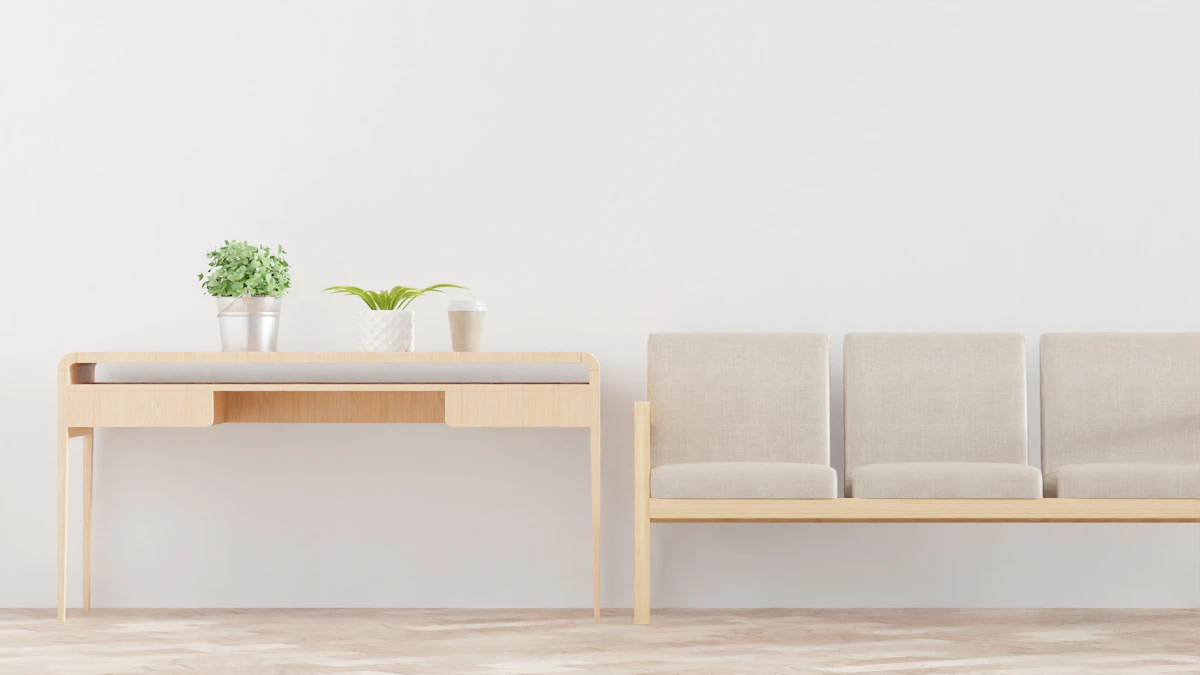
Make it work in a small apartment
Use a shallow tray on an existing surface, a permitted hook, or a basket on a shelf. For renters, choose removable solutions appropriate to your wall finish and load limits. Leave walking paths and doors unobstructed.
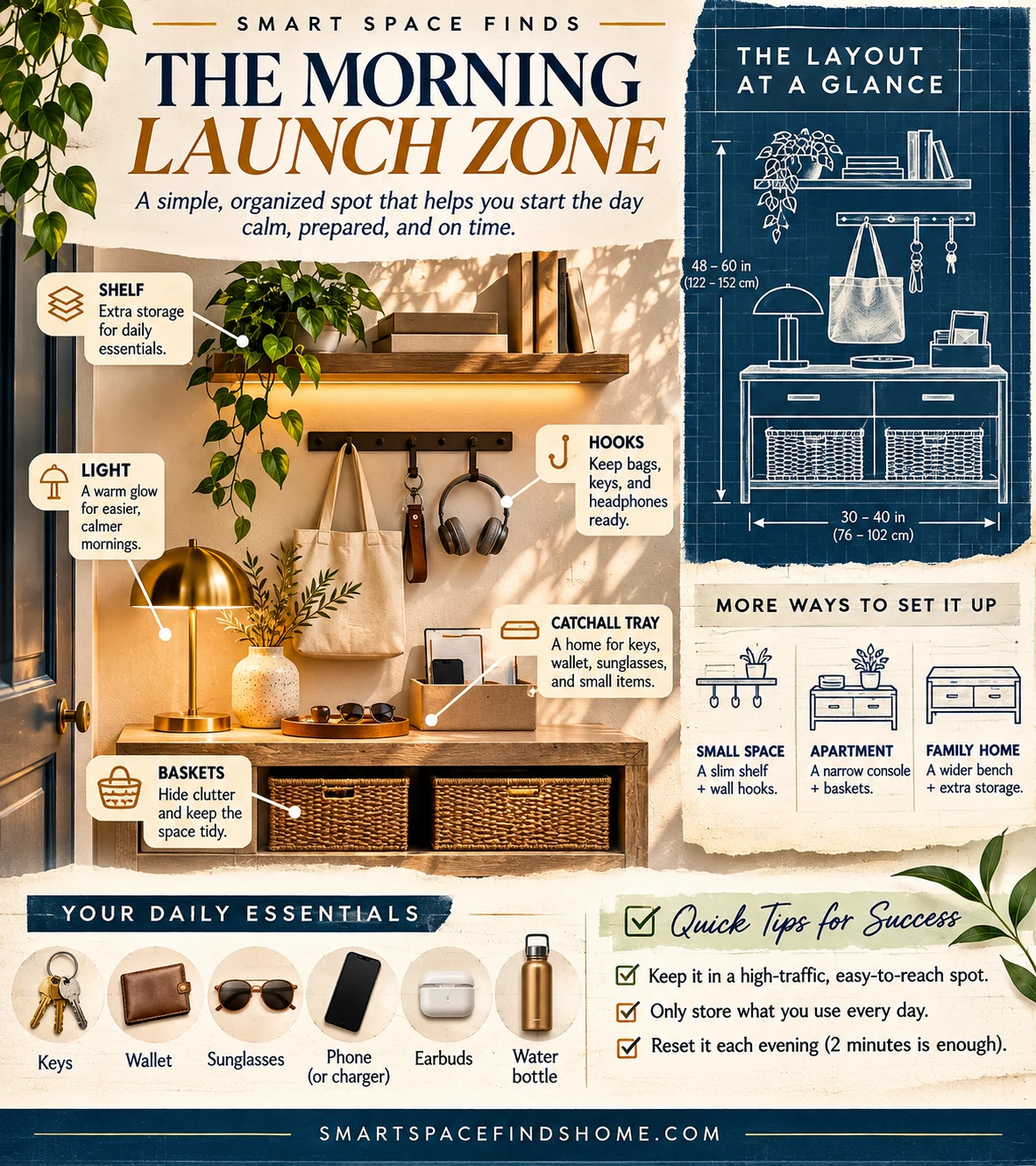
Try tonight: Put tomorrow’s essentials in the chosen place. Check tomorrow: Did leaving home require less searching? If the tray becomes a miscellaneous dumping ground, reduce what belongs there.
02 / THE ATTENTION WINDOW
Make one part of your day a little less distracting.
A calmer routine is not necessarily a stricter one. Pick a task that benefits from uninterrupted attention—paying a bill, folding clothes, reading, planning dinner—and create a short window to do it. Begin with a manageable interval rather than an ambitious two-hour block.
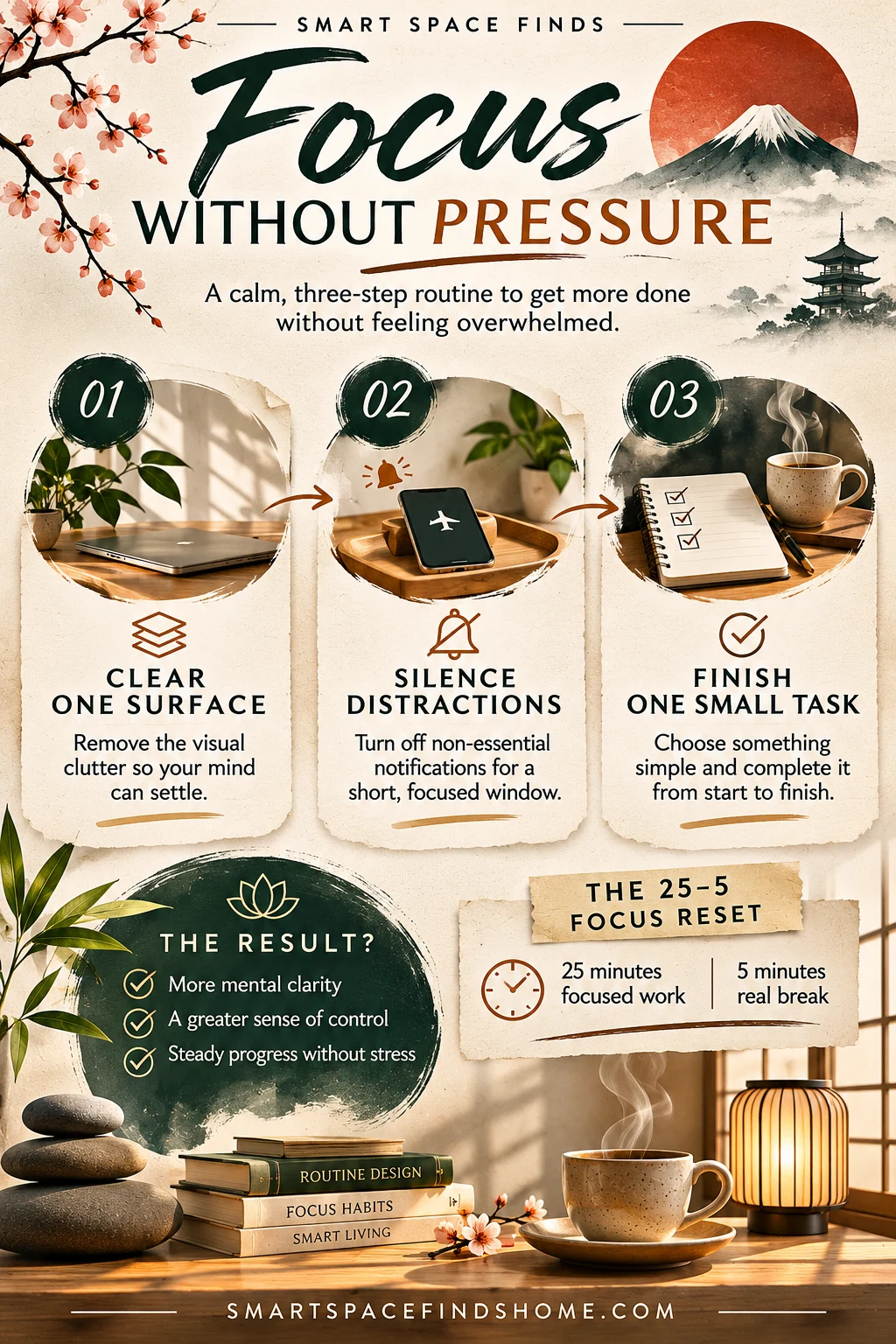
Design the environment, not just your willpower
Clear only the surface you need, move distracting items out of immediate reach, and silence optional notifications when appropriate. Keep urgent calls, caregiving needs, safety notifications, and accessibility alerts available.
Try today: Complete one small task during an interruption-light interval. Check afterward: Did the change reduce task switching? If not, use a shorter interval or move the activity to a better time.
03 / THE ONE-BATCH RULE
Group one recurring chore—but only when it truly saves effort.
Constantly starting tiny tasks can make a normal day feel fragmented. Try grouping similar work: sort incoming paperwork in one sitting, wash produce together before meal prep, or collect items that belong upstairs before making a trip. A batch is helpful when it cuts setup and transitions, not when it lets a mess become stressful.
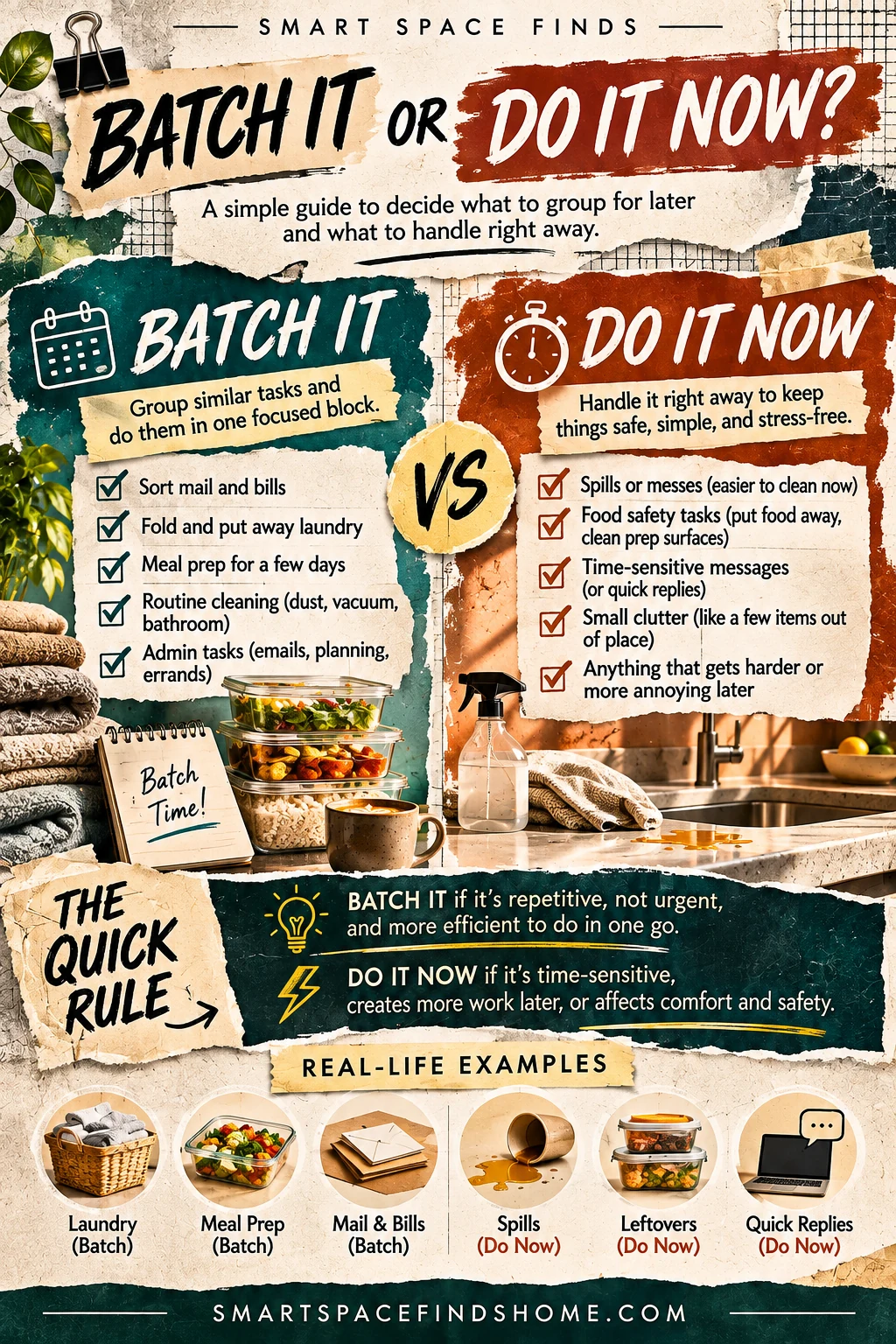
Mail sorting, routine admin, folding clean laundry, prepping a few compatible ingredients.
Food-safety tasks, spills, time-sensitive messages, anything that becomes harder or unsafe when delayed.
Try this week: Choose one recurring category and compare it with your previous approach. Keep it only if: You save effort without creating a worse backlog.
04 / THE REACH TEST
Put everyday tools closer to the place you use them.
Walk through a common task—making coffee, wiping the counter, getting dressed, doing laundry—and note how often you travel across the room for basic supplies. An efficient setup follows the actual sequence of use, not the arrangement that looks best in a styled photograph.
| Task | Keep nearby | Avoid |
|---|---|---|
| Morning coffee | Daily mug, coffee supplies, clean spoon | Blocking prep space or electrical outlets |
| Wiping counters | Appropriate cloth in a safe storage location | Unsafe storage of chemicals, especially around children |
| Getting dressed | Frequently used accessories together | Overstuffed drawers that hide everything |
| Sorting laundry | Hamper where clothes are usually changed | Obstructed exits and walkways |
Try today: Move only the two most-used items. Check later: Does the task now take fewer motions? Store cleaning products according to their labels, away from children and pets, and never trade safety for convenience.
05 / THE GENTLE HANDOFF
Create a small cue that separates one part of the day from the next.
If your dining table is also your desk, or your living room doubles as your office, the transition between responsibilities and rest can be blurry. A cue gives that transition a recognizable beginning. It might mean closing your laptop, putting away a notebook, taking a short walk, changing into comfortable clothes, or switching to softer lighting.
The ritual does not need to be cinematic or expensive. Even a two-minute tidy and turning off a desk lamp may be enough to tell yourself that one task is complete. If you work irregular shifts, link the cue to finishing work, not to a fixed clock time.
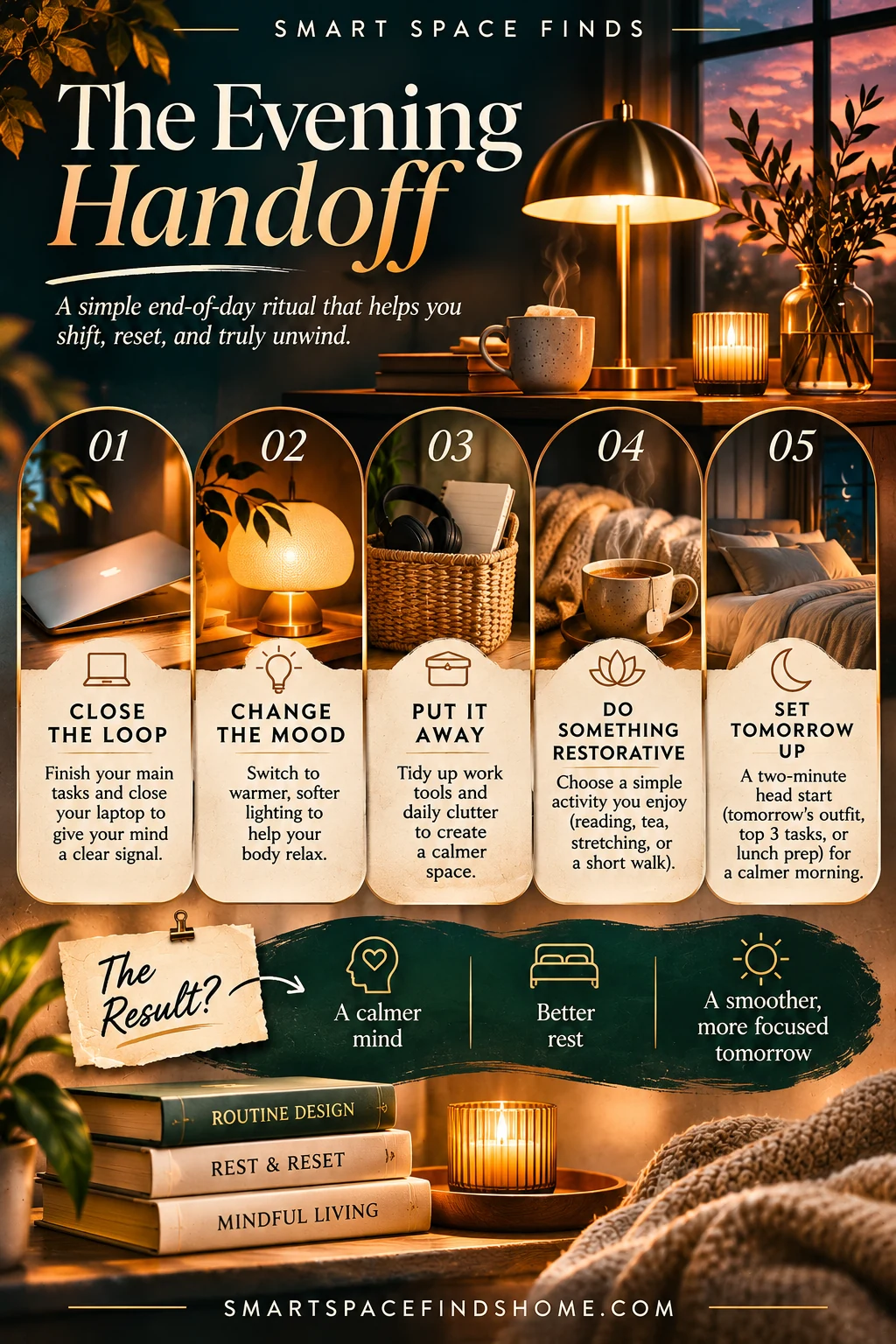
Try tonight: Choose one pleasant transition. Check after a week: Does it make your day feel easier to close? If it feels like another obligation, simplify it.
THE SMART SPACE FINDS EDITORIAL STUDIO / NO PURCHASE REQUIRED
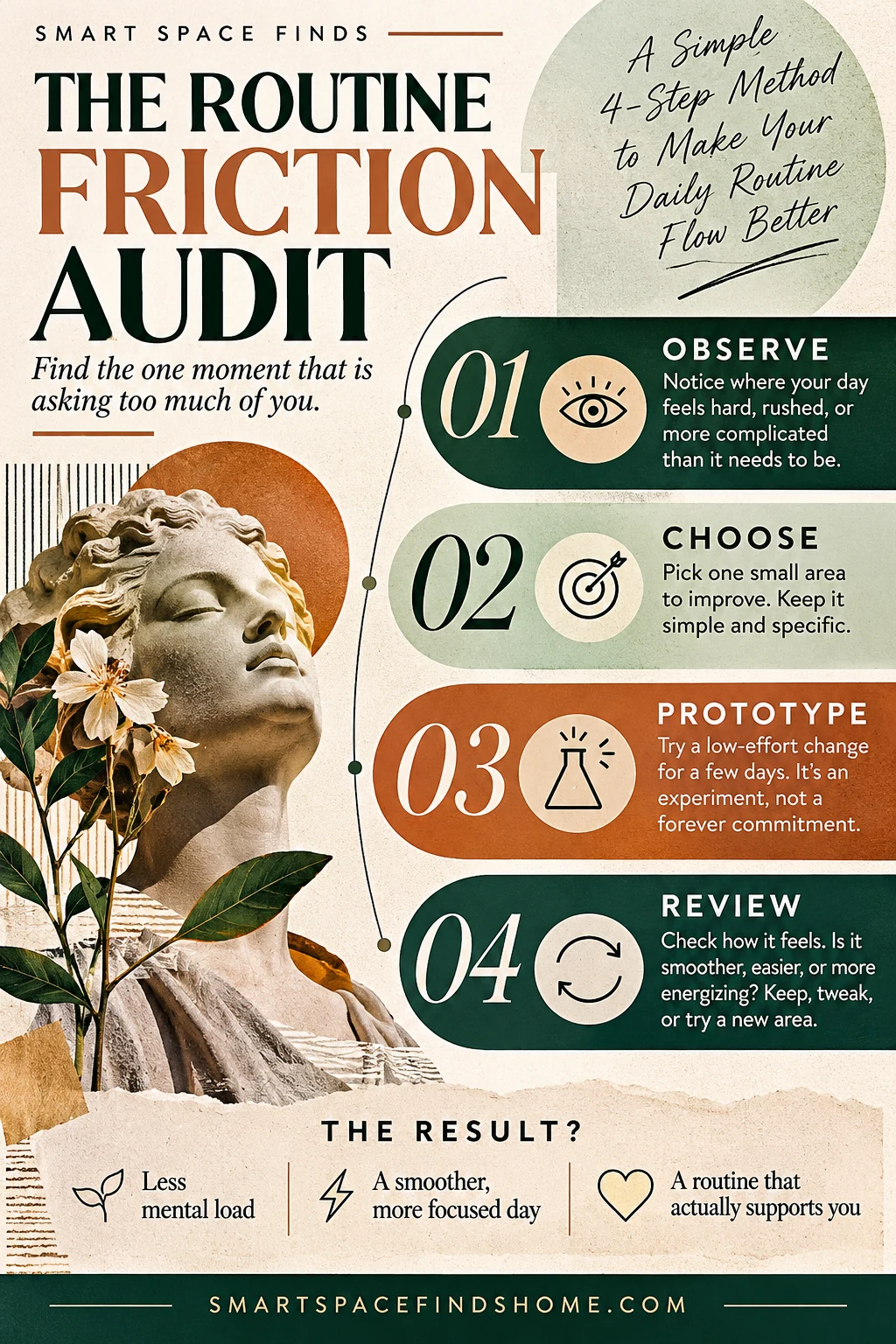
The Routine Friction Audit
Stop trying to improve your whole life at once. Find the one moment that is asking too much of you—and design a gentler next step.
01
Observe
During a typical day, note three moments when you search, backtrack, feel rushed, or repeat a decision.
02
Choose
Pick the most frequent, easiest-to-change annoyance. Skip anything that requires buying an entire system.
03
Prototype
Move one item, reduce one step, or add one visible cue. Keep your experiment small enough to reverse.
04
Review
After several ordinary days, ask: Was it easier, safer, or calmer? Keep, adapt, or abandon the change.
Not sure where to start? Choose the reset that matches your day.
Forget the idea that a great morning routine must begin before sunrise. A useful daily reset starts with the problem you actually feel. Scan the options below and choose one direction, not all five.
| If your day feels… | Start with… | The 2-minute version |
|---|---|---|
| Rushed before leaving | A launch spot by the door | Put keys and bag together tonight |
| Scattered or interrupted | A protected focus interval | Finish one tiny task with optional alerts off |
| Full of half-finished chores | One intentional batch | Sort today’s mail in one sitting |
| Cluttered or inefficient | The reach test | Move one everyday item to its point of use |
| Hard to switch off | An end-of-day cue | Close the laptop and change the lighting |
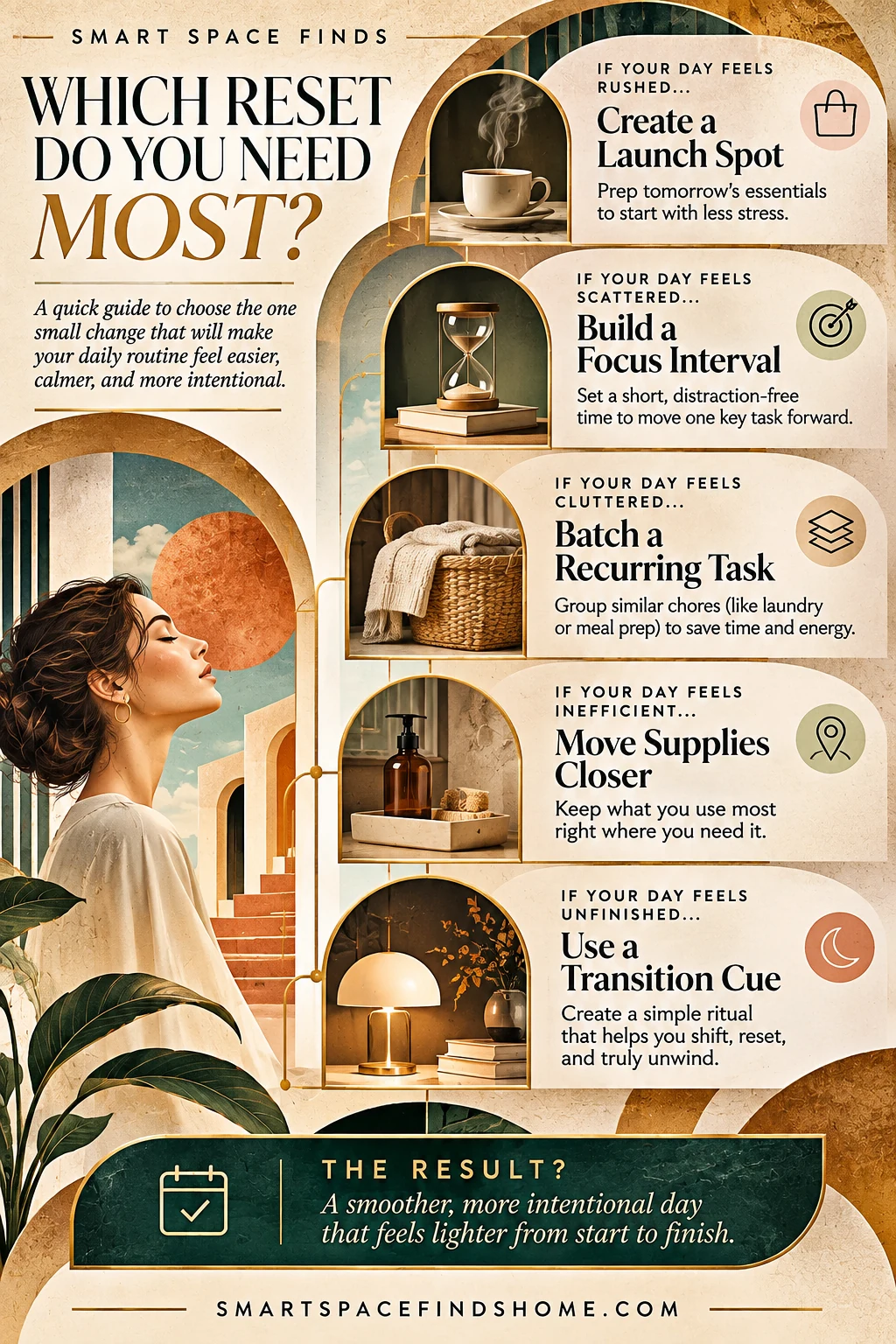
If the only change you make today is putting your essentials in one place, that is a complete first step. A smaller routine you can use is more valuable than an elaborate system you have no room for.
The LESS Friction Method: a practical decision filter
Not every attractive routine idea deserves space in your life. Use this simple four-part editorial tool to choose what to change and what to ignore. It is a practical checklist, not a clinically validated behavior-change method.
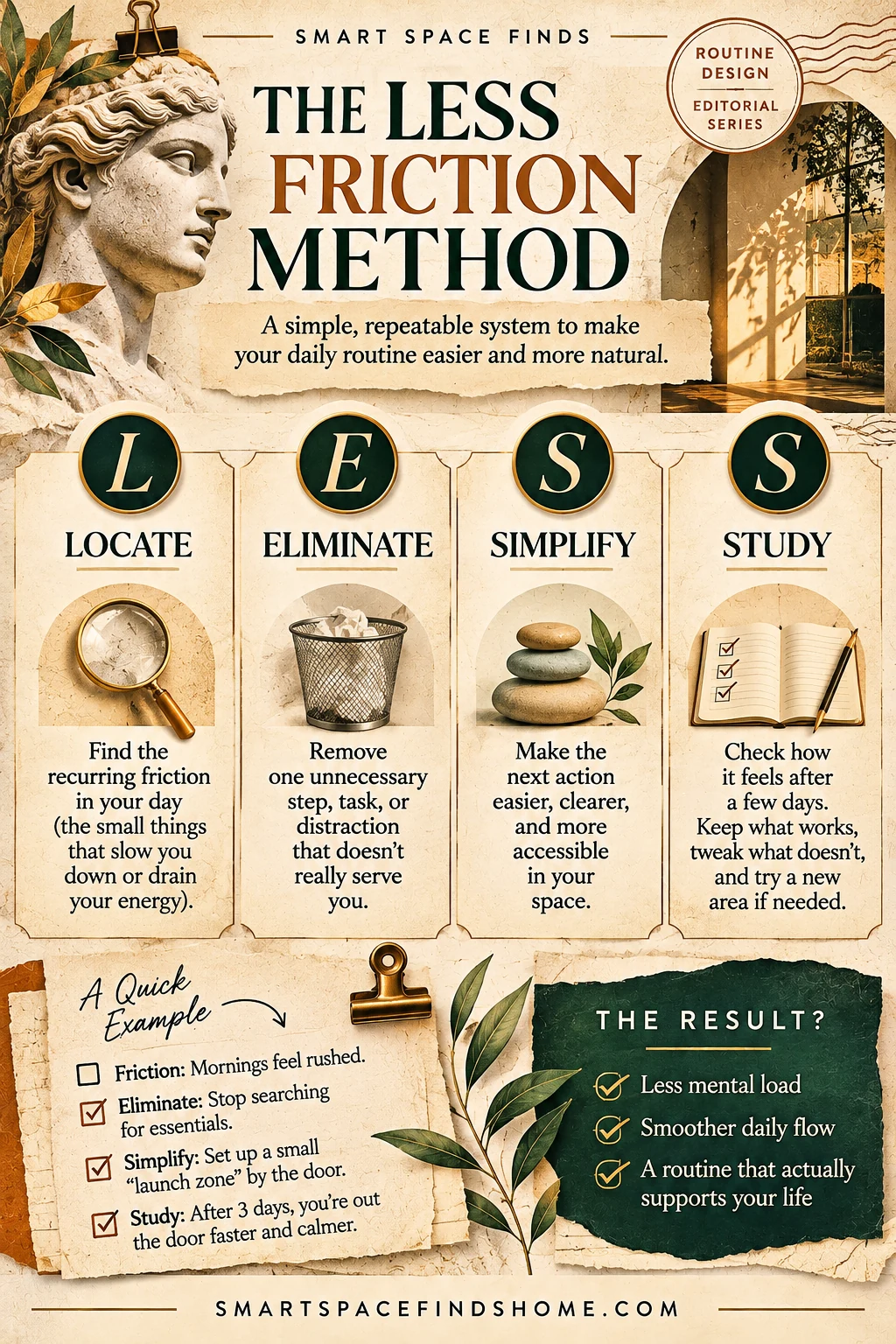
Spot a repeated annoyance in your real day.
Remove one unnecessary step or decision.
Put the next useful action within easy reach.
Notice the outcome and adjust without judgment.
Example: You leave home without your headphones. Locate the friction (they move around), eliminate the extra search (one home for them), simplify (put the case beside your keys), and study (was leaving easier this week?). If the solution fails, change the location rather than blaming yourself.
How to make a new routine easier to remember
One of the most useful lessons from habit research is that the context around an action matters. Repeating a manageable action in a consistent situation can make it easier to remember over time. A home-based routine therefore benefits from a visible cue and a clear next step—not simply stronger motivation.
Use an existing anchor
Instead of “I will be organized,” try “After I hang up my coat, I will put my keys on the tray.” Match the action to a moment that already happens.
Write a realistic if–then plan
“If I finish my shift, then I will put my work things away before sitting down.” Keep the action short enough to perform even on an ordinary, imperfect day.
Reduce setup effort
Put the basket where clutter collects, not where a styled room suggests it should go. Make the preferred action easier to do than the old workaround.
Plan for interruptions
“If the evening gets busy, then I will only put tomorrow’s keys and bag by the door.” A reduced version is a design choice, not a failure.
Research on habit formation describes the importance of repeated actions in stable contexts, while also showing substantial variation in how long automaticity takes to develop. That’s why our seven-day reset is an evaluation exercise, not a promise that a permanent habit forms in a week. To evaluate your own change, focus on what happens during ordinary days rather than expecting a universal habit-building deadline.
The 7-day everyday reset—without a perfect-streak rule
Use one week as a practical observation window, not a promise that habits form in seven days. One small experiment is easier to evaluate than five simultaneous changes.
| Day | What to do |
|---|---|
| 1 | Notice one recurring friction point; write it in a sentence. |
| 2 | Make the smallest free change that might remove it. |
| 3 | Try it on a normal day; notice what feels easier. |
| 4 | Adjust the placement, timing, or number of steps. |
| 5 | Repeat when convenient, without chasing a streak. |
| 6 | Test the version that takes the least effort. |
| 7 | Keep, modify, or drop it based on real usefulness. |
“The goal isn’t a more impressive routine. It’s a day that asks a little less of you.”
SMART SPACE FINDS / THE EVERYDAY EDIT
Make the routine fit your life—not the other way around.
THE REAL-LIFE EDIT / ONE ROOM, THREE USES
A studio apartment with an unpredictable workday
Before: Maya works from a small dining table. Charging cables share space with dinner plates, her work bag stays on the floor, and she often searches for her keys just as she needs to leave. A strict morning timetable would not solve the underlying problem.
The no-buy edit: She uses a dish she already owns for keys by the entrance, stores her laptop cable in one drawer, and ends each work session by clearing the table enough for a meal. On late nights, her fallback is simply putting the keys away.
The useful measure: She can leave without searching and use the table for dinner without moving a pile of work supplies. This is an illustrative scenario, not a claim about an actual reader or a tested result.
Small spaces
Use one shared landing zone, vertical storage where appropriate, and portable supplies. Do not sacrifice usable counter space for more containers.
Shared homes
Agree on the placement of shared items rather than silently introducing a system others cannot follow. Label only where it genuinely clarifies things.
Irregular schedules
Attach tasks to events—after your shift, before leaving, after washing dishes—instead of assuming every day follows the same clock.
Low-energy days
Use a smaller version: place just the keys on the tray, reset one surface, or complete a two-minute task. Rest can be the right choice, too.
Should you buy anything for a better routine?
Usually, no—not at first. Rearranging an existing tray, moving a basket, reducing visual clutter, or changing the order of two steps may solve the problem for free. A purchase is worth considering only after you have identified a specific need and checked measurements, safety, durability, and whether the item duplicates something you already own.
Buy when: it solves a repeated, clearly defined problem; fits the space; and makes the task measurably simpler.
Skip when: the old item still works, the purchase creates new maintenance, or the main benefit is how it looks in a photo.
For more space-first ideas, explore ways to use an overlooked corner, everyday luxury without unnecessary spending, and small home products that address real annoyances.
EDITOR’S NOTE / HOW THIS GUIDE WAS BUILT
Our approach combines practical home-organization principles with published habit research. The examples and LESS framework are editorial tools, not clinical advice or claims of tested outcomes. We prioritize affordable, reversible changes and explain where context, safety, and personal needs matter. The guide is designed to stand alone: adjust the examples to your available space, daily responsibilities, and energy level. There is no universal seven-day deadline for building a lasting routine.
When a routine doesn’t work: troubleshoot the system, not yourself.
| What’s going wrong? | Why it may happen | A better next attempt |
|---|---|---|
| You keep forgetting | The cue is hidden or inconsistent | Attach the action to something you already do |
| It takes too much time | The routine has grown beyond the original problem | Remove steps until it fits a busy day |
| Other people undo it | The system was designed for one person’s habits | Agree on a shared, obvious location |
| The organizer fills with clutter | Too many item categories share one space | Keep only daily essentials in that zone |
| You need perfect conditions | The plan depends on energy or a fixed schedule | Use an event-based trigger and a smaller fallback |
Most importantly, a daily routine is allowed to change with a new job, a new home, a family need, or a difficult season. A home should support the people who live there—not demand a performance from them.
Frequently asked questions
How can I refresh my daily routine without spending money?
Start by changing placement or sequence. Put essentials near the exit, group one repetitive chore, reduce optional distractions for a short interval, or close the workday with a simple cue. Use what you already own before considering organizers or gadgets.
What is the easiest daily routine change to start with?
Choose the annoyance that occurs most often and has an obvious low-effort fix. For many people, a consistent place for keys and everyday essentials is easier to test than redesigning an entire morning schedule.
Do I need a strict morning and evening routine?
No. Flexible routines can work better for shift workers, caregivers, roommates, and anyone whose day changes. An anchor such as “after I finish working” can be more useful than a fixed time.
How long does it take to see whether a routine change helps?
You may notice an immediate difference in a concrete task, such as finding keys, but longer-term usefulness takes observation. Use a week as a convenient review period, not as a scientific deadline for habit formation.
What if I cannot stick to a routine?
Make it smaller or change its location in the day. A routine should reduce effort, not require constant self-monitoring. If an idea only works on unusually quiet days, it may need redesigning.
How do I maintain a routine in a very small apartment?
Give high-use items a small, easy-to-reach home and avoid adding storage that blocks movement or work surfaces. Multiuse areas benefit from simple transitions, such as packing away work supplies after a shift.
The final edit: make ordinary life a little easier.
A thoughtful daily routine is not a collection of perfect habits. It is the quiet relationship between your time, your space, and what you actually need to do. Choose one recurring inconvenience today, remove one unnecessary step, and notice whether tomorrow feels a little simpler. That is a refresh worth keeping.